Chanderprabhu Jain College of Higher Studies & School of Law
Plot No. OCF, Sector A-8, Narela, New Delhi – 110040
(Affiliated to Guru Gobind Singh Indraprastha University and Approved by Govt of NCT of Delhi & Bar Council of India)
Management Process and
Organizational Behavior
Chanderprabhu Jain College of Higher Studies & School of Law
Plot No. OCF, Sector A-8, Narela, New Delhi – 110040
(Affiliated to Guru Gobind Singh Indraprastha University and Approved by Govt of NCT of Delhi & Bar Council of India)
Management
• According to Henri Fayol, "Management is to
manage is to forecast and to plan, to organise,
to command, to co-ordinate and to control.“
• Mary Parker Follett (1868–1933), defined
management as "the art of getting things
done through people."
Chanderprabhu Jain College of Higher Studies & School of Law
Plot No. OCF, Sector A-8, Narela, New Delhi – 110040
(Affiliated to Guru Gobind Singh Indraprastha University and Approved by Govt of NCT of Delhi & Bar Council of India)
NATURE OF MANAGEMENT
• Universal process
• Factor of production
• Goal Oriented
• Supreme in thought and action
• Group Activity
• Dynamic Function
• Social Science
Chanderprabhu Jain College of Higher Studies & School of Law
Plot No. OCF, Sector A-8, Narela, New Delhi – 110040
(Affiliated to Guru Gobind Singh Indraprastha University and Approved by Govt of NCT of Delhi & Bar Council of India)
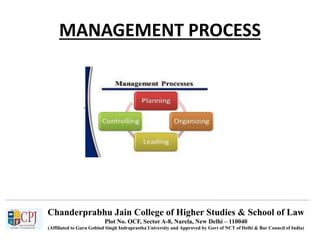
MANAGEMENT PROCESS
.
Chanderprabhu Jain College of Higher Studies & School of Law
Plot No. OCF, Sector A-8, Narela, New Delhi – 110040
(Affiliated to Guru Gobind Singh Indraprastha University and Approved by Govt of NCT of Delhi & Bar Council of India)
LEVELS OF MANAGEMENT
1. Top Level
2. Middle Level
3. Low Level
Chanderprabhu Jain College of Higher Studies & School of Law
Plot No. OCF, Sector A-8, Narela, New Delhi – 110040
(Affiliated to Guru Gobind Singh Indraprastha University and Approved by Govt of NCT of Delhi & Bar Council of India)
SIGNIFICANCE OF MANAGEMENT
– It helps in Achieving Group Goals
– Optimum Utilization of Resources
– Reduces Costs
– Establishes Sound Organization
– Establishes Equilibrium
– Essentials for Prosperity of Society
Chanderprabhu Jain College of Higher Studies & School of Law
Plot No. OCF, Sector A-8, Narela, New Delhi – 110040
(Affiliated to Guru Gobind Singh Indraprastha University and Approved by Govt of NCT of Delhi & Bar Council of India)
MANAGEMENT AND
ADMINISTRATION
According to Theo Haimann, “Administration means overall
determination of policies, setting of major objectives, the
identification of general purposes and laying down of broad
programmes and projects”. It refers to the activities of higher
level. It lays down basic principles of the enterprise.
According to Newman, “Administration means guidance,
leadership & control of the efforts of the groups towards some
common goals”.
Chanderprabhu Jain College of Higher Studies & School of Law
Plot No. OCF, Sector A-8, Narela, New Delhi – 110040
(Affiliated to Guru Gobind Singh Indraprastha University and Approved by Govt of NCT of Delhi & Bar Council of India)
Whereas, management involves conceiving, initiating
and bringing together the various elements;
coordinating, actuating, integrating the diverse
organizational components while sustaining the
viability of the organization towards some pre-
determined goals. In other words, it is an art of
getting things done through & with the people in
formally organized groups.
Chanderprabhu Jain College of Higher Studies & School of Law
Plot No. OCF, Sector A-8, Narela, New Delhi – 110040
(Affiliated to Guru Gobind Singh Indraprastha University and Approved by Govt of NCT of Delhi & Bar Council of India)
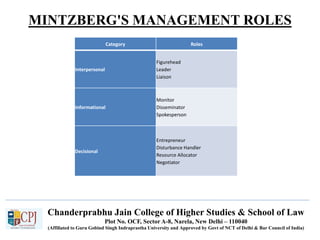
MINTZBERG'S MANAGEMENT ROLES
Category Roles
Interpersonal
Figurehead
Leader
Liaison
Informational
Monitor
Disseminator
Spokesperson
Decisional
Entrepreneur
Disturbance Handler
Resource Allocator
Negotiator
Chanderprabhu Jain College of Higher Studies & School of Law
Plot No. OCF, Sector A-8, Narela, New Delhi – 110040
(Affiliated to Guru Gobind Singh Indraprastha University and Approved by Govt of NCT of Delhi & Bar Council of India)
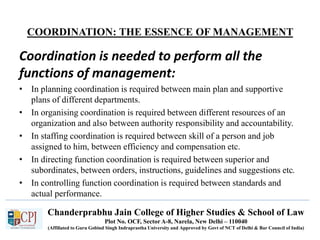
COORDINATION: THE ESSENCE OF MANAGEMENT
Coordination is needed to perform all the
functions of management:
• In planning coordination is required between main plan and supportive
plans of different departments.
• In organising coordination is required between different resources of an
organization and also between authority responsibility and accountability.
• In staffing coordination is required between skill of a person and job
assigned to him, between efficiency and compensation etc.
• In directing function coordination is required between superior and
subordinates, between orders, instructions, guidelines and suggestions etc.
• In controlling function coordination is required between standards and
actual performance.
Chanderprabhu Jain College of Higher Studies & School of Law
Plot No. OCF, Sector A-8, Narela, New Delhi – 110040
(Affiliated to Guru Gobind Singh Indraprastha University and Approved by Govt of NCT of Delhi & Bar Council of India)
• 2. Coordination is required at all the levels:
3.Coordination is the most important function
of an organization
Chanderprabhu Jain College of Higher Studies & School of Law
Plot No. OCF, Sector A-8, Narela, New Delhi – 110040
(Affiliated to Guru Gobind Singh Indraprastha University and Approved by Govt of NCT of Delhi & Bar Council of India)
PLANNING
Planning is the most basic of all managerial functions. It is the
process by which managers establish goals and define the
methods by which these goals are to be attained.
• Types of Plans are;
• Hierarchical plans,
• Standing plans,
• Single-use plans, and
• Contingency plans.
Chanderprabhu Jain College of Higher Studies & School of Law
Plot No. OCF, Sector A-8, Narela, New Delhi – 110040
(Affiliated to Guru Gobind Singh Indraprastha University and Approved by Govt of NCT of Delhi & Bar Council of India)
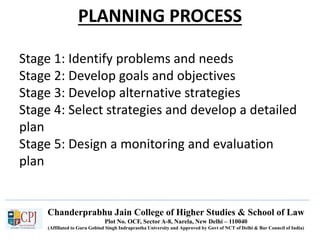
PLANNING PROCESS
Stage 1: Identify problems and needs
Stage 2: Develop goals and objectives
Stage 3: Develop alternative strategies
Stage 4: Select strategies and develop a detailed
plan
Stage 5: Design a monitoring and evaluation
plan
BOUNDED RATIONALITY
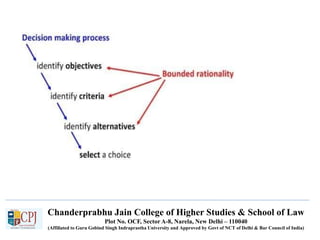
• Bounded rationality is the idea that when individuals make decisions,
their rationality is limited by the tractability of the decision problem, the
cognitive limitations of their minds, and the time available to make the
decision. Decision-makers in this view act as satisficers, seeking a
satisfactory solution rather than an optimal one. Herbert A. Simon proposed
bounded rationality as an alternative basis for the mathematical modeling
of decision-making, as used in economics, political science and related
disciplines. It complements "rationality as optimization", which views
decision-making as a fully rational process of finding an optimal choice
given the information available. Simon used the analogy of a pair of
scissors, where one blade represents "cognitive limitations" of actual
humans and the other the "structures of the environment", illustrating how
minds compensate for limited resources by exploiting known structural
regularity in the environment.
Chanderprabhu Jain College of Higher Studies & School of Law
Plot No. OCF, Sector A-8, Narela, New Delhi – 110040
(Affiliated to Guru Gobind Singh Indraprastha University and Approved by Govt of NCT of Delhi & Bar Council of India)
Chanderprabhu Jain College of Higher Studies & School of Law
Plot No. OCF, Sector A-8, Narela, New Delhi – 110040
(Affiliated to Guru Gobind Singh Indraprastha University and Approved by Govt of NCT of Delhi & Bar Council of India)
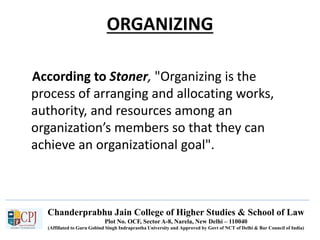
ORGANIZING
According to Stoner, "Organizing is the
process of arranging and allocating works,
authority, and resources among an
organization’s members so that they can
achieve an organizational goal".
Chanderprabhu Jain College of Higher Studies & School of Law
Plot No. OCF, Sector A-8, Narela, New Delhi – 110040
(Affiliated to Guru Gobind Singh Indraprastha University and Approved by Govt of NCT of Delhi & Bar Council of India)
PRINCIPLES OF ORGANIZATION
• The principle of unity of objectives
• The principle of efficiency
• Principles of the span of control
• The principle of a division of works
• The principle of unity of command
• The principle of unity of direction
• The principle of delegation
• The principle of simplicity
• The principle of authority
• The principle of responsibility
• The principle of flexibility
• The principle of balance
• Scalar Principle
• The principle of specialization
Chanderprabhu Jain College of Higher Studies & School of Law
Plot No. OCF, Sector A-8, Narela, New Delhi – 110040
(Affiliated to Guru Gobind Singh Indraprastha University and Approved by Govt of NCT of Delhi & Bar Council of India)
SPAN OF CONTROL
Span of Control is a term that describes the
number of subordinate workers /
organizational units under a single manager.
Determination of span of control is one of the
results of organizing and it is de-facto
manifestation of formal organizational
structure.
Chanderprabhu Jain College of Higher Studies & School of Law
Plot No. OCF, Sector A-8, Narela, New Delhi – 110040
(Affiliated to Guru Gobind Singh Indraprastha University and Approved by Govt of NCT of Delhi & Bar Council of India)
DEPARTMENTATION
• According to Koontz and O’Donnell, “A department
is a distinct area, division or branch of an enterprise
over which a manager has authority for the
performance of specified activities.”‘
• Departmentalization (or simply departmentation)
refers to the grouping of operating tasks into jobs, the
combining of jobs into effective work groups and the
combining of groups into divisions often termed as
‘Departments’.
Chanderprabhu Jain College of Higher Studies & School of Law
Plot No. OCF, Sector A-8, Narela, New Delhi – 110040
(Affiliated to Guru Gobind Singh Indraprastha University and Approved by Govt of NCT of Delhi & Bar Council of India)
TYPES OF ORGANIZATION
Formal organisations
Informal organisations
Chanderprabhu Jain College of Higher Studies & School of Law
Plot No. OCF, Sector A-8, Narela, New Delhi – 110040
(Affiliated to Guru Gobind Singh Indraprastha University and Approved by Govt of NCT of Delhi & Bar Council of India)
DELEGATION
Delegation is the assignment of any responsibility or
authority to another person (normally from a manager
to a subordinate) to carry out specific activities. It is
one of the core concepts of management leadership.
However, the person who delegated the work remains
accountable for the outcome of the delegated work.
Delegation empowers a subordinate to make
decisions.
DECENTRALIZATION
• Decentralization is the process by which the
activities of an organization, particularly those
regarding planning and decision-making, are
distributed or delegated away from a central,
authoritative location or group.
Chanderprabhu Jain College of Higher Studies & School of Law
Plot No. OCF, Sector A-8, Narela, New Delhi – 110040
(Affiliated to Guru Gobind Singh Indraprastha University and Approved by Govt of NCT of Delhi & Bar Council of India)
STAFFING
• The managerial function of staffing involves manning
the organization structure through proper and
effective selection, appraisal and development of the
personnels to fill the roles assigned to the
employers/workforce.
• According to Theo Haimann, “Staffing pertains to
recruitment, selection, development and
compensation of subordinates.”
Chanderprabhu Jain College of Higher Studies & School of Law
Plot No. OCF, Sector A-8, Narela, New Delhi – 110040
(Affiliated to Guru Gobind Singh Indraprastha University and Approved by Govt of NCT of Delhi & Bar Council of India)
Nature of Staffing Function
• Staffing is an important managerial function
• Staffing is a pervasive activity
• Staffing is a continuous activity
• The basis of staffing function is efficient
management of personnels.
• Staffing helps in placing right men at the right
job.
• Staffing is performed by all managers.
Chanderprabhu Jain College of Higher Studies & School of Law
Plot No. OCF, Sector A-8, Narela, New Delhi – 110040
(Affiliated to Guru Gobind Singh Indraprastha University and Approved by Govt of NCT of Delhi & Bar Council of India)
STAFFING PROCESS - STEPS
INVOLVED IN STAFFING
.
• Manpower requirements
• Recruitment
• Selection
• Orientation and Placement
• Training and Development
• Remuneration
• Performance Evaluation
• Promotion and transfer
Chanderprabhu Jain College of Higher Studies & School of Law
Plot No. OCF, Sector A-8, Narela, New Delhi – 110040
(Affiliated to Guru Gobind Singh Indraprastha University and Approved by Govt of NCT of Delhi & Bar Council of India)
IMPORTANCE OF STAFFING
1. Efficient Performance of Other Functions
2. Effective Use of Technology and Other Resources
3. Optimum Utilisation of Human Resources
4. Development of Human Capital
5. Motivation of Human Resources
6. Building Higher Morale
Chanderprabhu Jain College of Higher Studies & School of Law
Plot No. OCF, Sector A-8, Narela, New Delhi – 110040
(Affiliated to Guru Gobind Singh Indraprastha University and Approved by Govt of NCT of Delhi & Bar Council of India)
LEADERSHIP AND MOTIVATION
Motivation is a goal-oriented characteristic that helps a person achieve
his objectives. It pushes an individual to work hard at achieving his or
her goals. An executive must have the right leadership traits to
influence motivation. However, there is no specific blueprint for
motivation.
Both an employee as well as manager must possess leadership and
motivational traits. An effective leader must have a thorough
knowledge of motivational factors for others. He must understand the
basic needs of employees, peers and his superiors. Leadership is used
as a means of motivating others.
Chanderprabhu Jain College of Higher Studies & School of Law
Plot No. OCF, Sector A-8, Narela, New Delhi – 110040
(Affiliated to Guru Gobind Singh Indraprastha University and Approved by Govt of NCT of Delhi & Bar Council of India)
MOTIVATION
• Motivation is the word derived from the word ’motive’ which means needs,
desires, wants or drives within the individuals. It is the process of
stimulating people to actions to accomplish the goals. In the work goal
context the psychological factors stimulating the people’s behaviour can be
-
• desire for money
• success
• recognition
• job-satisfaction
• team work, etc
Chanderprabhu Jain College of Higher Studies & School of Law
Plot No. OCF, Sector A-8, Narela, New Delhi – 110040
(Affiliated to Guru Gobind Singh Indraprastha University and Approved by Govt of NCT of Delhi & Bar Council of India)
Classical Theories of Motivation
• Maslow’s hierarchy of needs theory
• Herzberg’s Two factor theory
• Theory X and Theory Y
Chanderprabhu Jain College of Higher Studies & School of Law
Plot No. OCF, Sector A-8, Narela, New Delhi – 110040
(Affiliated to Guru Gobind Singh Indraprastha University and Approved by Govt of NCT of Delhi & Bar Council of India)
Maslow’s Hierarchy of Needs Theory
Chanderprabhu Jain College of Higher Studies & School of Law
Plot No. OCF, Sector A-8, Narela, New Delhi – 110040
(Affiliated to Guru Gobind Singh Indraprastha University and Approved by Govt of NCT of Delhi & Bar Council of India)
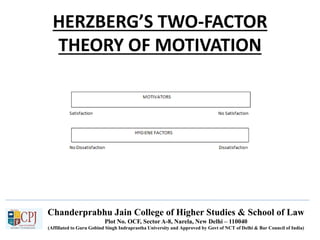
HERZBERG’S TWO-FACTOR
THEORY OF MOTIVATION
Chanderprabhu Jain College of Higher Studies & School of Law
Plot No. OCF, Sector A-8, Narela, New Delhi – 110040
(Affiliated to Guru Gobind Singh Indraprastha University and Approved by Govt of NCT of Delhi & Bar Council of India)
Theory X and Theory Y
In 1960, Douglas McGregor formulated Theory X and Theory Y
suggesting two aspects of human behaviour at work, or in
other words, two different views of individuals (employees):
one of which is negative, called as Theory X and the other is
positive, so called as Theory Y. According to McGregor, the
perception of managers on the nature of individuals is based
on various assumptions.
CONTROLLING
• According to Harold Koontz
“Controlling is the measurement and correction
of performance in order to make sure that
enterprise objectives and the plans devised to
attain them are accomplished.”
Chanderprabhu Jain College of Higher Studies & School of Law
Plot No. OCF, Sector A-8, Narela, New Delhi – 110040
(Affiliated to Guru Gobind Singh Indraprastha University and Approved by Govt of NCT of Delhi & Bar Council of India)
NATURE
• Control is a continuous process
• Control is a management process
• Control is embedded in each level of organizational hierarchy
• Control is forward looking
• Control is closely linked with planning
• Control is a tool for achieving organizational activities
• Control is an end process
• Control compares actual performance with planned performance*
• Control point out the error in the execution process
• Control helps in minimizing cost
• Control helps in achieving standard
• Control saves the time
• Control helps management for monitoring performance
Chanderprabhu Jain College of Higher Studies & School of Law
Plot No. OCF, Sector A-8, Narela, New Delhi – 110040
(Affiliated to Guru Gobind Singh Indraprastha University and Approved by Govt of NCT of Delhi & Bar Council of India)
Importance of Controlling
1. Accomplishing Organisational Goals
2. Judging Accuracy of Standards
3. Making Efficient Use of Resources
4. Improving Employee Motivation
5. Ensuring Order and Discipline
6. Facilitating Coordination in Action
Chanderprabhu Jain College of Higher Studies & School of Law
Plot No. OCF, Sector A-8, Narela, New Delhi – 110040
(Affiliated to Guru Gobind Singh Indraprastha University and Approved by Govt of NCT of Delhi & Bar Council of India)
Types of Organizational Controls
• Feedforward controls
• Concurrent controls
• Feedback controls
Chanderprabhu Jain College of Higher Studies & School of Law
Plot No. OCF, Sector A-8, Narela, New Delhi – 110040
(Affiliated to Guru Gobind Singh Indraprastha University and Approved by Govt of NCT of Delhi & Bar Council of India)
The Organizational Control
Process
• Establish standards to measure performance.
• Measure actual performance.
• Compare performance with the standards.
• Take corrective actions.
Chanderprabhu Jain College of Higher Studies & School of Law
Plot No. OCF, Sector A-8, Narela, New Delhi – 110040
(Affiliated to Guru Gobind Singh Indraprastha University and Approved by Govt of NCT of Delhi & Bar Council of India)
Techniques of Managerial Control:
Traditional Techniques:
a. Personal Observation
b. Statistical Reports.
c. Breakeven Analysis.
d. Budgetary Control.
Chanderprabhu Jain College of Higher Studies & School of Law
Plot No. OCF, Sector A-8, Narela, New Delhi – 110040
(Affiliated to Guru Gobind Singh Indraprastha University and Approved by Govt of NCT of Delhi & Bar Council of India)
(a) Return on Investment.
(b) Ratio Analysis.
(c) Responsibility Accounting.
(d) Management Audit.
(e) PERT and CPM.
MODERN TECHNIQUES
Chanderprabhu Jain College of Higher Studies & School of Law
Plot No. OCF, Sector A-8, Narela, New Delhi – 110040
(Affiliated to Guru Gobind Singh Indraprastha University and Approved by Govt of NCT of Delhi & Bar Council of India)
ORGANIZATIONAL BEHAVIOR
Organizational behavior is a relatively new, interdisciplinary
field of study.
Organizational behavior (OB) is the study of the way people
interact within groups. Normally this study is applied in an
attempt to create more efficient business organizations. The
central idea of the study of organizational behavior is that a
scientific approach can be applied to the management of workers.
Organizational behavior theories are used for human resource
purposes to maximize the output from individual group members.
Chanderprabhu Jain College of Higher Studies & School of Law
Plot No. OCF, Sector A-8, Narela, New Delhi – 110040
(Affiliated to Guru Gobind Singh Indraprastha University and Approved by Govt of NCT of Delhi & Bar Council of India)
Definitions:
• “Organisational behaviour is a subset of
management activities concerned with
understanding, predicting and influencing individual
behaviour in organisational setting.”—Callahan,
Fleenor and Kudson.
• “Organisational behaviour is directly concerned with
the understanding, production and control of human
behaviour in organisations.”—Fred Luthans.
Chanderprabhu Jain College of Higher Studies & School of Law
Plot No. OCF, Sector A-8, Narela, New Delhi – 110040
(Affiliated to Guru Gobind Singh Indraprastha University and Approved by Govt of NCT of Delhi & Bar Council of India)
In short, organisational behaviour revolves
around two fundamental components:
.
1. The nature of the man.
2. The nature of the organisation.
Chanderprabhu Jain College of Higher Studies & School of Law
Plot No. OCF, Sector A-8, Narela, New Delhi – 110040
(Affiliated to Guru Gobind Singh Indraprastha University and Approved by Govt of NCT of Delhi & Bar Council of India)
Characteristics of Organisational
Behavior
1. Behavioural Approach to Management
2. Cause and Effect Relationship
3. Organisational Behaviour is a Branch of Social Sciences
4. Three Levels of Analysis
5. A Science as well as an Art
6. A Body of Theory, Research and Application
7. Beneficial to both Organisation and Individuals
8. Rational Thinking
Chanderprabhu Jain College of Higher Studies & School of Law
Plot No. OCF, Sector A-8, Narela, New Delhi – 110040
(Affiliated to Guru Gobind Singh Indraprastha University and Approved by Govt of NCT of Delhi & Bar Council of India)
Three Levels of Analysis
– INDIVIDUAL LEVEL OF ANALYSIS
– GROUP LEVEL OF ANALYSIS
– ORGANIZATIONAL LEVEL OF ANALYSIS
Chanderprabhu Jain College of Higher Studies & School of Law
Plot No. OCF, Sector A-8, Narela, New Delhi – 110040
(Affiliated to Guru Gobind Singh Indraprastha University and Approved by Govt of NCT of Delhi & Bar Council of India)
IMPORTANCE OF ORGANIZATIONAL BEHAVIOR
• It builds better relationship by achieving people’s, organizational, and social
objectives.
• It covers a wide array of human resource like behavior, training and development,
change management, leadership, teams etc.
• It brings coordination which is the essence of management.
• It improves goodwill of the organization.
• It helps to achieve objectives quickly.
• It makes optimum utilization of resources.
• It facilitates motivation.
• It leads to higher efficiency.
• It improves relations in the organization.
• It is multidisciplinary, in the sense that applies different techniques, methods, and
theories to evaluate the performances.
Chanderprabhu Jain College of Higher Studies & School of Law
Plot No. OCF, Sector A-8, Narela, New Delhi – 110040
(Affiliated to Guru Gobind Singh Indraprastha University and Approved by Govt of NCT of Delhi & Bar Council of India)
CHALLENGES AND OPPORTUNITIES OF ORGANIZATIONAL
BEHAVIOR
• Improving Peoples’ Skills.
• Improving Quality and Productivity.
• Total Quality Management (TQM).
• Managing Workforce Diversity.
• Responding to Globalization.
• Empowering People.
• Coping with Temporariness.
• Stimulating Innovation and Change.
• Emergence of E-Organisation & E-Commerce.
• Improving Ethical Behavior.
• Improving Customer Service.
• Helping Employees Balance Work-Life Conflicts.
Chanderprabhu Jain College of Higher Studies & School of Law
Plot No. OCF, Sector A-8, Narela, New Delhi – 110040
(Affiliated to Guru Gobind Singh Indraprastha University and Approved by Govt of NCT of Delhi & Bar Council of India)
INDIVIDUAL BEHAVIOR
PERSONALITY
Personality means how a person affects others and how he understands and
views himself as well as the pattern of inner and outer measurable traits
and the person-situation interactions (Fred Luthans). According to
Stephen P. Robbins, personality is the sum total ways in which an
individual reacts and interacts with others. It may be defined as those
inner psychological characteristics that both determine and reflect how a
person responds to his environment.
Chanderprabhu Jain College of Higher Studies & School of Law
Plot No. OCF, Sector A-8, Narela, New Delhi – 110040
(Affiliated to Guru Gobind Singh Indraprastha University and Approved by Govt of NCT of Delhi & Bar Council of India)
Determinants of Personality
1. Heredity
2. Environment
(a) Culture
(b) Family
(c) Social
(d) Situational
Chanderprabhu Jain College of Higher Studies & School of Law
Plot No. OCF, Sector A-8, Narela, New Delhi – 110040
(Affiliated to Guru Gobind Singh Indraprastha University and Approved by Govt of NCT of Delhi & Bar Council of India)
The Nature of Personality
1. Personality reflects individual differences
2. Personality is consistent and enduring
3. Personality can change
Big Five personality traits
• Openness to experience
• Conscientiousness
• Extraversion
• Agreeableness
• Neuroticism
Chanderprabhu Jain College of Higher Studies & School of Law
Plot No. OCF, Sector A-8, Narela, New Delhi – 110040
(Affiliated to Guru Gobind Singh Indraprastha University and Approved by Govt of NCT of Delhi & Bar Council of India)
LEARNING
Learning can be defined as the permanent
change in behavior due to direct and indirect
experience. It means change in behavior,
attitude due to education and training,
practice and experience. It is completed by
acquisition of knowledge and skills, which are
relatively permanent.
Chanderprabhu Jain College of Higher Studies & School of Law
Plot No. OCF, Sector A-8, Narela, New Delhi – 110040
(Affiliated to Guru Gobind Singh Indraprastha University and Approved by Govt of NCT of Delhi & Bar Council of India)
Factors Affecting Learning
• MOTIVATION
• PRACTICE
• ENVIRONMENT
• MENTAL GROUP
Chanderprabhu Jain College of Higher Studies & School of Law
Plot No. OCF, Sector A-8, Narela, New Delhi – 110040
(Affiliated to Guru Gobind Singh Indraprastha University and Approved by Govt of NCT of Delhi & Bar Council of India)
THEORIES OF LEARNING
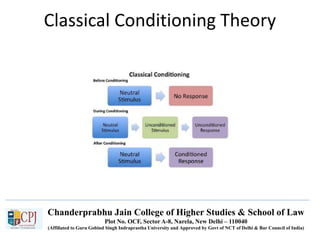
1. CLASSICAL CONDITIONING
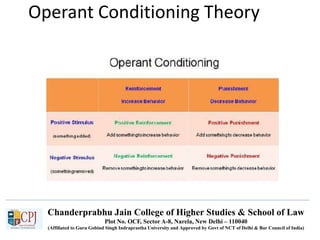
2. OPERANT CONDITIONING
3. COGNITIVE THEORY
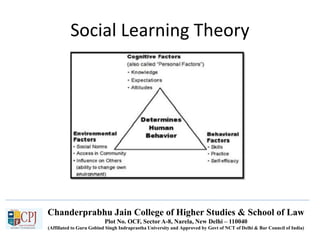
4. SOCIAL LEARNING THEORY
Chanderprabhu Jain College of Higher Studies & School of Law
Plot No. OCF, Sector A-8, Narela, New Delhi – 110040
(Affiliated to Guru Gobind Singh Indraprastha University and Approved by Govt of NCT of Delhi & Bar Council of India)
Classical Conditioning Theory
Chanderprabhu Jain College of Higher Studies & School of Law
Plot No. OCF, Sector A-8, Narela, New Delhi – 110040
(Affiliated to Guru Gobind Singh Indraprastha University and Approved by Govt of NCT of Delhi & Bar Council of India)
Operant Conditioning Theory
Chanderprabhu Jain College of Higher Studies & School of Law
Plot No. OCF, Sector A-8, Narela, New Delhi – 110040
(Affiliated to Guru Gobind Singh Indraprastha University and Approved by Govt of NCT of Delhi & Bar Council of India)
Social Learning Theory
Chanderprabhu Jain College of Higher Studies & School of Law
Plot No. OCF, Sector A-8, Narela, New Delhi – 110040
(Affiliated to Guru Gobind Singh Indraprastha University and Approved by Govt of NCT of Delhi & Bar Council of India)
Cognitive Learning Theory
• Cognition defines a person’s ideas, thoughts, knowledge, interpretation,
understanding about himself and environment.
• This theory considers learning as the outcome of deliberate thinking on a
problem or situation based upon known facts and responding in an
objective and more oriented manner. It perceives that a person learns the
meaning of various objects and events and also learns the response
depending upon the meaning assigned to the stimuli.
• This theory debates that the learner forms a cognitive structure in memory
which stores organized information about the various events that occurs.
Chanderprabhu Jain College of Higher Studies & School of Law
Plot No. OCF, Sector A-8, Narela, New Delhi – 110040
(Affiliated to Guru Gobind Singh Indraprastha University and Approved by Govt of NCT of Delhi & Bar Council of India)
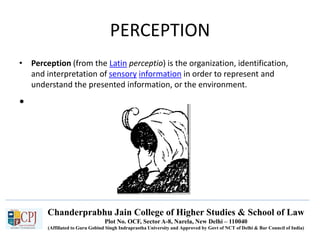
PERCEPTION
• Perception (from the Latin perceptio) is the organization, identification,
and interpretation of sensory information in order to represent and
understand the presented information, or the environment.
•
Chanderprabhu Jain College of Higher Studies & School of Law
Plot No. OCF, Sector A-8, Narela, New Delhi – 110040
(Affiliated to Guru Gobind Singh Indraprastha University and Approved by Govt of NCT of Delhi & Bar Council of India)
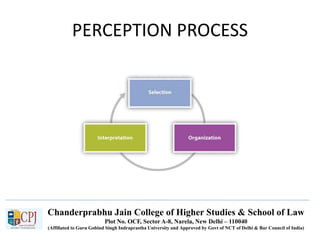
PERCEPTION PROCESS
Chanderprabhu Jain College of Higher Studies & School of Law
Plot No. OCF, Sector A-8, Narela, New Delhi – 110040
(Affiliated to Guru Gobind Singh Indraprastha University and Approved by Govt of NCT of Delhi & Bar Council of India)
PERCEPTION ERRORS
• Stereotypes and Prototypes
• Halo Effects / Horn Effects
• Selective Perception
• Contrast Effects
• Projections
Chanderprabhu Jain College of Higher Studies & School of Law
Plot No. OCF, Sector A-8, Narela, New Delhi – 110040
(Affiliated to Guru Gobind Singh Indraprastha University and Approved by Govt of NCT of Delhi & Bar Council of India)
ATTITUDE
• According to Gordon Allport, “An attitude is a
mental and neural state of readiness,
organized through experience, exerting a
directive or dynamic influence upon the
individual’s response to all objects and
situations with which it is related.”
Chanderprabhu Jain College of Higher Studies & School of Law
Plot No. OCF, Sector A-8, Narela, New Delhi – 110040
(Affiliated to Guru Gobind Singh Indraprastha University and Approved by Govt of NCT of Delhi & Bar Council of India)
ATTITUDE
• According to Si P. Robbins – “Attitude is
manner, disposition, feeling and position with
regard to a person or thing, tendency or
orientation especially in the mind.”
Chanderprabhu Jain College of Higher Studies & School of Law
Plot No. OCF, Sector A-8, Narela, New Delhi – 110040
(Affiliated to Guru Gobind Singh Indraprastha University and Approved by Govt of NCT of Delhi & Bar Council of India)
CHARACTERISTICS OF ATTITUDE
• Attitudes are the complex combination of things we tend to call personality,
beliefs, values, behaviors, and motivations.
• It can fall anywhere along a continuum from very favorable to very
unfavorable.
• All people, irrespective of their status or intelligence, hold attitudes.
• An attitude exists in every person’s mind. It helps to define our identity,
guide our actions, and influence how we judge people.
• Although the feeling and belief components of attitude are internal to a
person, we can view a person’s attitude from his or her resulting behavior.
Chanderprabhu Jain College of Higher Studies & School of Law
Plot No. OCF, Sector A-8, Narela, New Delhi – 110040
(Affiliated to Guru Gobind Singh Indraprastha University and Approved by Govt of NCT of Delhi & Bar Council of India)
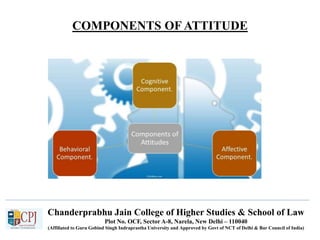
COMPONENTS OF ATTITUDE
FACTORS INFLUENCING ATTITUDES
• Social Factors.
• Direct Instruction.
• Family.
• Prejudices.
• Personal Experience.
• Media.
• Educational and Religious Institutions.
• Physical Factors.
• Economic Status and Occupations
TYPES OF ATTITUDES
• Job Satisfaction,
• Job Involvement, and
• Organizational Commitment
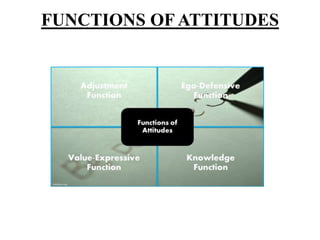
FUNCTIONS OF ATTITUDES
RELATIONSHIP BETWEEN INDIVIDUAL
DETERMINANTS
• By understanding personalities, managers can match the right people with
the right job and as a result increase job satisfaction and by extension
increase effectiveness and efficiency. In addition managers need to
recognise that employees react to perceptions, not reality. That is,
employers need to understand that the perception of a good work
environment and high wages is more important that actually having it
recognised as the best by some industry standard. Lastly, managers need to
recognise that employees learn on the job. whether it is work related
learning or learning how to get promoted makes no difference- they still
learn and managers need to try get them to learn the right lessons.
Chanderprabhu Jain College of Higher Studies & School of Law
Plot No. OCF, Sector A-8, Narela, New Delhi – 110040
(Affiliated to Guru Gobind Singh Indraprastha University and Approved by Govt of NCT of Delhi & Bar Council of India)
GROUP BEHAVIOR
A group can be defined as two or more
interacting and interdependent individuals
who come together to achieve particular
objectives. A group behavior can be stated as
a course of action a group takes as a family.
For example − Strike.
Chanderprabhu Jain College of Higher Studies & School of Law
Plot No. OCF, Sector A-8, Narela, New Delhi – 110040
(Affiliated to Guru Gobind Singh Indraprastha University and Approved by Govt of NCT of Delhi & Bar Council of India)
TYPES OF GROUPS
There are two types of groups individuals form. They are formal groups
and informal groups. Let us know about these groups.
Formal Groups
• These are the type of work groups created by the organization and have
designated work assignments and rooted tasks. The behavior of such
groups is directed toward achieving organizational goals.
Formal groups can be further classified into two sub-groups −
• Command Group − It is a group consisting of individuals who report
directly to the manager.
• Interest Group − It is a group formed by individuals working together
to achieve a specific objective.
Chanderprabhu Jain College of Higher Studies & School of Law
Plot No. OCF, Sector A-8, Narela, New Delhi – 110040
(Affiliated to Guru Gobind Singh Indraprastha University and Approved by Govt of NCT of Delhi & Bar Council of India)
Informal Groups
• These groups are formed with friendships and common interests.
These can be further classified into two sub-groups −
• Task group − Those working together to finish a job or task is known
as a task group.
• Friendship group − Those brought together because of their shared
interests or common characteristics is known as friendship group.
• For example − A group of workers working on a project and reporting
to the same manager is considered as command group, while a group of
friends chilling out together is considered as an interest group or say
members of a club.
Chanderprabhu Jain College of Higher Studies & School of Law
Plot No. OCF, Sector A-8, Narela, New Delhi – 110040
(Affiliated to Guru Gobind Singh Indraprastha University and Approved by Govt of NCT of Delhi & Bar Council of India)
TEAM DEVELOPMENT
Teams are becoming a key tool for organizing work in
today’s corporate world. Teams have the potential to
immediately amass, organize, relocate, and disperse. But,
teams are an effective tool of employee motivation. It is
essential to consider the fact that teams develop and get
mature over a period of time. Team development creates a
captivating atmosphere by encouraging co-operation,
teamwork, interdependence and by building trust among
team members.
Chanderprabhu Jain College of Higher Studies & School of Law
Plot No. OCF, Sector A-8, Narela, New Delhi – 110040
(Affiliated to Guru Gobind Singh Indraprastha University and Approved by Govt of NCT of Delhi & Bar Council of India)
GROUP
• A collection of individuals who have regular contact and
frequent interaction, mutual influence, common feeling of
camaraderie, and who work together to achieve a common
set of goals.
• Every organization is a group unto itself. A group refers to
two or more people who share a common meaning and
evaluation of themselves and come together to achieve
common goals..
Chanderprabhu Jain College of Higher Studies & School of Law
Plot No. OCF, Sector A-8, Narela, New Delhi – 110040
(Affiliated to Guru Gobind Singh Indraprastha University and Approved by Govt of NCT of Delhi & Bar Council of India)
GROUP DYNAMICS
• Group dynamics deals with the attitudes and behavioral patterns of a group.
• Group dynamics concern how groups are formed, what is their structure and
which processes are followed in their functioning. Thus, it is concerned with
the interactions and forces operating between groups.
• Group dynamics is relevant to groups of all kinds – both formal and informal.
• If the UPA government has set up Group of Ministers for every governance
issue, the Supreme Court of India has 27 Group of Judges committees
overseeing all manner of non-judicial work in the apex court. In an
organizational setting, the term groups are a very common and the study of
groups and group dynamics is an important area of study.
Chanderprabhu Jain College of Higher Studies & School of Law
Plot No. OCF, Sector A-8, Narela, New Delhi – 110040
(Affiliated to Guru Gobind Singh Indraprastha University and Approved by Govt of NCT of Delhi & Bar Council of India)
THE FOUR STAGES OF GROUP DEVELOPMENT
• Stage 1: Forming
• Stage 2: Storming
• Stage 3: Norming
• Stage 4: Performing
Chanderprabhu Jain College of Higher Studies & School of Law
Plot No. OCF, Sector A-8, Narela, New Delhi – 110040
(Affiliated to Guru Gobind Singh Indraprastha University and Approved by Govt of NCT of Delhi & Bar Council of India)
IMPORTANT THEORIES OF GROUP FORMATION
• 1.Propinquity Theory: As per this theory people affiliate with one
another because of spatial or geographical proximity. This means that
employees who have offices close to one another would form a group
more easily. here, nearness is the only factor for group formation
• 2. Homer’s Theory: According to George C. Homans, “The more
activities persons share, the more numerous will be their interactions
and the stronger will be their shared activities and sentiments, and the
more sentiments people have for one another, the more will be their
shared activities and interactions.”
Chanderprabhu Jain College of Higher Studies & School of Law
Plot No. OCF, Sector A-8, Narela, New Delhi – 110040
(Affiliated to Guru Gobind Singh Indraprastha University and Approved by Govt of NCT of Delhi & Bar Council of India)
• 3. Balance theory: Proposed by Theodore Newcomb, the balance
theory states that “Persons are attracted to one another on the basis of
similar attitudes towards commonly relevant objects and goals. Once a
relationship is formed, it strives to maintain a symmetrical balance
between the attraction and the common attitudes. If an imbalance
occurs, attempts are made to restore the balance. If the balance cannot
be restored, the relationship dissolves.”
• 4.Exchange Theory: This theory is based on reward-cost outcomes of
interactions. To be attracted towards a group, a person thinks in terms
of what he will get in exchange of interaction with group members. A
minimum positive level (rewards greater than costs) of an outcome
must exist in order for attraction or affiliation to take place. Rewards
from interactions gratify needs while costs incur anxiety, frustrations,
embarrassment or fatigue. Propinquity, interaction and common
attitudes all have roles in the exchange theory.
Chanderprabhu Jain College of Higher Studies & School of Law
Plot No. OCF, Sector A-8, Narela, New Delhi – 110040
(Affiliated to Guru Gobind Singh Indraprastha University and Approved by Govt of NCT of Delhi & Bar Council of India)
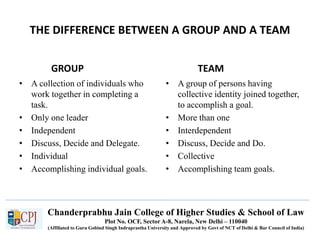
THE DIFFERENCE BETWEEN A GROUP AND A TEAM
GROUP
• A collection of individuals who
work together in completing a
task.
• Only one leader
• Independent
• Discuss, Decide and Delegate.
• Individual
• Accomplishing individual goals.
TEAM
• A group of persons having
collective identity joined together,
to accomplish a goal.
• More than one
• Interdependent
• Discuss, Decide and Do.
• Collective
• Accomplishing team goals.
Chanderprabhu Jain College of Higher Studies & School of Law
Plot No. OCF, Sector A-8, Narela, New Delhi – 110040
(Affiliated to Guru Gobind Singh Indraprastha University and Approved by Govt of NCT of Delhi & Bar Council of India)
TYPES OF TEAMS
• Permanent teams- These teams perform on a permanent
basis and are not dissolved once the task is accomplished.
• Temporary teams - Unlike permanent teams, temporary
teams loose their importance, once the task is
accomplished.
• Task Force - Such teams are formed for a special purpose
of working on any specific project or finding a solution to a
very critical problem.
Chanderprabhu Jain College of Higher Studies & School of Law
Plot No. OCF, Sector A-8, Narela, New Delhi – 110040
(Affiliated to Guru Gobind Singh Indraprastha University and Approved by Govt of NCT of Delhi & Bar Council of India)
• Committee - Committees are generally formed to work on a particular
assignment either permanently or on a temporary basis.
• Organization/Work Force - Such groups are formed in organizations
where team members work together under the expert guidance of
leader.
• Self Managed Teams - Self Managed Teams consist of individuals who
work together again for a common purpose but without the supervision
of any leader
• Virtual Teams - Virtual teams consist of individuals who are separated
by distances and connected through computer.
Chanderprabhu Jain College of Higher Studies & School of Law
Plot No. OCF, Sector A-8, Narela, New Delhi – 110040
(Affiliated to Guru Gobind Singh Indraprastha University and Approved by Govt of NCT of Delhi & Bar Council of India)
STEPS TO BUILDING AN EFFECTIVE
TEAM
Step 1: Establish leadership.
Step 2: Establish relationships with each of your employees.
Step 3: Build relationships between your employees.
Step 4: Foster teamwork.
Step 5: Set ground rules for the team.

Management Process and Organizational Behavior

  • 1.
    Chanderprabhu Jain Collegeof Higher Studies & School of Law Plot No. OCF, Sector A-8, Narela, New Delhi – 110040 (Affiliated to Guru Gobind Singh Indraprastha University and Approved by Govt of NCT of Delhi & Bar Council of India) Management Process and Organizational Behavior
  • 2.
    Chanderprabhu Jain Collegeof Higher Studies & School of Law Plot No. OCF, Sector A-8, Narela, New Delhi – 110040 (Affiliated to Guru Gobind Singh Indraprastha University and Approved by Govt of NCT of Delhi & Bar Council of India) Management • According to Henri Fayol, "Management is to manage is to forecast and to plan, to organise, to command, to co-ordinate and to control.“ • Mary Parker Follett (1868–1933), defined management as "the art of getting things done through people."
  • 3.
    Chanderprabhu Jain Collegeof Higher Studies & School of Law Plot No. OCF, Sector A-8, Narela, New Delhi – 110040 (Affiliated to Guru Gobind Singh Indraprastha University and Approved by Govt of NCT of Delhi & Bar Council of India) NATURE OF MANAGEMENT • Universal process • Factor of production • Goal Oriented • Supreme in thought and action • Group Activity • Dynamic Function • Social Science
  • 4.
    Chanderprabhu Jain Collegeof Higher Studies & School of Law Plot No. OCF, Sector A-8, Narela, New Delhi – 110040 (Affiliated to Guru Gobind Singh Indraprastha University and Approved by Govt of NCT of Delhi & Bar Council of India) MANAGEMENT PROCESS .
  • 5.
    Chanderprabhu Jain Collegeof Higher Studies & School of Law Plot No. OCF, Sector A-8, Narela, New Delhi – 110040 (Affiliated to Guru Gobind Singh Indraprastha University and Approved by Govt of NCT of Delhi & Bar Council of India) LEVELS OF MANAGEMENT 1. Top Level 2. Middle Level 3. Low Level
  • 6.
    Chanderprabhu Jain Collegeof Higher Studies & School of Law Plot No. OCF, Sector A-8, Narela, New Delhi – 110040 (Affiliated to Guru Gobind Singh Indraprastha University and Approved by Govt of NCT of Delhi & Bar Council of India) SIGNIFICANCE OF MANAGEMENT – It helps in Achieving Group Goals – Optimum Utilization of Resources – Reduces Costs – Establishes Sound Organization – Establishes Equilibrium – Essentials for Prosperity of Society
  • 7.
    Chanderprabhu Jain Collegeof Higher Studies & School of Law Plot No. OCF, Sector A-8, Narela, New Delhi – 110040 (Affiliated to Guru Gobind Singh Indraprastha University and Approved by Govt of NCT of Delhi & Bar Council of India) MANAGEMENT AND ADMINISTRATION According to Theo Haimann, “Administration means overall determination of policies, setting of major objectives, the identification of general purposes and laying down of broad programmes and projects”. It refers to the activities of higher level. It lays down basic principles of the enterprise. According to Newman, “Administration means guidance, leadership & control of the efforts of the groups towards some common goals”.
  • 8.
    Chanderprabhu Jain Collegeof Higher Studies & School of Law Plot No. OCF, Sector A-8, Narela, New Delhi – 110040 (Affiliated to Guru Gobind Singh Indraprastha University and Approved by Govt of NCT of Delhi & Bar Council of India) Whereas, management involves conceiving, initiating and bringing together the various elements; coordinating, actuating, integrating the diverse organizational components while sustaining the viability of the organization towards some pre- determined goals. In other words, it is an art of getting things done through & with the people in formally organized groups.
  • 9.
    Chanderprabhu Jain Collegeof Higher Studies & School of Law Plot No. OCF, Sector A-8, Narela, New Delhi – 110040 (Affiliated to Guru Gobind Singh Indraprastha University and Approved by Govt of NCT of Delhi & Bar Council of India) MINTZBERG'S MANAGEMENT ROLES Category Roles Interpersonal Figurehead Leader Liaison Informational Monitor Disseminator Spokesperson Decisional Entrepreneur Disturbance Handler Resource Allocator Negotiator
  • 10.
    Chanderprabhu Jain Collegeof Higher Studies & School of Law Plot No. OCF, Sector A-8, Narela, New Delhi – 110040 (Affiliated to Guru Gobind Singh Indraprastha University and Approved by Govt of NCT of Delhi & Bar Council of India) COORDINATION: THE ESSENCE OF MANAGEMENT Coordination is needed to perform all the functions of management: • In planning coordination is required between main plan and supportive plans of different departments. • In organising coordination is required between different resources of an organization and also between authority responsibility and accountability. • In staffing coordination is required between skill of a person and job assigned to him, between efficiency and compensation etc. • In directing function coordination is required between superior and subordinates, between orders, instructions, guidelines and suggestions etc. • In controlling function coordination is required between standards and actual performance.
  • 11.
    Chanderprabhu Jain Collegeof Higher Studies & School of Law Plot No. OCF, Sector A-8, Narela, New Delhi – 110040 (Affiliated to Guru Gobind Singh Indraprastha University and Approved by Govt of NCT of Delhi & Bar Council of India) • 2. Coordination is required at all the levels: 3.Coordination is the most important function of an organization
  • 12.
    Chanderprabhu Jain Collegeof Higher Studies & School of Law Plot No. OCF, Sector A-8, Narela, New Delhi – 110040 (Affiliated to Guru Gobind Singh Indraprastha University and Approved by Govt of NCT of Delhi & Bar Council of India) PLANNING Planning is the most basic of all managerial functions. It is the process by which managers establish goals and define the methods by which these goals are to be attained. • Types of Plans are; • Hierarchical plans, • Standing plans, • Single-use plans, and • Contingency plans.
  • 13.
    Chanderprabhu Jain Collegeof Higher Studies & School of Law Plot No. OCF, Sector A-8, Narela, New Delhi – 110040 (Affiliated to Guru Gobind Singh Indraprastha University and Approved by Govt of NCT of Delhi & Bar Council of India) PLANNING PROCESS Stage 1: Identify problems and needs Stage 2: Develop goals and objectives Stage 3: Develop alternative strategies Stage 4: Select strategies and develop a detailed plan Stage 5: Design a monitoring and evaluation plan
  • 14.
    BOUNDED RATIONALITY • Boundedrationality is the idea that when individuals make decisions, their rationality is limited by the tractability of the decision problem, the cognitive limitations of their minds, and the time available to make the decision. Decision-makers in this view act as satisficers, seeking a satisfactory solution rather than an optimal one. Herbert A. Simon proposed bounded rationality as an alternative basis for the mathematical modeling of decision-making, as used in economics, political science and related disciplines. It complements "rationality as optimization", which views decision-making as a fully rational process of finding an optimal choice given the information available. Simon used the analogy of a pair of scissors, where one blade represents "cognitive limitations" of actual humans and the other the "structures of the environment", illustrating how minds compensate for limited resources by exploiting known structural regularity in the environment.
  • 15.
    Chanderprabhu Jain Collegeof Higher Studies & School of Law Plot No. OCF, Sector A-8, Narela, New Delhi – 110040 (Affiliated to Guru Gobind Singh Indraprastha University and Approved by Govt of NCT of Delhi & Bar Council of India)
  • 16.
    Chanderprabhu Jain Collegeof Higher Studies & School of Law Plot No. OCF, Sector A-8, Narela, New Delhi – 110040 (Affiliated to Guru Gobind Singh Indraprastha University and Approved by Govt of NCT of Delhi & Bar Council of India) ORGANIZING According to Stoner, "Organizing is the process of arranging and allocating works, authority, and resources among an organization’s members so that they can achieve an organizational goal".
  • 17.
    Chanderprabhu Jain Collegeof Higher Studies & School of Law Plot No. OCF, Sector A-8, Narela, New Delhi – 110040 (Affiliated to Guru Gobind Singh Indraprastha University and Approved by Govt of NCT of Delhi & Bar Council of India) PRINCIPLES OF ORGANIZATION • The principle of unity of objectives • The principle of efficiency • Principles of the span of control • The principle of a division of works • The principle of unity of command • The principle of unity of direction • The principle of delegation • The principle of simplicity • The principle of authority • The principle of responsibility • The principle of flexibility • The principle of balance • Scalar Principle • The principle of specialization
  • 18.
    Chanderprabhu Jain Collegeof Higher Studies & School of Law Plot No. OCF, Sector A-8, Narela, New Delhi – 110040 (Affiliated to Guru Gobind Singh Indraprastha University and Approved by Govt of NCT of Delhi & Bar Council of India) SPAN OF CONTROL Span of Control is a term that describes the number of subordinate workers / organizational units under a single manager. Determination of span of control is one of the results of organizing and it is de-facto manifestation of formal organizational structure.
  • 19.
    Chanderprabhu Jain Collegeof Higher Studies & School of Law Plot No. OCF, Sector A-8, Narela, New Delhi – 110040 (Affiliated to Guru Gobind Singh Indraprastha University and Approved by Govt of NCT of Delhi & Bar Council of India) DEPARTMENTATION • According to Koontz and O’Donnell, “A department is a distinct area, division or branch of an enterprise over which a manager has authority for the performance of specified activities.”‘ • Departmentalization (or simply departmentation) refers to the grouping of operating tasks into jobs, the combining of jobs into effective work groups and the combining of groups into divisions often termed as ‘Departments’.
  • 20.
    Chanderprabhu Jain Collegeof Higher Studies & School of Law Plot No. OCF, Sector A-8, Narela, New Delhi – 110040 (Affiliated to Guru Gobind Singh Indraprastha University and Approved by Govt of NCT of Delhi & Bar Council of India) TYPES OF ORGANIZATION Formal organisations Informal organisations
  • 21.
    Chanderprabhu Jain Collegeof Higher Studies & School of Law Plot No. OCF, Sector A-8, Narela, New Delhi – 110040 (Affiliated to Guru Gobind Singh Indraprastha University and Approved by Govt of NCT of Delhi & Bar Council of India) DELEGATION Delegation is the assignment of any responsibility or authority to another person (normally from a manager to a subordinate) to carry out specific activities. It is one of the core concepts of management leadership. However, the person who delegated the work remains accountable for the outcome of the delegated work. Delegation empowers a subordinate to make decisions.
  • 22.
    DECENTRALIZATION • Decentralization isthe process by which the activities of an organization, particularly those regarding planning and decision-making, are distributed or delegated away from a central, authoritative location or group.
  • 23.
    Chanderprabhu Jain Collegeof Higher Studies & School of Law Plot No. OCF, Sector A-8, Narela, New Delhi – 110040 (Affiliated to Guru Gobind Singh Indraprastha University and Approved by Govt of NCT of Delhi & Bar Council of India) STAFFING • The managerial function of staffing involves manning the organization structure through proper and effective selection, appraisal and development of the personnels to fill the roles assigned to the employers/workforce. • According to Theo Haimann, “Staffing pertains to recruitment, selection, development and compensation of subordinates.”
  • 24.
    Chanderprabhu Jain Collegeof Higher Studies & School of Law Plot No. OCF, Sector A-8, Narela, New Delhi – 110040 (Affiliated to Guru Gobind Singh Indraprastha University and Approved by Govt of NCT of Delhi & Bar Council of India) Nature of Staffing Function • Staffing is an important managerial function • Staffing is a pervasive activity • Staffing is a continuous activity • The basis of staffing function is efficient management of personnels. • Staffing helps in placing right men at the right job. • Staffing is performed by all managers.
  • 25.
    Chanderprabhu Jain Collegeof Higher Studies & School of Law Plot No. OCF, Sector A-8, Narela, New Delhi – 110040 (Affiliated to Guru Gobind Singh Indraprastha University and Approved by Govt of NCT of Delhi & Bar Council of India) STAFFING PROCESS - STEPS INVOLVED IN STAFFING . • Manpower requirements • Recruitment • Selection • Orientation and Placement • Training and Development • Remuneration • Performance Evaluation • Promotion and transfer
  • 26.
    Chanderprabhu Jain Collegeof Higher Studies & School of Law Plot No. OCF, Sector A-8, Narela, New Delhi – 110040 (Affiliated to Guru Gobind Singh Indraprastha University and Approved by Govt of NCT of Delhi & Bar Council of India) IMPORTANCE OF STAFFING 1. Efficient Performance of Other Functions 2. Effective Use of Technology and Other Resources 3. Optimum Utilisation of Human Resources 4. Development of Human Capital 5. Motivation of Human Resources 6. Building Higher Morale
  • 27.
    Chanderprabhu Jain Collegeof Higher Studies & School of Law Plot No. OCF, Sector A-8, Narela, New Delhi – 110040 (Affiliated to Guru Gobind Singh Indraprastha University and Approved by Govt of NCT of Delhi & Bar Council of India) LEADERSHIP AND MOTIVATION Motivation is a goal-oriented characteristic that helps a person achieve his objectives. It pushes an individual to work hard at achieving his or her goals. An executive must have the right leadership traits to influence motivation. However, there is no specific blueprint for motivation. Both an employee as well as manager must possess leadership and motivational traits. An effective leader must have a thorough knowledge of motivational factors for others. He must understand the basic needs of employees, peers and his superiors. Leadership is used as a means of motivating others.
  • 28.
    Chanderprabhu Jain Collegeof Higher Studies & School of Law Plot No. OCF, Sector A-8, Narela, New Delhi – 110040 (Affiliated to Guru Gobind Singh Indraprastha University and Approved by Govt of NCT of Delhi & Bar Council of India) MOTIVATION • Motivation is the word derived from the word ’motive’ which means needs, desires, wants or drives within the individuals. It is the process of stimulating people to actions to accomplish the goals. In the work goal context the psychological factors stimulating the people’s behaviour can be - • desire for money • success • recognition • job-satisfaction • team work, etc
  • 29.
    Chanderprabhu Jain Collegeof Higher Studies & School of Law Plot No. OCF, Sector A-8, Narela, New Delhi – 110040 (Affiliated to Guru Gobind Singh Indraprastha University and Approved by Govt of NCT of Delhi & Bar Council of India) Classical Theories of Motivation • Maslow’s hierarchy of needs theory • Herzberg’s Two factor theory • Theory X and Theory Y
  • 30.
    Chanderprabhu Jain Collegeof Higher Studies & School of Law Plot No. OCF, Sector A-8, Narela, New Delhi – 110040 (Affiliated to Guru Gobind Singh Indraprastha University and Approved by Govt of NCT of Delhi & Bar Council of India) Maslow’s Hierarchy of Needs Theory
  • 31.
    Chanderprabhu Jain Collegeof Higher Studies & School of Law Plot No. OCF, Sector A-8, Narela, New Delhi – 110040 (Affiliated to Guru Gobind Singh Indraprastha University and Approved by Govt of NCT of Delhi & Bar Council of India) HERZBERG’S TWO-FACTOR THEORY OF MOTIVATION
  • 32.
    Chanderprabhu Jain Collegeof Higher Studies & School of Law Plot No. OCF, Sector A-8, Narela, New Delhi – 110040 (Affiliated to Guru Gobind Singh Indraprastha University and Approved by Govt of NCT of Delhi & Bar Council of India) Theory X and Theory Y In 1960, Douglas McGregor formulated Theory X and Theory Y suggesting two aspects of human behaviour at work, or in other words, two different views of individuals (employees): one of which is negative, called as Theory X and the other is positive, so called as Theory Y. According to McGregor, the perception of managers on the nature of individuals is based on various assumptions.
  • 33.
    CONTROLLING • According toHarold Koontz “Controlling is the measurement and correction of performance in order to make sure that enterprise objectives and the plans devised to attain them are accomplished.”
  • 34.
    Chanderprabhu Jain Collegeof Higher Studies & School of Law Plot No. OCF, Sector A-8, Narela, New Delhi – 110040 (Affiliated to Guru Gobind Singh Indraprastha University and Approved by Govt of NCT of Delhi & Bar Council of India) NATURE • Control is a continuous process • Control is a management process • Control is embedded in each level of organizational hierarchy • Control is forward looking • Control is closely linked with planning • Control is a tool for achieving organizational activities • Control is an end process • Control compares actual performance with planned performance* • Control point out the error in the execution process • Control helps in minimizing cost • Control helps in achieving standard • Control saves the time • Control helps management for monitoring performance
  • 35.
    Chanderprabhu Jain Collegeof Higher Studies & School of Law Plot No. OCF, Sector A-8, Narela, New Delhi – 110040 (Affiliated to Guru Gobind Singh Indraprastha University and Approved by Govt of NCT of Delhi & Bar Council of India) Importance of Controlling 1. Accomplishing Organisational Goals 2. Judging Accuracy of Standards 3. Making Efficient Use of Resources 4. Improving Employee Motivation 5. Ensuring Order and Discipline 6. Facilitating Coordination in Action
  • 36.
    Chanderprabhu Jain Collegeof Higher Studies & School of Law Plot No. OCF, Sector A-8, Narela, New Delhi – 110040 (Affiliated to Guru Gobind Singh Indraprastha University and Approved by Govt of NCT of Delhi & Bar Council of India) Types of Organizational Controls • Feedforward controls • Concurrent controls • Feedback controls
  • 37.
    Chanderprabhu Jain Collegeof Higher Studies & School of Law Plot No. OCF, Sector A-8, Narela, New Delhi – 110040 (Affiliated to Guru Gobind Singh Indraprastha University and Approved by Govt of NCT of Delhi & Bar Council of India) The Organizational Control Process • Establish standards to measure performance. • Measure actual performance. • Compare performance with the standards. • Take corrective actions.
  • 38.
    Chanderprabhu Jain Collegeof Higher Studies & School of Law Plot No. OCF, Sector A-8, Narela, New Delhi – 110040 (Affiliated to Guru Gobind Singh Indraprastha University and Approved by Govt of NCT of Delhi & Bar Council of India) Techniques of Managerial Control: Traditional Techniques: a. Personal Observation b. Statistical Reports. c. Breakeven Analysis. d. Budgetary Control.
  • 39.
    Chanderprabhu Jain Collegeof Higher Studies & School of Law Plot No. OCF, Sector A-8, Narela, New Delhi – 110040 (Affiliated to Guru Gobind Singh Indraprastha University and Approved by Govt of NCT of Delhi & Bar Council of India) (a) Return on Investment. (b) Ratio Analysis. (c) Responsibility Accounting. (d) Management Audit. (e) PERT and CPM. MODERN TECHNIQUES
  • 40.
    Chanderprabhu Jain Collegeof Higher Studies & School of Law Plot No. OCF, Sector A-8, Narela, New Delhi – 110040 (Affiliated to Guru Gobind Singh Indraprastha University and Approved by Govt of NCT of Delhi & Bar Council of India) ORGANIZATIONAL BEHAVIOR Organizational behavior is a relatively new, interdisciplinary field of study. Organizational behavior (OB) is the study of the way people interact within groups. Normally this study is applied in an attempt to create more efficient business organizations. The central idea of the study of organizational behavior is that a scientific approach can be applied to the management of workers. Organizational behavior theories are used for human resource purposes to maximize the output from individual group members.
  • 41.
    Chanderprabhu Jain Collegeof Higher Studies & School of Law Plot No. OCF, Sector A-8, Narela, New Delhi – 110040 (Affiliated to Guru Gobind Singh Indraprastha University and Approved by Govt of NCT of Delhi & Bar Council of India) Definitions: • “Organisational behaviour is a subset of management activities concerned with understanding, predicting and influencing individual behaviour in organisational setting.”—Callahan, Fleenor and Kudson. • “Organisational behaviour is directly concerned with the understanding, production and control of human behaviour in organisations.”—Fred Luthans.
  • 42.
    Chanderprabhu Jain Collegeof Higher Studies & School of Law Plot No. OCF, Sector A-8, Narela, New Delhi – 110040 (Affiliated to Guru Gobind Singh Indraprastha University and Approved by Govt of NCT of Delhi & Bar Council of India) In short, organisational behaviour revolves around two fundamental components: . 1. The nature of the man. 2. The nature of the organisation.
  • 43.
    Chanderprabhu Jain Collegeof Higher Studies & School of Law Plot No. OCF, Sector A-8, Narela, New Delhi – 110040 (Affiliated to Guru Gobind Singh Indraprastha University and Approved by Govt of NCT of Delhi & Bar Council of India) Characteristics of Organisational Behavior 1. Behavioural Approach to Management 2. Cause and Effect Relationship 3. Organisational Behaviour is a Branch of Social Sciences 4. Three Levels of Analysis 5. A Science as well as an Art 6. A Body of Theory, Research and Application 7. Beneficial to both Organisation and Individuals 8. Rational Thinking
  • 44.
    Chanderprabhu Jain Collegeof Higher Studies & School of Law Plot No. OCF, Sector A-8, Narela, New Delhi – 110040 (Affiliated to Guru Gobind Singh Indraprastha University and Approved by Govt of NCT of Delhi & Bar Council of India) Three Levels of Analysis – INDIVIDUAL LEVEL OF ANALYSIS – GROUP LEVEL OF ANALYSIS – ORGANIZATIONAL LEVEL OF ANALYSIS
  • 45.
    Chanderprabhu Jain Collegeof Higher Studies & School of Law Plot No. OCF, Sector A-8, Narela, New Delhi – 110040 (Affiliated to Guru Gobind Singh Indraprastha University and Approved by Govt of NCT of Delhi & Bar Council of India) IMPORTANCE OF ORGANIZATIONAL BEHAVIOR • It builds better relationship by achieving people’s, organizational, and social objectives. • It covers a wide array of human resource like behavior, training and development, change management, leadership, teams etc. • It brings coordination which is the essence of management. • It improves goodwill of the organization. • It helps to achieve objectives quickly. • It makes optimum utilization of resources. • It facilitates motivation. • It leads to higher efficiency. • It improves relations in the organization. • It is multidisciplinary, in the sense that applies different techniques, methods, and theories to evaluate the performances.
  • 46.
    Chanderprabhu Jain Collegeof Higher Studies & School of Law Plot No. OCF, Sector A-8, Narela, New Delhi – 110040 (Affiliated to Guru Gobind Singh Indraprastha University and Approved by Govt of NCT of Delhi & Bar Council of India) CHALLENGES AND OPPORTUNITIES OF ORGANIZATIONAL BEHAVIOR • Improving Peoples’ Skills. • Improving Quality and Productivity. • Total Quality Management (TQM). • Managing Workforce Diversity. • Responding to Globalization. • Empowering People. • Coping with Temporariness. • Stimulating Innovation and Change. • Emergence of E-Organisation & E-Commerce. • Improving Ethical Behavior. • Improving Customer Service. • Helping Employees Balance Work-Life Conflicts.
  • 47.
    Chanderprabhu Jain Collegeof Higher Studies & School of Law Plot No. OCF, Sector A-8, Narela, New Delhi – 110040 (Affiliated to Guru Gobind Singh Indraprastha University and Approved by Govt of NCT of Delhi & Bar Council of India) INDIVIDUAL BEHAVIOR PERSONALITY Personality means how a person affects others and how he understands and views himself as well as the pattern of inner and outer measurable traits and the person-situation interactions (Fred Luthans). According to Stephen P. Robbins, personality is the sum total ways in which an individual reacts and interacts with others. It may be defined as those inner psychological characteristics that both determine and reflect how a person responds to his environment.
  • 48.
    Chanderprabhu Jain Collegeof Higher Studies & School of Law Plot No. OCF, Sector A-8, Narela, New Delhi – 110040 (Affiliated to Guru Gobind Singh Indraprastha University and Approved by Govt of NCT of Delhi & Bar Council of India) Determinants of Personality 1. Heredity 2. Environment (a) Culture (b) Family (c) Social (d) Situational
  • 49.
    Chanderprabhu Jain Collegeof Higher Studies & School of Law Plot No. OCF, Sector A-8, Narela, New Delhi – 110040 (Affiliated to Guru Gobind Singh Indraprastha University and Approved by Govt of NCT of Delhi & Bar Council of India) The Nature of Personality 1. Personality reflects individual differences 2. Personality is consistent and enduring 3. Personality can change
  • 50.
    Big Five personalitytraits • Openness to experience • Conscientiousness • Extraversion • Agreeableness • Neuroticism
  • 51.
    Chanderprabhu Jain Collegeof Higher Studies & School of Law Plot No. OCF, Sector A-8, Narela, New Delhi – 110040 (Affiliated to Guru Gobind Singh Indraprastha University and Approved by Govt of NCT of Delhi & Bar Council of India) LEARNING Learning can be defined as the permanent change in behavior due to direct and indirect experience. It means change in behavior, attitude due to education and training, practice and experience. It is completed by acquisition of knowledge and skills, which are relatively permanent.
  • 52.
    Chanderprabhu Jain Collegeof Higher Studies & School of Law Plot No. OCF, Sector A-8, Narela, New Delhi – 110040 (Affiliated to Guru Gobind Singh Indraprastha University and Approved by Govt of NCT of Delhi & Bar Council of India) Factors Affecting Learning • MOTIVATION • PRACTICE • ENVIRONMENT • MENTAL GROUP
  • 53.
    Chanderprabhu Jain Collegeof Higher Studies & School of Law Plot No. OCF, Sector A-8, Narela, New Delhi – 110040 (Affiliated to Guru Gobind Singh Indraprastha University and Approved by Govt of NCT of Delhi & Bar Council of India) THEORIES OF LEARNING 1. CLASSICAL CONDITIONING 2. OPERANT CONDITIONING 3. COGNITIVE THEORY 4. SOCIAL LEARNING THEORY
  • 54.
    Chanderprabhu Jain Collegeof Higher Studies & School of Law Plot No. OCF, Sector A-8, Narela, New Delhi – 110040 (Affiliated to Guru Gobind Singh Indraprastha University and Approved by Govt of NCT of Delhi & Bar Council of India) Classical Conditioning Theory
  • 55.
    Chanderprabhu Jain Collegeof Higher Studies & School of Law Plot No. OCF, Sector A-8, Narela, New Delhi – 110040 (Affiliated to Guru Gobind Singh Indraprastha University and Approved by Govt of NCT of Delhi & Bar Council of India) Operant Conditioning Theory
  • 56.
    Chanderprabhu Jain Collegeof Higher Studies & School of Law Plot No. OCF, Sector A-8, Narela, New Delhi – 110040 (Affiliated to Guru Gobind Singh Indraprastha University and Approved by Govt of NCT of Delhi & Bar Council of India) Social Learning Theory
  • 57.
    Chanderprabhu Jain Collegeof Higher Studies & School of Law Plot No. OCF, Sector A-8, Narela, New Delhi – 110040 (Affiliated to Guru Gobind Singh Indraprastha University and Approved by Govt of NCT of Delhi & Bar Council of India) Cognitive Learning Theory • Cognition defines a person’s ideas, thoughts, knowledge, interpretation, understanding about himself and environment. • This theory considers learning as the outcome of deliberate thinking on a problem or situation based upon known facts and responding in an objective and more oriented manner. It perceives that a person learns the meaning of various objects and events and also learns the response depending upon the meaning assigned to the stimuli. • This theory debates that the learner forms a cognitive structure in memory which stores organized information about the various events that occurs.
  • 58.
    Chanderprabhu Jain Collegeof Higher Studies & School of Law Plot No. OCF, Sector A-8, Narela, New Delhi – 110040 (Affiliated to Guru Gobind Singh Indraprastha University and Approved by Govt of NCT of Delhi & Bar Council of India) PERCEPTION • Perception (from the Latin perceptio) is the organization, identification, and interpretation of sensory information in order to represent and understand the presented information, or the environment. •
  • 59.
    Chanderprabhu Jain Collegeof Higher Studies & School of Law Plot No. OCF, Sector A-8, Narela, New Delhi – 110040 (Affiliated to Guru Gobind Singh Indraprastha University and Approved by Govt of NCT of Delhi & Bar Council of India) PERCEPTION PROCESS
  • 60.
    Chanderprabhu Jain Collegeof Higher Studies & School of Law Plot No. OCF, Sector A-8, Narela, New Delhi – 110040 (Affiliated to Guru Gobind Singh Indraprastha University and Approved by Govt of NCT of Delhi & Bar Council of India) PERCEPTION ERRORS • Stereotypes and Prototypes • Halo Effects / Horn Effects • Selective Perception • Contrast Effects • Projections
  • 61.
    Chanderprabhu Jain Collegeof Higher Studies & School of Law Plot No. OCF, Sector A-8, Narela, New Delhi – 110040 (Affiliated to Guru Gobind Singh Indraprastha University and Approved by Govt of NCT of Delhi & Bar Council of India) ATTITUDE • According to Gordon Allport, “An attitude is a mental and neural state of readiness, organized through experience, exerting a directive or dynamic influence upon the individual’s response to all objects and situations with which it is related.”
  • 62.
    Chanderprabhu Jain Collegeof Higher Studies & School of Law Plot No. OCF, Sector A-8, Narela, New Delhi – 110040 (Affiliated to Guru Gobind Singh Indraprastha University and Approved by Govt of NCT of Delhi & Bar Council of India) ATTITUDE • According to Si P. Robbins – “Attitude is manner, disposition, feeling and position with regard to a person or thing, tendency or orientation especially in the mind.”
  • 63.
    Chanderprabhu Jain Collegeof Higher Studies & School of Law Plot No. OCF, Sector A-8, Narela, New Delhi – 110040 (Affiliated to Guru Gobind Singh Indraprastha University and Approved by Govt of NCT of Delhi & Bar Council of India) CHARACTERISTICS OF ATTITUDE • Attitudes are the complex combination of things we tend to call personality, beliefs, values, behaviors, and motivations. • It can fall anywhere along a continuum from very favorable to very unfavorable. • All people, irrespective of their status or intelligence, hold attitudes. • An attitude exists in every person’s mind. It helps to define our identity, guide our actions, and influence how we judge people. • Although the feeling and belief components of attitude are internal to a person, we can view a person’s attitude from his or her resulting behavior.
  • 64.
    Chanderprabhu Jain Collegeof Higher Studies & School of Law Plot No. OCF, Sector A-8, Narela, New Delhi – 110040 (Affiliated to Guru Gobind Singh Indraprastha University and Approved by Govt of NCT of Delhi & Bar Council of India) COMPONENTS OF ATTITUDE
  • 65.
    FACTORS INFLUENCING ATTITUDES •Social Factors. • Direct Instruction. • Family. • Prejudices. • Personal Experience. • Media. • Educational and Religious Institutions. • Physical Factors. • Economic Status and Occupations
  • 66.
    TYPES OF ATTITUDES •Job Satisfaction, • Job Involvement, and • Organizational Commitment
  • 67.
  • 68.
    RELATIONSHIP BETWEEN INDIVIDUAL DETERMINANTS •By understanding personalities, managers can match the right people with the right job and as a result increase job satisfaction and by extension increase effectiveness and efficiency. In addition managers need to recognise that employees react to perceptions, not reality. That is, employers need to understand that the perception of a good work environment and high wages is more important that actually having it recognised as the best by some industry standard. Lastly, managers need to recognise that employees learn on the job. whether it is work related learning or learning how to get promoted makes no difference- they still learn and managers need to try get them to learn the right lessons.
  • 69.
    Chanderprabhu Jain Collegeof Higher Studies & School of Law Plot No. OCF, Sector A-8, Narela, New Delhi – 110040 (Affiliated to Guru Gobind Singh Indraprastha University and Approved by Govt of NCT of Delhi & Bar Council of India) GROUP BEHAVIOR A group can be defined as two or more interacting and interdependent individuals who come together to achieve particular objectives. A group behavior can be stated as a course of action a group takes as a family. For example − Strike.
  • 70.
    Chanderprabhu Jain Collegeof Higher Studies & School of Law Plot No. OCF, Sector A-8, Narela, New Delhi – 110040 (Affiliated to Guru Gobind Singh Indraprastha University and Approved by Govt of NCT of Delhi & Bar Council of India) TYPES OF GROUPS There are two types of groups individuals form. They are formal groups and informal groups. Let us know about these groups. Formal Groups • These are the type of work groups created by the organization and have designated work assignments and rooted tasks. The behavior of such groups is directed toward achieving organizational goals. Formal groups can be further classified into two sub-groups − • Command Group − It is a group consisting of individuals who report directly to the manager. • Interest Group − It is a group formed by individuals working together to achieve a specific objective.
  • 71.
    Chanderprabhu Jain Collegeof Higher Studies & School of Law Plot No. OCF, Sector A-8, Narela, New Delhi – 110040 (Affiliated to Guru Gobind Singh Indraprastha University and Approved by Govt of NCT of Delhi & Bar Council of India) Informal Groups • These groups are formed with friendships and common interests. These can be further classified into two sub-groups − • Task group − Those working together to finish a job or task is known as a task group. • Friendship group − Those brought together because of their shared interests or common characteristics is known as friendship group. • For example − A group of workers working on a project and reporting to the same manager is considered as command group, while a group of friends chilling out together is considered as an interest group or say members of a club.
  • 72.
    Chanderprabhu Jain Collegeof Higher Studies & School of Law Plot No. OCF, Sector A-8, Narela, New Delhi – 110040 (Affiliated to Guru Gobind Singh Indraprastha University and Approved by Govt of NCT of Delhi & Bar Council of India) TEAM DEVELOPMENT Teams are becoming a key tool for organizing work in today’s corporate world. Teams have the potential to immediately amass, organize, relocate, and disperse. But, teams are an effective tool of employee motivation. It is essential to consider the fact that teams develop and get mature over a period of time. Team development creates a captivating atmosphere by encouraging co-operation, teamwork, interdependence and by building trust among team members.
  • 73.
    Chanderprabhu Jain Collegeof Higher Studies & School of Law Plot No. OCF, Sector A-8, Narela, New Delhi – 110040 (Affiliated to Guru Gobind Singh Indraprastha University and Approved by Govt of NCT of Delhi & Bar Council of India) GROUP • A collection of individuals who have regular contact and frequent interaction, mutual influence, common feeling of camaraderie, and who work together to achieve a common set of goals. • Every organization is a group unto itself. A group refers to two or more people who share a common meaning and evaluation of themselves and come together to achieve common goals..
  • 74.
    Chanderprabhu Jain Collegeof Higher Studies & School of Law Plot No. OCF, Sector A-8, Narela, New Delhi – 110040 (Affiliated to Guru Gobind Singh Indraprastha University and Approved by Govt of NCT of Delhi & Bar Council of India) GROUP DYNAMICS • Group dynamics deals with the attitudes and behavioral patterns of a group. • Group dynamics concern how groups are formed, what is their structure and which processes are followed in their functioning. Thus, it is concerned with the interactions and forces operating between groups. • Group dynamics is relevant to groups of all kinds – both formal and informal. • If the UPA government has set up Group of Ministers for every governance issue, the Supreme Court of India has 27 Group of Judges committees overseeing all manner of non-judicial work in the apex court. In an organizational setting, the term groups are a very common and the study of groups and group dynamics is an important area of study.
  • 75.
    Chanderprabhu Jain Collegeof Higher Studies & School of Law Plot No. OCF, Sector A-8, Narela, New Delhi – 110040 (Affiliated to Guru Gobind Singh Indraprastha University and Approved by Govt of NCT of Delhi & Bar Council of India) THE FOUR STAGES OF GROUP DEVELOPMENT • Stage 1: Forming • Stage 2: Storming • Stage 3: Norming • Stage 4: Performing
  • 76.
    Chanderprabhu Jain Collegeof Higher Studies & School of Law Plot No. OCF, Sector A-8, Narela, New Delhi – 110040 (Affiliated to Guru Gobind Singh Indraprastha University and Approved by Govt of NCT of Delhi & Bar Council of India) IMPORTANT THEORIES OF GROUP FORMATION • 1.Propinquity Theory: As per this theory people affiliate with one another because of spatial or geographical proximity. This means that employees who have offices close to one another would form a group more easily. here, nearness is the only factor for group formation • 2. Homer’s Theory: According to George C. Homans, “The more activities persons share, the more numerous will be their interactions and the stronger will be their shared activities and sentiments, and the more sentiments people have for one another, the more will be their shared activities and interactions.”
  • 77.
    Chanderprabhu Jain Collegeof Higher Studies & School of Law Plot No. OCF, Sector A-8, Narela, New Delhi – 110040 (Affiliated to Guru Gobind Singh Indraprastha University and Approved by Govt of NCT of Delhi & Bar Council of India) • 3. Balance theory: Proposed by Theodore Newcomb, the balance theory states that “Persons are attracted to one another on the basis of similar attitudes towards commonly relevant objects and goals. Once a relationship is formed, it strives to maintain a symmetrical balance between the attraction and the common attitudes. If an imbalance occurs, attempts are made to restore the balance. If the balance cannot be restored, the relationship dissolves.” • 4.Exchange Theory: This theory is based on reward-cost outcomes of interactions. To be attracted towards a group, a person thinks in terms of what he will get in exchange of interaction with group members. A minimum positive level (rewards greater than costs) of an outcome must exist in order for attraction or affiliation to take place. Rewards from interactions gratify needs while costs incur anxiety, frustrations, embarrassment or fatigue. Propinquity, interaction and common attitudes all have roles in the exchange theory.
  • 78.
    Chanderprabhu Jain Collegeof Higher Studies & School of Law Plot No. OCF, Sector A-8, Narela, New Delhi – 110040 (Affiliated to Guru Gobind Singh Indraprastha University and Approved by Govt of NCT of Delhi & Bar Council of India) THE DIFFERENCE BETWEEN A GROUP AND A TEAM GROUP • A collection of individuals who work together in completing a task. • Only one leader • Independent • Discuss, Decide and Delegate. • Individual • Accomplishing individual goals. TEAM • A group of persons having collective identity joined together, to accomplish a goal. • More than one • Interdependent • Discuss, Decide and Do. • Collective • Accomplishing team goals.
  • 79.
    Chanderprabhu Jain Collegeof Higher Studies & School of Law Plot No. OCF, Sector A-8, Narela, New Delhi – 110040 (Affiliated to Guru Gobind Singh Indraprastha University and Approved by Govt of NCT of Delhi & Bar Council of India) TYPES OF TEAMS • Permanent teams- These teams perform on a permanent basis and are not dissolved once the task is accomplished. • Temporary teams - Unlike permanent teams, temporary teams loose their importance, once the task is accomplished. • Task Force - Such teams are formed for a special purpose of working on any specific project or finding a solution to a very critical problem.
  • 80.
    Chanderprabhu Jain Collegeof Higher Studies & School of Law Plot No. OCF, Sector A-8, Narela, New Delhi – 110040 (Affiliated to Guru Gobind Singh Indraprastha University and Approved by Govt of NCT of Delhi & Bar Council of India) • Committee - Committees are generally formed to work on a particular assignment either permanently or on a temporary basis. • Organization/Work Force - Such groups are formed in organizations where team members work together under the expert guidance of leader. • Self Managed Teams - Self Managed Teams consist of individuals who work together again for a common purpose but without the supervision of any leader • Virtual Teams - Virtual teams consist of individuals who are separated by distances and connected through computer.
  • 81.
    Chanderprabhu Jain Collegeof Higher Studies & School of Law Plot No. OCF, Sector A-8, Narela, New Delhi – 110040 (Affiliated to Guru Gobind Singh Indraprastha University and Approved by Govt of NCT of Delhi & Bar Council of India) STEPS TO BUILDING AN EFFECTIVE TEAM Step 1: Establish leadership. Step 2: Establish relationships with each of your employees. Step 3: Build relationships between your employees. Step 4: Foster teamwork. Step 5: Set ground rules for the team.