GEOLOGICALTIMESCALE
FROM NOWHERE TO TODAY
SlideSkimmers
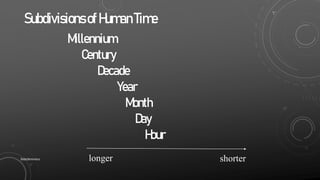
Millennium
Century
Decade
Year
Month
Day
Hour
SubdivisionsofHumanTime
longer shorter
SlideSkimmers
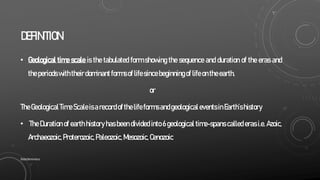
DEFINITION
• Geological time scale is the tabulated form showing the sequence and duration of the eras and
theperiodswiththeirdominantformsoflifesincebeginningoflifeontheearth.
or
TheGeologicalTimeScaleisarecordofthelifeformsandgeologicaleventsinEarth’shistory
• The Duration of earth history has been divided into 6 geological time-spans called eras i.e. Azoic,
Archaeozoic,Proterozoic,Paleozoic,Mesozoic,Cenozoic
SlideSkimmers
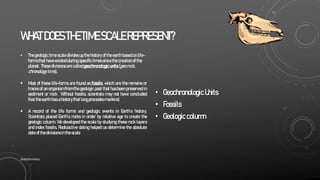
WHATDOESTHETIMESCALEREPRESENT?
• Thegeologic time scale divides up the history ofthe earth based onlife-
formsthat have existedduring specifictimes since the creation ofthe
planet. Thesedivisions are calledgeochronologicunits (geo:rock,
chronology: time).
 Most of these life-forms are found as fossils, which are the remains or
traces of an organism from the geologic past that has been preserved in
sediment or rock. Without fossils, scientists may not have concluded
that the earth has a history that longprecedesmankind.
 A record of the life forms and geologic events in Earth’s history.
Scientists placed Earth’s rocks in order by relative age to create the
geologic column. We developed the scale by studying these rock layers
and index fossils. Radioactive dating helped us determine the absolute
date ofthe divisions in the scale
• GeochronologicUnits
• Fossils
• Geologiccolumn
SlideSkimmers
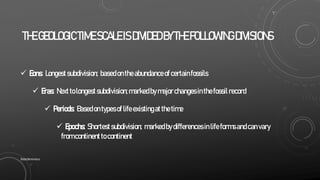
THEGEOLOGIC TIMESCALEISDIVIDEDBYTHEFOLLOWINGDIVISIONS
 Eons: Longestsubdivision; basedontheabundanceof certainfossils
 Eras: Nexttolongestsubdivision;markedbymajorchangesinthefossilrecord
 Periods: Basedontypesoflifeexistingatthetime
 Epochs: Shortestsubdivision; markedbydifferencesinlifeformsandcanvary
fromcontinenttocontinent
SlideSkimmers
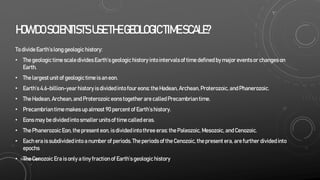
HOWDOSCIENTISTSUSETHEGEOLOGIC TIMESCALE?
To divide Earth’s long geologic history:
• The geologic time scaledividesEarth’s geologic history into intervalsof time definedby major eventsor changes on
Earth.
• The largest unitof geologic time is an eon.
• Earth’s 4.6-billion-yearhistory is dividedinto four eons: the Hadean, Archean, Proterozoic, and Phanerozoic.
• The Hadean, Archean,and Proterozoic eons together are called Precambrian time.
• Precambrian time makes up almost 90 percent of Earth’s history.
• Eons may be dividedinto smaller unitsof time called eras.
• The Phanerozoic Eon, the present eon, is dividedinto three eras: the Paleozoic, Mesozoic, and Cenozoic.
• Each era is subdividedinto a number of periods. The periods of the Cenozoic, the present era, are further dividedinto
epochs
• The Cenozoic Era is only a tiny fraction of Earth’s geologic history
SlideSkimmers
To mark major changes in the fossil record:
• Some divisionsare based entirely on the fossil record.
• At leastfive divisionsof geologic time have ended in large mass extinction events.
SlideSkimmers
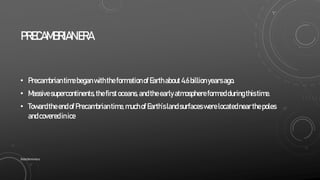
PRECAMBRIANERA
• Precambriantimebegan withtheformationofEarthabout4.6billionyearsago.
• Massivesupercontinents,thefirstoceans,andtheearlyatmosphereformedduringthistime.
• TowardtheendofPrecambriantime,muchofEarth’slandsurfaceswerelocatednearthepoles
andcoveredinice
SlideSkimmers
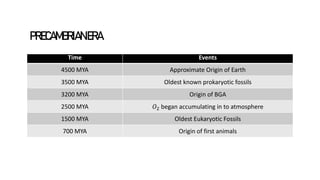
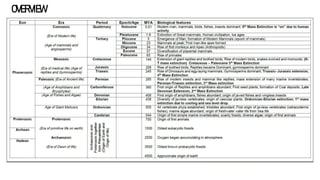
Time Events
4500 MYA Approximate Origin of Earth
3500 MYA Oldest known prokaryotic fossils
3200 MYA Origin of BGA
2500 MYA 𝑂2 began accumulating in to atmosphere
1500 MYA Oldest Eukaryotic Fossils
700 MYA Origin of first animals
PRECAMBRIANERA
SlideSkimmers
PALEOZOIC ERA
• Paleo=ancient,zoic=life
• Explosionofthelifein theoceansbeganduringthisera
• Mostof thecontinentswerecoveredinwarm,shallowareas
• Invertebrates,Fishes,Amphibiansemerged
• Earlylandplantsincludingmosses ferns andconebearingplantsoccurred
• *TheEarlycoalformingforests werealsoformedduringthistime
• *Muchof theLimestonequariedforbuildingandindustrialpurposesaswellasthecoaldepositsofWestern Europe
andeasternunitedstateswereformedduringpaleozoicera.
PaleozoicEraisdividedinto 6periods
SlideSkimmers
PALEOZOICERA
Period Time in MYA Biological Events
Cambrian 544 MYA
All the invertebrate phylums, Origin of first simple marine
invertebrate, Scanty Fossils
Origin of diverse algae
Origin of first animals
Ordovician 505 MYA
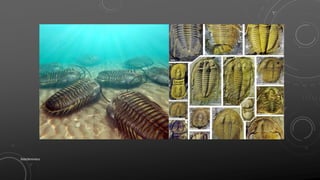
All vertebrate phyla established : Trilobites abundant. First origin of
jawless vertebrates ( Ostracoderm fishes ) . Marine algae abundant
* Origin of freshwater life from sea
Silurian 438 MYA
Diversity of jawless vertebrates . Origin of Vascular plants
# Ordovician-Silurian extinction;1st mass extinction due to cooling
sea level drop
Devonian
[Age of
Amphibians]
408 MYA
First origin of amphibians; Fishes flourished all over the world .
Origin of jawed fishes and winged insects
Carboniferous 360 MYA
Amphibians flourished, 1st origin of reptiles & seed plants :
Formation of coal deposits
# Late Devonian Extension, 2nd mass extinction
Permian 285 MYA
Rise of modern insects and radiation of repltiles
# Permian – Triassic extinction ; 3rd mass extinction
SlideSkimmers
SlideSkimmers
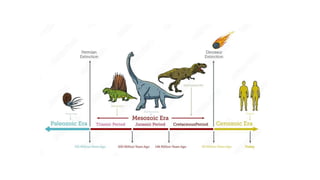
MESOZOIC ERA
• ReptilesbecamemostabundantduetotheirabilitytoadapttothedrierclimateoftheMesozoicera
• >SkinmaintainsthebodyFluids
• >EmbryosliveinShells
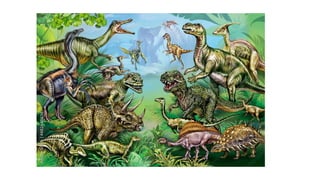
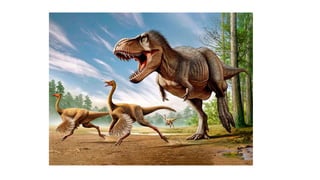
• Dinosaurswerealsoveryactiveduringthisera
• >FirstsmallDinosaursappearedinTriassicperiod,LargerandmoreabundantdinosaursappearedinJurassicperiod
• Smallmammalsandbirdsalsoappearedduringthisera.Haircoveringtheirbodies
• Thesecharacteristicshelptheminchangingenvironments
• Themainplantlifeofthistimeweregymnospermsorplantsthatproduceseedsbutnotflowers–Pinetree
• Floweringplantsappearedduringendofthisera
SlideSkimmers
SlideSkimmers
SlideSkimmers
MESOZOICERA
Period Time in MYA Biological Events
Triassic 245 MYA Rise of Dinosaurs and egg lying mammals
Gymnosperms dominated
# Triassic – Jurassic extension ,4th mass extinction
Jurassic ( Age
of Dinosaurs )
208 MYA Rise of toothed birds
Reptiles became dominant
Gymnosperms dominated
Cretaceous 144 MYA Extension of giant reptiles and toothed birds
Rise of modern birds, snakes and monocots
# ( K-T Mass extinction ) Cretaceous-Paleocene 5th Mass extinction
SlideSkimmers
SlideSkimmers
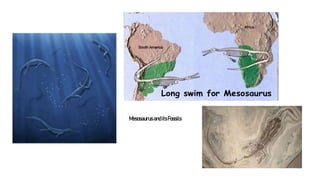
Mesosaurus andits Fossils
SlideSkimmers
MESOZOIC MASSEXTINCTION
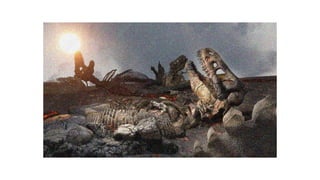
• Thiseraisendedwithmassextinctioneventabout 65MYA
• ManygroupofanimalsincludingtheDinosaursdisappearedsuddenlyatthistime
• Manyscientistsbelievethatthiseventwascausedbyacometorasteroidcollidingwithearth
 hugecloudof smokeanddustfillstheair
 Blocksoutsunlight
 PlantsDie
 Animalsthateatplantsdie
 Animalsthatplanteatinganimalsdie.
HowevernotallformsoflifediedduringthiseventManyanimalsweseetodayaredescedents fromsurvivorsofthis
extinctionevent
SlideSkimmers
SlideSkimmers
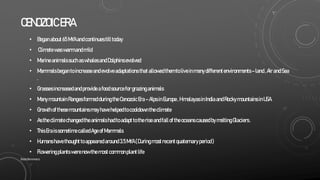
CENOZOICERA
• Beganabout 65 MYAandcontinuestilltoday
• Climatewas warmandmild
• Marineanimalssuch aswhalesand Dolphinsevolved
• Mammalsbeganto increaseandevolveadaptations that allowedthemto liveinmanydifferentenvironments –land,AirandSea
.
• Grasses increasedandprovide afood sourceforgrazinganimals
• Manymountain RangesformedduringtheCenozoicEra – AlpsinEurope,Himalayas inIndia andRockymountains inUSA
• Growth ofthesemountainsmayhavehelpedtocooldowntheclimate
• Astheclimatechangedtheanimalshadto adapt to theriseand falloftheoceanscausedbymeltingGlaciers.
• ThisErais sometimecalledAgeofMammals
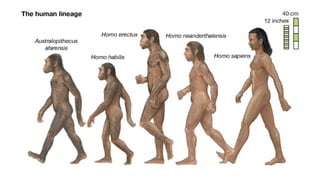
• Humanshavethoughtto appearedaround 3.5MYA( Duringmostrecentquaternaryperiod)
• Floweringplants werenowthemostcommonplant life
SlideSkimmers
SlideSkimmers
Period Epoch Time in
MYA
Biological Events
Tertiary Paleocene 65 MYA Origin of primitive primates
Eocene 57 MYA Diversification of Placental Mammals
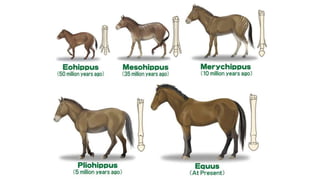
*Horse originated called as Eohippus
Oligocene 34 MYA Rise of first monkeys and Apes [ Anthropoids ]
Mesohippus
Miocene 23 MYA Mammals at peak , First man like apes formed
Merychippus
Pliocene
Epoch of mammals
5 MYA 1st Hominidae appeared i.e. emergence of man
Formation of modern mammals , Pliohippus originated
Quaternary Pleistocene 1.8 MYA Extinction of great mammals
Human civilization
Modern horse i.e Equss appeared
Holocene
Age of Man
0.01 MYA Modern man, mammals, birds, fishes, insects dominant
Man flourished all over the world
#6th Mass extionction is on due to human activity
ERAOFMODERNLIFE
SlideSkimmers
SlideSkimmers
SlideSkimmers
OVERVIEW
SlideSkimmers
MNEMONICS
SlideSkimmers
Please
Prepare
My
Chocolate Shake
ERAS
Precambrian
Palaeocene
Mesozoic
Cenozoic
SlideSkimmers
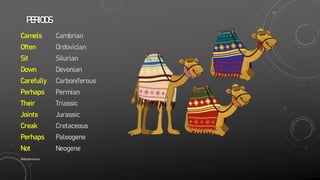
PERIODS
Camels
Often
Sit
Down
Carefully
Perhaps
Their
Joints
Creak
Perhaps
Not
Cambrian
Ordovician
Silurian
Devonian
Carboniferous
Permian
Triassic
Jurassic
Cretaceous
Paleogene
Neogene
SlideSkimmers
EPOCHS
Put
Eggs
On
My
Plate
Please
Honey
Palaeocene
Eocene
Oligocene
Miocene
Pliocene
Pleistocene
Holocene
SlideSkimmers
THEEND
SlideSkimmers
To Download This Presentation
Click on the link Geological Time Scale
OR
Visit https://slideskimmers.blogspot.com/2023/03/geological-
time-scale.html
SlideSkimmers

Geological Time Scale

  • 1.
    GEOLOGICALTIMESCALE FROM NOWHERE TOTODAY FROM NOWHERE TO TODAY FROM NOWHERE TO TODAY SlideSkimmers
  • 2.
  • 3.
    DEFINITION • Geological timescale is the tabulated form showing the sequence and duration of the eras and theperiodswiththeirdominantformsoflifesincebeginningoflifeontheearth. or TheGeologicalTimeScaleisarecordofthelifeformsandgeologicaleventsinEarth’shistory • The Duration of earth history has been divided into 6 geological time-spans called eras i.e. Azoic, Archaeozoic,Proterozoic,Paleozoic,Mesozoic,Cenozoic SlideSkimmers
  • 4.
    WHATDOESTHETIMESCALEREPRESENT? • Thegeologic timescale divides up the history ofthe earth based onlife- formsthat have existedduring specifictimes since the creation ofthe planet. Thesedivisions are calledgeochronologicunits (geo:rock, chronology: time).  Most of these life-forms are found as fossils, which are the remains or traces of an organism from the geologic past that has been preserved in sediment or rock. Without fossils, scientists may not have concluded that the earth has a history that longprecedesmankind.  A record of the life forms and geologic events in Earth’s history. Scientists placed Earth’s rocks in order by relative age to create the geologic column. We developed the scale by studying these rock layers and index fossils. Radioactive dating helped us determine the absolute date ofthe divisions in the scale • GeochronologicUnits • Fossils • Geologiccolumn SlideSkimmers
  • 5.
    THEGEOLOGIC TIMESCALEISDIVIDEDBYTHEFOLLOWINGDIVISIONS  Eons:Longestsubdivision; basedontheabundanceof certainfossils  Eras: Nexttolongestsubdivision;markedbymajorchangesinthefossilrecord  Periods: Basedontypesoflifeexistingatthetime  Epochs: Shortestsubdivision; markedbydifferencesinlifeformsandcanvary fromcontinenttocontinent SlideSkimmers
  • 6.
    HOWDOSCIENTISTSUSETHEGEOLOGIC TIMESCALE? To divideEarth’s long geologic history: • The geologic time scaledividesEarth’s geologic history into intervalsof time definedby major eventsor changes on Earth. • The largest unitof geologic time is an eon. • Earth’s 4.6-billion-yearhistory is dividedinto four eons: the Hadean, Archean, Proterozoic, and Phanerozoic. • The Hadean, Archean,and Proterozoic eons together are called Precambrian time. • Precambrian time makes up almost 90 percent of Earth’s history. • Eons may be dividedinto smaller unitsof time called eras. • The Phanerozoic Eon, the present eon, is dividedinto three eras: the Paleozoic, Mesozoic, and Cenozoic. • Each era is subdividedinto a number of periods. The periods of the Cenozoic, the present era, are further dividedinto epochs • The Cenozoic Era is only a tiny fraction of Earth’s geologic history SlideSkimmers
  • 7.
    To mark majorchanges in the fossil record: • Some divisionsare based entirely on the fossil record. • At leastfive divisionsof geologic time have ended in large mass extinction events. SlideSkimmers
  • 8.
    PRECAMBRIANERA • Precambriantimebegan withtheformationofEarthabout4.6billionyearsago. •Massivesupercontinents,thefirstoceans,andtheearlyatmosphereformedduringthistime. • TowardtheendofPrecambriantime,muchofEarth’slandsurfaceswerelocatednearthepoles andcoveredinice SlideSkimmers
  • 9.
    Time Events 4500 MYAApproximate Origin of Earth 3500 MYA Oldest known prokaryotic fossils 3200 MYA Origin of BGA 2500 MYA 𝑂2 began accumulating in to atmosphere 1500 MYA Oldest Eukaryotic Fossils 700 MYA Origin of first animals PRECAMBRIANERA SlideSkimmers
  • 10.
    PALEOZOIC ERA • Paleo=ancient,zoic=life •Explosionofthelifein theoceansbeganduringthisera • Mostof thecontinentswerecoveredinwarm,shallowareas • Invertebrates,Fishes,Amphibiansemerged • Earlylandplantsincludingmosses ferns andconebearingplantsoccurred • *TheEarlycoalformingforests werealsoformedduringthistime • *Muchof theLimestonequariedforbuildingandindustrialpurposesaswellasthecoaldepositsofWestern Europe andeasternunitedstateswereformedduringpaleozoicera. PaleozoicEraisdividedinto 6periods SlideSkimmers
  • 11.
    PALEOZOICERA Period Time inMYA Biological Events Cambrian 544 MYA All the invertebrate phylums, Origin of first simple marine invertebrate, Scanty Fossils Origin of diverse algae Origin of first animals Ordovician 505 MYA All vertebrate phyla established : Trilobites abundant. First origin of jawless vertebrates ( Ostracoderm fishes ) . Marine algae abundant * Origin of freshwater life from sea Silurian 438 MYA Diversity of jawless vertebrates . Origin of Vascular plants # Ordovician-Silurian extinction;1st mass extinction due to cooling sea level drop Devonian [Age of Amphibians] 408 MYA First origin of amphibians; Fishes flourished all over the world . Origin of jawed fishes and winged insects Carboniferous 360 MYA Amphibians flourished, 1st origin of reptiles & seed plants : Formation of coal deposits # Late Devonian Extension, 2nd mass extinction Permian 285 MYA Rise of modern insects and radiation of repltiles # Permian – Triassic extinction ; 3rd mass extinction SlideSkimmers
  • 12.
  • 13.
    MESOZOIC ERA • ReptilesbecamemostabundantduetotheirabilitytoadapttothedrierclimateoftheMesozoicera •>SkinmaintainsthebodyFluids • >EmbryosliveinShells • Dinosaurswerealsoveryactiveduringthisera • >FirstsmallDinosaursappearedinTriassicperiod,LargerandmoreabundantdinosaursappearedinJurassicperiod • Smallmammalsandbirdsalsoappearedduringthisera.Haircoveringtheirbodies • Thesecharacteristicshelptheminchangingenvironments • Themainplantlifeofthistimeweregymnospermsorplantsthatproduceseedsbutnotflowers–Pinetree • Floweringplantsappearedduringendofthisera SlideSkimmers
  • 14.
  • 15.
  • 16.
    MESOZOICERA Period Time inMYA Biological Events Triassic 245 MYA Rise of Dinosaurs and egg lying mammals Gymnosperms dominated # Triassic – Jurassic extension ,4th mass extinction Jurassic ( Age of Dinosaurs ) 208 MYA Rise of toothed birds Reptiles became dominant Gymnosperms dominated Cretaceous 144 MYA Extension of giant reptiles and toothed birds Rise of modern birds, snakes and monocots # ( K-T Mass extinction ) Cretaceous-Paleocene 5th Mass extinction SlideSkimmers
  • 17.
  • 18.
  • 19.
    MESOZOIC MASSEXTINCTION • Thiseraisendedwithmassextinctioneventabout65MYA • ManygroupofanimalsincludingtheDinosaursdisappearedsuddenlyatthistime • Manyscientistsbelievethatthiseventwascausedbyacometorasteroidcollidingwithearth  hugecloudof smokeanddustfillstheair  Blocksoutsunlight  PlantsDie  Animalsthateatplantsdie  Animalsthatplanteatinganimalsdie. HowevernotallformsoflifediedduringthiseventManyanimalsweseetodayaredescedents fromsurvivorsofthis extinctionevent SlideSkimmers
  • 20.
  • 21.
    CENOZOICERA • Beganabout 65MYAandcontinuestilltoday • Climatewas warmandmild • Marineanimalssuch aswhalesand Dolphinsevolved • Mammalsbeganto increaseandevolveadaptations that allowedthemto liveinmanydifferentenvironments –land,AirandSea . • Grasses increasedandprovide afood sourceforgrazinganimals • Manymountain RangesformedduringtheCenozoicEra – AlpsinEurope,Himalayas inIndia andRockymountains inUSA • Growth ofthesemountainsmayhavehelpedtocooldowntheclimate • Astheclimatechangedtheanimalshadto adapt to theriseand falloftheoceanscausedbymeltingGlaciers. • ThisErais sometimecalledAgeofMammals • Humanshavethoughtto appearedaround 3.5MYA( Duringmostrecentquaternaryperiod) • Floweringplants werenowthemostcommonplant life SlideSkimmers
  • 22.
  • 23.
    Period Epoch Timein MYA Biological Events Tertiary Paleocene 65 MYA Origin of primitive primates Eocene 57 MYA Diversification of Placental Mammals *Horse originated called as Eohippus Oligocene 34 MYA Rise of first monkeys and Apes [ Anthropoids ] Mesohippus Miocene 23 MYA Mammals at peak , First man like apes formed Merychippus Pliocene Epoch of mammals 5 MYA 1st Hominidae appeared i.e. emergence of man Formation of modern mammals , Pliohippus originated Quaternary Pleistocene 1.8 MYA Extinction of great mammals Human civilization Modern horse i.e Equss appeared Holocene Age of Man 0.01 MYA Modern man, mammals, birds, fishes, insects dominant Man flourished all over the world #6th Mass extionction is on due to human activity ERAOFMODERNLIFE SlideSkimmers
  • 24.
  • 25.
  • 26.
  • 27.
  • 28.
  • 29.
  • 30.
  • 31.
  • 32.
    To Download ThisPresentation Click on the link Geological Time Scale OR Visit https://slideskimmers.blogspot.com/2023/03/geological- time-scale.html SlideSkimmers