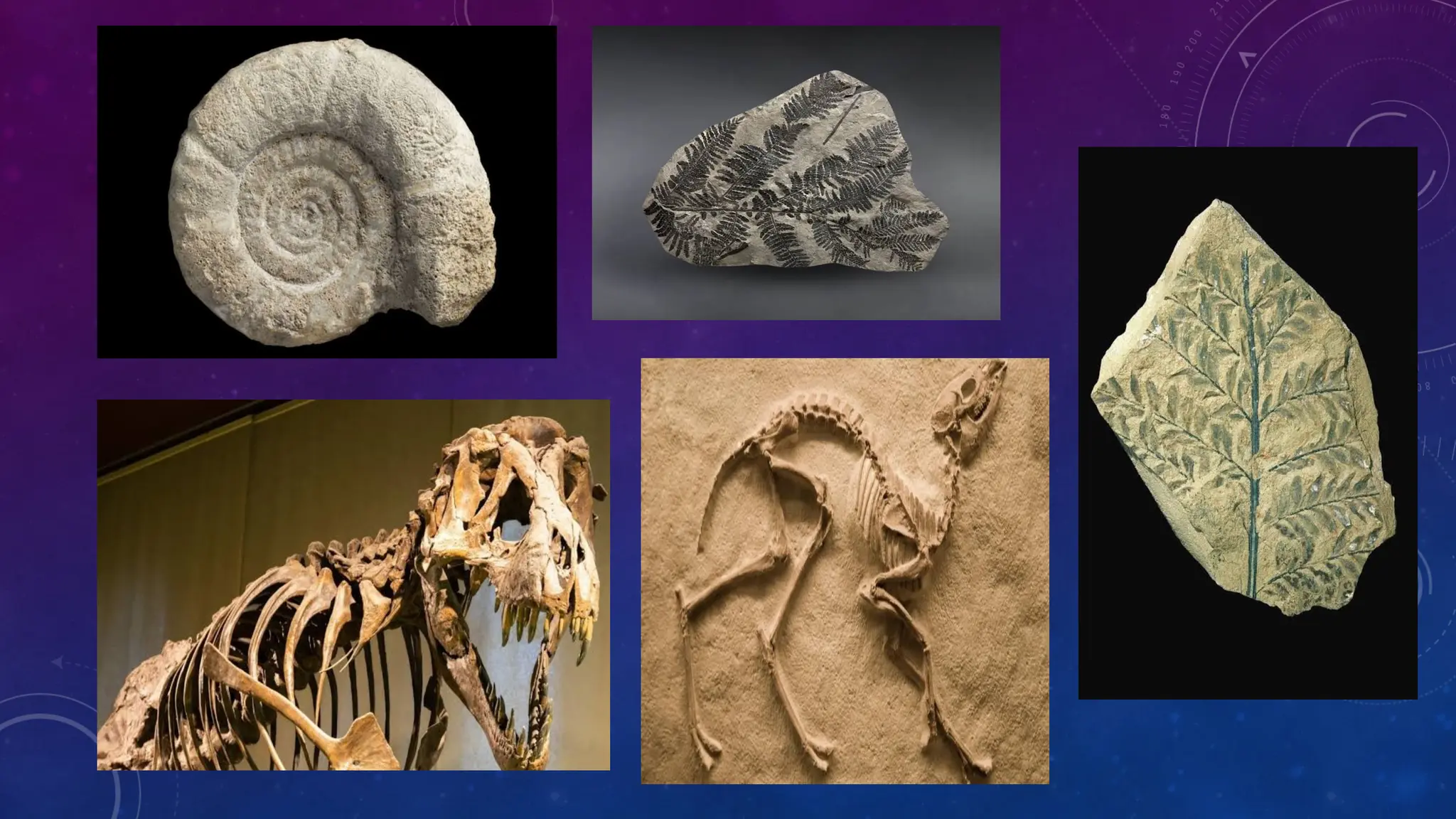
FOSSILS
• Fossils arethe preserved remains or
traces of plants, animals, and other
organisms from the distant past.
4.
FOSSILS
• Aside fromrocks, geologist also use the remains of
living organisms in understanding Earth’s history.
• These remains are typically found in rocks
formations and can include bones shells, teeth,
footprints and even impression of leaves.
• Provides valuable insights in the history of life on
earth and the environment of the past periods.
5.
2 TYPES OFFOSSILS:
Body fossils – preserved parts of the organisms
itself such as bones, teeth, shells, leaves.
Trace fossils – evidence of an organism’s activity
and not the organisms itself.
6.
INDEX FOSSILS
• Anyanimal or plant preserved in the rock
record of the earth characteristics of a
particular span of geological Time of
environment.
7.
GEOLOGIC TIME SCALE:
•Is a systematic system which organizes Earth’s
history into named units of time, based on
geological and paleontological events. It’s a
chronological framework used by scientists to
understand the timing and relationship of
events in Earth’s past.
8.
EONS:
• The largestdivisions of geologic time , 2 main eons
in the history that is Phanerozoic and Precambrian
eon.
PHANEROZOIC:
• Divided to 3 eras Paleozoic, Mesozoic and Cenozoic.
PRECAMBRIAN:
• Divided to 3 eons- Hadean, Archean and
Proterozoic eons.
9.
• Eras aredivided into periods which are
characterized by e less profound change in life
forms.
• Periods are made up of few epochs, epochs is
the smallest unit in the geologic time scale.
10.
• Mass Extinction
Thesemass extinction can happen when
there are changes in the global climate or ocean
currents, or when there are sudden events such
as a large volcanic eruption or a meteorite
impact.
11.
The three erasunder Phanerozoic eon:
•Paleozoic era (the era of old life)
•Mesozoic era (the age of reptiles)
•Cenozoic era (the age of mammals)
12.
PALEOZOIC ERA: ERAOF OLD LIFE
• Paleozoic era literally means “era of old life” where the word
Paleo means “old” And zoic means “life”. It lasted from 542 Ma to
251 Ma. It is further divided into 7 periods the:
• Combrian • Mississippi
• Ordovician • Pennsylvania
• Silurian • Permian
• Devonian
13.
The Cambrian andOrdovician periods are part
of what has been known as the “age of
invertebrates” such as trilobites and
cephalopods, were dominant in the ocean.
14.
The Silurian andDevonian periods became the
“age of fishes”, since fishes became dominant
creatures of the sea, most of the organisms
were found in the oceans until the Silurian
period, when scorpion and millipedes appeared
on land.
15.
The Mississippian andPennsylvanian periods also
know a carboniferous period) where earth had the
highest concentration of atmospheric oxygen. It also
had large coal swamps since plants that live and die
easily eventually turned into coal.
16.
Mesozoic Era: Theage of reptiles
This era spans from about 251 to 65.5 Mya. It’s divided
into Triassic, Jurassic, and cretaceous. Reptiles are
dominant organisms.
During the cretaceous period, existing birds, mammals
and flowering plants diversified and the end of the
mesozoic era was marked by the mass exstinction of the
huge land dwelling dinosaurs and few reptiles survived.
17.
• The majorgeologic event in the mesozoic era is
the break-up of Pangaea and the formation of the
modern ocean basins.
18.
• Cenozoic Era:the era of recent life
This era started from 65.5 Ma to the present.
The Cenozoic era represents only a small
portion of the geologic time. During this era,
features of the modern world came into
existence. This era has the most extensive
records since rock formation are less disturbed
compared to the other eras.