IMPRESSION MATERIALS
PART - 2
Dr. shiva sai
Based on
mechanical
properties
Elastic
Nonelastic or
rigid
soft tissue
Mucostatic
Mucocompressive
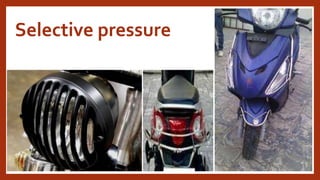
Selective
pressure
nature of
hardening
physical change
chemical change
Viscosity
High viscosity
Medium viscosity
Low viscosity
Dispensing
system
Cakes, cylinders,
sticks, and cones
Powder
Two-paste system
Three-paste
system
Single paste
system
clinical
applications
Preliminary
Secondary
Mucocompressive
Mucostatic
Selective pressure
Classification of impression materials
setting
mechanism
Inelasticity elasticity
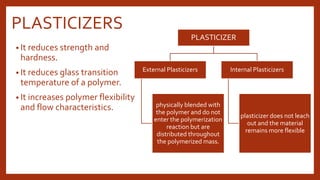
PLASTICIZERS
• It reduces strength and
hardness.
• It reduces glass transition
temperature of a polymer.
• It increases polymer flexibility
and flow characteristics.
PLASTICIZER
External Plasticizers
physically blended with
the polymer and do not
enter the polymerization
reaction but are
distributed throughout
the polymerized mass.
Internal Plasticizers
plasticizer does not leach
out and the material
remains more flexible
FILLERAND
PLASTICIZER
Filler = increases
strength and hardness
Filler = ground nuts
Plasticizer = jaggery
filler α 1/plasticizer
Rigid impression materials
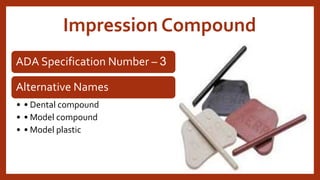
Impression Compound
ADA Specification Number – 3
Alternative Names
• • Dental compound
• • Model compound
• • Model plastic
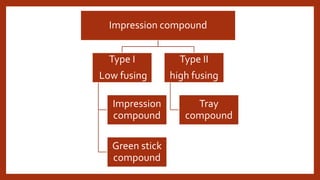
Impression compound
Type I
Low fusing
Impression
compound
Green stick
compound
Type II
high fusing
Tray
compound
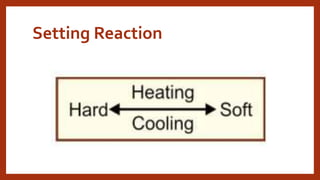
Setting Reaction
Properties
•Biological Properties
•Rheological Properties
•Thermal Properties
•Mechanical Properties
Manipulation
Softening
• 55°C–60°C
Kneading
• to obtain uniform plasticity
Loading
• Placing in impression tray
Tempering
• Immersing in hot and cold water
Making impression
• cools to mouth temperature
Softening
• 55°C–60°C
Kneading
• to obtain uniform plasticity
Loading
• Placing in impression tray
Tempering
• Immersing in hot and cold water
Making impression
• cools to mouth temperature
Advantages
• compressing soft tissues.
• close peripheral seal.
• Can be used in combination with other
materials.
• added and readopted.
• Relatively cheap.
Disadvantages
• Distorts easily and should not be used
when undercuts exist.
• Does not reproduce fine surface detail.
• Can only give an accurate impression
• unhygienic since it cannot be sterilised
• large COTE and low thermal
conductivity
Uses
• Used for recording preliminary
impressions of edentulous arches
for the construction of special
trays
Green Stick Compound
•ADA - 3
•The composition of green stick compound is
almost similar to that of impression compound
with more plasticizers. It is softened by waving
over a gas flame and kneaded (dry kneading).
Copper RingTechnique orTube ImpressionTechnique
Uses
• It is used for border extensions of special trays (border
molding technique).
•To obtain an impression of single tooth preparations
using copper band.
• Peripheral seal material
Tray Compound
• ADA-3
• They are similar in composition and working
qualities to the impression compound except that
the temperature at which they soften, i.e. higher
(70° C) and the property of flow at mouth
temperature is minimal (less than 2%).
USES
• used to prepare custom made preliminary impression (special
tray) that will later hold a second impression material, which will
record final impression (secondary impression).
• NOTE:-
• Tray compounds lack strength and dimensional stability; hence
they have been replaced to a large extent by trays made from
self-cure acrylic resins.
Zinc Oxide Eugenol Impression Paste
• ADA Specification Number: 16
Types
Type I – Hard Type II – Soft
Dispensing
• Usually supplied as two pastes in
collapsible metal tubes .Tube-1 is
base (white in color) and tube-2 is
reactor (red in color).They are also
available in powder (ZnO) and liquid
(Eugenol) system
COMPOSITION
Setting reaction
Autocatalyzation
• On mixing the two pastes, a reaction between zinc and eugenol
begins.The basis of the reaction is that the phenolic – OH groups
of eugenol acts as a weak acid and undergoes an acid-base
reaction with ZnO to form a salt, “zinc eugenolate”.
• it can be seen that ionic salt bonds are formed between zinc and
phenolic oxygen of each molecule of eugenol.Two further
coordination bonds formed by donation of a pair of electrons
form methoxyoxygen to zinc.
• Water is needed to initiate the reaction and it is also a byproduct
of the reaction.This type of reaction is often called “auto
catalyzation”.
Acid - base reaction
Setting Time
Initial Setting Time
Type – 1
3-6 min
Type – 2
3-6 min
Final Setting Time
Type – 1
10 min
Type – 2
15 min
Kreb’s Penetrometer
Factors affecting setting time
Advantages
1.Accurate & stable dimensionally.
2.They adhere well to dried surfaces
of compound, resin and shellac bases
3.Inexpensive
4.Easy to manipulate
5.No requirement of separating
medium
Disadvantages
1.It cannot be used when a undercut
exists.
2.Requires special tray
3.unpleasant (may cause burning
sensation or irritation to the oral tissues).
4.Instruments are difficult to clean.
secondary or corrective wash
impressions of edentulous
arches.
Temporary relining material
and remodeling material.
Uses
Modifications
• Surgical Paste
• Bite Registration Paste
• Noneugenol Pastes
• zinc oxide is reacted with
carboxylic acid (Orthoethoxy
benzoic acid)
Thank you
Drshivasai
Scan for PPT
MIND MAPPING
Rigid impression materials
Impression
compound
Green stick Zoe
• Ada specification no
• Filler
• plasticizer
• Dispensing
• composition
• Manipulation
• Factors effecting
setting time
• Properties
• Classification
• Chemical reaction
• Advantages
• Disadvantages
• Uses
• modifications

Impression materials 2.pptx

  • 1.
  • 2.
    Based on mechanical properties Elastic Nonelastic or rigid softtissue Mucostatic Mucocompressive Selective pressure nature of hardening physical change chemical change Viscosity High viscosity Medium viscosity Low viscosity Dispensing system Cakes, cylinders, sticks, and cones Powder Two-paste system Three-paste system Single paste system clinical applications Preliminary Secondary
  • 3.
  • 4.
  • 5.
  • 6.
    Classification of impressionmaterials setting mechanism Inelasticity elasticity
  • 7.
    PLASTICIZERS • It reducesstrength and hardness. • It reduces glass transition temperature of a polymer. • It increases polymer flexibility and flow characteristics. PLASTICIZER External Plasticizers physically blended with the polymer and do not enter the polymerization reaction but are distributed throughout the polymerized mass. Internal Plasticizers plasticizer does not leach out and the material remains more flexible
  • 8.
    FILLERAND PLASTICIZER Filler = increases strengthand hardness Filler = ground nuts Plasticizer = jaggery filler α 1/plasticizer
  • 9.
  • 10.
    Impression Compound ADA SpecificationNumber – 3 Alternative Names • • Dental compound • • Model compound • • Model plastic
  • 12.
    Impression compound Type I Lowfusing Impression compound Green stick compound Type II high fusing Tray compound
  • 13.
  • 14.
  • 15.
    Manipulation Softening • 55°C–60°C Kneading • toobtain uniform plasticity Loading • Placing in impression tray Tempering • Immersing in hot and cold water Making impression • cools to mouth temperature
  • 16.
    Softening • 55°C–60°C Kneading • toobtain uniform plasticity Loading • Placing in impression tray Tempering • Immersing in hot and cold water Making impression • cools to mouth temperature
  • 17.
    Advantages • compressing softtissues. • close peripheral seal. • Can be used in combination with other materials. • added and readopted. • Relatively cheap. Disadvantages • Distorts easily and should not be used when undercuts exist. • Does not reproduce fine surface detail. • Can only give an accurate impression • unhygienic since it cannot be sterilised • large COTE and low thermal conductivity
  • 18.
    Uses • Used forrecording preliminary impressions of edentulous arches for the construction of special trays
  • 19.
    Green Stick Compound •ADA- 3 •The composition of green stick compound is almost similar to that of impression compound with more plasticizers. It is softened by waving over a gas flame and kneaded (dry kneading).
  • 21.
    Copper RingTechnique orTubeImpressionTechnique
  • 22.
    Uses • It isused for border extensions of special trays (border molding technique). •To obtain an impression of single tooth preparations using copper band. • Peripheral seal material
  • 23.
    Tray Compound • ADA-3 •They are similar in composition and working qualities to the impression compound except that the temperature at which they soften, i.e. higher (70° C) and the property of flow at mouth temperature is minimal (less than 2%).
  • 24.
    USES • used toprepare custom made preliminary impression (special tray) that will later hold a second impression material, which will record final impression (secondary impression). • NOTE:- • Tray compounds lack strength and dimensional stability; hence they have been replaced to a large extent by trays made from self-cure acrylic resins.
  • 25.
    Zinc Oxide EugenolImpression Paste • ADA Specification Number: 16 Types Type I – Hard Type II – Soft
  • 26.
    Dispensing • Usually suppliedas two pastes in collapsible metal tubes .Tube-1 is base (white in color) and tube-2 is reactor (red in color).They are also available in powder (ZnO) and liquid (Eugenol) system
  • 27.
  • 29.
  • 30.
  • 31.
    • On mixingthe two pastes, a reaction between zinc and eugenol begins.The basis of the reaction is that the phenolic – OH groups of eugenol acts as a weak acid and undergoes an acid-base reaction with ZnO to form a salt, “zinc eugenolate”. • it can be seen that ionic salt bonds are formed between zinc and phenolic oxygen of each molecule of eugenol.Two further coordination bonds formed by donation of a pair of electrons form methoxyoxygen to zinc. • Water is needed to initiate the reaction and it is also a byproduct of the reaction.This type of reaction is often called “auto catalyzation”.
  • 32.
    Acid - basereaction
  • 33.
    Setting Time Initial SettingTime Type – 1 3-6 min Type – 2 3-6 min Final Setting Time Type – 1 10 min Type – 2 15 min
  • 34.
  • 35.
  • 36.
    Advantages 1.Accurate & stabledimensionally. 2.They adhere well to dried surfaces of compound, resin and shellac bases 3.Inexpensive 4.Easy to manipulate 5.No requirement of separating medium Disadvantages 1.It cannot be used when a undercut exists. 2.Requires special tray 3.unpleasant (may cause burning sensation or irritation to the oral tissues). 4.Instruments are difficult to clean.
  • 37.
    secondary or correctivewash impressions of edentulous arches. Temporary relining material and remodeling material. Uses
  • 38.
    Modifications • Surgical Paste •Bite Registration Paste • Noneugenol Pastes • zinc oxide is reacted with carboxylic acid (Orthoethoxy benzoic acid)
  • 39.
  • 40.
  • 41.
  • 42.
    Rigid impression materials Impression compound Greenstick Zoe • Ada specification no • Filler • plasticizer • Dispensing • composition • Manipulation • Factors effecting setting time • Properties • Classification • Chemical reaction • Advantages • Disadvantages • Uses • modifications