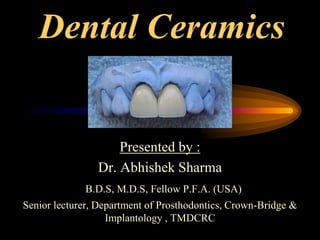
Dental Ceramics
Presented by :
Dr. Abhishek Sharma
B.D.S, M.D.S, Fellow P.F.A. (USA)
Senior lecturer, Department of Prosthodontics, Crown-Bridge &
Implantology , TMDCRC
CONTENTS
• INTRODUCTION
• HISTORICAL PERSPECTIVE
• CLASSIFICATION
• COMPOSITION
• PROPERTIES OF DENTAL PORCELAIN
• CONDENSATION OF DENTAL
PORCELAIN
• METHODS OF STRENGTHENING
2
3
• ALL CERAMIC SYSTEMS
• METAL CERAMIC SYSTEMS
• ADVANCES IN DENTAL CERAMICS
• CONCLUSION
• REFERENCES
CONTENTS CONTD..
INTRODUCTION
4
• Esthetics in dentistry is defined by patient’s desire
for naturality and beauty.
• The development of ceramic materials has helped
the dentist to translate the patient’s wishes to
reality by providing the ideal restorations.
• Word ‘ceramic’ derived from the Greek word
‘keramos’ means ‘pottery’ or ‘burnt stuff ’.
5
A ceramic is therefore an earthy
material usually of a silicate nature
and may be defined as “a
combination of one or more metals
with a non- metallic element, usually
oxygen”
DEFINITION
Historical Perspective
• Fabrication of ceramic articles dates back to
23,000 yrs B.C.
• Alex Duchateau was the first person to
introduce porcelain as a material in
dentistry as a denture paste.
• Nicolas Dubois de Chemant and Alexis
Duchateau teamed up to form “mineral
paste”
• Giuseppangelo Fonzi, 1808 formed the first
porcelain tooth. 6
• Porcelain fused to thin platinum foil :
CHARLES H. LAND
7
CLASSIFICATION
• According to type: -
• Feldspathic porcelain
• Leucite-reinforced porcelain
• Aluminous porcelain
• Glass infiltrated alumina
• Glass infiltrated spinel
• Glass ceramic
8
• According to use:
• Denture teeth
• Metal ceramic restorations
• Veneers
• Inlays/Onlays
• Crowns and anterior bridges
• According to method of processing:
• Sintering
• Casting
• Machining 9
10
• According to firing temperature:
• High fusing -1300oC(2372oF)
• Medium fusing-1101-1300oc(2013-2072oF)
• Low fusing-850-1100oc(1562-2012oF)
• Ultra low fusing-<850oc(1562oF)
medium fusing and high fusing : PORCELAIN
DENTURE TEETH
low fusing and ultra low fusing porcelains : for
crown and bridge construction
11
• According to application:
• Core porcelain: is the basis of porcelain jacket
crown, must have good mechanical properties.
• Dentin or Body porcelain: more translucent
than core porcelain, largely governs the shape
and color of restoration.
• Enamel porcelain: is used in areas requiring
maximum translucency, for example- at the
incisal edge.
12
• According to Phillips’ science of dental
materials:
• Silicate ceramics - Dental porcelains with SiO2
(amorphous glass phase) as the main
component and additions of crystalline Al2O3,
MgO, ZrO2 and other oxides are included in
this category.
• Oxide ceramics - contains a principal
crystalline phase of Al2O3 MgO, ThO2 or ZrO2
with either no or a small amount of glass phase.
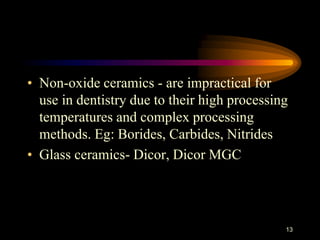
• Non-oxide ceramics - are impractical for
use in dentistry due to their high processing
temperatures and complex processing
methods. Eg: Borides, Carbides, Nitrides
• Glass ceramics- Dicor, Dicor MGC
13
14
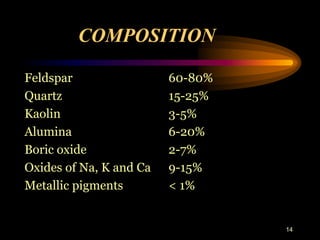
COMPOSITION
Feldspar
Quartz
Kaolin
Alumina
Boric oxide
Oxides of Na, K and Ca
Metallic pigments
60-80%
15-25%
3-5%
6-20%
2-7%
9-15%
< 1%
Components
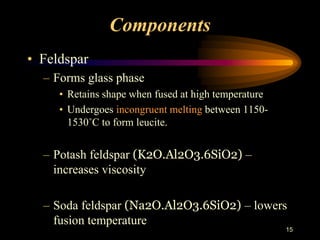
• Feldspar
– Forms glass phase
• Retains shape when fused at high temperature
• Undergoes incongruent melting between 1150-
1530˚C to form leucite.
– Potash feldspar (K2O.Al2O3.6SiO2) –
increases viscosity
– Soda feldspar (Na2O.Al2O3.6SiO2) – lowers
fusion temperature
15
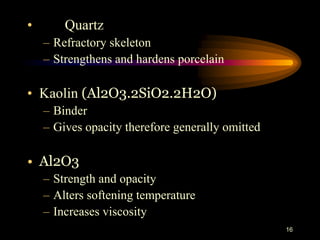
• Quartz
– Refractory skeleton
– Strengthens and hardens porcelain
• Kaolin (Al2O3.2SiO2.2H2O)
– Binder
– Gives opacity therefore generally omitted
• Al2O3
– Strength and opacity
– Alters softening temperature
– Increases viscosity
16
17
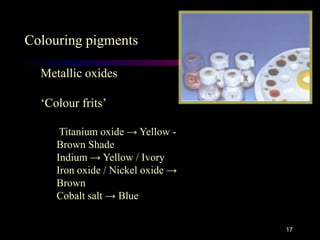
Colouring pigments
Metallic oxides
‘Colour frits’
Titanium oxide → Yellow -
Brown Shade
Indium → Yellow / Ivory
Iron oxide / Nickel oxide →
Brown
Cobalt salt → Blue
18
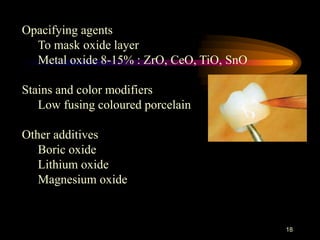
Opacifying agents
To mask oxide layer
Metal oxide 8-15% : ZrO, CeO, TiO, SnO
Stains and color modifiers
Low fusing coloured porcelain
Other additives
Boric oxide
Lithium oxide
Magnesium oxide
19
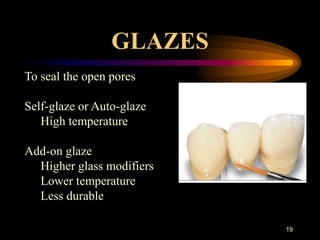
To seal the open pores
Self-glaze or Auto-glaze
High temperature
Add-on glaze
Higher glass modifiers
Lower temperature
Less durable
GLAZES
Properties of Dental Ceramics
• Biocompatibility
• Esthetics
– Colour and Translucency
– Long term colour stability
• Durability
– Wear resistant
– No Solubility
• Ability to be formed into precise
shapes 20
A
D
V
A
N
T
A
G
E
S
• Brittle
• High shrinkage of conventional
porcelains
• Technique sensitive
• Specialized training required
• Costly equipment
• More tooth reduction
• Attrition of opposing tooth
• Difficult to repair
• Expensive
21
D
I
S
A
D
V
A
N
T
A
G
E
S
PROCESSING OF DENTAL CERAMICS
• The processing of dental ceramics is done in
three stages :
a.) CONDENSATION
b.) FIRING
c.) GLAZING
22
CONDENSATION
• The process of packing the particles together and of
removing the liquid binder is known as condensation.
• The main driving force involved in condensing dental
porcelain is surface tension.
• Liquid
– Distilled water
– Propylene glycol
– Alcohol
– Special liquid
23
Methods of condensation
• Wet brush technique/ Brush additive
technique ( most commonly used )
• Brush application method
• Vibration
• Spatulation
• Whipping
• Mechanical
• Ultrasonic vibration
24
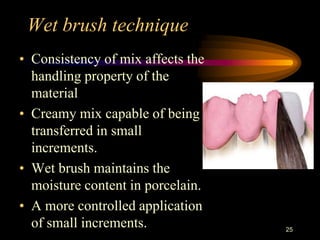
Wet brush technique
• Consistency of mix affects the
handling property of the
material
• Creamy mix capable of being
transferred in small
increments.
• Wet brush maintains the
moisture content in porcelain.
• A more controlled application
of small increments. 25
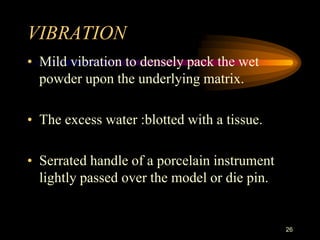
VIBRATION
• Mild vibration to densely pack the wet
powder upon the underlying matrix.
• The excess water :blotted with a tissue.
• Serrated handle of a porcelain instrument
lightly passed over the model or die pin.
26
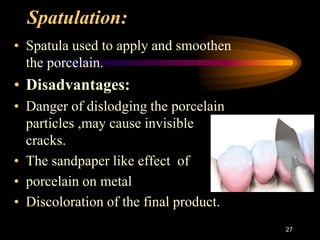
Spatulation:
• Spatula used to apply and smoothen
the porcelain.
• Disadvantages:
• Danger of dislodging the porcelain
particles ,may cause invisible
cracks.
• The sandpaper like effect of
• porcelain on metal
• Discoloration of the final product.
27
Whipping
• A large soft brush moved in light dusting action over the
wet porcelain
• Brings excess water to the surface,
• Same brush can be used to remove any coarse surface
particles along with excess water.
• Combination of vibration and the whipping.
Disadvantage:
• This method works best with fine grain,
• Excess manipulation could allows these fine particles to
float away with
• liquid during blotting.
28
29
SINTERING / FIRING
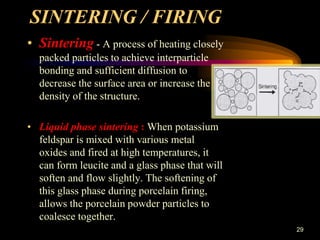
• Sintering - A process of heating closely
packed particles to achieve interparticle
bonding and sufficient diffusion to
decrease the surface area or increase the
density of the structure.
• Liquid phase sintering : When potassium
feldspar is mixed with various metal
oxides and fired at high temperatures, it
can form leucite and a glass phase that will
soften and flow slightly. The softening of
this glass phase during porcelain firing,
allows the porcelain powder particles to
coalesce together.
TYPES OF FIRING
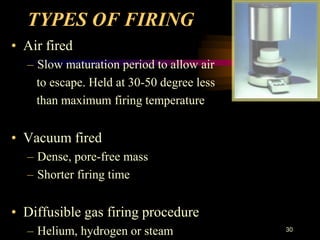
• Air fired
– Slow maturation period to allow air
to escape. Held at 30-50 degree less
than maximum firing temperature
• Vacuum fired
– Dense, pore-free mass
– Shorter firing time
• Diffusible gas firing procedure
– Helium, hydrogen or steam 30
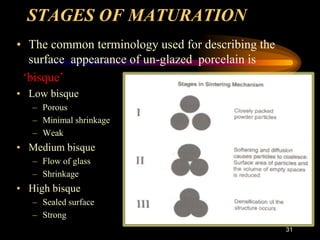
STAGES OF MATURATION
• The common terminology used for describing the
surface appearance of un-glazed porcelain is
‘bisque’
• Low bisque
– Porous
– Minimal shrinkage
– Weak
• Medium bisque
– Flow of glass
– Shrinkage
• High bisque
– Sealed surface
– Strong
31
Methods of strengthening ceramics
• Methods used to overcome the deficiencies of ceramics
like brittleness, low fracture toughness and low tensile
strength, fall into two general categories:-
• Strengthening of the brittle material
– Development of residual compressive stresses
within the surface of the material.
– Interruption of crack propagation through the
material.
• Methods of designing components to minimize
stress concentrations and tensile stresses 32
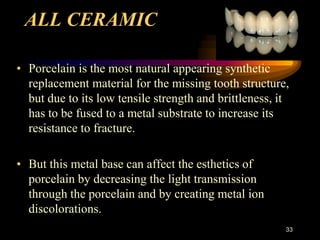
ALL CERAMIC
• Porcelain is the most natural appearing synthetic
replacement material for the missing tooth structure,
but due to its low tensile strength and brittleness, it
has to be fused to a metal substrate to increase its
resistance to fracture.
• But this metal base can affect the esthetics of
porcelain by decreasing the light transmission
through the porcelain and by creating metal ion
discolorations.
33
CLASSIFICATION OF ALL CERAMICS
• 1) Conventional powder- slurry ceramics:-
* Hi ceram – Alumina reinforced porcelain.
* Optec HSP – Leucite reinforced porcelain.
• 2) Computer - aided design/computer-aided
milling (CAD/CAM):-
* Cerec
• 4) CAD/CAM with aluminium oxide coping:-
* Procera
34
• 5) Castable ceramics:-
* Dicor
• 6) Infiltrated ceramics:-
* In-Ceram
• Pressable ceramics :-
* IPS empress
* Optec pressable ceramic
• 8) Machinable ceramics:-
* Cerec vitablocks
* Celay blocks
* Dicor MGC 35
FEATURES OF NEWER ALL-
CERAMIC MATERIALS
• Stronger materials that involve better fabricating
techniques.
• Can be etched and bonded to the underlying
tooth structure with newer dentin adhesives.
• Greater tooth reduction than what was previously
used for PJC’s is carried out
36
CONVENTIONAL POWDER SLURRY
CERAMICS
• Processing: Sintering
• Aluminous porcelain crowns (PJCs)
– Mc Lean and Hughes (1965)
– E.g. Hi-ceram, Vitadur N
– Made with platinum foil backing which is later
removed
– Advantages:
• Better esthetics
– Disadvantages:
• Inadequate strength for posterior teeth
37
• Optec HSP
– Feldspathic composition glass filled with
crystalline leucite
– Leucite reinforced porcelain – 50.6%wt
– Increased strength
– Uses
• Inlays
• Onlays
• Anterior crowns
• Veneers
38
– Advantages
• More translucent than alumina core crowns.
• Good flexural strength – 146Mpa.
• No special processing equipment
• Lack of metal or opaque substructure.
• Can be etched
– Disadvantages
• High chances of wearing of opposing teeth
• Potential to fracture in posterior teeth.
• Requires a special die material.
39
Castable Ceramic Systems
• Processing: casting through lost wax technique
• DICOR
– Adair and Grossman 1984
– Glass ceramic: a ceramic consisting of a glass matrix
phase and at least one crystal phase that is produced by
the controlled crystallization of the glass.
– Casting at 1350˚C, heat treatment at 1075˚C for 10 hrs.
• Ceramming: heat treatment that causes microscopic plate
like crystals of crystalline material (mica) to grow within
the glass matrix.
40
–Advantages:
• Increased strength and toughness
• Good marginal adaptation (30-60 m)
• Ease of fabrication
• Improved esthetics – Chameleon effect
• Minimal processing shrinkage
• Low thermal expansion
• Minimal abrasiveness to tooth structure
Disadvantages
• Inability to be coloured internally
• Grinding of restoration may leave white area
• Technique sensitive 41
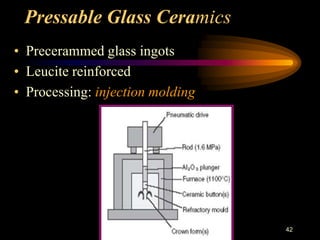
Pressable Glass Ceramics
• Precerammed glass ingots
• Leucite reinforced
• Processing: injection molding
42
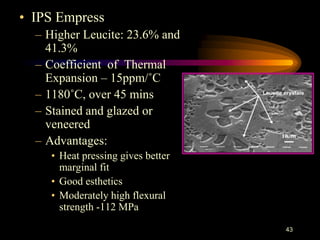
• IPS Empress
– Higher Leucite: 23.6% and
41.3%
– Coefficient of Thermal
Expansion – 15ppm/˚C
– 1180˚C, over 45 mins
– Stained and glazed or
veneered
– Advantages:
• Heat pressing gives better
marginal fit
• Good esthetics
• Moderately high flexural
strength -112 MPa
43
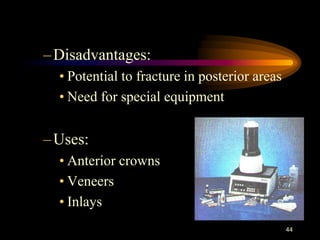
–Disadvantages:
• Potential to fracture in posterior areas
• Need for special equipment
–Uses:
• Anterior crowns
• Veneers
• Inlays
44
• Optec OPC (Optimal Press able Ceramic)
– Leucite reinforced
– 1150˚C
– Advantages:
• Good flexural strength
• Translucent and dense
• Can be etched and bonded to natural tooth.
– Disadvantages:
• Increased abrasiveness
• Special equipment required
45
Infiltrated Ceramics
Sadoun 1989
• In-Ceram Alumina
• In-Ceram Spinell
• In-Ceram Zirconia
Successor system of Hi-ceram, differing from
this system by having sufficiently lower grain
size of aluminum oxide and thereby greater
density.
46
• Processing: slip casting
“The core is made from fine grained particles
that are mixed with water to from a
suspension referred to as a ‘slip’, is painted
on a gypsum die (absorbent refractory die).
The die draws water from the slurry under
capillary pressure thereby depositing a layer
of solid alumina on the surface, which is
subsequently sintered/baked at 1120oc for
10hrs to produce an opaque porous core. This
process is called ‘slip casting’
47
• Firing at 1120˚C for 10 hrs
• Porous substructure infiltrated with
molten sodium lanthanum glass
(1120˚C for 4 hrs.)
– Increases strength
– Reduces porosity of final structure
– Increases refractive index
48
• Uses:-
- Single anterior and posterior crowns.
- Anterior 3 - unit bridges.
- Implant supported bridges (recently).
• Advantages:-
a) Lack of metal substructure.
b) It has extremely high flexural strength -
450Mpa strongest all ceramic dental restorations
presently available.
c) Excellent fit, as little shrinkage occurs due to
sufficient time at optimum temperature, which
causes bonding between particles at small areas.
49
• Disadvantages:-
Opacity of the material and hence can be
used only as a core.
a) Unsuitable for conventional acid -
etching.
b) Special die material and high temperature
oven is required.
c) Wear of opposing occluding enamel or
dentin occurs if the In ceram restoration is a
part of heavy incisal guidance or canine
rise.
50
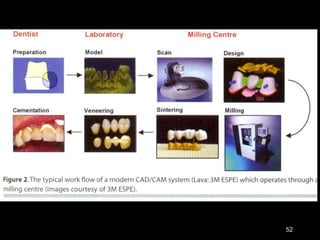
CAD-CAM Ceramics
• Processing: Computer Aided Designing –
Computer Aided Manufacturing.
• 3 parts:
– Camera or Scanner to take picture of the preparation
– Computer to design the prosthesis
– Milling machine
51
52
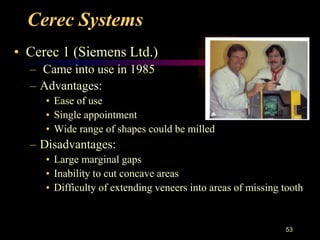
Cerec Systems
• Cerec 1 (Siemens Ltd.)
– Came into use in 1985
– Advantages:
• Ease of use
• Single appointment
• Wide range of shapes could be milled
– Disadvantages:
• Large marginal gaps
• Inability to cut concave areas
• Difficulty of extending veneers into areas of missing tooth
53
Cerec 2 System
• Came into use in 1994.
• Benefits of Cerec 2 system:-
1) Benefits for the patients:-
-Esthetic and cosmetic restoration
-Best material properties in dental ceramics.
-Biocompatible.
-Cost-effective.
-Quick turn around time (1 day laboratory
time)
54
-Perfect occlusion.
-High marginal integrity.
-No metal in mouth.
• 2) Benefits for the dentist:-
- Economic production in the laboratory.
- Increased precision.
- Better interproximal integrity.
- No polishing needed.
- Contacts optimized in the Laboratory.
55
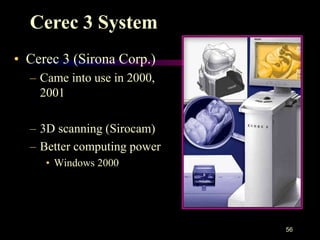
• Cerec 3 (Sirona Corp.)
– Came into use in 2000,
2001
– 3D scanning (Sirocam)
– Better computing power
• Windows 2000
56
Cerec 3 System
57
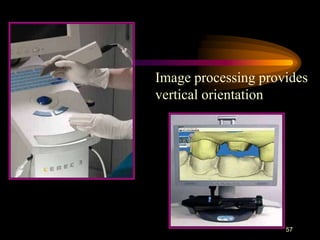
Image processing provides
vertical orientation
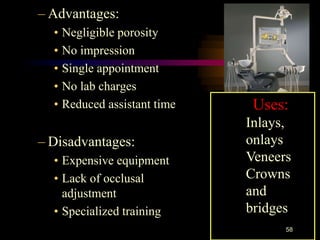
– Advantages:
• Negligible porosity
• No impression
• Single appointment
• No lab charges
• Reduced assistant time
– Disadvantages:
• Expensive equipment
• Lack of occlusal
adjustment
• Specialized training
58
Uses:
Inlays,
onlays
Veneers
Crowns
and
bridges
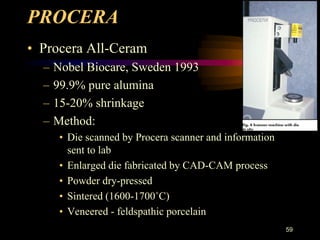
PROCERA
• Procera All-Ceram
– Nobel Biocare, Sweden 1993
– 99.9% pure alumina
– 15-20% shrinkage
– Method:
• Die scanned by Procera scanner and information
sent to lab
• Enlarged die fabricated by CAD-CAM process
• Powder dry-pressed
• Sintered (1600-1700˚C)
• Veneered - feldspathic porcelain
59
– Advantages:
• High Flexural strength
• High hardness
• Good marginal fit
• More translucent than infiltrated ceramics
– Disadvantages:
• Special equipments and computer software
– Uses:
• Anterior and posterior crowns
• Inlays and onlays
60
Machinable Ceramics
• Processing: CAD-CAM or Copy-
milling
• Types:
– Feldspathic porcelains
– Glass ceramics (Dicor MGC light and
Dicor MGC dark; Dentsply).
61
• Dicor MGC :-
• This is a machinable glass ceramic composed of
fluorosilicate mica crystals in a glass matrix. It
has greater flexural strength than cast dicor .
They have shown to be softer than
conventional feldspathic porcelain and
produces less abrasive wear of the opposing
tooth structure than cerec mark I but causes
more wear than cerec markII.
62
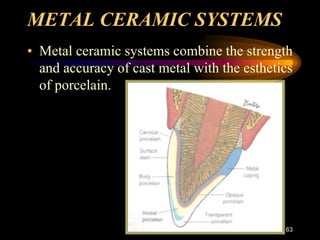
METAL CERAMIC SYSTEMS
• Metal ceramic systems combine the strength
and accuracy of cast metal with the esthetics
of porcelain.
63
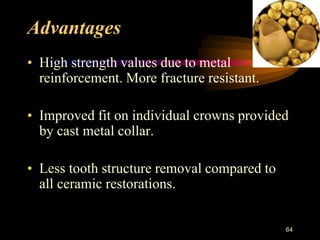
Advantages
• High strength values due to metal
reinforcement. More fracture resistant.
• Improved fit on individual crowns provided
by cast metal collar.
• Less tooth structure removal compared to
all ceramic restorations.
64
Disadvantages
• Difficult to obtain good esthetics due to increased
opacity of metal substructure.
• More difficult to create depth of translucency
because of dense opaque porcelain
• Preparation for metal ceramic requires significant
tooth reduction to provide sufficient space for the
materials when compared to all metal restoration.
• Patients may be allergic to the metal
65
Indications
• Discolored teeth
• Grossly decayed carious teeth
• Congenital anomalies
• Splinting mobile teeth
• Occlusal corrections
• Alignment corrections
66
Contraindications
• Patients with active caries or untreated periodontal
disease.
• In young patients with large pulp chambers due to
high risk of pulp exposure
• Teeth where enamel wear is high and there is
insufficient bulk of tooth structure to allow room
for metal and porcelain.
• Anterior teeth where esthetics is of prime
importance
• Short and thin crowns
67
Classification of MC alloys
(Naylor 1986)
• Alloys divided into 2 systems:
A. Noble (Precious) metal alloys
B. Base-metal (Non-noble/non-precious) alloys
• Each system further divided into
constituents :
68
69
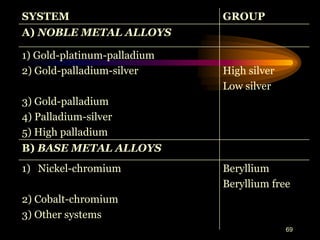
SYSTEM GROUP
A) NOBLE METAL ALLOYS
1) Gold-platinum-palladium
2) Gold-palladium-silver
3) Gold-palladium
4) Palladium-silver
5) High palladium
High silver
Low silver
B) BASE METAL ALLOYS
1) Nickel-chromium
2) Cobalt-chromium
3) Other systems
Beryllium
Beryllium free
Requirements of Metal Ceramic alloys
• Must be able to produce surface oxides for chemical bonding
with dental porcelains.
• Co-efficient of thermal expansion should be slightly greater
(0.5-1 ppm/˚C) than that of the porcelain veneer to maintain
the metal- porcelain attachment.
• Melting range considerably higher than the fusing range of the
dental porcelain fired on it.
• The alloy must have high temperature strength or sag
resistance → that is the ability to withstand exposure to high
temperatures without undergoing dimensional change.
• Processing should not be too technically demanding.
70
Nature of Metal-ceramic Bond
• Van der Waals forces
• Mechanical retention/entrapment
• Compressive forces
• Direct chemical bonding
71
Direct Chemical Bonding
• Formation of surface oxides which bond to
porcelain
• Mechanisms:
– Oxide layer permanently bonded to the metal
– Surface oxides dissolved by the opaque layer. Enhanced
wetting of metal surface.
• Techniques:
– < 1% of Fe, Sn or In added to alloy. Bond strength
increases 3 times
– Direct oxide production in base metal alloys (Ni and Cr)
– Electrodeposition of tin on platinum (0.2-2 m) 72
Oxidation or Degassing
• This high temperature processing allows specific
oxides to form on the metal surface which are
responsible for forming a mature, stable oxide
layer for the porcelain metal attachment
• Also recommended for cleaning the metal of
organic debris and remove entrapped surface
gases such as hydrogen
• Post oxidation treatment:
– To reduce oxide layer or contaminants
– Acid treatment: HF, HCl, H2SO4.
– Non-acid treatment 73
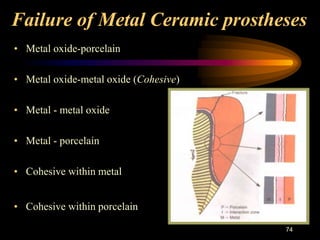
Failure of Metal Ceramic prostheses
• Metal oxide-porcelain
• Metal oxide-metal oxide (Cohesive)
• Metal - metal oxide
• Metal - porcelain
• Cohesive within metal
• Cohesive within porcelain
74
RECENT ADVANCES IN
DENTAL CERAMICS
75
Shrink-free Ceramics
• CERESTORE system
• The application of an all ceramic crown
employing a unique shrink-free alumina
substrate with specially formlulated porcelain
veneers (cerestore system) offers a viable
alternative to both the metal ceramic crown
and traditional PJC.
• The development of the advanced alumina
ceramic substrate allows the construction of
highly durable all ceramic restorations with
exceptional fit. 76
• The shrink free- ceramic can be formed directly on
the master die, producing extreme accuracy of fit .
• A master die made from a special epoxy resin die
materia, which is heat stable and undergoes
permanent controlled expansions during curing.
• The ceramic substrate supplied as dense pellet of the
compacted shrink free formulation is heated until it is
flowable (160oC) and then transferred by pressure
into a suitable mold directly on the master die. After
it sets, the green substrate is removed from die and
sintered/controlled firing is carried out resulting in
zero shrinkage of the ceramic
77
Hybrid Ceramics
• Hahn (1995, 1997) proposed a new ceramic
material that is a hybrid between organic and
inorganic components.
– Polyvinyl siloxane 50 vol%
– Ti 30%
– Inert filler (Al2O3) 15%
– Titanium boride 5%
• Mixture can be handled like composite and
cured .
• Firing - 1150ºC for 6 hrs in N2 atmosphere
78
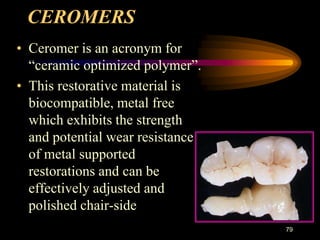
CEROMERS
• Ceromer is an acronym for
“ceramic optimized polymer”.
• This restorative material is
biocompatible, metal free
which exhibits the strength
and potential wear resistance
of metal supported
restorations and can be
effectively adjusted and
polished chair-side
79
• Advantages:
– Good wear resistance
– Good strength
– Easily contoured
• Disadvantages:
– Needs complete isolation
– Cannot be used in very high stress regions
– Preferably supra-gingival margins
• Uses:
– Posterior bridge
– Implant restorations
– Fillings
– Repair of ceramics
80
CONCLUSION:
• Ceramics have a great past in dentistry.
• They are the most esthetic materials to
restore missing tooth structures.
• Advances in dental ceramics has facilitated
in better esthetics, function and longevity of
the dental prosthesis.
81
REFERENCES
• Philips. Science of dental materials.
Kenneth J. Anusvice. Xth Edition.
• Robert G. Craig. Restorative dental
materials. Xth Edition. Mosby
Publication.
• Ronald E. Goldstein. Esthetics in
dentistry. IInd Edition.
• Barry G. Dale, Kenneth W. Ascheim -
Esthetic dentistry, IInd Edition
82

Ceramics seminar

  • 1.
    Dental Ceramics Presented by: Dr. Abhishek Sharma B.D.S, M.D.S, Fellow P.F.A. (USA) Senior lecturer, Department of Prosthodontics, Crown-Bridge & Implantology , TMDCRC
  • 2.
    CONTENTS • INTRODUCTION • HISTORICALPERSPECTIVE • CLASSIFICATION • COMPOSITION • PROPERTIES OF DENTAL PORCELAIN • CONDENSATION OF DENTAL PORCELAIN • METHODS OF STRENGTHENING 2
  • 3.
    3 • ALL CERAMICSYSTEMS • METAL CERAMIC SYSTEMS • ADVANCES IN DENTAL CERAMICS • CONCLUSION • REFERENCES CONTENTS CONTD..
  • 4.
    INTRODUCTION 4 • Esthetics indentistry is defined by patient’s desire for naturality and beauty. • The development of ceramic materials has helped the dentist to translate the patient’s wishes to reality by providing the ideal restorations. • Word ‘ceramic’ derived from the Greek word ‘keramos’ means ‘pottery’ or ‘burnt stuff ’.
  • 5.
    5 A ceramic istherefore an earthy material usually of a silicate nature and may be defined as “a combination of one or more metals with a non- metallic element, usually oxygen” DEFINITION
  • 6.
    Historical Perspective • Fabricationof ceramic articles dates back to 23,000 yrs B.C. • Alex Duchateau was the first person to introduce porcelain as a material in dentistry as a denture paste. • Nicolas Dubois de Chemant and Alexis Duchateau teamed up to form “mineral paste” • Giuseppangelo Fonzi, 1808 formed the first porcelain tooth. 6
  • 7.
    • Porcelain fusedto thin platinum foil : CHARLES H. LAND 7
  • 8.
    CLASSIFICATION • According totype: - • Feldspathic porcelain • Leucite-reinforced porcelain • Aluminous porcelain • Glass infiltrated alumina • Glass infiltrated spinel • Glass ceramic 8
  • 9.
    • According touse: • Denture teeth • Metal ceramic restorations • Veneers • Inlays/Onlays • Crowns and anterior bridges • According to method of processing: • Sintering • Casting • Machining 9
  • 10.
    10 • According tofiring temperature: • High fusing -1300oC(2372oF) • Medium fusing-1101-1300oc(2013-2072oF) • Low fusing-850-1100oc(1562-2012oF) • Ultra low fusing-<850oc(1562oF) medium fusing and high fusing : PORCELAIN DENTURE TEETH low fusing and ultra low fusing porcelains : for crown and bridge construction
  • 11.
    11 • According toapplication: • Core porcelain: is the basis of porcelain jacket crown, must have good mechanical properties. • Dentin or Body porcelain: more translucent than core porcelain, largely governs the shape and color of restoration. • Enamel porcelain: is used in areas requiring maximum translucency, for example- at the incisal edge.
  • 12.
    12 • According toPhillips’ science of dental materials: • Silicate ceramics - Dental porcelains with SiO2 (amorphous glass phase) as the main component and additions of crystalline Al2O3, MgO, ZrO2 and other oxides are included in this category. • Oxide ceramics - contains a principal crystalline phase of Al2O3 MgO, ThO2 or ZrO2 with either no or a small amount of glass phase.
  • 13.
    • Non-oxide ceramics- are impractical for use in dentistry due to their high processing temperatures and complex processing methods. Eg: Borides, Carbides, Nitrides • Glass ceramics- Dicor, Dicor MGC 13
  • 14.
    14 COMPOSITION Feldspar Quartz Kaolin Alumina Boric oxide Oxides ofNa, K and Ca Metallic pigments 60-80% 15-25% 3-5% 6-20% 2-7% 9-15% < 1%
  • 15.
    Components • Feldspar – Formsglass phase • Retains shape when fused at high temperature • Undergoes incongruent melting between 1150- 1530˚C to form leucite. – Potash feldspar (K2O.Al2O3.6SiO2) – increases viscosity – Soda feldspar (Na2O.Al2O3.6SiO2) – lowers fusion temperature 15
  • 16.
    • Quartz – Refractoryskeleton – Strengthens and hardens porcelain • Kaolin (Al2O3.2SiO2.2H2O) – Binder – Gives opacity therefore generally omitted • Al2O3 – Strength and opacity – Alters softening temperature – Increases viscosity 16
  • 17.
    17 Colouring pigments Metallic oxides ‘Colourfrits’ Titanium oxide → Yellow - Brown Shade Indium → Yellow / Ivory Iron oxide / Nickel oxide → Brown Cobalt salt → Blue
  • 18.
    18 Opacifying agents To maskoxide layer Metal oxide 8-15% : ZrO, CeO, TiO, SnO Stains and color modifiers Low fusing coloured porcelain Other additives Boric oxide Lithium oxide Magnesium oxide
  • 19.
    19 To seal theopen pores Self-glaze or Auto-glaze High temperature Add-on glaze Higher glass modifiers Lower temperature Less durable GLAZES
  • 20.
    Properties of DentalCeramics • Biocompatibility • Esthetics – Colour and Translucency – Long term colour stability • Durability – Wear resistant – No Solubility • Ability to be formed into precise shapes 20 A D V A N T A G E S
  • 21.
    • Brittle • Highshrinkage of conventional porcelains • Technique sensitive • Specialized training required • Costly equipment • More tooth reduction • Attrition of opposing tooth • Difficult to repair • Expensive 21 D I S A D V A N T A G E S
  • 22.
    PROCESSING OF DENTALCERAMICS • The processing of dental ceramics is done in three stages : a.) CONDENSATION b.) FIRING c.) GLAZING 22
  • 23.
    CONDENSATION • The processof packing the particles together and of removing the liquid binder is known as condensation. • The main driving force involved in condensing dental porcelain is surface tension. • Liquid – Distilled water – Propylene glycol – Alcohol – Special liquid 23
  • 24.
    Methods of condensation •Wet brush technique/ Brush additive technique ( most commonly used ) • Brush application method • Vibration • Spatulation • Whipping • Mechanical • Ultrasonic vibration 24
  • 25.
    Wet brush technique •Consistency of mix affects the handling property of the material • Creamy mix capable of being transferred in small increments. • Wet brush maintains the moisture content in porcelain. • A more controlled application of small increments. 25
  • 26.
    VIBRATION • Mild vibrationto densely pack the wet powder upon the underlying matrix. • The excess water :blotted with a tissue. • Serrated handle of a porcelain instrument lightly passed over the model or die pin. 26
  • 27.
    Spatulation: • Spatula usedto apply and smoothen the porcelain. • Disadvantages: • Danger of dislodging the porcelain particles ,may cause invisible cracks. • The sandpaper like effect of • porcelain on metal • Discoloration of the final product. 27
  • 28.
    Whipping • A largesoft brush moved in light dusting action over the wet porcelain • Brings excess water to the surface, • Same brush can be used to remove any coarse surface particles along with excess water. • Combination of vibration and the whipping. Disadvantage: • This method works best with fine grain, • Excess manipulation could allows these fine particles to float away with • liquid during blotting. 28
  • 29.
    29 SINTERING / FIRING •Sintering - A process of heating closely packed particles to achieve interparticle bonding and sufficient diffusion to decrease the surface area or increase the density of the structure. • Liquid phase sintering : When potassium feldspar is mixed with various metal oxides and fired at high temperatures, it can form leucite and a glass phase that will soften and flow slightly. The softening of this glass phase during porcelain firing, allows the porcelain powder particles to coalesce together.
  • 30.
    TYPES OF FIRING •Air fired – Slow maturation period to allow air to escape. Held at 30-50 degree less than maximum firing temperature • Vacuum fired – Dense, pore-free mass – Shorter firing time • Diffusible gas firing procedure – Helium, hydrogen or steam 30
  • 31.
    STAGES OF MATURATION •The common terminology used for describing the surface appearance of un-glazed porcelain is ‘bisque’ • Low bisque – Porous – Minimal shrinkage – Weak • Medium bisque – Flow of glass – Shrinkage • High bisque – Sealed surface – Strong 31
  • 32.
    Methods of strengtheningceramics • Methods used to overcome the deficiencies of ceramics like brittleness, low fracture toughness and low tensile strength, fall into two general categories:- • Strengthening of the brittle material – Development of residual compressive stresses within the surface of the material. – Interruption of crack propagation through the material. • Methods of designing components to minimize stress concentrations and tensile stresses 32
  • 33.
    ALL CERAMIC • Porcelainis the most natural appearing synthetic replacement material for the missing tooth structure, but due to its low tensile strength and brittleness, it has to be fused to a metal substrate to increase its resistance to fracture. • But this metal base can affect the esthetics of porcelain by decreasing the light transmission through the porcelain and by creating metal ion discolorations. 33
  • 34.
    CLASSIFICATION OF ALLCERAMICS • 1) Conventional powder- slurry ceramics:- * Hi ceram – Alumina reinforced porcelain. * Optec HSP – Leucite reinforced porcelain. • 2) Computer - aided design/computer-aided milling (CAD/CAM):- * Cerec • 4) CAD/CAM with aluminium oxide coping:- * Procera 34
  • 35.
    • 5) Castableceramics:- * Dicor • 6) Infiltrated ceramics:- * In-Ceram • Pressable ceramics :- * IPS empress * Optec pressable ceramic • 8) Machinable ceramics:- * Cerec vitablocks * Celay blocks * Dicor MGC 35
  • 36.
    FEATURES OF NEWERALL- CERAMIC MATERIALS • Stronger materials that involve better fabricating techniques. • Can be etched and bonded to the underlying tooth structure with newer dentin adhesives. • Greater tooth reduction than what was previously used for PJC’s is carried out 36
  • 37.
    CONVENTIONAL POWDER SLURRY CERAMICS •Processing: Sintering • Aluminous porcelain crowns (PJCs) – Mc Lean and Hughes (1965) – E.g. Hi-ceram, Vitadur N – Made with platinum foil backing which is later removed – Advantages: • Better esthetics – Disadvantages: • Inadequate strength for posterior teeth 37
  • 38.
    • Optec HSP –Feldspathic composition glass filled with crystalline leucite – Leucite reinforced porcelain – 50.6%wt – Increased strength – Uses • Inlays • Onlays • Anterior crowns • Veneers 38
  • 39.
    – Advantages • Moretranslucent than alumina core crowns. • Good flexural strength – 146Mpa. • No special processing equipment • Lack of metal or opaque substructure. • Can be etched – Disadvantages • High chances of wearing of opposing teeth • Potential to fracture in posterior teeth. • Requires a special die material. 39
  • 40.
    Castable Ceramic Systems •Processing: casting through lost wax technique • DICOR – Adair and Grossman 1984 – Glass ceramic: a ceramic consisting of a glass matrix phase and at least one crystal phase that is produced by the controlled crystallization of the glass. – Casting at 1350˚C, heat treatment at 1075˚C for 10 hrs. • Ceramming: heat treatment that causes microscopic plate like crystals of crystalline material (mica) to grow within the glass matrix. 40
  • 41.
    –Advantages: • Increased strengthand toughness • Good marginal adaptation (30-60 m) • Ease of fabrication • Improved esthetics – Chameleon effect • Minimal processing shrinkage • Low thermal expansion • Minimal abrasiveness to tooth structure Disadvantages • Inability to be coloured internally • Grinding of restoration may leave white area • Technique sensitive 41
  • 42.
    Pressable Glass Ceramics •Precerammed glass ingots • Leucite reinforced • Processing: injection molding 42
  • 43.
    • IPS Empress –Higher Leucite: 23.6% and 41.3% – Coefficient of Thermal Expansion – 15ppm/˚C – 1180˚C, over 45 mins – Stained and glazed or veneered – Advantages: • Heat pressing gives better marginal fit • Good esthetics • Moderately high flexural strength -112 MPa 43
  • 44.
    –Disadvantages: • Potential tofracture in posterior areas • Need for special equipment –Uses: • Anterior crowns • Veneers • Inlays 44
  • 45.
    • Optec OPC(Optimal Press able Ceramic) – Leucite reinforced – 1150˚C – Advantages: • Good flexural strength • Translucent and dense • Can be etched and bonded to natural tooth. – Disadvantages: • Increased abrasiveness • Special equipment required 45
  • 46.
    Infiltrated Ceramics Sadoun 1989 •In-Ceram Alumina • In-Ceram Spinell • In-Ceram Zirconia Successor system of Hi-ceram, differing from this system by having sufficiently lower grain size of aluminum oxide and thereby greater density. 46
  • 47.
    • Processing: slipcasting “The core is made from fine grained particles that are mixed with water to from a suspension referred to as a ‘slip’, is painted on a gypsum die (absorbent refractory die). The die draws water from the slurry under capillary pressure thereby depositing a layer of solid alumina on the surface, which is subsequently sintered/baked at 1120oc for 10hrs to produce an opaque porous core. This process is called ‘slip casting’ 47
  • 48.
    • Firing at1120˚C for 10 hrs • Porous substructure infiltrated with molten sodium lanthanum glass (1120˚C for 4 hrs.) – Increases strength – Reduces porosity of final structure – Increases refractive index 48
  • 49.
    • Uses:- - Singleanterior and posterior crowns. - Anterior 3 - unit bridges. - Implant supported bridges (recently). • Advantages:- a) Lack of metal substructure. b) It has extremely high flexural strength - 450Mpa strongest all ceramic dental restorations presently available. c) Excellent fit, as little shrinkage occurs due to sufficient time at optimum temperature, which causes bonding between particles at small areas. 49
  • 50.
    • Disadvantages:- Opacity ofthe material and hence can be used only as a core. a) Unsuitable for conventional acid - etching. b) Special die material and high temperature oven is required. c) Wear of opposing occluding enamel or dentin occurs if the In ceram restoration is a part of heavy incisal guidance or canine rise. 50
  • 51.
    CAD-CAM Ceramics • Processing:Computer Aided Designing – Computer Aided Manufacturing. • 3 parts: – Camera or Scanner to take picture of the preparation – Computer to design the prosthesis – Milling machine 51
  • 52.
  • 53.
    Cerec Systems • Cerec1 (Siemens Ltd.) – Came into use in 1985 – Advantages: • Ease of use • Single appointment • Wide range of shapes could be milled – Disadvantages: • Large marginal gaps • Inability to cut concave areas • Difficulty of extending veneers into areas of missing tooth 53
  • 54.
    Cerec 2 System •Came into use in 1994. • Benefits of Cerec 2 system:- 1) Benefits for the patients:- -Esthetic and cosmetic restoration -Best material properties in dental ceramics. -Biocompatible. -Cost-effective. -Quick turn around time (1 day laboratory time) 54
  • 55.
    -Perfect occlusion. -High marginalintegrity. -No metal in mouth. • 2) Benefits for the dentist:- - Economic production in the laboratory. - Increased precision. - Better interproximal integrity. - No polishing needed. - Contacts optimized in the Laboratory. 55
  • 56.
    • Cerec 3(Sirona Corp.) – Came into use in 2000, 2001 – 3D scanning (Sirocam) – Better computing power • Windows 2000 56 Cerec 3 System
  • 57.
  • 58.
    – Advantages: • Negligibleporosity • No impression • Single appointment • No lab charges • Reduced assistant time – Disadvantages: • Expensive equipment • Lack of occlusal adjustment • Specialized training 58 Uses: Inlays, onlays Veneers Crowns and bridges
  • 59.
    PROCERA • Procera All-Ceram –Nobel Biocare, Sweden 1993 – 99.9% pure alumina – 15-20% shrinkage – Method: • Die scanned by Procera scanner and information sent to lab • Enlarged die fabricated by CAD-CAM process • Powder dry-pressed • Sintered (1600-1700˚C) • Veneered - feldspathic porcelain 59
  • 60.
    – Advantages: • HighFlexural strength • High hardness • Good marginal fit • More translucent than infiltrated ceramics – Disadvantages: • Special equipments and computer software – Uses: • Anterior and posterior crowns • Inlays and onlays 60
  • 61.
    Machinable Ceramics • Processing:CAD-CAM or Copy- milling • Types: – Feldspathic porcelains – Glass ceramics (Dicor MGC light and Dicor MGC dark; Dentsply). 61
  • 62.
    • Dicor MGC:- • This is a machinable glass ceramic composed of fluorosilicate mica crystals in a glass matrix. It has greater flexural strength than cast dicor . They have shown to be softer than conventional feldspathic porcelain and produces less abrasive wear of the opposing tooth structure than cerec mark I but causes more wear than cerec markII. 62
  • 63.
    METAL CERAMIC SYSTEMS •Metal ceramic systems combine the strength and accuracy of cast metal with the esthetics of porcelain. 63
  • 64.
    Advantages • High strengthvalues due to metal reinforcement. More fracture resistant. • Improved fit on individual crowns provided by cast metal collar. • Less tooth structure removal compared to all ceramic restorations. 64
  • 65.
    Disadvantages • Difficult toobtain good esthetics due to increased opacity of metal substructure. • More difficult to create depth of translucency because of dense opaque porcelain • Preparation for metal ceramic requires significant tooth reduction to provide sufficient space for the materials when compared to all metal restoration. • Patients may be allergic to the metal 65
  • 66.
    Indications • Discolored teeth •Grossly decayed carious teeth • Congenital anomalies • Splinting mobile teeth • Occlusal corrections • Alignment corrections 66
  • 67.
    Contraindications • Patients withactive caries or untreated periodontal disease. • In young patients with large pulp chambers due to high risk of pulp exposure • Teeth where enamel wear is high and there is insufficient bulk of tooth structure to allow room for metal and porcelain. • Anterior teeth where esthetics is of prime importance • Short and thin crowns 67
  • 68.
    Classification of MCalloys (Naylor 1986) • Alloys divided into 2 systems: A. Noble (Precious) metal alloys B. Base-metal (Non-noble/non-precious) alloys • Each system further divided into constituents : 68
  • 69.
    69 SYSTEM GROUP A) NOBLEMETAL ALLOYS 1) Gold-platinum-palladium 2) Gold-palladium-silver 3) Gold-palladium 4) Palladium-silver 5) High palladium High silver Low silver B) BASE METAL ALLOYS 1) Nickel-chromium 2) Cobalt-chromium 3) Other systems Beryllium Beryllium free
  • 70.
    Requirements of MetalCeramic alloys • Must be able to produce surface oxides for chemical bonding with dental porcelains. • Co-efficient of thermal expansion should be slightly greater (0.5-1 ppm/˚C) than that of the porcelain veneer to maintain the metal- porcelain attachment. • Melting range considerably higher than the fusing range of the dental porcelain fired on it. • The alloy must have high temperature strength or sag resistance → that is the ability to withstand exposure to high temperatures without undergoing dimensional change. • Processing should not be too technically demanding. 70
  • 71.
    Nature of Metal-ceramicBond • Van der Waals forces • Mechanical retention/entrapment • Compressive forces • Direct chemical bonding 71
  • 72.
    Direct Chemical Bonding •Formation of surface oxides which bond to porcelain • Mechanisms: – Oxide layer permanently bonded to the metal – Surface oxides dissolved by the opaque layer. Enhanced wetting of metal surface. • Techniques: – < 1% of Fe, Sn or In added to alloy. Bond strength increases 3 times – Direct oxide production in base metal alloys (Ni and Cr) – Electrodeposition of tin on platinum (0.2-2 m) 72
  • 73.
    Oxidation or Degassing •This high temperature processing allows specific oxides to form on the metal surface which are responsible for forming a mature, stable oxide layer for the porcelain metal attachment • Also recommended for cleaning the metal of organic debris and remove entrapped surface gases such as hydrogen • Post oxidation treatment: – To reduce oxide layer or contaminants – Acid treatment: HF, HCl, H2SO4. – Non-acid treatment 73
  • 74.
    Failure of MetalCeramic prostheses • Metal oxide-porcelain • Metal oxide-metal oxide (Cohesive) • Metal - metal oxide • Metal - porcelain • Cohesive within metal • Cohesive within porcelain 74
  • 75.
  • 76.
    Shrink-free Ceramics • CERESTOREsystem • The application of an all ceramic crown employing a unique shrink-free alumina substrate with specially formlulated porcelain veneers (cerestore system) offers a viable alternative to both the metal ceramic crown and traditional PJC. • The development of the advanced alumina ceramic substrate allows the construction of highly durable all ceramic restorations with exceptional fit. 76
  • 77.
    • The shrinkfree- ceramic can be formed directly on the master die, producing extreme accuracy of fit . • A master die made from a special epoxy resin die materia, which is heat stable and undergoes permanent controlled expansions during curing. • The ceramic substrate supplied as dense pellet of the compacted shrink free formulation is heated until it is flowable (160oC) and then transferred by pressure into a suitable mold directly on the master die. After it sets, the green substrate is removed from die and sintered/controlled firing is carried out resulting in zero shrinkage of the ceramic 77
  • 78.
    Hybrid Ceramics • Hahn(1995, 1997) proposed a new ceramic material that is a hybrid between organic and inorganic components. – Polyvinyl siloxane 50 vol% – Ti 30% – Inert filler (Al2O3) 15% – Titanium boride 5% • Mixture can be handled like composite and cured . • Firing - 1150ºC for 6 hrs in N2 atmosphere 78
  • 79.
    CEROMERS • Ceromer isan acronym for “ceramic optimized polymer”. • This restorative material is biocompatible, metal free which exhibits the strength and potential wear resistance of metal supported restorations and can be effectively adjusted and polished chair-side 79
  • 80.
    • Advantages: – Goodwear resistance – Good strength – Easily contoured • Disadvantages: – Needs complete isolation – Cannot be used in very high stress regions – Preferably supra-gingival margins • Uses: – Posterior bridge – Implant restorations – Fillings – Repair of ceramics 80
  • 81.
    CONCLUSION: • Ceramics havea great past in dentistry. • They are the most esthetic materials to restore missing tooth structures. • Advances in dental ceramics has facilitated in better esthetics, function and longevity of the dental prosthesis. 81
  • 82.
    REFERENCES • Philips. Scienceof dental materials. Kenneth J. Anusvice. Xth Edition. • Robert G. Craig. Restorative dental materials. Xth Edition. Mosby Publication. • Ronald E. Goldstein. Esthetics in dentistry. IInd Edition. • Barry G. Dale, Kenneth W. Ascheim - Esthetic dentistry, IInd Edition 82