ROTARY CUTTING
INSTRUMENT
ROTARY CUTTING INSTRUMENT
• The individual instruments intended for use with dental handpieces are manufactured in hundreds
of sizes, shapes, and types. This variation is in part a result of the need for specialized designs for
particular clinical applications or to it particular handpieces, but much of the variation also results
from individual preferences on the part of dentists.
COMMON DESIGN CHARACTERISTIC
• Despite the great variation among rotary cutting instruments, they share certain design features.
each instrument consists of three parts: (1) shank, (2) neck, and (3) head. Each has its own
function, inluencing its design and the materials used for its construction.
SHANK DESIGN
The shank is the part that its into the handpiece, accepts the rotary motion from the handpiece, and
provides a bearing surface to control the alignment and concentricity of the instrument.
Neck Design
As shown in Fig. 14.18, the neck is the intermediate portion of an instrument that connects the head to
the shank. The main function of the neck is to transmit rotational and translational forces to the head.
Head Design
The head is the working part of the instrument, the cutting edges or points that perform the desired
shaping of tooth structure. The shape of the head and the material used to construct it are closely
related to its intended application and technique of use. The heads of instruments show greater variation
in design and construction than either of the other main components of the rotary cutting instrument. For
this reason, the characteristics of the head form the basis on which rotary instruments are usually
classified.
Many characteristics of the heads of rotary instruments could be used for classification. Most important among
these is the division into bladed instruments and abrasive instruments. Material of construction, head size, and head
shape are additional characteristics that are useful for further subdivision. Bladed and abrasive instruments exhibit
substantially different clinical performance, even when operated under nearly identical conditions. The two main
divisions that will be utilized for this discussion are dental burs and diamond abrasive instruments.
Dental Burs
The term bur is applied to all rotary cutting instruments
that have bladed cutting heads. This includes instruments
intended for finishing metal restorations, surgical removal
of bone, and tooth preparation.
Early burs were made of steel. Steel burs perform well,
cutting human dentin at low speeds, but dull rapidly at
higher speeds or when cutting enamel.
Carbide burs, which were introduced in 1947, have largely replaced steel
burs for tooth preparation. Steel burs now are used mainly for finishing
procedures. Carbide burs perform better than steel burs at all speeds, and
their superiority is greatest at high speeds. All carbide burs have heads of
cemented carbide in which microscopic carbide particles, usually tungsten
carbide, are held together in a matrix of cobalt or nickel. Carbide is much
harder than steel and less prone to dull during cutting.
Shapes
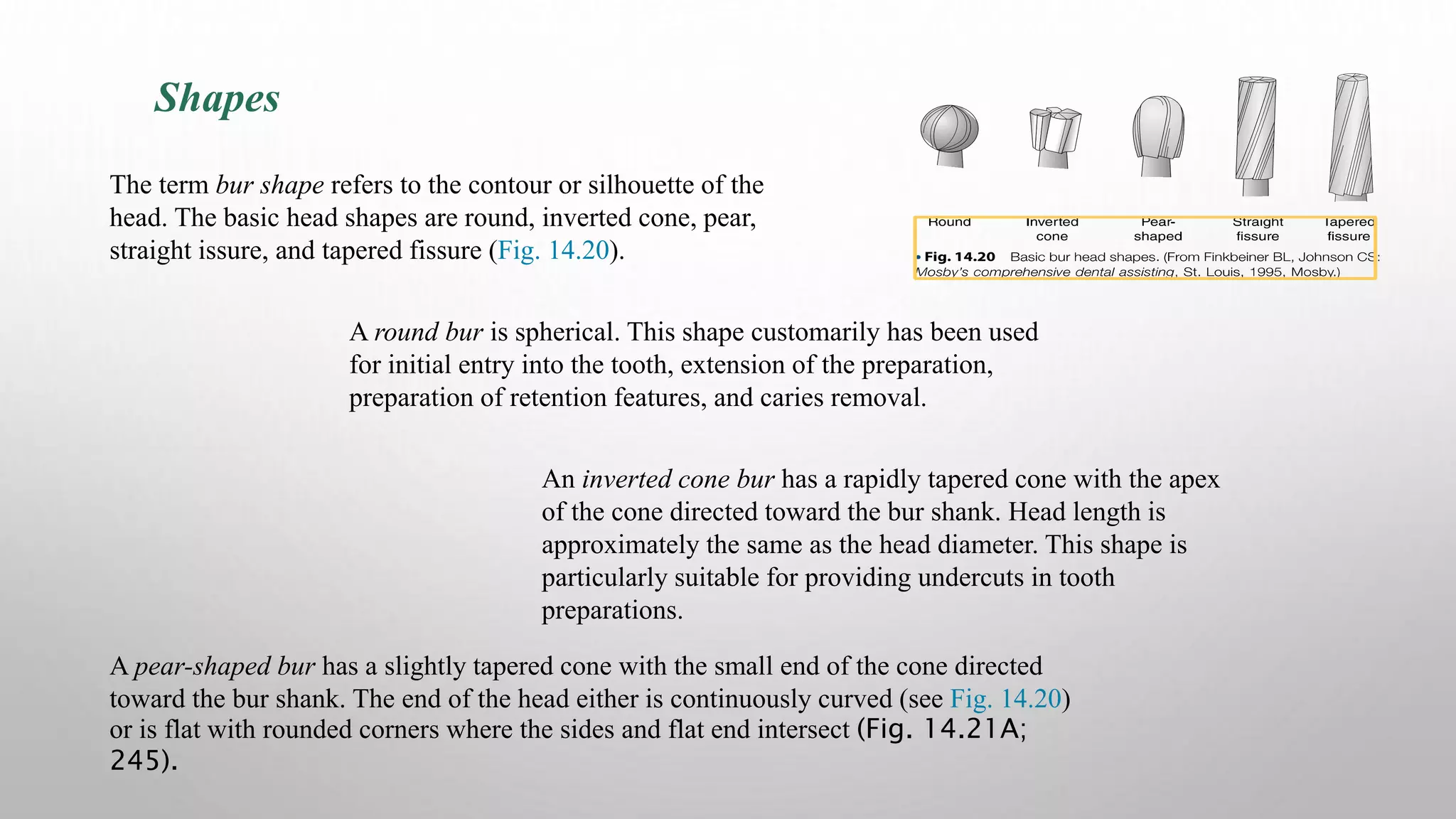
The term bur shape refers to the contour or silhouette of the
head. The basic head shapes are round, inverted cone, pear,
straight issure, and tapered fissure (Fig. 14.20).
A round bur is spherical. This shape customarily has been used
for initial entry into the tooth, extension of the preparation,
preparation of retention features, and caries removal.
An inverted cone bur has a rapidly tapered cone with the apex
of the cone directed toward the bur shank. Head length is
approximately the same as the head diameter. This shape is
particularly suitable for providing undercuts in tooth
preparations.
A pear-shaped bur has a slightly tapered cone with the small end of the cone directed
toward the bur shank. The end of the head either is continuously curved (see Fig. 14.20)
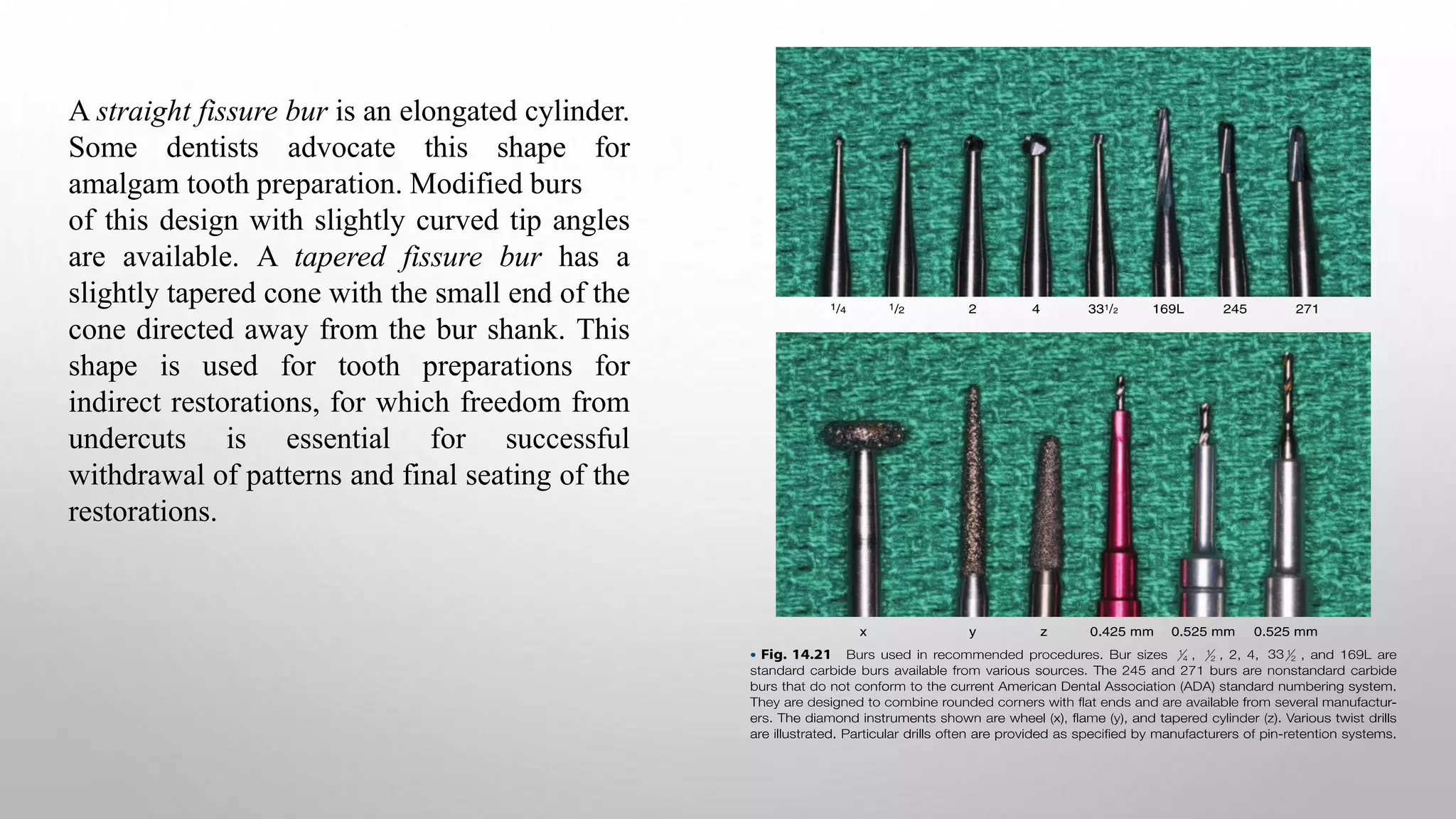
or is flat with rounded corners where the sides and flat end intersect (Fig. 14.21A;
245).
A straight fissure bur is an elongated cylinder.
Some dentists advocate this shape for
amalgam tooth preparation. Modified burs
of this design with slightly curved tip angles
are available. A tapered fissure bur has a
slightly tapered cone with the small end of the
cone directed away from the bur shank. This
shape is used for tooth preparations for
indirect restorations, for which freedom from
undercuts is essential for successful
withdrawal of patterns and final seating of the
restorations.
Among these basic shapes, variations are possible. Fissure and
inverted cone burs may have half-round or domed ends. Taper
and cone angles may vary. The ratio of head length to diameter
may be varied. In addition to shape, other features may be varied,
such as the number of blades, spiral versus axial patterns for
blades, and continuous versus crosscut blade edges.
Bur Blade Design
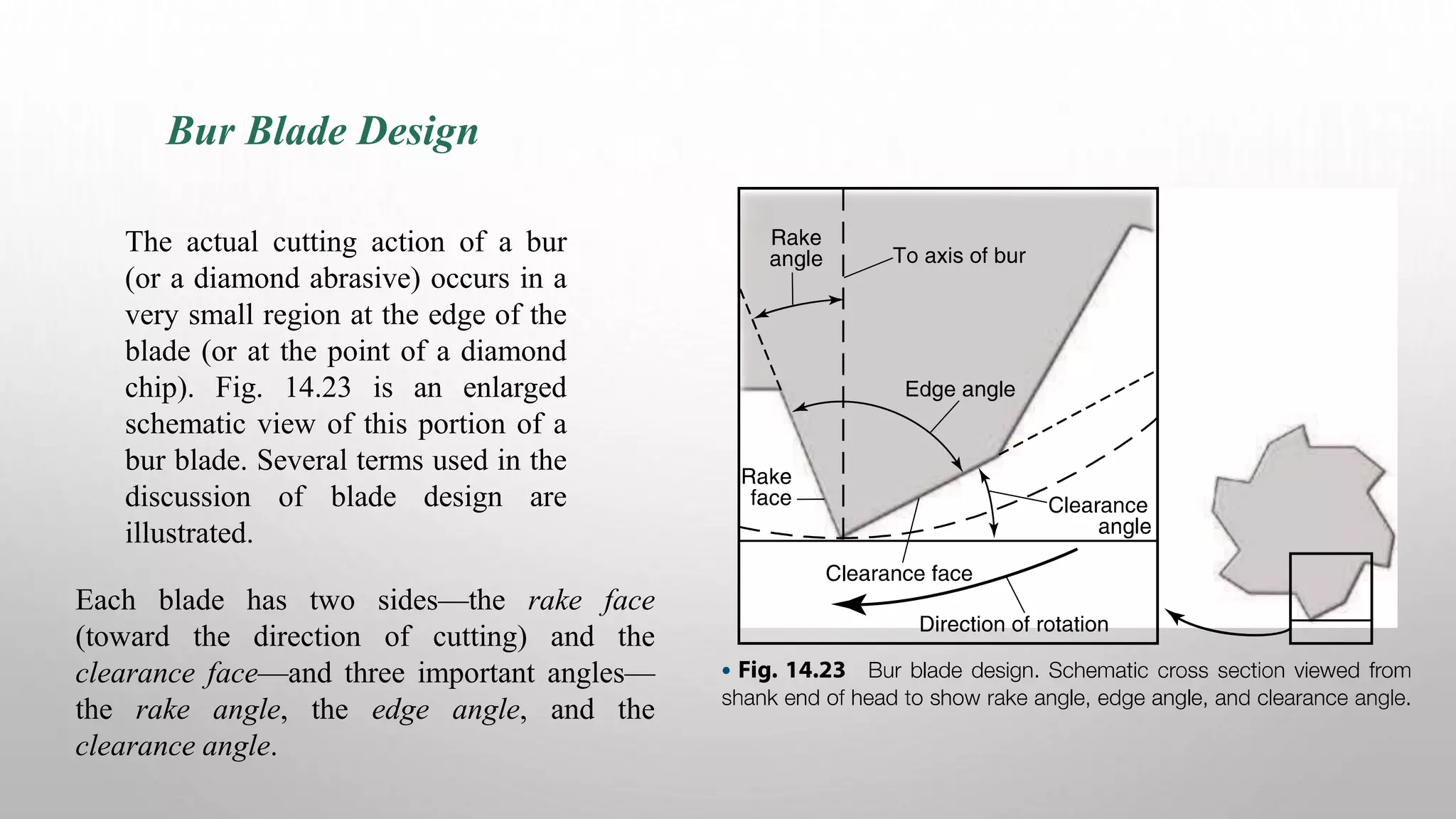
The actual cutting action of a bur
(or a diamond abrasive) occurs in a
very small region at the edge of the
blade (or at the point of a diamond
chip). Fig. 14.23 is an enlarged
schematic view of this portion of a
bur blade. Several terms used in the
discussion of blade design are
illustrated.
Each blade has two sides—the rake face
(toward the direction of cutting) and the
clearance face—and three important angles—
the rake angle, the edge angle, and the
clearance angle.
The rake angle is the most important design characteristic of a
bur blade. For cutting hard, brittle materials, a negative rake
angle minimizes fractures of the cutting edge, increasing the bur
life.
The three angles cannot be varied independently of each other. An
increase in the clearance angle causes a decrease in the edge angle.
The clearance angle eliminates rubbing friction of the clearance face,
provides a stop to prevent the bur edge from digging into the tooth
structure excessively, and reduces the radius of the blade back of the
cutting edge to provide adequate flute space or clearance space for
the cutting debris that accumulates ahead of the following blade.
DIAMOND ABRASIVE INSTRUMENT
The second major category of rotary dental cutting
instruments involves abrasive cutting rather than blade
cutting.
Abrasive instruments are generally grouped as diamond or other instruments.
Diamond instruments have had great clinical impact because of their long life
and great efectiveness in cutting enamel and dentin.
Diamond instruments consist of three parts: (1)
a metal blank, (2) the powdered diamond
abrasive, and (3) a metallic bonding material
that holds the diamond powder onto the blank
(Fig. 14.24). The blank in many ways
resembles a bur without blades. It has the same
essential parts: head, neck, and shank.
Classification
Diamond instruments currently are marketed in a myriad
of head shapes and sizes (Table 14.4) and in all of the
standard shank designs.
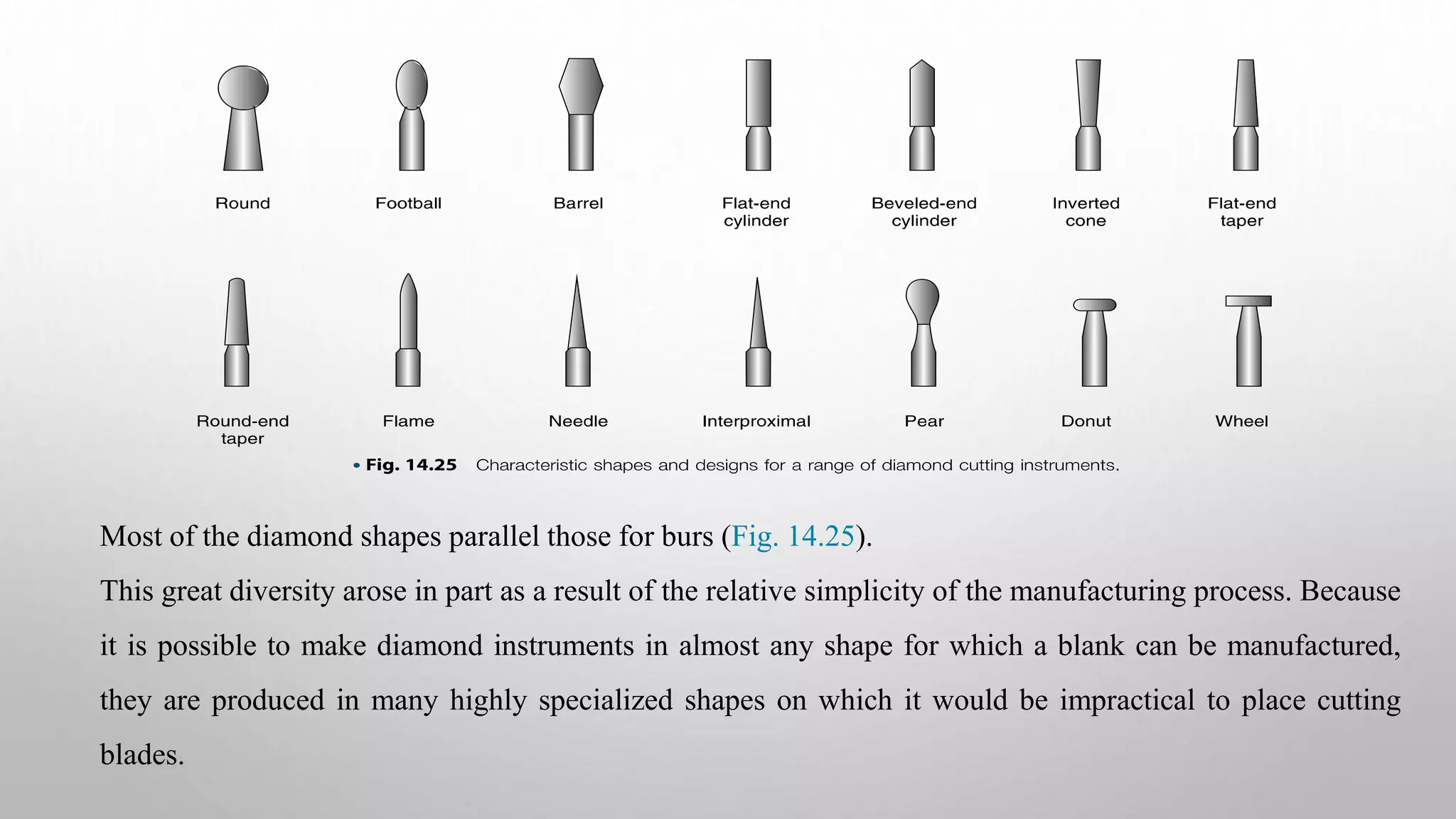
Most of the diamond shapes parallel those for burs (Fig. 14.25).
This great diversity arose in part as a result of the relative simplicity of the manufacturing process. Because
it is possible to make diamond instruments in almost any shape for which a blank can be manufactured,
they are produced in many highly specialized shapes on which it would be impractical to place cutting
blades.
• The clinical performance of diamond abrasive
instruments depends on the size, spacing, uniformity,
exposure, and bonding of the diamond particles.
• Diamond particle size is commonly categorized as
coarse (125–150 μm), medium (88–125 μm), fine (60–
74 μm), and very fine (38–44 μm) for diamond
preparation instruments.
• Diamond finishing instruments use even finer
diamonds (10–38 μm) to produce relatively smooth
surfaces for final finishing with diamond polishing
pastes.
Proper diamond instrument speed and pressure are the
major factors in determining service life. Properly used
diamond instruments last almost indefinitely. A
primary cause of failure of diamond instruments is loss
of the diamonds from critical areas. This loss results
from the use of excess pressure in an attempt to
increase the cutting rate at inadequate speeds.
Other Abrasive Instrument
• In addition to diamond instruments, many other types of abrasive instruments are used in
dentistry. At one time they were extensively used for tooth preparation, but their use is now
primarily restricted to shaping, finishing, and polishing restorations in the clinic and in the
laboratory.
• CLASSIFICATION
• In these instruments, as in the diamond instruments, the cutting surfaces of the head are
composed of abrasive particles held in a continuous matrix of softer material. They may be
divided into two distinct groups—molded instruments and coated instruments. Each uses various
abrasives and matrix materials.
• Molded abrasive instruments have heads that are
manufactured by molding or pressing a uniform mixture of
abrasive and matrix around the roughened end of the shank
or cementing a premolded head to the shank.
• The mounted heads are often termed points and stones.
• Other molded instrument heads use flexible matrix
materials, such as rubber, to hold the abrasive particles.
These are used predominantly for finishing and polishing
procedures. Molded unmounted disks or wheelstones are
attached by a screw to a mandrel of suitable size for a given
handpiece that has a threaded hole in the end.
• The coated abrasive instruments are mostly disks that have a thin
layer of abrasive cemented to a flexible backing. This construction
allows the instrument to conform to the surface contour of a tooth
or restoration. Most flexible disks are designed for reversible
attachment to a mandrel. Coated abrasive instruments may be used
in the finishing and smoothing procedures of certain enamel walls
(and margins) of tooth preparations for indirect restorations but are
most often used in finishing procedures for restorations.
Cutting Recommendations
• Overall, the requirements for
effective and efficient cutting
include using a contra-angle
handpiece, air-water spray for
cooling, high operating speed
(>200,000 rpm), light pressure, and
a carbide bur or diamond
instrument. Carbide burs are better
for end cutting, produce lower heat,
and have more blade edges per
diameter for cutting.
They are used efectively for punch
cuts to enter tooth structure,
intracoronal tooth preparation,
amalgam removal, small
preparations, and secondary
retention features. Diamond
instruments have higher hardness,
and coarse diamonds have high
cutting effectiveness. Diamonds are
more effective than burs for
intracoronal and extracoronal tooth
preparations, beveling enamel
margins on tooth preparations, and
enameloplasty.
Hazards with Cutting Instruments
• Almost everything done in a dental office involves
some risk to the patient, the dentist, or the dental
assistant. For the patient, pulpal dangers arise from
tooth preparation and restoration procedures. Soft
tissue dangers are also present. Everyone is
potentially susceptible to eye, ear, and inhalation
dangers. Careful adherence to normal precautions
can, however, eliminate or minimize most risks
associated with the use of cutting instruments. This patient suffered a burn from the overheated bearing of an electric
handpiece. Because the patient was anesthetized, he was unaware of the
burn as it occurred from the overheated handpiece.
week 4- dental burs.pptx

week 4- dental burs.pptx

  • 1.
  • 2.
    ROTARY CUTTING INSTRUMENT •The individual instruments intended for use with dental handpieces are manufactured in hundreds of sizes, shapes, and types. This variation is in part a result of the need for specialized designs for particular clinical applications or to it particular handpieces, but much of the variation also results from individual preferences on the part of dentists.
  • 3.
    COMMON DESIGN CHARACTERISTIC •Despite the great variation among rotary cutting instruments, they share certain design features. each instrument consists of three parts: (1) shank, (2) neck, and (3) head. Each has its own function, inluencing its design and the materials used for its construction.
  • 4.
    SHANK DESIGN The shankis the part that its into the handpiece, accepts the rotary motion from the handpiece, and provides a bearing surface to control the alignment and concentricity of the instrument. Neck Design As shown in Fig. 14.18, the neck is the intermediate portion of an instrument that connects the head to the shank. The main function of the neck is to transmit rotational and translational forces to the head. Head Design The head is the working part of the instrument, the cutting edges or points that perform the desired shaping of tooth structure. The shape of the head and the material used to construct it are closely related to its intended application and technique of use. The heads of instruments show greater variation in design and construction than either of the other main components of the rotary cutting instrument. For this reason, the characteristics of the head form the basis on which rotary instruments are usually classified.
  • 5.
    Many characteristics ofthe heads of rotary instruments could be used for classification. Most important among these is the division into bladed instruments and abrasive instruments. Material of construction, head size, and head shape are additional characteristics that are useful for further subdivision. Bladed and abrasive instruments exhibit substantially different clinical performance, even when operated under nearly identical conditions. The two main divisions that will be utilized for this discussion are dental burs and diamond abrasive instruments.
  • 6.
    Dental Burs The termbur is applied to all rotary cutting instruments that have bladed cutting heads. This includes instruments intended for finishing metal restorations, surgical removal of bone, and tooth preparation. Early burs were made of steel. Steel burs perform well, cutting human dentin at low speeds, but dull rapidly at higher speeds or when cutting enamel. Carbide burs, which were introduced in 1947, have largely replaced steel burs for tooth preparation. Steel burs now are used mainly for finishing procedures. Carbide burs perform better than steel burs at all speeds, and their superiority is greatest at high speeds. All carbide burs have heads of cemented carbide in which microscopic carbide particles, usually tungsten carbide, are held together in a matrix of cobalt or nickel. Carbide is much harder than steel and less prone to dull during cutting.
  • 7.
    Shapes The term burshape refers to the contour or silhouette of the head. The basic head shapes are round, inverted cone, pear, straight issure, and tapered fissure (Fig. 14.20). A round bur is spherical. This shape customarily has been used for initial entry into the tooth, extension of the preparation, preparation of retention features, and caries removal. An inverted cone bur has a rapidly tapered cone with the apex of the cone directed toward the bur shank. Head length is approximately the same as the head diameter. This shape is particularly suitable for providing undercuts in tooth preparations. A pear-shaped bur has a slightly tapered cone with the small end of the cone directed toward the bur shank. The end of the head either is continuously curved (see Fig. 14.20) or is flat with rounded corners where the sides and flat end intersect (Fig. 14.21A; 245).
  • 8.
    A straight fissurebur is an elongated cylinder. Some dentists advocate this shape for amalgam tooth preparation. Modified burs of this design with slightly curved tip angles are available. A tapered fissure bur has a slightly tapered cone with the small end of the cone directed away from the bur shank. This shape is used for tooth preparations for indirect restorations, for which freedom from undercuts is essential for successful withdrawal of patterns and final seating of the restorations.
  • 9.
    Among these basicshapes, variations are possible. Fissure and inverted cone burs may have half-round or domed ends. Taper and cone angles may vary. The ratio of head length to diameter may be varied. In addition to shape, other features may be varied, such as the number of blades, spiral versus axial patterns for blades, and continuous versus crosscut blade edges.
  • 10.
    Bur Blade Design Theactual cutting action of a bur (or a diamond abrasive) occurs in a very small region at the edge of the blade (or at the point of a diamond chip). Fig. 14.23 is an enlarged schematic view of this portion of a bur blade. Several terms used in the discussion of blade design are illustrated. Each blade has two sides—the rake face (toward the direction of cutting) and the clearance face—and three important angles— the rake angle, the edge angle, and the clearance angle.
  • 11.
    The rake angleis the most important design characteristic of a bur blade. For cutting hard, brittle materials, a negative rake angle minimizes fractures of the cutting edge, increasing the bur life. The three angles cannot be varied independently of each other. An increase in the clearance angle causes a decrease in the edge angle. The clearance angle eliminates rubbing friction of the clearance face, provides a stop to prevent the bur edge from digging into the tooth structure excessively, and reduces the radius of the blade back of the cutting edge to provide adequate flute space or clearance space for the cutting debris that accumulates ahead of the following blade.
  • 12.
    DIAMOND ABRASIVE INSTRUMENT Thesecond major category of rotary dental cutting instruments involves abrasive cutting rather than blade cutting. Abrasive instruments are generally grouped as diamond or other instruments. Diamond instruments have had great clinical impact because of their long life and great efectiveness in cutting enamel and dentin.
  • 13.
    Diamond instruments consistof three parts: (1) a metal blank, (2) the powdered diamond abrasive, and (3) a metallic bonding material that holds the diamond powder onto the blank (Fig. 14.24). The blank in many ways resembles a bur without blades. It has the same essential parts: head, neck, and shank.
  • 14.
    Classification Diamond instruments currentlyare marketed in a myriad of head shapes and sizes (Table 14.4) and in all of the standard shank designs.
  • 15.
    Most of thediamond shapes parallel those for burs (Fig. 14.25). This great diversity arose in part as a result of the relative simplicity of the manufacturing process. Because it is possible to make diamond instruments in almost any shape for which a blank can be manufactured, they are produced in many highly specialized shapes on which it would be impractical to place cutting blades.
  • 16.
    • The clinicalperformance of diamond abrasive instruments depends on the size, spacing, uniformity, exposure, and bonding of the diamond particles. • Diamond particle size is commonly categorized as coarse (125–150 μm), medium (88–125 μm), fine (60– 74 μm), and very fine (38–44 μm) for diamond preparation instruments. • Diamond finishing instruments use even finer diamonds (10–38 μm) to produce relatively smooth surfaces for final finishing with diamond polishing pastes.
  • 17.
    Proper diamond instrumentspeed and pressure are the major factors in determining service life. Properly used diamond instruments last almost indefinitely. A primary cause of failure of diamond instruments is loss of the diamonds from critical areas. This loss results from the use of excess pressure in an attempt to increase the cutting rate at inadequate speeds.
  • 18.
    Other Abrasive Instrument •In addition to diamond instruments, many other types of abrasive instruments are used in dentistry. At one time they were extensively used for tooth preparation, but their use is now primarily restricted to shaping, finishing, and polishing restorations in the clinic and in the laboratory. • CLASSIFICATION • In these instruments, as in the diamond instruments, the cutting surfaces of the head are composed of abrasive particles held in a continuous matrix of softer material. They may be divided into two distinct groups—molded instruments and coated instruments. Each uses various abrasives and matrix materials.
  • 19.
    • Molded abrasiveinstruments have heads that are manufactured by molding or pressing a uniform mixture of abrasive and matrix around the roughened end of the shank or cementing a premolded head to the shank. • The mounted heads are often termed points and stones. • Other molded instrument heads use flexible matrix materials, such as rubber, to hold the abrasive particles. These are used predominantly for finishing and polishing procedures. Molded unmounted disks or wheelstones are attached by a screw to a mandrel of suitable size for a given handpiece that has a threaded hole in the end.
  • 20.
    • The coatedabrasive instruments are mostly disks that have a thin layer of abrasive cemented to a flexible backing. This construction allows the instrument to conform to the surface contour of a tooth or restoration. Most flexible disks are designed for reversible attachment to a mandrel. Coated abrasive instruments may be used in the finishing and smoothing procedures of certain enamel walls (and margins) of tooth preparations for indirect restorations but are most often used in finishing procedures for restorations.
  • 21.
    Cutting Recommendations • Overall,the requirements for effective and efficient cutting include using a contra-angle handpiece, air-water spray for cooling, high operating speed (>200,000 rpm), light pressure, and a carbide bur or diamond instrument. Carbide burs are better for end cutting, produce lower heat, and have more blade edges per diameter for cutting. They are used efectively for punch cuts to enter tooth structure, intracoronal tooth preparation, amalgam removal, small preparations, and secondary retention features. Diamond instruments have higher hardness, and coarse diamonds have high cutting effectiveness. Diamonds are more effective than burs for intracoronal and extracoronal tooth preparations, beveling enamel margins on tooth preparations, and enameloplasty.
  • 22.
    Hazards with CuttingInstruments • Almost everything done in a dental office involves some risk to the patient, the dentist, or the dental assistant. For the patient, pulpal dangers arise from tooth preparation and restoration procedures. Soft tissue dangers are also present. Everyone is potentially susceptible to eye, ear, and inhalation dangers. Careful adherence to normal precautions can, however, eliminate or minimize most risks associated with the use of cutting instruments. This patient suffered a burn from the overheated bearing of an electric handpiece. Because the patient was anesthetized, he was unaware of the burn as it occurred from the overheated handpiece.