
TRANSIENT
MALOCCLUSIONS
Transient malocclusions

These are self-correcting malocclusions

encountered during the development of

the dental occlusion, which are normal

for that age.
TRANSIENT
  MALOCCLUSIONS

      IN
      THE
PREDENTATE
PERIOD
Retrognathic Mandible
When neonatal jaws are closed, there is
contact only in the posterior region of
the gum pads & the mandible is severely
retruded in relation to the maxilla.
This retrognathia is for the most
part corrected by the increased pace
of forward growth of the mandible as
compared to that of the maxilla seen
in most people.

Although the mandibular deficit
(ANB) may approach 14° at birth, by
adulthood it is reduced to only 2°.
Infantile Swallowing
       The ability to feed from
        the breast is present in
        the new born child. During
        the process of suckling the
         nipple is drawn into the
        mouth       by      negative
        pressure. The tongue lies
        over the lower gum pads &
        protrudes between the
        nipple & lower lip.
 The milk is directed continuously to the
  pharynx by an automatic peristaltic
  movement of the tongue & mylohyoid
  muscle. During the process, regular
  breathing continues. The milk passes
  between the faucial pillar & the lateral
  channel of the pharynx.

 The infantile swallowing pattern changes
  to the mature or adult type during the
  first year of life with the introduction of
  solid foods in the diet.
Anterior open bite of the
          gum pads
 Clinch & Sillman have shown that there is
  rarely any contact between the gum pads
  anteriorly when they are approximated,
  contact being found only in the first molar
  region.

 The open bite is corrected when the primary
  incisor teeth erupt.
TRANSIENT
 MALOCCLUSIONS
    IN
     THE
PRIMARY
 DENTITION
Anterior Deep Bite
Primary teeth are upright i.e. they have an
almost vertical inclination with an interincisal
angle of about 150° between the maxillary and
mandibular primary central incisors. The
primary incisors generally erupt into a rather
deep overbite.

This deep bite is reduced by the eruption of
the primary molars & attrition of the incisal
edges of the primary anterior teeth.
Spacing
The primary dentition may classified as
     Type I (spaced)
     Type II (closed)
                   - Baume (1950)

Spaces in the primary dentition may be
      generalized (developmental/physiological
       spaces) or
      localized (primate spaces)
Primate spaces:

 Spaces found mesial to the primary canine in
 the maxilla & distal to the primary canine in the
 mandible
 So called because most subhuman primates
 have these spaces throughout life
 Also known as anthropoid or simian spaces
Significance of spacing
Spacing in the primary dentition is essential
to the normal eruption & alignment of the
larger permanent successors.
Failure of incisor spacing to appear before 5
years of age usually indicates crowding in the
permanent dentition.
Spaces that exist between the primary
molars usually close by the time of eruption
of the first permanent molars, whereas those
between the primary incisors persist until
these teeth are replaced.
Edge-to-edge bite
 At 2 years, the overjet is on average 4 mm,
with a range of 2-6mm. With attrition of the
teeth, lengthening of the ramus & downward &
forward growth of the mandible, the overjet
exhibits a steady decrease up to the age of 5
years,   where     an   edge-to-edge   incisor
relationship is common.

This edge-to-edge incisal relationship is
corrected when the permanent incisors erupt.
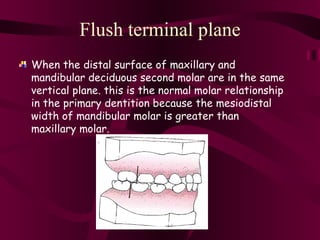
Flush terminal plane
When the distal surface of maxillary and
mandibular deciduous second molar are in the same
vertical plane. this is the normal molar relationship
in the primary dentition because the mesiodistal
width of mandibular molar is greater than
maxillary molar.
TRASIENT
 MALOCCLUSION
      IN

MIXED DENTITION
     PERIOD
Anterior deepbite

 Deepbite because of larger permanent
incisors and shedding of primary molars which
is usually alleviated following exfoliation of
second primary molars.
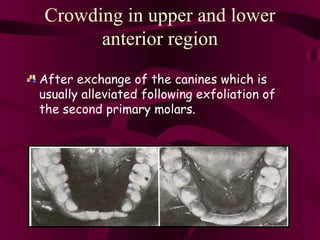
Crowding in upper and lower
      anterior region
After exchange of the canines which is
usually alleviated following exfoliation of
the second primary molars.
Ugly-Duckling Stage

It is an ugly arrangement of the anterior
teeth which is a merely a temporary phase
during the process of normal development.
Here the developing permanent canines
especially the upper canines cause mesial
displacement of the roots of permanent
incisors around the age of 8 to 9 years.
This cause a distal divergence of crown of
the incisors.
Initial end-on relationship

It is of the upper and lower first
permanent molars which is later corrected
when the lower first molar moves mesially
by utilizing the physiological spaces.
TRASIENT MALOCCLUSION

         IN

PERMANENT DENTITION
Increased Overjet

It is the horizontal distance between the
lingual aspect of the maxillary incisors and
labial aspect of mandibular incisors.
  During   the   transition   of   deciduous
anteriors with the permanent incisors
causes     increased     overjet        beyond
2mm-3mm.
Increased Overbite
It is the distance which the incisal edge of
the maxillary incisors overlap vertically
past the incisal edge of the mandibular
incisors.
During the transition of deciduous incisors
with   the   permanent     incisors   causes
increases overbite 2-3mm
References:-
• Textbook of Pedodontics - Shobha
  Tandon-
  1st edi. – pg. 113-15
• Orthodontics The Art & Science – S.I.
   Bhalajhi – 3rd edi. – pg.129-40
transient-malocclusions-pedodontics

transient-malocclusions-pedodontics

  • 2.
  • 3.
    Transient malocclusions These areself-correcting malocclusions encountered during the development of the dental occlusion, which are normal for that age.
  • 4.
    TRANSIENT MALOCCLUSIONS IN THE PREDENTATE PERIOD
  • 5.
    Retrognathic Mandible When neonataljaws are closed, there is contact only in the posterior region of the gum pads & the mandible is severely retruded in relation to the maxilla.
  • 6.
    This retrognathia isfor the most part corrected by the increased pace of forward growth of the mandible as compared to that of the maxilla seen in most people. Although the mandibular deficit (ANB) may approach 14° at birth, by adulthood it is reduced to only 2°.
  • 7.
    Infantile Swallowing  The ability to feed from the breast is present in the new born child. During the process of suckling the nipple is drawn into the mouth by negative pressure. The tongue lies over the lower gum pads & protrudes between the nipple & lower lip.
  • 8.
     The milkis directed continuously to the pharynx by an automatic peristaltic movement of the tongue & mylohyoid muscle. During the process, regular breathing continues. The milk passes between the faucial pillar & the lateral channel of the pharynx.  The infantile swallowing pattern changes to the mature or adult type during the first year of life with the introduction of solid foods in the diet.
  • 9.
    Anterior open biteof the gum pads  Clinch & Sillman have shown that there is rarely any contact between the gum pads anteriorly when they are approximated, contact being found only in the first molar region.  The open bite is corrected when the primary incisor teeth erupt.
  • 10.
    TRANSIENT MALOCCLUSIONS IN THE PRIMARY DENTITION
  • 11.
    Anterior Deep Bite Primaryteeth are upright i.e. they have an almost vertical inclination with an interincisal angle of about 150° between the maxillary and mandibular primary central incisors. The primary incisors generally erupt into a rather deep overbite. This deep bite is reduced by the eruption of the primary molars & attrition of the incisal edges of the primary anterior teeth.
  • 13.
    Spacing The primary dentitionmay classified as Type I (spaced) Type II (closed) - Baume (1950) Spaces in the primary dentition may be  generalized (developmental/physiological spaces) or  localized (primate spaces)
  • 14.
    Primate spaces:  Spacesfound mesial to the primary canine in the maxilla & distal to the primary canine in the mandible  So called because most subhuman primates have these spaces throughout life  Also known as anthropoid or simian spaces
  • 15.
    Significance of spacing Spacingin the primary dentition is essential to the normal eruption & alignment of the larger permanent successors. Failure of incisor spacing to appear before 5 years of age usually indicates crowding in the permanent dentition. Spaces that exist between the primary molars usually close by the time of eruption of the first permanent molars, whereas those between the primary incisors persist until these teeth are replaced.
  • 16.
    Edge-to-edge bite At2 years, the overjet is on average 4 mm, with a range of 2-6mm. With attrition of the teeth, lengthening of the ramus & downward & forward growth of the mandible, the overjet exhibits a steady decrease up to the age of 5 years, where an edge-to-edge incisor relationship is common. This edge-to-edge incisal relationship is corrected when the permanent incisors erupt.
  • 17.
    Flush terminal plane Whenthe distal surface of maxillary and mandibular deciduous second molar are in the same vertical plane. this is the normal molar relationship in the primary dentition because the mesiodistal width of mandibular molar is greater than maxillary molar.
  • 18.
    TRASIENT MALOCCLUSION IN MIXED DENTITION PERIOD
  • 19.
    Anterior deepbite Deepbitebecause of larger permanent incisors and shedding of primary molars which is usually alleviated following exfoliation of second primary molars.
  • 20.
    Crowding in upperand lower anterior region After exchange of the canines which is usually alleviated following exfoliation of the second primary molars.
  • 21.
    Ugly-Duckling Stage It isan ugly arrangement of the anterior teeth which is a merely a temporary phase during the process of normal development. Here the developing permanent canines especially the upper canines cause mesial displacement of the roots of permanent incisors around the age of 8 to 9 years. This cause a distal divergence of crown of the incisors.
  • 25.
    Initial end-on relationship Itis of the upper and lower first permanent molars which is later corrected when the lower first molar moves mesially by utilizing the physiological spaces.
  • 26.
    TRASIENT MALOCCLUSION IN PERMANENT DENTITION
  • 27.
    Increased Overjet It isthe horizontal distance between the lingual aspect of the maxillary incisors and labial aspect of mandibular incisors. During the transition of deciduous anteriors with the permanent incisors causes increased overjet beyond 2mm-3mm.
  • 28.
    Increased Overbite It isthe distance which the incisal edge of the maxillary incisors overlap vertically past the incisal edge of the mandibular incisors. During the transition of deciduous incisors with the permanent incisors causes increases overbite 2-3mm
  • 29.
    References:- • Textbook ofPedodontics - Shobha Tandon- 1st edi. – pg. 113-15 • Orthodontics The Art & Science – S.I. Bhalajhi – 3rd edi. – pg.129-40