
4/19/2020 1
Calcium Hydroxide Cements
Professor
DR. Tahir Ali Khan
4/19/2020 2
Rebel summarized his thoughts in the
expression “the exposed pulp is a doomed
organ”
Once pulp exposed
Consider it a lost organ
4/19/2020 3
Hermann’s (1920) introduced Calcium
hydroxide formulation
The emphasis has shifted from
“Doomed Organ” concept of an
exposed pulp
To one of hope and recovery
Calcium hydroxide
Limestone: A natural rock
Composed of calcium carbonate
(CaCO3)
The combustion of limestone between
900ºC and 1200ºC causes the following
chemical reaction:
CaCO3 → CaO + CO2
4/19/2020 4
How Calcium hydroxide formed
CaO + H2O → Ca(OH)2
Strong alkali
White odorless powder
Formula: Ca(OH)2
Molecular weight: 74.08
4/19/2020 5
4/19/2020 6
History
Introduction to dentistry by Hermann
Indicated to promote healing in many
clinical situations.
Initially Nygren (1838) used it for the
treatment of the `fistula dentalis',
Codman (1851) was the first to
attempt to preserve the involved
dental pulp.
4/19/2020 7
4/19/2020 8
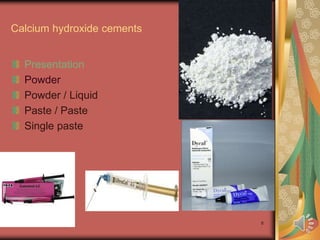
Calcium hydroxide cements
Presentation
Powder
Powder / Liquid
Paste / Paste
Single paste
Classification
Based on the setting time
Fast setting
Controlled setting
Slow setting
No setting
4/19/2020 9
Based on mechanism of setting
Self curing
Light curing
.
4/19/2020 10
Based on vehicle used
Aqueous vehicle
Water, saline, dental anesthetic, ringers
solution, aqueous suspension of
methylcellulose
Viscous vehicle
Glycerine, polyethylene glycol and
propylene glycol.
• Oily vehicles – Olive oil, oleic acid, linoleic
4/19/2020 11
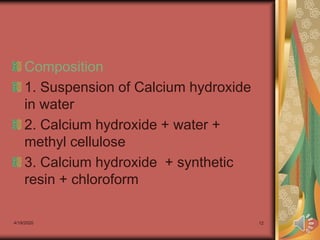
Composition
1. Suspension of Calcium hydroxide
in water
2. Calcium hydroxide + water +
methyl cellulose
3. Calcium hydroxide + synthetic
resin + chloroform
4/19/2020 12
4/19/2020 13
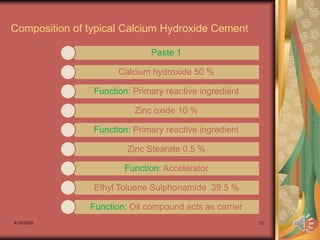
Composition of typical Calcium Hydroxide Cement
Paste 1
Calcium hydroxide 50 %
Function: Primary reactive ingredient
Zinc oxide 10 %
Function: Primary reactive ingredient
Zinc Stearate 0.5 %
Function: Accelerator
Ethyl Toluene Sulphonamide 39.5 %
Function: Oil compound acts as carrier
4/19/2020 14
Composition of typical Calcium hydroxide cement
Paste 2
Glycol Salicylate 40 %
Function: Primary reactive ingredient
Titanium dioxide
Calcium Sulphate
Calcium Tungstate
Function: Inert fillers, pigments and
radio pacifiers
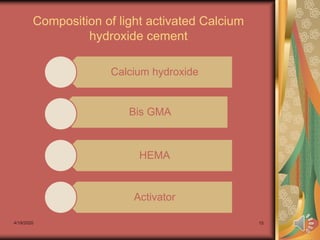
Composition of light activated Calcium
hydroxide cement
Calcium hydroxide
Bis GMA
HEMA
Activator
4/19/2020 15
4/19/2020 16
Properties
Manipulative properties
The mixed material have very low
viscosity
Setting can be relatively slow for some
products
Moisture has a dramatic effect on the rate of
setting however, material can set within few
seconds of being placed in cavity
4/19/2020 17
Setting of light cured material is
under the operator control
During setting
Temperature rises due to
Heating effect of light source
Reaction is Exothermic
4/19/2020 18
Mechanical properties
Weak cement
Compressive strength is 20 MPa
4/19/2020 19
At 7 minutes
The compressive strength : 6 MPa
The tensile strength :1.5 MPa
At 1 hour
The compressive strength :10 MPa
The tensile strength:1.5 MPa (200 psi)
At 24 hours
The compressive strength :14 to 20 MPa
The tensile strength :1.7 to 2 MPa
Thin films become resistant to 8 Mpa penetration
force in 90 seconds
At 37 deree celciuos plastic flow without fracture
occurs
4/19/2020 20
Biocompatibility
It is sufficiently biocompatible
To be placed adjacent to the pulp and capable of
destroying any remaining bacteria
4/19/2020 21
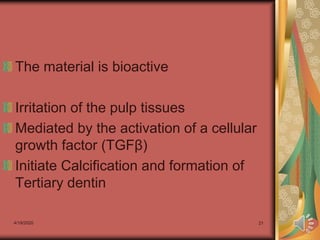
The material is bioactive
Irritation of the pulp tissues
Mediated by the activation of a cellular
growth factor (TGFβ)
Initiate Calcification and formation of
Tertiary dentin
4/19/2020 22
Solubility
Set materials have relatively high
solubility in aqueous media
Resin based Calcium hydroxide cement
are less soluble than conventional
products but still Calcium hydroxide
release remain great enough
4/19/2020 23
Application
As lining and
base agent
As a pulp
capping agent
Therapeutic root
canal sealer
4/19/2020 24
4/19/2020 25
4/19/2020 26
4/19/2020 27
4/19/2020 28
4/19/2020 29
Advantages
Easy manipulation,
Rapid hardening in thin layers,
Good sealing characteristics, and
Beneficial effects on carious dentin and
exposed pulp.
4/19/2020 30
Disadvantages
Show low strength even when fully set,
Exhibit plastic deformation,
Are weakened by exposure to moisture, and
Will dissolve under acidic conditions and if
marginal leakage occurs

Calcium hydroxide cements

  • 1.
    4/19/2020 1 Calcium HydroxideCements Professor DR. Tahir Ali Khan
  • 2.
    4/19/2020 2 Rebel summarizedhis thoughts in the expression “the exposed pulp is a doomed organ” Once pulp exposed Consider it a lost organ
  • 3.
    4/19/2020 3 Hermann’s (1920)introduced Calcium hydroxide formulation The emphasis has shifted from “Doomed Organ” concept of an exposed pulp To one of hope and recovery
  • 4.
    Calcium hydroxide Limestone: Anatural rock Composed of calcium carbonate (CaCO3) The combustion of limestone between 900ºC and 1200ºC causes the following chemical reaction: CaCO3 → CaO + CO2 4/19/2020 4
  • 5.
    How Calcium hydroxideformed CaO + H2O → Ca(OH)2 Strong alkali White odorless powder Formula: Ca(OH)2 Molecular weight: 74.08 4/19/2020 5
  • 6.
    4/19/2020 6 History Introduction todentistry by Hermann Indicated to promote healing in many clinical situations. Initially Nygren (1838) used it for the treatment of the `fistula dentalis', Codman (1851) was the first to attempt to preserve the involved dental pulp.
  • 7.
  • 8.
    4/19/2020 8 Calcium hydroxidecements Presentation Powder Powder / Liquid Paste / Paste Single paste
  • 9.
    Classification Based on thesetting time Fast setting Controlled setting Slow setting No setting 4/19/2020 9
  • 10.
    Based on mechanismof setting Self curing Light curing . 4/19/2020 10
  • 11.
    Based on vehicleused Aqueous vehicle Water, saline, dental anesthetic, ringers solution, aqueous suspension of methylcellulose Viscous vehicle Glycerine, polyethylene glycol and propylene glycol. • Oily vehicles – Olive oil, oleic acid, linoleic 4/19/2020 11
  • 12.
    Composition 1. Suspension ofCalcium hydroxide in water 2. Calcium hydroxide + water + methyl cellulose 3. Calcium hydroxide + synthetic resin + chloroform 4/19/2020 12
  • 13.
    4/19/2020 13 Composition oftypical Calcium Hydroxide Cement Paste 1 Calcium hydroxide 50 % Function: Primary reactive ingredient Zinc oxide 10 % Function: Primary reactive ingredient Zinc Stearate 0.5 % Function: Accelerator Ethyl Toluene Sulphonamide 39.5 % Function: Oil compound acts as carrier
  • 14.
    4/19/2020 14 Composition oftypical Calcium hydroxide cement Paste 2 Glycol Salicylate 40 % Function: Primary reactive ingredient Titanium dioxide Calcium Sulphate Calcium Tungstate Function: Inert fillers, pigments and radio pacifiers
  • 15.
    Composition of lightactivated Calcium hydroxide cement Calcium hydroxide Bis GMA HEMA Activator 4/19/2020 15
  • 16.
    4/19/2020 16 Properties Manipulative properties Themixed material have very low viscosity Setting can be relatively slow for some products Moisture has a dramatic effect on the rate of setting however, material can set within few seconds of being placed in cavity
  • 17.
    4/19/2020 17 Setting oflight cured material is under the operator control During setting Temperature rises due to Heating effect of light source Reaction is Exothermic
  • 18.
    4/19/2020 18 Mechanical properties Weakcement Compressive strength is 20 MPa
  • 19.
    4/19/2020 19 At 7minutes The compressive strength : 6 MPa The tensile strength :1.5 MPa At 1 hour The compressive strength :10 MPa The tensile strength:1.5 MPa (200 psi) At 24 hours The compressive strength :14 to 20 MPa The tensile strength :1.7 to 2 MPa Thin films become resistant to 8 Mpa penetration force in 90 seconds At 37 deree celciuos plastic flow without fracture occurs
  • 20.
    4/19/2020 20 Biocompatibility It issufficiently biocompatible To be placed adjacent to the pulp and capable of destroying any remaining bacteria
  • 21.
    4/19/2020 21 The materialis bioactive Irritation of the pulp tissues Mediated by the activation of a cellular growth factor (TGFβ) Initiate Calcification and formation of Tertiary dentin
  • 22.
    4/19/2020 22 Solubility Set materialshave relatively high solubility in aqueous media Resin based Calcium hydroxide cement are less soluble than conventional products but still Calcium hydroxide release remain great enough
  • 23.
    4/19/2020 23 Application As liningand base agent As a pulp capping agent Therapeutic root canal sealer
  • 24.
  • 25.
  • 26.
  • 27.
  • 28.
  • 29.
    4/19/2020 29 Advantages Easy manipulation, Rapidhardening in thin layers, Good sealing characteristics, and Beneficial effects on carious dentin and exposed pulp.
  • 30.
    4/19/2020 30 Disadvantages Show lowstrength even when fully set, Exhibit plastic deformation, Are weakened by exposure to moisture, and Will dissolve under acidic conditions and if marginal leakage occurs

Editor's Notes

  • #5 Limestone: A natural rock mainly composed of calcium carbonate (CaCO3) which forms when the calcium carbonate solution existing in mountain and sea water becomes crystallized The combustion of limestone between 900ºC and 1200ºC causes the following chemical reaction: CaCO3 → CaO + CO2
  • #6 Can be formed by the reaction of calcium oxide The calcium oxide (CaO) (quicklime) contacts water, the following reaction occurs Calcium hydroxide is a white odorless powde
  • #7 the initial reference to its use has been attributed to Nygren (1838) for the treatment of the `fistula dentalis',
  • #12 Aqueous vehicle Water, saline, dental anesthetic, ringers solution, aqueous suspension of methylcellulose Viscous vehicle Glycerine, polyethylene glycol and propylene glycol. • Oily vehicles – Olive oil, oleic acid, linoleic and isosteric acid
  • #16 DMAEMA
  • #21 Calcium hydroxide acts as Antibacterial And got alkaline pH Calcium hydroxide is readily leached out Generating an alkaline environment in the area surrounding the cement This is thought to be responsible for the proven antibacterial properties of these materials The lethal effects of calcium hydroxide on bacterial cells are probably due to protein denaturation and damage to DNA and cytoplasmic membranes.
  • #22 The material is bioactive Initiate Calcification and formation of Tertiary dentin due to Irritation of the pulp tissues by the cement, possibly mediated by the Activation of a cellular growth factor (TGFβ)