Density Functional and Dynamical
Mean-Field Theory (DFT+DMFT) method
and its application to real materials
Vladimir I. Anisimov
Institute of Metal Physics
Ekaterinburg, Russia
Contents
Method formulation:
Dynamical Mean-Field Theory (DMFT)
Wannier functions as localized orbitals basis
Determination of Hamiltonian parameters
“Constrained DFT” calculations for Coulomb
interaction parameters
DFT+DMFT calculation scheme
Contents
Results of DFT+DMFT calculations:
Strongly correlated metal SrVO3
Metal-insulator transition in V2O3
Heavy fermions in d-system Li2VO4
Charge transfer insulator NiO
Metal-insulator transition with pressure in MnO
Correlated covalent insulators FeSi and FeSb2
Novel superconductors LaOFeAs, BaFe2As2
Jahn-Teller distortions in KCuF3
f-electrons localization in Ce
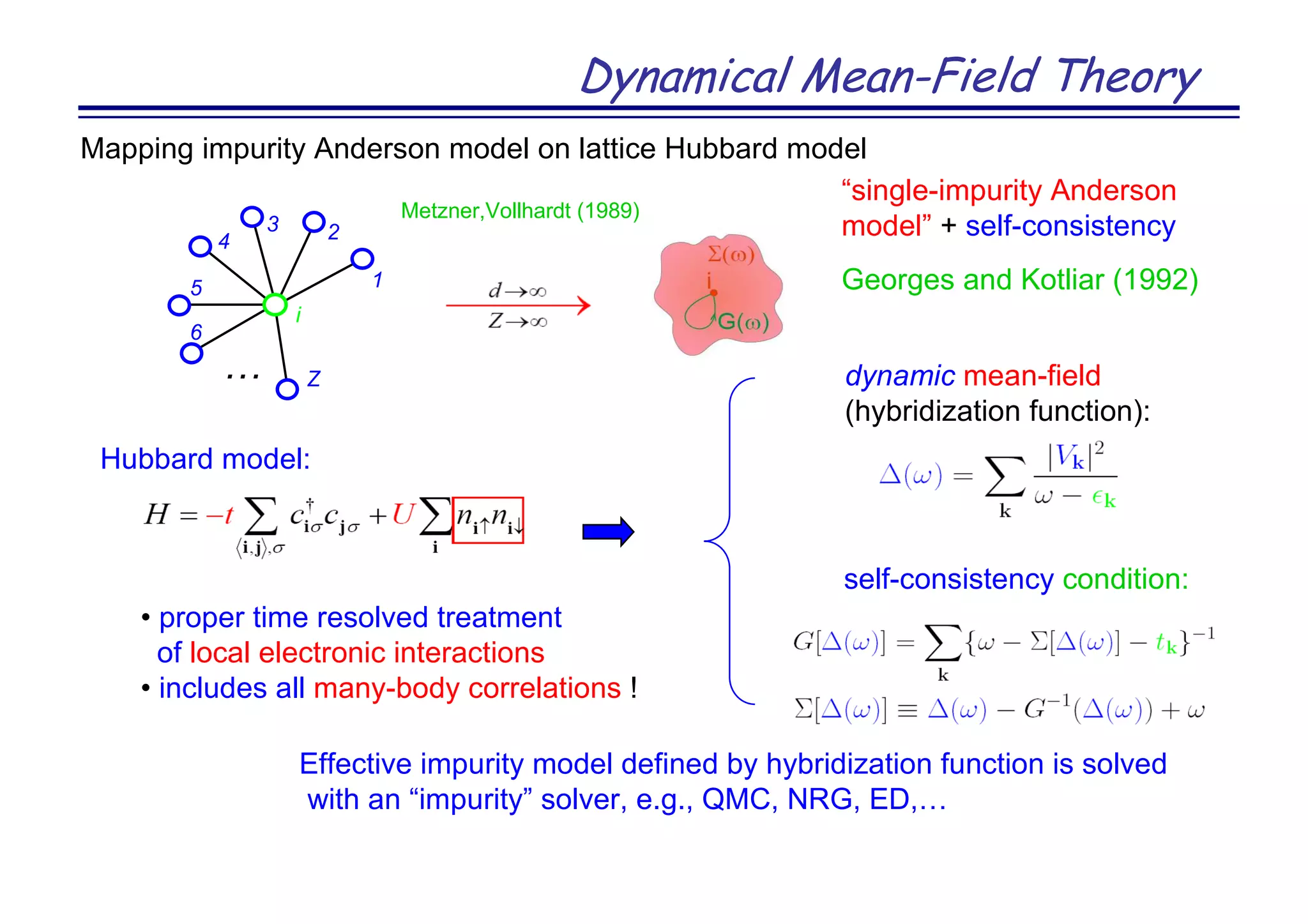
Dynamical Mean-Field Theory
i
23
4
5
6
1
Z
• proper time resolved treatment
of local electronic interactions
• includes all many-body correlations !
Hubbard model:
“single-impurity Anderson
model” + self-consistency
Georges and Kotliar (1992)
self-consistency condition:
dynamic mean-field
(hybridization function):
Effective impurity model defined by hybridization function is solved
with an “impurity” solver, e.g., QMC, NRG, ED,
Metzner,Vollhardt (1989)
Mapping impurity Anderson model on lattice Hubbard model
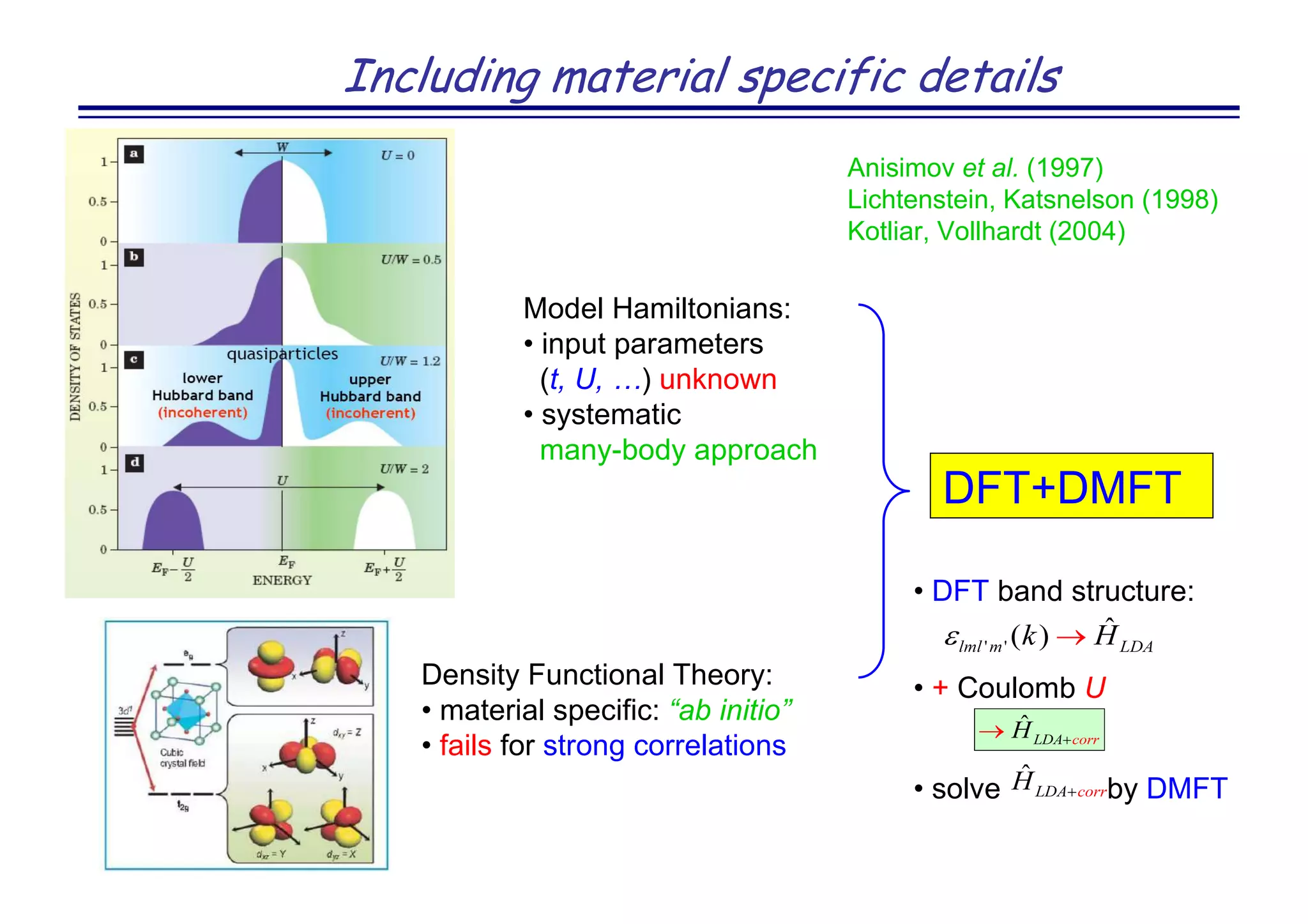
Including material specific details
DFT+DMFT
Anisimov et al. (1997)
Lichtenstein, Katsnelson (1998)
Kotliar, Vollhardt (2004)
Density Functional Theory:
• material specific: “ab initio”
• fails for strong correlations
Model Hamiltonians:
• input parameters
(t, U, ) unknown
• systematic
many-body approach
• DFT band structure:
• + Coulomb U
• solve by DMFT
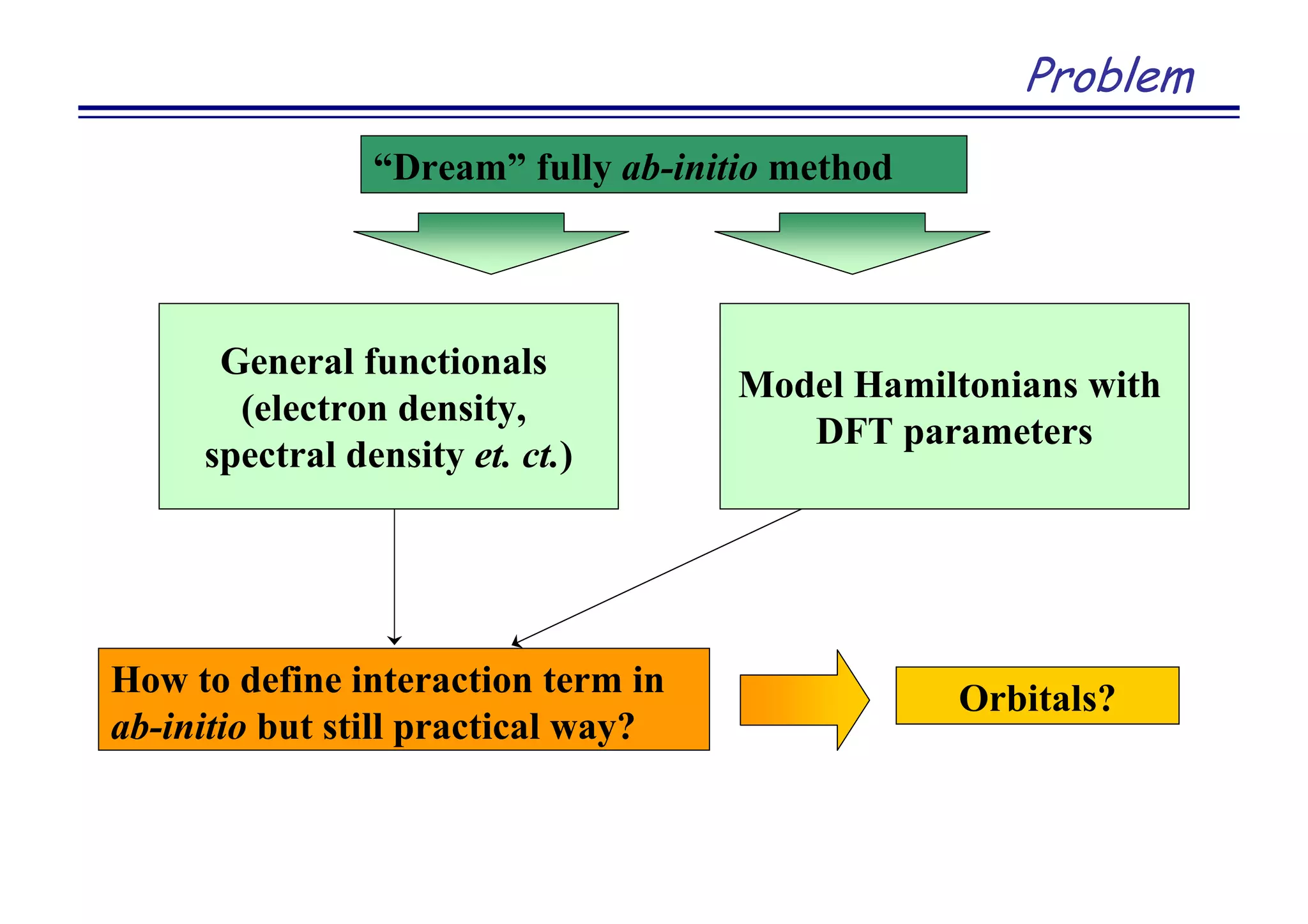
General functionals
(electron density,
spectral density et. ct.)
Model Hamiltonians with
DFT parameters
Problem
“Dream” fully ab-initio method
How to define interaction term in
ab-initio but still practical way?
Orbitals?
Why Wannier Functions?
Advantages of Wannier function basis set:
<Explicit form of the orbitals
forming complete basis set
< Localized orbitals
< Orbitals are centered on atoms
Wannier functions in real space [1]:
[1] G.H. Wannier, Phys. Rev. 52, 192 (1937)
Bloch functions
like in Hubbard model
Uncertainty of WF definition
for a many-band case:
Unitary matrix
Wannier functions and projection
Eigenvector
element
WF in k-space – projection of the set of trial functions [2] (atomic
orbitals) into Bloch functions subspace :
Bloch functions in DFT basis
(LMTO or plane waves):
coefficients of WF expansion in LMTO-orbitals:
Bloch sums of
LMTO orbitals
[2] D.Vanderbildt et al, Phys. Rev.B 56, 12847 (1997)
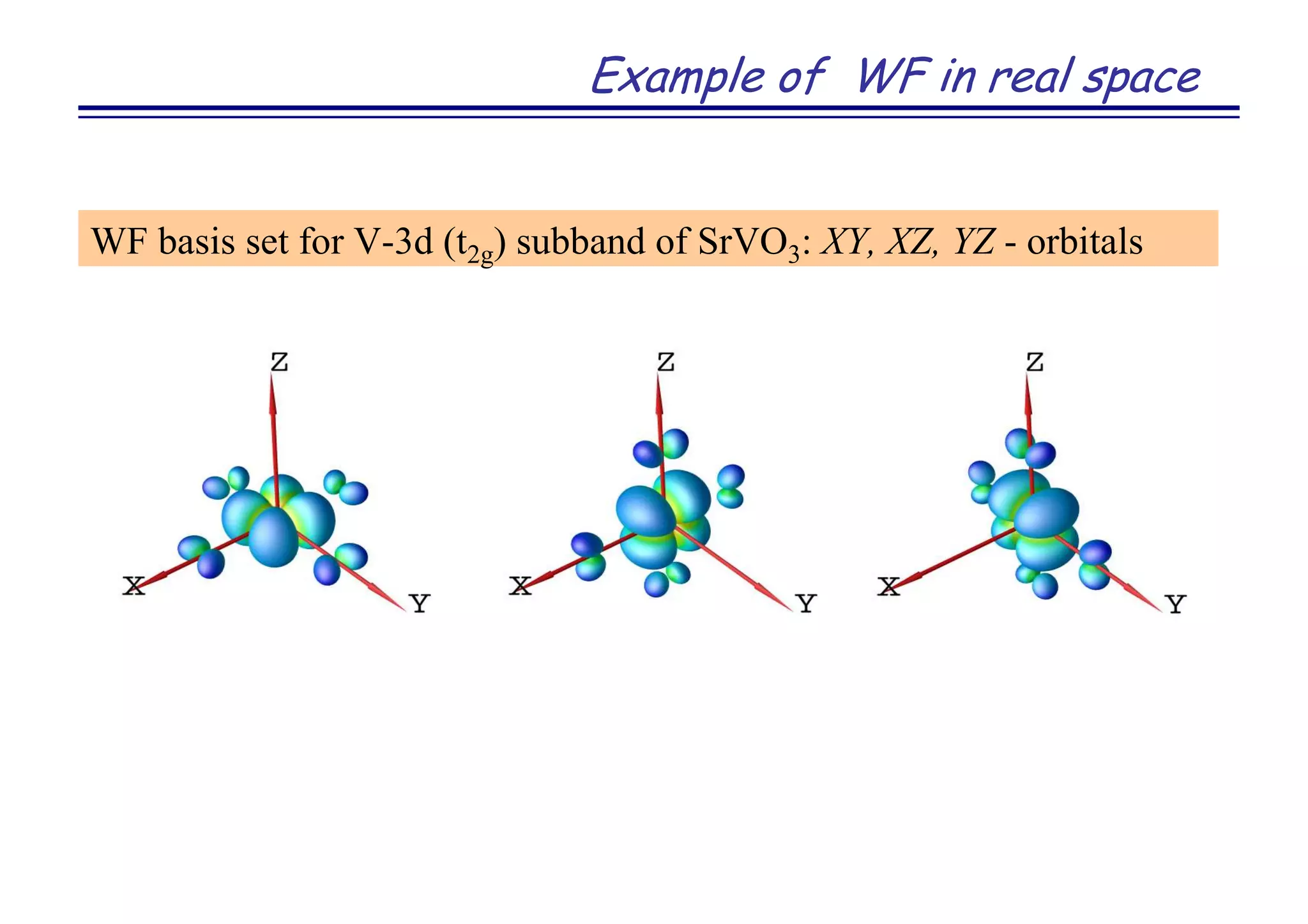
Example of WF in real space
WF basis set for V-3d (t2g) subband of SrVO3: XY, XZ, YZ - orbitals
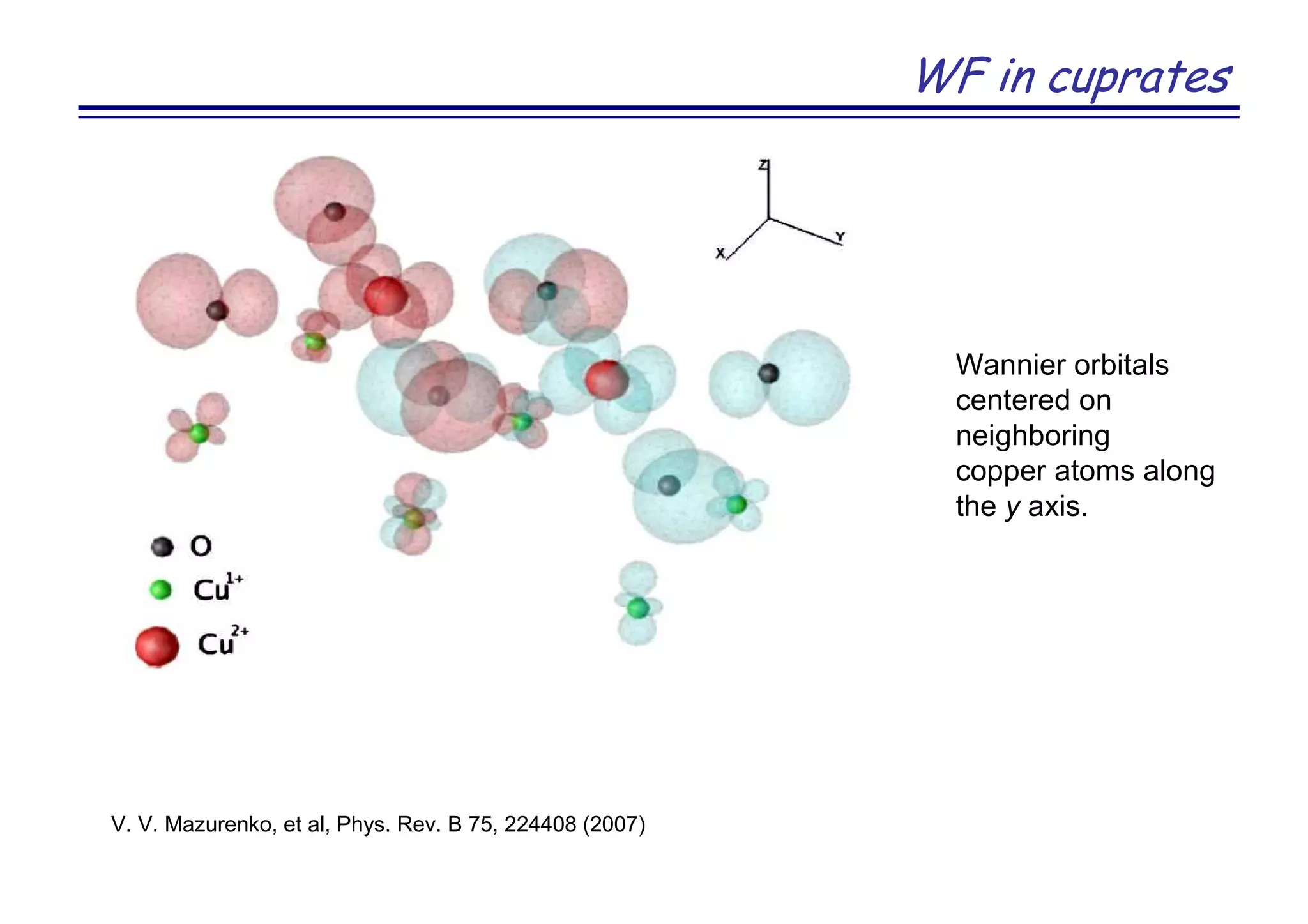
WF in cuprates
V. V. Mazurenko, et al, Phys. Rev. B 75, 224408 (2007)
Wannier orbitals
centered on
neighboring
copper atoms along
the y axis.
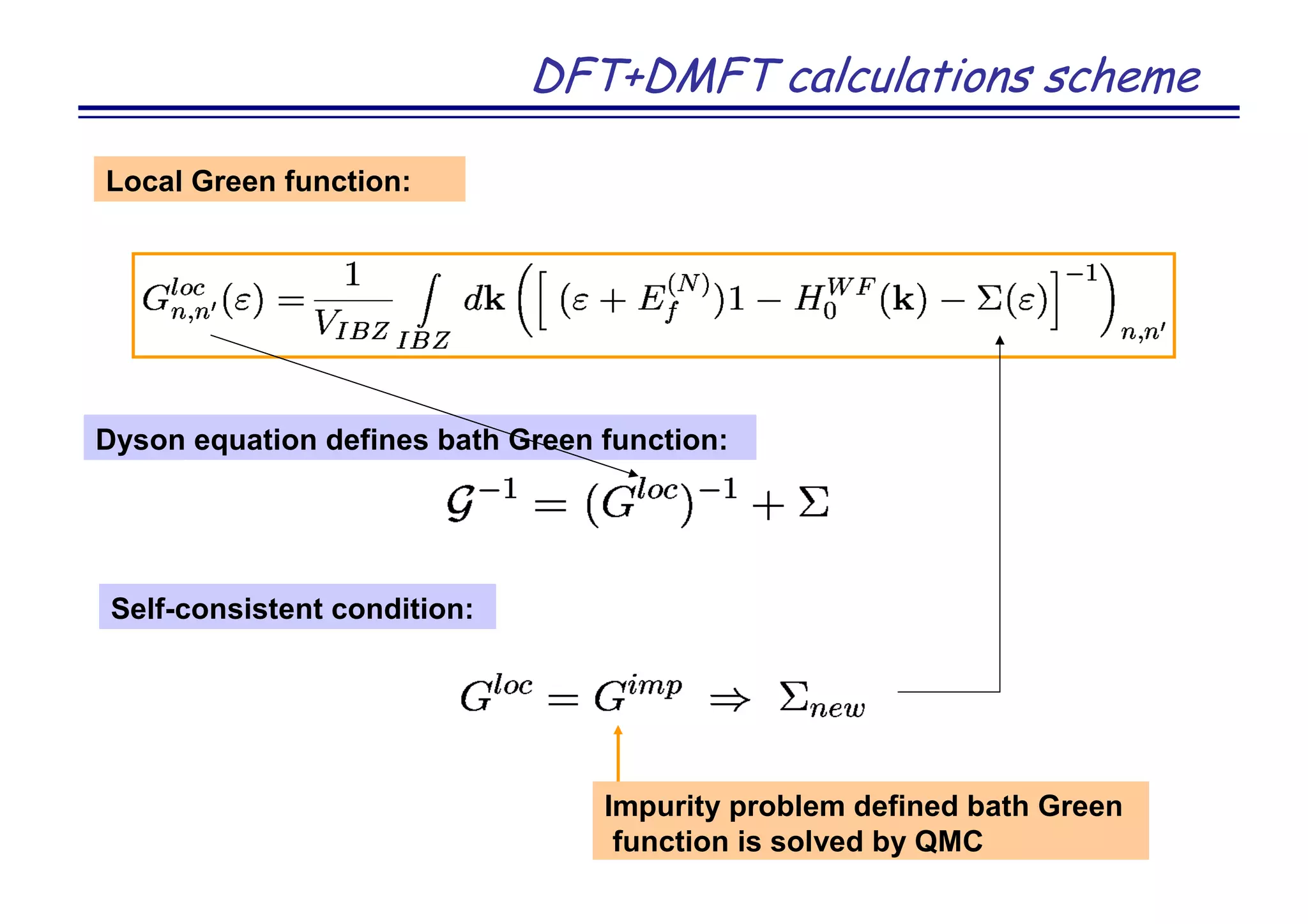
DFT+DMFT calculations scheme
Local Green function:
Dyson equation defines bath Green function:
Self-consistent condition:
Impurity problem defined bath Green
function is solved by QMC
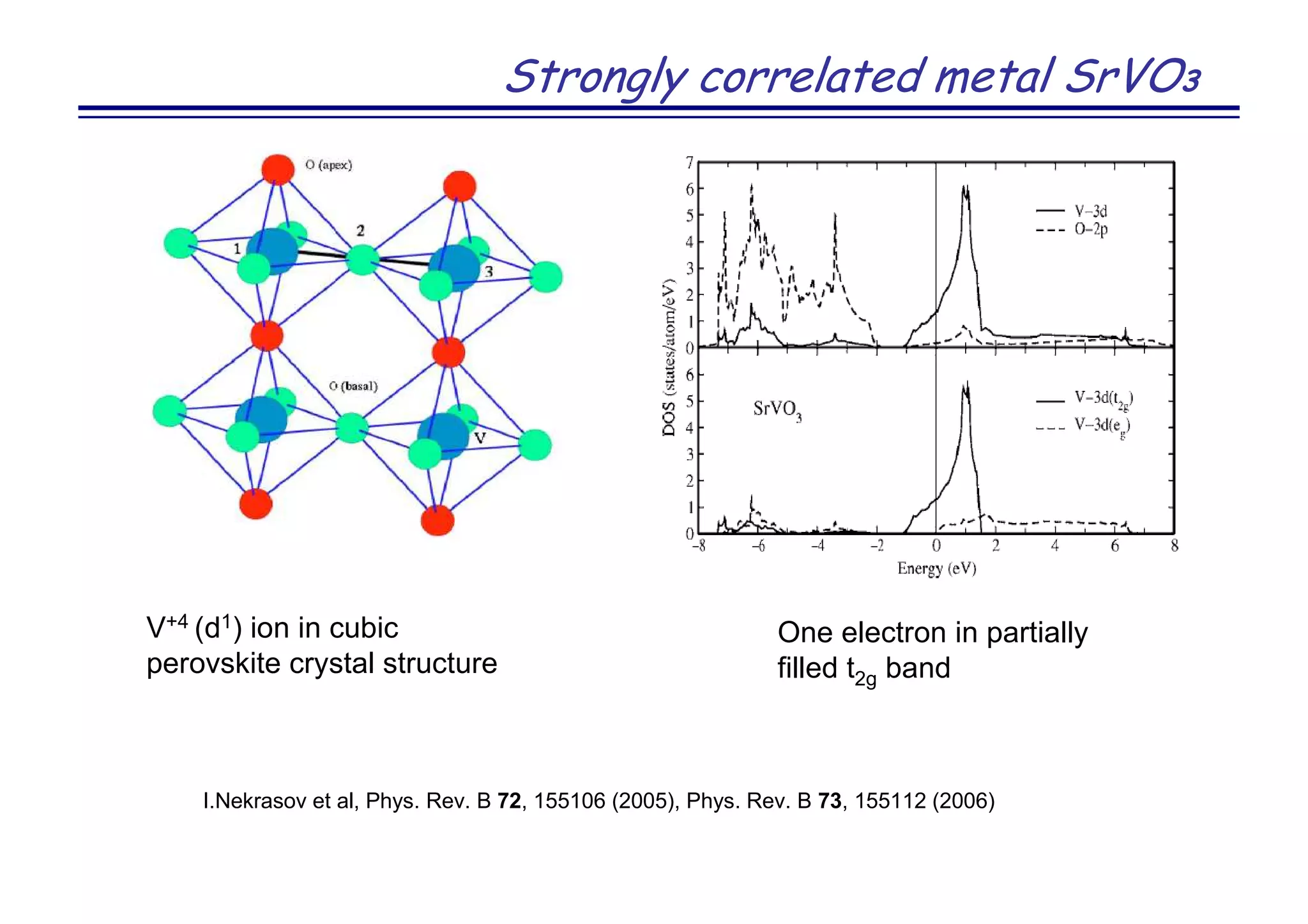
Strongly correlated metal SrVO3
V+4 (d1) ion in cubic
perovskite crystal structure
One electron in partially
filled t2g band
I.Nekrasov et al, Phys. Rev. B 72, 155106 (2005), Phys. Rev. B 73, 155112 (2006)
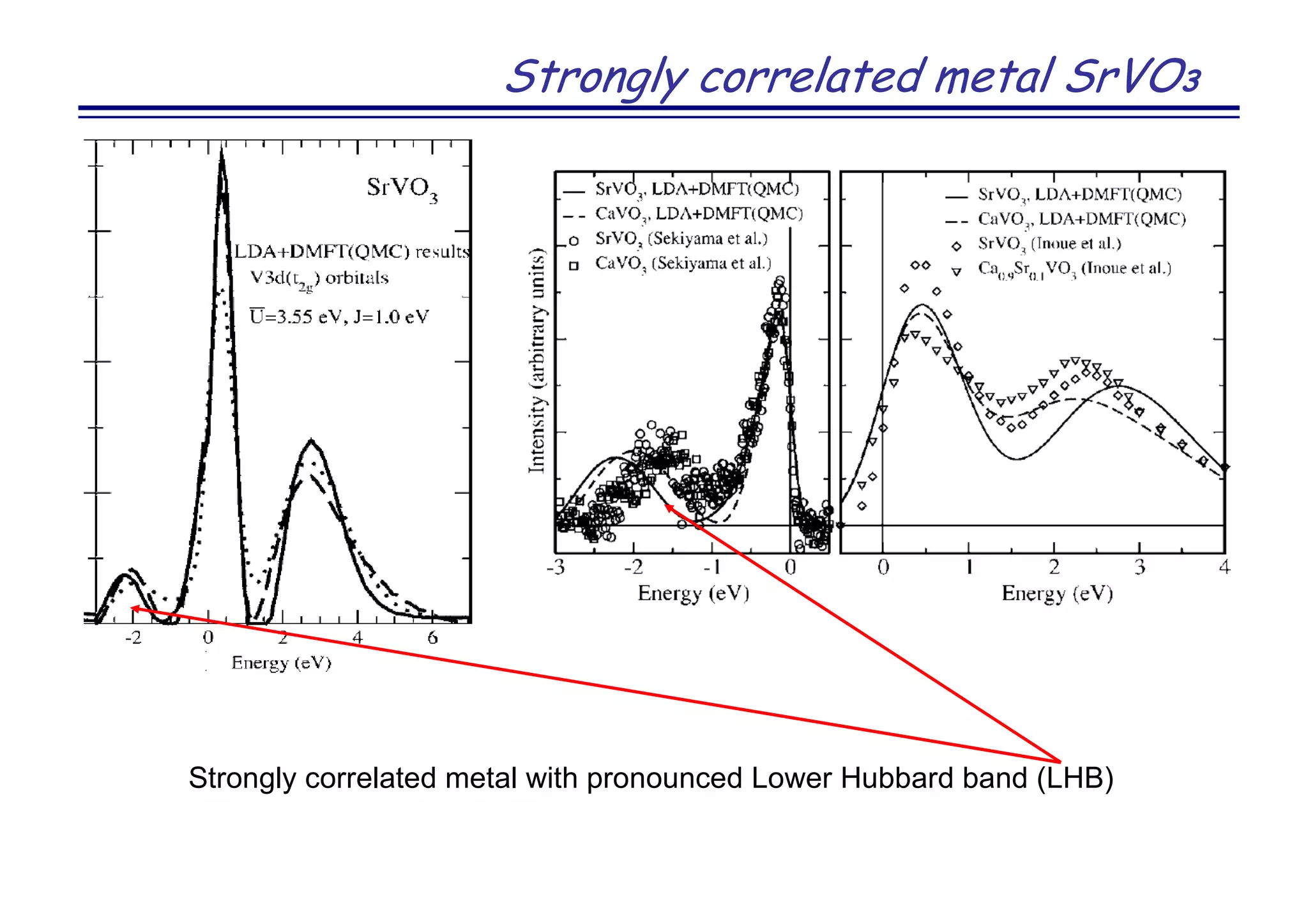
Strongly correlated metal SrVO3
Strongly correlated metal with pronounced Lower Hubbard band (LHB)
Strongly correlated metal SrVO3
[ ] 1
0 (k)H-)(-TrIm
1
),(AfunctionSpectral
−
Σ−= ωω
π
ωk
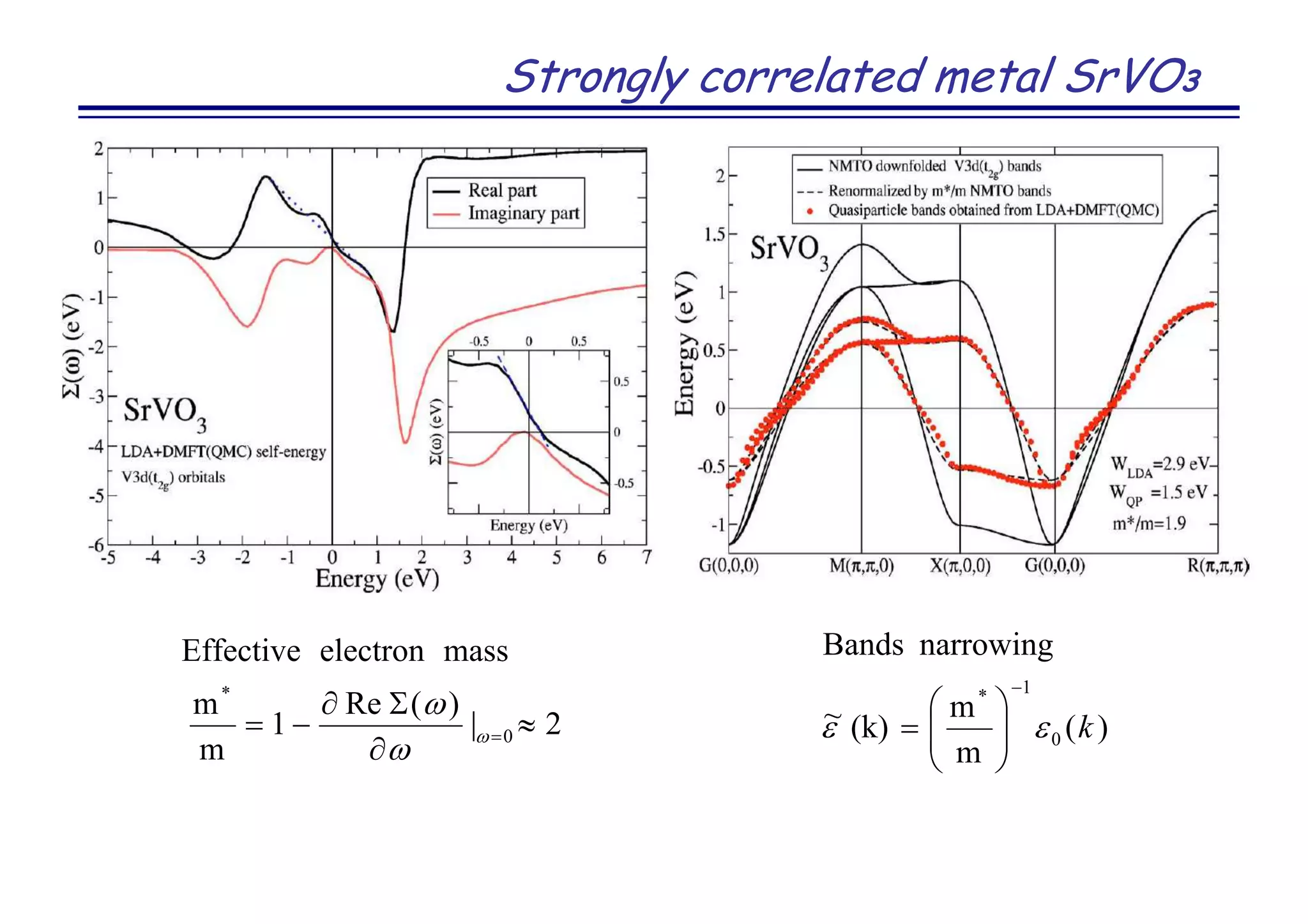
Strongly correlated metal SrVO3
2|
)(Re
1
m
m
masselectronEffective
0
*
≈
∂
Σ∂
−= =ω
ω
ω
)(
m
m
(k)~
narrowingBands
0
1*
kεε
−






=
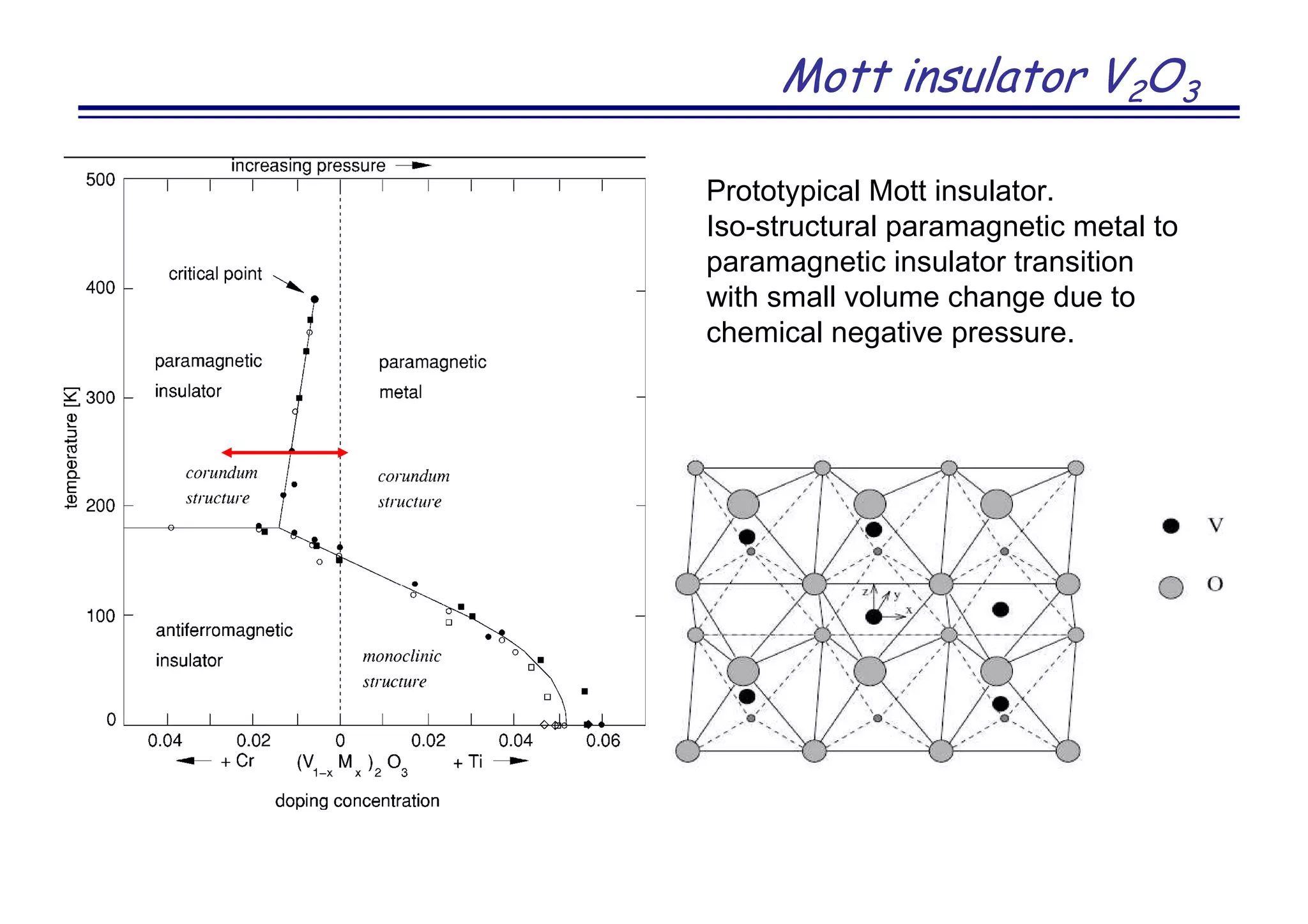
Mott insulator V2O3
Prototypical Mott insulator.
Iso-structural paramagnetic metal to
paramagnetic insulator transition
with small volume change due to
chemical negative pressure.
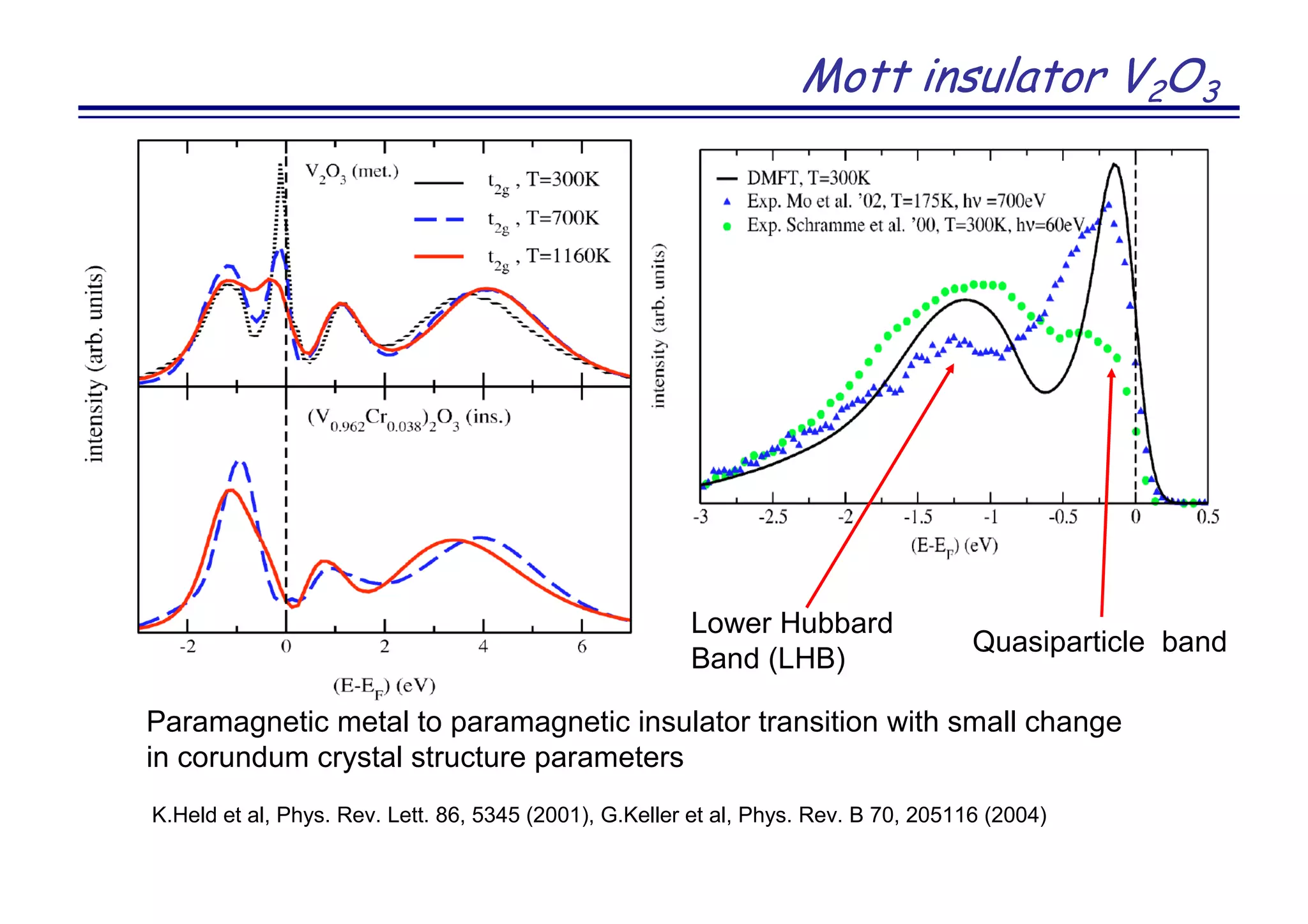
Mott insulator V2O3
Paramagnetic metal to paramagnetic insulator transition with small change
in corundum crystal structure parameters
Lower Hubbard
Band (LHB)
Quasiparticle band
K.Held et al, Phys. Rev. Lett. 86, 5345 (2001), G.Keller et al, Phys. Rev. B 70, 205116 (2004)
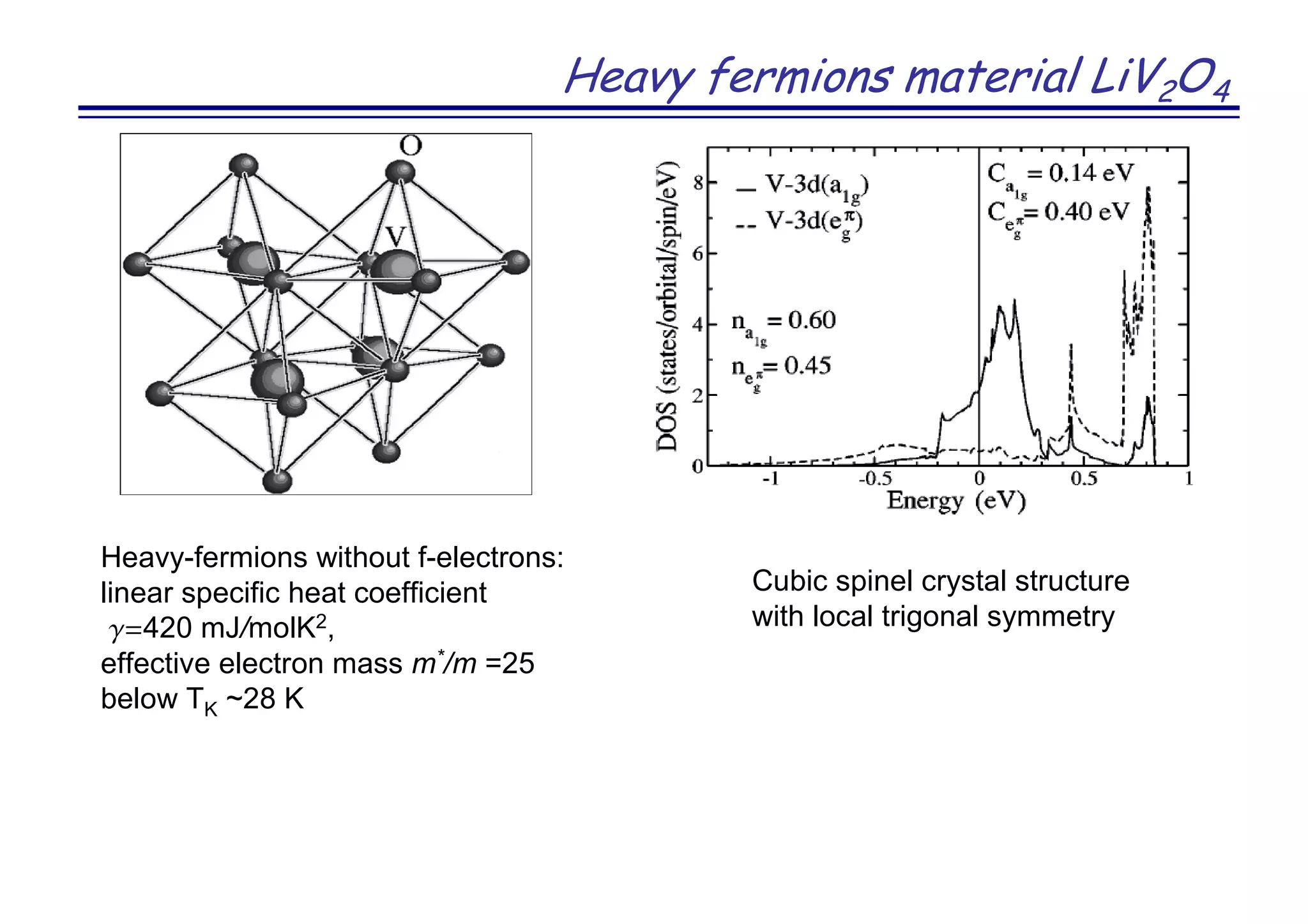
Heavy fermions material LiV2O4
Heavy-fermions without f-electrons:
linear specific heat coefficient
g=420 mJ/molK2,
effective electron mass m*/m =25
below TK ~28 K
Cubic spinel crystal structure
with local trigonal symmetry
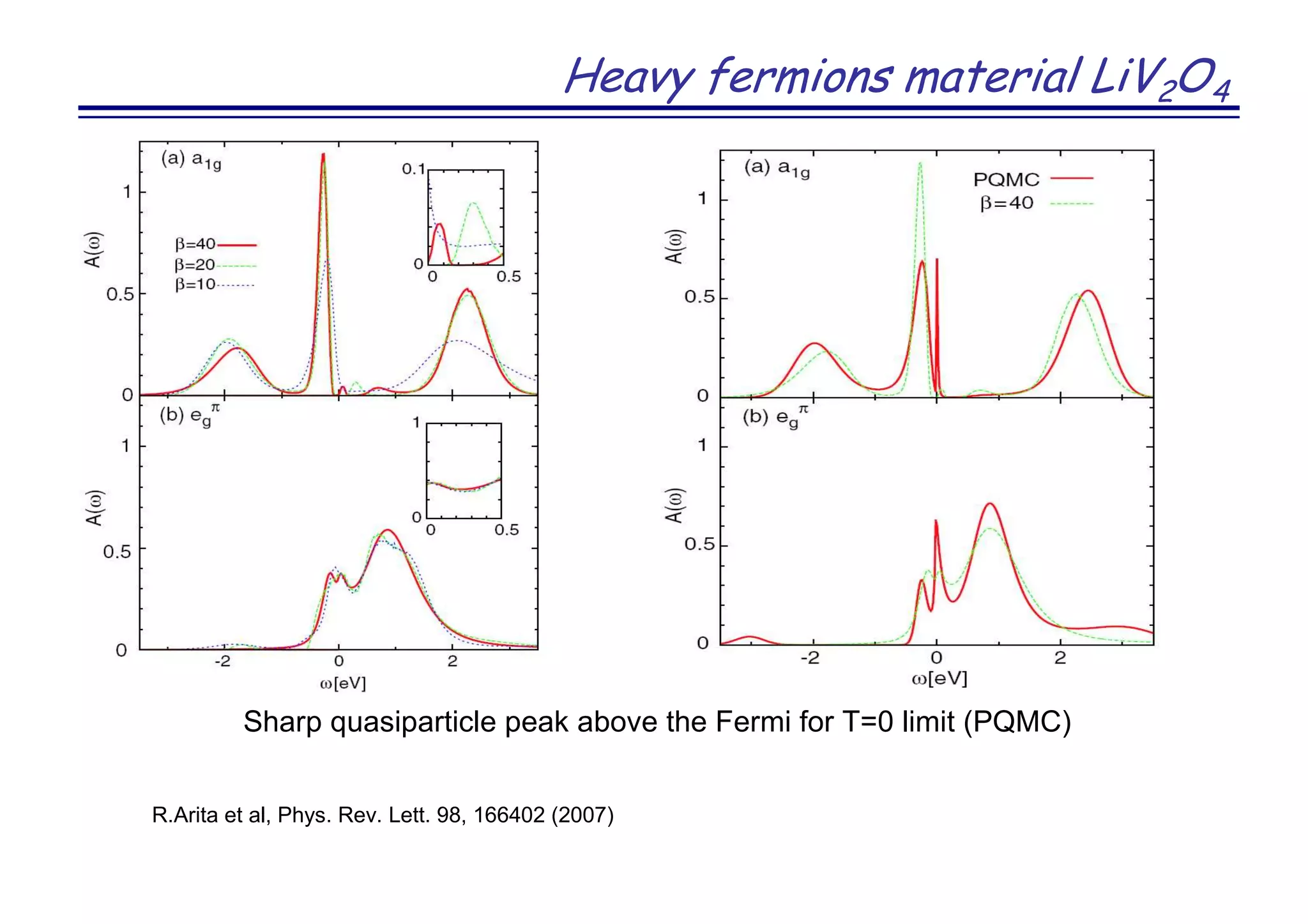
Heavy fermions material LiV2O4
R.Arita et al, Phys. Rev. Lett. 98, 166402 (2007)
Sharp quasiparticle peak above the Fermi for T=0 limit (PQMC)
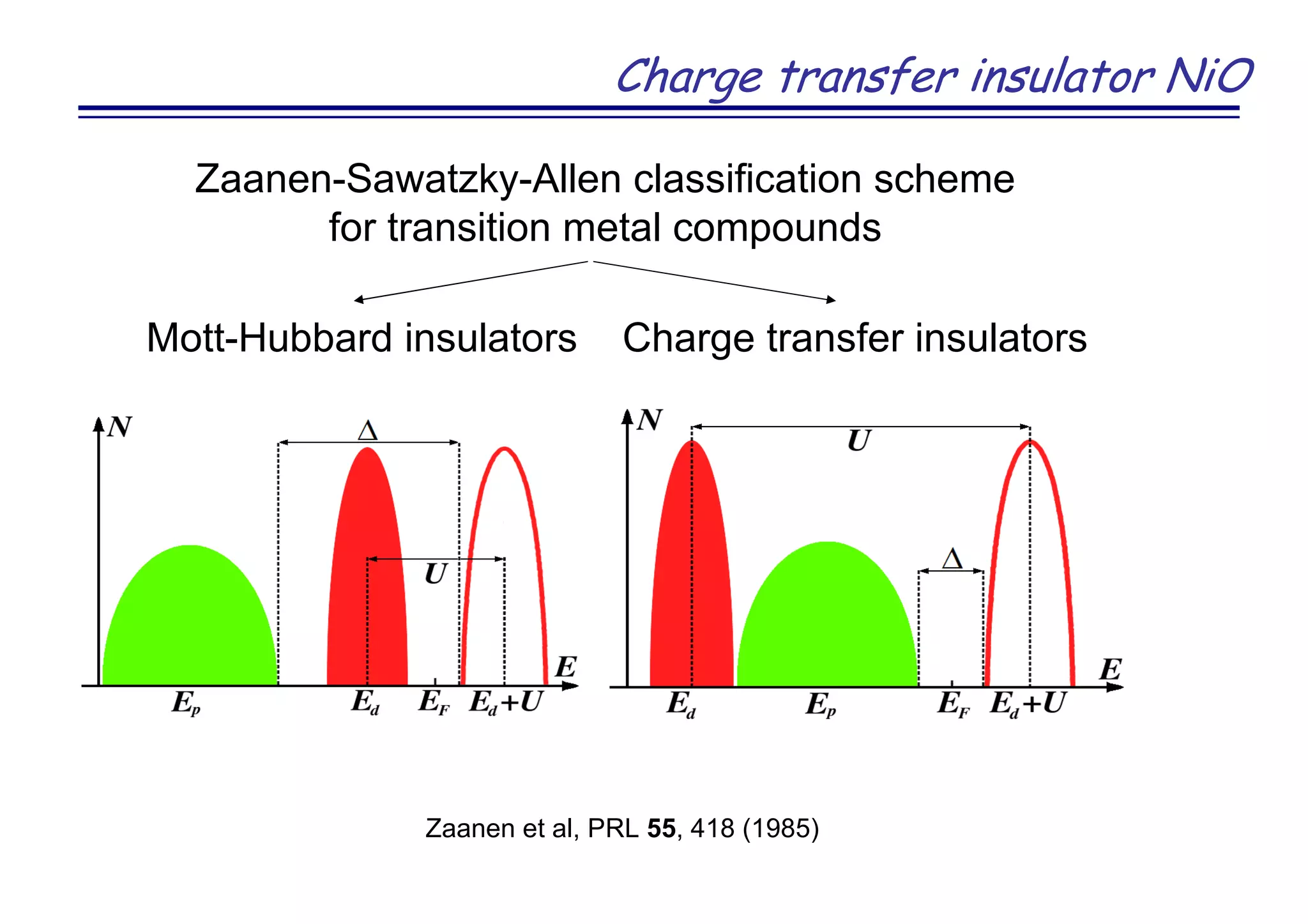
Charge transfer insulator NiO
Zaanen-Sawatzky-Allen classification scheme
for transition metal compounds
Mott-Hubbard insulators Charge transfer insulators
Zaanen et al, PRL 55, 418 (1985)
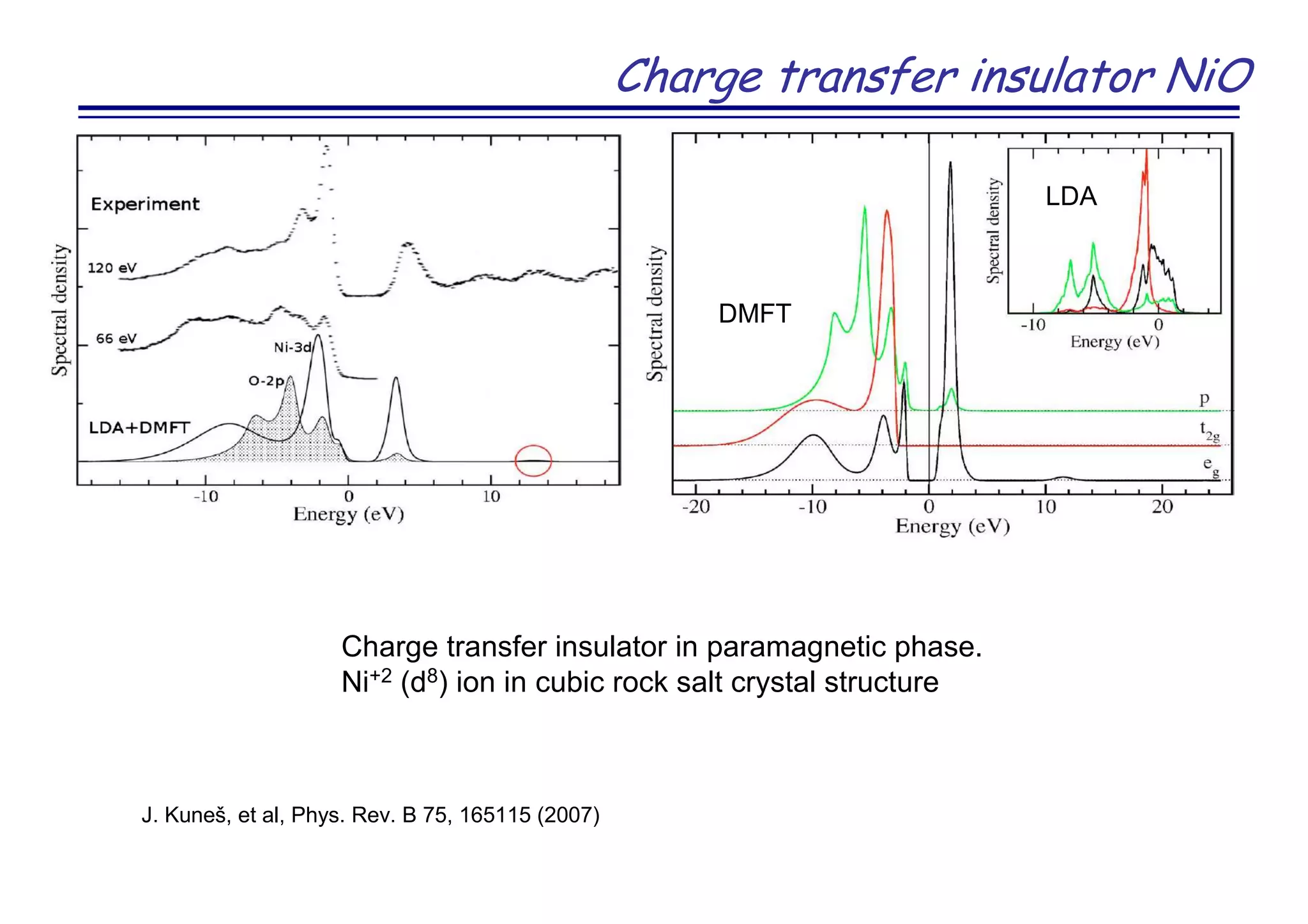
Charge transfer insulator NiO
Charge transfer insulator in paramagnetic phase.
Ni+2 (d8) ion in cubic rock salt crystal structure
J. Kuneš, et al, Phys. Rev. B 75, 165115 (2007)
LDA
DMFT
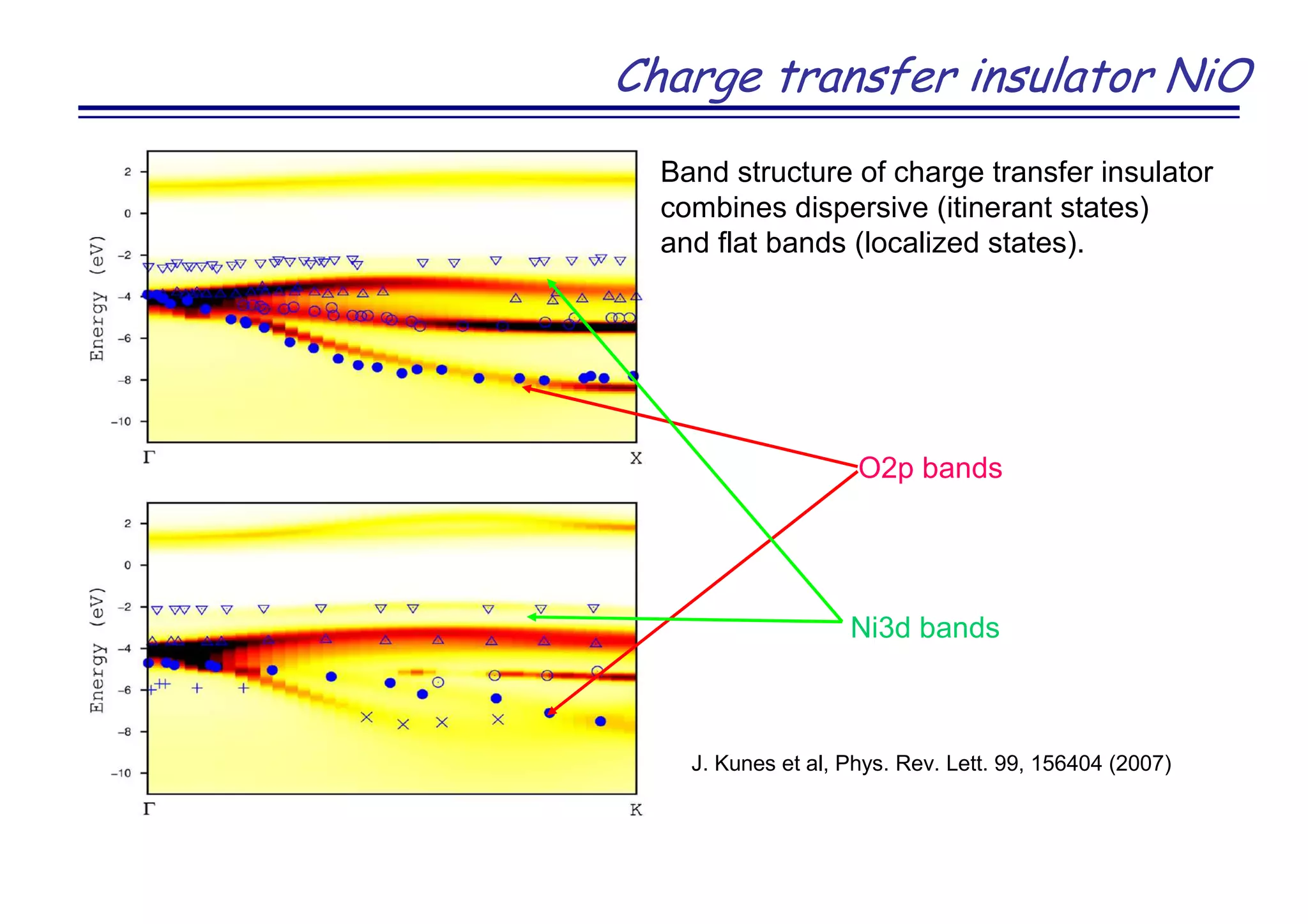
Charge transfer insulator NiO
Band structure of charge transfer insulator
combines dispersive (itinerant states)
and flat bands (localized states).
O2p bands
Ni3d bands
J. Kunes et al, Phys. Rev. Lett. 99, 156404 (2007)
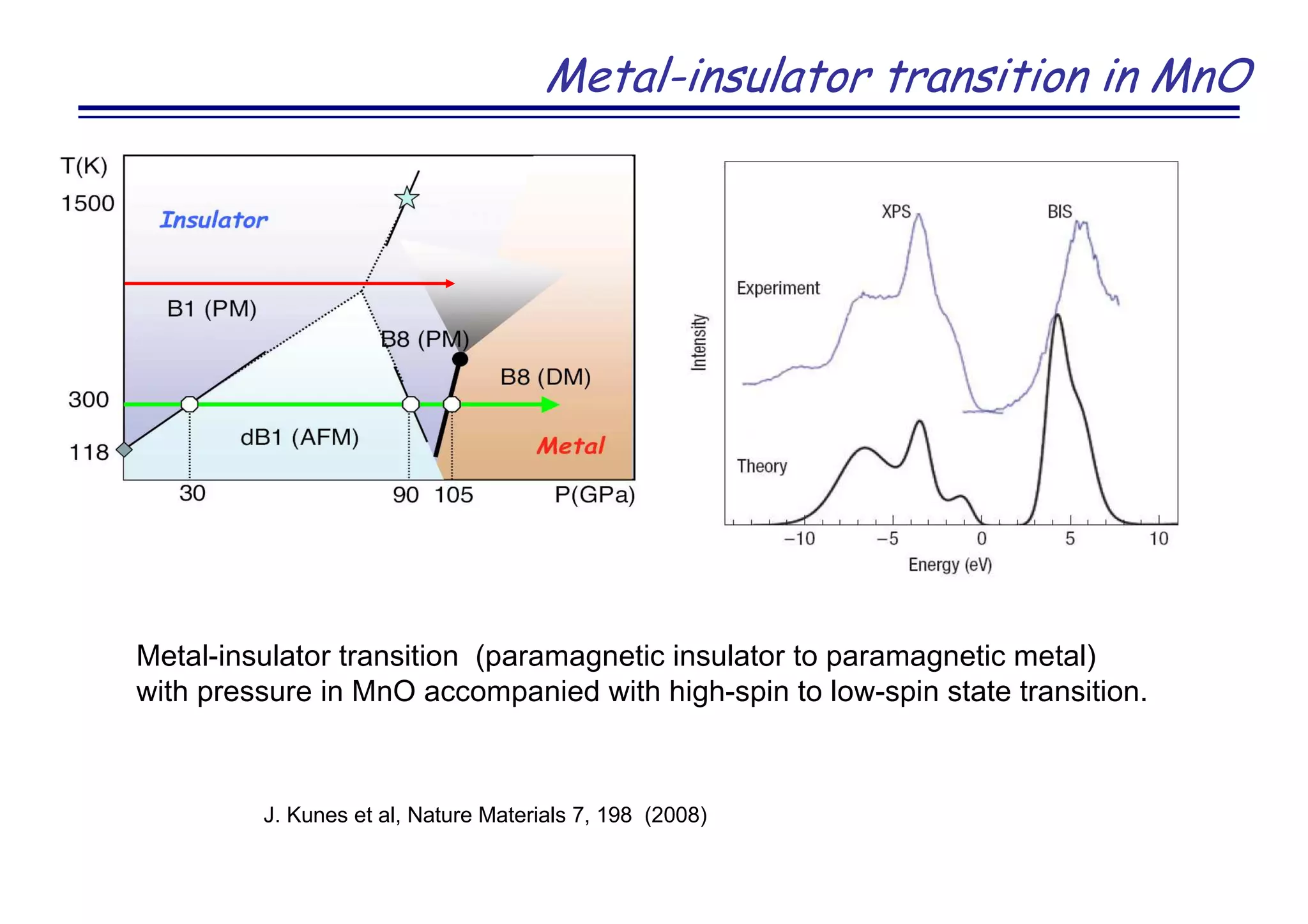
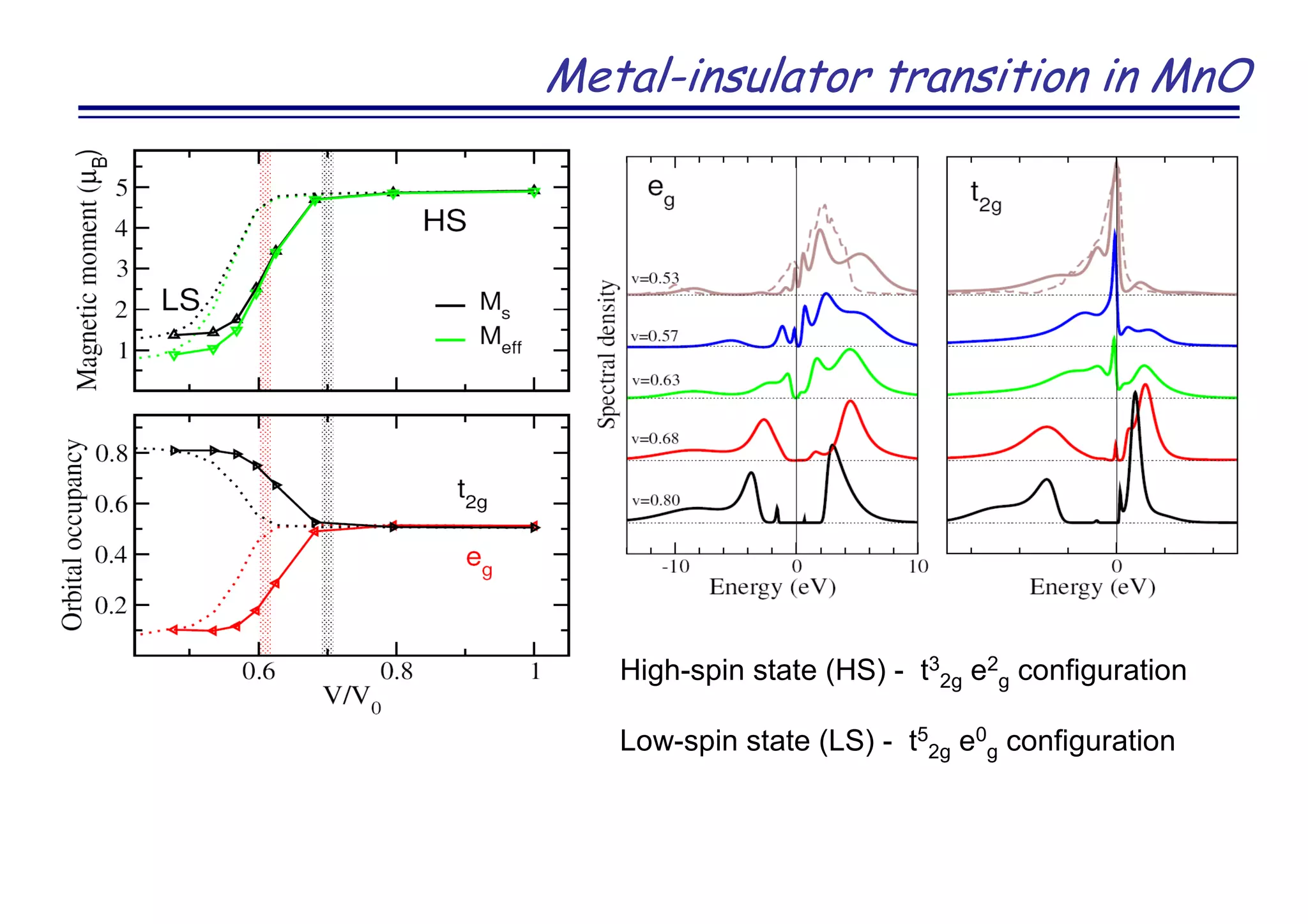
Metal-insulator transition in MnO
Metal-insulator transition (paramagnetic insulator to paramagnetic metal)
with pressure in MnO accompanied with high-spin to low-spin state transition.
J. Kunes et al, Nature Materials 7, 198 (2008)
Metal-insulator transition in MnO
High-spin state (HS) - t3
2g e2
g configuration
Low-spin state (LS) - t5
2g e0
g configuration
Metal-insulator transition in MnO
collapse.volumewithtransition
LSHSinresultsthat
Jenergyexchangewith
competingsplitingfield
crystalincreasespressure
withvolumeDecreasing
cf
→
∆
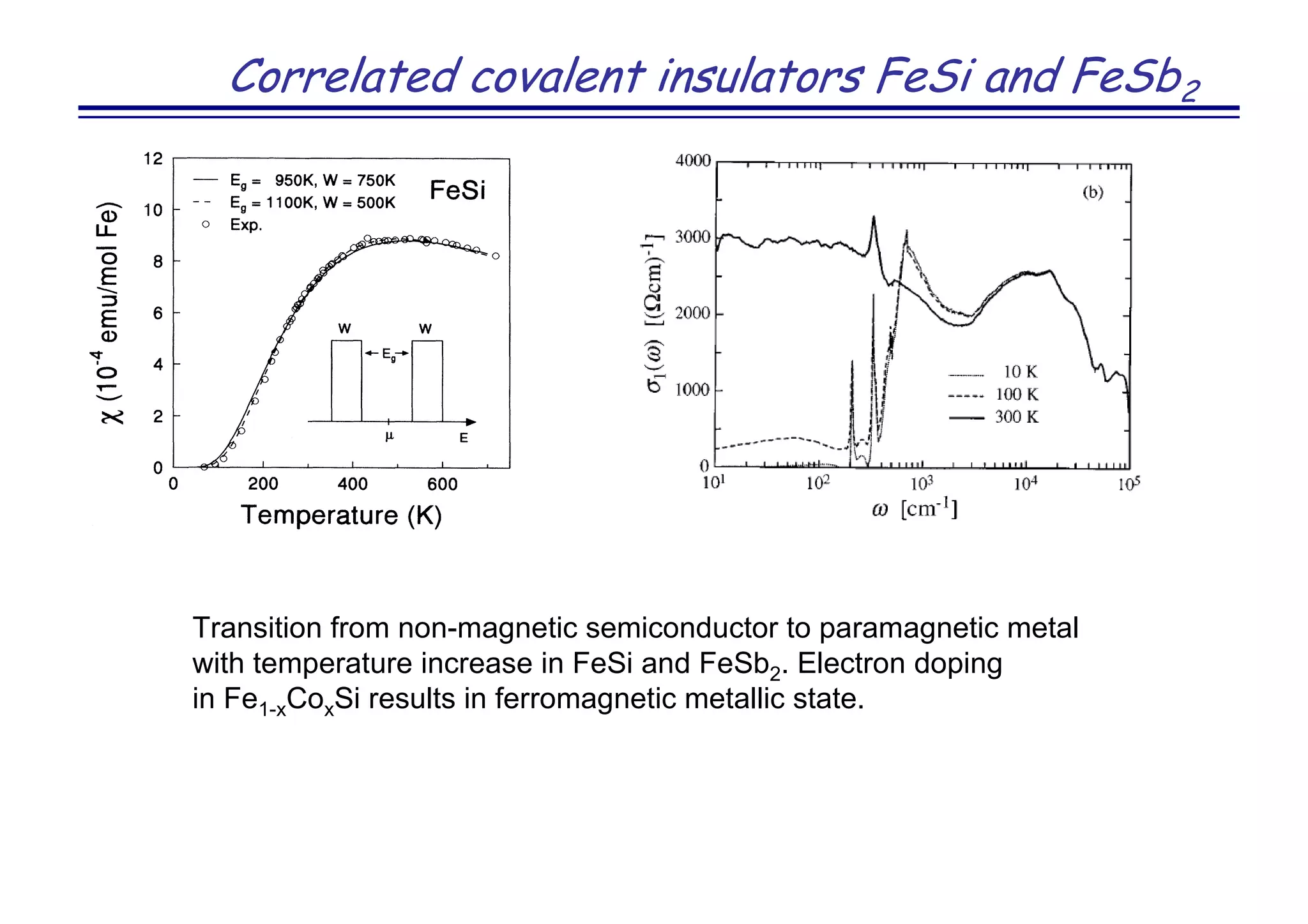
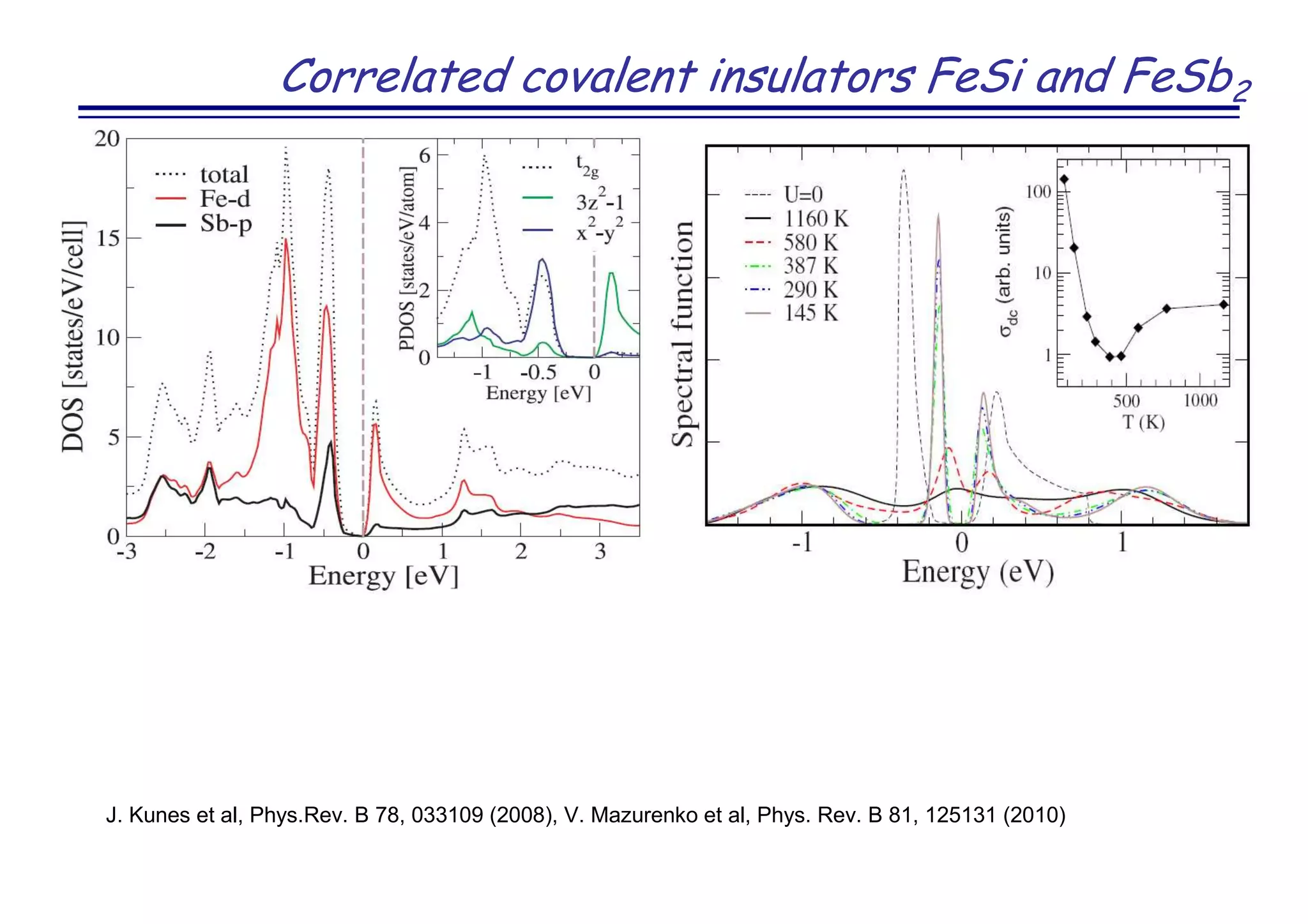
Correlated covalent insulators FeSi and FeSb2
Transition from non-magnetic semiconductor to paramagnetic metal
with temperature increase in FeSi and FeSb2. Electron doping
in Fe1-xCoxSi results in ferromagnetic metallic state.
Correlated covalent insulators FeSi and FeSb2
J. Kunes et al, Phys.Rev. B 78, 033109 (2008), V. Mazurenko et al, Phys. Rev. B 81, 125131 (2010)
Novel superconductor LaOFeAs
Tc=26K for F content ~11%
Y. Kanamura et al. J. Am. Chem. Soc. 130, 3296 (2008)]
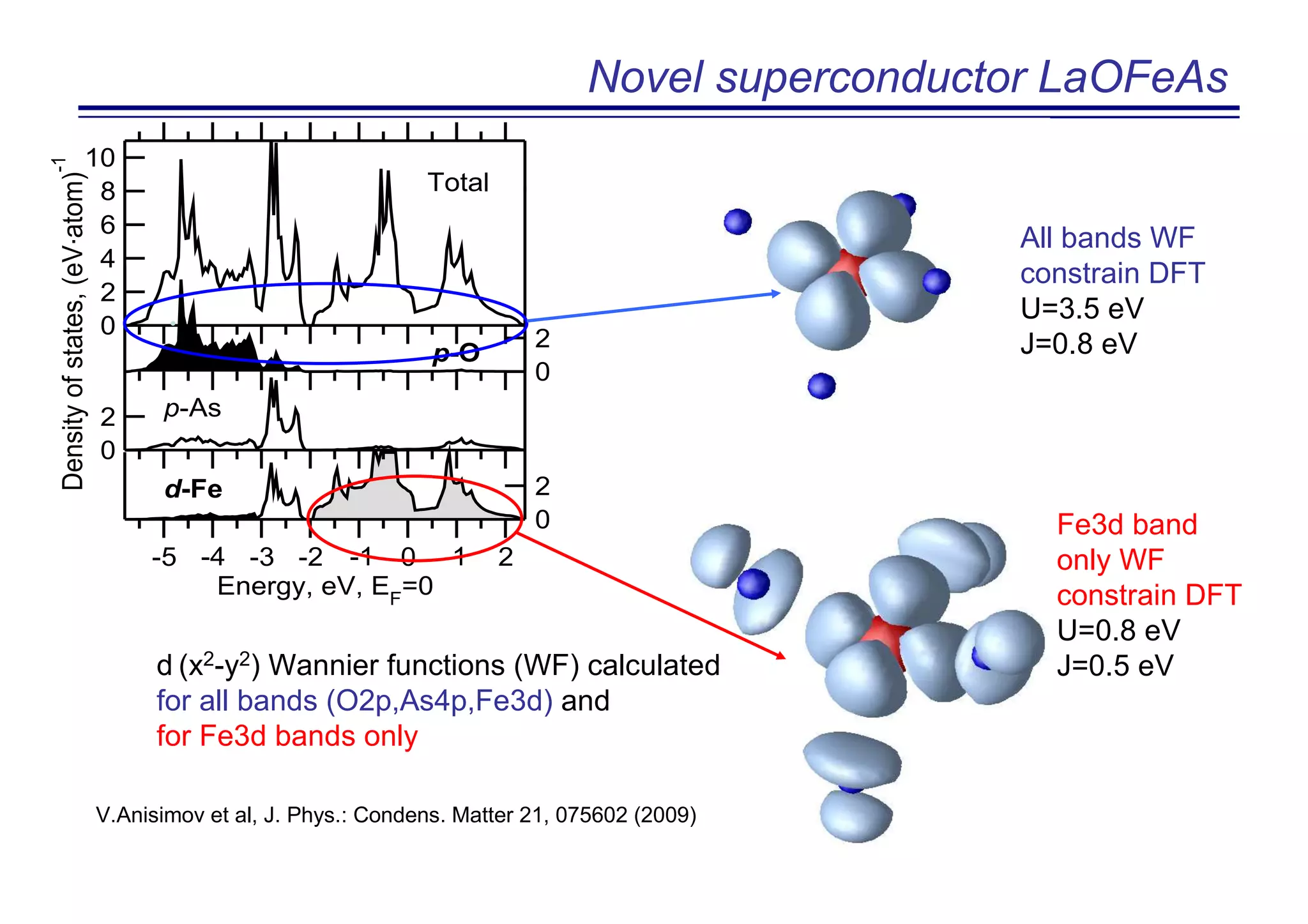
Novel superconductor LaOFeAs
0
2
4
6
8
10
Total
-5 -4 -3 -2 -1 0 1 2
Energy, eV, EF
=0
0
2d-Fe
0
2
Densityofstates,(eV.atom)
-1
p-As
0
2
p-O
d (x2-y2) Wannier functions (WF) calculated
for all bands (O2p,As4p,Fe3d) and
for Fe3d bands only
All bands WF
constrain DFT
U=3.5 eV
J=0.8 eV
Fe3d band
only WF
constrain DFT
U=0.8 eV
J=0.5 eV
V.Anisimov et al, J. Phys.: Condens. Matter 21, 075602 (2009)
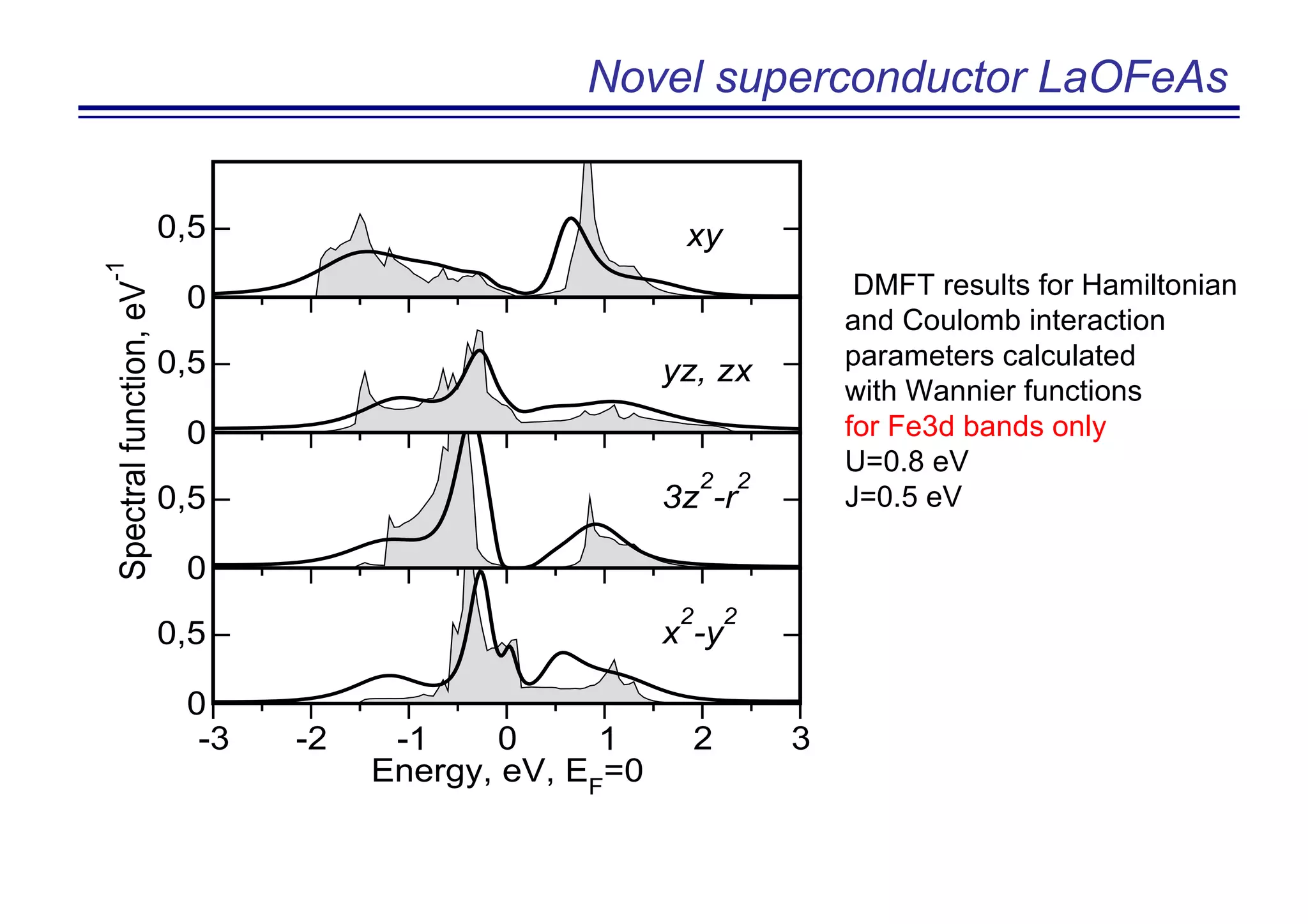
Novel superconductor LaOFeAs
0
0,5
Spectralfunction,eV
-1
xy
0
0,5 yz, zx
0
0,5 3z
2
-r
2
-3 -2 -1 0 1 2 3
Energy, eV, EF
=0
0
0,5 x
2
-y
2
DMFT results for Hamiltonian
and Coulomb interaction
parameters calculated
with Wannier functions
for Fe3d bands only
U=0.8 eV
J=0.5 eV
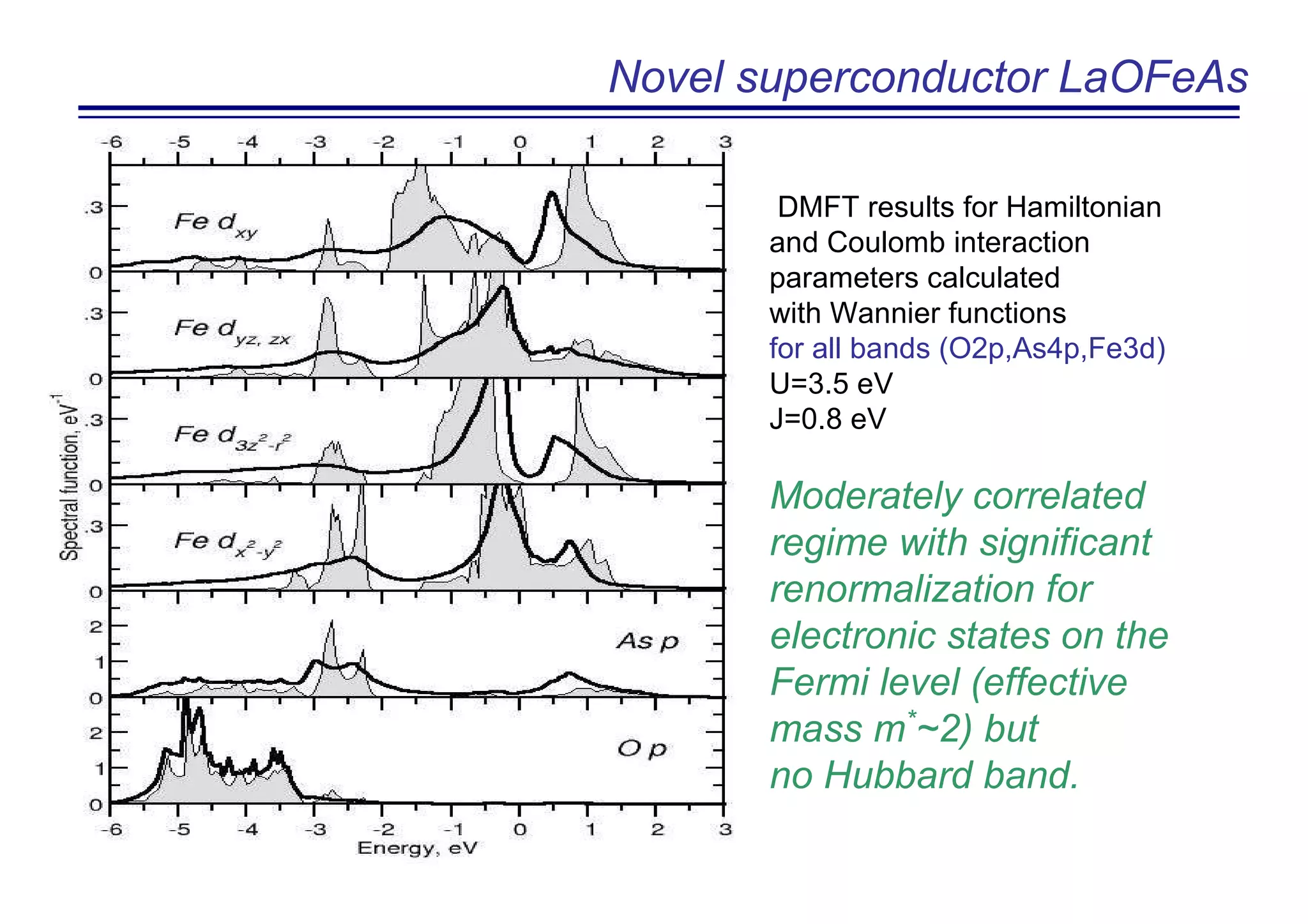
Novel superconductor LaOFeAs
DMFT results for Hamiltonian
and Coulomb interaction
parameters calculated
with Wannier functions
for all bands (O2p,As4p,Fe3d)
U=3.5 eV
J=0.8 eV
Moderately correlated
regime with significant
renormalization for
electronic states on the
Fermi level (effective
mass m*~2) but
no Hubbard band.
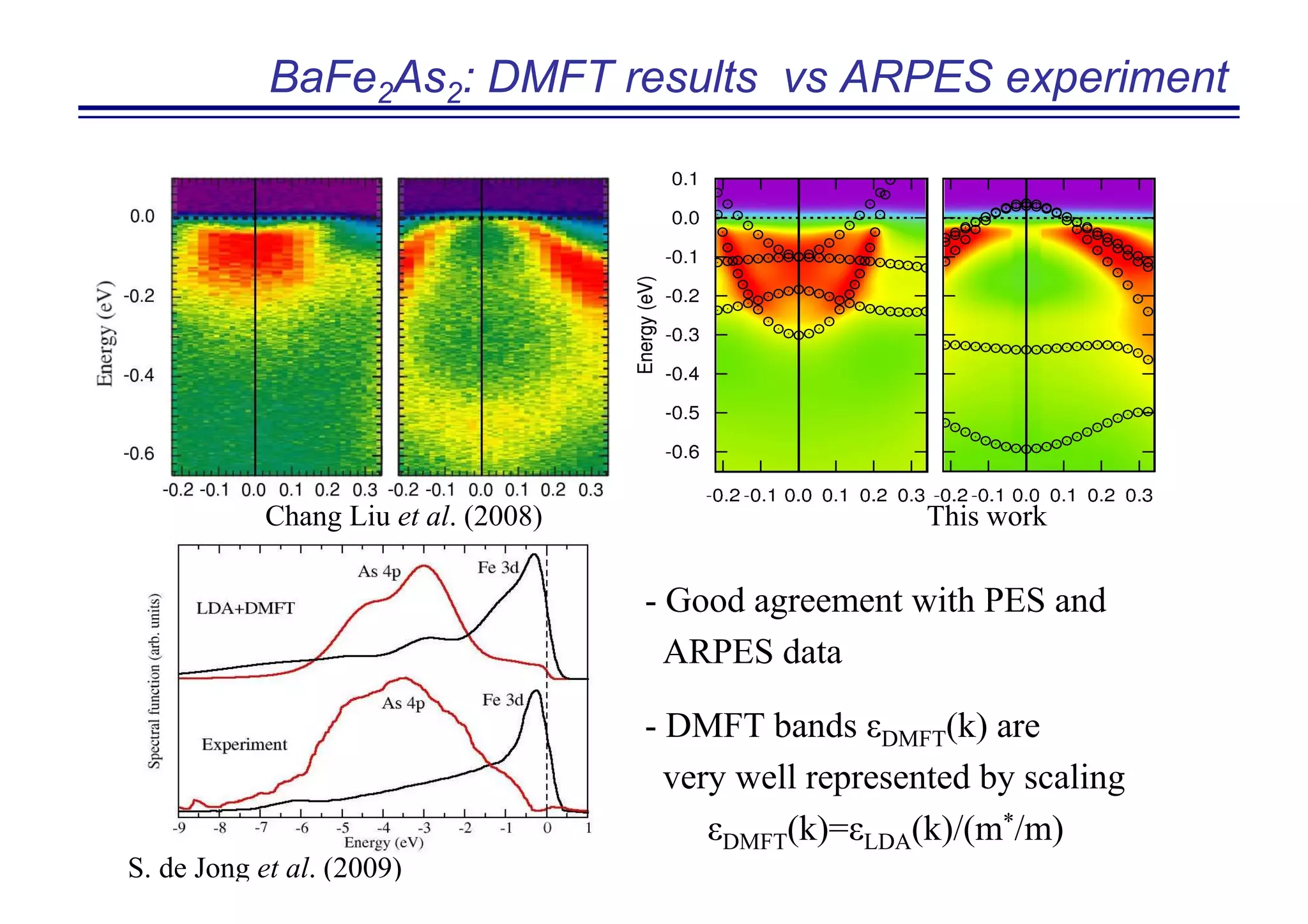
- Good agreement with PES and
ARPES data
- DMFT bands εDMFT(k) are
very well represented by scaling
εDMFT(k)=εLDA(k)/(m*/m)
S. de Jong et al. (2009)
Chang Liu et al. (2008) This work
BaFe2As2: DMFT results vs ARPES experiment
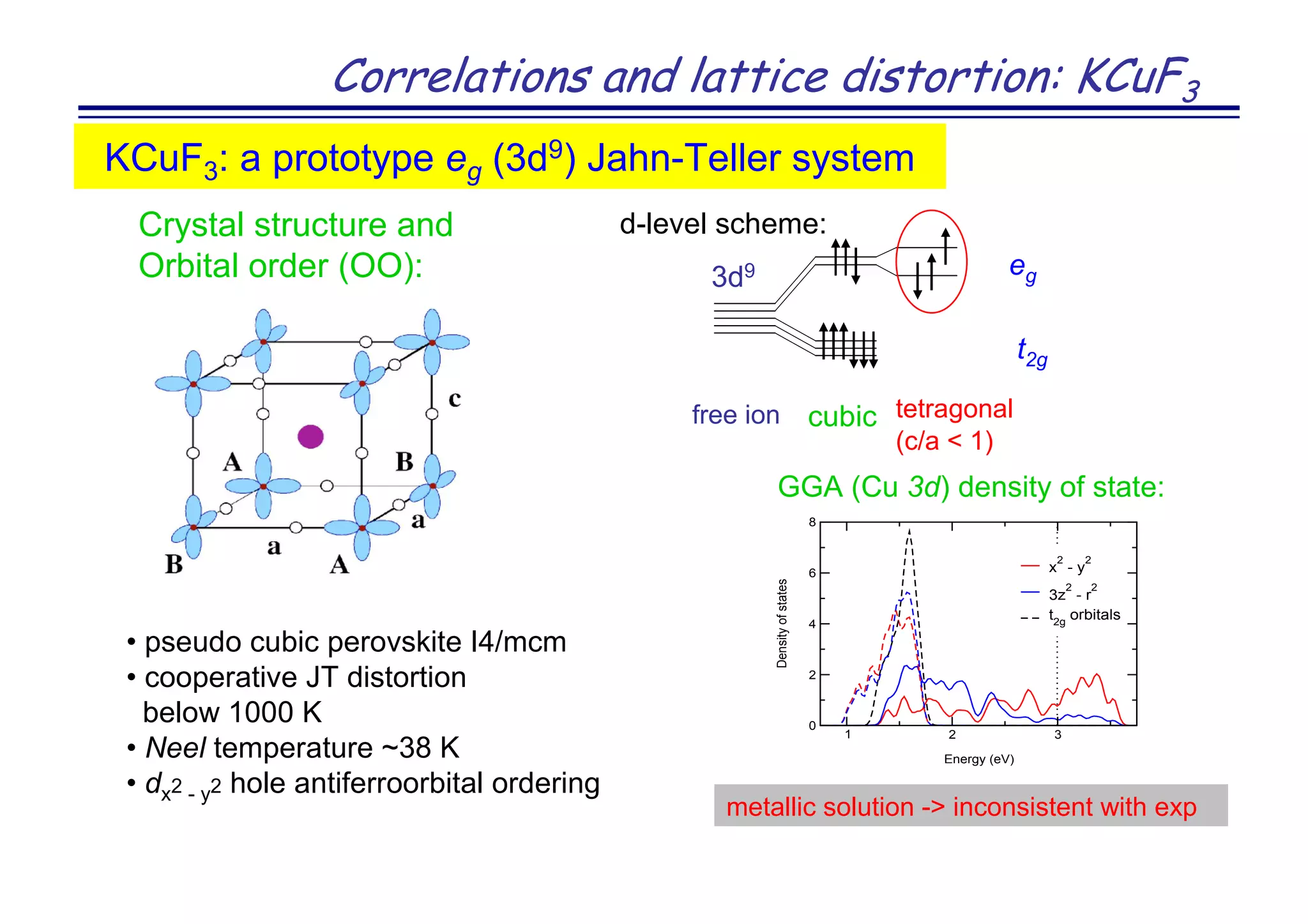
Correlations and lattice distortion: KCuF3
d-level scheme:
3d9
free ion cubic
eg
t2g
Crystal structure and
Orbital order (OO):
• pseudo cubic perovskite I4/mcm
• cooperative JT distortion
below 1000 K
• Neel temperature ~38 K
• dx2 - y2 hole antiferroorbital ordering
1 2 3
Energy (eV)
0
2
4
6
8
Densityofstates
x
2
- y
2
3z
2
- r
2
t2g
orbitals
GGA (Cu 3d) density of state:
metallic solution -> inconsistent with exp
tetragonal
(c/a < 1)
KCuF3: a prototype eg (3d9) Jahn-Teller system
Correlations and lattice distortion: KCuF3
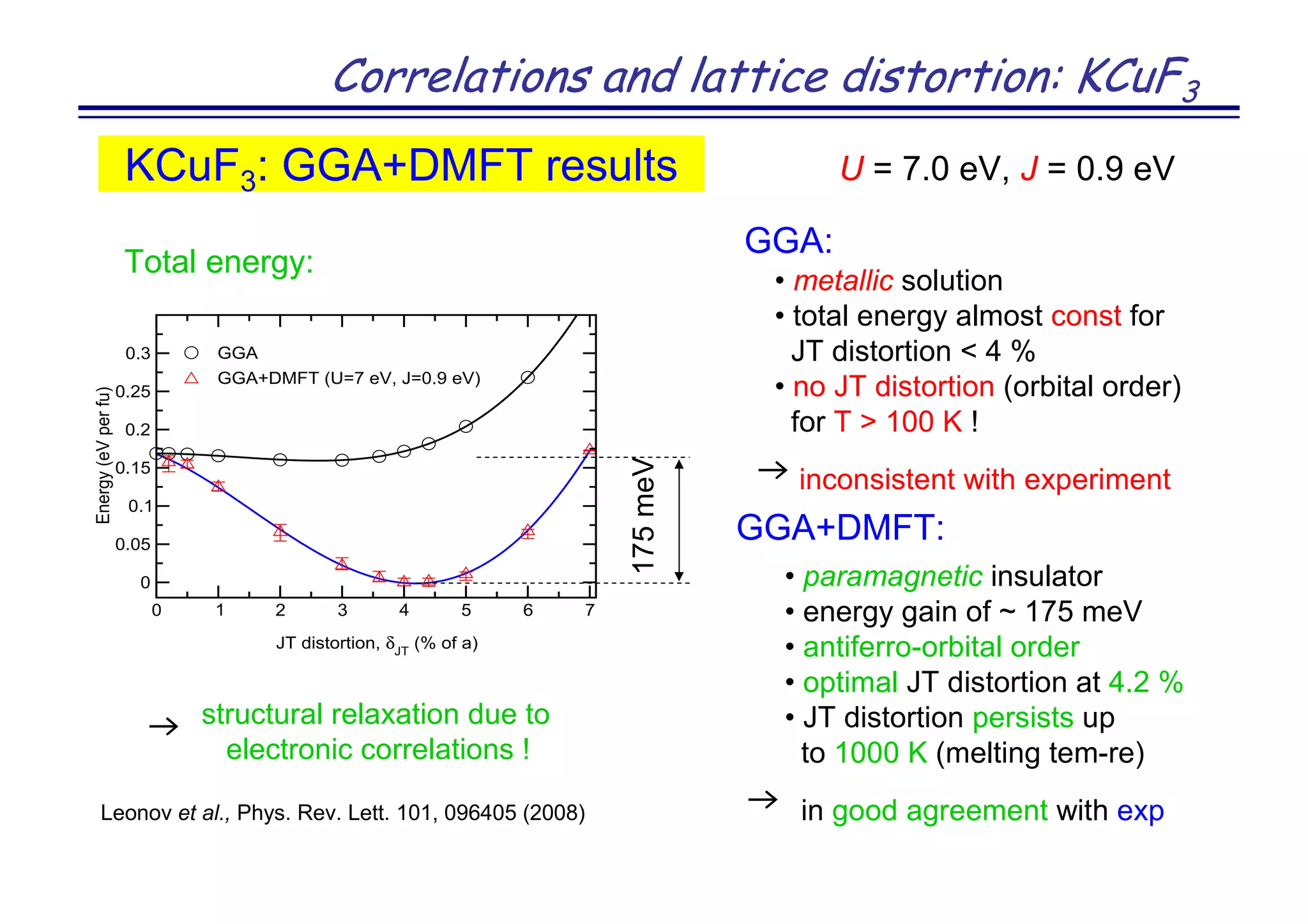
KCuF3: GGA+DMFT results
0 1 2 3 4 5 6 7
JT distortion, δJT
(% of a)
0
0.05
0.1
0.15
0.2
0.25
0.3
Energy(eVperfu)
GGA
GGA+DMFT (U=7 eV, J=0.9 eV)
Total energy:
U = 7.0 eV, J = 0.9 eV
GGA:
GGA+DMFT:
• metallic solution
• total energy almost const for
JT distortion < 4 %
• no JT distortion (orbital order)
for T > 100 K !
inconsistent with experiment
• paramagnetic insulator
• energy gain of ~ 175 meV
• antiferro-orbital order
• optimal JT distortion at 4.2 %
• JT distortion persists up
to 1000 K (melting tem-re)
in good agreement with exp
structural relaxation due to
electronic correlations !
175meV
Leonov et al., Phys. Rev. Lett. 101, 096405 (2008)
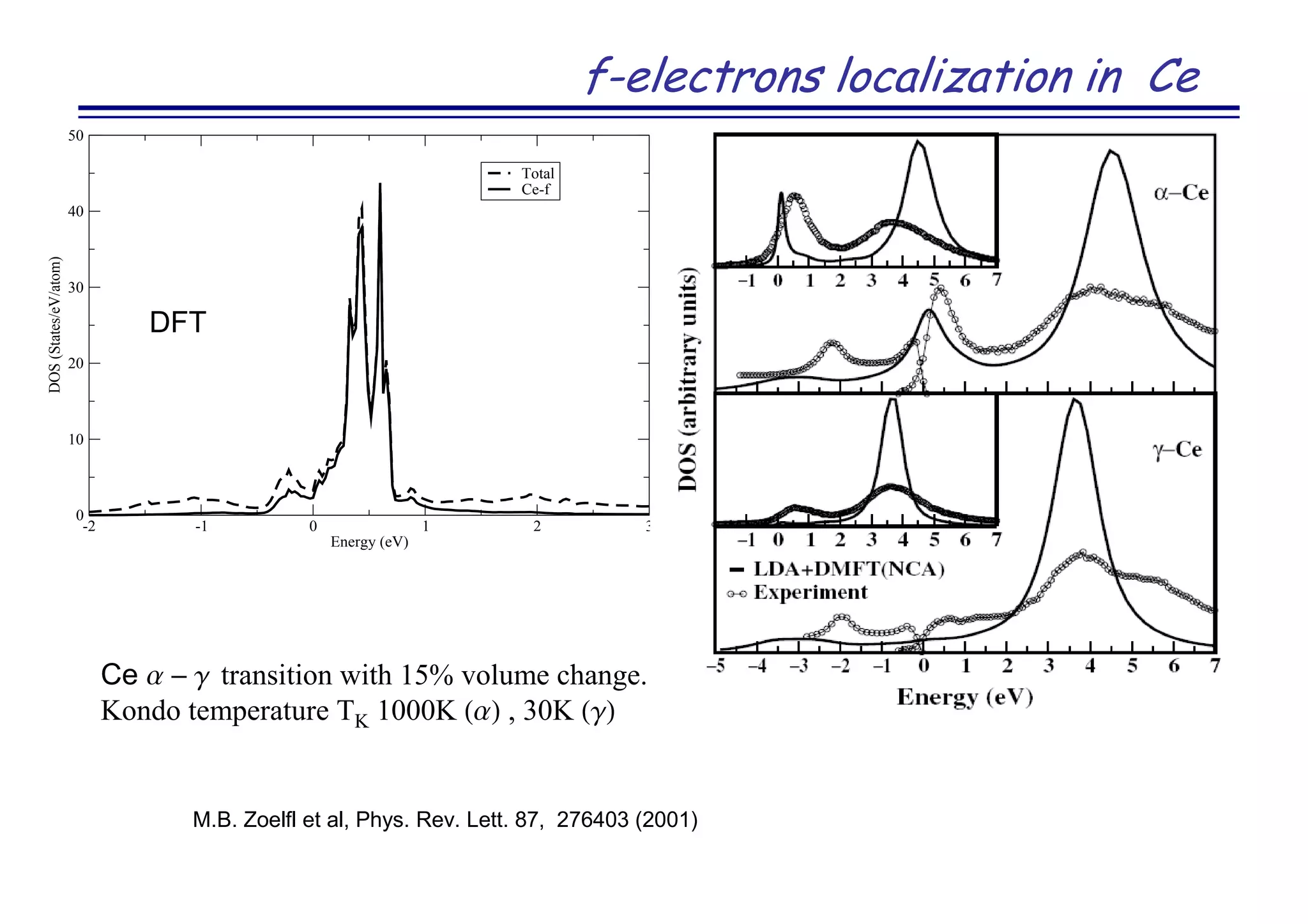
f-electrons localization in Ce
-2 -1 0 1 2 3
Energy (eV)
0
10
20
30
40
50
DOS(States/eV/atom)
Total
Ce-f
DFT
Ce a - g transition with 15% volume change.
Kondo temperature TK 1000K (a) , 30K (g)
M.B. Zoelfl et al, Phys. Rev. Lett. 87, 276403 (2001)
Conclusions
• Dynamical mean-field theory (DMFT) is a powerful tool
to study correlation effects
• Ab-initio definition of correlated orbitals and
interaction strength (U) between them based on
Wannier functions formalism results in “first-
principles” DFT+DMFT calculations scheme
• DFT+DMFT method was successful in describing
paramagnetic Mott insulators, correlated metals, charge
transfer insulators, metal-insulator transitions with
pressure and temperature, cooperative Jahn-Teller
lattice distortions

Density Functional and Dynamical Mean-Field Theory (DFT+DMFT) method and its application to real materials

  • 1.
    Density Functional andDynamical Mean-Field Theory (DFT+DMFT) method and its application to real materials Vladimir I. Anisimov Institute of Metal Physics Ekaterinburg, Russia
  • 2.
    Contents Method formulation: Dynamical Mean-FieldTheory (DMFT) Wannier functions as localized orbitals basis Determination of Hamiltonian parameters “Constrained DFT” calculations for Coulomb interaction parameters DFT+DMFT calculation scheme
  • 3.
    Contents Results of DFT+DMFTcalculations: Strongly correlated metal SrVO3 Metal-insulator transition in V2O3 Heavy fermions in d-system Li2VO4 Charge transfer insulator NiO Metal-insulator transition with pressure in MnO Correlated covalent insulators FeSi and FeSb2 Novel superconductors LaOFeAs, BaFe2As2 Jahn-Teller distortions in KCuF3 f-electrons localization in Ce
  • 4.
    Dynamical Mean-Field Theory i 23 4 5 6 1 Z •proper time resolved treatment of local electronic interactions • includes all many-body correlations ! Hubbard model: “single-impurity Anderson model” + self-consistency Georges and Kotliar (1992) self-consistency condition: dynamic mean-field (hybridization function): Effective impurity model defined by hybridization function is solved with an “impurity” solver, e.g., QMC, NRG, ED, Metzner,Vollhardt (1989) Mapping impurity Anderson model on lattice Hubbard model
  • 5.
    Including material specificdetails DFT+DMFT Anisimov et al. (1997) Lichtenstein, Katsnelson (1998) Kotliar, Vollhardt (2004) Density Functional Theory: • material specific: “ab initio” • fails for strong correlations Model Hamiltonians: • input parameters (t, U, ) unknown • systematic many-body approach • DFT band structure: • + Coulomb U • solve by DMFT
  • 6.
    General functionals (electron density, spectraldensity et. ct.) Model Hamiltonians with DFT parameters Problem “Dream” fully ab-initio method How to define interaction term in ab-initio but still practical way? Orbitals?
  • 7.
    Why Wannier Functions? Advantagesof Wannier function basis set: <Explicit form of the orbitals forming complete basis set < Localized orbitals < Orbitals are centered on atoms Wannier functions in real space [1]: [1] G.H. Wannier, Phys. Rev. 52, 192 (1937) Bloch functions like in Hubbard model Uncertainty of WF definition for a many-band case: Unitary matrix
  • 8.
    Wannier functions andprojection Eigenvector element WF in k-space – projection of the set of trial functions [2] (atomic orbitals) into Bloch functions subspace : Bloch functions in DFT basis (LMTO or plane waves): coefficients of WF expansion in LMTO-orbitals: Bloch sums of LMTO orbitals [2] D.Vanderbildt et al, Phys. Rev.B 56, 12847 (1997)
  • 9.
    Example of WFin real space WF basis set for V-3d (t2g) subband of SrVO3: XY, XZ, YZ - orbitals
  • 10.
    WF in cuprates V.V. Mazurenko, et al, Phys. Rev. B 75, 224408 (2007) Wannier orbitals centered on neighboring copper atoms along the y axis.
  • 11.
    DFT+DMFT calculations scheme LocalGreen function: Dyson equation defines bath Green function: Self-consistent condition: Impurity problem defined bath Green function is solved by QMC
  • 12.
    Strongly correlated metalSrVO3 V+4 (d1) ion in cubic perovskite crystal structure One electron in partially filled t2g band I.Nekrasov et al, Phys. Rev. B 72, 155106 (2005), Phys. Rev. B 73, 155112 (2006)
  • 13.
    Strongly correlated metalSrVO3 Strongly correlated metal with pronounced Lower Hubbard band (LHB)
  • 14.
    Strongly correlated metalSrVO3 [ ] 1 0 (k)H-)(-TrIm 1 ),(AfunctionSpectral − Σ−= ωω π ωk
  • 15.
    Strongly correlated metalSrVO3 2| )(Re 1 m m masselectronEffective 0 * ≈ ∂ Σ∂ −= =ω ω ω )( m m (k)~ narrowingBands 0 1* kεε −       =
  • 16.
    Mott insulator V2O3 PrototypicalMott insulator. Iso-structural paramagnetic metal to paramagnetic insulator transition with small volume change due to chemical negative pressure.
  • 17.
    Mott insulator V2O3 Paramagneticmetal to paramagnetic insulator transition with small change in corundum crystal structure parameters Lower Hubbard Band (LHB) Quasiparticle band K.Held et al, Phys. Rev. Lett. 86, 5345 (2001), G.Keller et al, Phys. Rev. B 70, 205116 (2004)
  • 18.
    Heavy fermions materialLiV2O4 Heavy-fermions without f-electrons: linear specific heat coefficient g=420 mJ/molK2, effective electron mass m*/m =25 below TK ~28 K Cubic spinel crystal structure with local trigonal symmetry
  • 19.
    Heavy fermions materialLiV2O4 R.Arita et al, Phys. Rev. Lett. 98, 166402 (2007) Sharp quasiparticle peak above the Fermi for T=0 limit (PQMC)
  • 20.
    Charge transfer insulatorNiO Zaanen-Sawatzky-Allen classification scheme for transition metal compounds Mott-Hubbard insulators Charge transfer insulators Zaanen et al, PRL 55, 418 (1985)
  • 21.
    Charge transfer insulatorNiO Charge transfer insulator in paramagnetic phase. Ni+2 (d8) ion in cubic rock salt crystal structure J. Kuneš, et al, Phys. Rev. B 75, 165115 (2007) LDA DMFT
  • 22.
    Charge transfer insulatorNiO Band structure of charge transfer insulator combines dispersive (itinerant states) and flat bands (localized states). O2p bands Ni3d bands J. Kunes et al, Phys. Rev. Lett. 99, 156404 (2007)
  • 23.
    Metal-insulator transition inMnO Metal-insulator transition (paramagnetic insulator to paramagnetic metal) with pressure in MnO accompanied with high-spin to low-spin state transition. J. Kunes et al, Nature Materials 7, 198 (2008)
  • 24.
    Metal-insulator transition inMnO High-spin state (HS) - t3 2g e2 g configuration Low-spin state (LS) - t5 2g e0 g configuration
  • 25.
    Metal-insulator transition inMnO collapse.volumewithtransition LSHSinresultsthat Jenergyexchangewith competingsplitingfield crystalincreasespressure withvolumeDecreasing cf → ∆
  • 26.
    Correlated covalent insulatorsFeSi and FeSb2 Transition from non-magnetic semiconductor to paramagnetic metal with temperature increase in FeSi and FeSb2. Electron doping in Fe1-xCoxSi results in ferromagnetic metallic state.
  • 27.
    Correlated covalent insulatorsFeSi and FeSb2 J. Kunes et al, Phys.Rev. B 78, 033109 (2008), V. Mazurenko et al, Phys. Rev. B 81, 125131 (2010)
  • 28.
    Novel superconductor LaOFeAs Tc=26Kfor F content ~11% Y. Kanamura et al. J. Am. Chem. Soc. 130, 3296 (2008)]
  • 29.
    Novel superconductor LaOFeAs 0 2 4 6 8 10 Total -5-4 -3 -2 -1 0 1 2 Energy, eV, EF =0 0 2d-Fe 0 2 Densityofstates,(eV.atom) -1 p-As 0 2 p-O d (x2-y2) Wannier functions (WF) calculated for all bands (O2p,As4p,Fe3d) and for Fe3d bands only All bands WF constrain DFT U=3.5 eV J=0.8 eV Fe3d band only WF constrain DFT U=0.8 eV J=0.5 eV V.Anisimov et al, J. Phys.: Condens. Matter 21, 075602 (2009)
  • 30.
    Novel superconductor LaOFeAs 0 0,5 Spectralfunction,eV -1 xy 0 0,5yz, zx 0 0,5 3z 2 -r 2 -3 -2 -1 0 1 2 3 Energy, eV, EF =0 0 0,5 x 2 -y 2 DMFT results for Hamiltonian and Coulomb interaction parameters calculated with Wannier functions for Fe3d bands only U=0.8 eV J=0.5 eV
  • 31.
    Novel superconductor LaOFeAs DMFTresults for Hamiltonian and Coulomb interaction parameters calculated with Wannier functions for all bands (O2p,As4p,Fe3d) U=3.5 eV J=0.8 eV Moderately correlated regime with significant renormalization for electronic states on the Fermi level (effective mass m*~2) but no Hubbard band.
  • 32.
    - Good agreementwith PES and ARPES data - DMFT bands εDMFT(k) are very well represented by scaling εDMFT(k)=εLDA(k)/(m*/m) S. de Jong et al. (2009) Chang Liu et al. (2008) This work BaFe2As2: DMFT results vs ARPES experiment
  • 33.
    Correlations and latticedistortion: KCuF3 d-level scheme: 3d9 free ion cubic eg t2g Crystal structure and Orbital order (OO): • pseudo cubic perovskite I4/mcm • cooperative JT distortion below 1000 K • Neel temperature ~38 K • dx2 - y2 hole antiferroorbital ordering 1 2 3 Energy (eV) 0 2 4 6 8 Densityofstates x 2 - y 2 3z 2 - r 2 t2g orbitals GGA (Cu 3d) density of state: metallic solution -> inconsistent with exp tetragonal (c/a < 1) KCuF3: a prototype eg (3d9) Jahn-Teller system
  • 34.
    Correlations and latticedistortion: KCuF3 KCuF3: GGA+DMFT results 0 1 2 3 4 5 6 7 JT distortion, δJT (% of a) 0 0.05 0.1 0.15 0.2 0.25 0.3 Energy(eVperfu) GGA GGA+DMFT (U=7 eV, J=0.9 eV) Total energy: U = 7.0 eV, J = 0.9 eV GGA: GGA+DMFT: • metallic solution • total energy almost const for JT distortion < 4 % • no JT distortion (orbital order) for T > 100 K ! inconsistent with experiment • paramagnetic insulator • energy gain of ~ 175 meV • antiferro-orbital order • optimal JT distortion at 4.2 % • JT distortion persists up to 1000 K (melting tem-re) in good agreement with exp structural relaxation due to electronic correlations ! 175meV Leonov et al., Phys. Rev. Lett. 101, 096405 (2008)
  • 35.
    f-electrons localization inCe -2 -1 0 1 2 3 Energy (eV) 0 10 20 30 40 50 DOS(States/eV/atom) Total Ce-f DFT Ce a - g transition with 15% volume change. Kondo temperature TK 1000K (a) , 30K (g) M.B. Zoelfl et al, Phys. Rev. Lett. 87, 276403 (2001)
  • 36.
    Conclusions • Dynamical mean-fieldtheory (DMFT) is a powerful tool to study correlation effects • Ab-initio definition of correlated orbitals and interaction strength (U) between them based on Wannier functions formalism results in “first- principles” DFT+DMFT calculations scheme • DFT+DMFT method was successful in describing paramagnetic Mott insulators, correlated metals, charge transfer insulators, metal-insulator transitions with pressure and temperature, cooperative Jahn-Teller lattice distortions