The metal-insulator transition of VO2
revisited
J.-P. Pouget
Laboratoire de Physique des Solides,
CNRS-UMR 8502,
Université Paris-sud 91405 Orsay
« Correlated electronic states in low dimensions »
Orsay 16 et 17 juin 2008
Conférence en l’honneur de Pascal Lederer
outline
• Electronic structure of metallic VO2
• Insulating ground states
• Role of the lattice in the metal-insulator
transition of VO2
• General phase diagram of VO2 and its
substituants
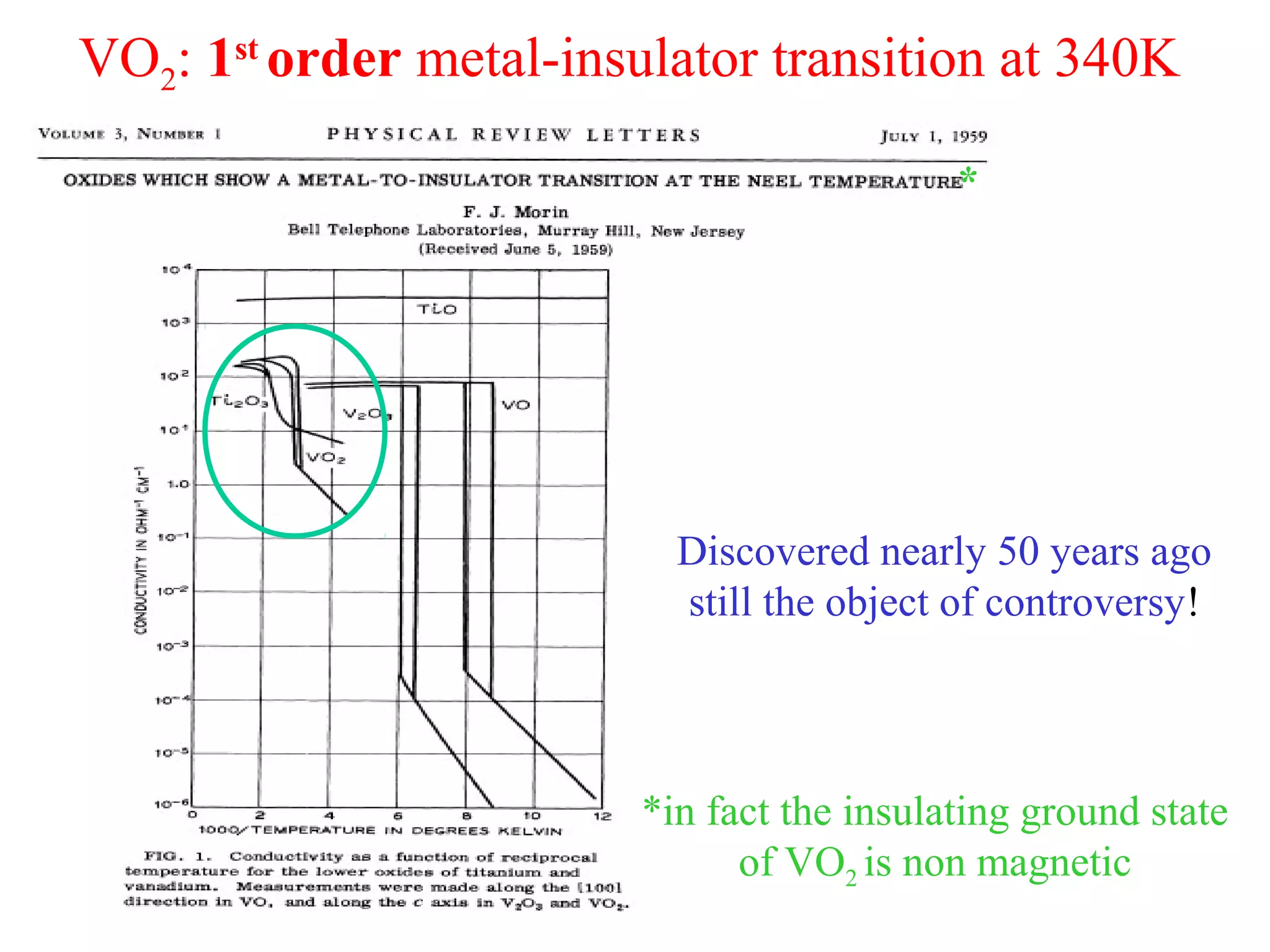
VO2: 1st
order metal-insulator transition at 340K
Discovered nearly 50 years ago
still the object of controversy!
*
*in fact the insulating ground state
of VO2 is non magnetic
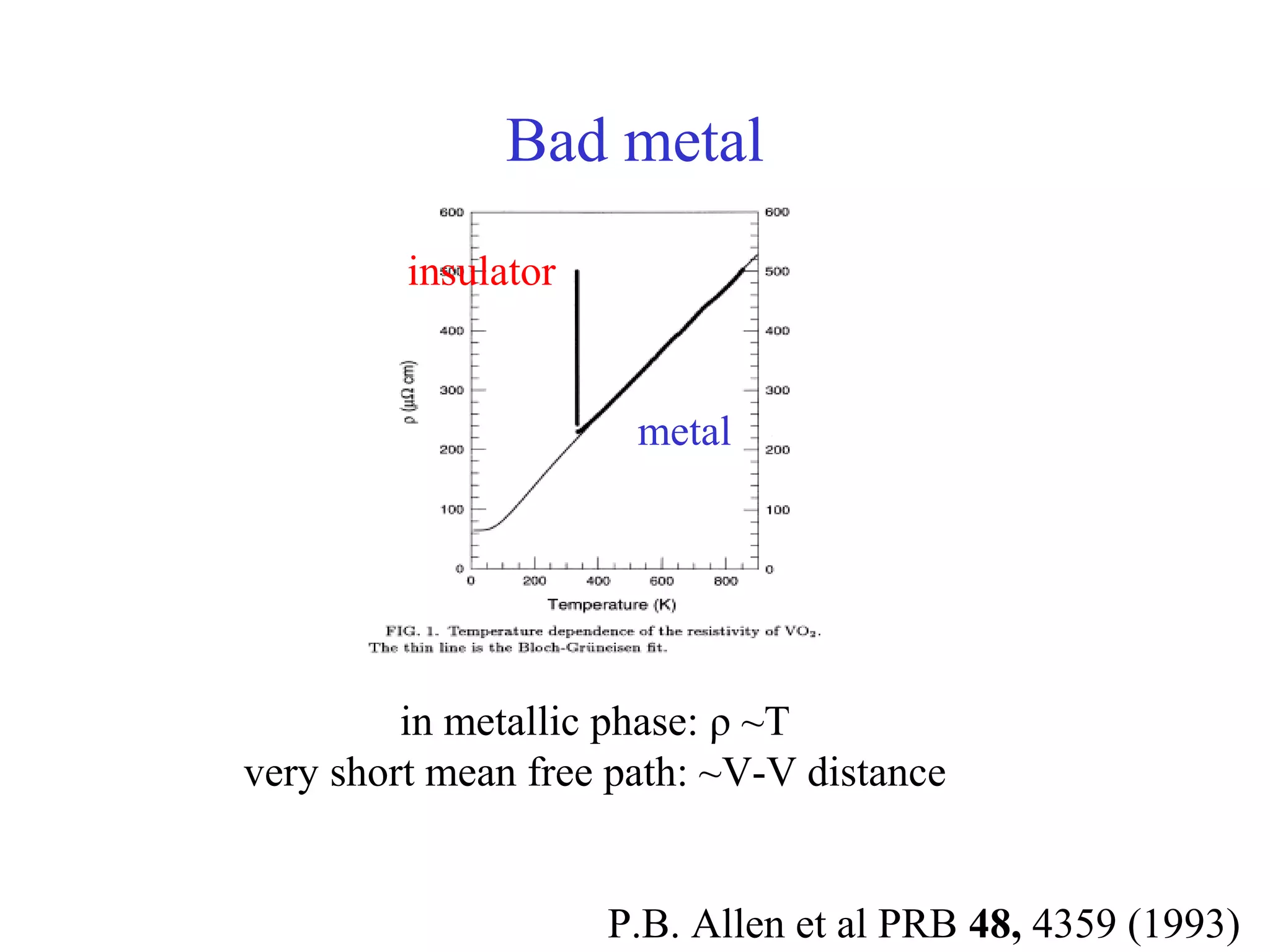
Bad metal
in metallic phase: ρ ~T
very short mean free path: ~V-V distance
P.B. Allen et al PRB 48, 4359 (1993)
metal
insulator
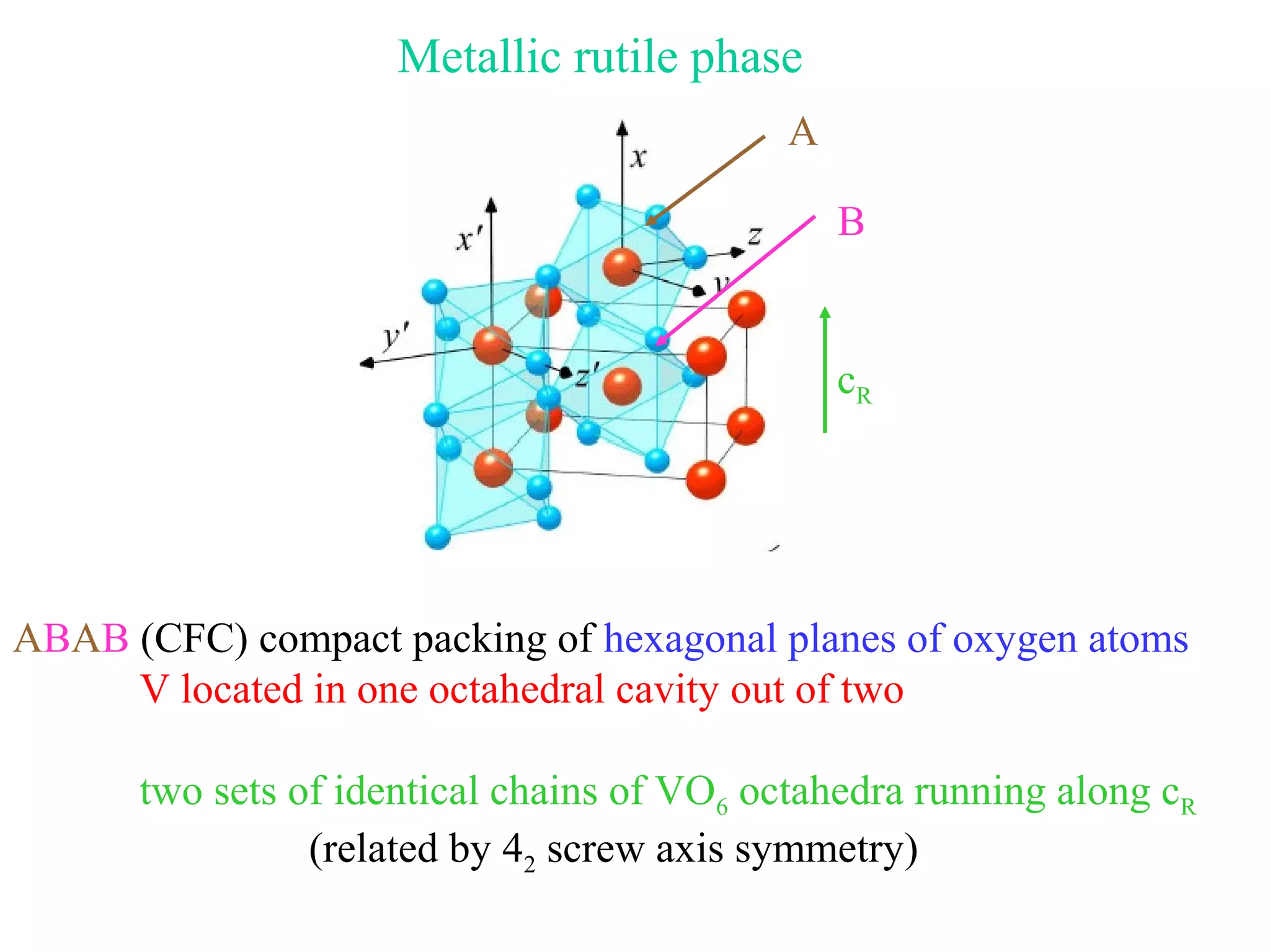
Metallic rutile phase
cR
ABAB (CFC) compact packing of hexagonal planes of oxygen atoms
V located in one octahedral cavity out of two
two sets of identical chains of VO6 octahedra running along cR
(related by 42 screw axis symmetry)
A
B
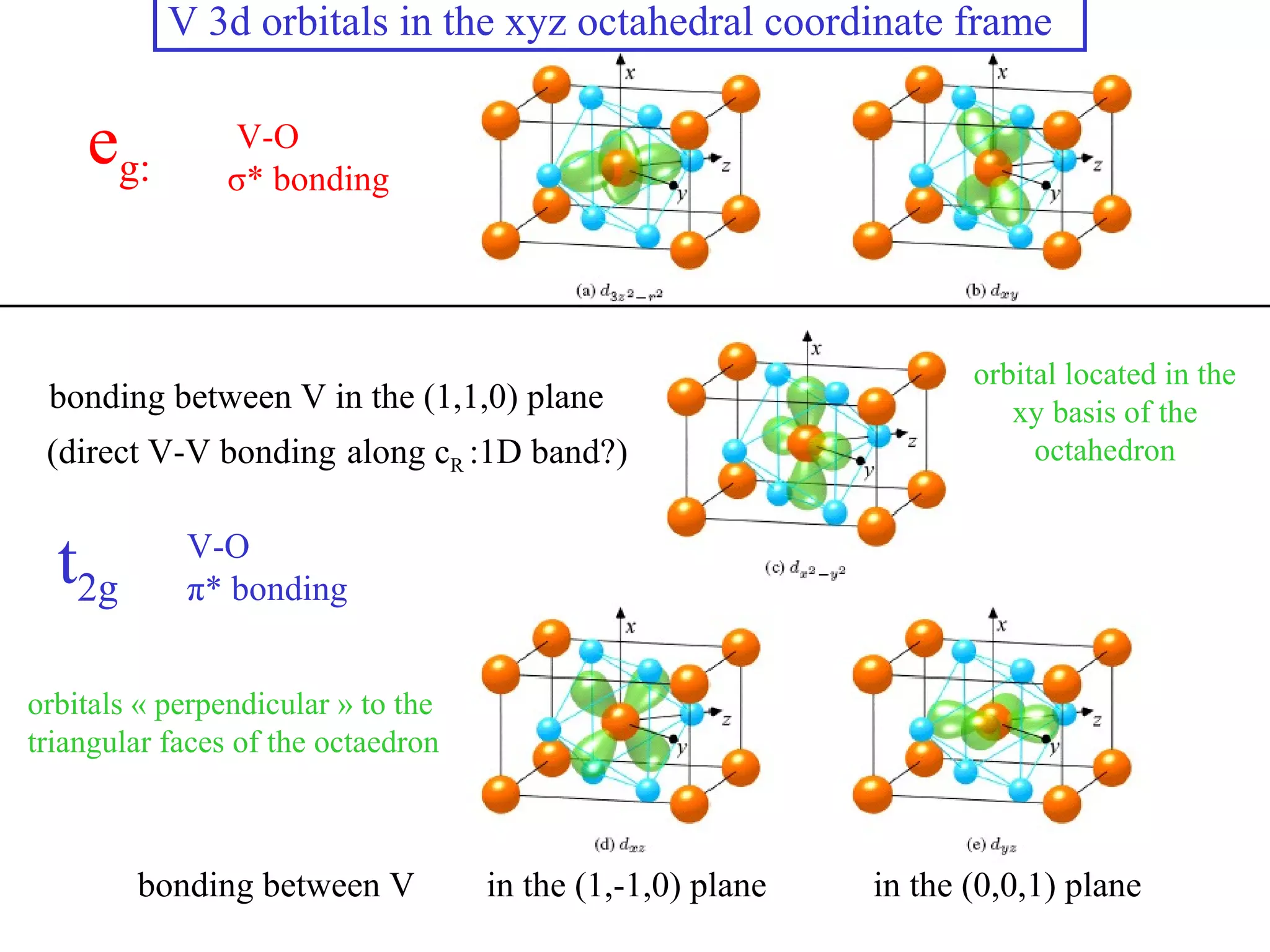
eg:
t2g
V-O
σ* bonding
bonding between V in the (1,1,0) plane
(direct V-V bonding along cR :1D band?)
bonding between V in the (1,-1,0) plane in the (0,0,1) plane
V 3d orbitals in the xyz octahedral coordinate frame
V-O
π* bonding
orbital located in the
xy basis of the
octahedron
orbitals « perpendicular » to the
triangular faces of the octaedron
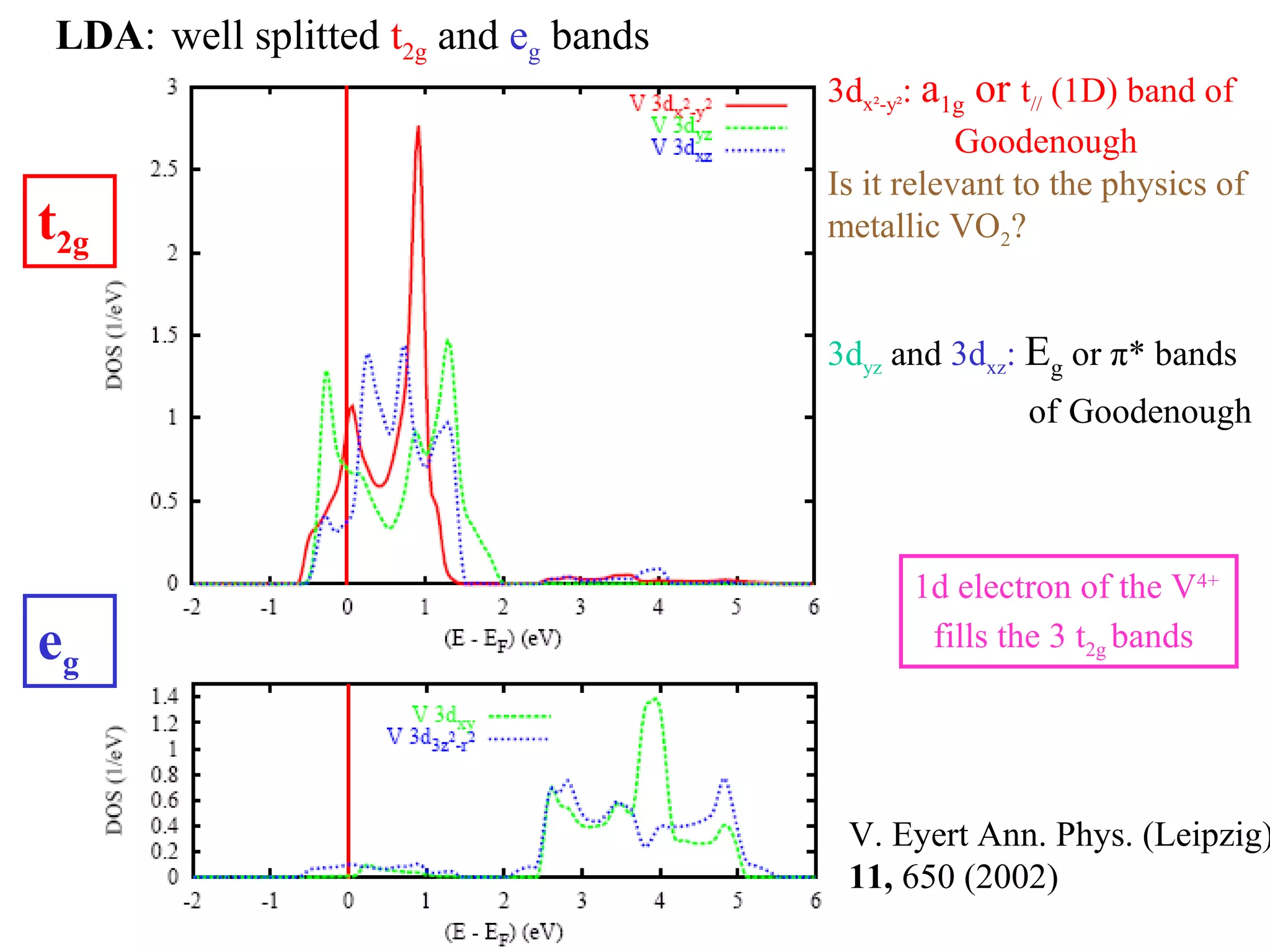
well splitted t2g and eg bands
V. Eyert Ann. Phys. (Leipzig)
11, 650 (2002)
3dyz and 3dxz: Eg or π* bands
of Goodenough
3dx²-y²: a1g or t// (1D) band of
Goodenough
Is it relevant to the physics of
metallic VO2?
LDA:
1d electron of the V4+
fills the 3 t2g bands
t2g
eg
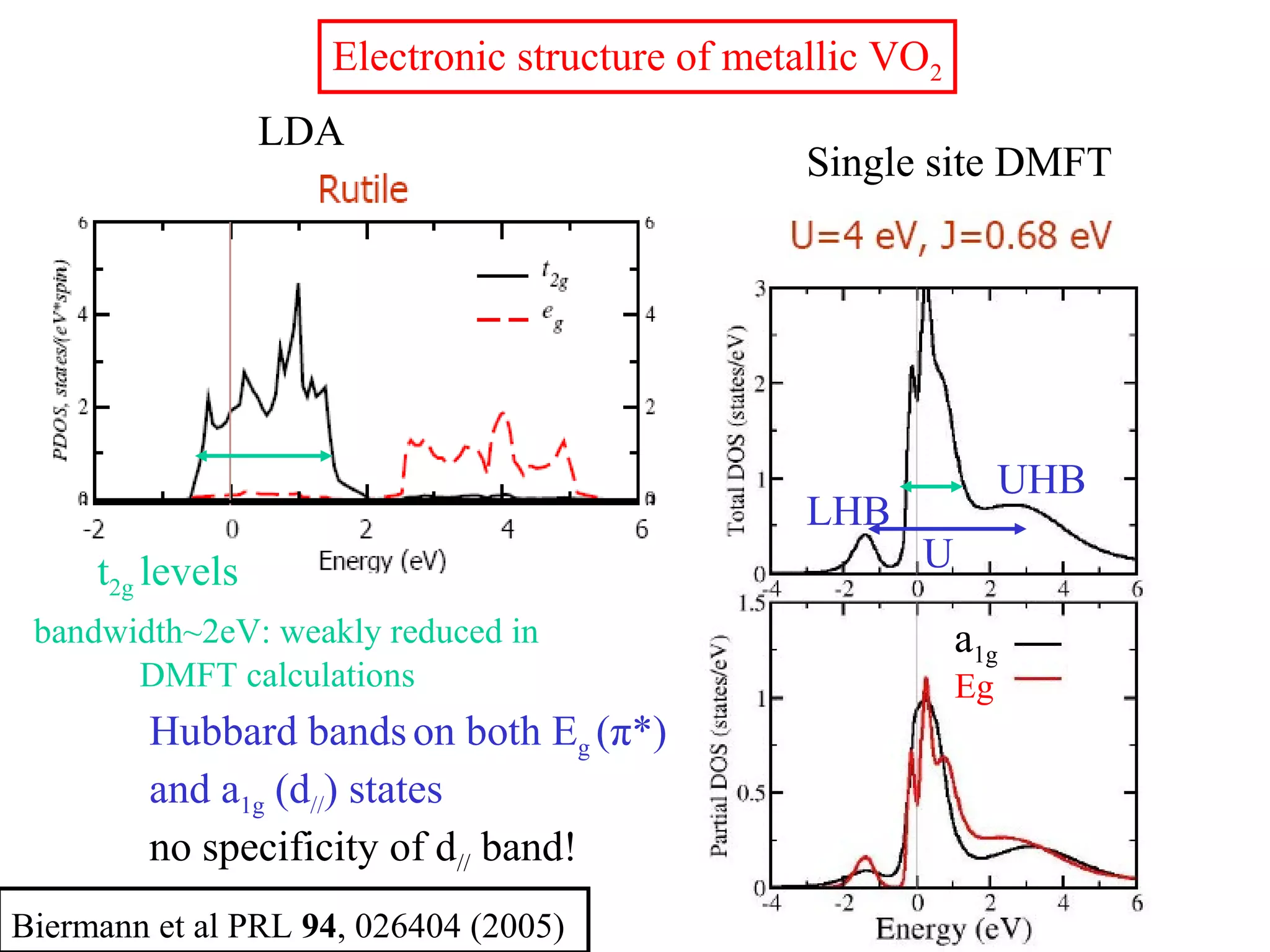
Electronic structure of metallic VO2
LDA
Single site DMFT
Eg
a1g
t2g levels
bandwidth~2eV: weakly reduced in
DMFT calculations
U
LHB
UHB
Biermann et al PRL 94, 026404 (2005)
Hubbard bandson both Eg (π*)
and a1g (d//) states
no specificity of d// band!
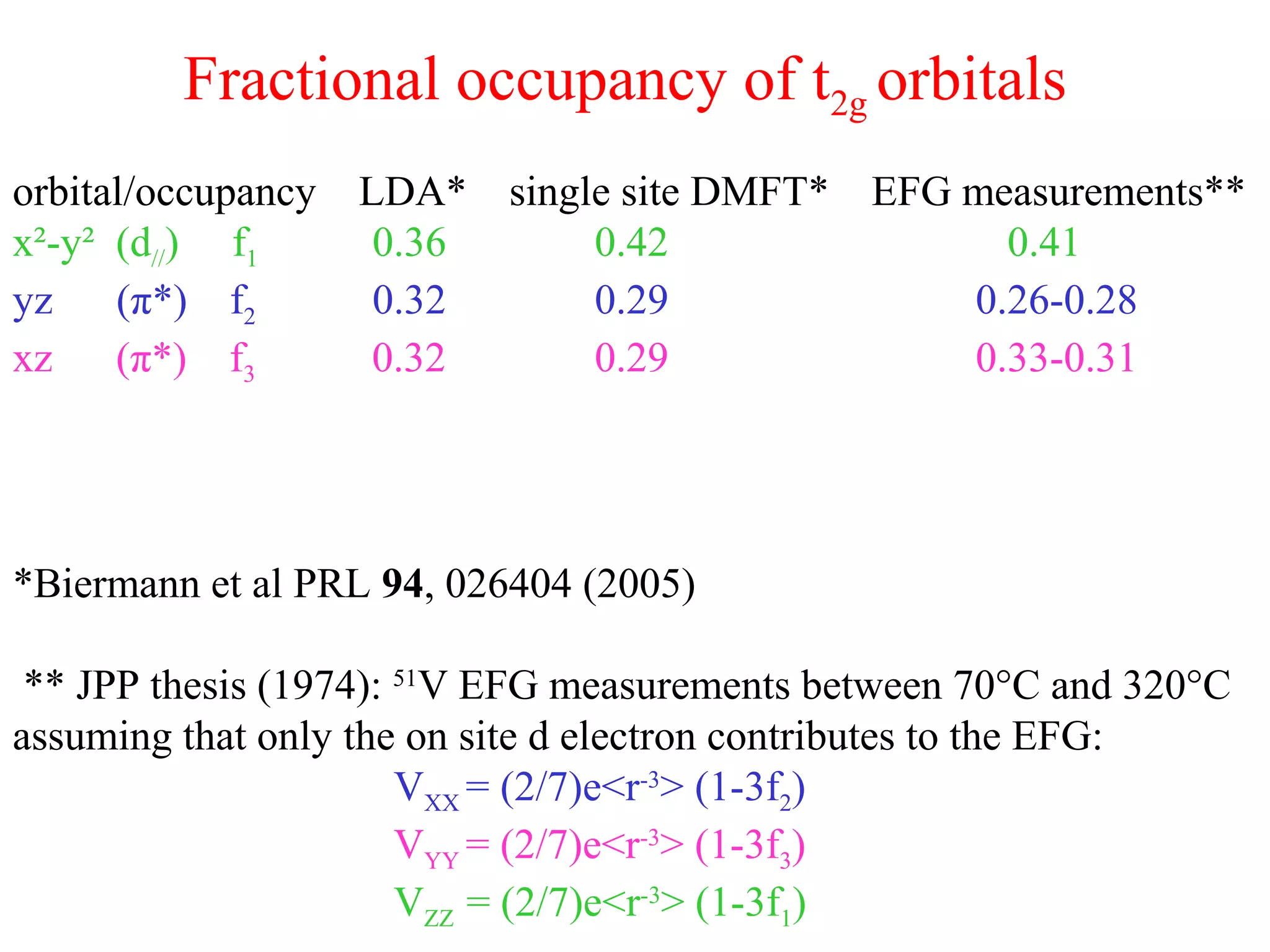
Fractional occupancy of t2g orbitals
orbital/occupancy LDA* single site DMFT* EFG measurements**
x²-y² (d//) f1 0.36 0.42 0.41
yz (π*) f2 0.32 0.29 0.26-0.28
xz (π*) f3 0.32 0.29 0.33-0.31
*Biermann et al PRL 94, 026404 (2005)
** JPP thesis (1974): 51
V EFG measurements between 70°C and 320°C
assuming that only the on site d electron contributes to the EFG:
VXX = (2/7)e<r-3
> (1-3f2)
VYY = (2/7)e<r-3
> (1-3f3)
VZZ = (2/7)e<r-3
> (1-3f1)
VO2: a correlated metal?
• Total spin susceptiblity:
Neff (EF)~10 states /eV, spin direction
J.P. Pouget & H. Launois, Journal de Physique 37, C4-49 (1976)
• Density of state at EF:
N(EF)~1.3*, 1.5**, 2*** state/eV, spin direction
*LDA: Eyert Ann Phys. (Leipzig) 11, 650 (2002),
**LDA: Korotin et al cond-mat/0301347
***LDA and DMFT: Biermann et al PRL 94, 026404 (2005)
Enhancement factor of χPauli: 5-8
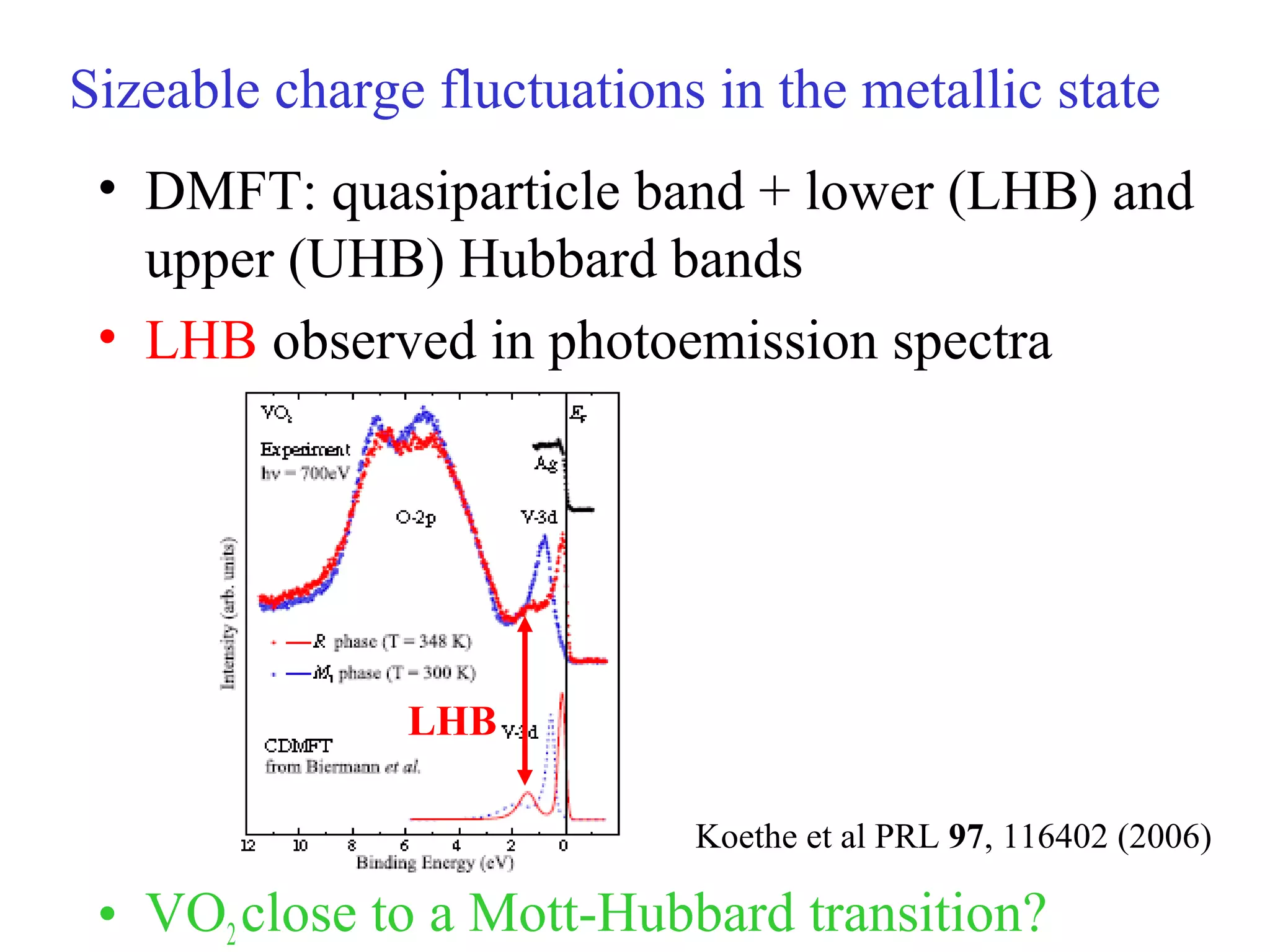
Sizeable charge fluctuations in the metallic state
• DMFT: quasiparticle band + lower (LHB) and
upper (UHB) Hubbard bands
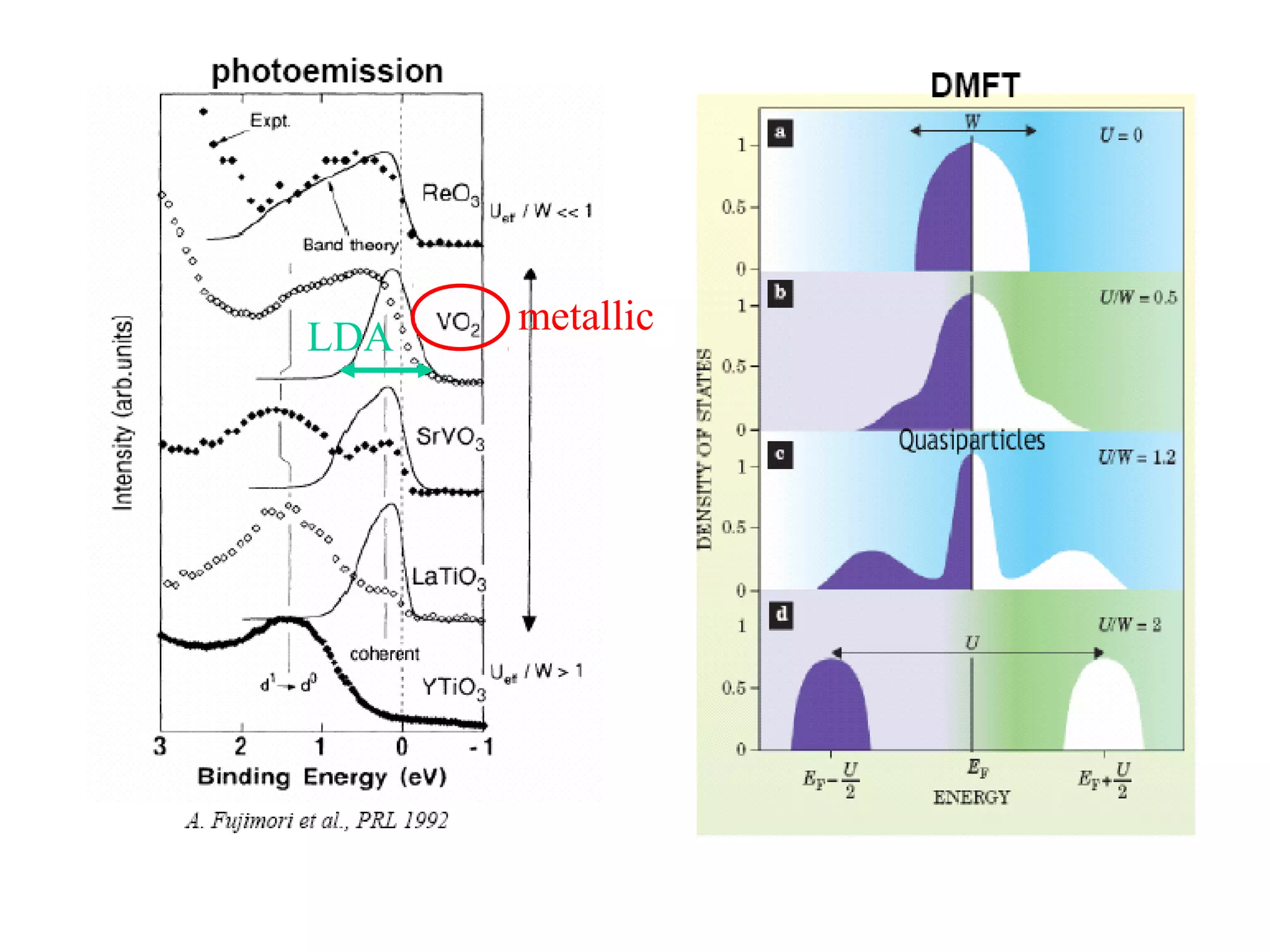
• LHB observed in photoemission spectra
• VO2close to a Mott-Hubbard transition?
LHB
Koethe et al PRL 97, 116402 (2006)
Mott Hubbard transition for x increasing in
Nb substitued VO2: V1-XNbXO2?
• Nb isoelectronic of V but of larger size
• lattice parameters of the rutile phase strongly increase with x
• Very large increase of the spin susceptibility with x
NMR in the metallic state show that this increase is homogeneous (no local effects) for
x<xC
magnetism becomes more localized when x increases (Curis Weiss behavior of χspin for x
large)
• beyond xC ~0.2: electronic conductivity becomes activated
electronic charges become localized
local effects (induced by the disorder) become relevant near the metal-insulator transition
metal-insulator transition with x due to combined effect of correlations and
disorder
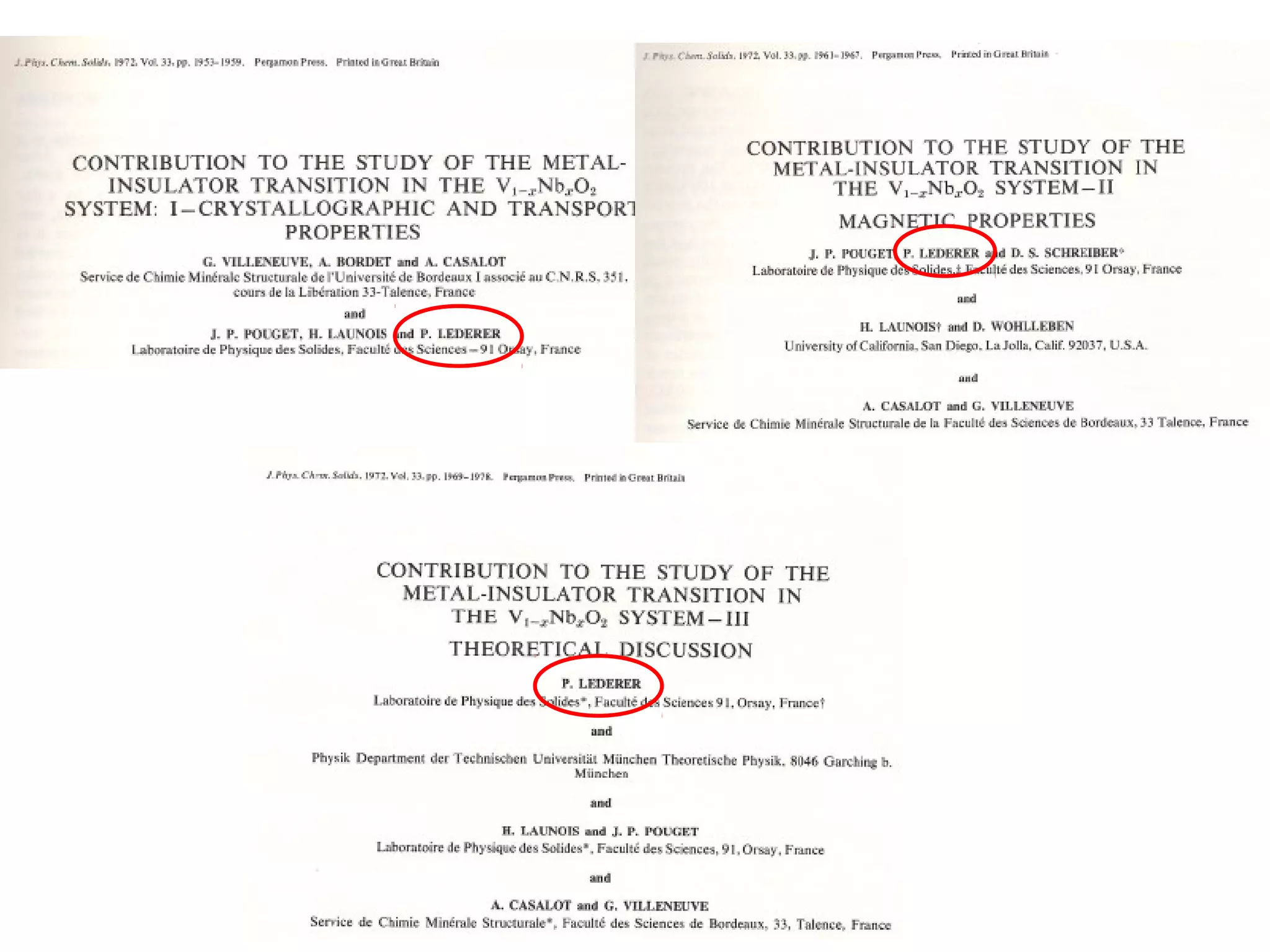
concept of strongly correlated Fermi glass (P. Lederer)
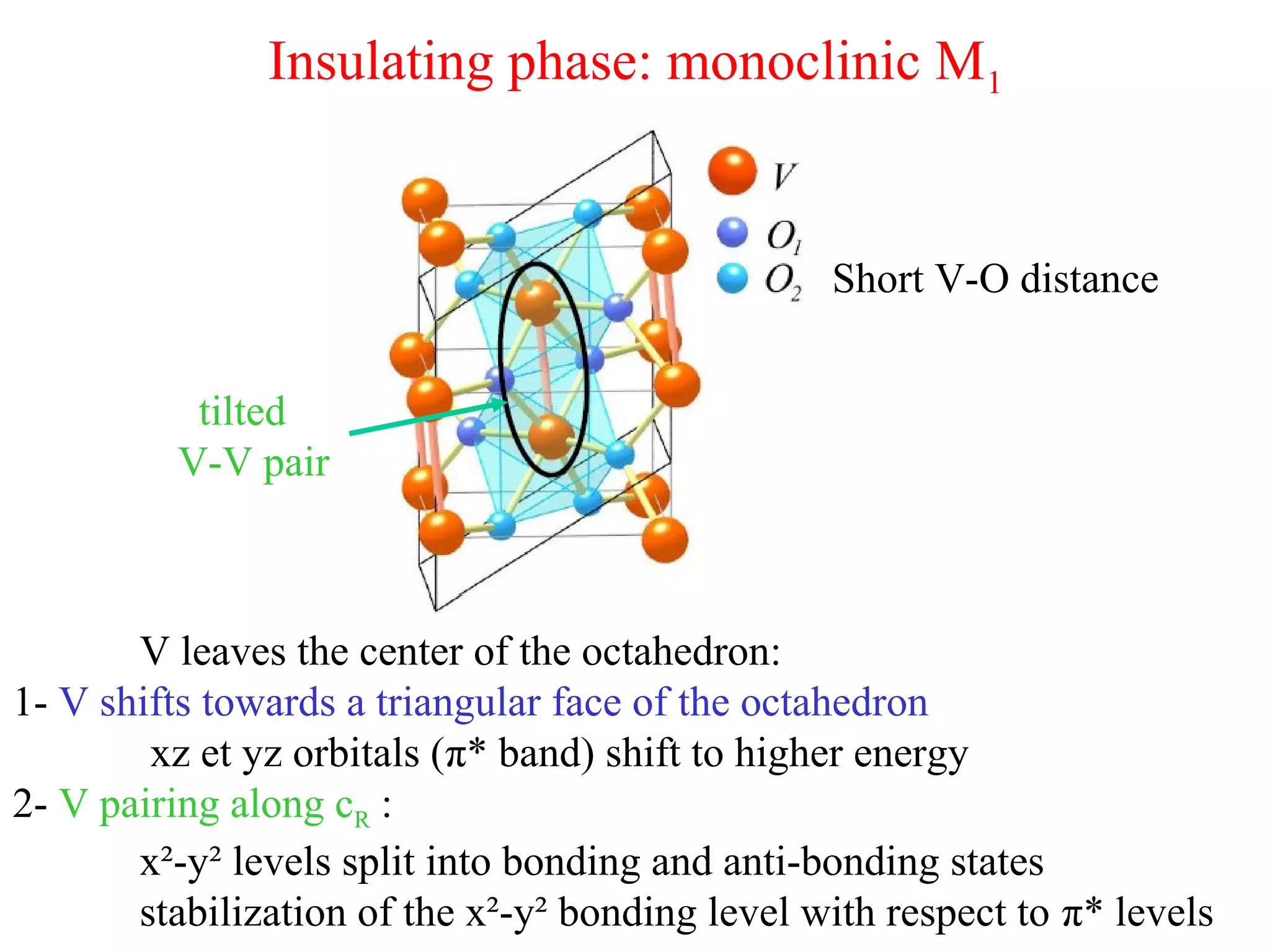
Insulating phase: monoclinic M1
tilted
V-V pair
V leaves the center of the octahedron:
1- V shifts towards a triangular face of the octahedron
xz et yz orbitals (π* band) shift to higher energy
2- V pairing along cR :
x²-y² levels split into bonding and anti-bonding states
stabilization of the x²-y² bonding level with respect to π* levels
Short V-O distance
Driving force of the metal-insulator
transition?
• The 1st
order metal- insulator transition induces a very large
electronic redistribution between the t2g orbitals
• Insulating non magnetic V-V paired M1ground state
stabilized by:
- a Peierls instability in the d// band ?
- Mott-Hubbard charge localization effects?
• To differentiate more clearly these two processes let us look
at alternative insulating phases stabilized in:
Cr substitued VO2
uniaxial stressedVO2
The x²-y² bonding level of the V4+
pair is occupied by 2 electrons of
opposite spin: magnetic singlet (S=0)
R-M1 transition of VO2 splitted into
R-M2-T-M1transitions
V1-XCrXO2
J.P. Pouget et al PRB 10,
1801 (1974)
VO2 stressed along [110]R
J.P. Pouget et al PRL 35,
873 (1975)
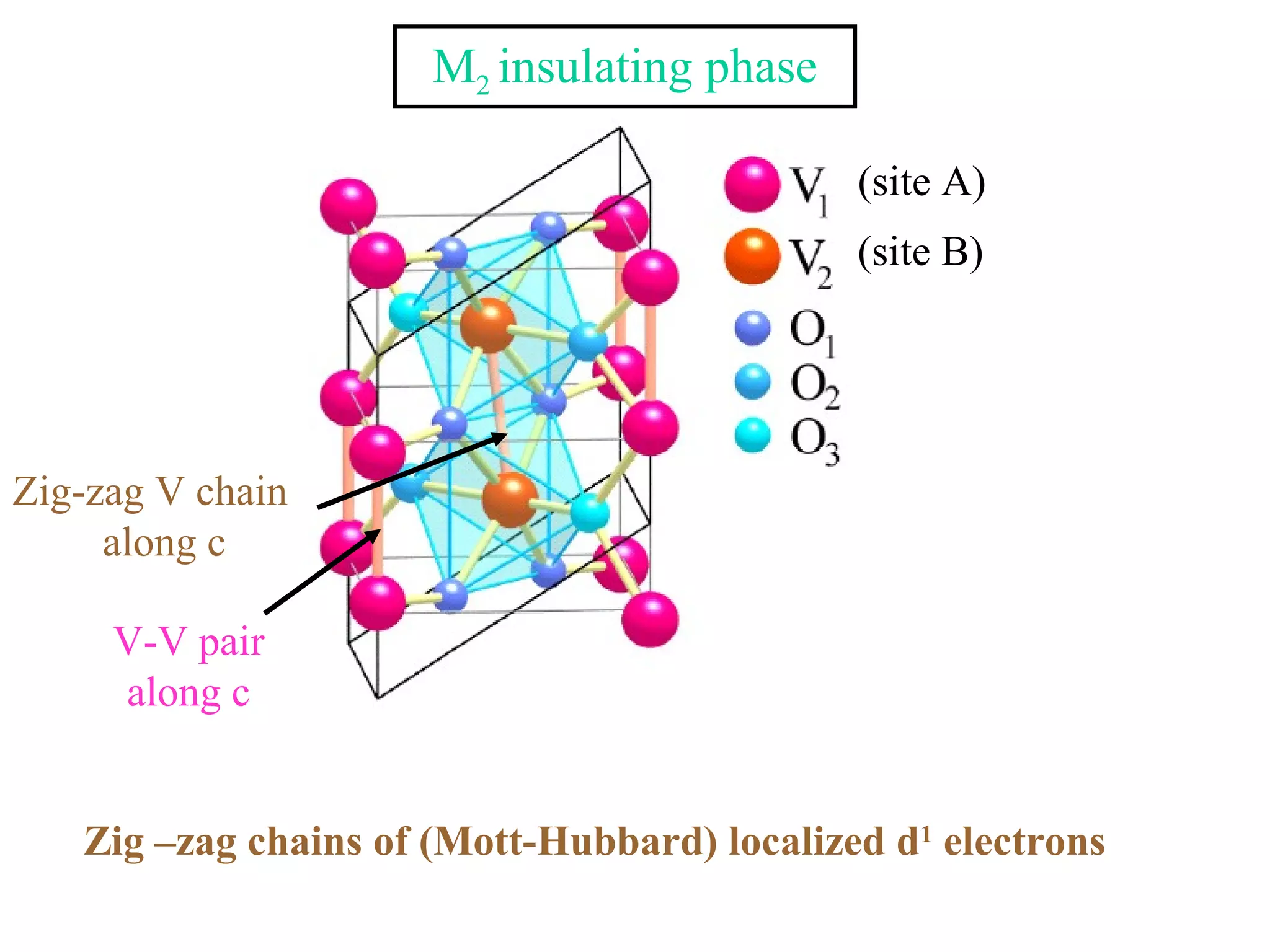
M2 insulating phase
Zig-zag V chain
along c
V-V pair
along c
(site B)
(site A)
Zig –zag chains of (Mott-Hubbard) localized d1
electrons
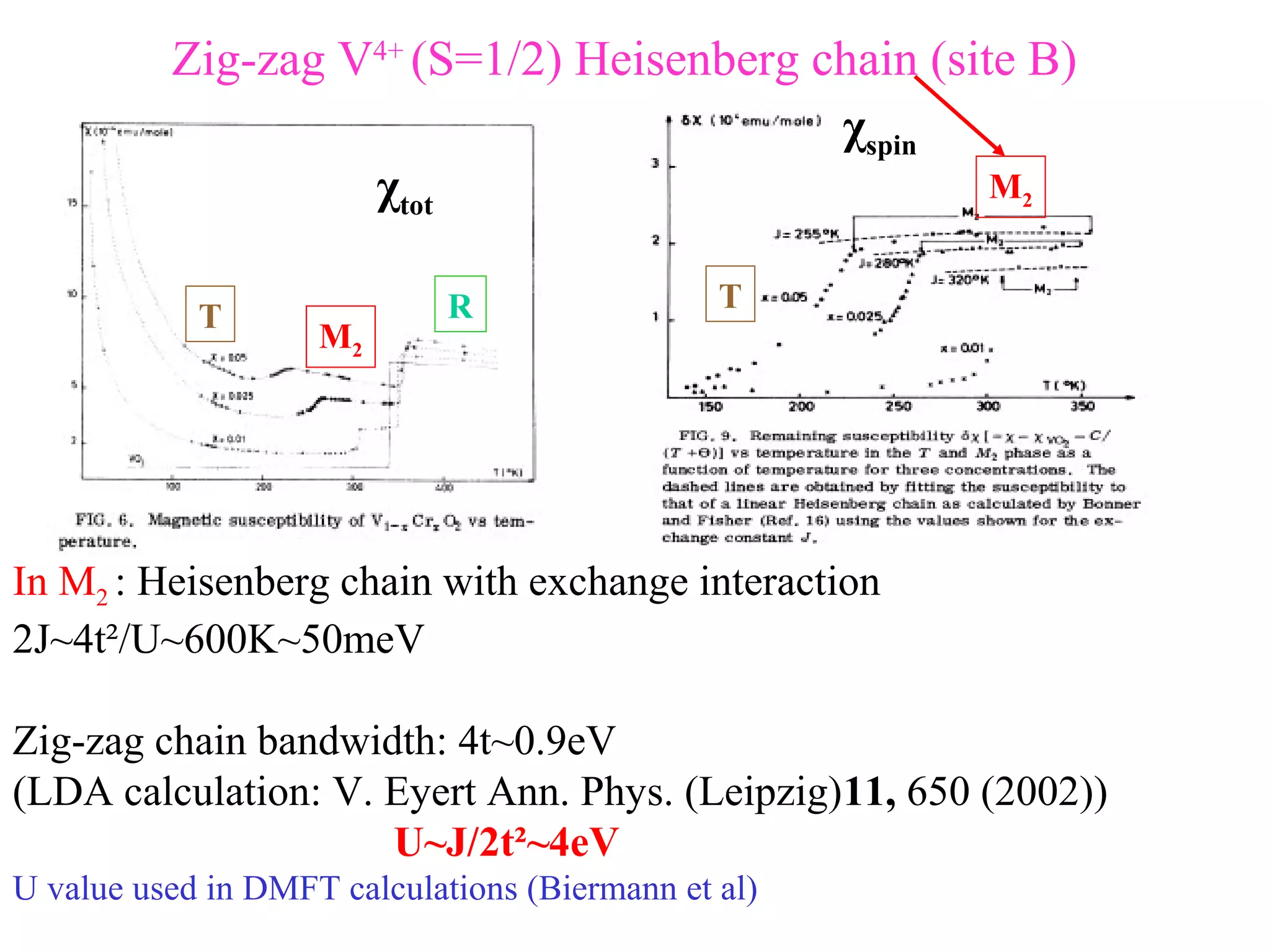
In M2 : Heisenberg chain with exchange interaction
2J~4t²/U~600K~50meV
Zig-zag chain bandwidth: 4t~0.9eV
(LDA calculation: V. Eyert Ann. Phys. (Leipzig)11, 650 (2002))
U~J/2t²~4eV
U value used in DMFT calculations (Biermann et al)
Zig-zag V4+
(S=1/2) Heisenberg chain (site B)
χtot
χspin
T
M2
R T
M2
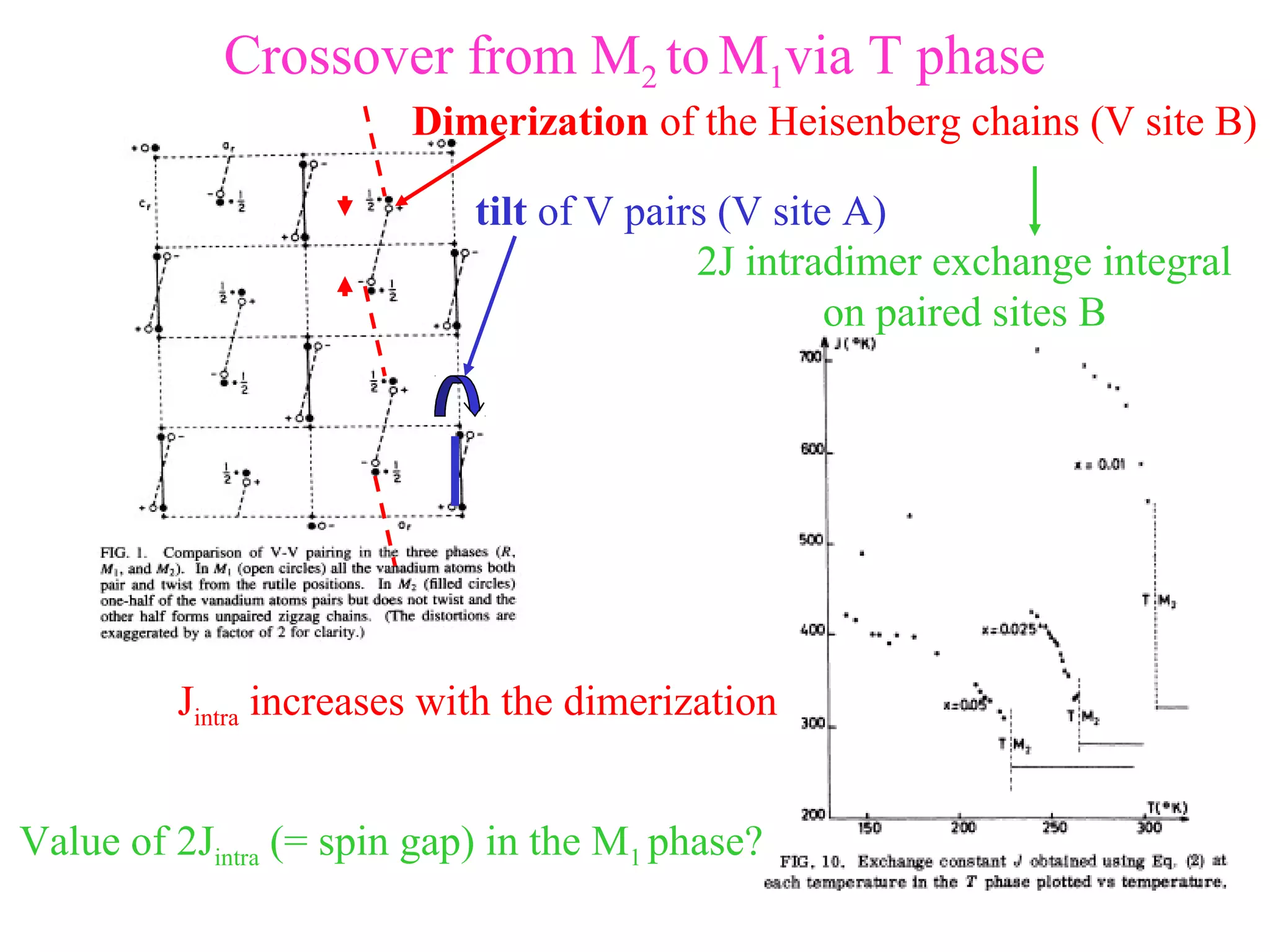
Crossover from M2 to M1via T phase
tilt of V pairs (V site A)
Dimerization of the Heisenberg chains (V site B)
2J intradimer exchange integral
on paired sites B
Value of 2Jintra (= spin gap) in the M1 phase?
Jintra increases with the dimerization
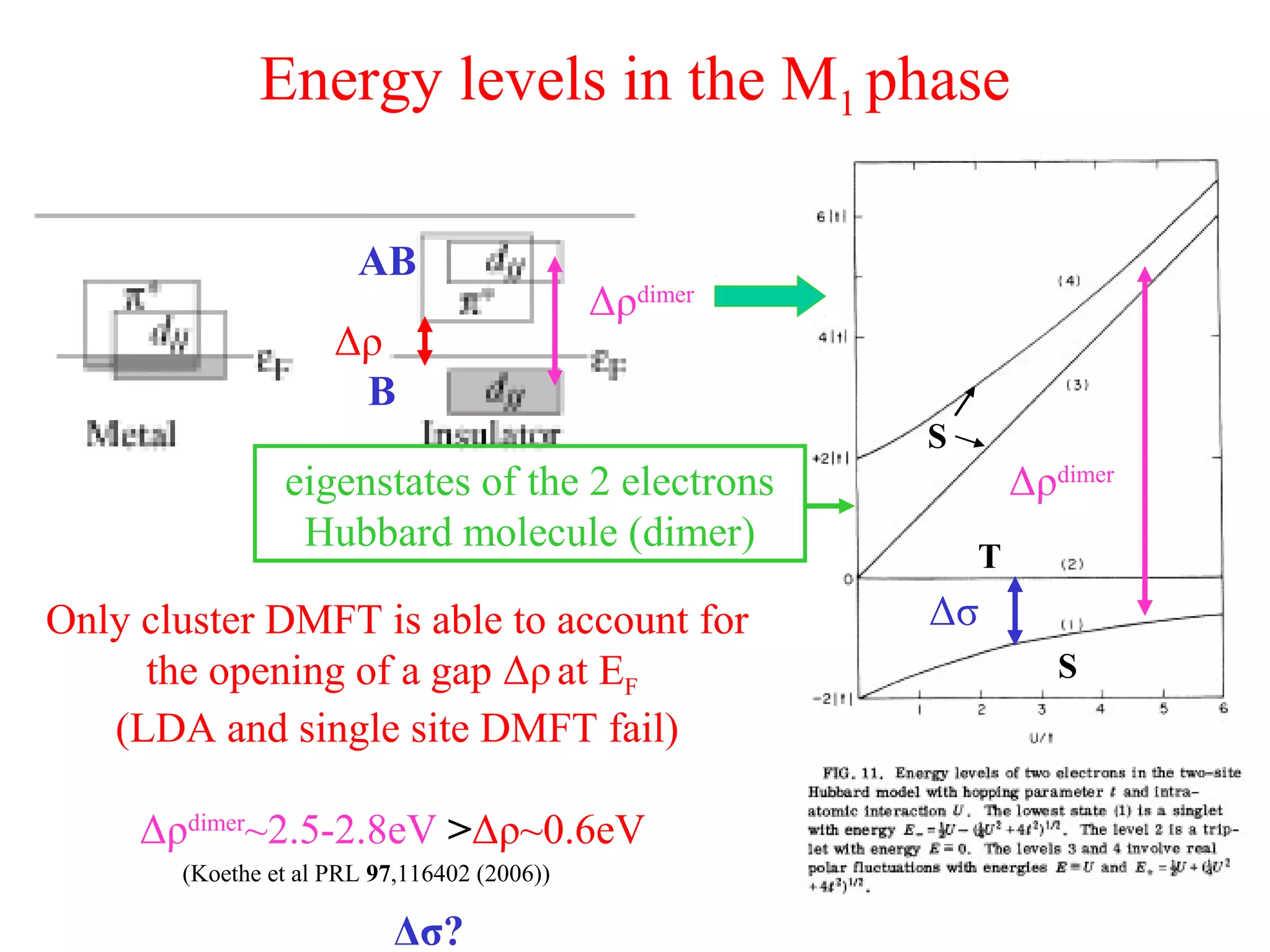
Energy levels in the M1 phase
Δρ
Δρdimer
Δρdimer
Δσ
eigenstates of the 2 electrons
Hubbard molecule (dimer)
Only cluster DMFT is able to account for
the opening of a gap Δρat EF
(LDA and single site DMFT fail)
Δρdimer
~2.5-2.8eV >Δρ~0.6eV
(Koethe et al PRL 97,116402 (2006))
Δσ?
S
T
S
B
AB
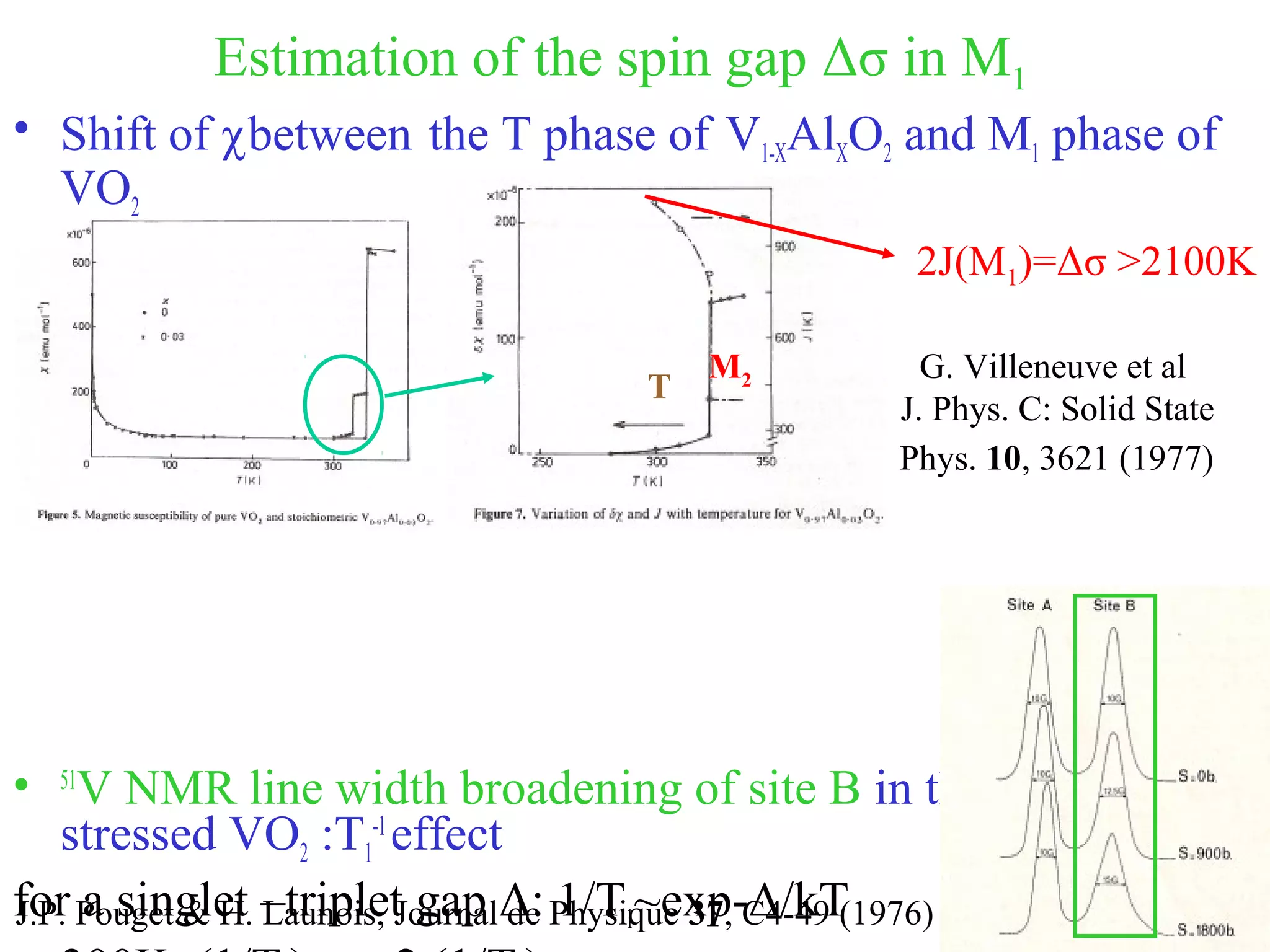
Estimation of the spin gap Δσ in M1
• Shift of χbetween the T phase of V1-XAlXO2 and M1 phase of
VO2
• 51
V NMR line width broadening of site B in the T phase of
stressed VO2 :T1
-1
effect
for a singlet –triplet gap Δ: 1/T1~exp-Δ/kT
2J(M1)=Δσ >2100K
G. Villeneuve et al
J. Phys. C: Solid State
Phys. 10, 3621 (1977)
J.P. Pouget & H. Launois, Journal de Physique 37, C4-49 (1976)
M2
T
50 60 70 80 90 100 110 120 130
200
400
600
800
1000
1200
Jintra(°K)
Vyy (KHz)
V1-X
CrX
O2
X=1%
stressed VO2
% T=295K
M1
T
M2
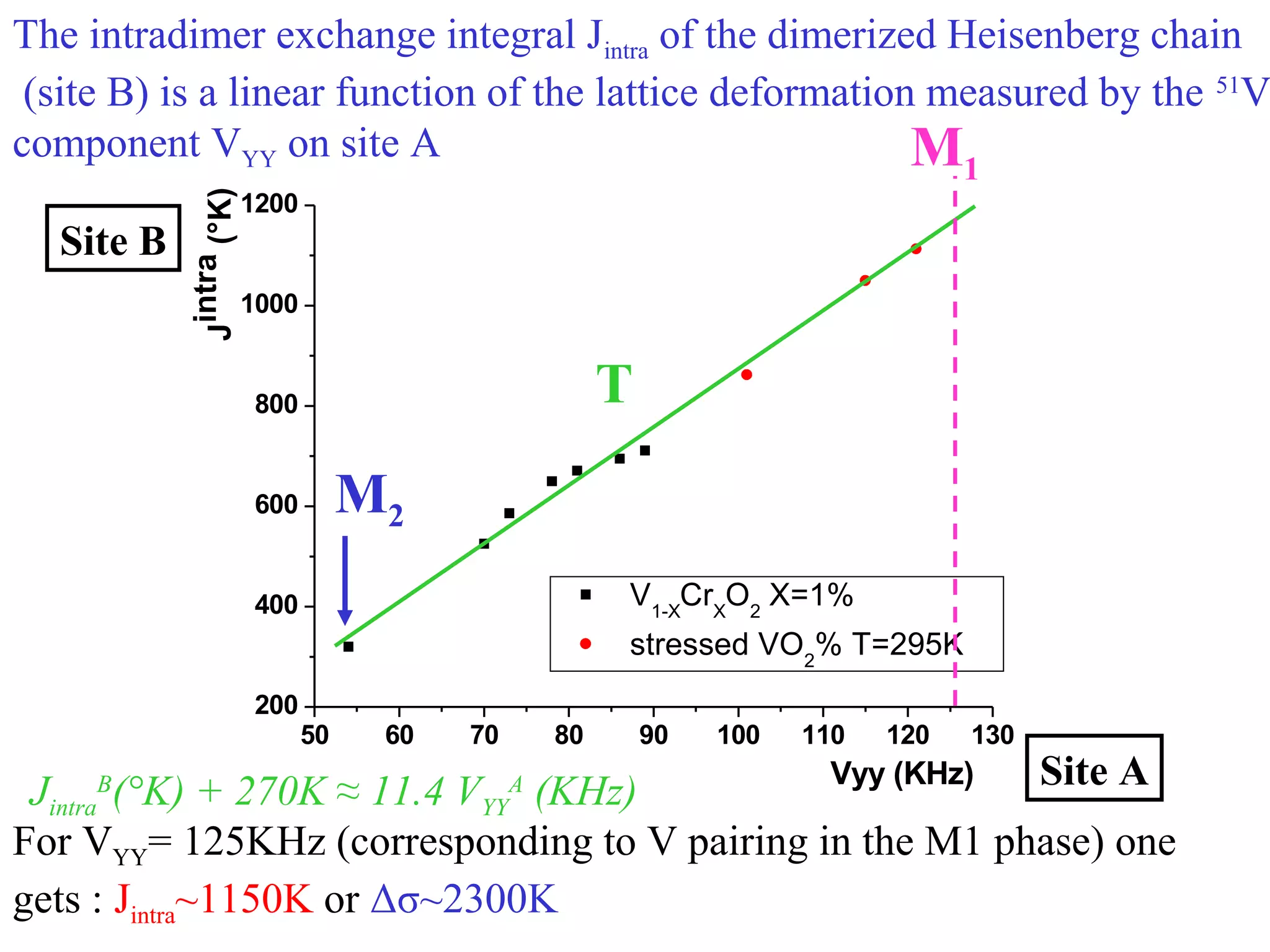
Jintra
B
(°K) + 270K ≈ 11.4 VYY
A
(KHz)
The intradimer exchange integral Jintra of the dimerized Heisenberg chain
(site B) is a linear function of the lattice deformation measured by the 51
V
component VYY on site A
For VYY= 125KHz (corresponding to V pairing in the M1 phase) one
gets : Jintra~1150K or Δσ~2300K
Site B
Site A
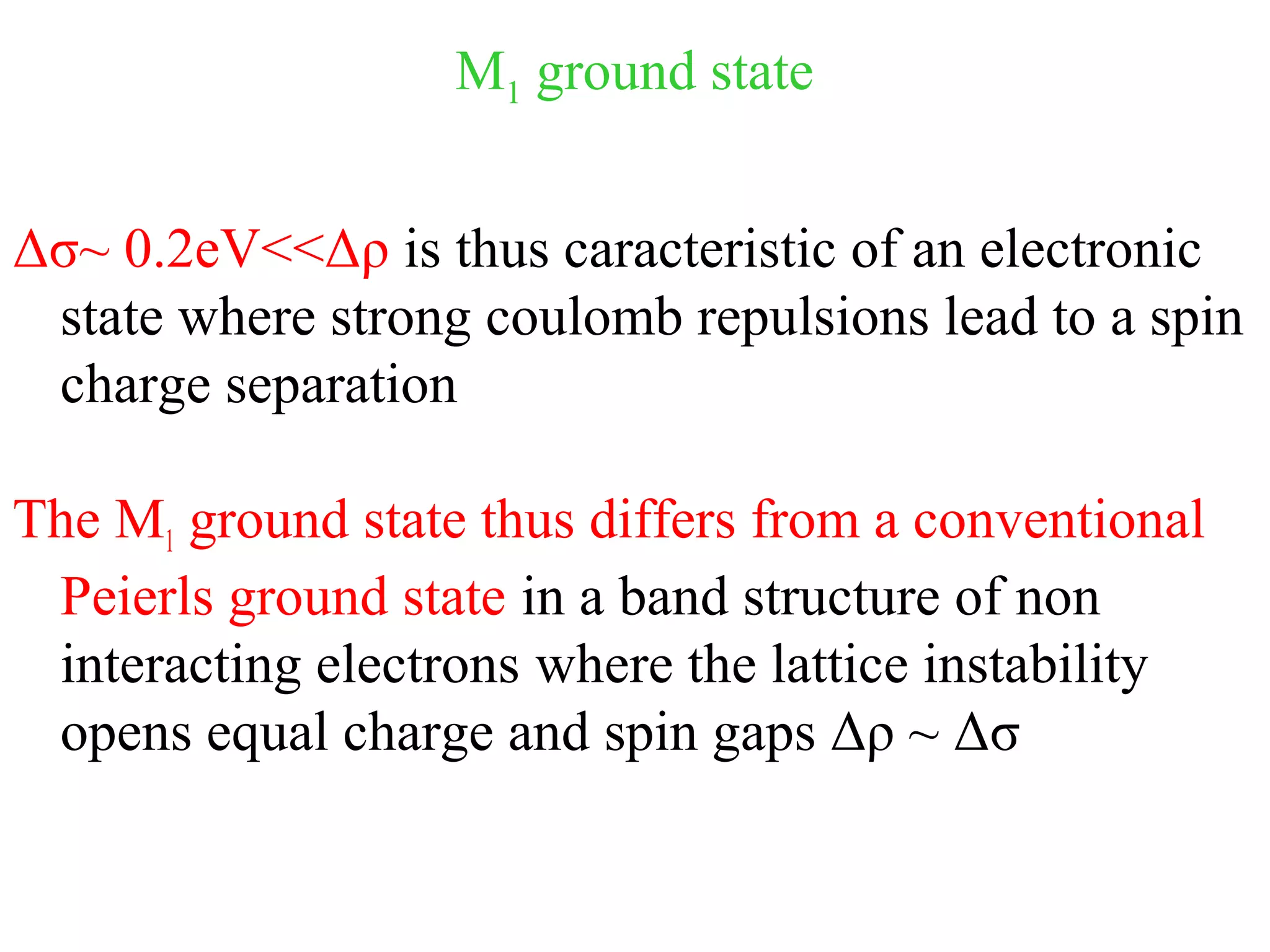
M1 ground state
Δσ~ 0.2eV<<Δρ is thus caracteristic of an electronic
state where strong coulomb repulsions lead to a spin
charge separation
The M1 ground state thus differs from a conventional
Peierls ground state in a band structure of non
interacting electrons where the lattice instability
opens equal charge and spin gaps Δρ ~ Δσ
Electronic parameters of the M1 Hubbarddimer
• Spin gap value Δσ ~ 0.2 eV
Δσ= [-U+ (U²+16t²)1/2
]/2
which leads to:
2t ≈ (Δσ Δρintra
)1/2
≈0.7eV
2t amounts to the splitting between bonding and anti-bonding quasiparticle states
in DMFT (0.7eV) and cluster DMFT (0.9eV) calculations
2t is nearly twice smaller than the B-AB splitting found in LDA (~1.4eV)
• U ≈ Δρintra
-Δσ ~ 2.5eV
(in the M2 phase U estimated at ~4eV)
• For U/t ~ 7
double site occupation ~ 6% per dimer
nearly no charge fluctuations no LHB seen in photoemission
ground state wave function very close to the Heitler-London limit*
*wave function expected for a spin-Peierls ground state
The ground state of VO2 is such that Δσ~7J (strong coupling limit)
In weak coupling spin-Peierls systems Δσ<J
Lattice effects
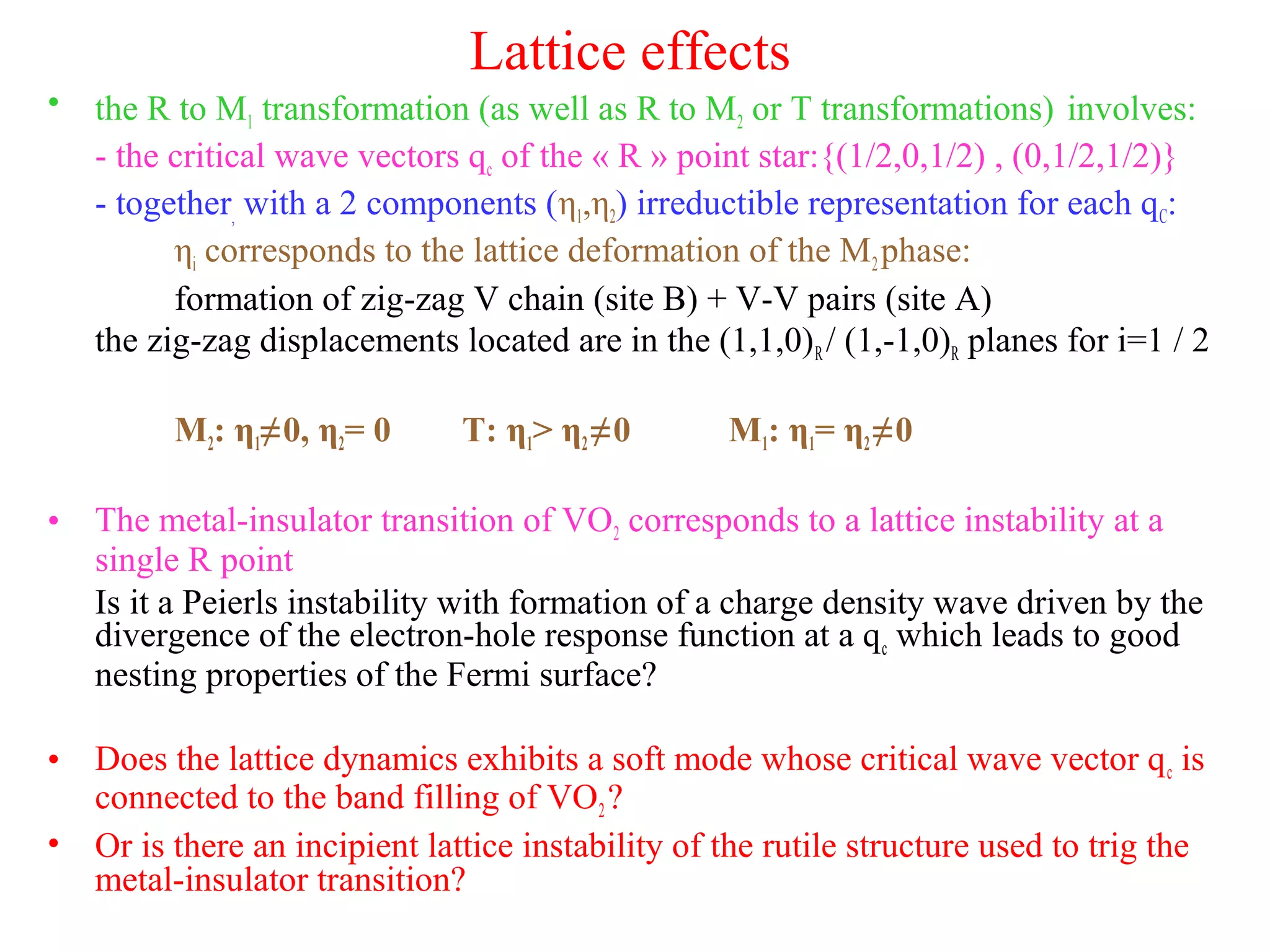
• the R to M1 transformation (as well as R to M2 or T transformations) involves:
- the critical wave vectors qc of the « R » point star:{(1/2,0,1/2) , (0,1/2,1/2)}
- together, with a 2 components (η1,η2) irreductible representation for each qC:
ηi corresponds to the lattice deformation of the M2phase:
formation of zig-zag V chain (site B) + V-V pairs (site A)
the zig-zag displacements located are in the (1,1,0)R/ (1,-1,0)R planes for i=1 / 2
M2: η1≠0, η2= 0 T: η1> η2≠0 M1: η1= η2≠0
• The metal-insulator transition of VO2 corresponds to a lattice instability at a
single R point
Is it a Peierls instability with formation of a charge density wave driven by the
divergence of the electron-hole response function at a qc which leads to good
nesting properties of the Fermi surface?
• Does the lattice dynamics exhibits a soft mode whose critical wave vector qc is
connected to the band filling of VO2?
• Or is there an incipient lattice instability of the rutile structure used to trig the
metal-insulator transition?
Evidences of soft lattice dynamics
• X-ray diffuse scattering experiments show the presence of {1,1,1}
planes of « soft phonons » in rutile phase of
(metallic)VO2 (insulating) TiO2
(R. Comès, P. Felix and JPP: 35 years old unpublished results)
aR*/2
aR*/2
cR*/2
R critical point of VO2
P critical point of NbO2
Γ critical point of TiO2
(incipient ferroelectricity
of symmetry A2U and
2x degenerate EU)
+(001) planes
{u//cR}
[001]
[110]
A2U
EU
{u//[110]}
smeared diffuse
scattering ┴ c*R
{1,1,1} planar soft phonon modes in VO2
• not related to the band filling (the diffuse scattering exists also in TiO2)
• 2kFof the d//band does not appear to be a pertinent critical wave vector
as expected for a Peierls transition
but the incipient (001)-like diffuse lines could be the fingerprint of a 4kFinstability
(not critical) of fully occupied d// levels
• instability of VO2 is triggerred by an incipient lattice instability of the
rutile structure which tends to induce a V zig-zag shift*
ferroelectric V shift along the [110] / [1-10] direction* (degenerate RI?) accounts for the
polarisation of the diffuse scattering
correlated V shifts along [111] direction give rise to the observed (111) X-ray diffuse
scattering sheets
*the zig-zag displacement destabilizes the π* orbitals
a further stabilization of d// orbitals occurs via the formation of bonding levels
achieved by V pairing between neighbouring [111] « chains »
[111]
[110
]cR
[1-
10]
phase diagram of substitued VO2
R
M1
0.03x
V1-XMXO2
0
dTMI/dx ≈ -12K/%V3+
uniaxial stress // [110]R
xV5+
V3+
M=Cr, Al,Fe
VO2+y
VO2-yFy
M=Nb, Mo, W
Oxydation of V4+
Reduction of V4+
MVO2
dTMI/dx≈0
Sublatices A≡B Sublatices A≠B
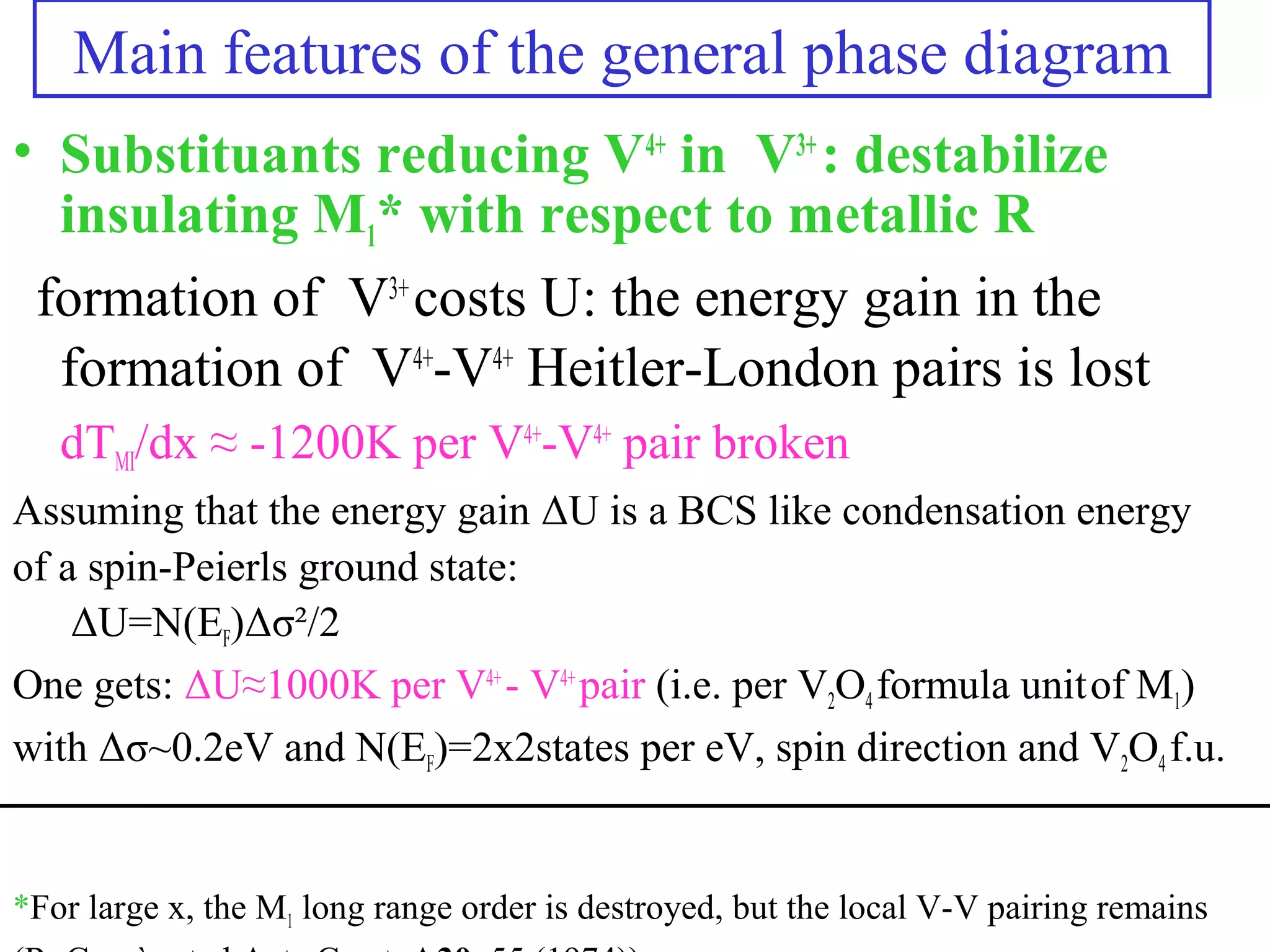
Main features of the general phase diagram
• Substituants reducing V4+
in V3+
: destabilize
insulating M1* with respect to metallic R
formation of V3+
costs U: the energy gain in the
formation of V4+
-V4+
Heitler-London pairs is lost
dTMI/dx ≈ -1200K per V4+
-V4+
pair broken
Assuming that the energy gain ΔU is a BCS like condensation energy
of a spin-Peierls ground state:
ΔU=N(EF)Δσ²/2
One gets: ΔU≈1000K per V4+
- V4+
pair (i.e. per V2O4formula unitof M1)
with Δσ~0.2eV and N(EF)=2x2states per eV, spin direction and V2O4 f.u.
*For large x, the M1 long range order is destroyed, but the local V-V pairing remains
Main features of the general phase diagram
• Substituants reducing V4+
in V5+
: destabilize insulating M1
with respect to new insulating T and M2phases
butleaves unchangedmetal-insulator transition: dTMI/dx≈0
below R: the totally paired M1phase is replaced by the half
paired M2 phase
formation of V5+
looses also thepairing energy gain but does not kill
the zig-zag instability (also present in TiO2!)
as a consequence the M2phase is favored
uniaxial stress along [110] induces zig-zag V displacements along [1-10]
Note the non symmetric phase diagram with respect to
electron and hole « doping » of VO2!
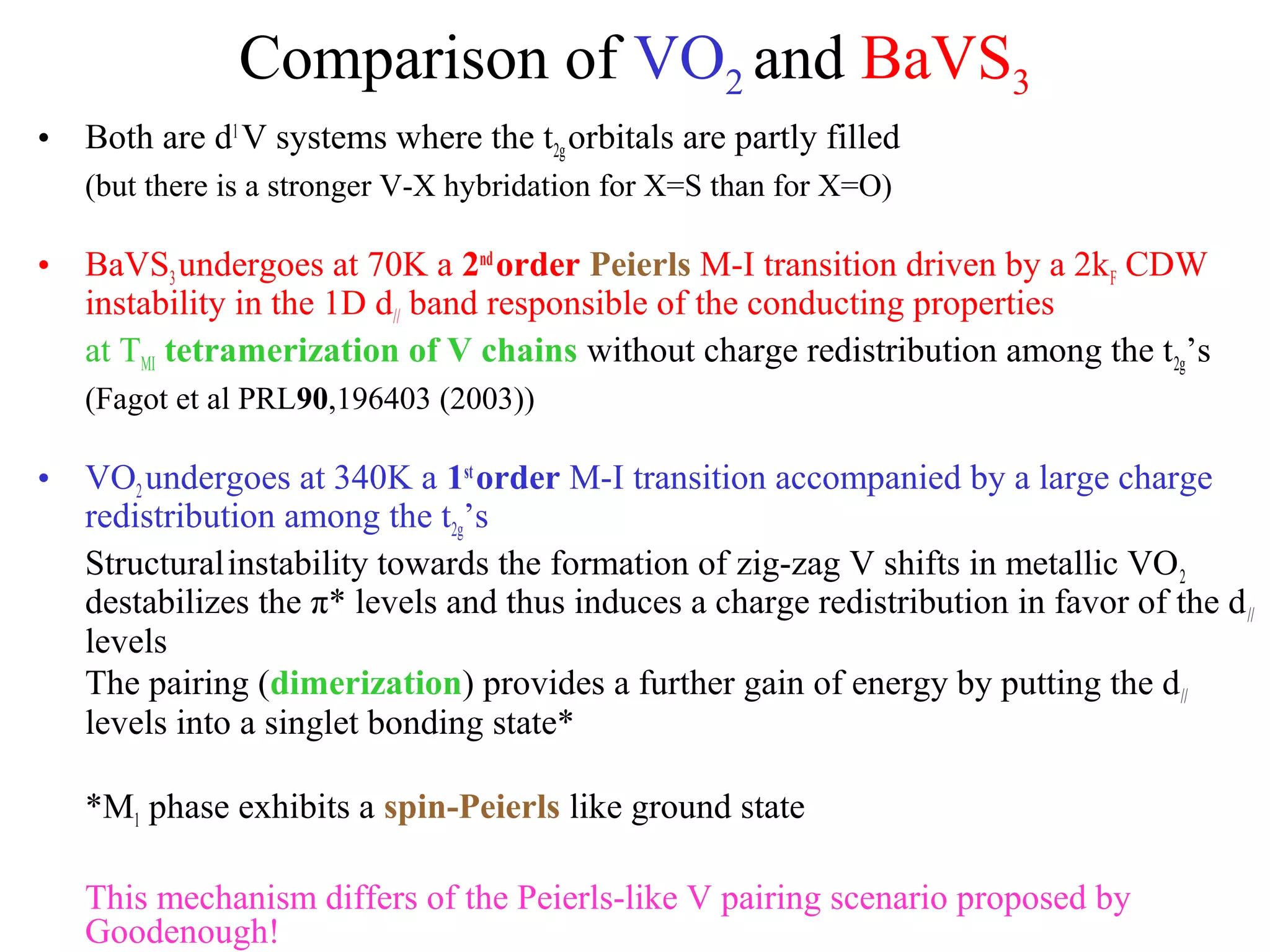
Comparison of VO2 and BaVS3
• Both are d1
V systems where the t2gorbitals are partly filled
(but there is a stronger V-X hybridation for X=S than for X=O)
• BaVS3undergoes at 70K a 2nd
order Peierls M-I transition driven by a 2kF CDW
instability in the 1D d// band responsible of the conducting properties
at TMI tetramerization of V chains without charge redistribution among the t2g’s
(Fagot et al PRL90,196403 (2003))
• VO2undergoes at 340K a 1st
order M-I transition accompanied by a large charge
redistribution among the t2g’s
Structuralinstability towards the formation of zig-zag V shifts in metallic VO2
destabilizes the π* levels and thus induces a charge redistribution in favor of the d//
levels
The pairing (dimerization) provides a further gain of energy by putting the d//
levels into a singlet bonding state*
*M1 phase exhibits a spin-Peierls like ground state
This mechanism differs of the Peierls-like V pairing scenario proposed by
Goodenough!
acknowledgements
• During the thesis work
H. Launois
P. Lederer
T.M. Rice
R. Comès
J. Friedel
• Renew of interest from recent DMFT calculations
A. Georges
S. Biermann
A. Poteryaev
J.M. Tomczak
Supplementary material
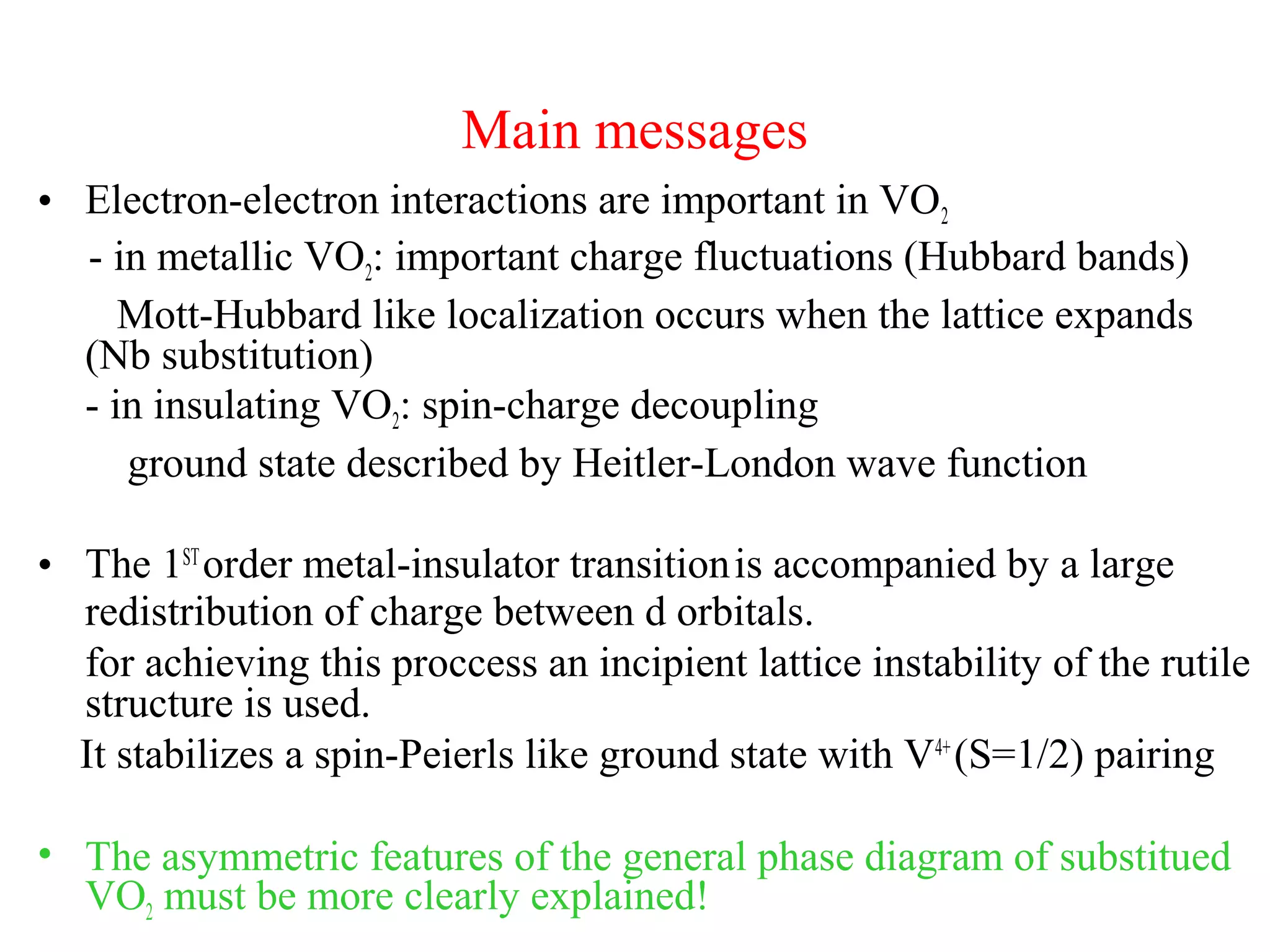
Main messages
• Electron-electron interactions are important in VO2
- in metallic VO2: important charge fluctuations (Hubbard bands)
Mott-Hubbard like localization occurs when the lattice expands
(Nb substitution)
- in insulating VO2: spin-charge decoupling
ground state described by Heitler-London wave function
• The 1ST
order metal-insulator transitionis accompanied by a large
redistribution of charge between d orbitals.
for achieving this proccess an incipient lattice instability of the rutile
structure is used.
It stabilizes a spin-Peierls like ground state with V4+
(S=1/2) pairing
• The asymmetric features of the general phase diagram of substitued
VO2 must be more clearly explained!
LDA
metallic
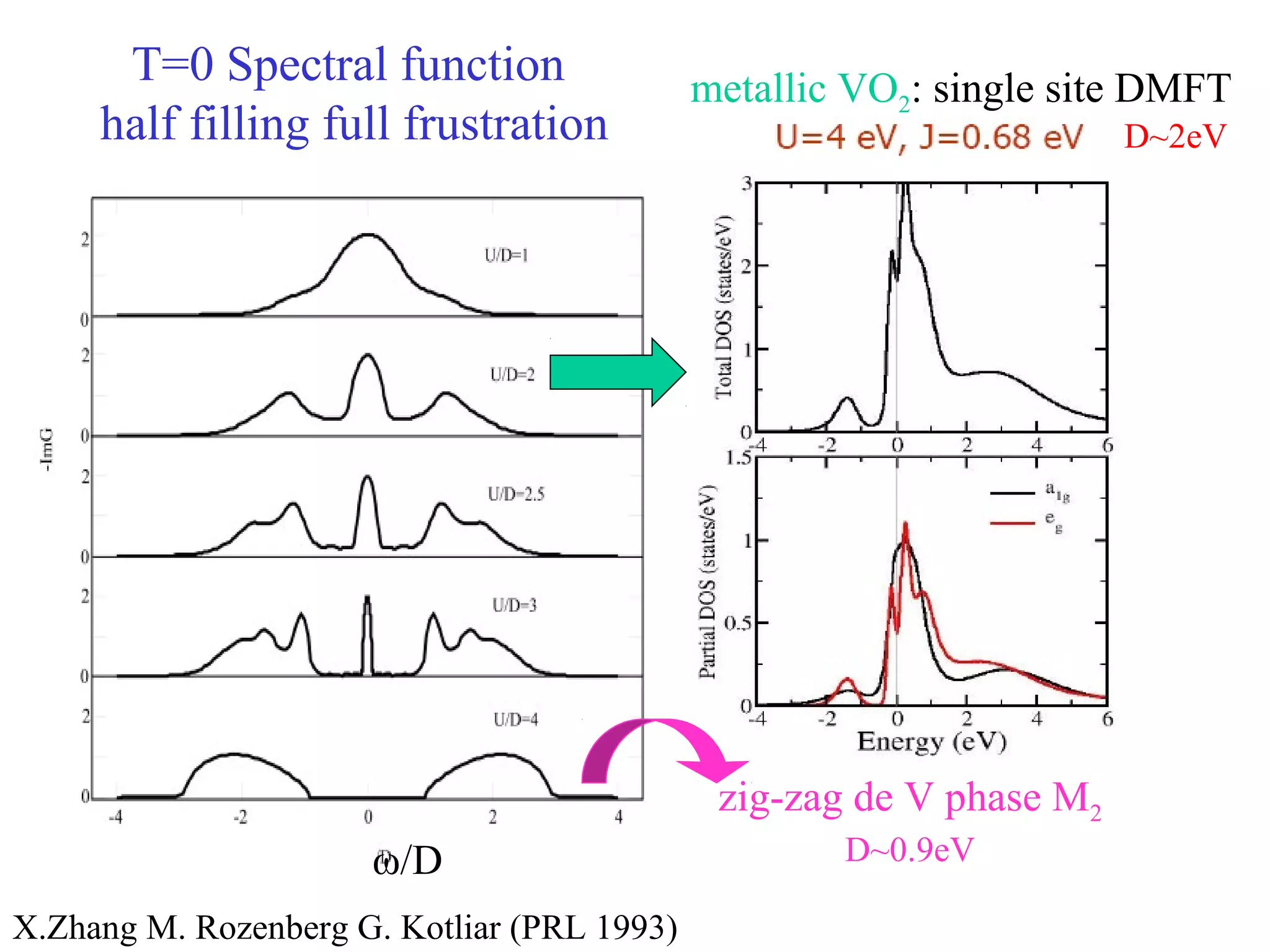
T=0 Spectral function
half filling full frustration
X.Zhang M. Rozenberg G. Kotliar (PRL 1993)
ω/D
metallic VO2: single site DMFT
D~2eV
zig-zag de V phase M2
D~0.9eV
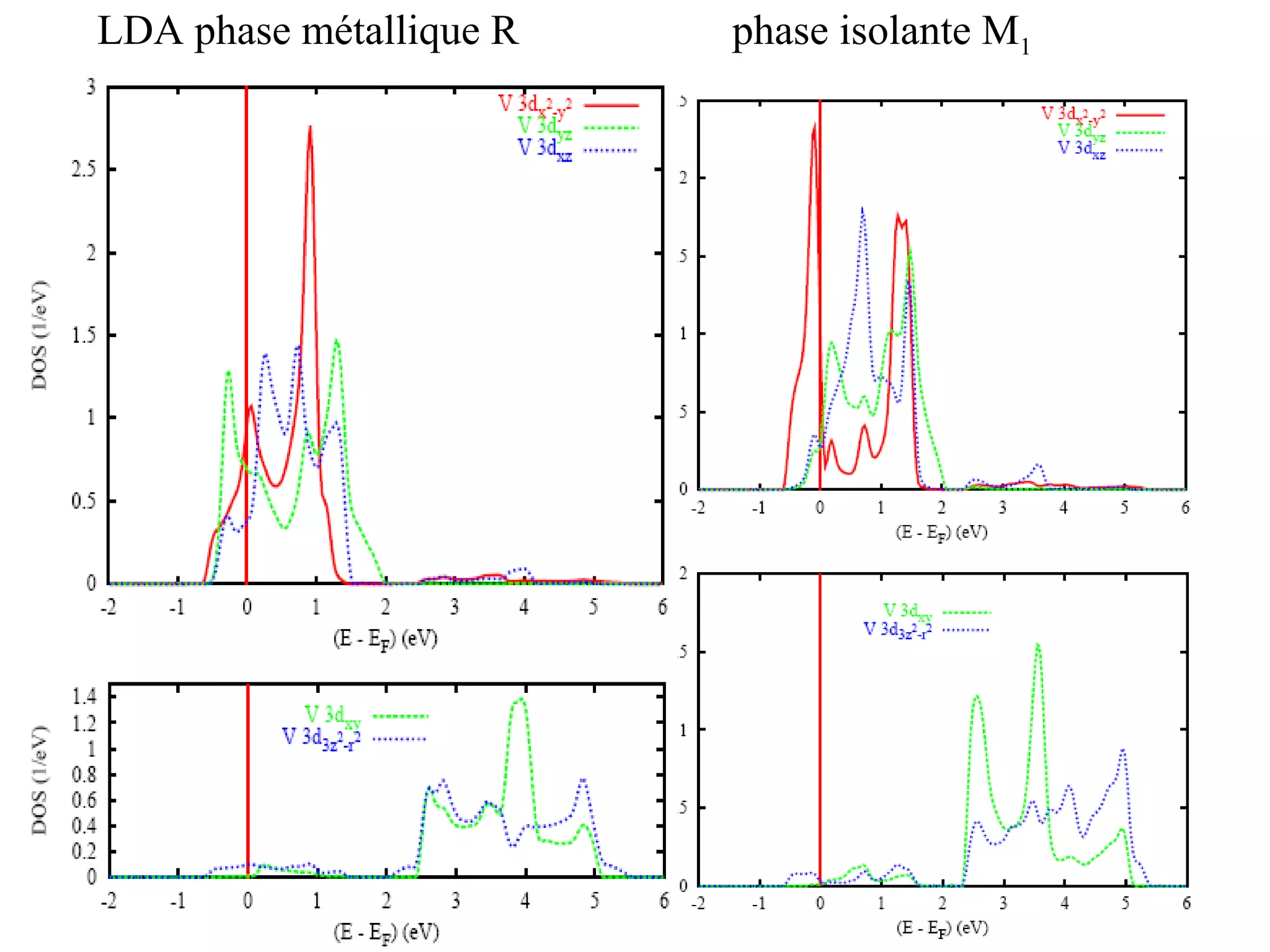
LDA phase métallique R phase isolante M1
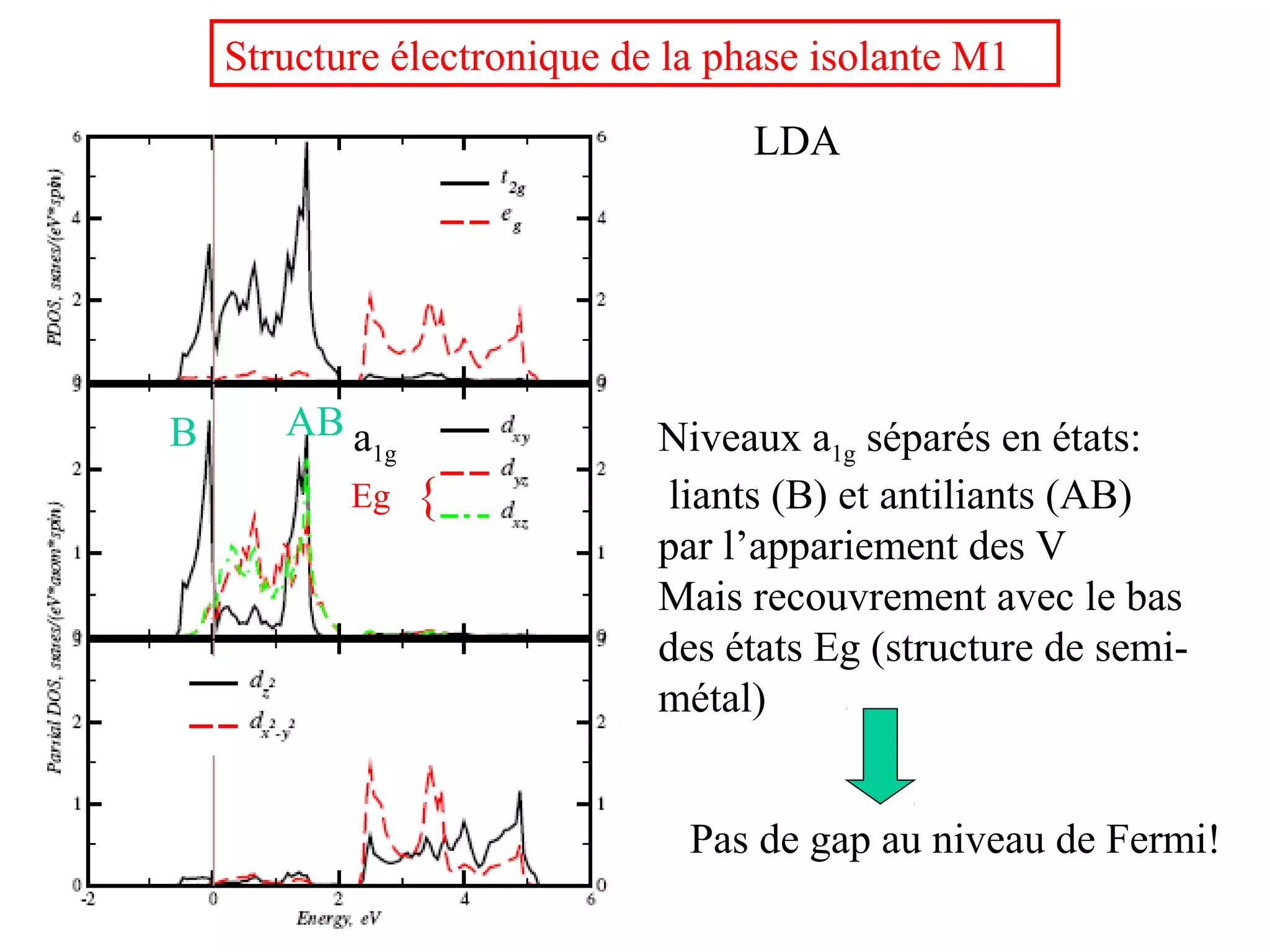
Structure électronique de la phase isolante M1
LDA LDA
Pas de gap au niveau de Fermi!
Eg {
a1g
B AB Niveaux a1g séparés en états:
liants (B) et antiliants (AB)
par l’appariement des V
Mais recouvrement avec le bas
des états Eg (structure de semi-
métal)
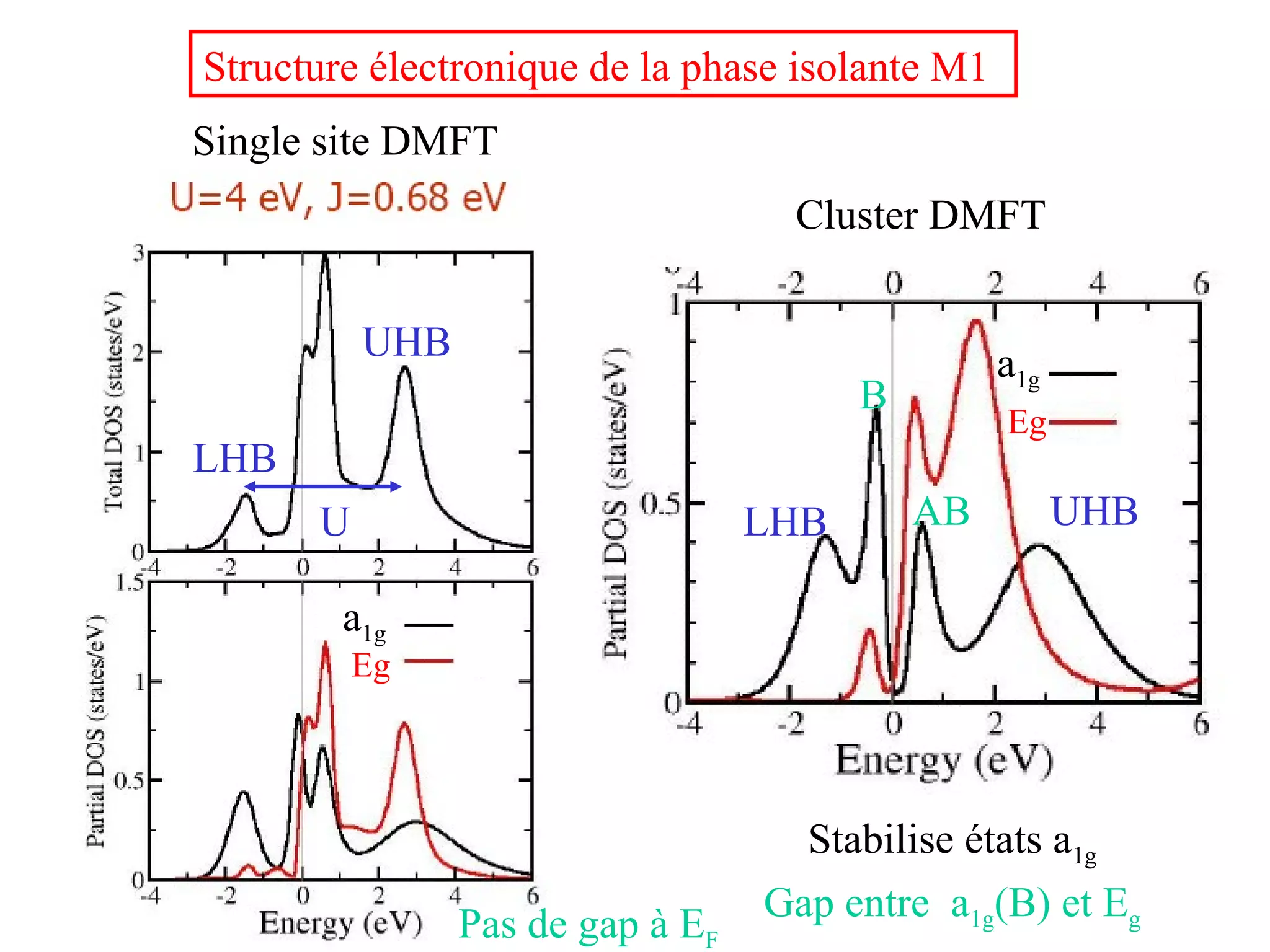
Cluster DMFT
Gap entre a1g(B) et Eg
Structure électronique de la phase isolante M1
Eg
a1g
Single site DMFT
Pas de gap à EF
Eg
a1g
LHB
UHB
U
B
ABLHB UHB
Stabilise états a1g
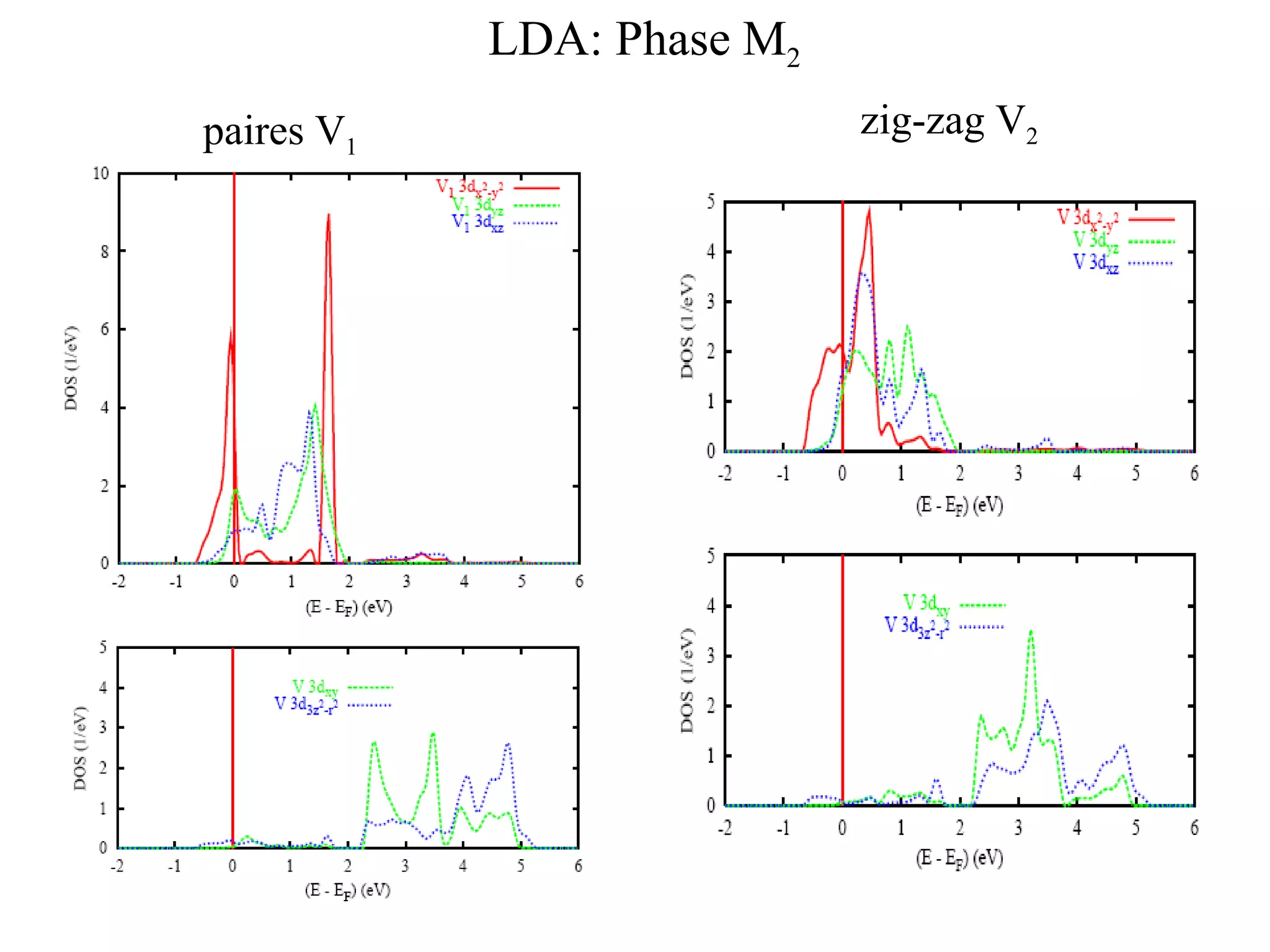
LDA: Phase M2
paires V1
zig-zag V2

The metal-insulator transition of VO2 revisited

  • 1.
    The metal-insulator transitionof VO2 revisited J.-P. Pouget Laboratoire de Physique des Solides, CNRS-UMR 8502, Université Paris-sud 91405 Orsay « Correlated electronic states in low dimensions » Orsay 16 et 17 juin 2008 Conférence en l’honneur de Pascal Lederer
  • 2.
    outline • Electronic structureof metallic VO2 • Insulating ground states • Role of the lattice in the metal-insulator transition of VO2 • General phase diagram of VO2 and its substituants
  • 3.
    VO2: 1st order metal-insulatortransition at 340K Discovered nearly 50 years ago still the object of controversy! * *in fact the insulating ground state of VO2 is non magnetic
  • 4.
    Bad metal in metallicphase: ρ ~T very short mean free path: ~V-V distance P.B. Allen et al PRB 48, 4359 (1993) metal insulator
  • 5.
    Metallic rutile phase cR ABAB(CFC) compact packing of hexagonal planes of oxygen atoms V located in one octahedral cavity out of two two sets of identical chains of VO6 octahedra running along cR (related by 42 screw axis symmetry) A B
  • 6.
    eg: t2g V-O σ* bonding bonding betweenV in the (1,1,0) plane (direct V-V bonding along cR :1D band?) bonding between V in the (1,-1,0) plane in the (0,0,1) plane V 3d orbitals in the xyz octahedral coordinate frame V-O π* bonding orbital located in the xy basis of the octahedron orbitals « perpendicular » to the triangular faces of the octaedron
  • 7.
    well splitted t2gand eg bands V. Eyert Ann. Phys. (Leipzig) 11, 650 (2002) 3dyz and 3dxz: Eg or π* bands of Goodenough 3dx²-y²: a1g or t// (1D) band of Goodenough Is it relevant to the physics of metallic VO2? LDA: 1d electron of the V4+ fills the 3 t2g bands t2g eg
  • 8.
    Electronic structure ofmetallic VO2 LDA Single site DMFT Eg a1g t2g levels bandwidth~2eV: weakly reduced in DMFT calculations U LHB UHB Biermann et al PRL 94, 026404 (2005) Hubbard bandson both Eg (π*) and a1g (d//) states no specificity of d// band!
  • 9.
    Fractional occupancy oft2g orbitals orbital/occupancy LDA* single site DMFT* EFG measurements** x²-y² (d//) f1 0.36 0.42 0.41 yz (π*) f2 0.32 0.29 0.26-0.28 xz (π*) f3 0.32 0.29 0.33-0.31 *Biermann et al PRL 94, 026404 (2005) ** JPP thesis (1974): 51 V EFG measurements between 70°C and 320°C assuming that only the on site d electron contributes to the EFG: VXX = (2/7)e<r-3 > (1-3f2) VYY = (2/7)e<r-3 > (1-3f3) VZZ = (2/7)e<r-3 > (1-3f1)
  • 10.
    VO2: a correlatedmetal? • Total spin susceptiblity: Neff (EF)~10 states /eV, spin direction J.P. Pouget & H. Launois, Journal de Physique 37, C4-49 (1976) • Density of state at EF: N(EF)~1.3*, 1.5**, 2*** state/eV, spin direction *LDA: Eyert Ann Phys. (Leipzig) 11, 650 (2002), **LDA: Korotin et al cond-mat/0301347 ***LDA and DMFT: Biermann et al PRL 94, 026404 (2005) Enhancement factor of χPauli: 5-8
  • 11.
    Sizeable charge fluctuationsin the metallic state • DMFT: quasiparticle band + lower (LHB) and upper (UHB) Hubbard bands • LHB observed in photoemission spectra • VO2close to a Mott-Hubbard transition? LHB Koethe et al PRL 97, 116402 (2006)
  • 12.
    Mott Hubbard transitionfor x increasing in Nb substitued VO2: V1-XNbXO2? • Nb isoelectronic of V but of larger size • lattice parameters of the rutile phase strongly increase with x • Very large increase of the spin susceptibility with x NMR in the metallic state show that this increase is homogeneous (no local effects) for x<xC magnetism becomes more localized when x increases (Curis Weiss behavior of χspin for x large) • beyond xC ~0.2: electronic conductivity becomes activated electronic charges become localized local effects (induced by the disorder) become relevant near the metal-insulator transition metal-insulator transition with x due to combined effect of correlations and disorder concept of strongly correlated Fermi glass (P. Lederer)
  • 14.
    Insulating phase: monoclinicM1 tilted V-V pair V leaves the center of the octahedron: 1- V shifts towards a triangular face of the octahedron xz et yz orbitals (π* band) shift to higher energy 2- V pairing along cR : x²-y² levels split into bonding and anti-bonding states stabilization of the x²-y² bonding level with respect to π* levels Short V-O distance
  • 15.
    Driving force ofthe metal-insulator transition? • The 1st order metal- insulator transition induces a very large electronic redistribution between the t2g orbitals • Insulating non magnetic V-V paired M1ground state stabilized by: - a Peierls instability in the d// band ? - Mott-Hubbard charge localization effects? • To differentiate more clearly these two processes let us look at alternative insulating phases stabilized in: Cr substitued VO2 uniaxial stressedVO2 The x²-y² bonding level of the V4+ pair is occupied by 2 electrons of opposite spin: magnetic singlet (S=0)
  • 16.
    R-M1 transition ofVO2 splitted into R-M2-T-M1transitions V1-XCrXO2 J.P. Pouget et al PRB 10, 1801 (1974) VO2 stressed along [110]R J.P. Pouget et al PRL 35, 873 (1975)
  • 17.
    M2 insulating phase Zig-zagV chain along c V-V pair along c (site B) (site A) Zig –zag chains of (Mott-Hubbard) localized d1 electrons
  • 18.
    In M2 :Heisenberg chain with exchange interaction 2J~4t²/U~600K~50meV Zig-zag chain bandwidth: 4t~0.9eV (LDA calculation: V. Eyert Ann. Phys. (Leipzig)11, 650 (2002)) U~J/2t²~4eV U value used in DMFT calculations (Biermann et al) Zig-zag V4+ (S=1/2) Heisenberg chain (site B) χtot χspin T M2 R T M2
  • 19.
    Crossover from M2to M1via T phase tilt of V pairs (V site A) Dimerization of the Heisenberg chains (V site B) 2J intradimer exchange integral on paired sites B Value of 2Jintra (= spin gap) in the M1 phase? Jintra increases with the dimerization
  • 20.
    Energy levels inthe M1 phase Δρ Δρdimer Δρdimer Δσ eigenstates of the 2 electrons Hubbard molecule (dimer) Only cluster DMFT is able to account for the opening of a gap Δρat EF (LDA and single site DMFT fail) Δρdimer ~2.5-2.8eV >Δρ~0.6eV (Koethe et al PRL 97,116402 (2006)) Δσ? S T S B AB
  • 21.
    Estimation of thespin gap Δσ in M1 • Shift of χbetween the T phase of V1-XAlXO2 and M1 phase of VO2 • 51 V NMR line width broadening of site B in the T phase of stressed VO2 :T1 -1 effect for a singlet –triplet gap Δ: 1/T1~exp-Δ/kT 2J(M1)=Δσ >2100K G. Villeneuve et al J. Phys. C: Solid State Phys. 10, 3621 (1977) J.P. Pouget & H. Launois, Journal de Physique 37, C4-49 (1976) M2 T
  • 22.
    50 60 7080 90 100 110 120 130 200 400 600 800 1000 1200 Jintra(°K) Vyy (KHz) V1-X CrX O2 X=1% stressed VO2 % T=295K M1 T M2 Jintra B (°K) + 270K ≈ 11.4 VYY A (KHz) The intradimer exchange integral Jintra of the dimerized Heisenberg chain (site B) is a linear function of the lattice deformation measured by the 51 V component VYY on site A For VYY= 125KHz (corresponding to V pairing in the M1 phase) one gets : Jintra~1150K or Δσ~2300K Site B Site A
  • 23.
    M1 ground state Δσ~0.2eV<<Δρ is thus caracteristic of an electronic state where strong coulomb repulsions lead to a spin charge separation The M1 ground state thus differs from a conventional Peierls ground state in a band structure of non interacting electrons where the lattice instability opens equal charge and spin gaps Δρ ~ Δσ
  • 24.
    Electronic parameters ofthe M1 Hubbarddimer • Spin gap value Δσ ~ 0.2 eV Δσ= [-U+ (U²+16t²)1/2 ]/2 which leads to: 2t ≈ (Δσ Δρintra )1/2 ≈0.7eV 2t amounts to the splitting between bonding and anti-bonding quasiparticle states in DMFT (0.7eV) and cluster DMFT (0.9eV) calculations 2t is nearly twice smaller than the B-AB splitting found in LDA (~1.4eV) • U ≈ Δρintra -Δσ ~ 2.5eV (in the M2 phase U estimated at ~4eV) • For U/t ~ 7 double site occupation ~ 6% per dimer nearly no charge fluctuations no LHB seen in photoemission ground state wave function very close to the Heitler-London limit* *wave function expected for a spin-Peierls ground state The ground state of VO2 is such that Δσ~7J (strong coupling limit) In weak coupling spin-Peierls systems Δσ<J
  • 25.
    Lattice effects • theR to M1 transformation (as well as R to M2 or T transformations) involves: - the critical wave vectors qc of the « R » point star:{(1/2,0,1/2) , (0,1/2,1/2)} - together, with a 2 components (η1,η2) irreductible representation for each qC: ηi corresponds to the lattice deformation of the M2phase: formation of zig-zag V chain (site B) + V-V pairs (site A) the zig-zag displacements located are in the (1,1,0)R/ (1,-1,0)R planes for i=1 / 2 M2: η1≠0, η2= 0 T: η1> η2≠0 M1: η1= η2≠0 • The metal-insulator transition of VO2 corresponds to a lattice instability at a single R point Is it a Peierls instability with formation of a charge density wave driven by the divergence of the electron-hole response function at a qc which leads to good nesting properties of the Fermi surface? • Does the lattice dynamics exhibits a soft mode whose critical wave vector qc is connected to the band filling of VO2? • Or is there an incipient lattice instability of the rutile structure used to trig the metal-insulator transition?
  • 26.
    Evidences of softlattice dynamics • X-ray diffuse scattering experiments show the presence of {1,1,1} planes of « soft phonons » in rutile phase of (metallic)VO2 (insulating) TiO2 (R. Comès, P. Felix and JPP: 35 years old unpublished results) aR*/2 aR*/2 cR*/2 R critical point of VO2 P critical point of NbO2 Γ critical point of TiO2 (incipient ferroelectricity of symmetry A2U and 2x degenerate EU) +(001) planes {u//cR} [001] [110] A2U EU {u//[110]} smeared diffuse scattering ┴ c*R
  • 27.
    {1,1,1} planar softphonon modes in VO2 • not related to the band filling (the diffuse scattering exists also in TiO2) • 2kFof the d//band does not appear to be a pertinent critical wave vector as expected for a Peierls transition but the incipient (001)-like diffuse lines could be the fingerprint of a 4kFinstability (not critical) of fully occupied d// levels • instability of VO2 is triggerred by an incipient lattice instability of the rutile structure which tends to induce a V zig-zag shift* ferroelectric V shift along the [110] / [1-10] direction* (degenerate RI?) accounts for the polarisation of the diffuse scattering correlated V shifts along [111] direction give rise to the observed (111) X-ray diffuse scattering sheets *the zig-zag displacement destabilizes the π* orbitals a further stabilization of d// orbitals occurs via the formation of bonding levels achieved by V pairing between neighbouring [111] « chains » [111] [110 ]cR [1- 10]
  • 28.
    phase diagram ofsubstitued VO2 R M1 0.03x V1-XMXO2 0 dTMI/dx ≈ -12K/%V3+ uniaxial stress // [110]R xV5+ V3+ M=Cr, Al,Fe VO2+y VO2-yFy M=Nb, Mo, W Oxydation of V4+ Reduction of V4+ MVO2 dTMI/dx≈0 Sublatices A≡B Sublatices A≠B
  • 29.
    Main features ofthe general phase diagram • Substituants reducing V4+ in V3+ : destabilize insulating M1* with respect to metallic R formation of V3+ costs U: the energy gain in the formation of V4+ -V4+ Heitler-London pairs is lost dTMI/dx ≈ -1200K per V4+ -V4+ pair broken Assuming that the energy gain ΔU is a BCS like condensation energy of a spin-Peierls ground state: ΔU=N(EF)Δσ²/2 One gets: ΔU≈1000K per V4+ - V4+ pair (i.e. per V2O4formula unitof M1) with Δσ~0.2eV and N(EF)=2x2states per eV, spin direction and V2O4 f.u. *For large x, the M1 long range order is destroyed, but the local V-V pairing remains
  • 30.
    Main features ofthe general phase diagram • Substituants reducing V4+ in V5+ : destabilize insulating M1 with respect to new insulating T and M2phases butleaves unchangedmetal-insulator transition: dTMI/dx≈0 below R: the totally paired M1phase is replaced by the half paired M2 phase formation of V5+ looses also thepairing energy gain but does not kill the zig-zag instability (also present in TiO2!) as a consequence the M2phase is favored uniaxial stress along [110] induces zig-zag V displacements along [1-10] Note the non symmetric phase diagram with respect to electron and hole « doping » of VO2!
  • 31.
    Comparison of VO2and BaVS3 • Both are d1 V systems where the t2gorbitals are partly filled (but there is a stronger V-X hybridation for X=S than for X=O) • BaVS3undergoes at 70K a 2nd order Peierls M-I transition driven by a 2kF CDW instability in the 1D d// band responsible of the conducting properties at TMI tetramerization of V chains without charge redistribution among the t2g’s (Fagot et al PRL90,196403 (2003)) • VO2undergoes at 340K a 1st order M-I transition accompanied by a large charge redistribution among the t2g’s Structuralinstability towards the formation of zig-zag V shifts in metallic VO2 destabilizes the π* levels and thus induces a charge redistribution in favor of the d// levels The pairing (dimerization) provides a further gain of energy by putting the d// levels into a singlet bonding state* *M1 phase exhibits a spin-Peierls like ground state This mechanism differs of the Peierls-like V pairing scenario proposed by Goodenough!
  • 32.
    acknowledgements • During thethesis work H. Launois P. Lederer T.M. Rice R. Comès J. Friedel • Renew of interest from recent DMFT calculations A. Georges S. Biermann A. Poteryaev J.M. Tomczak
  • 33.
  • 34.
    Main messages • Electron-electroninteractions are important in VO2 - in metallic VO2: important charge fluctuations (Hubbard bands) Mott-Hubbard like localization occurs when the lattice expands (Nb substitution) - in insulating VO2: spin-charge decoupling ground state described by Heitler-London wave function • The 1ST order metal-insulator transitionis accompanied by a large redistribution of charge between d orbitals. for achieving this proccess an incipient lattice instability of the rutile structure is used. It stabilizes a spin-Peierls like ground state with V4+ (S=1/2) pairing • The asymmetric features of the general phase diagram of substitued VO2 must be more clearly explained!
  • 35.
  • 36.
    T=0 Spectral function halffilling full frustration X.Zhang M. Rozenberg G. Kotliar (PRL 1993) ω/D metallic VO2: single site DMFT D~2eV zig-zag de V phase M2 D~0.9eV
  • 37.
    LDA phase métalliqueR phase isolante M1
  • 38.
    Structure électronique dela phase isolante M1 LDA LDA Pas de gap au niveau de Fermi! Eg { a1g B AB Niveaux a1g séparés en états: liants (B) et antiliants (AB) par l’appariement des V Mais recouvrement avec le bas des états Eg (structure de semi- métal)
  • 39.
    Cluster DMFT Gap entrea1g(B) et Eg Structure électronique de la phase isolante M1 Eg a1g Single site DMFT Pas de gap à EF Eg a1g LHB UHB U B ABLHB UHB Stabilise états a1g
  • 40.
    LDA: Phase M2 pairesV1 zig-zag V2