Discovery


                                                                                               New
  National Aeronautics and Space Administration                                            Frontiers


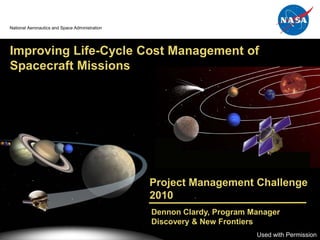
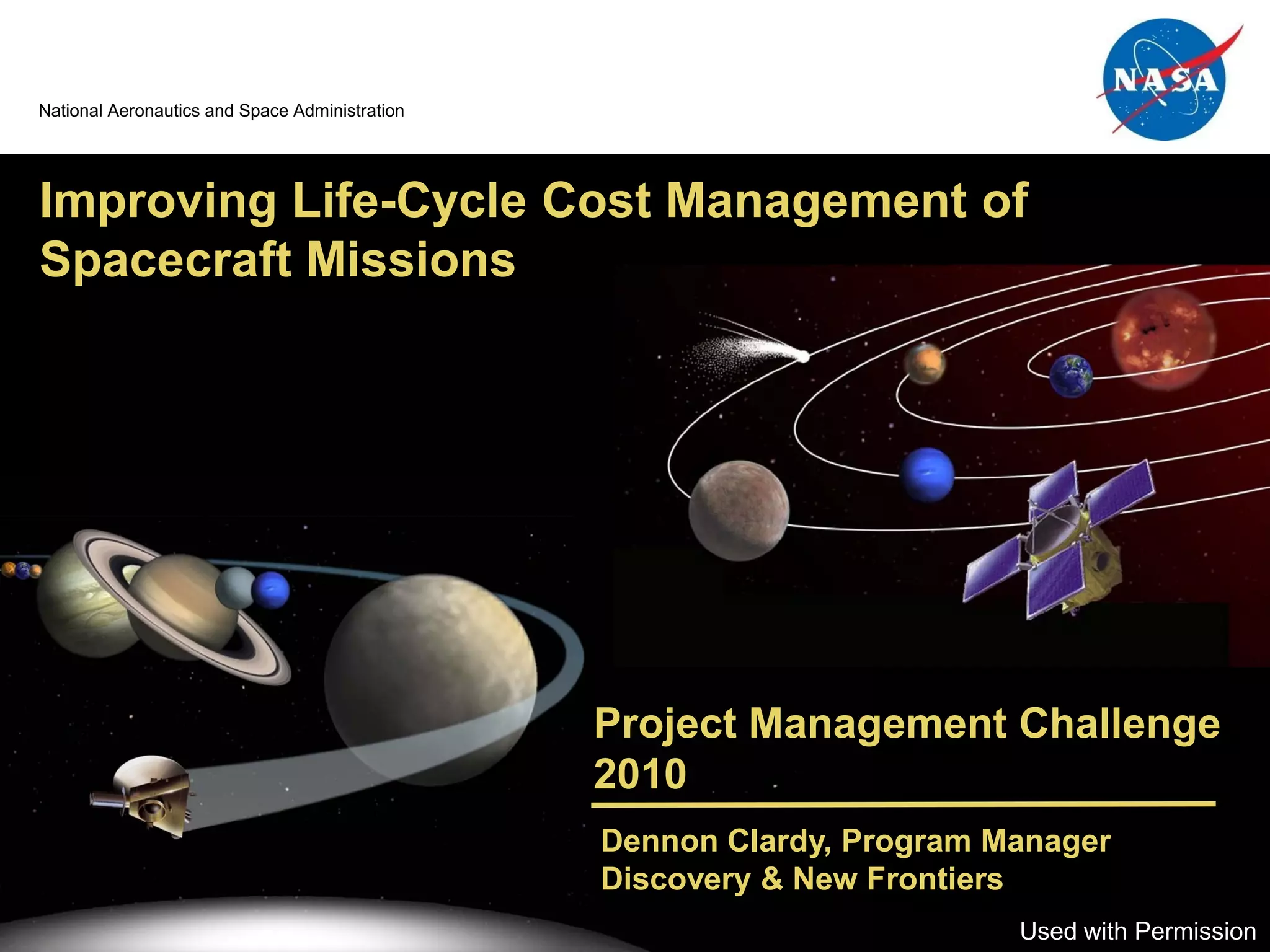
   Improving Life-Cycle Cost Management of
   Spacecraft Missions


                                                  Project Management Challenge
                                                  2010
                                                  Dennon Clardy, Program Manager
                                                  Discovery & New Frontiers
February 2010                                                             Used with Permission
                                                                                             0
Discovery


Overview of Programs                                                                                      New
                                                                                                      Frontiers


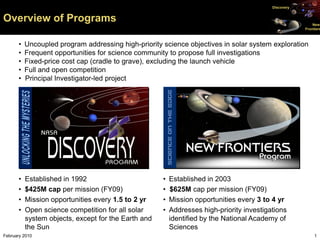
      •   Uncoupled program addressing high-priority science objectives in solar system exploration
      •   Frequent opportunities for science community to propose full investigations
      •   Fixed-price cost cap (cradle to grave), excluding the launch vehicle
      •   Full and open competition
      •   Principal Investigator-led project


      •   Established in 1992                        •   Established in 2003
      •   $425M cap per mission (FY09)               •   $625M cap per mission (FY09)
      •   Mission opportunities every 1.5 to 2 yr    •   Mission opportunities every 3 to 4 yr
      •   Open science competition for all solar     •   Addresses high-priority investigations
          system objects, except for the Earth and       identified by the National Academy of
          the Sun                                        Sciences
February 2010                                                                                              1
Discovery


D&NF Science Mission Targets                                                                                                         New
                                                                                                                                 Frontiers

                                                                                                                                Kepler


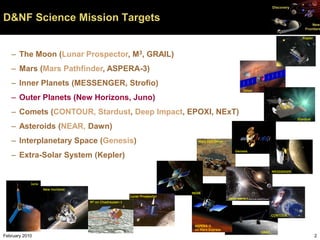
   – The Moon (Lunar Prospector, M3, GRAIL)
   – Mars (Mars Pathfinder, ASPERA-3)
   – Inner Planets (MESSENGER, Strofio)
                                                                                                  Dawn

   – Outer Planets (New Horizons, Juno)
   – Comets (CONTOUR, Stardust, Deep Impact, EPOXI, NExT)
                                                                                                                             Stardust

   – Asteroids (NEAR, Dawn)
   – Interplanetary Space (Genesis)                                         Mars Pathfinder


                                                                                              Genesis
   – Extra-Solar System (Kepler)
                                                                                                                 MESSENGER


            Juno
                   New Horizons
                                                                          NEAR
                                                       Lunar Prospector
                                  M3 on Chadrayaan-1


                                                                                                                 CONTOUR


                                                                           ASPERA-3
                                                                           on Mars Express
                                                                                                         GRAIL
February 2010                                                                                                                            2
Discovery


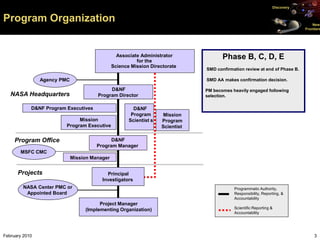
Program Organization                                                                                                             New
                                                                                                                             Frontiers


                                                 Associate Administrator
                                                         for the
                                                                                       Phase B, C, D, E
                                               Science Mission Directorate
                                                                                SMD confirmation review at end of Phase B.

                Agency PMC                                                      SMD AA makes confirmation decision.

                                            D&NF                                PM becomes heavily engaged following
   NASA Headquarters                   Program Director                         selection.

            D&NF Program Executives                     D&NF
                                                       Program       Mission
                              Mission                 Scientist s   Program
                         Program Executive                          Scientist

     Program Office                          D&NF
                                       Program Manager
       MSFC CMC
                             Mission Manager


      Projects                             Principal
                                         Investigators
         NASA Center PMC or                                                                 Programmatic Authority,
          Appointed Board                                                                   Responsibility, Reporting, &
                                                                                            Accountability
                                        Project Manager
                                  (Implementing Organization)                               Scientific Reporting &
                                                                                            Accountability


February 2010                                                                                                                     3
Discovery


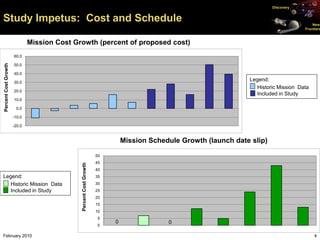
Study Impetus: Cost and Schedule                                                                                                          New
                                                                                                                                      Frontiers


                              Mission Cost Growth (percent of proposed cost)
                      60.0
Percent Cost Growth


                      50.0

                      40.0

                      30.0
                                                                                                                Legend:
                                                                                                                   Historic Mission Data
                      20.0
                                                                                                                   Included in Study
                      10.0

                       0.0

                      -10.0

                      -20.0


                                                                            Mission Schedule Growth (launch date slip)

                                                                   50
                                                                   45
                                             Percent Cost Growth


                                                                   40
Legend:                                                            35
   Historic Mission Data                                           30
   Included in Study                                               25
                                                                   20
                                                                   15
                                                                   10
                                                                    5
                                                                        0                0
                                                                    0

February 2010                                                                                                                              4
Discovery


Study Impetus & Research Plan                                                                           New
                                                                                                    Frontiers


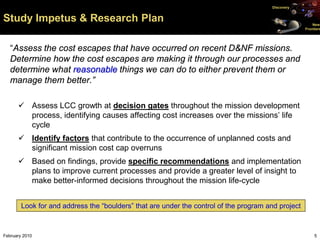
   ā€œAssess the cost escapes that have occurred on recent D&NF missions.
   Determine how the cost escapes are making it through our processes and
   determine what reasonable things we can do to either prevent them or
   manage them better.ā€

       Assess LCC growth at decision gates throughout the mission development
        process, identifying causes affecting cost increases over the missions’ life
        cycle
       Identify factors that contribute to the occurrence of unplanned costs and
        significant mission cost cap overruns
       Based on findings, provide specific recommendations and implementation
        plans to improve current processes and provide a greater level of insight to
        make better-informed decisions throughout the mission life-cycle


        Look for and address the ā€œbouldersā€ that are under the control of the program and project


February 2010                                                                                            5
Discovery


Study Implementation                                                                                                                                               New
                                                                                                                                                               Frontiers


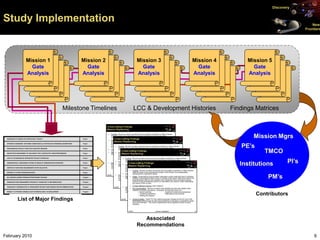
                        Mission 1                                                   Mission 2    Mission 3         Mission 4         Mission 5
                          Gate                                                        Gate         Gate              Gate              Gate
                        Analysis                                                    Analysis     Analysis          Analysis          Analysis


                                                                      Milestone Timelines       LCC & Development Histories    Findings Matrices


 INADEQUATE PLANNING FOR OPERATIONS / PHASE E                                       Project
                                                                                                                                       Mission Mgrs
 OPTIMISTIC HARDWARE / SOFTWARE INHERITANCE and TECHNOLOGY READINESS ASSUMPTIONS    Project


 INEXPERIENCED PROJECT TEAM FOR PLANETARY MISSIONS                                  Project
                                                                                                                                  PE’s
 INSUFFICIENT MANAGEMENT OF AND INSIGHT INTO CONTRACTOR TASKS/PERFORMANCE           Project
                                                                                                                                            TMCO
 LACK OF OR INADEQUATE INTEGRATED PROJECT SCHEDULES                                 Project


 UNIQUE/SPECIAL TASKS/WORK OUTSIDE OF AREAS OF DEMONSTRATED EXPERTISE               Project
                                                                                                                                  Institutions          PI’s
 ADDITION OF NEW NASA REQUIREMENTS AFTER SELECTION                                  Project


 INSTABILITY IN NASA PROGRAM BUDGETS                                                Project


 NO LESSONS LEARNED FEEDBACK/FEEDFOWARD PROCESS                                     Program
                                                                                                                                             PM’s
 INADEQUATE RISK MANAGEMENT PROCESS AT TRANSITION TO IMPLEMENTATION                 Program


 INADEQUATE CONSIDERATION OF INDEPENDENT REVIEW TEAM FINDINGS AND RECOMMENDATIONS   Program


 INABILITY TO PROVIDE CREDIBLE COST ESTIMATES EARLY IN DEVELOPMENT                  Program

                                                                                                                                         Contributors
              List of Major Findings


                                                                                                    Associated
                                                                                                 Recommendations

February 2010                                                                                                                                                       6
Discovery


Major Findings                                                                                 New
                                                                                           Frontiers


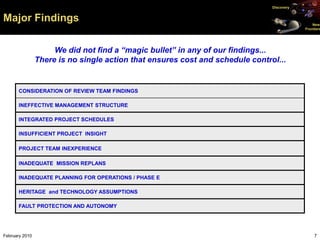
                     We did not find a ā€œmagic bulletā€ in any of our findings...
                There is no single action that ensures cost and schedule control...


       CONSIDERATION OF REVIEW TEAM FINDINGS

       INEFFECTIVE MANAGEMENT STRUCTURE

       INTEGRATED PROJECT SCHEDULES

       INSUFFICIENT PROJECT INSIGHT

       PROJECT TEAM INEXPERIENCE

       INADEQUATE MISSION REPLANS

       INADEQUATE PLANNING FOR OPERATIONS / PHASE E

       HERITAGE and TECHNOLOGY ASSUMPTIONS

       FAULT PROTECTION AND AUTONOMY


February 2010                                                                                   7
Discovery


Consideration of Review Team Findings                                                                     New
                                                                                                      Frontiers


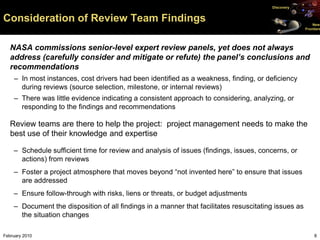
   NASA commissions senior-level expert review panels, yet does not always
   address (carefully consider and mitigate or refute) the panel’s conclusions and
   recommendations
    – In most instances, cost drivers had been identified as a weakness, finding, or deficiency
      during reviews (source selection, milestone, or internal reviews)
    – There was little evidence indicating a consistent approach to considering, analyzing, or
      responding to the findings and recommendations

   Review teams are there to help the project: project management needs to make the
   best use of their knowledge and expertise

    – Schedule sufficient time for review and analysis of issues (findings, issues, concerns, or
      actions) from reviews
    – Foster a project atmosphere that moves beyond ā€œnot invented hereā€ to ensure that issues
      are addressed
    – Ensure follow-through with risks, liens or threats, or budget adjustments
    – Document the disposition of all findings in a manner that facilitates resuscitating issues as
      the situation changes

February 2010                                                                                              8
Discovery


Ineffective Management Structure                                                                           New
                                                                                                       Frontiers


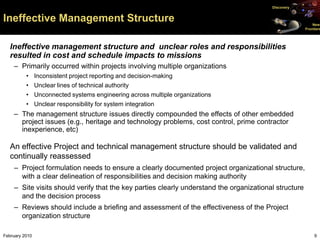
   Ineffective management structure and unclear roles and responsibilities
   resulted in cost and schedule impacts to missions
    – Primarily occurred within projects involving multiple organizations
          • Inconsistent project reporting and decision-making
          • Unclear lines of technical authority
          • Unconnected systems engineering across multiple organizations
          • Unclear responsibility for system integration
    – The management structure issues directly compounded the effects of other embedded
      project issues (e.g., heritage and technology problems, cost control, prime contractor
      inexperience, etc)

   An effective Project and technical management structure should be validated and
   continually reassessed
    – Project formulation needs to ensure a clearly documented project organizational structure,
      with a clear delineation of responsibilities and decision making authority
    – Site visits should verify that the key parties clearly understand the organizational structure
      and the decision process
    – Reviews should include a briefing and assessment of the effectiveness of the Project
      organization structure

February 2010                                                                                               9
Discovery


Integrated Project Schedules                                                                             New
                                                                                                     Frontiers


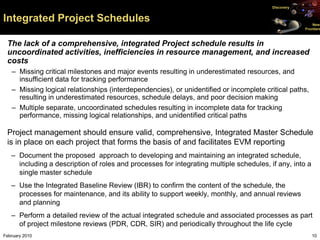
 The lack of a comprehensive, integrated Project schedule results in
 uncoordinated activities, inefficiencies in resource management, and increased
 costs
   – Missing critical milestones and major events resulting in underestimated resources, and
     insufficient data for tracking performance
   – Missing logical relationships (interdependencies), or unidentified or incomplete critical paths,
     resulting in underestimated resources, schedule delays, and poor decision making
   – Multiple separate, uncoordinated schedules resulting in incomplete data for tracking
     performance, missing logical relationships, and unidentified critical paths

 Project management should ensure valid, comprehensive, Integrated Master Schedule
 is in place on each project that forms the basis of and facilitates EVM reporting
   – Document the proposed approach to developing and maintaining an integrated schedule,
     including a description of roles and processes for integrating multiple schedules, if any, into a
     single master schedule
   – Use the Integrated Baseline Review (IBR) to confirm the content of the schedule, the
     processes for maintenance, and its ability to support weekly, monthly, and annual reviews
     and planning
   – Perform a detailed review of the actual integrated schedule and associated processes as part
     of project milestone reviews (PDR, CDR, SIR) and periodically throughout the life cycle
February 2010                                                                                            10
Discovery


Insufficient Project Insight                                                                             New
                                                                                                     Frontiers


  Insufficient project management and technical insight into contractor
  performance results in poor communications, schedule delays, and technical
  problems that manifest as cost over-runs
     – Specifications, processes, and procedures that did not meet institutional standards due to
       organization ā€œculturalā€ differences or insufficient flow down of requirements
     – Rework, retest, and waivers to hardware and software
     – Hardware mishaps
     – Additional personnel to perform the appropriate level of insight is added to correct issues

  Project management should ensure that the structure and rationale for the approach to
  the insight and oversight is documented and understood at all levels
     – Document the oversight approach (including rationale and staffing levels) for appropriate
       oversight based upon implementing center, prime contractor, and subcontractor/vendor
       experience
     – Include a clear plan for appropriate mission assurance oversight at the prime and
       subcontractors/vendors
     – Review and independently assess the effectiveness of their planned oversight approach at
       major milestones

February 2010                                                                                           11
Discovery


Project Team Inexperience                                                                           New
                                                                                                Frontiers


   Teams with major players with limited experience in planetary mission
   development are a major contributor to program management issues resulting
   in cost over-runs
     – Complex or poorly-defined management structure, roles and responsibilities, and
       communications
     – Inadequate development schedules and implementation of performance measuring
       techniques
     – Inadequate performance oversight and configuration management: institute to prime and
       prime to sub
     – Inaccurate cost estimates, inadequate cost control and management of reserves

   Given there may be strategic benefits to selecting ā€œnewā€ team members, the Project
   and Program should assume a greater cost risk and operate with increased
   insight/oversight for less experienced team members
    – Assess the relevant experience for major partners and identify associated risks
    – Develop mitigation plans, including mentoring and active sharing of lessons learned from
      more experienced partners
    – Identify and carry a cost threat, adjusted to reflect continuing team performance
    – Review and independently assess the risks and associated mitigations at major milestones

February 2010                                                                                      12
Discovery


Inadequate Mission Replans                                                                                        New
                                                                                                              Frontiers


  The impact of significant changes to mission scope, schedule, or funding
  profiles were not sufficiently understood, resulting in unexpected cost
  increases and schedule delays
   – Program- and Project-driven changes, regardless of lifecycle timeframe, often result in
     underestimates of the effects (i.e., duration and complexity) on the operations phase
         • Replans during development tend to concentrate on Phase C/D, so impacts to operations receive
           limited analysis and review
         • Operations is often not well-defined early enough in the project development cycle to understand the
           full impact of any changes

  Program and Project management need to work together to ensure sufficient time to perform a
  detailed assessment, develop a detailed revised baseline, and complete an independent
  evaluation
   – Carefully consider ancillary effects such as heritage assumptions (see Heritage and
     Technology Assumptions)
   – Specifically address any operational considerations and impacts (see Inadequate Planning
     for Operations/Phase E )
   – Document the cost and schedule impact, along with a complete description of all associated
     drivers

February 2010                                                                                                     13
Discovery


Inadequate Planning for Operations/Phase E                                                               New
                                                                                                     Frontiers


 Phase E cost increases result from poorly scoped mission operations. Even
 moderate yearly underestimates can present significant LCC impacts for
 missions with long Phase E durations
     – Early focus on hardware development schedules and cost (big ticket items)
     – Underestimating the complexity of the operation, ignoring special requirements for a
       particular mission type, or inadequate planning for sustaining engineering

 Project Management should emphasize from the beginning the need for an full and
 accurate life cycle cost estimate
     – Emphasize the importance of a detailed operations concept that identifies plans for
       equipment maintenance/replacement and parts obsolescence, longevity plan for
       retaining/replacing key personnel
     – Develop a Phase E staffing estimate by primary operations functional area that can clearly be
       traced to and supported by the operations concept
     – Review and independently assess the operations concept and staffing estimates, including
       revisions to the operations concept driven by project replans
     – Consider the risk of significant Phase D activities deferred into Phase E and the potential
       impact to operations staffing
     – Manage deferred Phase D work as development effort, including appropriate metrics and
       schedules
February 2010                                                                                           14
Discovery


Heritage and Technology Assumptions                                                                    New
                                                                                                   Frontiers


  Optimistic hardware/software inheritance and technology readiness
  assumptions cause significant cost and schedule growth in Phases C/D
     – Heritage is used to justify decreased cost and risk, but can increase cost and risk
     – Heritage is more than just a specific piece of hardware or software, it must be considered to
       include all associated aspects (available documentation, knowledgeable personnel,
       operational paradigm, spacecraft design, etc.)
     – New or reapplied technology may be required to enable a mission

  Project Management should realistically assess both the benefits and risks associated with
  heritage and new technology, and ensure appropriate mitigations are identified and implemented
    – Clearly demonstrate the relationship between heritage/technology rankings and cost/reserve
       estimates
    – Create a living reference for the relationship between heritage/technology rankings and
       cost/reserve estimates, updated throughout formulation and implementation
    – Capture high risk heritage/technology assumptions project risks and tracked for mitigation
       actions
    – Cost factors/threats should be updated after each review, particularly heritage reviews
   – Review and independently assess the risks and associated mitigations at major milestones
   – Select membership of SRB or internal review teamsto ensure members possess needed
      areas of expertise

February 2010                                                                                          15
Discovery


Fault Protection and Autonomy                                                                       New
                                                                                                Frontiers


   Missions underestimate the time and effort required to design, implement, and
   test fault protection and autonomy (FPA) capabilities
    – Developing an integrated hardware, software, and operations approach to FPA starting early
      in the development life cycle
    – Defining appropriate autonomy requirements and the proper level of fault protection
    – Estimating resource requirements, including hardware (test beds)
   Institutions, programs, and projects need to develop a better understanding of the cost
   drivers associated with FPA to improve our processes and estimating capabilities

   Project management needs to ensure FPA is addressed as a separate and equal
   engineering discipline
    – Emphasize the importance of a comprehensive FPA approach starting with the initial system
      concept
    – Develop an FPA development resource estimate that can clearly be traced to and supported
      by the operations concept
    – Define FPA to the same level of maturity as the hardware and software for the mission
      concept throughout the mission life cycle
    – Derive FPA from the operations concept, and implement a systems approach encompassing
      hardware, software, and operations
February 2010                                                                                      16
Discovery


Embedding and Impact Realization Timing                                                                                                                New
                                                                                                                                                   Frontiers


                                                                                                                                  Insight

                                                                                                                                  Inexperience

                                                                                                                                  Fault Prot.

                                                                                                                                  Heritage/Tech.

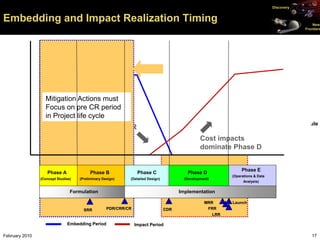
                  Mitigation Actions must                                                                                         Mgt. Structure
                  Focus on pre CR period                                                                                          Phase E
                  in Project life cycle
                  Ability to descope content
                                                                                                                                  Integrated Schedule
                  (cost) falls sharply post CR
                         Most Findings                                                Most Impacts
                                                                                            Cost impacts                          Replan
                         Embedded pre CR                                              Occurdominate Phase D
                                                                                            post CDR


                                                                                                                  Phase E
                   Phase A               Phase B                 Phase C                 Phase D
                                                                                                             (Operations & Data
                (Concept Studies)   (Preliminary Design)    (Detailed Design)          (Development)
                                                                                                                   Analysis)

                                Formulation                                           Implementation

                                                                                                 MRR         Launch
                                      SRR          PDR/CRR/CR                   CDR               FRR
                                                                                                       LRR

                              Embedding Period                  Impact Period

February 2010                                                                                                                                         17
Discovery


Conclusion                                                                                                          New
                                                                                                                Frontiers


      We did not find a ā€œmagic bulletā€ in any of our findings...
      There are no surprises here...
                         except that we continue to have problems in these areas
    So what do we do with the results?
       – First, avoid the temptation to acknowledge and then put on a shelf along with most of the
         previous cost growth studies
       – Second, while there were no surprises, that does not mean there are no actions the
         entire community can take to significantly improve performance against approved
         budgets
       – D/NF Program Office is implementing a fairly disciplined approach to
           • Continually identify actions we can take to avoid the traps identified in the study
           • Avoid the ā€œchecklistā€ mentality and ensure that project management activities and tools directly
             contribute to planning, tracking, and controlling cost and schedule

       – We are also available to engage in more detailed discussions concerning the study
         approach, findings, and potential actions with groups inside and outside of the D/NF
         community

      The Discovery and New Frontiers Program Office Life Cycle Cost Study was performed under the
       direction of Paul Gilbert (MSFC), led by Bryan Barley (MSFC), and supported by Kenny Mitchell
                                  (MSFC-retired) and Marilyn Newhouse (CSC)
February 2010                                                                                                      18
Improving the Life-Cycle Cost Management of    Discovery


Planetary Missions                                             New
                                                           Frontiers


                Supplemental Data and Backup


February 2010                                                 19
Discovery


Acronyms                                                                                                         New
                                                                                                             Frontiers


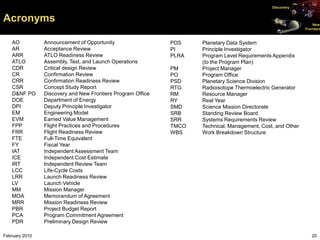
   AO           Announcement of Opportunity                  PDS    Planetary Data System
   AR           Acceptance Review                            PI     Principle Investigator
   ARR          ATLO Readiness Review                        PLRA   Program Level Requirements Appendix
   ATLO         Assembly, Test, and Launch Operations               (to the Program Plan)
   CDR          Critical design Review                       PM     Project Manager
   CR           Confirmation Review                          PO     Program Office
   CRR          Confirmation Readiness Review                PSD    Planetary Science Division
   CSR          Concept Study Report                         RTG    Radioisotope Thermoelectric Generator
   D&NF PO      Discovery and New Frontiers Program Office   RM     Resource Manager
   DOE          Department of Energy                         RY     Real Year
   DPI          Deputy Principle Investigator                SMD    Science Mission Directorate
   EM           Engineering Model                            SRB    Standing Review Board
   EVM          Earned Value Management                      SRR    Systems Requirements Review
   FPP          Flight Practices and Procedures              TMCO   Technical, Management, Cost, and Other
   FRR          Flight Readiness Review                      WBS    Work Breakdown Structure
   FTE          Full-Time Equivalent
   FY           Fiscal Year
   IAT          Independent Assessment Team
   ICE          Independent Cost Estimate
   IRT          Independent Review Team
   LCC          Life-Cycle Costs
   LRR          Launch Readiness Review
   LV           Launch Vehicle
   MM           Mission Manager
   MOA          Memorandum of Agreement
   MRR          Mission Readiness Review
   PBR          Project Budget Report
   PCA          Program Commitment Agreement
   PDR          Preliminary Design Review

February 2010                                                                                                   20
Discovery
Background
Generic Mission Development Process                                                                                                                        New
                                                                                                                                                       Frontiers


    AO Development         AO Implementation
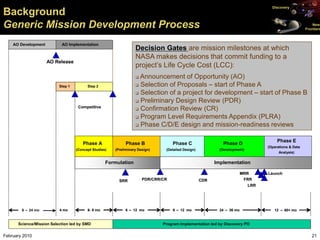
                                                                  Decision Gates are mission milestones at which
                                                                  NASA makes decisions that commit funding to a
                     AO Release
                                                                  project’s Life Cycle Cost (LCC):
                                                                   Announcement of Opportunity (AO)
                          Step 1         Step 2                    Selection of Proposals – start of Phase A

                                                                   Selection of a project for development – start of Phase B

                                                                   Preliminary Design Review (PDR)
                                    Competitive
                                                                   Confirmation Review (CR)

                                                                   Program Level Requirements Appendix (PLRA)

                                                                   Phase C/D/E design and mission-readiness reviews


                                                                                                                                       Phase E
                                      Phase A               Phase B                 Phase C                   Phase D
                                                                                                                                  (Operations & Data
                                   (Concept Studies)   (Preliminary Design)      (Detailed Design)          (Development)
                                                                                                                                        Analysis)

                                                   Formulation                                             Implementation

                                                                                                                          MRR     Launch
                                                         SRR          PDR/CRR/CR                     CDR                   FRR
                                                                                                                            LRR


        6 – 24 mo         4 mo           6- 8 mo            6 – 12 mo               6 – 12 mo                24 – 36 mo              12 – 60+ mo


      Science/Mission Selection led by SMD                             Program Implementation led by DiscoveryDiscovery PO
                                                                                Program Implementation led by PO

February 2010                                                                                                                                             21
Discovery
Study Implementation
Issues Affecting Data Collection                                                                         New
                                                                                                     Frontiers


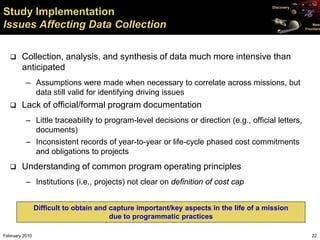
       Collection, analysis, and synthesis of data much more intensive than
        anticipated
          – Assumptions were made when necessary to correlate across missions, but
            data still valid for identifying driving issues
       Lack of official/formal program documentation
          – Little traceability to program-level decisions or direction (e.g., official letters,
            documents)
          – Inconsistent records of year-to-year or life-cycle phased cost commitments
            and obligations to projects
       Understanding of common program operating principles
          – Institutions (i.e., projects) not clear on definition of cost cap


                Difficult to obtain and capture important/key aspects in the life of a mission
                                        due to programmatic practices

February 2010                                                                                           22
Discovery
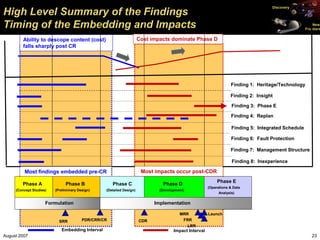
High Level Summary of the Findings
Timing of the Embedding and Impacts                                                                                                                     New
                                                                                                                                                    Frontiers


         Ability to descope content (cost)                           Cost impacts dominate Phase D
         falls sharply post CR


                                                                                                                   Finding 1: Heritage/Technology

                                                                                                                  Finding 2: Insight

                                                                                                                   Finding 3: Phase E

                                                                                                                   Finding 4: Replan

                                                                                                                   Finding 5: Integrated Schedule

                                                                                                                   Finding 6: Fault Protection

                                                                                                                   Finding 7: Management Structure

                                                                                                                   Finding 8: Inexperience

         Most findings embedded pre-CR                                Most impacts occur post-CDR
                                                                                                           Phase E
        Phase A               Phase B                Phase C                   Phase D
                                                                                                      (Operations & Data
     (Concept Studies)   (Preliminary Design)    (Detailed Design)           (Development)
                                                                                                            Analysis)

                     Formulation                                           Implementation

                                                                                       MRR            Launch
                           SRR          PDR/CRR/CR                   CDR                FRR
                                                                                             LRR
                            Embedding Interval                                      Impact Interval
August 2007                                                                                                                                            23

Dennon.clardy

  • 1.
    Discovery New National Aeronautics and Space Administration Frontiers Improving Life-Cycle Cost Management of Spacecraft Missions Project Management Challenge 2010 Dennon Clardy, Program Manager Discovery & New Frontiers February 2010 Used with Permission 0
  • 2.
    Discovery Overview of Programs New Frontiers • Uncoupled program addressing high-priority science objectives in solar system exploration • Frequent opportunities for science community to propose full investigations • Fixed-price cost cap (cradle to grave), excluding the launch vehicle • Full and open competition • Principal Investigator-led project • Established in 1992 • Established in 2003 • $425M cap per mission (FY09) • $625M cap per mission (FY09) • Mission opportunities every 1.5 to 2 yr • Mission opportunities every 3 to 4 yr • Open science competition for all solar • Addresses high-priority investigations system objects, except for the Earth and identified by the National Academy of the Sun Sciences February 2010 1
  • 3.
    Discovery D&NF Science MissionTargets New Frontiers Kepler – The Moon (Lunar Prospector, M3, GRAIL) – Mars (Mars Pathfinder, ASPERA-3) – Inner Planets (MESSENGER, Strofio) Dawn – Outer Planets (New Horizons, Juno) – Comets (CONTOUR, Stardust, Deep Impact, EPOXI, NExT) Stardust – Asteroids (NEAR, Dawn) – Interplanetary Space (Genesis) Mars Pathfinder Genesis – Extra-Solar System (Kepler) MESSENGER Juno New Horizons NEAR Lunar Prospector M3 on Chadrayaan-1 CONTOUR ASPERA-3 on Mars Express GRAIL February 2010 2
  • 4.
    Discovery Program Organization New Frontiers Associate Administrator for the Phase B, C, D, E Science Mission Directorate SMD confirmation review at end of Phase B. Agency PMC SMD AA makes confirmation decision. D&NF PM becomes heavily engaged following NASA Headquarters Program Director selection. D&NF Program Executives D&NF Program Mission Mission Scientist s Program Program Executive Scientist Program Office D&NF Program Manager MSFC CMC Mission Manager Projects Principal Investigators NASA Center PMC or Programmatic Authority, Appointed Board Responsibility, Reporting, & Accountability Project Manager (Implementing Organization) Scientific Reporting & Accountability February 2010 3
  • 5.
    Discovery Study Impetus: Costand Schedule New Frontiers Mission Cost Growth (percent of proposed cost) 60.0 Percent Cost Growth 50.0 40.0 30.0 Legend: Historic Mission Data 20.0 Included in Study 10.0 0.0 -10.0 -20.0 Mission Schedule Growth (launch date slip) 50 45 Percent Cost Growth 40 Legend: 35 Historic Mission Data 30 Included in Study 25 20 15 10 5 0 0 0 February 2010 4
  • 6.
    Discovery Study Impetus &Research Plan New Frontiers ā€œAssess the cost escapes that have occurred on recent D&NF missions. Determine how the cost escapes are making it through our processes and determine what reasonable things we can do to either prevent them or manage them better.ā€  Assess LCC growth at decision gates throughout the mission development process, identifying causes affecting cost increases over the missions’ life cycle  Identify factors that contribute to the occurrence of unplanned costs and significant mission cost cap overruns  Based on findings, provide specific recommendations and implementation plans to improve current processes and provide a greater level of insight to make better-informed decisions throughout the mission life-cycle Look for and address the ā€œbouldersā€ that are under the control of the program and project February 2010 5
  • 7.
    Discovery Study Implementation New Frontiers Mission 1 Mission 2 Mission 3 Mission 4 Mission 5 Gate Gate Gate Gate Gate Analysis Analysis Analysis Analysis Analysis Milestone Timelines LCC & Development Histories Findings Matrices INADEQUATE PLANNING FOR OPERATIONS / PHASE E Project Mission Mgrs OPTIMISTIC HARDWARE / SOFTWARE INHERITANCE and TECHNOLOGY READINESS ASSUMPTIONS Project INEXPERIENCED PROJECT TEAM FOR PLANETARY MISSIONS Project PE’s INSUFFICIENT MANAGEMENT OF AND INSIGHT INTO CONTRACTOR TASKS/PERFORMANCE Project TMCO LACK OF OR INADEQUATE INTEGRATED PROJECT SCHEDULES Project UNIQUE/SPECIAL TASKS/WORK OUTSIDE OF AREAS OF DEMONSTRATED EXPERTISE Project Institutions PI’s ADDITION OF NEW NASA REQUIREMENTS AFTER SELECTION Project INSTABILITY IN NASA PROGRAM BUDGETS Project NO LESSONS LEARNED FEEDBACK/FEEDFOWARD PROCESS Program PM’s INADEQUATE RISK MANAGEMENT PROCESS AT TRANSITION TO IMPLEMENTATION Program INADEQUATE CONSIDERATION OF INDEPENDENT REVIEW TEAM FINDINGS AND RECOMMENDATIONS Program INABILITY TO PROVIDE CREDIBLE COST ESTIMATES EARLY IN DEVELOPMENT Program Contributors List of Major Findings Associated Recommendations February 2010 6
  • 8.
    Discovery Major Findings New Frontiers We did not find a ā€œmagic bulletā€ in any of our findings... There is no single action that ensures cost and schedule control... CONSIDERATION OF REVIEW TEAM FINDINGS INEFFECTIVE MANAGEMENT STRUCTURE INTEGRATED PROJECT SCHEDULES INSUFFICIENT PROJECT INSIGHT PROJECT TEAM INEXPERIENCE INADEQUATE MISSION REPLANS INADEQUATE PLANNING FOR OPERATIONS / PHASE E HERITAGE and TECHNOLOGY ASSUMPTIONS FAULT PROTECTION AND AUTONOMY February 2010 7
  • 9.
    Discovery Consideration of ReviewTeam Findings New Frontiers NASA commissions senior-level expert review panels, yet does not always address (carefully consider and mitigate or refute) the panel’s conclusions and recommendations – In most instances, cost drivers had been identified as a weakness, finding, or deficiency during reviews (source selection, milestone, or internal reviews) – There was little evidence indicating a consistent approach to considering, analyzing, or responding to the findings and recommendations Review teams are there to help the project: project management needs to make the best use of their knowledge and expertise – Schedule sufficient time for review and analysis of issues (findings, issues, concerns, or actions) from reviews – Foster a project atmosphere that moves beyond ā€œnot invented hereā€ to ensure that issues are addressed – Ensure follow-through with risks, liens or threats, or budget adjustments – Document the disposition of all findings in a manner that facilitates resuscitating issues as the situation changes February 2010 8
  • 10.
    Discovery Ineffective Management Structure New Frontiers Ineffective management structure and unclear roles and responsibilities resulted in cost and schedule impacts to missions – Primarily occurred within projects involving multiple organizations • Inconsistent project reporting and decision-making • Unclear lines of technical authority • Unconnected systems engineering across multiple organizations • Unclear responsibility for system integration – The management structure issues directly compounded the effects of other embedded project issues (e.g., heritage and technology problems, cost control, prime contractor inexperience, etc) An effective Project and technical management structure should be validated and continually reassessed – Project formulation needs to ensure a clearly documented project organizational structure, with a clear delineation of responsibilities and decision making authority – Site visits should verify that the key parties clearly understand the organizational structure and the decision process – Reviews should include a briefing and assessment of the effectiveness of the Project organization structure February 2010 9
  • 11.
    Discovery Integrated Project Schedules New Frontiers The lack of a comprehensive, integrated Project schedule results in uncoordinated activities, inefficiencies in resource management, and increased costs – Missing critical milestones and major events resulting in underestimated resources, and insufficient data for tracking performance – Missing logical relationships (interdependencies), or unidentified or incomplete critical paths, resulting in underestimated resources, schedule delays, and poor decision making – Multiple separate, uncoordinated schedules resulting in incomplete data for tracking performance, missing logical relationships, and unidentified critical paths Project management should ensure valid, comprehensive, Integrated Master Schedule is in place on each project that forms the basis of and facilitates EVM reporting – Document the proposed approach to developing and maintaining an integrated schedule, including a description of roles and processes for integrating multiple schedules, if any, into a single master schedule – Use the Integrated Baseline Review (IBR) to confirm the content of the schedule, the processes for maintenance, and its ability to support weekly, monthly, and annual reviews and planning – Perform a detailed review of the actual integrated schedule and associated processes as part of project milestone reviews (PDR, CDR, SIR) and periodically throughout the life cycle February 2010 10
  • 12.
    Discovery Insufficient Project Insight New Frontiers Insufficient project management and technical insight into contractor performance results in poor communications, schedule delays, and technical problems that manifest as cost over-runs – Specifications, processes, and procedures that did not meet institutional standards due to organization ā€œculturalā€ differences or insufficient flow down of requirements – Rework, retest, and waivers to hardware and software – Hardware mishaps – Additional personnel to perform the appropriate level of insight is added to correct issues Project management should ensure that the structure and rationale for the approach to the insight and oversight is documented and understood at all levels – Document the oversight approach (including rationale and staffing levels) for appropriate oversight based upon implementing center, prime contractor, and subcontractor/vendor experience – Include a clear plan for appropriate mission assurance oversight at the prime and subcontractors/vendors – Review and independently assess the effectiveness of their planned oversight approach at major milestones February 2010 11
  • 13.
    Discovery Project Team Inexperience New Frontiers Teams with major players with limited experience in planetary mission development are a major contributor to program management issues resulting in cost over-runs – Complex or poorly-defined management structure, roles and responsibilities, and communications – Inadequate development schedules and implementation of performance measuring techniques – Inadequate performance oversight and configuration management: institute to prime and prime to sub – Inaccurate cost estimates, inadequate cost control and management of reserves Given there may be strategic benefits to selecting ā€œnewā€ team members, the Project and Program should assume a greater cost risk and operate with increased insight/oversight for less experienced team members – Assess the relevant experience for major partners and identify associated risks – Develop mitigation plans, including mentoring and active sharing of lessons learned from more experienced partners – Identify and carry a cost threat, adjusted to reflect continuing team performance – Review and independently assess the risks and associated mitigations at major milestones February 2010 12
  • 14.
    Discovery Inadequate Mission Replans New Frontiers The impact of significant changes to mission scope, schedule, or funding profiles were not sufficiently understood, resulting in unexpected cost increases and schedule delays – Program- and Project-driven changes, regardless of lifecycle timeframe, often result in underestimates of the effects (i.e., duration and complexity) on the operations phase • Replans during development tend to concentrate on Phase C/D, so impacts to operations receive limited analysis and review • Operations is often not well-defined early enough in the project development cycle to understand the full impact of any changes Program and Project management need to work together to ensure sufficient time to perform a detailed assessment, develop a detailed revised baseline, and complete an independent evaluation – Carefully consider ancillary effects such as heritage assumptions (see Heritage and Technology Assumptions) – Specifically address any operational considerations and impacts (see Inadequate Planning for Operations/Phase E ) – Document the cost and schedule impact, along with a complete description of all associated drivers February 2010 13
  • 15.
    Discovery Inadequate Planning forOperations/Phase E New Frontiers Phase E cost increases result from poorly scoped mission operations. Even moderate yearly underestimates can present significant LCC impacts for missions with long Phase E durations – Early focus on hardware development schedules and cost (big ticket items) – Underestimating the complexity of the operation, ignoring special requirements for a particular mission type, or inadequate planning for sustaining engineering Project Management should emphasize from the beginning the need for an full and accurate life cycle cost estimate – Emphasize the importance of a detailed operations concept that identifies plans for equipment maintenance/replacement and parts obsolescence, longevity plan for retaining/replacing key personnel – Develop a Phase E staffing estimate by primary operations functional area that can clearly be traced to and supported by the operations concept – Review and independently assess the operations concept and staffing estimates, including revisions to the operations concept driven by project replans – Consider the risk of significant Phase D activities deferred into Phase E and the potential impact to operations staffing – Manage deferred Phase D work as development effort, including appropriate metrics and schedules February 2010 14
  • 16.
    Discovery Heritage and TechnologyAssumptions New Frontiers Optimistic hardware/software inheritance and technology readiness assumptions cause significant cost and schedule growth in Phases C/D – Heritage is used to justify decreased cost and risk, but can increase cost and risk – Heritage is more than just a specific piece of hardware or software, it must be considered to include all associated aspects (available documentation, knowledgeable personnel, operational paradigm, spacecraft design, etc.) – New or reapplied technology may be required to enable a mission Project Management should realistically assess both the benefits and risks associated with heritage and new technology, and ensure appropriate mitigations are identified and implemented – Clearly demonstrate the relationship between heritage/technology rankings and cost/reserve estimates – Create a living reference for the relationship between heritage/technology rankings and cost/reserve estimates, updated throughout formulation and implementation – Capture high risk heritage/technology assumptions project risks and tracked for mitigation actions – Cost factors/threats should be updated after each review, particularly heritage reviews – Review and independently assess the risks and associated mitigations at major milestones – Select membership of SRB or internal review teamsto ensure members possess needed areas of expertise February 2010 15
  • 17.
    Discovery Fault Protection andAutonomy New Frontiers Missions underestimate the time and effort required to design, implement, and test fault protection and autonomy (FPA) capabilities – Developing an integrated hardware, software, and operations approach to FPA starting early in the development life cycle – Defining appropriate autonomy requirements and the proper level of fault protection – Estimating resource requirements, including hardware (test beds) Institutions, programs, and projects need to develop a better understanding of the cost drivers associated with FPA to improve our processes and estimating capabilities Project management needs to ensure FPA is addressed as a separate and equal engineering discipline – Emphasize the importance of a comprehensive FPA approach starting with the initial system concept – Develop an FPA development resource estimate that can clearly be traced to and supported by the operations concept – Define FPA to the same level of maturity as the hardware and software for the mission concept throughout the mission life cycle – Derive FPA from the operations concept, and implement a systems approach encompassing hardware, software, and operations February 2010 16
  • 18.
    Discovery Embedding and ImpactRealization Timing New Frontiers Insight Inexperience Fault Prot. Heritage/Tech. Mitigation Actions must Mgt. Structure Focus on pre CR period Phase E in Project life cycle Ability to descope content Integrated Schedule (cost) falls sharply post CR Most Findings Most Impacts Cost impacts Replan Embedded pre CR Occurdominate Phase D post CDR Phase E Phase A Phase B Phase C Phase D (Operations & Data (Concept Studies) (Preliminary Design) (Detailed Design) (Development) Analysis) Formulation Implementation MRR Launch SRR PDR/CRR/CR CDR FRR LRR Embedding Period Impact Period February 2010 17
  • 19.
    Discovery Conclusion New Frontiers We did not find a ā€œmagic bulletā€ in any of our findings... There are no surprises here... except that we continue to have problems in these areas So what do we do with the results? – First, avoid the temptation to acknowledge and then put on a shelf along with most of the previous cost growth studies – Second, while there were no surprises, that does not mean there are no actions the entire community can take to significantly improve performance against approved budgets – D/NF Program Office is implementing a fairly disciplined approach to • Continually identify actions we can take to avoid the traps identified in the study • Avoid the ā€œchecklistā€ mentality and ensure that project management activities and tools directly contribute to planning, tracking, and controlling cost and schedule – We are also available to engage in more detailed discussions concerning the study approach, findings, and potential actions with groups inside and outside of the D/NF community The Discovery and New Frontiers Program Office Life Cycle Cost Study was performed under the direction of Paul Gilbert (MSFC), led by Bryan Barley (MSFC), and supported by Kenny Mitchell (MSFC-retired) and Marilyn Newhouse (CSC) February 2010 18
  • 20.
    Improving the Life-CycleCost Management of Discovery Planetary Missions New Frontiers Supplemental Data and Backup February 2010 19
  • 21.
    Discovery Acronyms New Frontiers AO Announcement of Opportunity PDS Planetary Data System AR Acceptance Review PI Principle Investigator ARR ATLO Readiness Review PLRA Program Level Requirements Appendix ATLO Assembly, Test, and Launch Operations (to the Program Plan) CDR Critical design Review PM Project Manager CR Confirmation Review PO Program Office CRR Confirmation Readiness Review PSD Planetary Science Division CSR Concept Study Report RTG Radioisotope Thermoelectric Generator D&NF PO Discovery and New Frontiers Program Office RM Resource Manager DOE Department of Energy RY Real Year DPI Deputy Principle Investigator SMD Science Mission Directorate EM Engineering Model SRB Standing Review Board EVM Earned Value Management SRR Systems Requirements Review FPP Flight Practices and Procedures TMCO Technical, Management, Cost, and Other FRR Flight Readiness Review WBS Work Breakdown Structure FTE Full-Time Equivalent FY Fiscal Year IAT Independent Assessment Team ICE Independent Cost Estimate IRT Independent Review Team LCC Life-Cycle Costs LRR Launch Readiness Review LV Launch Vehicle MM Mission Manager MOA Memorandum of Agreement MRR Mission Readiness Review PBR Project Budget Report PCA Program Commitment Agreement PDR Preliminary Design Review February 2010 20
  • 22.
    Discovery Background Generic Mission DevelopmentProcess New Frontiers AO Development AO Implementation Decision Gates are mission milestones at which NASA makes decisions that commit funding to a AO Release project’s Life Cycle Cost (LCC):  Announcement of Opportunity (AO) Step 1 Step 2  Selection of Proposals – start of Phase A  Selection of a project for development – start of Phase B  Preliminary Design Review (PDR) Competitive  Confirmation Review (CR)  Program Level Requirements Appendix (PLRA)  Phase C/D/E design and mission-readiness reviews Phase E Phase A Phase B Phase C Phase D (Operations & Data (Concept Studies) (Preliminary Design) (Detailed Design) (Development) Analysis) Formulation Implementation MRR Launch SRR PDR/CRR/CR CDR FRR LRR 6 – 24 mo 4 mo 6- 8 mo 6 – 12 mo 6 – 12 mo 24 – 36 mo 12 – 60+ mo Science/Mission Selection led by SMD Program Implementation led by DiscoveryDiscovery PO Program Implementation led by PO February 2010 21
  • 23.
    Discovery Study Implementation Issues AffectingData Collection New Frontiers  Collection, analysis, and synthesis of data much more intensive than anticipated – Assumptions were made when necessary to correlate across missions, but data still valid for identifying driving issues  Lack of official/formal program documentation – Little traceability to program-level decisions or direction (e.g., official letters, documents) – Inconsistent records of year-to-year or life-cycle phased cost commitments and obligations to projects  Understanding of common program operating principles – Institutions (i.e., projects) not clear on definition of cost cap Difficult to obtain and capture important/key aspects in the life of a mission due to programmatic practices February 2010 22
  • 24.
    Discovery High Level Summaryof the Findings Timing of the Embedding and Impacts New Frontiers Ability to descope content (cost) Cost impacts dominate Phase D falls sharply post CR Finding 1: Heritage/Technology Finding 2: Insight Finding 3: Phase E Finding 4: Replan Finding 5: Integrated Schedule Finding 6: Fault Protection Finding 7: Management Structure Finding 8: Inexperience Most findings embedded pre-CR Most impacts occur post-CDR Phase E Phase A Phase B Phase C Phase D (Operations & Data (Concept Studies) (Preliminary Design) (Detailed Design) (Development) Analysis) Formulation Implementation MRR Launch SRR PDR/CRR/CR CDR FRR LRR Embedding Interval Impact Interval August 2007 23