SMD Perspectives @ ARCtek
       Michael D. Bicay
         Director for Science
      NASA Ames Research Center
               2012.01.18
NRC Decade Survey (2010): Astronomy & Astrophysics

•      Large Space-Based Programs (priority order)
     1.  WFIRST: Wide-Field Infrared Survey Telescope
     2.  (Astrophysics) Augmentation to Explorer Program
     3.  LISA: Laser Interferometer Space Antenna
     4.  ISO: International X-Ray Observatory
     [Note: #3 and #4 have been cancelled; funding for #1 has not been
         identified.]

•     Medium Space-Based Programs (priority order)
     1.  New Worlds Technology Development
     2.  Inflation Probe Technology Development
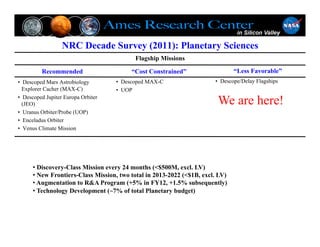
NRC Decade Survey (2011): Planetary Sciences
                                           Flagship Missions

          Recommended                     “Cost Constrained”                    “Less Favorable”
•  Descoped Mars Astrobiology        •  Descoped MAX-C                  •  Descope/Delay Flagships
  Explorer Cacher (MAX-C)            •  UOP
•  Descoped Jupiter Europa Orbiter
  (JEO)                                                                  We are here!
•  Uranus Orbiter/Probe (UOP)
•  Enceladus Orbiter
•  Venus Climate Mission


      •  Discovery-Class Mission every 24 months (<$500M, excl. LV)
      •  New Frontiers-Class Mission, two total in 2013-2022 (<$1B, excl. LV)
      •  Augmentation to R&A Program (+5% in FY12, +1.5% subsequently)
      •  Technology Development (~7% of total Planetary budget)
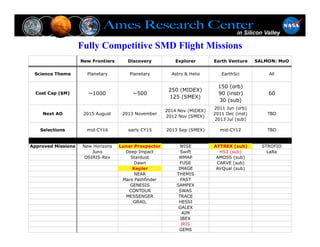
Fully Competitive SMD Flight Missions
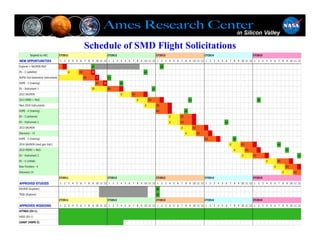
Schedule of SMD Flight Solicitations
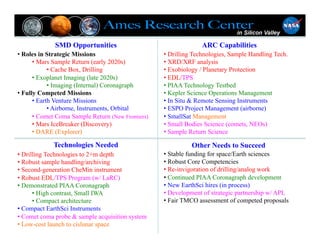
SMD Opportunities                                    ARC Capabilities
•  Roles in Strategic Missions                       •  Drilling Technologies, Sample Handling Tech.
       •  Mars Sample Return (early 2020s)           •  XRD/XRF analysis
              •  Cache Box, Drilling                 •  Exobiology / Planetary Protection
       •  Exoplanet Imaging (late 2020s)             •  EDL/TPS
              •  Imaging (Internal) Coronagraph      •  PIAA Technology Testbed
•  Fully Competed Missions                           •  Kepler Science Operations Management
       •  Earth Venture Missions                     •  In Situ & Remote Sensing Instruments
              •  Airborne, Instruments, Orbital      •  ESPO Project Management (airborne)
       •  Comet Coma Sample Return (New Frontiers)   •  SmallSat Management
       •  Mars IceBreaker (Discovery)                •  Small Bodies Science (comets, NEOs)
       •  DARE (Explorer)                            •  Sample Return Science

             Technologies Needed                               Other Needs to Succeed
•  Drilling Technologies to 2+m depth                •  Stable funding for space/Earth sciences
•  Robust sample handling/archiving                  •  Robust Core Competencies
•  Second-generation CheMin instrument               •  Re-invigoration of drilling/analog work
•  Robust EDL/TPS Program (w/ LaRC)                  •  Continued PIAA Coronagraph development
•  Demonstrated PIAA Coronagraph                     •  New EarthSci hires (in process)
       •  High contrast, Small IWA                   •  Development of strategic partnership w/ APL
       •  Compact architecture                       •  Fair TMCO assessment of competed proposals
•  Compact EarthSci Instruments
•  Comet coma probe & sample acquisition system
•  Low-cost launch to cislunar space
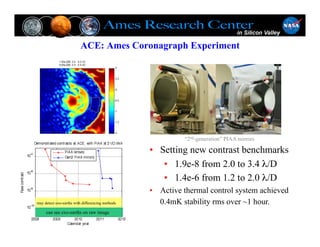
ACE: Ames Coronagraph Experiment


                                                            “2nd-generation” PIAA mirrors

                                                  •  Setting new contrast benchmarks
                                                      •  1.9e-8 from 2.0 to 3.4 λ/D
                                                      •  1.4e-6 from 1.2 to 2.0 λ/D
                                                  •  Active thermal control system achieved
may detect exo-earths with differencing methods      0.4mK stability rms over ~1 hour.
     can see exo-earths on raw image

Bicay_Post

  • 1.
    SMD Perspectives @ARCtek Michael D. Bicay Director for Science NASA Ames Research Center 2012.01.18
  • 2.
    NRC Decade Survey(2010): Astronomy & Astrophysics •  Large Space-Based Programs (priority order) 1.  WFIRST: Wide-Field Infrared Survey Telescope 2.  (Astrophysics) Augmentation to Explorer Program 3.  LISA: Laser Interferometer Space Antenna 4.  ISO: International X-Ray Observatory [Note: #3 and #4 have been cancelled; funding for #1 has not been identified.] •  Medium Space-Based Programs (priority order) 1.  New Worlds Technology Development 2.  Inflation Probe Technology Development
  • 3.
    NRC Decade Survey(2011): Planetary Sciences Flagship Missions Recommended “Cost Constrained” “Less Favorable” •  Descoped Mars Astrobiology •  Descoped MAX-C •  Descope/Delay Flagships Explorer Cacher (MAX-C) •  UOP •  Descoped Jupiter Europa Orbiter (JEO) We are here! •  Uranus Orbiter/Probe (UOP) •  Enceladus Orbiter •  Venus Climate Mission •  Discovery-Class Mission every 24 months (<$500M, excl. LV) •  New Frontiers-Class Mission, two total in 2013-2022 (<$1B, excl. LV) •  Augmentation to R&A Program (+5% in FY12, +1.5% subsequently) •  Technology Development (~7% of total Planetary budget)
  • 4.
    Fully Competitive SMDFlight Missions
  • 5.
    Schedule of SMDFlight Solicitations
  • 6.
    SMD Opportunities ARC Capabilities •  Roles in Strategic Missions •  Drilling Technologies, Sample Handling Tech. •  Mars Sample Return (early 2020s) •  XRD/XRF analysis •  Cache Box, Drilling •  Exobiology / Planetary Protection •  Exoplanet Imaging (late 2020s) •  EDL/TPS •  Imaging (Internal) Coronagraph •  PIAA Technology Testbed •  Fully Competed Missions •  Kepler Science Operations Management •  Earth Venture Missions •  In Situ & Remote Sensing Instruments •  Airborne, Instruments, Orbital •  ESPO Project Management (airborne) •  Comet Coma Sample Return (New Frontiers) •  SmallSat Management •  Mars IceBreaker (Discovery) •  Small Bodies Science (comets, NEOs) •  DARE (Explorer) •  Sample Return Science Technologies Needed Other Needs to Succeed •  Drilling Technologies to 2+m depth •  Stable funding for space/Earth sciences •  Robust sample handling/archiving •  Robust Core Competencies •  Second-generation CheMin instrument •  Re-invigoration of drilling/analog work •  Robust EDL/TPS Program (w/ LaRC) •  Continued PIAA Coronagraph development •  Demonstrated PIAA Coronagraph •  New EarthSci hires (in process) •  High contrast, Small IWA •  Development of strategic partnership w/ APL •  Compact architecture •  Fair TMCO assessment of competed proposals •  Compact EarthSci Instruments •  Comet coma probe & sample acquisition system •  Low-cost launch to cislunar space
  • 7.
    ACE: Ames CoronagraphExperiment “2nd-generation” PIAA mirrors •  Setting new contrast benchmarks •  1.9e-8 from 2.0 to 3.4 λ/D •  1.4e-6 from 1.2 to 2.0 λ/D •  Active thermal control system achieved may detect exo-earths with differencing methods 0.4mK stability rms over ~1 hour. can see exo-earths on raw image