A NEW ERA IN SPACE
EXPLORATION
ORION & SLS
What is ORION?
• For the first time in a generation, NASA is building a new human
spacecraft that will usher a new era of space exploration.
• Program announced by NASA on may 24, 2011
under the US govt of ex president Barack Obama.
• This spacecraft will take us farther than we’ve gone before,
including asteroids & Mars.
• Intended to facilitate the supplies of Cargo, basic needs and to
retrieve crew to & from ISS.
• The Orion spacecraft is designed to meet the evolving needs of the
deep space exploration program for decades to come.
• It will be the safest, most advanced spacecraft ever built.
A brief history
• Before ORION program, a constellation program & conceptual
orbital space plane program were under development.
• Because of cost overrun, budget limit exceeded resulting in
cancellation of both the programs.
• CEV effectively replaced Lockheed martin X33 program to produce
the replacement for space shuttle.
• All these programs were a reaction to space shuttle Columbia
accident.
• CEV was being developed alongside these programs but didn’t get
cancelled and later termed as MPCV i.e. ORION.
How Was Orion Designed?
• The ORION spacecraft similar to APPOLO capsule but little bigger in size and
can carry more crew members.
• Contains three main modules:
(1) Crew module- Developed by Lockheed
Martin & Boeing at a
facility in new Orleans.
(2) Service module-Developed by European
Space Agency.
(3) Launch abort system-It is also developed
by Lockheed Martin.
• ORION capsule weighs 23 tonnes.
• Designed to provide safe re-entry from deep space into the earth’s atmosphere.
• NASA used lessons learned from Apollo and space shuttle parachutes to design
the new Orion parachutes.
SPECIFICATION OF THE ORION
• Height: Approximately 3.3 m (11 ft)
• Diameter:5 m (16 ft)
• Pressurizedvolume:19.56 m3 (691 cu ft) [7]
• Habitable volume:8.95 m3 (316 cu ft)
• Capsule mass:10,387 kg (22,899 lb)
• Service Module mass:15,461 kg (34,086 lb)
• Total mass:25,848 kg (56,985 lb)
• Service module propellant mass:9,276 kg (20,450
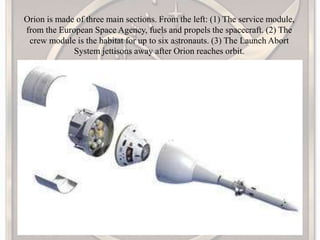
Orion is made of three main sections. From the left: (1) The service module,
from the European Space Agency, fuels and propels the spacecraft. (2) The
crew module is the habitat for up to six astronauts. (3) The Launch Abort
System jettisons away after Orion reaches orbit.
Orion's First test Flight
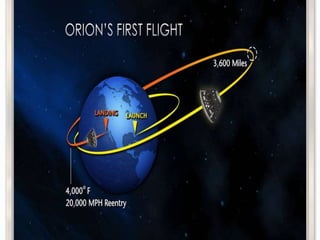
• Orion had its first flight test on Dec. 5, 2014, without a crew.
• Launched from Florida on a rocket called a Delta IV (4) Heavy, the
test vehicle flew two orbits around Earth. The flight lasted 4.5 hours.
• Orion reached an altitude of 3,600 miles above Earth (15 times
higher than the International Space Station).
• The test vehicle hit speeds of 20,000 mph and temperatures
approaching 4,000 degrees Fahrenheit as it entered Earth's
atmosphere.
• The test vehicle splashed down in the Pacific Ocean near California.
Orion's CM(crew module) will use advanced
technologies
• Glass cockpit digital control systems derived from those of
the Boeing 787 Dreamliner.
• An "auto dock" feature, like those of Russian Progress spacecraft
and the European Automated Transfer Vehicle, with provision for
the flight crew to take over in an emergency. .
• Improved waste-management facilities, with a miniature
camping-style toilet used on the space shuttle
• This eliminates the use of the much-hated plastic "Apollo bags"
used by the Apollo crews.
• Far more advanced computers than on prior crew vehicles.
Exploration Mission-1
• The spacecraft will deploy with SLS upper stage, called the Interim
Cryogenic Propulsion Stage (ICPS).
• The ICPS will then deploy a number of small satellites, known as
CubeSats.
• As Orion continues on its path from Earth orbit to the moon, it will be
propelled by a service module provided by the European Space Agency
• Orion will pass through the Van Allen radiation belts, fly past the Global
Positioning System (GPS) satellite constellation and above communication
satellites in Earth orbit.
• for the first time for a human spaceflight vehicle in decades, it will
communicate through the Deep Space Network.
Exploration Mission-1 contd.
• Orion will fly about 62 miles (100 km) above the surface of the moon
• It will use the moon’s gravitational force to propel Orion into a new deep
orbit about 40,000 miles (70,000 km) from the moon.
• The spacecraft will stay in that orbit for approximately six days to collect
data and allow mission controllers to assess the performance of the
spacecraft.
• During return ,Orion will be directed towards earth trajectory.
• During re-entry into earth’s atmosphere at 25,000 mph (11 kilometres per
second), producing temperatures of approximately 5,000 degrees
Fahrenheit (2,760 degrees Celsius).
Sci-Tech Satellites
• The 13 CubeSats that will fly to deep space as secondary payloads aboard SLS on EM-1
• Sky fire - Lockheed Martin Space Systems Company, Denver, Colorado, will develop a Cube
Sat to perform a lunar flyby of the moon
• Lunar Ice Cube - State University, Kentucky, will build a Cube Sat to search for water ice
and other resources at a low orbit of only 62 miles above the surface of the moon
• Near-Earth Asteroid Scout, or NEA Scout -will perform reconnaissance of an asteroid, take
pictures and observe its position in space
• BioSentine will use yeast to detect, measure and compare the impact of deep space radiation
on living organisms over long durations in deep space
• Lunar Flashlight- will look for ice deposits and identify locations where resources may be
extracted from the lunar surface
• Cusp – a “space weather station” to measure particles and magnetic fields in space
• LunaH-Map -will map hydrogen within craters and other permanently shadowed regions
throughout the moon’s south pole.
Sci-Tech Satellites contd.
• Three additional payloads will be determined through NASA’s Cube Quest
Challenge.
• NASA has also reserved three slots for payloads from international
partners.
• Discussions to fly those three payloads are ongoing, and they will be
announced at a later time.
• The CubeSats will be deployed following Orion separation from the upper
stage
• . Following deployment, the transmitters on the CubeSats will turn on, and
ground stations will listen for their beacons to determine the functionality
of these small satellites.
Why doesn’t NASA used the space shuttle?
• From 1981-2011, the space shuttle flew 135 missions.
• The shuttle carried satellites to orbit; transported parts, cargo and
crew to build the International Space Station; and helped NASA
learn about living and working in space.
• However, the space shuttle was not designed to travel beyond low
Earth orbit.
• It could not stay in space for much more than two weeks at a time.
• The space shuttle was not built to resist the high temperatures of a
high-speed return.
What's Next for Orion?
• After Orion is tested on this EM-1, it will soon be time for the
spacecraft to transport humans.
• Exploration Mission-2 will travel the same path as Exploration
Mission-1, but this time with a crew!
• Then, in the 2020s, Orion will carry astronauts to an asteroid.
• In the 2030s, NASA’s goal is for Orion to carry the first human
explorers to Mars, the Red Planet!
NASA opens door to competitors
• SLS rocket and Orion spacecraft presently consume more than $3 billion annually
in development costs.
• Both SpaceX and Blue Origin (with the Falcon Heavy and New Glenn boosters,
respectively) are deep into development of heavy lift rockets in the same class as
the SLS launcher.
• United Launch Alliance is also developing the Vulcan rocket with an upper stage
being optimized for use in NASA's.
• These are all expected to cost significantly less to fly than the SLS
• Spacecraft aren't pickup trucks where one design can work across a variety of
missions.
• The problem with Orion is NASA being forced to use it as some general purpose
starship when it IS a lunar command module, nothing more, nothing less. For
anything else it is either way over engineer or insufficient for the mission.
• If NASA wants a general purpose capsule it should be limited to a space taxi.
THANK YOU

Orion

  • 1.
    A NEW ERAIN SPACE EXPLORATION ORION & SLS
  • 2.
    What is ORION? •For the first time in a generation, NASA is building a new human spacecraft that will usher a new era of space exploration. • Program announced by NASA on may 24, 2011 under the US govt of ex president Barack Obama. • This spacecraft will take us farther than we’ve gone before, including asteroids & Mars. • Intended to facilitate the supplies of Cargo, basic needs and to retrieve crew to & from ISS. • The Orion spacecraft is designed to meet the evolving needs of the deep space exploration program for decades to come. • It will be the safest, most advanced spacecraft ever built.
  • 3.
    A brief history •Before ORION program, a constellation program & conceptual orbital space plane program were under development. • Because of cost overrun, budget limit exceeded resulting in cancellation of both the programs. • CEV effectively replaced Lockheed martin X33 program to produce the replacement for space shuttle. • All these programs were a reaction to space shuttle Columbia accident. • CEV was being developed alongside these programs but didn’t get cancelled and later termed as MPCV i.e. ORION.
  • 4.
    How Was OrionDesigned? • The ORION spacecraft similar to APPOLO capsule but little bigger in size and can carry more crew members. • Contains three main modules: (1) Crew module- Developed by Lockheed Martin & Boeing at a facility in new Orleans. (2) Service module-Developed by European Space Agency. (3) Launch abort system-It is also developed by Lockheed Martin. • ORION capsule weighs 23 tonnes. • Designed to provide safe re-entry from deep space into the earth’s atmosphere. • NASA used lessons learned from Apollo and space shuttle parachutes to design the new Orion parachutes.
  • 5.
    SPECIFICATION OF THEORION • Height: Approximately 3.3 m (11 ft) • Diameter:5 m (16 ft) • Pressurizedvolume:19.56 m3 (691 cu ft) [7] • Habitable volume:8.95 m3 (316 cu ft) • Capsule mass:10,387 kg (22,899 lb) • Service Module mass:15,461 kg (34,086 lb) • Total mass:25,848 kg (56,985 lb) • Service module propellant mass:9,276 kg (20,450
  • 6.
    Orion is madeof three main sections. From the left: (1) The service module, from the European Space Agency, fuels and propels the spacecraft. (2) The crew module is the habitat for up to six astronauts. (3) The Launch Abort System jettisons away after Orion reaches orbit.
  • 7.
    Orion's First testFlight • Orion had its first flight test on Dec. 5, 2014, without a crew. • Launched from Florida on a rocket called a Delta IV (4) Heavy, the test vehicle flew two orbits around Earth. The flight lasted 4.5 hours. • Orion reached an altitude of 3,600 miles above Earth (15 times higher than the International Space Station). • The test vehicle hit speeds of 20,000 mph and temperatures approaching 4,000 degrees Fahrenheit as it entered Earth's atmosphere. • The test vehicle splashed down in the Pacific Ocean near California.
  • 9.
    Orion's CM(crew module)will use advanced technologies • Glass cockpit digital control systems derived from those of the Boeing 787 Dreamliner. • An "auto dock" feature, like those of Russian Progress spacecraft and the European Automated Transfer Vehicle, with provision for the flight crew to take over in an emergency. . • Improved waste-management facilities, with a miniature camping-style toilet used on the space shuttle • This eliminates the use of the much-hated plastic "Apollo bags" used by the Apollo crews. • Far more advanced computers than on prior crew vehicles.
  • 10.
    Exploration Mission-1 • Thespacecraft will deploy with SLS upper stage, called the Interim Cryogenic Propulsion Stage (ICPS). • The ICPS will then deploy a number of small satellites, known as CubeSats. • As Orion continues on its path from Earth orbit to the moon, it will be propelled by a service module provided by the European Space Agency • Orion will pass through the Van Allen radiation belts, fly past the Global Positioning System (GPS) satellite constellation and above communication satellites in Earth orbit. • for the first time for a human spaceflight vehicle in decades, it will communicate through the Deep Space Network.
  • 11.
    Exploration Mission-1 contd. •Orion will fly about 62 miles (100 km) above the surface of the moon • It will use the moon’s gravitational force to propel Orion into a new deep orbit about 40,000 miles (70,000 km) from the moon. • The spacecraft will stay in that orbit for approximately six days to collect data and allow mission controllers to assess the performance of the spacecraft. • During return ,Orion will be directed towards earth trajectory. • During re-entry into earth’s atmosphere at 25,000 mph (11 kilometres per second), producing temperatures of approximately 5,000 degrees Fahrenheit (2,760 degrees Celsius).
  • 12.
    Sci-Tech Satellites • The13 CubeSats that will fly to deep space as secondary payloads aboard SLS on EM-1 • Sky fire - Lockheed Martin Space Systems Company, Denver, Colorado, will develop a Cube Sat to perform a lunar flyby of the moon • Lunar Ice Cube - State University, Kentucky, will build a Cube Sat to search for water ice and other resources at a low orbit of only 62 miles above the surface of the moon • Near-Earth Asteroid Scout, or NEA Scout -will perform reconnaissance of an asteroid, take pictures and observe its position in space • BioSentine will use yeast to detect, measure and compare the impact of deep space radiation on living organisms over long durations in deep space • Lunar Flashlight- will look for ice deposits and identify locations where resources may be extracted from the lunar surface • Cusp – a “space weather station” to measure particles and magnetic fields in space • LunaH-Map -will map hydrogen within craters and other permanently shadowed regions throughout the moon’s south pole.
  • 13.
    Sci-Tech Satellites contd. •Three additional payloads will be determined through NASA’s Cube Quest Challenge. • NASA has also reserved three slots for payloads from international partners. • Discussions to fly those three payloads are ongoing, and they will be announced at a later time. • The CubeSats will be deployed following Orion separation from the upper stage • . Following deployment, the transmitters on the CubeSats will turn on, and ground stations will listen for their beacons to determine the functionality of these small satellites.
  • 14.
    Why doesn’t NASAused the space shuttle? • From 1981-2011, the space shuttle flew 135 missions. • The shuttle carried satellites to orbit; transported parts, cargo and crew to build the International Space Station; and helped NASA learn about living and working in space. • However, the space shuttle was not designed to travel beyond low Earth orbit. • It could not stay in space for much more than two weeks at a time. • The space shuttle was not built to resist the high temperatures of a high-speed return.
  • 15.
    What's Next forOrion? • After Orion is tested on this EM-1, it will soon be time for the spacecraft to transport humans. • Exploration Mission-2 will travel the same path as Exploration Mission-1, but this time with a crew! • Then, in the 2020s, Orion will carry astronauts to an asteroid. • In the 2030s, NASA’s goal is for Orion to carry the first human explorers to Mars, the Red Planet!
  • 16.
    NASA opens doorto competitors • SLS rocket and Orion spacecraft presently consume more than $3 billion annually in development costs. • Both SpaceX and Blue Origin (with the Falcon Heavy and New Glenn boosters, respectively) are deep into development of heavy lift rockets in the same class as the SLS launcher. • United Launch Alliance is also developing the Vulcan rocket with an upper stage being optimized for use in NASA's. • These are all expected to cost significantly less to fly than the SLS • Spacecraft aren't pickup trucks where one design can work across a variety of missions. • The problem with Orion is NASA being forced to use it as some general purpose starship when it IS a lunar command module, nothing more, nothing less. For anything else it is either way over engineer or insufficient for the mission. • If NASA wants a general purpose capsule it should be limited to a space taxi.
  • 18.