 mosquito-borne infection found in tropical
and subtropical regions around the world.
 Philippine hemorrhagic fever
 Thai hemorrhagic fever
 Singapore hemorrhagic fever
 Onyong- Nyang Fever
 West Nile Fever
 Dandy fever
 Break Bone Fever
 Dengue like Disease
 Break-bone fever’ / dandy fever (Haddi tod
bukhar)
 Dengue is a mosquito-borne disease caused
by any one of four closely related dengue
viruses (DENV-1, -2, -3, and -4).
 Infection with one serotype of DENV provides
immunity to that serotype for life, but
provides no long-term immunity to other
serotypes.
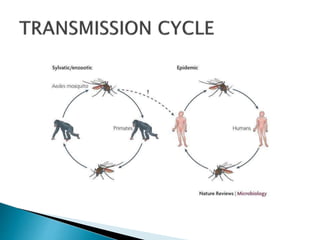
 Dengue viruses are transmitted from person
to person by Aedes mosquitoes (most often
Aedes aegypti) in the domestic environment.
 Dr Benjamin Rush a professor of chemistry and
medical theory at UPEN, during Philadelphia
epidemic 1779-1780, first described the
dramatic symptom of dengue as breakbone fever
 In India first outbreak of dengue was recorded in
1812.
 A double peak hemorrhagic fever epidemic
occurred in India for the first time in Calcutta
between July 1963 & March 1964
 In New Delhi, outbreaks of dengue fever
reported in 1967,1970,1982, 1996, 2012& 2015
 Rapid expansion of urbanization
 Inadequate closed drainage
 ↑ movement of human population within and
between countries
 Insecticide resistance in mosquito vector
population are few of the reasons for ↑
dengue transmission in recent years
 Dengue infection is caused by dengue virus
(DENV), which is a single-stranded RNA virus
(approximately 11 kilobases long) with an
icosahedral nucleocapsid and covered by a
lipid envelope.
 The virus is in the family Flaviviridae, genus
Flavivirus, and the type specific virus is yellow
fever.
 Transmission of dengue virus into the host is
through the vectors
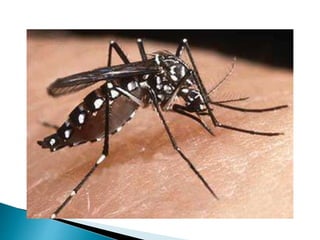
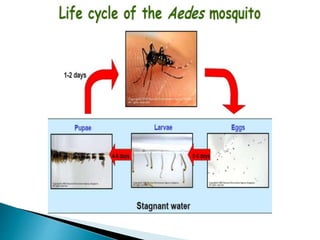
 Lays its eggs in clean, stagnant water.
 One distinct physical feature – black and
white stripes on its body and legs – Tiger
mosquito
 Bites during the day.
 On average, a female Aedes mosquito can lay
about 300 eggs during her life span of 14 to
21 days.
 Only the female Aedes mosquito feeds on
blood.
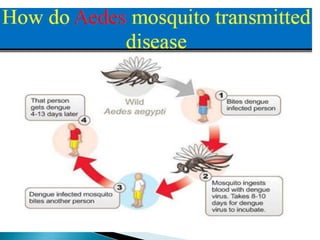
1. The transmission cycle of dengue virus by the
mosquito Aedes aegypti begins with a dengue
infected person. This person will have virus
circulating in the blood—a viremia that lasts for
about five days.
2. During the viremic period, an uninfected female
Aedes aegypti mosquito bites the person and
ingests blood that contains dengue virus.
3. Then, within the mosquito, the virus replicates
during an extrinsic incubation period of eight to
twelve days.
 The mosquito then bites a susceptible person and transmits
the virus .
 The virus then replicates in the second person and produces
symptoms. The symptoms begin to appear an average of four
to seven days after the mosquito bite—this is the intrinsic
incubation period, within humans.
 It can range from 3 to 14 days (average 4-7 days).
 While viral replication takes place in target dendritic cells.
Infection of target cells, primarily those of the
reticuloendothelial system, such as dendritic cells,
hepatocytes, and endothelial cells
 This result in the production of immune mediators that serve
to shape the quantity, type, and duration of cellular and
humoral immune response to both the initial and subsequent
virus infections.
 Fever typically begins on the third day of illness and persists
5-7 days, abating with the cessation of viremia. Fever may
reach 41C°.
 Occasionally, and more frequently in children, the fever
abates for a day and recurs, a pattern that is termed a
saddleback fever; however, this pattern is more commonly
seen in dengue hemorrhagic fever.
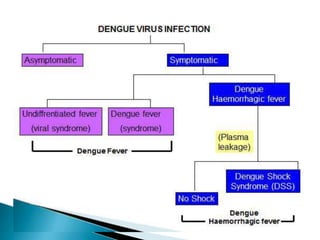
There are actually four dengue clinical
syndromes:
 Undifferentiated fever;
 Classic dengue fever;
 Dengue hemorrhagic fever, or DHF; and
 Dengue shock syndrome, or DSS.
 Dengue shock syndrome is actually a severe
form of DHF.
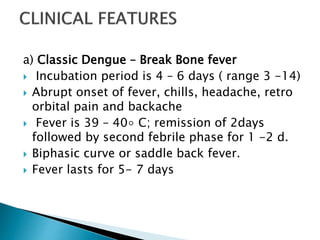
a) Classic Dengue – Break Bone fever
 Incubation period is 4 – 6 days ( range 3 -14)
 Abrupt onset of fever, chills, headache, retro
orbital pain and backache
 Fever is 39 – 40◦ C; remission of 2days
followed by second febrile phase for 1 -2 d.
 Biphasic curve or saddle back fever.
 Fever lasts for 5- 7 days
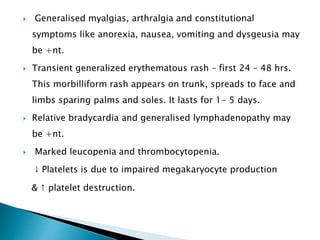
 Generalised myalgias, arthralgia and constitutional
symptoms like anorexia, nausea, vomiting and dysgeusia may
be +nt.
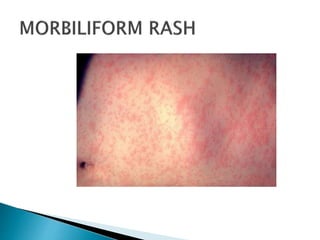
 Transient generalized erythematous rash – first 24 – 48 hrs.
This morbilliform rash appears on trunk, spreads to face and
limbs sparing palms and soles. It lasts for 1- 5 days.
 Relative bradycardia and generalised lymphadenopathy may
be +nt.
 Marked leucopenia and thrombocytopenia.
↓ Platelets is due to impaired megakaryocyte production
& ↑ platelet destruction.
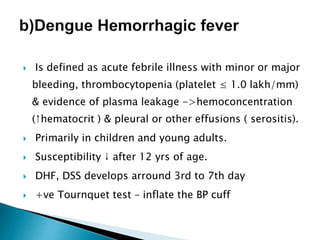
 Is defined as acute febrile illness with minor or major
bleeding, thrombocytopenia (platelet ≤ 1.0 lakh/mm)
& evidence of plasma leakage ->hemoconcentration
(↑hematocrit ) & pleural or other effusions ( serositis).
 Primarily in children and young adults.
 Susceptibility ↓ after 12 yrs of age.
 DHF, DSS develops arround 3rd to 7th day
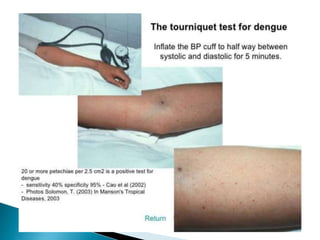
 +ve Tournquet test – inflate the BP cuff
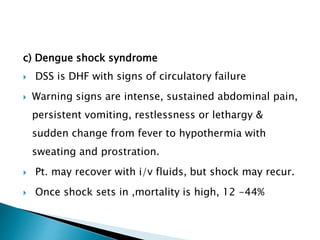
c) Dengue shock syndrome
 DSS is DHF with signs of circulatory failure
 Warning signs are intense, sustained abdominal pain,
persistent vomiting, restlessness or lethargy &
sudden change from fever to hypothermia with
sweating and prostration.
 Pt. may recover with i/v fluids, but shock may recur.
 Once shock sets in ,mortality is high, 12 -44%
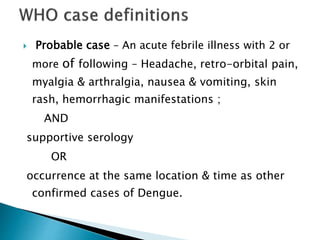
 Probable case – An acute febrile illness with 2 or
more of following – Headache, retro-orbital pain,
myalgia & arthralgia, nausea & vomiting, skin
rash, hemorrhagic manifestations ;
AND
supportive serology
OR
occurrence at the same location & time as other
confirmed cases of Dengue.
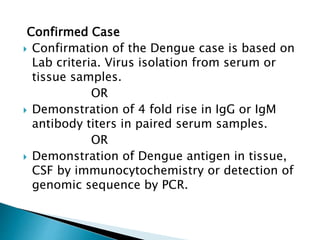
Confirmed Case
 Confirmation of the Dengue case is based on
Lab criteria. Virus isolation from serum or
tissue samples.
OR
 Demonstration of 4 fold rise in IgG or IgM
antibody titers in paired serum samples.
OR
 Demonstration of Dengue antigen in tissue,
CSF by immunocytochemistry or detection of
genomic sequence by PCR.
warning signs again are
 The abdominal pain or tenderness
 Persistent vomiting
 clinical fluid accumulation
 mucosal bleed
 lethargy
 Restlessness
 liver enlargement
 increase inhematocrit concurrent with a
rapid decrease in platelet count
 If left untreated, dengue hemorrhagic fever
most likely progresses to dengue shock
syndrome. Common symptoms in impending
shock include abdominal pain, vomiting, and
restlessness. Patients also may have
symptoms related to
(ALL 4 CRITERIA ARE REQUIRED)
 Fever or h/o fever lasting 2-7 days
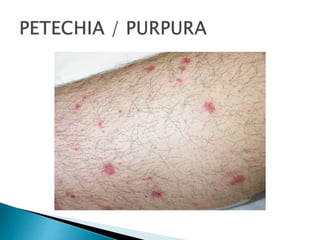
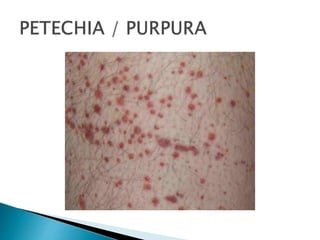
 Hemorrhagic tendency
- a +ve tourniquet test
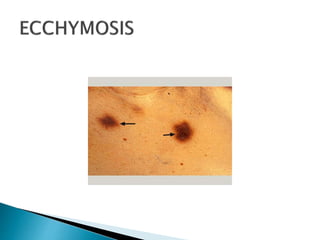
- Petechae, ecchymosis, purpura
- Bleeding per mucosa, GIT , etc.
- Hematemesis, Malena
 Thrombocytopenia, Platelets < 1.0 lakh/mm3
 Plasma leakage
- rise in hematocrit > 20%
- fall in hematocrit > 20% after i/v fluids
- Pleural effusion, ascites, hypoalbuminemia.
 DSS requires all the DHF criteria in addition a
circulatory failure manifested by
- Rapid and weak pulse
- Narrow pulse pressure ( < 20 mm Hg)
- Hypotension, For age > 5yrs < 90 mm Hg
for age < 5 yrs < 80 mm Hg
- Cold dry skin, restlessness
 Any acute febrile illness with thrombocytopenia
 1. Malaria
 2. Leptospirosis
 3. Infectious mononucleosis
 4. Chickungunya
 5. Viral hepatitis
 6. Sepsis
 7. Meningococcimeia
 8. Influenza
 9. Other hemorrhagic fever
 Medical history
 Physical examination
 Laboratory tests
 Radiological test
fever
rash
haemorrhagic manifestations
 Petechiae
 Purpura/ ecchymosis
 Epistaxis
 Gum bleeding
 Blood in vomitus, urine, or stool
 Vaginal bleeding
 Positive tourniquet test
hypotension
evidence of circulatory failure
 EVALUATE: HR, capillary refill, skin
colour, temperature, BP, PP
 LOOK FOR: evidence of bleeding on
the skin and other sites
 LOOK FOR: evidence of increased
vascular permeability
 MEASURE and ask about urine output
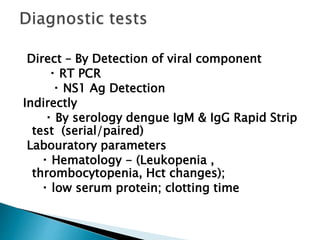
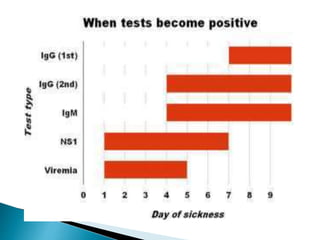
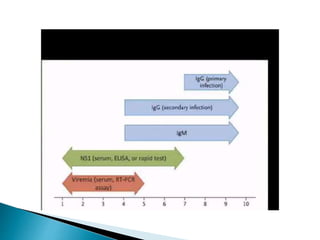
Direct – By Detection of viral component
RT PCR
NS1 Ag Detection
Indirectly
By serology dengue IgM & IgG Rapid Strip
test (serial/paired)
Labouratory parameters
Hematology - (Leukopenia ,
thrombocytopenia, Hct changes);
low serum protein; clotting time
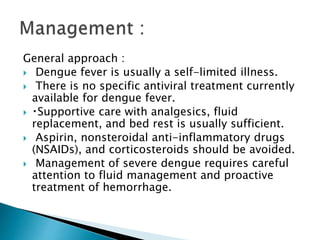
General approach :
 Dengue fever is usually a self-limited illness.
 There is no specific antiviral treatment currently
available for dengue fever.
 Supportive care with analgesics, fluid
replacement, and bed rest is usually sufficient.
 Aspirin, nonsteroidal anti-inflammatory drugs
(NSAIDs), and corticosteroids should be avoided.
 Management of severe dengue requires careful
attention to fluid management and proactive
treatment of hemorrhage.
 Symptomatic - Paracetamol for fever &
myalgia. Aspirin, NSAIDS avoided due to risk
of erosive gastritis and bleeding.
 Rest
 Oral rehydration
 In DHF careful & repeated estimation of
volume status & fluid replacement is corner-
stone of management. Use isotonic i/v fluids.
TREATMENT 2
 Because patients have loss of plasma they
must be given isotonic solution or plasma
expanders.
 Platelets are replaced if the count is less than
10000 /mm3 or clinical bleeding is +nt. It is
better to give Single donor apheresis Platelets
(SDAP) as compared to RDP to lower the risk
of alloimmunization.
TREATMENT 3
 Besides bleeding other complications are
ARDS, renal failure, hepatic failure &
encephalopathy.
 It is by control of mosquitoes which live & breed in
stagnant water in and around the house.
 Lays eggs preferentially in jars, discarded containers,
coconut shells, old tires etc.
 Year round breeding
 Tropical regions like India are its favorite zones.
How to prevent mosquito spread?
 Do not allow empty vessels, coconut shells, plastic
containers, flower pots, tires etc to collect rain water
in them
 Frequently (once in 2-3 days) empty all water
storage containers
 Cover your overhead tanks to prevent mosquitoes
breeding in fresh water
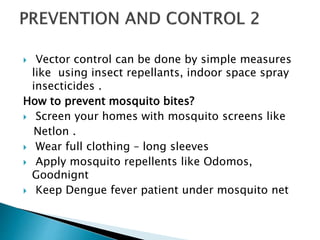
 Vector control can be done by simple measures
like using insect repellants, indoor space spray
insecticides .
How to prevent mosquito bites?
 Screen your homes with mosquito screens like
Netlon .
 Wear full clothing – long sleeves
 Apply mosquito repellents like Odomos,
Goodnignt
 Keep Dengue fever patient under mosquito net

Dengue fever 2020

  • 2.
     mosquito-borne infectionfound in tropical and subtropical regions around the world.
  • 3.
     Philippine hemorrhagicfever  Thai hemorrhagic fever  Singapore hemorrhagic fever  Onyong- Nyang Fever  West Nile Fever  Dandy fever  Break Bone Fever  Dengue like Disease
  • 4.
     Break-bone fever’/ dandy fever (Haddi tod bukhar)  Dengue is a mosquito-borne disease caused by any one of four closely related dengue viruses (DENV-1, -2, -3, and -4).  Infection with one serotype of DENV provides immunity to that serotype for life, but provides no long-term immunity to other serotypes.  Dengue viruses are transmitted from person to person by Aedes mosquitoes (most often Aedes aegypti) in the domestic environment.
  • 5.
     Dr BenjaminRush a professor of chemistry and medical theory at UPEN, during Philadelphia epidemic 1779-1780, first described the dramatic symptom of dengue as breakbone fever  In India first outbreak of dengue was recorded in 1812.  A double peak hemorrhagic fever epidemic occurred in India for the first time in Calcutta between July 1963 & March 1964  In New Delhi, outbreaks of dengue fever reported in 1967,1970,1982, 1996, 2012& 2015
  • 6.
     Rapid expansionof urbanization  Inadequate closed drainage  ↑ movement of human population within and between countries  Insecticide resistance in mosquito vector population are few of the reasons for ↑ dengue transmission in recent years
  • 7.
     Dengue infectionis caused by dengue virus (DENV), which is a single-stranded RNA virus (approximately 11 kilobases long) with an icosahedral nucleocapsid and covered by a lipid envelope.  The virus is in the family Flaviviridae, genus Flavivirus, and the type specific virus is yellow fever.  Transmission of dengue virus into the host is through the vectors
  • 8.
     Lays itseggs in clean, stagnant water.  One distinct physical feature – black and white stripes on its body and legs – Tiger mosquito  Bites during the day.  On average, a female Aedes mosquito can lay about 300 eggs during her life span of 14 to 21 days.  Only the female Aedes mosquito feeds on blood.
  • 13.
    1. The transmissioncycle of dengue virus by the mosquito Aedes aegypti begins with a dengue infected person. This person will have virus circulating in the blood—a viremia that lasts for about five days. 2. During the viremic period, an uninfected female Aedes aegypti mosquito bites the person and ingests blood that contains dengue virus. 3. Then, within the mosquito, the virus replicates during an extrinsic incubation period of eight to twelve days.
  • 14.
     The mosquitothen bites a susceptible person and transmits the virus .  The virus then replicates in the second person and produces symptoms. The symptoms begin to appear an average of four to seven days after the mosquito bite—this is the intrinsic incubation period, within humans.  It can range from 3 to 14 days (average 4-7 days).  While viral replication takes place in target dendritic cells. Infection of target cells, primarily those of the reticuloendothelial system, such as dendritic cells, hepatocytes, and endothelial cells
  • 15.
     This resultin the production of immune mediators that serve to shape the quantity, type, and duration of cellular and humoral immune response to both the initial and subsequent virus infections.  Fever typically begins on the third day of illness and persists 5-7 days, abating with the cessation of viremia. Fever may reach 41C°.  Occasionally, and more frequently in children, the fever abates for a day and recurs, a pattern that is termed a saddleback fever; however, this pattern is more commonly seen in dengue hemorrhagic fever.
  • 16.
    There are actuallyfour dengue clinical syndromes:  Undifferentiated fever;  Classic dengue fever;  Dengue hemorrhagic fever, or DHF; and  Dengue shock syndrome, or DSS.  Dengue shock syndrome is actually a severe form of DHF.
  • 18.
    a) Classic Dengue– Break Bone fever  Incubation period is 4 – 6 days ( range 3 -14)  Abrupt onset of fever, chills, headache, retro orbital pain and backache  Fever is 39 – 40◦ C; remission of 2days followed by second febrile phase for 1 -2 d.  Biphasic curve or saddle back fever.  Fever lasts for 5- 7 days
  • 19.
     Generalised myalgias,arthralgia and constitutional symptoms like anorexia, nausea, vomiting and dysgeusia may be +nt.  Transient generalized erythematous rash – first 24 – 48 hrs. This morbilliform rash appears on trunk, spreads to face and limbs sparing palms and soles. It lasts for 1- 5 days.  Relative bradycardia and generalised lymphadenopathy may be +nt.  Marked leucopenia and thrombocytopenia. ↓ Platelets is due to impaired megakaryocyte production & ↑ platelet destruction.
  • 21.
     Is definedas acute febrile illness with minor or major bleeding, thrombocytopenia (platelet ≤ 1.0 lakh/mm) & evidence of plasma leakage ->hemoconcentration (↑hematocrit ) & pleural or other effusions ( serositis).  Primarily in children and young adults.  Susceptibility ↓ after 12 yrs of age.  DHF, DSS develops arround 3rd to 7th day  +ve Tournquet test – inflate the BP cuff
  • 26.
    c) Dengue shocksyndrome  DSS is DHF with signs of circulatory failure  Warning signs are intense, sustained abdominal pain, persistent vomiting, restlessness or lethargy & sudden change from fever to hypothermia with sweating and prostration.  Pt. may recover with i/v fluids, but shock may recur.  Once shock sets in ,mortality is high, 12 -44%
  • 27.
     Probable case– An acute febrile illness with 2 or more of following – Headache, retro-orbital pain, myalgia & arthralgia, nausea & vomiting, skin rash, hemorrhagic manifestations ; AND supportive serology OR occurrence at the same location & time as other confirmed cases of Dengue.
  • 28.
    Confirmed Case  Confirmationof the Dengue case is based on Lab criteria. Virus isolation from serum or tissue samples. OR  Demonstration of 4 fold rise in IgG or IgM antibody titers in paired serum samples. OR  Demonstration of Dengue antigen in tissue, CSF by immunocytochemistry or detection of genomic sequence by PCR.
  • 29.
    warning signs againare  The abdominal pain or tenderness  Persistent vomiting  clinical fluid accumulation  mucosal bleed  lethargy  Restlessness  liver enlargement  increase inhematocrit concurrent with a rapid decrease in platelet count
  • 30.
     If leftuntreated, dengue hemorrhagic fever most likely progresses to dengue shock syndrome. Common symptoms in impending shock include abdominal pain, vomiting, and restlessness. Patients also may have symptoms related to
  • 31.
    (ALL 4 CRITERIAARE REQUIRED)  Fever or h/o fever lasting 2-7 days  Hemorrhagic tendency - a +ve tourniquet test - Petechae, ecchymosis, purpura - Bleeding per mucosa, GIT , etc. - Hematemesis, Malena  Thrombocytopenia, Platelets < 1.0 lakh/mm3  Plasma leakage - rise in hematocrit > 20% - fall in hematocrit > 20% after i/v fluids - Pleural effusion, ascites, hypoalbuminemia.
  • 32.
     DSS requiresall the DHF criteria in addition a circulatory failure manifested by - Rapid and weak pulse - Narrow pulse pressure ( < 20 mm Hg) - Hypotension, For age > 5yrs < 90 mm Hg for age < 5 yrs < 80 mm Hg - Cold dry skin, restlessness
  • 33.
     Any acutefebrile illness with thrombocytopenia  1. Malaria  2. Leptospirosis  3. Infectious mononucleosis  4. Chickungunya  5. Viral hepatitis  6. Sepsis  7. Meningococcimeia  8. Influenza  9. Other hemorrhagic fever
  • 34.
     Medical history Physical examination  Laboratory tests  Radiological test
  • 35.
    fever rash haemorrhagic manifestations  Petechiae Purpura/ ecchymosis  Epistaxis  Gum bleeding  Blood in vomitus, urine, or stool  Vaginal bleeding  Positive tourniquet test hypotension evidence of circulatory failure
  • 36.
     EVALUATE: HR,capillary refill, skin colour, temperature, BP, PP  LOOK FOR: evidence of bleeding on the skin and other sites  LOOK FOR: evidence of increased vascular permeability  MEASURE and ask about urine output
  • 37.
    Direct – ByDetection of viral component RT PCR NS1 Ag Detection Indirectly By serology dengue IgM & IgG Rapid Strip test (serial/paired) Labouratory parameters Hematology - (Leukopenia , thrombocytopenia, Hct changes); low serum protein; clotting time
  • 40.
    General approach : Dengue fever is usually a self-limited illness.  There is no specific antiviral treatment currently available for dengue fever.  Supportive care with analgesics, fluid replacement, and bed rest is usually sufficient.  Aspirin, nonsteroidal anti-inflammatory drugs (NSAIDs), and corticosteroids should be avoided.  Management of severe dengue requires careful attention to fluid management and proactive treatment of hemorrhage.
  • 41.
     Symptomatic -Paracetamol for fever & myalgia. Aspirin, NSAIDS avoided due to risk of erosive gastritis and bleeding.  Rest  Oral rehydration  In DHF careful & repeated estimation of volume status & fluid replacement is corner- stone of management. Use isotonic i/v fluids.
  • 42.
    TREATMENT 2  Becausepatients have loss of plasma they must be given isotonic solution or plasma expanders.  Platelets are replaced if the count is less than 10000 /mm3 or clinical bleeding is +nt. It is better to give Single donor apheresis Platelets (SDAP) as compared to RDP to lower the risk of alloimmunization.
  • 43.
    TREATMENT 3  Besidesbleeding other complications are ARDS, renal failure, hepatic failure & encephalopathy.
  • 44.
     It isby control of mosquitoes which live & breed in stagnant water in and around the house.  Lays eggs preferentially in jars, discarded containers, coconut shells, old tires etc.  Year round breeding  Tropical regions like India are its favorite zones. How to prevent mosquito spread?  Do not allow empty vessels, coconut shells, plastic containers, flower pots, tires etc to collect rain water in them  Frequently (once in 2-3 days) empty all water storage containers  Cover your overhead tanks to prevent mosquitoes breeding in fresh water
  • 45.
     Vector controlcan be done by simple measures like using insect repellants, indoor space spray insecticides . How to prevent mosquito bites?  Screen your homes with mosquito screens like Netlon .  Wear full clothing – long sleeves  Apply mosquito repellents like Odomos, Goodnignt  Keep Dengue fever patient under mosquito net