Dendrimers
Anamika Dey
MPH/10009/19
Introduction
 The word “dendrimer” originated from two Greek words,
dendron :- meaning tree,
meros:- meaning part or segment.
 Dendrimers are a new class of polymeric materials. They are
highly branched, monodisperse , artificial macromolecules.
 Dendrimers may be defined as synthetic three-dimensional hyper
branched, globular macromolecule, which is characterized by its
highly branched 3D structure that provides a high degree of
surface functionality.
History
 In 1978, Vogtle and co-workers was first introduced chemistry
of Dendrimer .
 In 1980, Donald Tomalia and co-workers discovered, these hyper
branched molecules were called dendrimers.
 In 1985, Vogtle synthesized the first family of dendrimers the
first “cascade molecules”.
 At the same time, Newkome’s groupindependently reported
synthesis of similar macromolecules.
 They called them arborols from the Latin word ‘arbor’ also
meaning a tree.
 The term cascade molecule is also used, but ‘dendrimer’ is the
well established one.
Structure
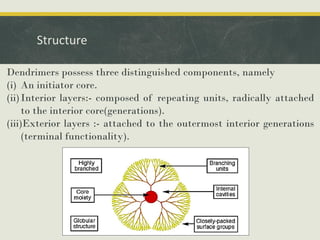
Dendrimers possess three distinguished components, namely
(i) An initiator core.
(ii)Interior layers:- composed of repeating units, radically attached
to the interior core(generations).
(iii)Exterior layers :- attached to the outermost interior generations
(terminal functionality).
Need of Dendrimer
 Nano-particle drug-delivery systems are most popular one.
 However reticuloendothelial system (RES) uptake, drug leakage,
immunogenicity, haemolytic toxicity, cytotoxicity, restrict the use
of these nanostructures.
 These are overcome by surface engineering the dendrimer such as
Polyester dendrimer, Glyco-dendrimers, PEGylated dendrimers
etc.
 The bioactive agents can be easily encapsulated into the interior
of the dendrimers.
or
 Chemically attached i.e. physically adsorbed on to the dendrimer
surface
Synthesis
• Traditional method dendrimer synthesis are:
 Michael reaction,
 Williamson ether synthesis.
• Modern techniques are :
 solid-phase synthesis,
 organosilicon chemistry,
 organo-phosphorus chemistry.
Methods of Synthesis
1) Divergent method.
2) Convergent method.
3) Hypercores & branched monomers method.
4) Double Exponential And Mixed Growth.
5) Other accelerated growth technique.
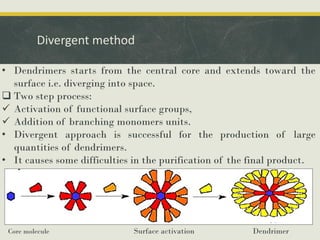
Divergent method
• Dendrimers starts from the central core and extends toward the
surface i.e. diverging into space.
 Two step process:
 Activation of functional surface groups,
 Addition of branching monomers units.
• Divergent approach is successful for the production of large
quantities of dendrimers.
• It causes some difficulties in the purification of the final product.
Core molecule Surface activation Dendrimer
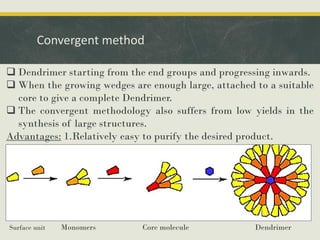
Convergent method
 Dendrimer starting from the end groups and progressing inwards.
 When the growing wedges are enough large, attached to a suitable
core to give a complete Dendrimer.
 The convergent methodology also suffers from low yields in the
synthesis of large structures.
Advantages: 1.Relatively easy to purify the desired product.
Surface unit Monomers Core molecule Dendrimer
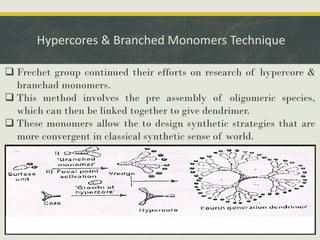
Hypercores & Branched Monomers Technique
 Frechet group continued their efforts on research of hypercore &
branchad monomers.
 This method involves the pre assembly of oligomeric species,
which can then be linked together to give dendrimer.
 These monomers allow the to design synthetic strategies that are
more convergent in classical synthetic sense of world.
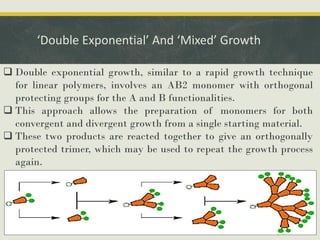
‘Double Exponential’ And ‘Mixed’ Growth
 Double exponential growth, similar to a rapid growth technique
for linear polymers, involves an AB2 monomer with orthogonal
protecting groups for the A and B functionalities.
 This approach allows the preparation of monomers for both
convergent and divergent growth from a single starting material.
 These two products are reacted together to give an orthogonally
protected trimer, which may be used to repeat the growth process
again.
Other Accelerated Growth Techniques
This is two step approach designed by frechet.
• In this approach two different monomers are used so as to avoid
the need of an activation step between growth steps.
• The two monomeric units are AB2 &CD2.where A&D reacts to
form bond under required conditions while B&C are stable, where
B&C reacts to form bond while A&D remain stable.
• In this technique the hindrance likely to be experienced is that
difficulty of finding a set of reactions,which conform to above
criteria.
Mechanisms of Drug Delivery
• Simple encapsulation:-It directly encapsulates guest molecules
into macromolecule interior.
• Electrostatic interaction:-Surface functional groups enhances
solubility of hydrophobic drugs by electrostatic interaction e.g.
Ibuprofen, ketoprofen, indomethacin.
• Covalent conjugation:-The drug is covalently bound to
dendrimers & its cleavage occurs via chemical or enzymatic
cleavage of hydrolytically labile bonds. It allows tissue targeting
& controlled delivery as drug-dendrimer conjugate diffuse slower
than the free.
Generations
The number of focal points when going from the core towards the
dendrimer surface is the generation number.
That is a dendrimer having five focal points when going from the
centre to the periphery is denoted as the 5th generation
dendrimer.
Here, we abbreviate this term to simply a G5-dendrimer, e.g. a
5th generation polypropylene imine is abbreviated to a “G5-PPI-
dendrimer.”
Intermediates during the dendrimer synthesis are sometimes
denoted half-generations, a well-known example is the carboxylic
acid- terminated PAMAM dendrimers.
Diameter of dendrimer with an ethylenediamine core increases
from 1.1 to 12.4 nm.
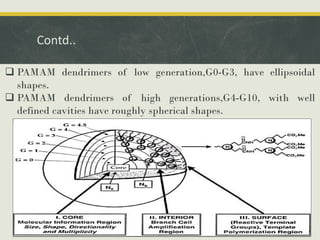
Contd..
 PAMAM dendrimers of low generation,G0-G3, have ellipsoidal
shapes.
 PAMAM dendrimers of high generations,G4-G10, with well
defined cavities have roughly spherical shapes.
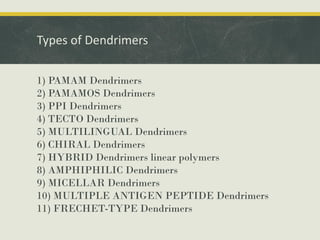
Types of Dendrimers
1) PAMAM Dendrimers
2) PAMAMOS Dendrimers
3) PPI Dendrimers
4) TECTO Dendrimers
5) MULTILINGUAL Dendrimers
6) CHIRAL Dendrimers
7) HYBRID Dendrimers linear polymers
8) AMPHIPHILIC Dendrimers
9) MICELLAR Dendrimers
10) MULTIPLE ANTIGEN PEPTIDE Dendrimers
11) FRECHET-TYPE Dendrimers
Properties
Characterization
1. Spectroscopy and Spectrometry Methods (NMR, IR, UV-Vis,
XRD, Circular dichroism, Mass Spectrometry etc.)
2. Scattering Techniques (Small angle X-ray Scattering, Small
angle neutron scattering, Laser Light Scattering)
3. Electrical Techniques (Electron paramagnetic resonance,
Electrophoresis and Electrochemistry)
4. Size Exclusion Chromatography
5. Microscopy (TEM, SEM etc.)
6. Physical Properties & Rheology (Intrinsic Viscosity, DSC,
Dielectric Spectroscopy)
7. Miscellaneous (X-ray photoelectron spectroscopy, Tritimetry,
Measurement of dipole moment etc.)
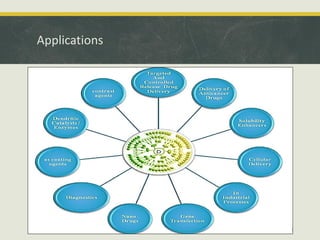
Applications
References
 “Advances in Controlled & Novel Drug Delivery”, 1st edition
2001,by Jain N.K,CBS Publications, New Delhi,361-376.
 “Encyclopedia of Pharmaceutical Technology”, vol-18,by
James swarbrick, Marcel dekker inc,55-89.
 “ Journal of Pharmaceutical sciences”, vol-97,No-1. January
2008,by American Pharmacists Association,123- 143.
 “Journal of Pharmaceutical sciences”, vol-98,No-1. January
2009,by American Pharmacists Association,1-26.
 http://en.wikipedia.org/wiki/dendrimer.
 http://www.actabp.pl/pdf/1_2001/199-208.pdf.
 http://www.pharmainfo.net/reviews/dendrimer-overview.
Thank You

Dendrimers

  • 1.
  • 2.
    Introduction  The word“dendrimer” originated from two Greek words, dendron :- meaning tree, meros:- meaning part or segment.  Dendrimers are a new class of polymeric materials. They are highly branched, monodisperse , artificial macromolecules.  Dendrimers may be defined as synthetic three-dimensional hyper branched, globular macromolecule, which is characterized by its highly branched 3D structure that provides a high degree of surface functionality.
  • 3.
    History  In 1978,Vogtle and co-workers was first introduced chemistry of Dendrimer .  In 1980, Donald Tomalia and co-workers discovered, these hyper branched molecules were called dendrimers.  In 1985, Vogtle synthesized the first family of dendrimers the first “cascade molecules”.  At the same time, Newkome’s groupindependently reported synthesis of similar macromolecules.  They called them arborols from the Latin word ‘arbor’ also meaning a tree.  The term cascade molecule is also used, but ‘dendrimer’ is the well established one.
  • 4.
    Structure Dendrimers possess threedistinguished components, namely (i) An initiator core. (ii)Interior layers:- composed of repeating units, radically attached to the interior core(generations). (iii)Exterior layers :- attached to the outermost interior generations (terminal functionality).
  • 5.
    Need of Dendrimer Nano-particle drug-delivery systems are most popular one.  However reticuloendothelial system (RES) uptake, drug leakage, immunogenicity, haemolytic toxicity, cytotoxicity, restrict the use of these nanostructures.  These are overcome by surface engineering the dendrimer such as Polyester dendrimer, Glyco-dendrimers, PEGylated dendrimers etc.  The bioactive agents can be easily encapsulated into the interior of the dendrimers. or  Chemically attached i.e. physically adsorbed on to the dendrimer surface
  • 6.
    Synthesis • Traditional methoddendrimer synthesis are:  Michael reaction,  Williamson ether synthesis. • Modern techniques are :  solid-phase synthesis,  organosilicon chemistry,  organo-phosphorus chemistry.
  • 7.
    Methods of Synthesis 1)Divergent method. 2) Convergent method. 3) Hypercores & branched monomers method. 4) Double Exponential And Mixed Growth. 5) Other accelerated growth technique.
  • 8.
    Divergent method • Dendrimersstarts from the central core and extends toward the surface i.e. diverging into space.  Two step process:  Activation of functional surface groups,  Addition of branching monomers units. • Divergent approach is successful for the production of large quantities of dendrimers. • It causes some difficulties in the purification of the final product. Core molecule Surface activation Dendrimer
  • 9.
    Convergent method  Dendrimerstarting from the end groups and progressing inwards.  When the growing wedges are enough large, attached to a suitable core to give a complete Dendrimer.  The convergent methodology also suffers from low yields in the synthesis of large structures. Advantages: 1.Relatively easy to purify the desired product. Surface unit Monomers Core molecule Dendrimer
  • 10.
    Hypercores & BranchedMonomers Technique  Frechet group continued their efforts on research of hypercore & branchad monomers.  This method involves the pre assembly of oligomeric species, which can then be linked together to give dendrimer.  These monomers allow the to design synthetic strategies that are more convergent in classical synthetic sense of world.
  • 11.
    ‘Double Exponential’ And‘Mixed’ Growth  Double exponential growth, similar to a rapid growth technique for linear polymers, involves an AB2 monomer with orthogonal protecting groups for the A and B functionalities.  This approach allows the preparation of monomers for both convergent and divergent growth from a single starting material.  These two products are reacted together to give an orthogonally protected trimer, which may be used to repeat the growth process again.
  • 12.
    Other Accelerated GrowthTechniques This is two step approach designed by frechet. • In this approach two different monomers are used so as to avoid the need of an activation step between growth steps. • The two monomeric units are AB2 &CD2.where A&D reacts to form bond under required conditions while B&C are stable, where B&C reacts to form bond while A&D remain stable. • In this technique the hindrance likely to be experienced is that difficulty of finding a set of reactions,which conform to above criteria.
  • 13.
    Mechanisms of DrugDelivery • Simple encapsulation:-It directly encapsulates guest molecules into macromolecule interior. • Electrostatic interaction:-Surface functional groups enhances solubility of hydrophobic drugs by electrostatic interaction e.g. Ibuprofen, ketoprofen, indomethacin. • Covalent conjugation:-The drug is covalently bound to dendrimers & its cleavage occurs via chemical or enzymatic cleavage of hydrolytically labile bonds. It allows tissue targeting & controlled delivery as drug-dendrimer conjugate diffuse slower than the free.
  • 14.
    Generations The number offocal points when going from the core towards the dendrimer surface is the generation number. That is a dendrimer having five focal points when going from the centre to the periphery is denoted as the 5th generation dendrimer. Here, we abbreviate this term to simply a G5-dendrimer, e.g. a 5th generation polypropylene imine is abbreviated to a “G5-PPI- dendrimer.” Intermediates during the dendrimer synthesis are sometimes denoted half-generations, a well-known example is the carboxylic acid- terminated PAMAM dendrimers. Diameter of dendrimer with an ethylenediamine core increases from 1.1 to 12.4 nm.
  • 15.
    Contd..  PAMAM dendrimersof low generation,G0-G3, have ellipsoidal shapes.  PAMAM dendrimers of high generations,G4-G10, with well defined cavities have roughly spherical shapes.
  • 16.
    Types of Dendrimers 1)PAMAM Dendrimers 2) PAMAMOS Dendrimers 3) PPI Dendrimers 4) TECTO Dendrimers 5) MULTILINGUAL Dendrimers 6) CHIRAL Dendrimers 7) HYBRID Dendrimers linear polymers 8) AMPHIPHILIC Dendrimers 9) MICELLAR Dendrimers 10) MULTIPLE ANTIGEN PEPTIDE Dendrimers 11) FRECHET-TYPE Dendrimers
  • 17.
  • 18.
    Characterization 1. Spectroscopy andSpectrometry Methods (NMR, IR, UV-Vis, XRD, Circular dichroism, Mass Spectrometry etc.) 2. Scattering Techniques (Small angle X-ray Scattering, Small angle neutron scattering, Laser Light Scattering) 3. Electrical Techniques (Electron paramagnetic resonance, Electrophoresis and Electrochemistry) 4. Size Exclusion Chromatography 5. Microscopy (TEM, SEM etc.) 6. Physical Properties & Rheology (Intrinsic Viscosity, DSC, Dielectric Spectroscopy) 7. Miscellaneous (X-ray photoelectron spectroscopy, Tritimetry, Measurement of dipole moment etc.)
  • 19.
  • 20.
    References  “Advances inControlled & Novel Drug Delivery”, 1st edition 2001,by Jain N.K,CBS Publications, New Delhi,361-376.  “Encyclopedia of Pharmaceutical Technology”, vol-18,by James swarbrick, Marcel dekker inc,55-89.  “ Journal of Pharmaceutical sciences”, vol-97,No-1. January 2008,by American Pharmacists Association,123- 143.  “Journal of Pharmaceutical sciences”, vol-98,No-1. January 2009,by American Pharmacists Association,1-26.  http://en.wikipedia.org/wiki/dendrimer.  http://www.actabp.pl/pdf/1_2001/199-208.pdf.  http://www.pharmainfo.net/reviews/dendrimer-overview.
  • 21.