Submitted By
            SAIKAT GHOSH
                UG-IV

        Under the Guidance of
        Dr. Ketousetuo Kuotsu
Department of Pharmaceutical Technology,
          Jadavpur University
The word Dendrimer comes from the Greek word ”DENDRON” meaning tree and
“MEROS” meaning part


A dendrimer is generally described as a macromolecule, which is characterized by
its highly branched 3D structure that provides a high degree of surface functionality
and versatility. Dendrimers have often been referred to as the “Polymers of the 21st
century”.


The first dendrimers were synthesised divergently by Vögtle in 1978, by
Denkewalter and coworkers at Allied Corporation as polylysine dendrimers in
1981, by Donald Tomalia at Dow Chemical in 1983 and in 1985, and by Newkome in
1985. In 1990 a convergent synthesis was introduced by Jean FrechetThey called them
arborols fromthe Latin word ‘arbor’ also meaning a tree.
Dendrimer Designing should take into consideration:-
(1) Architecturing
(2) Synthesis
(3) Properties & Applications of the dendrimer
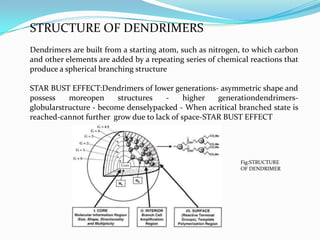
STRUCTURE OF DENDRIMERS
Dendrimers are built from a starting atom, such as nitrogen, to which carbon
and other elements are added by a repeating series of chemical reactions that
produce a spherical branching structure

STAR BUST EFFECT:Dendrimers of lower generations- asymmetric shape and
possess    moreopen      structures   -     higher  generationdendrimers-
globularstructure - become denselypacked - When acritical branched state is
reached-cannot further grow due to lack of space-STAR BUST EFFECT


                                                            Fig:STRUCTURE
                                                            OF DENDRIMER
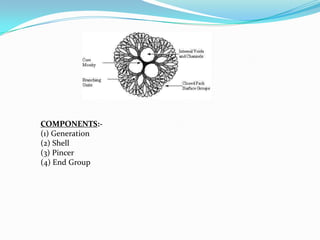
COMPONENTS:-
(1) Generation
(2) Shell
(3) Pincer
(4) End Group
TYPES OF DENDRIMERS

Pamam Dendrimer
 Pamamos Dendrimer
Tecto Dendrimer
PPI Dendrimer
 Multilingual Dendrimers
 Chiral Dendrimers
Hybrid Dendrimer Linear
Polymers
Amphiphilic Dendrimers Micellar
Dendrimers
 Multiple Antigen Peptide Dendrimers
 Fréchet-Type Dendrimers
Glycodendrimer
Peptide dendrimer
Ferrocene dendrimer
Denderonised polymers
                                        Fig;GLYCODENDRIMER


FIG: FERROCENE DENDRIMER
                                         FIG:PAMAM DENDRIMER
Synthesis of dendrimers
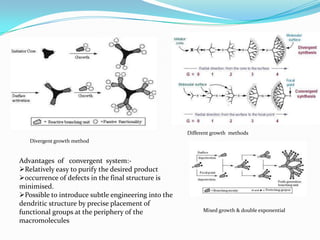
Monomers lead to a Monodisperse polymer, tree-like, or generational
structure.

There are three defined methods of dendrimer synthesis

Divergent synthesis - assemble the molecule from the core, extending
radially to the periphery

Convergent methods-start at the surface and proceed inwards, before
the attachment of pre-synthesised dendrons to the core.

Double exponential and mixed growth

To synthesize dendrimers repeated reaction consisting of many steps is
needed to protect the active site --it is difficult even if both methods are
used--obstacles to the synthesis of large quantities of dendrimers
Different growth methods
   Divergent growth method


Advantages of convergent system:-
Relatively easy to purify the desired product
occurrence of defects in the final structure is
minimised.
Possible to introduce subtle engineering into the
dendritic structure by precise placement of
functional groups at the periphery of the                  Mixed growth & double exponential

macromolecules
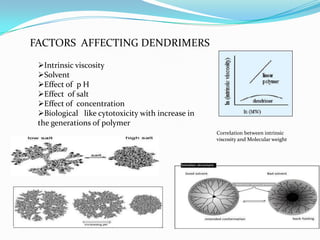
FACTORS AFFECTING DENDRIMERS

 Intrinsic viscosity
 Solvent
 Effect of p H
 Effect of salt
 Effect of concentration
 Biological like cytotoxicity with increase in
 the generations of polymer
                                                  Correlation between intrinsic
                                                  viscosity and Molecular weight
APPLICATIONS OF DENDRIMERS

PHARMACEUTICAL APPLICATIONS

Targeted And Controlled Release Drug
 Delivery
Delivery of Anticancer Drugs
                                        The encapsulation of anticancer drugs
Dendrimer As Solubility Enhancers      methotraxate (left) and 5-fluorouracil (right) into
                                        PEGylated generation 3 and 4 PAMAM dendrimers

Cellular Delivery Using Dendrimer
  Carriers

Dendrimers As Nano-Drugs

Dendrimers In Photodynamic Therapy


                                                 Cellular delivery system
Dendrimers In Gene Transfection
Dendrimers in gene therapy
Cardiac testing
Boron Neutron Capture Therapy
Dendrimers for Drug and Gene Delivery
Drug Delivery
Gene Delivery
Advancement in Gene Therapy
Dendrimers in tissue engineering


Non-Pharmaceutical Application
Diagnostics-MRI
Dendritic Catalysts / Enzymes
Metallodendritic catalysts
 Catalysis with phosphine-based dendrimers
Catalysis with (metallo)dendrimers containing chiral ligands
Non-metal containing dendrimers
Industrial Processes
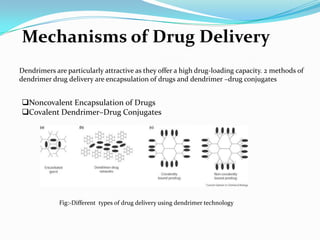
Mechanisms of Drug Delivery
Dendrimers are particularly attractive as they offer a high drug-loading capacity. 2 methods of
dendrimer drug delivery are encapsulation of drugs and dendrimer –drug conjugates


Noncovalent Encapsulation of Drugs
Covalent Dendrimer–Drug Conjugates


             Fig:-Different types of drug delivery using dendrimer technology
RECENT DEVELOPMENTS
In the field of glycodendrimers
In the field of peptide dendrimers
In the field of PAMAM dendrimers

SAFETY

Conclusion
References
1. G.R. Newkome, C.N. Moorefield and F. Vogtle Dendrimers and Dendrons:
Concepts, Syntheses, Applications, Wiley-VCH, New York (2001).

2•. G.M. Dykes , Dendrimers: a review of their appeal and applications. J Chem Technol Biotechnol 76
(2001), pp. 903–918 This review provides basic background information for readers who desire an introduction
to dendrimer chemistry. .
3: Stiriba, H. Frey and R. Haag , Dendritic polymers in biomedical applications: from potential to clinical use in
diagnostics and therapy. Angew Chem Int Ed Engl 41 (2002), pp. 1329–1334.

4. W.B. Turnbull and J.F. Stoddart , Design and synthesis of glycodendrimers. Rev Mol Biotechnol 90 (2002), pp.
231–255
5:J.J. Lundquist and E.J. Toone , The cluster glycoside effect. Chem Rev 102 (2002), pp. 555–578 Many systems
that have been reported for the study of glycocluster–, polymer– and glycodendrimer–protein interactions are
compared. The hemagglutination assay, the enzyme-linked lectin assay, isothermal titration microcalorimetry
and surface plasmon resonance are evaluated
6. N. Rockendorf and T.K. Lindhorst , Glycodendrimers. In: Dendrimers IV, Topics in Current Chemistry
217, Springer-Verlag, New York (2001), pp. 201–238
7. M. Mammen, S-K. Choi and G.M. Whitesides , Polyvalent interactions in biological systems: implications for
design and use of multivalent ligands and inhibitors. Angew Chem Int Ed Engl 37 (1998), pp. 2754–2794.

8 E.K. Woller and M.C. Cloninger , The lectin-binding properties of six generations of mannose-functionalized
dendrimers. Org Lett 4 (2002), pp. 7–10 Binding enhancements for mannose-functionalized dendrimers
relative to methyl mannose were consistent with monovalent interaction (generations 1 and 2), glycoside
clustering (generation 3), and multivalent binding generations 4–6). The wide range of activities that were
observed indicates that dendrimer systems can be fine-tuned to obtain any desired level of activity in protein–
carbohydrate interactions.
THANK YOU

Dendrimers

  • 1.
    Submitted By SAIKAT GHOSH UG-IV Under the Guidance of Dr. Ketousetuo Kuotsu Department of Pharmaceutical Technology, Jadavpur University
  • 2.
    The word Dendrimercomes from the Greek word ”DENDRON” meaning tree and “MEROS” meaning part A dendrimer is generally described as a macromolecule, which is characterized by its highly branched 3D structure that provides a high degree of surface functionality and versatility. Dendrimers have often been referred to as the “Polymers of the 21st century”. The first dendrimers were synthesised divergently by Vögtle in 1978, by Denkewalter and coworkers at Allied Corporation as polylysine dendrimers in 1981, by Donald Tomalia at Dow Chemical in 1983 and in 1985, and by Newkome in 1985. In 1990 a convergent synthesis was introduced by Jean FrechetThey called them arborols fromthe Latin word ‘arbor’ also meaning a tree.
  • 3.
    Dendrimer Designing shouldtake into consideration:- (1) Architecturing (2) Synthesis (3) Properties & Applications of the dendrimer
  • 4.
    STRUCTURE OF DENDRIMERS Dendrimersare built from a starting atom, such as nitrogen, to which carbon and other elements are added by a repeating series of chemical reactions that produce a spherical branching structure STAR BUST EFFECT:Dendrimers of lower generations- asymmetric shape and possess moreopen structures - higher generationdendrimers- globularstructure - become denselypacked - When acritical branched state is reached-cannot further grow due to lack of space-STAR BUST EFFECT Fig:STRUCTURE OF DENDRIMER
  • 5.
  • 6.
    TYPES OF DENDRIMERS PamamDendrimer  Pamamos Dendrimer Tecto Dendrimer PPI Dendrimer  Multilingual Dendrimers  Chiral Dendrimers Hybrid Dendrimer Linear Polymers Amphiphilic Dendrimers Micellar Dendrimers
  • 7.
     Multiple AntigenPeptide Dendrimers  Fréchet-Type Dendrimers Glycodendrimer Peptide dendrimer Ferrocene dendrimer Denderonised polymers Fig;GLYCODENDRIMER FIG: FERROCENE DENDRIMER FIG:PAMAM DENDRIMER
  • 8.
    Synthesis of dendrimers Monomerslead to a Monodisperse polymer, tree-like, or generational structure. There are three defined methods of dendrimer synthesis Divergent synthesis - assemble the molecule from the core, extending radially to the periphery Convergent methods-start at the surface and proceed inwards, before the attachment of pre-synthesised dendrons to the core. Double exponential and mixed growth To synthesize dendrimers repeated reaction consisting of many steps is needed to protect the active site --it is difficult even if both methods are used--obstacles to the synthesis of large quantities of dendrimers
  • 9.
    Different growth methods Divergent growth method Advantages of convergent system:- Relatively easy to purify the desired product occurrence of defects in the final structure is minimised. Possible to introduce subtle engineering into the dendritic structure by precise placement of functional groups at the periphery of the Mixed growth & double exponential macromolecules
  • 10.
    FACTORS AFFECTING DENDRIMERS Intrinsic viscosity Solvent Effect of p H Effect of salt Effect of concentration Biological like cytotoxicity with increase in the generations of polymer Correlation between intrinsic viscosity and Molecular weight
  • 11.
    APPLICATIONS OF DENDRIMERS PHARMACEUTICALAPPLICATIONS Targeted And Controlled Release Drug Delivery Delivery of Anticancer Drugs The encapsulation of anticancer drugs Dendrimer As Solubility Enhancers methotraxate (left) and 5-fluorouracil (right) into PEGylated generation 3 and 4 PAMAM dendrimers Cellular Delivery Using Dendrimer Carriers Dendrimers As Nano-Drugs Dendrimers In Photodynamic Therapy Cellular delivery system
  • 12.
    Dendrimers In GeneTransfection Dendrimers in gene therapy Cardiac testing Boron Neutron Capture Therapy Dendrimers for Drug and Gene Delivery Drug Delivery Gene Delivery Advancement in Gene Therapy Dendrimers in tissue engineering Non-Pharmaceutical Application Diagnostics-MRI Dendritic Catalysts / Enzymes Metallodendritic catalysts  Catalysis with phosphine-based dendrimers Catalysis with (metallo)dendrimers containing chiral ligands Non-metal containing dendrimers Industrial Processes
  • 13.
    Mechanisms of DrugDelivery Dendrimers are particularly attractive as they offer a high drug-loading capacity. 2 methods of dendrimer drug delivery are encapsulation of drugs and dendrimer –drug conjugates Noncovalent Encapsulation of Drugs Covalent Dendrimer–Drug Conjugates Fig:-Different types of drug delivery using dendrimer technology
  • 14.
    RECENT DEVELOPMENTS In thefield of glycodendrimers In the field of peptide dendrimers In the field of PAMAM dendrimers SAFETY Conclusion
  • 15.
    References 1. G.R. Newkome,C.N. Moorefield and F. Vogtle Dendrimers and Dendrons: Concepts, Syntheses, Applications, Wiley-VCH, New York (2001). 2•. G.M. Dykes , Dendrimers: a review of their appeal and applications. J Chem Technol Biotechnol 76 (2001), pp. 903–918 This review provides basic background information for readers who desire an introduction to dendrimer chemistry. . 3: Stiriba, H. Frey and R. Haag , Dendritic polymers in biomedical applications: from potential to clinical use in diagnostics and therapy. Angew Chem Int Ed Engl 41 (2002), pp. 1329–1334. 4. W.B. Turnbull and J.F. Stoddart , Design and synthesis of glycodendrimers. Rev Mol Biotechnol 90 (2002), pp. 231–255 5:J.J. Lundquist and E.J. Toone , The cluster glycoside effect. Chem Rev 102 (2002), pp. 555–578 Many systems that have been reported for the study of glycocluster–, polymer– and glycodendrimer–protein interactions are compared. The hemagglutination assay, the enzyme-linked lectin assay, isothermal titration microcalorimetry and surface plasmon resonance are evaluated 6. N. Rockendorf and T.K. Lindhorst , Glycodendrimers. In: Dendrimers IV, Topics in Current Chemistry 217, Springer-Verlag, New York (2001), pp. 201–238 7. M. Mammen, S-K. Choi and G.M. Whitesides , Polyvalent interactions in biological systems: implications for design and use of multivalent ligands and inhibitors. Angew Chem Int Ed Engl 37 (1998), pp. 2754–2794. 8 E.K. Woller and M.C. Cloninger , The lectin-binding properties of six generations of mannose-functionalized dendrimers. Org Lett 4 (2002), pp. 7–10 Binding enhancements for mannose-functionalized dendrimers relative to methyl mannose were consistent with monovalent interaction (generations 1 and 2), glycoside clustering (generation 3), and multivalent binding generations 4–6). The wide range of activities that were observed indicates that dendrimer systems can be fine-tuned to obtain any desired level of activity in protein– carbohydrate interactions.
  • 16.

Editor's Notes