DENDRIMERS
ARENDRA PRATAP SINGH
M.PHARMACY
CONTENTS:-
1. INTRODUCTION
2. HISTORY
3. COMPONENTS OF DENDRIMERS
4. NEED OF DENDRIMERS
5. METHODS OF SYNTHESIS
6. TYPES OF DENDRIMERS
7. CHARACTERIZATION OF DENDRIMERS POLYMERS
8. APPLICATIONS
INTRODUCTION:-
 The word “ Dendrimer” originated from two Greek words
Dendron :- meaning tree
meros :- meaning part or segment
 Dendrimers are a new class of Polymeric materials. They are highly branched
monodispers , Artificial macromolecules.
 Dendrimers may be defined as Synthetic three – dimensional hyper branched
globular macromolecules , which is characterized by its highly branched 3D
structure that provides a high degree of surface functionality .
HISTORY :-
 In 1978 Vogtle and Co – workers was First introduced chemistry of
Dendrimers.
 In 1980 , Donald Tomalia and Co – workers discovered these hyper branched
molecules were called dendrimers .
 In 1985 , Vogtle synthesized the first family of Dendrimers the First “ Cascade
molecules”.
 At the same time , Newkame’s group independently reported synthesis of
similar molecules.
 They called them arborols from the Latin word ( arbor also means “a tree”)
COMPONENTS OF DENDRIMERS:-
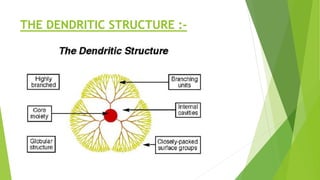
 Dendrimers contain three different components
1. An Initiator core :-
2. Interior layers :- Composed of repeating unit’s , radically attached to the
interior core (generation).
3. Exterior layer :- Attached to the outermost interior generation ( Terminal
functionality)
THE DENDRITIC STRUCTURE :-
NEED OF DENDRIMERS:-
 Nano particles , drug delivery systems are most popular one.
 However reticuloendothelial system (RES ) Uptake , drug leakage ,
immunogenicity, haemolytic toxicity, cytotoxicity, restrict the use of
nanostructures.
 These are overcome by surface engineering the Dendrimer such as Polyester
Dendrimer, Glyco – Dendrimers , PEGylated Dendrimers etc.
 The bioactive Agent Can be easily encapsulated into the interior of the
Dendrimers.
METHOD OF SYNTHESIS:-
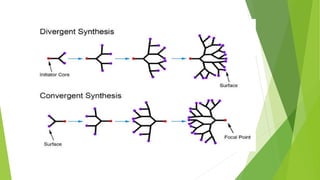
1. Divergent method
2. Convergent method
3. Hypercores & branched monomers method
4. Double Exponential and Mixed growth
5. Other accelerated growth techniques
DIVERGENT METHOD:-
 Dendrimers Starts from the central core and extends towards the surface i.e.
Diverging into space .
 Two step process .
 Activation of functional surface groups.
 Addition of branching monomer units .
 Divergent approach is successful for the production of large quantities of
Dendrimers
 It causes some difficulties in the purification of the final product
CONVERGENT METHOD:-
 Dendrimer starting from the end groups and progression inwards.
 When the growing wedges are enough large , attached to a suitable core to
give a complete Dendrimer.
 The convergent methodology also suffers from low yields in the synthesis of
large structures.
HYPERCORES & BRANCHED MONOMERS
TECHNIQUE :-
 Freechet group continued their efforts on research of hypercore & branched
monomers .
 This method involves the pre assembly of oilgomeric species, which can then
be linked together to give Dendrimer.
 These monomers allow to the design synthesis strategies that are more
convergent in classical synthesis sense of world.
DOUBLE EXPONENTIAL AND MIXED
GROWTH METHOD:-
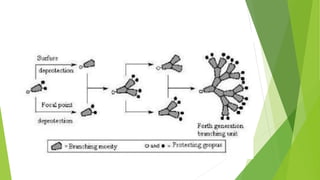
 Double Exponential growth similar to a rapid growth technique for linear
polymers , involves an AB2 monomers with orthogonal protecting groups for
the A and B functionalities .
 This approach allows the preparation of monomers for both convergent and
divergent growth from a single starting material .
 These two products are reacts together to give an orthogonally protected
trimer, which may be used to repeat the growth process again .
OTHER ACCELERATED GROWTH
TECHNIQUES:-
This is two step approach designed by fretchet .
 In this approach two different monomers are used so as to avoid the need of
an activation step between growth steps .
 The two monomeric units are AB2 & CD2 . Where A&D react to form bond
under required conditions while B&C are stable , Where B&C React to form
bond while A&D remain stable .
 In this technique the hindrance likely to be experienced is that difficulty of
Finding a set of reactions , Which conform to above criteria.
TYPES OF DENDRIMERS:-
1. PAMAM Dendrimers
2. PAMAMOS Dendrimers
3. PPI Dendrimers
4. MULTILINGUAL Dendrimers
5. CHIRAL Dendrimers
6. MICELLAR Dendrimers
7. MULTIPLE ANTIGEN PEPTIDE Dendrimers
CHARACTERIZATION OF DENDRIMERS
POLYMERS:-
1. Spectroscopy and spectrometry Methods
2. Scattering Techniques
3. Electrical Techniques
4. Size exclusion chromatography
5. Microscopy
6. Physical properties and Rheology
7. Miscellaneous
APPLICATIONS:-
1. Delivery of antycancer Drugs
2. Solubility Enhancers
3. Cellular Delivery
4. In Industrial proceses
5. Gene Transformation
6. Nano drugs
7. Diagnostics
8. As a coding agents
Dendrimers

Dendrimers

  • 1.
  • 2.
    CONTENTS:- 1. INTRODUCTION 2. HISTORY 3.COMPONENTS OF DENDRIMERS 4. NEED OF DENDRIMERS 5. METHODS OF SYNTHESIS 6. TYPES OF DENDRIMERS 7. CHARACTERIZATION OF DENDRIMERS POLYMERS 8. APPLICATIONS
  • 3.
    INTRODUCTION:-  The word“ Dendrimer” originated from two Greek words Dendron :- meaning tree meros :- meaning part or segment  Dendrimers are a new class of Polymeric materials. They are highly branched monodispers , Artificial macromolecules.  Dendrimers may be defined as Synthetic three – dimensional hyper branched globular macromolecules , which is characterized by its highly branched 3D structure that provides a high degree of surface functionality .
  • 4.
    HISTORY :-  In1978 Vogtle and Co – workers was First introduced chemistry of Dendrimers.  In 1980 , Donald Tomalia and Co – workers discovered these hyper branched molecules were called dendrimers .  In 1985 , Vogtle synthesized the first family of Dendrimers the First “ Cascade molecules”.  At the same time , Newkame’s group independently reported synthesis of similar molecules.  They called them arborols from the Latin word ( arbor also means “a tree”)
  • 5.
    COMPONENTS OF DENDRIMERS:- Dendrimers contain three different components 1. An Initiator core :- 2. Interior layers :- Composed of repeating unit’s , radically attached to the interior core (generation). 3. Exterior layer :- Attached to the outermost interior generation ( Terminal functionality)
  • 6.
  • 7.
    NEED OF DENDRIMERS:- Nano particles , drug delivery systems are most popular one.  However reticuloendothelial system (RES ) Uptake , drug leakage , immunogenicity, haemolytic toxicity, cytotoxicity, restrict the use of nanostructures.  These are overcome by surface engineering the Dendrimer such as Polyester Dendrimer, Glyco – Dendrimers , PEGylated Dendrimers etc.  The bioactive Agent Can be easily encapsulated into the interior of the Dendrimers.
  • 8.
    METHOD OF SYNTHESIS:- 1.Divergent method 2. Convergent method 3. Hypercores & branched monomers method 4. Double Exponential and Mixed growth 5. Other accelerated growth techniques
  • 9.
    DIVERGENT METHOD:-  DendrimersStarts from the central core and extends towards the surface i.e. Diverging into space .  Two step process .  Activation of functional surface groups.  Addition of branching monomer units .  Divergent approach is successful for the production of large quantities of Dendrimers  It causes some difficulties in the purification of the final product
  • 10.
    CONVERGENT METHOD:-  Dendrimerstarting from the end groups and progression inwards.  When the growing wedges are enough large , attached to a suitable core to give a complete Dendrimer.  The convergent methodology also suffers from low yields in the synthesis of large structures.
  • 12.
    HYPERCORES & BRANCHEDMONOMERS TECHNIQUE :-  Freechet group continued their efforts on research of hypercore & branched monomers .  This method involves the pre assembly of oilgomeric species, which can then be linked together to give Dendrimer.  These monomers allow to the design synthesis strategies that are more convergent in classical synthesis sense of world.
  • 13.
    DOUBLE EXPONENTIAL ANDMIXED GROWTH METHOD:-  Double Exponential growth similar to a rapid growth technique for linear polymers , involves an AB2 monomers with orthogonal protecting groups for the A and B functionalities .  This approach allows the preparation of monomers for both convergent and divergent growth from a single starting material .  These two products are reacts together to give an orthogonally protected trimer, which may be used to repeat the growth process again .
  • 15.
    OTHER ACCELERATED GROWTH TECHNIQUES:- Thisis two step approach designed by fretchet .  In this approach two different monomers are used so as to avoid the need of an activation step between growth steps .  The two monomeric units are AB2 & CD2 . Where A&D react to form bond under required conditions while B&C are stable , Where B&C React to form bond while A&D remain stable .  In this technique the hindrance likely to be experienced is that difficulty of Finding a set of reactions , Which conform to above criteria.
  • 16.
    TYPES OF DENDRIMERS:- 1.PAMAM Dendrimers 2. PAMAMOS Dendrimers 3. PPI Dendrimers 4. MULTILINGUAL Dendrimers 5. CHIRAL Dendrimers 6. MICELLAR Dendrimers 7. MULTIPLE ANTIGEN PEPTIDE Dendrimers
  • 17.
    CHARACTERIZATION OF DENDRIMERS POLYMERS:- 1.Spectroscopy and spectrometry Methods 2. Scattering Techniques 3. Electrical Techniques 4. Size exclusion chromatography 5. Microscopy 6. Physical properties and Rheology 7. Miscellaneous
  • 18.
    APPLICATIONS:- 1. Delivery ofantycancer Drugs 2. Solubility Enhancers 3. Cellular Delivery 4. In Industrial proceses 5. Gene Transformation 6. Nano drugs 7. Diagnostics 8. As a coding agents