Suprachoroidal Drug Delivery System
Presented By-
Kushal Saha
M Pharm
(Pharmaceutics)
BIT Mesra
 What is Suprachoroidal Drug Delivery System?
A novel approach currently in development is the use of
the suprachoroidal space between the sclera and choroid as a
reservoir for ophthalmic therapeutic agents. The drug dose is
injected to the suprachoroidal space, just beneath the inner surface
of sclera.
 Suprachoroidal space was first shown by Poole (1986) and later
Einmahl (2002) & Olsen (2006) also made this path popular.
 Generally given by injection in the Suprachoroidal space.
 The injection volume is small, about 50 µl and typically these
injections are given with micro-needles, though cannulation is
also possible.
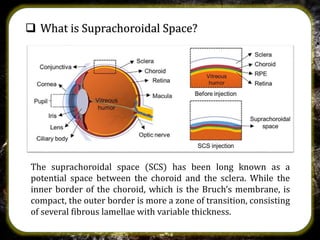
 What is Suprachoroidal Space?
The suprachoroidal space (SCS) has been long known as a
potential space between the choroid and the sclera. While the
inner border of the choroid, which is the Bruch’s membrane, is
compact, the outer border is more a zone of transition, consisting
of several fibrous lamellae with variable thickness.
Why to select Suprachoroidal Route?
By considering several limitations of traditional route of ocular delivery along
with so many advantages of suprachoroidal route we are thinking of it as a novel
drug delivery system.
So, let’s begin with limitations regarding traditional route of ocular
delivery.
Traditional routes of delivery, namely topical eye drops and intravitreal
injections, are the current gold standards used for treating ophthalmic disease.
Topical eye drops result in low bioavailability (1–7%) within the anterior
chamber of human eyes, and negligible penetration past the anterior chamber.
Thus, topical eye drops have limited applications in the management of
posterior segment diseases in humans. However, the drug diffuses isotropically
through the vitreous and can thus diffuse towards non-target regions of the eye
(e.g., lens and ciliary body), resulting in side effects. An intact blood-retinal
barrier can also impede the transport of drugs from the vitreous to the choroid
and retinal pigment epithelium.
Now let’s focus on the Advantages of Suprachoroidal route of drug
delivery.
 With suprachoroidal injection it is possible to reach wider area
around the eyeball than in the case of sub-conjuctival injection.
 Fluid flows instantaneously and posteriorly. Drug administration
in this manner, offers the unique capability of targeting a
formulation to disease sites in the choroid and adjacent retina.
 Minimally invasive and might be safer because it doesn't require
entry into the vitreous, thereby potentially protecting retina from
any injection related damage.
 It is potential to-
• Achieve high bioavailability,
• Maximize drug level in retina,
• Minimize ocular side effects like endopthalmitis, retinal
detachment and cataract formation.
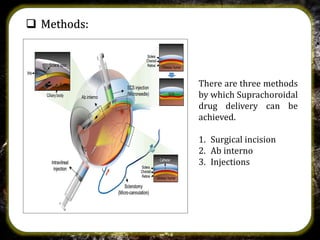
 Methods:
There are three methods
by which Suprachoroidal
drug delivery can be
achieved.
1. Surgical incision
2. Ab interno
3. Injections
 Pharmacokinetics:
 Distribution within ocular layers: Immediately after injection into
the SCS, higher levels of small molecules and macromolecules were
found in the choroidal, retinal pigment epithelium (RPE), and
retinal tissues. For this reason, long-acting formulations are
needed to enable extended drug delivery in the SCS after a single
injection.
 Circumferential distribution: Though fluid delivered into the SCS
distributes circumferentially around the eye in the SCS, it does not
typically cover the entire space due to anatomical barriers.
 Clearance:
Clearance kinetics from the SCS: Cleared within 1-12 hours from
SCS.
Clearance route from the SCS: Clearance of drug is done by
perivascular drainage routes via choroidal blood flow.
 Safety and Efficacy:
 Preclinical animal studies suggest that SCS drug delivery has a
similar or better safety profile compared with intravitreal
injections.
 Results from completed Phase I/II and II clinical trials have also
reported promising safety profiles.
 While IOP immediately after injection increased with increasing
injection volume, IOP returned to baseline within 1 h post-
injection. These IOP changes are similar to those observed with
intravitreal injections, and are not expected to cause long-term
ocular damage.
 For example, SCS delivery of hyaluronic acid resulted in retinal
atrophy in one study, however, no abnormalities were noted.
 Conclusion:
The SCS is a potential space found between the sclera and the
choroid, and has become increasingly studied as a route of
administration to treat posterior segment diseases of the eye. Due to
its close proximity to the sclera, choroid, and RPE, high
bioavailability is achievable at these tissues compared with
traditional ophthalmic drug delivery techniques. While access to the
SCS by sclerotomy and catheterization has been FDA-cleared, it is a
surgical intervention that is not in clinical use. Instead, microneedle
injection into the SCS is receiving significant attention and is
undergoing Phase III clinical trials. Noninfectious uveitis has been
the most studied indication both preclinically and in clinical trials.
Exploration of additional indications is warranted. Optimizing drug
delivery strategies and formulations are the subject of ongoing
research. In conclusion, the SCS offers a novel route of
administration to the posterior segment of the eye that offers great
promise for improved drug targeting to sites of action in sclera,
choroid and RPE.
References:
1. Progress in Retinal and Eye Research 57 (2017) 134-185
2. T.W. Olsen, X. Feng, K. Wabner, K. Csaky, S. Pambuccian, J.D. Cameron,
Pharmacokinetics of pars plana intravitreal injections versus microcannula
suprachoroidal injections of bevacizumab in a porcine model, Invest.
Ophthalmol. Vis. Sci. 52 (2011) 4749–4756.
3. Y.C. Kim, H.F. Edelhauser, M.R. Prausnitz, Targeted delivery of antiglaucoma
drugs to the supraciliary space using microneedles, Invest. Ophthalmol. Vis.
Sci. 55 (2014) 7387–7397
4. S. Einmahl, M. Savoldelli, F. D'Hermies, C. Tabatabay, R. Gurny, F. Behar-
Cohen, Evaluation of a novel biomaterial in the suprachoroidal space of the
rabbit eye, Invest. Ophthalmol. Vis. Sci. 43 (2002) 1533–1539
5. B. Chiang, K. Wang, C.R. Ethier, M.R. Prausnitz, Clearance kinetics and
clearance routes of molecules from the suprachoroidal space after
microneedle injection, Invest. Ophthalmol. Vis. Sci. 58 (2017) 545–554.
6. H. Moseley, W.S. Foulds, D. Allan, P.M. Kyle, Routes of clearance of radioactive
water from the rabbit vitreous, Br. J. Ophthalmol. 68 (1984) 145–151
7. Slean GR, Khurana, RN. Local therapeutic options for uveitic cystoid macular
edema. Int Ophthalmol Clin. 2015;55:39-61.
Suprachoroidal drug delivery system

Suprachoroidal drug delivery system

  • 1.
    Suprachoroidal Drug DeliverySystem Presented By- Kushal Saha M Pharm (Pharmaceutics) BIT Mesra
  • 3.
     What isSuprachoroidal Drug Delivery System? A novel approach currently in development is the use of the suprachoroidal space between the sclera and choroid as a reservoir for ophthalmic therapeutic agents. The drug dose is injected to the suprachoroidal space, just beneath the inner surface of sclera.  Suprachoroidal space was first shown by Poole (1986) and later Einmahl (2002) & Olsen (2006) also made this path popular.  Generally given by injection in the Suprachoroidal space.  The injection volume is small, about 50 µl and typically these injections are given with micro-needles, though cannulation is also possible.
  • 4.
     What isSuprachoroidal Space? The suprachoroidal space (SCS) has been long known as a potential space between the choroid and the sclera. While the inner border of the choroid, which is the Bruch’s membrane, is compact, the outer border is more a zone of transition, consisting of several fibrous lamellae with variable thickness.
  • 5.
    Why to selectSuprachoroidal Route? By considering several limitations of traditional route of ocular delivery along with so many advantages of suprachoroidal route we are thinking of it as a novel drug delivery system. So, let’s begin with limitations regarding traditional route of ocular delivery. Traditional routes of delivery, namely topical eye drops and intravitreal injections, are the current gold standards used for treating ophthalmic disease. Topical eye drops result in low bioavailability (1–7%) within the anterior chamber of human eyes, and negligible penetration past the anterior chamber. Thus, topical eye drops have limited applications in the management of posterior segment diseases in humans. However, the drug diffuses isotropically through the vitreous and can thus diffuse towards non-target regions of the eye (e.g., lens and ciliary body), resulting in side effects. An intact blood-retinal barrier can also impede the transport of drugs from the vitreous to the choroid and retinal pigment epithelium.
  • 6.
    Now let’s focuson the Advantages of Suprachoroidal route of drug delivery.  With suprachoroidal injection it is possible to reach wider area around the eyeball than in the case of sub-conjuctival injection.  Fluid flows instantaneously and posteriorly. Drug administration in this manner, offers the unique capability of targeting a formulation to disease sites in the choroid and adjacent retina.  Minimally invasive and might be safer because it doesn't require entry into the vitreous, thereby potentially protecting retina from any injection related damage.  It is potential to- • Achieve high bioavailability, • Maximize drug level in retina, • Minimize ocular side effects like endopthalmitis, retinal detachment and cataract formation.
  • 7.
     Methods: There arethree methods by which Suprachoroidal drug delivery can be achieved. 1. Surgical incision 2. Ab interno 3. Injections
  • 8.
     Pharmacokinetics:  Distributionwithin ocular layers: Immediately after injection into the SCS, higher levels of small molecules and macromolecules were found in the choroidal, retinal pigment epithelium (RPE), and retinal tissues. For this reason, long-acting formulations are needed to enable extended drug delivery in the SCS after a single injection.  Circumferential distribution: Though fluid delivered into the SCS distributes circumferentially around the eye in the SCS, it does not typically cover the entire space due to anatomical barriers.  Clearance: Clearance kinetics from the SCS: Cleared within 1-12 hours from SCS. Clearance route from the SCS: Clearance of drug is done by perivascular drainage routes via choroidal blood flow.
  • 9.
     Safety andEfficacy:  Preclinical animal studies suggest that SCS drug delivery has a similar or better safety profile compared with intravitreal injections.  Results from completed Phase I/II and II clinical trials have also reported promising safety profiles.  While IOP immediately after injection increased with increasing injection volume, IOP returned to baseline within 1 h post- injection. These IOP changes are similar to those observed with intravitreal injections, and are not expected to cause long-term ocular damage.  For example, SCS delivery of hyaluronic acid resulted in retinal atrophy in one study, however, no abnormalities were noted.
  • 10.
     Conclusion: The SCSis a potential space found between the sclera and the choroid, and has become increasingly studied as a route of administration to treat posterior segment diseases of the eye. Due to its close proximity to the sclera, choroid, and RPE, high bioavailability is achievable at these tissues compared with traditional ophthalmic drug delivery techniques. While access to the SCS by sclerotomy and catheterization has been FDA-cleared, it is a surgical intervention that is not in clinical use. Instead, microneedle injection into the SCS is receiving significant attention and is undergoing Phase III clinical trials. Noninfectious uveitis has been the most studied indication both preclinically and in clinical trials. Exploration of additional indications is warranted. Optimizing drug delivery strategies and formulations are the subject of ongoing research. In conclusion, the SCS offers a novel route of administration to the posterior segment of the eye that offers great promise for improved drug targeting to sites of action in sclera, choroid and RPE.
  • 11.
    References: 1. Progress inRetinal and Eye Research 57 (2017) 134-185 2. T.W. Olsen, X. Feng, K. Wabner, K. Csaky, S. Pambuccian, J.D. Cameron, Pharmacokinetics of pars plana intravitreal injections versus microcannula suprachoroidal injections of bevacizumab in a porcine model, Invest. Ophthalmol. Vis. Sci. 52 (2011) 4749–4756. 3. Y.C. Kim, H.F. Edelhauser, M.R. Prausnitz, Targeted delivery of antiglaucoma drugs to the supraciliary space using microneedles, Invest. Ophthalmol. Vis. Sci. 55 (2014) 7387–7397 4. S. Einmahl, M. Savoldelli, F. D'Hermies, C. Tabatabay, R. Gurny, F. Behar- Cohen, Evaluation of a novel biomaterial in the suprachoroidal space of the rabbit eye, Invest. Ophthalmol. Vis. Sci. 43 (2002) 1533–1539 5. B. Chiang, K. Wang, C.R. Ethier, M.R. Prausnitz, Clearance kinetics and clearance routes of molecules from the suprachoroidal space after microneedle injection, Invest. Ophthalmol. Vis. Sci. 58 (2017) 545–554. 6. H. Moseley, W.S. Foulds, D. Allan, P.M. Kyle, Routes of clearance of radioactive water from the rabbit vitreous, Br. J. Ophthalmol. 68 (1984) 145–151 7. Slean GR, Khurana, RN. Local therapeutic options for uveitic cystoid macular edema. Int Ophthalmol Clin. 2015;55:39-61.