Democratic Practices and
Inclusive Excellence
Stephan Hiroshi Gilchrist
Office of Equity, Diversity, and Inclusion
What brought you to this presentation?
What is Democratic Practice?
1. Engages diverse perspectives, explores concerns and
assumptions, transforms conflict and disagreement, and works
collaboratively to find creative solutions and constructive change
2. It is a set of principles and practices that guide how people interact
and work together every day to improve their community and to
create a more just society
3. Involves informed community members
4. Involvement in decision-making by those most likely to be affected
by the outcome
The Democracy Imperative
Democratic Practices
• Systems Thinking
• Dialogue
• Deliberation
• Conflict Transformation
Systems Thinking
Systems thinking is a way of understanding reality that
emphasizes the relationships among a system's
parts, rather than the parts themselves. It can help
you design smart, enduring solutions to problems.
Systems thinking gives you a more accurate picture
of reality. It encourages you to think about problems
and solutions with an eye toward the long view.
Pegasus Communication
Dialogue
• Dialogue is about bringing together many voices, many
stories, many perspectives, many experiences with a goal to
increase understanding about others and ourselves. It is a
safe and honest facilitated discussion aimed at providing an
opportunity to tell your story, listen to others and build
understanding. Jen Murphy, George Mason University’
• Dialogue is a foundational communication process leading directly
to personal and organizational transformation. It assists in creating
environments of high trust and openness, with reflective and
generative capacities. One might think of dialogue as
[an]…approach in the development of the following organizational
disciplines: continuous learning, diversity, conflict exploration,
decision making and problem solving, leadership, self-managing
teams, organizational planning and alignment, and culture change.
Linda Ellinor, The Dialogue Group dialogue video
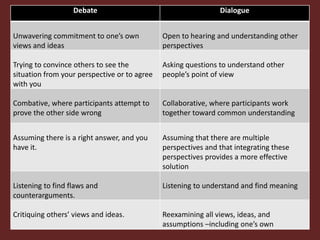
Debate Dialogue
Unwavering commitment to one’s own
views and ideas
Open to hearing and understanding other
perspectives
Trying to convince others to see the
situation from your perspective or to agree
with you
Asking questions to understand other
people’s point of view
Combative, where participants attempt to
prove the other side wrong
Collaborative, where participants work
together toward common understanding
Assuming there is a right answer, and you
have it.
Assuming that there are multiple
perspectives and that integrating these
perspectives provides a more effective
solution
Listening to find flaws and
counterarguments.
Listening to understand and find meaning
Critiquing others’ views and ideas. Reexamining all views, ideas, and
assumptions –including one’s own
Deliberation
Deliberation is a process that brings people
together to study an organizational, community,
social, or political issue. It asks it’s participants
to identify possible solutions, consider the
advantages, disadvantages, and trade-offs for
each choice, and make decisions about how an
issue should be addressed. Dialogue provides
the comprehensive and shared understanding
needed for quality deliberation and effective
decision making to occur. The Democracy Imperative
Open Space Video
Conflict Transformation
Conflict is…foremost a potential occasion for growth in two critical and
interrelated dimensions of human morality. The first dimension involves
strengthening the self. This occurs through realizing and strengthening
one’s inherent human capacity for dealing with difficulties of all kinds by
engaging in conscious and deliberate reflection, choice, and action. The
second dimension involves reaching beyond the self to relate to others.
This occurs through realizing and strengthening one’s inherent human
capacity for experiencing and expressing concern and consideration for
others, especially others whose “situation” is different from one’s own.
Conflict confronts each party with a challenge…or adversity to grapple
with. This challenge presents…the opportunity to clarify…their needs and
values, what causes them satisfaction and dissatisfaction. Bush and Folger
Skills and Knowledge
1. Intercultural communication
2. Conflict transformation
3. Deep listening, self-reflection, empathy, flexibility,
curiosity
4. Self-awareness of one’s own cultural biases,
assumptions, and preferences
5. Understanding shared human needs and interests
6. Gather relevant data for dialogue and deliberation
What Is Democratic Practice?
1. What would a democratic work environment look
like where you work currently?
2. What are the qualities that are needed?
Example: trust, transparency, reciprocity
3. What would democratic structures and processes
look like?
Where would decision be made, by whom, how?
What happens if there are different perspectives?
4. How are decisions made currently?
Resources
• National Coalition on Dialogue and Deliberation
• The Democracy Imperative
• Wisconsin Institute for Public Policy and Service
• Cooperative Extension Systems Thinking Team
• Cooperative Extension Conflict Management Team
• Colleagues in Cooperative Extension
• Office of Equity, Diversity, and Inclusion
stephan.gilchrist@uwex.uwc.edu
608-262-3049

Democratic Practices and Inclusive Excellence

  • 1.
    Democratic Practices and InclusiveExcellence Stephan Hiroshi Gilchrist Office of Equity, Diversity, and Inclusion
  • 2.
    What brought youto this presentation?
  • 4.
    What is DemocraticPractice? 1. Engages diverse perspectives, explores concerns and assumptions, transforms conflict and disagreement, and works collaboratively to find creative solutions and constructive change 2. It is a set of principles and practices that guide how people interact and work together every day to improve their community and to create a more just society 3. Involves informed community members 4. Involvement in decision-making by those most likely to be affected by the outcome The Democracy Imperative
  • 5.
    Democratic Practices • SystemsThinking • Dialogue • Deliberation • Conflict Transformation
  • 6.
    Systems Thinking Systems thinkingis a way of understanding reality that emphasizes the relationships among a system's parts, rather than the parts themselves. It can help you design smart, enduring solutions to problems. Systems thinking gives you a more accurate picture of reality. It encourages you to think about problems and solutions with an eye toward the long view. Pegasus Communication
  • 7.
    Dialogue • Dialogue isabout bringing together many voices, many stories, many perspectives, many experiences with a goal to increase understanding about others and ourselves. It is a safe and honest facilitated discussion aimed at providing an opportunity to tell your story, listen to others and build understanding. Jen Murphy, George Mason University’ • Dialogue is a foundational communication process leading directly to personal and organizational transformation. It assists in creating environments of high trust and openness, with reflective and generative capacities. One might think of dialogue as [an]…approach in the development of the following organizational disciplines: continuous learning, diversity, conflict exploration, decision making and problem solving, leadership, self-managing teams, organizational planning and alignment, and culture change. Linda Ellinor, The Dialogue Group dialogue video
  • 8.
    Debate Dialogue Unwavering commitmentto one’s own views and ideas Open to hearing and understanding other perspectives Trying to convince others to see the situation from your perspective or to agree with you Asking questions to understand other people’s point of view Combative, where participants attempt to prove the other side wrong Collaborative, where participants work together toward common understanding Assuming there is a right answer, and you have it. Assuming that there are multiple perspectives and that integrating these perspectives provides a more effective solution Listening to find flaws and counterarguments. Listening to understand and find meaning Critiquing others’ views and ideas. Reexamining all views, ideas, and assumptions –including one’s own
  • 9.
    Deliberation Deliberation is aprocess that brings people together to study an organizational, community, social, or political issue. It asks it’s participants to identify possible solutions, consider the advantages, disadvantages, and trade-offs for each choice, and make decisions about how an issue should be addressed. Dialogue provides the comprehensive and shared understanding needed for quality deliberation and effective decision making to occur. The Democracy Imperative Open Space Video
  • 10.
    Conflict Transformation Conflict is…foremosta potential occasion for growth in two critical and interrelated dimensions of human morality. The first dimension involves strengthening the self. This occurs through realizing and strengthening one’s inherent human capacity for dealing with difficulties of all kinds by engaging in conscious and deliberate reflection, choice, and action. The second dimension involves reaching beyond the self to relate to others. This occurs through realizing and strengthening one’s inherent human capacity for experiencing and expressing concern and consideration for others, especially others whose “situation” is different from one’s own. Conflict confronts each party with a challenge…or adversity to grapple with. This challenge presents…the opportunity to clarify…their needs and values, what causes them satisfaction and dissatisfaction. Bush and Folger
  • 11.
    Skills and Knowledge 1.Intercultural communication 2. Conflict transformation 3. Deep listening, self-reflection, empathy, flexibility, curiosity 4. Self-awareness of one’s own cultural biases, assumptions, and preferences 5. Understanding shared human needs and interests 6. Gather relevant data for dialogue and deliberation
  • 12.
    What Is DemocraticPractice? 1. What would a democratic work environment look like where you work currently? 2. What are the qualities that are needed? Example: trust, transparency, reciprocity 3. What would democratic structures and processes look like? Where would decision be made, by whom, how? What happens if there are different perspectives? 4. How are decisions made currently?
  • 13.
    Resources • National Coalitionon Dialogue and Deliberation • The Democracy Imperative • Wisconsin Institute for Public Policy and Service • Cooperative Extension Systems Thinking Team • Cooperative Extension Conflict Management Team • Colleagues in Cooperative Extension • Office of Equity, Diversity, and Inclusion stephan.gilchrist@uwex.uwc.edu 608-262-3049