TRENDS, NETWORKS AND CRITICAL THINKING IN
THE 21ST CENTURY
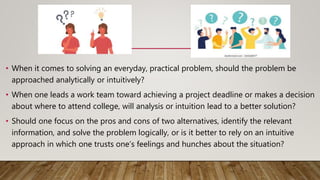
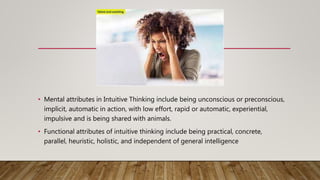
SAY SOMETHING ABOUT THE PICTURE…
• When it comes to solving an everyday, practical problem, should the problem be
approached analytically or intuitively?
• When one leads a work team toward achieving a project deadline or makes a decision
about where to attend college, will analysis or intuition lead to a better solution?
• Should one focus on the pros and cons of two alternatives, identify the relevant
information, and solve the problem logically, or is it better to rely on an intuitive
approach in which one trusts one’s feelings and hunches about the situation?
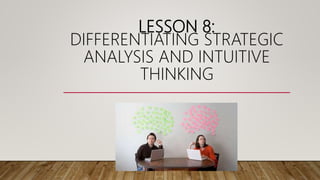
LESSON 8:
DIFFERENTIATING STRATEGIC
ANALYSIS AND INTUITIVE
THINKING
SOME FACTS TO DIFFERENTIATE STRATEGIC ANALYSIS FROM
INTUITIVE THINKING
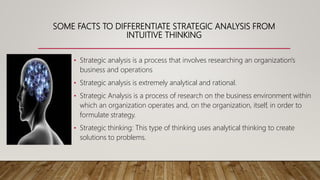
• Strategic analysis is a process that involves researching an organization's
business and operations
• Strategic analysis is extremely analytical and rational.
• Strategic Analysis is a process of research on the business environment within
which an organization operates and, on the organization, itself, in order to
formulate strategy.
• Strategic thinking: This type of thinking uses analytical thinking to create
solutions to problems.
• Analytical thinking: This is simply the act of breaking down data into useful
information.
• Mental attributes of Strategic Analysis include being conscious, explicit, in control,
with high effort but slow on action, rational, reflective, and uniquely humans.
• Functional attributes include being analytical, theoretical, sequential, rule-based,
analytical and is linked to general intelligence.
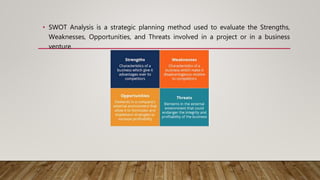
• SWOT Analysis is a strategic planning method used to evaluate the Strengths,
Weaknesses, Opportunities, and Threats involved in a project or in a business
venture.
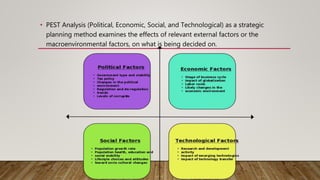
• PEST Analysis (Political, Economic, Social, and Technological) as a strategic
planning method examines the effects of relevant external factors or the
macroenvironmental factors, on what is being decided on.
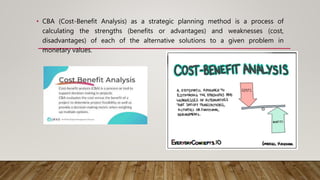
• CBA (Cost-Benefit Analysis) as a strategic planning method is a process of
calculating the strengths (benefits or advantages) and weaknesses (cost,
disadvantages) of each of the alternative solutions to a given problem in
monetary values.
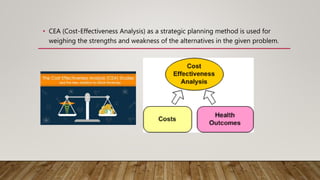
• CEA (Cost-Effectiveness Analysis) as a strategic planning method is used for
weighing the strengths and weakness of the alternatives in the given problem.
• SEU Analysis (Subjective Expected Utility) is a strategic planning method which
examines a Decision Theory, the discipline that provides a rational framework for
choosing between alternative courses of action when the consequences resulting
from the choice are imperfectly known.
• Intuitive thinking is a feeling (a sense) that doesn't use rational processes such as
facts and data.
• Intuitive thinking: It's more of an instinct or immediate reaction. Typically, no
'thinking' is involved.
• Intuitive thinking has contrasting qualities: it is unfocused, nonlinear, contains
"no time," sees many things at once, views the big picture, contains perspective, is
heart centered, oriented in space and time, and tends to the real or concrete.
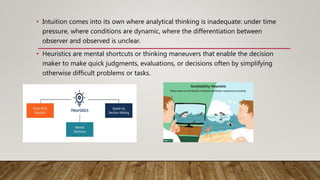
• Intuition comes into its own where analytical thinking is inadequate: under time
pressure, where conditions are dynamic, where the differentiation between
observer and observed is unclear.
• Heuristics are mental shortcuts or thinking maneuvers that enable the decision
maker to make quick judgments, evaluations, or decisions often by simplifying
otherwise difficult problems or tasks.
• Mental attributes in Intuitive Thinking include being unconscious or preconscious,
implicit, automatic in action, with low effort, rapid or automatic, experiential,
impulsive and is being shared with animals.
• Functional attributes of intuitive thinking include being practical, concrete,
parallel, heuristic, holistic, and independent of general intelligence
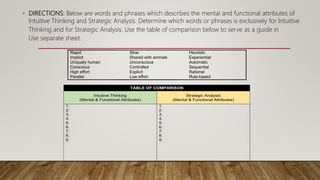
• DIRECTIONS: Below are words and phrases which describes the mental and functional attributes of
Intuitive Thinking and Strategic Analysis. Determine which words or phrases is exclusively for Intuitive
Thinking and for Strategic Analysis. Use the table of comparison below to serve as a guide in
Use separate sheet.
Rapid Slow Heuristic
Implicit Shared with animals Experiential
Uniquely human Unconscious Automatic
Conscious Controlled Sequential
High effort Explicit Rational
Parallel Low effort Rule-based
TABLE OF COMPARISON
Intuitive Thinking
(Mental & Functional Attributes)
Strategic Analysis
(Mental & Functional Attributes)
1. 1.
2. 2.
3. 3.
4. 4.
5. 5.
6. 6.
7. 7.
8. 8.
9. 9.
•Thank you for listening! 
REFERRENCES:
• Anderson, James A. (1995). An Introduction to Neural Networks. Cambridge,
Massachusetts: MIT Press.
•
• Carolan, Brian V (2014). Social Network Analysis and Education: Theory, Methods
and Applications.
• Los Angeles, London, New Delhi: Sage.
• Haykin, Simon(1999). Neural Networks: A Comprehensive Foundation. New
Jersey: Prentice Hall International, Inc.

Trends Lesson 8 Strategic Planning.pptx

  • 1.
    TRENDS, NETWORKS ANDCRITICAL THINKING IN THE 21ST CENTURY
  • 2.
    SAY SOMETHING ABOUTTHE PICTURE…
  • 3.
    • When itcomes to solving an everyday, practical problem, should the problem be approached analytically or intuitively? • When one leads a work team toward achieving a project deadline or makes a decision about where to attend college, will analysis or intuition lead to a better solution? • Should one focus on the pros and cons of two alternatives, identify the relevant information, and solve the problem logically, or is it better to rely on an intuitive approach in which one trusts one’s feelings and hunches about the situation?
  • 4.
  • 5.
    SOME FACTS TODIFFERENTIATE STRATEGIC ANALYSIS FROM INTUITIVE THINKING • Strategic analysis is a process that involves researching an organization's business and operations • Strategic analysis is extremely analytical and rational. • Strategic Analysis is a process of research on the business environment within which an organization operates and, on the organization, itself, in order to formulate strategy. • Strategic thinking: This type of thinking uses analytical thinking to create solutions to problems.
  • 6.
    • Analytical thinking:This is simply the act of breaking down data into useful information. • Mental attributes of Strategic Analysis include being conscious, explicit, in control, with high effort but slow on action, rational, reflective, and uniquely humans. • Functional attributes include being analytical, theoretical, sequential, rule-based, analytical and is linked to general intelligence.
  • 7.
    • SWOT Analysisis a strategic planning method used to evaluate the Strengths, Weaknesses, Opportunities, and Threats involved in a project or in a business venture.
  • 8.
    • PEST Analysis(Political, Economic, Social, and Technological) as a strategic planning method examines the effects of relevant external factors or the macroenvironmental factors, on what is being decided on.
  • 9.
    • CBA (Cost-BenefitAnalysis) as a strategic planning method is a process of calculating the strengths (benefits or advantages) and weaknesses (cost, disadvantages) of each of the alternative solutions to a given problem in monetary values.
  • 10.
    • CEA (Cost-EffectivenessAnalysis) as a strategic planning method is used for weighing the strengths and weakness of the alternatives in the given problem.
  • 11.
    • SEU Analysis(Subjective Expected Utility) is a strategic planning method which examines a Decision Theory, the discipline that provides a rational framework for choosing between alternative courses of action when the consequences resulting from the choice are imperfectly known.
  • 12.
    • Intuitive thinkingis a feeling (a sense) that doesn't use rational processes such as facts and data. • Intuitive thinking: It's more of an instinct or immediate reaction. Typically, no 'thinking' is involved. • Intuitive thinking has contrasting qualities: it is unfocused, nonlinear, contains "no time," sees many things at once, views the big picture, contains perspective, is heart centered, oriented in space and time, and tends to the real or concrete.
  • 13.
    • Intuition comesinto its own where analytical thinking is inadequate: under time pressure, where conditions are dynamic, where the differentiation between observer and observed is unclear. • Heuristics are mental shortcuts or thinking maneuvers that enable the decision maker to make quick judgments, evaluations, or decisions often by simplifying otherwise difficult problems or tasks.
  • 14.
    • Mental attributesin Intuitive Thinking include being unconscious or preconscious, implicit, automatic in action, with low effort, rapid or automatic, experiential, impulsive and is being shared with animals. • Functional attributes of intuitive thinking include being practical, concrete, parallel, heuristic, holistic, and independent of general intelligence
  • 15.
    • DIRECTIONS: Beloware words and phrases which describes the mental and functional attributes of Intuitive Thinking and Strategic Analysis. Determine which words or phrases is exclusively for Intuitive Thinking and for Strategic Analysis. Use the table of comparison below to serve as a guide in Use separate sheet. Rapid Slow Heuristic Implicit Shared with animals Experiential Uniquely human Unconscious Automatic Conscious Controlled Sequential High effort Explicit Rational Parallel Low effort Rule-based TABLE OF COMPARISON Intuitive Thinking (Mental & Functional Attributes) Strategic Analysis (Mental & Functional Attributes) 1. 1. 2. 2. 3. 3. 4. 4. 5. 5. 6. 6. 7. 7. 8. 8. 9. 9.
  • 16.
    •Thank you forlistening! 
  • 17.
    REFERRENCES: • Anderson, JamesA. (1995). An Introduction to Neural Networks. Cambridge, Massachusetts: MIT Press. • • Carolan, Brian V (2014). Social Network Analysis and Education: Theory, Methods and Applications. • Los Angeles, London, New Delhi: Sage. • Haykin, Simon(1999). Neural Networks: A Comprehensive Foundation. New Jersey: Prentice Hall International, Inc.