DIALOGIC ORGANIZATION DEVELOPMENT
1. INOC-Meeting, May 29-30, 2015 in Wiesloch, Germany
MICHAEL ROEHRIG
ORGANIZATION DEVELOPMENT RELOADED
1. Some useful Frameworks about
Leading / Enabling Change
2. Dialogic Organization Development:
A New Generative Image
3. Amplifying Change:
Organizing for “Planned Emergence”
MICHAEL ROEHRIG
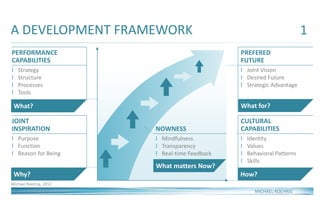
A DEVELOPMENT FRAMEWORK
PERFORMANCE
CAPABILITIES
l Strategy
l Structure
l Processes
l Tools
Michael Roehrig, 2012
What?
JOINT
INSPIRATION
l Purpose
l Function
l Reason for Being
Why?
PREFERED
FUTURE
l Joint Vision
l Desired Future
l Strategic Advantage
What for?
CULTURAL
CAPABILITIES
l Identity
l Values
l Behavioral Patterns
l Skills
How?
MICHAEL ROEHRIG
What matters Now?
NOWNESS
l Mindfulness
l Transparency
l Real-time Feedback
1
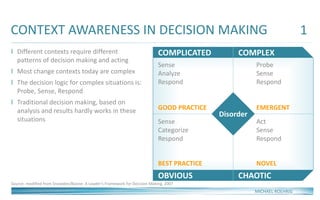
CONTEXT AWARENESS IN DECISION MAKING
MICHAEL ROEHRIG
l Different contexts require different
patterns of decision making and acting
l Most change contexts today are complex
l The decision logic for complex situations is:
Probe, Sense, Respond
l Traditional decision making, based on
analysis and results hardly works in these
situations
COMPLICATED COMPLEX
OBVIOUS CHAOTIC
Sense
Analyze
Respond
Probe
Sense
Respond
Sense
Categorize
Respond
Act
Sense
Respond
GOOD PRACTICE EMERGENT
BEST PRACTICE NOVEL
Disorder
Source: modified from Snowden/Boone: A Leader‘s Framework for Decision Making, 2007
1
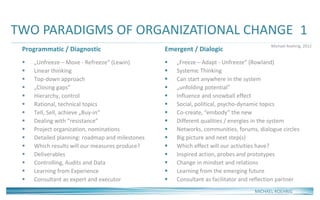
TWO PARADIGMS OF ORGANIZATIONAL CHANGE
MICHAEL ROEHRIG
Programmatic / Diagnostic
 „Unfreeze – Move - Refreeze“ (Lewin)
 Linear thinking
 Top-down approach
 „Closing gaps”
 Hierarchy, control
 Rational, technical topics
 Tell, Sell, achieve „Buy-in“
 Dealing with “resistance”
 Project organization, nominations
 Detailed planning: roadmap and milestones
 Which results will our measures produce?
 Deliverables
 Controlling, Audits and Data
 Learning from Experience
 Consultant as expert and executor
Emergent / Dialogic
 „Freeze – Adapt - Unfreeze“ (Rowland)
 Systemic Thinking
 Can start anywhere in the system
 „unfolding potential”
 Influence and snowball effect
 Social, political, psycho-dynamic topics
 Co-create, “embody” the new
 Different qualities / energies in the system
 Networks, communities, forums, dialogue circles
 Big picture and next step(s)
 Which effect will our activities have?
 Inspired action, probes and prototypes
 Change in mindset and relations
 Learning from the emerging future
 Consultant as facilitator and reflection partner
Michael Roehrig, 2012
1
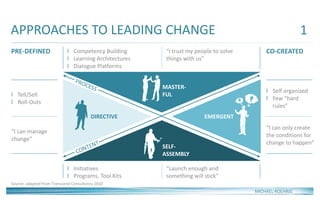
APPROACHES TO LEADING CHANGE
CO-CREATEDPRE-DEFINED
l Initiatives
l Programs, Tool Kits
l Self organized
l Few “hard
rules”
l Competency Building
l Learning Architectures
l Dialogue Platforms
l Tell/Sell
l Roll-Outs
“I can manage
change”
“Launch enough and
something will stick”
“I can only create
the conditions for
change to happen”
“I trust my people to solve
things with us”
Source: adapted from Transcend Consultancy 2010
DIRECTIVE EMERGENT
SELF-
ASSEMBLY
MASTER-
FUL
MICHAEL ROEHRIG
1
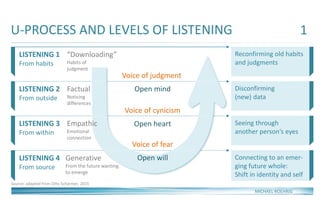
U-PROCESS AND LEVELS OF LISTENING
Voice of fear
Open will
Voice of cynicism
Open heart
Voice of judgment
Open mindLISTENING 2
From outside
Disconfirming
(new) data
“Downloading”
Habits of
judgment
Reconfirming old habits
and judgments
Factual
Noticing
differences
LISTENING 3
From within
Empathic
Emotional
connection
LISTENING 1
From habits
LISTENING 4
From source
Generative
From the future wanting
to emerge
Source: adapted from Otto Scharmer, 2015
Seeing through
another person‘s eyes
Connecting to an emer-
ging future whole:
Shift in identity and self
MICHAEL ROEHRIG
1
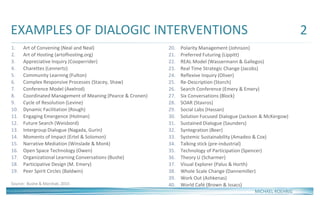
EXAMPLES OF DIALOGIC INTERVENTIONS
MICHAEL ROEHRIG
1. Art of Convening (Neal and Neal)
2. Art of Hosting (artofhosting.org)
3. Appreciative Inquiry (Cooperrider)
4. Charettes (Lennertz)
5. Community Learning (Fulton)
6. Complex Responsive Processes (Stacey, Shaw)
7. Conference Model (Axelrod)
8. Coordinated Management of Meaning (Pearce & Cronen)
9. Cycle of Resolution (Levine)
10. Dynamic Facilitation (Rough)
11. Engaging Emergence (Holman)
12. Future Search (Weisbord)
13. Intergroup Dialogue (Nagada, Gurin)
14. Moments of Impact (Ertel & Solomon)
15. Narrative Mediation (Winslade & Monk)
16. Open Space Technology (Owen)
17. Organizational Learning Conversations (Bushe)
18. Participative Design (M. Emery)
19. Peer Spirit Circles (Baldwin)
20. Polarity Management (Johnson)
21. Preferred Futuring (Lippitt)
22. REAL Model (Wassermann & Gallegos)
23. Real Time Strategic Change (Jacobs)
24. Reflexive Inquiry (Oliver)
25. Re-Description (Storch)
26. Search Conference (Emery & Emery)
27. Six Conversations (Block)
28. SOAR (Stavros)
29. Social Labs (Hassan)
30. Solution Focused Dialogue (Jackson & McKergow)
31. Sustained Dialogue (Saunders)
32. Syntegration (Beer)
33. Systemic Sustainability (Amadeo & Cox)
34. Talking stick (pre-industrial)
35. Technology of Participation (Spencer)
36. Theory U (Scharmer)
37. Visual Explorer (Palus & Horth)
38. Whole Scale Change (Dannemiller)
39. Work Out (Ashkenas)
40. World Café (Brown & Issacs)Source: Bushe & Marshak, 2015
2
Source: modified from Bushe & Marshak, 2015
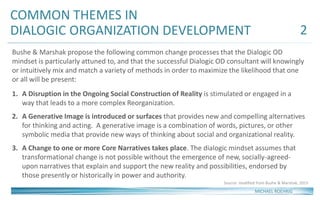
COMMON THEMES IN
DIALOGIC ORGANIZATION DEVELOPMENT
Bushe & Marshak propose the following common change processes that the Dialogic OD
mindset is particularly attuned to, and that the successful Dialogic OD consultant will knowingly
or intuitively mix and match a variety of methods in order to maximize the likelihood that one
or all will be present:
1. A Disruption in the Ongoing Social Construction of Reality is stimulated or engaged in a
way that leads to a more complex Reorganization.
2. A Generative Image is introduced or surfaces that provides new and compelling alternatives
for thinking and acting. A generative image is a combination of words, pictures, or other
symbolic media that provide new ways of thinking about social and organizational reality.
3. A Change to one or more Core Narratives takes place. The dialogic mindset assumes that
transformational change is not possible without the emergence of new, socially-agreed-
upon narratives that explain and support the new reality and possibilities, endorsed by
those presently or historically in power and authority.
2
MICHAEL ROEHRIG
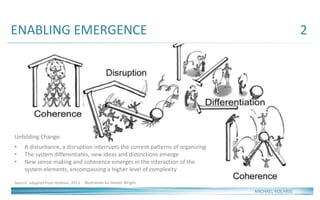
ENABLING EMERGENCE
Unfolding Change:
• A disturbance, a disruption interrupts the current patterns of organizing
• The system differentiates, new ideas and distinctions emerge
• New sense making and coherence emerges in the interaction of the
system elements, encompassing a higher level of complexity
Source: adapted from Holman, 2013
2
MICHAEL ROEHRIG
Illustration by Steven Wright
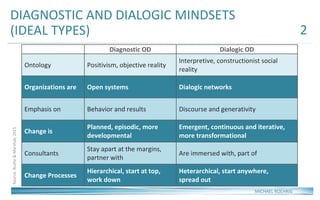
DIAGNOSTIC AND DIALOGIC MINDSETS
(IDEAL TYPES)
Diagnostic OD Dialogic OD
Ontology Positivism, objective reality
Interpretive, constructionist social
reality
Organizations are Open systems Dialogic networks
Emphasis on Behavior and results Discourse and generativity
Change is
Planned, episodic, more
developmental
Emergent, continuous and iterative,
more transformational
Consultants
Stay apart at the margins,
partner with
Are immersed with, part of
Change Processes
Hierarchical, start at top,
work down
Heterarchical, start anywhere,
spread out
Source:Bushe&Marshak,2015
2
MICHAEL ROEHRIG
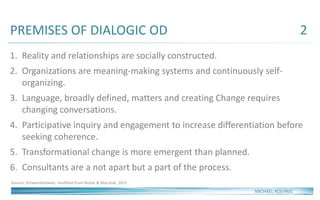
PREMISES OF DIALOGIC OD
1. Reality and relationships are socially constructed.
2. Organizations are meaning-making systems and continuously self-
organizing.
3. Language, broadly defined, matters and creating Change requires
changing conversations.
4. Participative inquiry and engagement to increase differentiation before
seeking coherence.
5. Transformational change is more emergent than planned.
6. Consultants are a not apart but a part of the process.
Source: Schwendenwein, modified from Bushe & Marshak, 2015
2
MICHAEL ROEHRIG
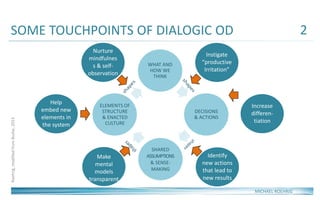
SOME TOUCHPOINTS OF DIALOGIC OD
Roehrig,modifiedfromBushe,2013
2
WHAT AND
HOW WE
THINK
DECISIONS
& ACTIONS
SHARED
ASSUMPTIONS
& SENSE-
MAKING
ELEMENTS OF
STRUCTURE
& ENACTED
CULTURE
A
Generative
Image
Increase
differen-
tiation
Identify
new actions
that lead to
new results
Help
embed new
elements in
the system
Instigate
“productive
Irritation”
Nurture
mindfulnes
s & self-
observation
Make
mental
models
transparent
MICHAEL ROEHRIG
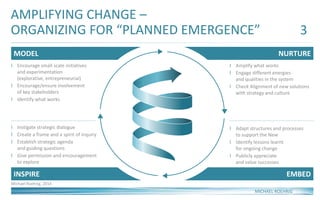
AMPLIFYING CHANGE –
ORGANIZING FOR “PLANNED EMERGENCE”
Michael Roehrig, 2014
MICHAEL ROEHRIG
INSPIRE
l Instigate strategic dialogue
l Create a frame and a spirit of inquiry
l Establish strategic agenda
and guiding questions
l Give permission and encouragement
to explore
MODEL
l Encourage small scale initiatives
and experimentation
(explorative, entrepreneurial)
l Encourage/ensure involvement
of key stakeholders
l Identify what works
NURTURE
l Amplify what works
l Engage different energies
and qualities in the system
l Check Alignment of new solutions
with strategy and culture
EMBED
l Adapt structures and processes
to support the New
l Identify lessons learnt
for ongoing change
l Publicly appreciate
and value successes
3
IMPLICATIONS
MICHAEL ROEHRIG
 What resonates in you? Agreement? Doubts? News? Empathy?
Generative seeds?
 What qualities of leadership in organizations would this approach require?
 How would we arrange change processes? What would be different?
 How can we ensure broad involvement and engagement?
 Which organizational design, which governance is needed if change is the
new normal?
 How can Coaching help in this?
REFERENCES
MICHAEL ROEHRIG
• Bushe, Gervase R. & Marshak; Robert J.:
Dialogic Organization Development - The Theory and Practice of Transformational Change, 2015
• Bushe, Gervase R. & Marshak; Robert J.: Dialogic Organization Development in: Jones, B. & Brazzel, M. (eds): The
NTL Handbook of Organization Development, 2nd Ed., 2013
• Forchhammer, Lorenz S. & Straub, Walter: Verändern – Change Praxis für Entscheider und Führungskräfte, 2013
(Unternehmensentwicklung im Korridor)
• Holman, Peggy: A Call to Engage in: OD Practitioner, Winter 2013, Vol. 45, No. 1
• Rowland, Deborah & Higgs, Malcolm: Sustaining Change – Leadership that Works, 2008
• Scharmer, C. Otto & Käufer, Katrin: Leading from the Emerging Future – From Ego-System to Eco-System
Economies, 2013
• Scharmer, C. Otto: Theory U – Leading from the Future as it Emerges, 2009
• Snowden, D. & Boone, M.: A Leader‘s Framework for Decision Making, in: Harvard Business Review, November
2007
Get in touch: www.michaelroehrig.de (website currently available in German)

1. INOC Meeting - Dialogic Organization Development

  • 1.
    DIALOGIC ORGANIZATION DEVELOPMENT 1.INOC-Meeting, May 29-30, 2015 in Wiesloch, Germany MICHAEL ROEHRIG
  • 2.
    ORGANIZATION DEVELOPMENT RELOADED 1.Some useful Frameworks about Leading / Enabling Change 2. Dialogic Organization Development: A New Generative Image 3. Amplifying Change: Organizing for “Planned Emergence” MICHAEL ROEHRIG
  • 3.
    A DEVELOPMENT FRAMEWORK PERFORMANCE CAPABILITIES lStrategy l Structure l Processes l Tools Michael Roehrig, 2012 What? JOINT INSPIRATION l Purpose l Function l Reason for Being Why? PREFERED FUTURE l Joint Vision l Desired Future l Strategic Advantage What for? CULTURAL CAPABILITIES l Identity l Values l Behavioral Patterns l Skills How? MICHAEL ROEHRIG What matters Now? NOWNESS l Mindfulness l Transparency l Real-time Feedback 1
  • 4.
    CONTEXT AWARENESS INDECISION MAKING MICHAEL ROEHRIG l Different contexts require different patterns of decision making and acting l Most change contexts today are complex l The decision logic for complex situations is: Probe, Sense, Respond l Traditional decision making, based on analysis and results hardly works in these situations COMPLICATED COMPLEX OBVIOUS CHAOTIC Sense Analyze Respond Probe Sense Respond Sense Categorize Respond Act Sense Respond GOOD PRACTICE EMERGENT BEST PRACTICE NOVEL Disorder Source: modified from Snowden/Boone: A Leader‘s Framework for Decision Making, 2007 1
  • 5.
    TWO PARADIGMS OFORGANIZATIONAL CHANGE MICHAEL ROEHRIG Programmatic / Diagnostic  „Unfreeze – Move - Refreeze“ (Lewin)  Linear thinking  Top-down approach  „Closing gaps”  Hierarchy, control  Rational, technical topics  Tell, Sell, achieve „Buy-in“  Dealing with “resistance”  Project organization, nominations  Detailed planning: roadmap and milestones  Which results will our measures produce?  Deliverables  Controlling, Audits and Data  Learning from Experience  Consultant as expert and executor Emergent / Dialogic  „Freeze – Adapt - Unfreeze“ (Rowland)  Systemic Thinking  Can start anywhere in the system  „unfolding potential”  Influence and snowball effect  Social, political, psycho-dynamic topics  Co-create, “embody” the new  Different qualities / energies in the system  Networks, communities, forums, dialogue circles  Big picture and next step(s)  Which effect will our activities have?  Inspired action, probes and prototypes  Change in mindset and relations  Learning from the emerging future  Consultant as facilitator and reflection partner Michael Roehrig, 2012 1
  • 6.
    APPROACHES TO LEADINGCHANGE CO-CREATEDPRE-DEFINED l Initiatives l Programs, Tool Kits l Self organized l Few “hard rules” l Competency Building l Learning Architectures l Dialogue Platforms l Tell/Sell l Roll-Outs “I can manage change” “Launch enough and something will stick” “I can only create the conditions for change to happen” “I trust my people to solve things with us” Source: adapted from Transcend Consultancy 2010 DIRECTIVE EMERGENT SELF- ASSEMBLY MASTER- FUL MICHAEL ROEHRIG 1
  • 7.
    U-PROCESS AND LEVELSOF LISTENING Voice of fear Open will Voice of cynicism Open heart Voice of judgment Open mindLISTENING 2 From outside Disconfirming (new) data “Downloading” Habits of judgment Reconfirming old habits and judgments Factual Noticing differences LISTENING 3 From within Empathic Emotional connection LISTENING 1 From habits LISTENING 4 From source Generative From the future wanting to emerge Source: adapted from Otto Scharmer, 2015 Seeing through another person‘s eyes Connecting to an emer- ging future whole: Shift in identity and self MICHAEL ROEHRIG 1
  • 8.
    EXAMPLES OF DIALOGICINTERVENTIONS MICHAEL ROEHRIG 1. Art of Convening (Neal and Neal) 2. Art of Hosting (artofhosting.org) 3. Appreciative Inquiry (Cooperrider) 4. Charettes (Lennertz) 5. Community Learning (Fulton) 6. Complex Responsive Processes (Stacey, Shaw) 7. Conference Model (Axelrod) 8. Coordinated Management of Meaning (Pearce & Cronen) 9. Cycle of Resolution (Levine) 10. Dynamic Facilitation (Rough) 11. Engaging Emergence (Holman) 12. Future Search (Weisbord) 13. Intergroup Dialogue (Nagada, Gurin) 14. Moments of Impact (Ertel & Solomon) 15. Narrative Mediation (Winslade & Monk) 16. Open Space Technology (Owen) 17. Organizational Learning Conversations (Bushe) 18. Participative Design (M. Emery) 19. Peer Spirit Circles (Baldwin) 20. Polarity Management (Johnson) 21. Preferred Futuring (Lippitt) 22. REAL Model (Wassermann & Gallegos) 23. Real Time Strategic Change (Jacobs) 24. Reflexive Inquiry (Oliver) 25. Re-Description (Storch) 26. Search Conference (Emery & Emery) 27. Six Conversations (Block) 28. SOAR (Stavros) 29. Social Labs (Hassan) 30. Solution Focused Dialogue (Jackson & McKergow) 31. Sustained Dialogue (Saunders) 32. Syntegration (Beer) 33. Systemic Sustainability (Amadeo & Cox) 34. Talking stick (pre-industrial) 35. Technology of Participation (Spencer) 36. Theory U (Scharmer) 37. Visual Explorer (Palus & Horth) 38. Whole Scale Change (Dannemiller) 39. Work Out (Ashkenas) 40. World Café (Brown & Issacs)Source: Bushe & Marshak, 2015 2
  • 9.
    Source: modified fromBushe & Marshak, 2015 COMMON THEMES IN DIALOGIC ORGANIZATION DEVELOPMENT Bushe & Marshak propose the following common change processes that the Dialogic OD mindset is particularly attuned to, and that the successful Dialogic OD consultant will knowingly or intuitively mix and match a variety of methods in order to maximize the likelihood that one or all will be present: 1. A Disruption in the Ongoing Social Construction of Reality is stimulated or engaged in a way that leads to a more complex Reorganization. 2. A Generative Image is introduced or surfaces that provides new and compelling alternatives for thinking and acting. A generative image is a combination of words, pictures, or other symbolic media that provide new ways of thinking about social and organizational reality. 3. A Change to one or more Core Narratives takes place. The dialogic mindset assumes that transformational change is not possible without the emergence of new, socially-agreed- upon narratives that explain and support the new reality and possibilities, endorsed by those presently or historically in power and authority. 2 MICHAEL ROEHRIG
  • 10.
    ENABLING EMERGENCE Unfolding Change: •A disturbance, a disruption interrupts the current patterns of organizing • The system differentiates, new ideas and distinctions emerge • New sense making and coherence emerges in the interaction of the system elements, encompassing a higher level of complexity Source: adapted from Holman, 2013 2 MICHAEL ROEHRIG Illustration by Steven Wright
  • 11.
    DIAGNOSTIC AND DIALOGICMINDSETS (IDEAL TYPES) Diagnostic OD Dialogic OD Ontology Positivism, objective reality Interpretive, constructionist social reality Organizations are Open systems Dialogic networks Emphasis on Behavior and results Discourse and generativity Change is Planned, episodic, more developmental Emergent, continuous and iterative, more transformational Consultants Stay apart at the margins, partner with Are immersed with, part of Change Processes Hierarchical, start at top, work down Heterarchical, start anywhere, spread out Source:Bushe&Marshak,2015 2 MICHAEL ROEHRIG
  • 12.
    PREMISES OF DIALOGICOD 1. Reality and relationships are socially constructed. 2. Organizations are meaning-making systems and continuously self- organizing. 3. Language, broadly defined, matters and creating Change requires changing conversations. 4. Participative inquiry and engagement to increase differentiation before seeking coherence. 5. Transformational change is more emergent than planned. 6. Consultants are a not apart but a part of the process. Source: Schwendenwein, modified from Bushe & Marshak, 2015 2 MICHAEL ROEHRIG
  • 13.
    SOME TOUCHPOINTS OFDIALOGIC OD Roehrig,modifiedfromBushe,2013 2 WHAT AND HOW WE THINK DECISIONS & ACTIONS SHARED ASSUMPTIONS & SENSE- MAKING ELEMENTS OF STRUCTURE & ENACTED CULTURE A Generative Image Increase differen- tiation Identify new actions that lead to new results Help embed new elements in the system Instigate “productive Irritation” Nurture mindfulnes s & self- observation Make mental models transparent MICHAEL ROEHRIG
  • 14.
    AMPLIFYING CHANGE – ORGANIZINGFOR “PLANNED EMERGENCE” Michael Roehrig, 2014 MICHAEL ROEHRIG INSPIRE l Instigate strategic dialogue l Create a frame and a spirit of inquiry l Establish strategic agenda and guiding questions l Give permission and encouragement to explore MODEL l Encourage small scale initiatives and experimentation (explorative, entrepreneurial) l Encourage/ensure involvement of key stakeholders l Identify what works NURTURE l Amplify what works l Engage different energies and qualities in the system l Check Alignment of new solutions with strategy and culture EMBED l Adapt structures and processes to support the New l Identify lessons learnt for ongoing change l Publicly appreciate and value successes 3
  • 15.
    IMPLICATIONS MICHAEL ROEHRIG  Whatresonates in you? Agreement? Doubts? News? Empathy? Generative seeds?  What qualities of leadership in organizations would this approach require?  How would we arrange change processes? What would be different?  How can we ensure broad involvement and engagement?  Which organizational design, which governance is needed if change is the new normal?  How can Coaching help in this?
  • 16.
    REFERENCES MICHAEL ROEHRIG • Bushe,Gervase R. & Marshak; Robert J.: Dialogic Organization Development - The Theory and Practice of Transformational Change, 2015 • Bushe, Gervase R. & Marshak; Robert J.: Dialogic Organization Development in: Jones, B. & Brazzel, M. (eds): The NTL Handbook of Organization Development, 2nd Ed., 2013 • Forchhammer, Lorenz S. & Straub, Walter: Verändern – Change Praxis für Entscheider und Führungskräfte, 2013 (Unternehmensentwicklung im Korridor) • Holman, Peggy: A Call to Engage in: OD Practitioner, Winter 2013, Vol. 45, No. 1 • Rowland, Deborah & Higgs, Malcolm: Sustaining Change – Leadership that Works, 2008 • Scharmer, C. Otto & Käufer, Katrin: Leading from the Emerging Future – From Ego-System to Eco-System Economies, 2013 • Scharmer, C. Otto: Theory U – Leading from the Future as it Emerges, 2009 • Snowden, D. & Boone, M.: A Leader‘s Framework for Decision Making, in: Harvard Business Review, November 2007 Get in touch: www.michaelroehrig.de (website currently available in German)