Team member
Ritwik Sharma 90
Pratik Patel 62
 Founded by: Michael Dell (CEO) in 1984.
 The company is well known for its innovations in supply chain
management .
 Dell is selling computer systems directly to customers. This direct
business model eliminates retailers that add unnecessary time and
cost, or can diminish Dell's understanding of customer
expectations.
 Round Rock, TX, United States of America
 The direct model allows the company to build every
system to order and offer customers powerful, richly-
configured systems at competitive prices
PRODUCTS:-
 Laptop, Servers, Data Storage Devices, Network
Switches, Software, and Computer peripherals.
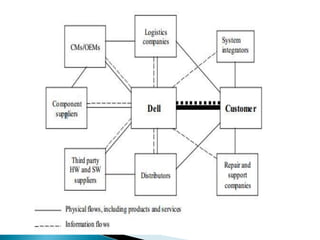
 There are more than 65 supplier for Dell
 Some of the suppliers
◦ Logitech
◦ NVIDIA
◦ Compeq
◦ Coolit System
◦ Delta Product
◦ Pegatron
◦ Alpha and Omega
 Dell choose it supplier carefully and if those
supplier don’t keep up, they are out
 Dell goes for bigger supplier
 There message is clear: Dell ways or the
highway
 Dell’s new and improved design for a channel distribution model:
 Order processing
 Pre-production
 Accessories ready
 Configuration
 Test
 Boxing
 Distribution preparations
 Shipping(transportation)
 Optimize inbound and outbound
transportation networks
 Collaborate with the best logistics
and transportation providers
 Mode of transportation –
 By Ship
 By Rail
 By Air
 “GREEN” INITIATIVES
 Dell has competitive advantage of lowest in the Industry cost
structure, and this cost Structure due in part to DELL raw
materials management strategy.
e-VMI(Vendor management inventory) and JIT combination of
management techniques
 Increasingly zero inventory. Dell receives the exact material
every two hours to fulfill actual customer orders.
 Dell’s factories have only 7 hrs worth of inventory .
 The original parts are directly sent to the assembly line
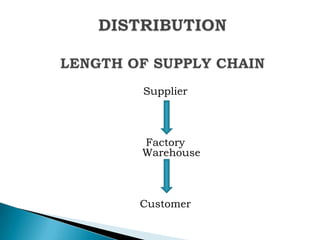
Supplier
Factory
Warehouse
Customer
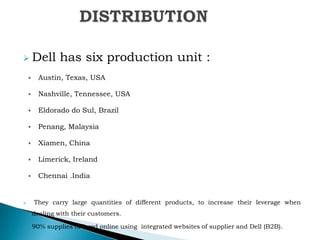
 Dell has six production unit :
 Austin, Texas, USA
 Nashville, Tennessee, USA
 Eldorado do Sul, Brazil
 Penang, Malaysia
 Xiamen, China
 Limerick, Ireland
 Chennai .India
 They carry large quantities of different products, to increase their leverage when
dealing with their customers.
 90% supplies ordered online using integrated websites of supplier and Dell (B2B).
 Virtual integration
 Innovation on the assembly floor
 Disintermediation (cutting out the middleman)
 Enhancing customer value
 CASH: Dell maintains a negative cash conversion cycle
means the payment receive for product before it has to
pay for material.
 COST: Dell’s direct sales and build-to-order model has
achieved superior performance in the PC industry in
terms of inventory turnover, reduced overhead, cash
conversion, and return on investment
 Bypassing the reseller channel that causes further cost
reduction to company.
 CRM: Direct customer relationship is the key to Dell’s
business model .
 DEMAND FORECAST: Dell additional advantages is try
to forecast demand and ship products based on those
forecasts.
 Tailored offerings from Dell in terms of add-
on products and services.
 Very customizable systems at an affordable
rate, since Dell manufacturing builds
specifically for each customer.
 Dell demand price cut form the component
supplier
 Dell - Take the Money and Run
 Dell shares fell more than 30 percent over the
five years before the company announced its
sale plans in February
 Entering the server business
 Dell’s problems caused due to faulty chips on its
computers
 Product problem (Power supply)
 Dell’s Price Fixing Claims Against Display Panel
Suppliers
 Worker Dispute Halts Production at Chinese
Electronics Plant
 Different suppliers and partners involved, the location
decisions of these companies naturally vary by company
and location
 Many parts and components are manufactured in Asia
and shipped to distribution centers near Dell facilities
 This is usually the case for hard disk drives, floppy drives,
power supplies, CD-ROM drives, cables and connectors,
and many add-on cards such as modems, sound cards
and video cards
 Fullerton -- a Scottish company from Glenrothes that
does work for Dell and for IBM in Raleigh, NC;
 Lightening Beech - a U.S. company that supplies
sheet metal;
 Trend Tec--a company that does metal and plastics
in the U.S. and serves Dell and Compaq; and APW,
which bought two Irish companies and does chassis,
plastics, and metal
 For some specific components and peripherals, the locations are as
follows:
◦ Monitors- Europe and Asia (Phillips, Nokia, Samsung, Sony,
Acer)
◦ PCBs- Asia, Scotland, and Eastern Europe (SCI, Celestica)
◦ Drives- Asia, mainly Singapore (Seagate, Maxtor, Western Digital)
◦ Printers- Europe (Barcelona)
◦ Box -builds Asia and Eastern Europe (Hon Hai/Foxteq)
◦ Chassis- Asia and Ireland (Hon Hai/Foxteq)
 First, Dell requires that suppliers locate material
within a specified delivery time from its assembly
plants.
 Asian suppliers (and U.S. suppliers producing in
Asia, such as disk drive makers) maintain supply
hubs near Dell assembly plants worldwide,
where material is pulled as it is needed for
production.
 Second Dell requires that its suppliers
continually reduce the price they are
charging Dell;
 In exchange it agrees to reward these
suppliers with larger orders and longer-term
contracts
 Third Dell requires that suppliers have
adequate inventory to supply the needs of its
direct, build-to-order production model
 Dell makes extensive use of outsourcing, but
claims it will never outsource the final
assembly of configure-to-order products
 Dell only entered the PC business in 1985, it has become
a global company with global production networks
spanning the three major world regions
 Dell has organized its operations by region and by country
 Headquarters offices, assembly production and call
centers are centralized within each region (although not all
in the same country),
 whereas sales, service and support are decentralized to
individual countries.
Dell distribution

Dell distribution

  • 1.
    Team member Ritwik Sharma90 Pratik Patel 62
  • 2.
     Founded by:Michael Dell (CEO) in 1984.  The company is well known for its innovations in supply chain management .  Dell is selling computer systems directly to customers. This direct business model eliminates retailers that add unnecessary time and cost, or can diminish Dell's understanding of customer expectations.  Round Rock, TX, United States of America
  • 3.
     The directmodel allows the company to build every system to order and offer customers powerful, richly- configured systems at competitive prices PRODUCTS:-  Laptop, Servers, Data Storage Devices, Network Switches, Software, and Computer peripherals.
  • 4.
     There aremore than 65 supplier for Dell  Some of the suppliers ◦ Logitech ◦ NVIDIA ◦ Compeq ◦ Coolit System ◦ Delta Product ◦ Pegatron ◦ Alpha and Omega
  • 5.
     Dell chooseit supplier carefully and if those supplier don’t keep up, they are out  Dell goes for bigger supplier  There message is clear: Dell ways or the highway
  • 6.
     Dell’s newand improved design for a channel distribution model:  Order processing  Pre-production  Accessories ready  Configuration  Test  Boxing  Distribution preparations  Shipping(transportation)
  • 7.
     Optimize inboundand outbound transportation networks  Collaborate with the best logistics and transportation providers  Mode of transportation –  By Ship  By Rail  By Air  “GREEN” INITIATIVES
  • 8.
     Dell hascompetitive advantage of lowest in the Industry cost structure, and this cost Structure due in part to DELL raw materials management strategy. e-VMI(Vendor management inventory) and JIT combination of management techniques  Increasingly zero inventory. Dell receives the exact material every two hours to fulfill actual customer orders.  Dell’s factories have only 7 hrs worth of inventory .  The original parts are directly sent to the assembly line
  • 9.
  • 11.
     Dell hassix production unit :  Austin, Texas, USA  Nashville, Tennessee, USA  Eldorado do Sul, Brazil  Penang, Malaysia  Xiamen, China  Limerick, Ireland  Chennai .India  They carry large quantities of different products, to increase their leverage when dealing with their customers.  90% supplies ordered online using integrated websites of supplier and Dell (B2B).
  • 12.
     Virtual integration Innovation on the assembly floor  Disintermediation (cutting out the middleman)  Enhancing customer value
  • 13.
     CASH: Dellmaintains a negative cash conversion cycle means the payment receive for product before it has to pay for material.  COST: Dell’s direct sales and build-to-order model has achieved superior performance in the PC industry in terms of inventory turnover, reduced overhead, cash conversion, and return on investment
  • 14.
     Bypassing thereseller channel that causes further cost reduction to company.  CRM: Direct customer relationship is the key to Dell’s business model .  DEMAND FORECAST: Dell additional advantages is try to forecast demand and ship products based on those forecasts.
  • 15.
     Tailored offeringsfrom Dell in terms of add- on products and services.  Very customizable systems at an affordable rate, since Dell manufacturing builds specifically for each customer.
  • 16.
     Dell demandprice cut form the component supplier  Dell - Take the Money and Run  Dell shares fell more than 30 percent over the five years before the company announced its sale plans in February
  • 17.
     Entering theserver business  Dell’s problems caused due to faulty chips on its computers  Product problem (Power supply)  Dell’s Price Fixing Claims Against Display Panel Suppliers  Worker Dispute Halts Production at Chinese Electronics Plant
  • 18.
     Different suppliersand partners involved, the location decisions of these companies naturally vary by company and location  Many parts and components are manufactured in Asia and shipped to distribution centers near Dell facilities  This is usually the case for hard disk drives, floppy drives, power supplies, CD-ROM drives, cables and connectors, and many add-on cards such as modems, sound cards and video cards
  • 19.
     Fullerton --a Scottish company from Glenrothes that does work for Dell and for IBM in Raleigh, NC;  Lightening Beech - a U.S. company that supplies sheet metal;  Trend Tec--a company that does metal and plastics in the U.S. and serves Dell and Compaq; and APW, which bought two Irish companies and does chassis, plastics, and metal
  • 20.
     For somespecific components and peripherals, the locations are as follows: ◦ Monitors- Europe and Asia (Phillips, Nokia, Samsung, Sony, Acer) ◦ PCBs- Asia, Scotland, and Eastern Europe (SCI, Celestica) ◦ Drives- Asia, mainly Singapore (Seagate, Maxtor, Western Digital) ◦ Printers- Europe (Barcelona) ◦ Box -builds Asia and Eastern Europe (Hon Hai/Foxteq) ◦ Chassis- Asia and Ireland (Hon Hai/Foxteq)
  • 21.
     First, Dellrequires that suppliers locate material within a specified delivery time from its assembly plants.  Asian suppliers (and U.S. suppliers producing in Asia, such as disk drive makers) maintain supply hubs near Dell assembly plants worldwide, where material is pulled as it is needed for production.
  • 22.
     Second Dellrequires that its suppliers continually reduce the price they are charging Dell;  In exchange it agrees to reward these suppliers with larger orders and longer-term contracts
  • 23.
     Third Dellrequires that suppliers have adequate inventory to supply the needs of its direct, build-to-order production model  Dell makes extensive use of outsourcing, but claims it will never outsource the final assembly of configure-to-order products
  • 24.
     Dell onlyentered the PC business in 1985, it has become a global company with global production networks spanning the three major world regions  Dell has organized its operations by region and by country  Headquarters offices, assembly production and call centers are centralized within each region (although not all in the same country),  whereas sales, service and support are decentralized to individual countries.