
Dell 
- Alika Koshy 
Aman Sawhney 
Ribhu Vashishtha
Dell 
 Dell has been the industry leader in direct 
sale of PC to consumers. 
 Since its start 
 simplify its business for its customers. 
 huge range of products and services, which 
can all be accessed by the consumers from 
home or from the office very easily.
Supply chain management 
Revolutionized the way people buy computers. 
 Markets its direct sales model. 
 No intermediaries 
 No warehousing 
 No physical store presence 
Eliminated the need for central warehousing 
 Saves money and time. 
 Sales 
 Production 
 Warehousing
The supply chain of Dell includes 
 The customer 
 Dell’s website 
 Dell assembly plant 
 Dell’s suppliers 
 Their suppliers
Types of supply chain 
 Pull process (Reactive process) 
 Push process(Speculative process)
Process cycle of dell 
 Customer order and manufacturing cycle 
–Pull Process 
 Procurement cycle –Push process
Drivers of supply chain 
 Facilities : Low facility cost 
 Inventory:Low inventory costs 
 Transportation:High transportation costs 
 Information:high information cost
Distribution in Supply Chain 
 Distribution refers to steps taken to move 
and store a product 
 From supplier stage to customer stage in 
supply chain
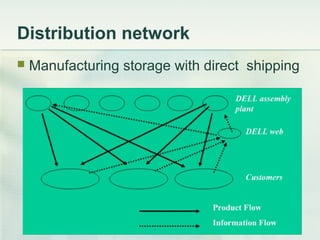
Distribution network 
 Manufacturing storage with direct shipping
Distribution network 
 Manufacturing storage with direct shipping 
and intransit merge
Business Model 
 Combination of three things: 
A. Direct Sales 
B. Build to order 
C. Supplier Integration
Direct Sales 
 A direct sales system allows DELL to: 
 Cut Costs 
 Develop exactly what customers want 
 Build relationships with customers
Build to Order 
 A build to order system allows DELL to: 
 Increase inventory velocity 
 Minimize inventory cost 
 Minimize the need for forecasting 
 Build exactly that its customer wants
Supplier Integration 
 Supplier integration allows DELL to 
maximize the benefit of its other core 
competencies 
 How? 
 Location of Supplier warehouses 
 Extranet 
 Meeting with suppliers
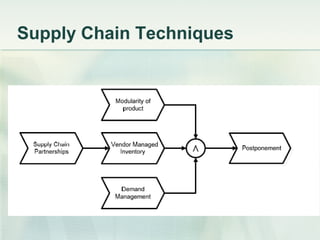
Supply Chain Techniques
Postponement 
 Build-to-Order Strategy used 
 Product assembly begins after order received 
from customer and credit cleared 
 Allows for customization. Results in shorter lead 
time. 
 Dell has 3-4 days of finished inventory as 
compared to 30-45 days for most of its 
competitors
Modularity 
 Organization of complex products by 
decomposing it into smaller portions that can be 
managed independently. 
 Slots available within CPU casing to fit different 
types of components from various suppliers 
 Large number of product variations possible 
 Also assists the reverse supply chain by ease in 
breaking down components
Vendor Managed Inventory 
 Supplier to focus on part innovation and 
Dell to concentrate on customers and 
supply chain 
 Inventory replenished 3 times a week 
 Forecast information shared by Dell with 
vendors to ensure timely supply 
 Inventory held in small warehouses near 
Dell plants called “Revolvers”
Demand Management 
 Direct Selling enables real-time 
collaboration and synchronization between 
sales and manufacturing 
 Eg: When inventory for a component runs low, 
Dell runs a promotion on another substitute part 
of equal or greater quality. This helps shift 
customer demand from standard ordering 
patterns
Thank You !! 
Alika Koshy 
Ribhu Vashishtha 
Aman Sawhney

Dell

  • 1.
    Dell - AlikaKoshy Aman Sawhney Ribhu Vashishtha
  • 2.
    Dell  Dellhas been the industry leader in direct sale of PC to consumers.  Since its start  simplify its business for its customers.  huge range of products and services, which can all be accessed by the consumers from home or from the office very easily.
  • 3.
    Supply chain management Revolutionized the way people buy computers.  Markets its direct sales model.  No intermediaries  No warehousing  No physical store presence Eliminated the need for central warehousing  Saves money and time.  Sales  Production  Warehousing
  • 4.
    The supply chainof Dell includes  The customer  Dell’s website  Dell assembly plant  Dell’s suppliers  Their suppliers
  • 5.
    Types of supplychain  Pull process (Reactive process)  Push process(Speculative process)
  • 6.
    Process cycle ofdell  Customer order and manufacturing cycle –Pull Process  Procurement cycle –Push process
  • 7.
    Drivers of supplychain  Facilities : Low facility cost  Inventory:Low inventory costs  Transportation:High transportation costs  Information:high information cost
  • 8.
    Distribution in SupplyChain  Distribution refers to steps taken to move and store a product  From supplier stage to customer stage in supply chain
  • 9.
    Distribution network Manufacturing storage with direct shipping
  • 10.
    Distribution network Manufacturing storage with direct shipping and intransit merge
  • 11.
    Business Model Combination of three things: A. Direct Sales B. Build to order C. Supplier Integration
  • 12.
    Direct Sales A direct sales system allows DELL to:  Cut Costs  Develop exactly what customers want  Build relationships with customers
  • 13.
    Build to Order  A build to order system allows DELL to:  Increase inventory velocity  Minimize inventory cost  Minimize the need for forecasting  Build exactly that its customer wants
  • 14.
    Supplier Integration Supplier integration allows DELL to maximize the benefit of its other core competencies  How?  Location of Supplier warehouses  Extranet  Meeting with suppliers
  • 15.
  • 16.
    Postponement  Build-to-OrderStrategy used  Product assembly begins after order received from customer and credit cleared  Allows for customization. Results in shorter lead time.  Dell has 3-4 days of finished inventory as compared to 30-45 days for most of its competitors
  • 17.
    Modularity  Organizationof complex products by decomposing it into smaller portions that can be managed independently.  Slots available within CPU casing to fit different types of components from various suppliers  Large number of product variations possible  Also assists the reverse supply chain by ease in breaking down components
  • 18.
    Vendor Managed Inventory  Supplier to focus on part innovation and Dell to concentrate on customers and supply chain  Inventory replenished 3 times a week  Forecast information shared by Dell with vendors to ensure timely supply  Inventory held in small warehouses near Dell plants called “Revolvers”
  • 19.
    Demand Management Direct Selling enables real-time collaboration and synchronization between sales and manufacturing  Eg: When inventory for a component runs low, Dell runs a promotion on another substitute part of equal or greater quality. This helps shift customer demand from standard ordering patterns
  • 20.
    Thank You !! Alika Koshy Ribhu Vashishtha Aman Sawhney

Editor's Notes

  • #4 Dell eliminated the need for central warehousing as well as the need for a physical store presence. Instead Dell attracts customers to its site and then builds bonds with them there rather than investing in a physical relationship.