DELL COMPUTER CORPORATIONS
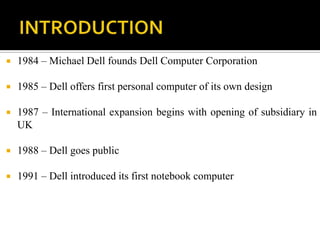
   1984 – Michael Dell founds Dell Computer Corporation

   1985 – Dell offers first personal computer of its own design

   1987 – International expansion begins with opening of subsidiary in
    UK

   1988 – Dell goes public

   1991 – Dell introduced its first notebook computer
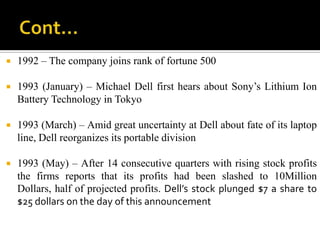
   1992 – The company joins rank of fortune 500

   1993 (January) – Michael Dell first hears about Sony’s Lithium Ion
    Battery Technology in Tokyo

   1993 (March) – Amid great uncertainty at Dell about fate of its laptop
    line, Dell reorganizes its portable division

   1993 (May) – After 14 consecutive quarters with rising stock profits
    the firms reports that its profits had been slashed to 10Million
    Dollars, half of projected profits. Dell’s stock plunged $7 a share to
    $25 dollars on the day of this announcement
   1993 (August) – Market decisions are made about new laptop
    computer line

   1993 (Oct.) – Dell recalls 17,000 discontinued notebooks after 3
    machines were returned by owners reporting such technical problems
    as smoke or melted spots
   The company focused on selling customized
    products directly via e-mail
   Dell serviced its customers with combination of
    home based telephone representatives & field
    based representatives
   Dell assured product quality by extensively pre-
    testing all the configuration options it offered
   A 24hours telephone support system comprising
    well-trained technical representatives provided the
    first post shipment level of support
   Dell maintained a month’s worth of
    component inventory, but its suppliers
    generally carried supplemental buffer stock
    that could be immediately shipped
   By creating close, correlated relationships
    with its suppliers, vendors, and third party
    maintenance providers- customers were
    dealing with one large, well-run company
   Through its strategy, the company hoped to achieve what Michael
    Dell called "virtual integration"—a stitching together of Dell's
    business with its supply partners and customers in real time such that
    all three appeared to be part of the same organizational team

   Dell’s strategy was based on:
     Market leadership as a result of a persistent focus on delivering the best possible
      customer experience. Direct selling, from manufacturing to consumer, was a key
      component of its strategy

     Its reputation as one of the world’s most preferred computer systems companies
      and       a      premier provider    of      products     and      services
      that customers worldwide needed to build their information-technology and
      internet infrastructure
   CORE ELEMENTS:
     Build-to-order manufacturing
     Mass customization
     Partnerships with suppliers
     Just-in-time components inventories
     Direct sales
     Market segmentation
     Customer service
     Extensive data & information sharing with both supply partners and customers
Dell redesigning PC industry value chain as a tool in developing
  competitive advantage based on:
   Cost advantage: This was done in three areas. Component purchase costs,
    inventory costs and selling and administrative costs

   Customer knowledge advantage: Dell understood consumer needs and efficiently
    met those needs by selling computer systems directly to customers. The direct
    business model eliminated retailers, who added unnecessary time and cost, and
    shipped directly from its factories to end customers. It took orders for hardware and
    software over the phone or via the internet. Dell designed an integrated supply
    chain linking Dell’s suppliers very closely to its assembly factories and order-intake
    system. Dell outsourced all components but performed assembly
   Technology advantage: Dell custom-built its machines after
    receiving an order instead of making machines for inventory in
    anticipation of orders. Dell introduced the latest relevant
    technology much more quickly than companies with slow
    moving inventories; turning Dell to become the number-one
    retailer of PC, outselling IBM and Hewlett-Packard

   IBM and Hewlett-Packard

   Dell moved into IT portfolio; it moved into servers, and storage,
    mobility products, and also challenged Printer leader HP
   Performance                                                           Measures:
    Dell’s scorecard included both financial measures (such as ROIC,
    component purchasing costs, selling and administration costs) and non-
    financial measures(component inventory stock outs, finished goods inventory, A/R
    day and A/P days)

   Localised decision making system: Dell used its structure as a flat organization as
    a competitive advantage and localized its decision-making. If an issue did
    not require a higher up’s attention, then decision would be made without involving
    him. This would not have been possible in companies bogged down by layers of
    bureaucracy.

   Business unit Performance: In 1993, Dell developed a set of metrics to judge
    business-unit performance

   Expedited the assembly process: Dell recognized early the need for speed, or
    velocity, quickening the pace at pace at every step of business

Dellcomputercorporation

  • 1.
  • 2.
    1984 – Michael Dell founds Dell Computer Corporation  1985 – Dell offers first personal computer of its own design  1987 – International expansion begins with opening of subsidiary in UK  1988 – Dell goes public  1991 – Dell introduced its first notebook computer
  • 3.
    1992 – The company joins rank of fortune 500  1993 (January) – Michael Dell first hears about Sony’s Lithium Ion Battery Technology in Tokyo  1993 (March) – Amid great uncertainty at Dell about fate of its laptop line, Dell reorganizes its portable division  1993 (May) – After 14 consecutive quarters with rising stock profits the firms reports that its profits had been slashed to 10Million Dollars, half of projected profits. Dell’s stock plunged $7 a share to $25 dollars on the day of this announcement
  • 4.
    1993 (August) – Market decisions are made about new laptop computer line  1993 (Oct.) – Dell recalls 17,000 discontinued notebooks after 3 machines were returned by owners reporting such technical problems as smoke or melted spots
  • 5.
    The company focused on selling customized products directly via e-mail  Dell serviced its customers with combination of home based telephone representatives & field based representatives  Dell assured product quality by extensively pre- testing all the configuration options it offered  A 24hours telephone support system comprising well-trained technical representatives provided the first post shipment level of support
  • 6.
    Dell maintained a month’s worth of component inventory, but its suppliers generally carried supplemental buffer stock that could be immediately shipped  By creating close, correlated relationships with its suppliers, vendors, and third party maintenance providers- customers were dealing with one large, well-run company
  • 7.
    Through its strategy, the company hoped to achieve what Michael Dell called "virtual integration"—a stitching together of Dell's business with its supply partners and customers in real time such that all three appeared to be part of the same organizational team  Dell’s strategy was based on:  Market leadership as a result of a persistent focus on delivering the best possible customer experience. Direct selling, from manufacturing to consumer, was a key component of its strategy  Its reputation as one of the world’s most preferred computer systems companies and a premier provider of products and services that customers worldwide needed to build their information-technology and internet infrastructure
  • 8.
    CORE ELEMENTS:  Build-to-order manufacturing  Mass customization  Partnerships with suppliers  Just-in-time components inventories  Direct sales  Market segmentation  Customer service  Extensive data & information sharing with both supply partners and customers
  • 9.
    Dell redesigning PCindustry value chain as a tool in developing competitive advantage based on:  Cost advantage: This was done in three areas. Component purchase costs, inventory costs and selling and administrative costs  Customer knowledge advantage: Dell understood consumer needs and efficiently met those needs by selling computer systems directly to customers. The direct business model eliminated retailers, who added unnecessary time and cost, and shipped directly from its factories to end customers. It took orders for hardware and software over the phone or via the internet. Dell designed an integrated supply chain linking Dell’s suppliers very closely to its assembly factories and order-intake system. Dell outsourced all components but performed assembly
  • 10.
    Technology advantage: Dell custom-built its machines after receiving an order instead of making machines for inventory in anticipation of orders. Dell introduced the latest relevant technology much more quickly than companies with slow moving inventories; turning Dell to become the number-one retailer of PC, outselling IBM and Hewlett-Packard  IBM and Hewlett-Packard  Dell moved into IT portfolio; it moved into servers, and storage, mobility products, and also challenged Printer leader HP
  • 11.
    Performance Measures: Dell’s scorecard included both financial measures (such as ROIC, component purchasing costs, selling and administration costs) and non- financial measures(component inventory stock outs, finished goods inventory, A/R day and A/P days)  Localised decision making system: Dell used its structure as a flat organization as a competitive advantage and localized its decision-making. If an issue did not require a higher up’s attention, then decision would be made without involving him. This would not have been possible in companies bogged down by layers of bureaucracy.  Business unit Performance: In 1993, Dell developed a set of metrics to judge business-unit performance  Expedited the assembly process: Dell recognized early the need for speed, or velocity, quickening the pace at pace at every step of business