By-
Nisha Dmello (14)
Disha Gupta (20)
Anirudh Jindal (22)
Vishnu Manasa
Kanchiraju (25)
Divya Kaul (27)
Sayoni Maitra (31)
ON THE AGENDA
•Brand Definition
•Unilever
- Category Management Strategy
- Brand Management Strategy
- Why does Unilever want fewer brands?
•Evolution of Brand ‘Dove’
- Dove: POP & POD
- Product Launch
- What compelled Dove to go for CFRB
•Dove’s market positioning in the 1950’s
•Dove’s market positioning in 2007
- The CBBE Model
- BRAND DYNAMICS OF DOVE
- Marketing Strategy
•‘We The PEOPLE’
- USER’s Verdict : MILDNESS IS THE KEY
•Conflicting brand image
•Risks to the brand today
UNILEVER’S CATEGORY MANAGEMENT STRATEGY
Then
 World’s largest producer but lacked a unified global identity.
 Brands managed in a decentralized fashion
 Years of slow performance
 Lack of sound corporate strategy
 Numerous low-volume brands
 Small global presence compared to competition
 Mediocre performance in emerging markets
Now
 Reduce portfolio to 400 “core” brands
 Path to growth Initiative (Brand building and brand development – separate
functions)
 Concentrate on product innovation to fuel internal growth
 An initiative to create an overall umbrella brand across all Unilever’s brands
WHY DOES UNILEVER WANT FEWER BRANDS?
 Global decentralization brought problems of control.
 Company’s brand portfolio had grown is a relatively laissez-faire
manner.
 Unilever lacked a global identity.
 Product categories had checkered identities.
 Embarked on a 5 year strategic initiative “Path to Growth”:
- Winnowing 1600 brands down to 400.
- Selected “Masterbrands”,
mandate to serve as umbrella identities
over a range of product forms.
- Global brand unit for each “Masterbrand”
EVOLUTION OF A BRAND
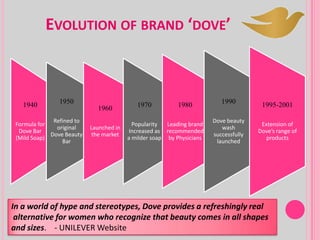
EVOLUTION OF BRAND ‘DOVE’
1940
Formula for
Dove Bar
(Mild Soap)
1950
Refined to
original
Dove Beauty
Bar
1960
Launched in
the market
1970
Popularity
Increased as
a milder soap
1980
Leading brand
recommended
by Physicians
1990
Dove beauty
wash
successfully
launched
1995-2001
Extension of
Dove’s range of
products
In a world of hype and stereotypes, Dove provides a refreshingly real
alternative for women who recognize that beauty comes in all shapes
and sizes. - UNILEVER Website
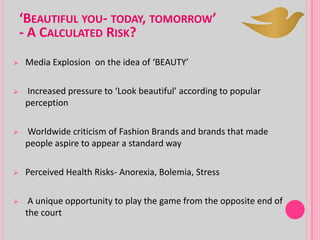
‘BEAUTIFUL YOU- TODAY, TOMORROW’
- A CALCULATED RISK?
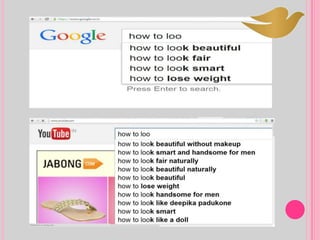
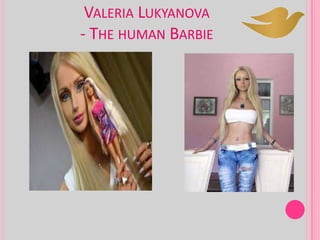
 Media Explosion on the idea of ‘BEAUTY’
 Increased pressure to ‘Look beautiful’ according to popular
perception
 Worldwide criticism of Fashion Brands and brands that made
people aspire to appear a standard way
 Perceived Health Risks- Anorexia, Bolemia, Stress
 A unique opportunity to play the game from the opposite end of
the court
VALERIA LUKYANOVA
- THE HUMAN BARBIE
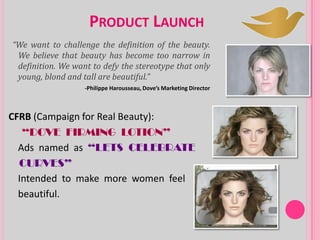
PRODUCT LAUNCH
“We want to challenge the definition of the beauty.
We believe that beauty has become too narrow in
definition. We want to defy the stereotype that only
young, blond and tall are beautiful.”
-Philippe Harousseau, Dove’s Marketing Director
CFRB (Campaign for Real Beauty):
“DOVE FIRMING LOTION”
Ads named as “LETS CELEBRATE
CURVES”
Intended to make more women feel
beautiful.
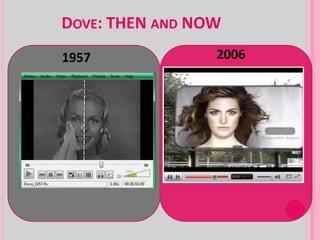
1957
DOVE: THEN AND NOW
2006
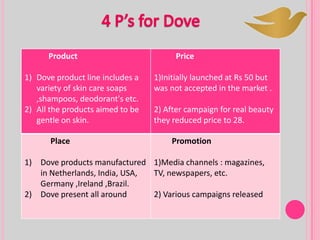
Product
1) Dove product line includes a
variety of skin care soaps
,shampoos, deodorant's etc.
2) All the products aimed to be
gentle on skin.
Price
1)Initially launched at Rs 50 but
was not accepted in the market .
2) After campaign for real beauty
they reduced price to 28.
Place
1) Dove products manufactured
in Netherlands, India, USA,
Germany ,Ireland ,Brazil.
2) Dove present all around
Promotion
1)Media channels : magazines,
TV, newspapers, etc.
2) Various campaigns released
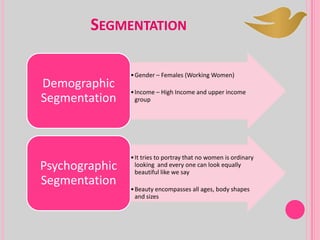
SEGMENTATION
•Gender – Females (Working Women)
•Income – High Income and upper income
group
Demographic
Segmentation
•It tries to portray that no women is ordinary
looking and every one can look equally
beautiful like we say
•Beauty encompasses all ages, body shapes
and sizes
Psychographic
Segmentation
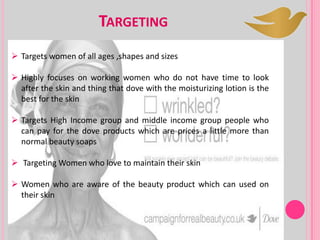
 Targets women of all ages ,shapes and sizes
 Highly focuses on working women who do not have time to look
after the skin and thing that dove with the moisturizing lotion is the
best for the skin
 Targets High Income group and middle income group people who
can pay for the dove products which are prices a little more than
normal beauty soaps
 Targeting Women who love to maintain their skin
 Women who are aware of the beauty product which can used on
their skin
TARGETING
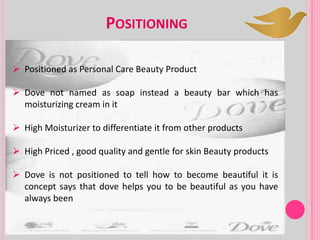
POSITIONING
 Positioned as Personal Care Beauty Product
 Dove not named as soap instead a beauty bar which has
moisturizing cream in it
 High Moisturizer to differentiate it from other products
 High Priced , good quality and gentle for skin Beauty products
 Dove is not positioned to tell how to become beautiful it is
concept says that dove helps you to be beautiful as you have
always been
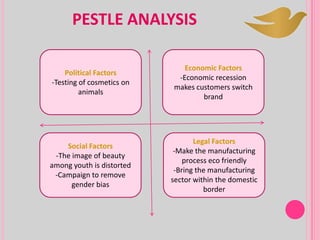
PESTLE ANALYSIS
Political Factors
-Testing of cosmetics on
animals
Economic Factors
-Economic recession
makes customers switch
brand
Social Factors
-The image of beauty
among youth is distorted
-Campaign to remove
gender bias
Legal Factors
-Make the manufacturing
process eco friendly
-Bring the manufacturing
sector within the domestic
border
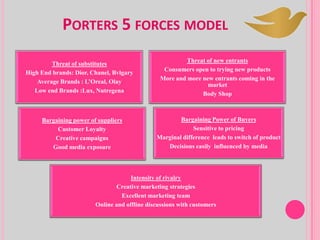
PORTERS 5 FORCES MODEL
Threat of substitutes
High End brands: Dior, Chanel, Bvlgary
Average Brands : L’Oreal, Olay
Low end Brands :Lux, Nutregena
Threat of new entrants
Consumers open to trying new products
More and more new entrants coming in the
market
Body Shop
Bargaining power of suppliers
Customer Loyalty
Creative campaigns
Good media exposure
Bargaining Power of Buyers
Sensitive to pricing
Marginal difference leads to switch of product
Decisions easily influenced by media
Intensity of rivalry
Creative marketing strategies
Excellent marketing team
Online and offline discussions with customers
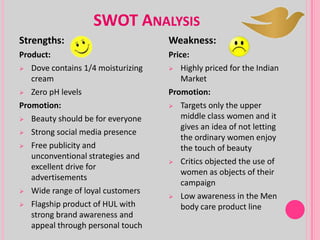
SWOT ANALYSIS
Strengths:
Product:
 Dove contains 1/4 moisturizing
cream
 Zero pH levels
Promotion:
 Beauty should be for everyone
 Strong social media presence
 Free publicity and
unconventional strategies and
excellent drive for
advertisements
 Wide range of loyal customers
 Flagship product of HUL with
strong brand awareness and
appeal through personal touch
Weakness:
Price:
 Highly priced for the Indian
Market
Promotion:
 Targets only the upper
middle class women and it
gives an idea of not letting
the ordinary women enjoy
the touch of beauty
 Critics objected the use of
women as objects of their
campaign
 Low awareness in the Men
body care product line
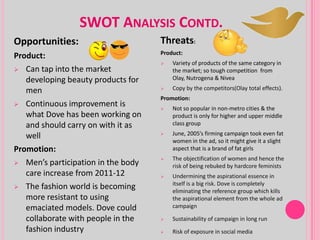
SWOT ANALYSIS CONTD.
Opportunities:
Product:
 Can tap into the market
developing beauty products for
men
 Continuous improvement is
what Dove has been working on
and should carry on with it as
well
Promotion:
 Men’s participation in the body
care increase from 2011-12
 The fashion world is becoming
more resistant to using
emaciated models. Dove could
collaborate with people in the
fashion industry
Threats:
Product:
 Variety of products of the same category in
the market; so tough competition from
Olay, Nutrogena & Nivea
 Copy by the competitors(Olay total effects).
Promotion:
 Not so popular in non-metro cities & the
product is only for higher and upper middle
class group
 June, 2005’s firming campaign took even fat
women in the ad, so it might give it a slight
aspect that is a brand of fat girls
 The objectification of women and hence the
risk of being rebuked by hardcore feminists
 Undermining the aspirational essence in
itself is a big risk. Dove is completely
eliminating the reference group which kills
the aspirational element from the whole ad
campaign
 Sustainability of campaign in long run
 Risk of exposure in social media
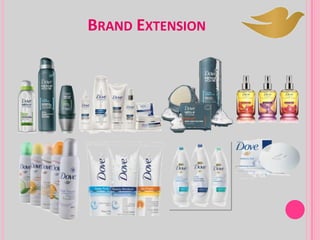
BRAND EXTENSION
BRAND EXTENSION CONTD.
DOVE
Beauty
Bar/Body
wash
Hair Care Deodorant
(Aerosol) Face Wash Lotions
Men + Care
[USA]
Beauty
Bar
Body
Wash
Crème, Exfoliating,
Fresh Moisture
Shampoo Oil
(Elixir)
Conditioner
Treatment
Bar, Body Wash,
Shampoo, Face
Care,
Deodorant
Go Fresh, Deep
Pure, Beauty
Moisture
Essential Nourishment,
Go Fresh Nourishment,
Indulgent Nourishment
Original, Silky dry,
New Dove
Whitening, Go Fresh
Cucumber,
Grapefruit &
Nectarine
Nourished Shine, Hair
fall Rescue, dryness Care
Oil Care
Treatment
Musk &
Serum, Hair
fall Rescue
Serum
Intense Repair, Dandruff
Care, Daily Shine,
Nourishing Oil Care,
Split End Rescue, Hail
Fall Rescue, Dryness
Care
Same as
Shampoo
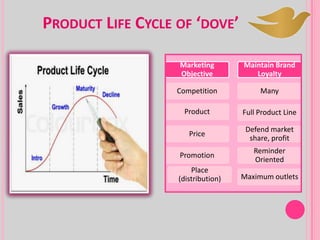
PRODUCT LIFE CYCLE OF ‘DOVE’
Marketing
Objective
Competition
Product
Price
Promotion
Place
(distribution)
Maintain Brand
Loyalty
Many
Full Product Line
Defend market
share, profit
Reminder
Oriented
Maximum outlets
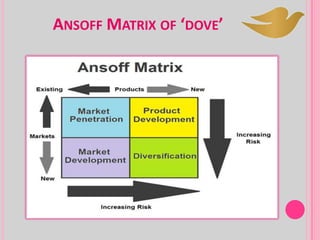
ANSOFF MATRIX OF ‘DOVE’
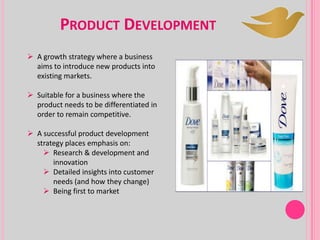
PRODUCT DEVELOPMENT
 A growth strategy where a business
aims to introduce new products into
existing markets.
 Suitable for a business where the
product needs to be differentiated in
order to remain competitive.
 A successful product development
strategy places emphasis on:
 Research & development and
innovation
 Detailed insights into customer
needs (and how they change)
 Being first to market
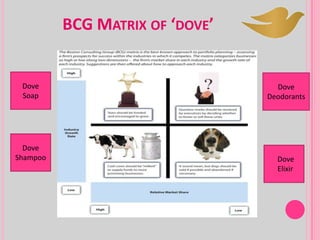
BCG MATRIX OF ‘DOVE’
Dove
Soap
Dove
Shampoo
Dove
Deodorants
Dove
Elixir
CONTD.
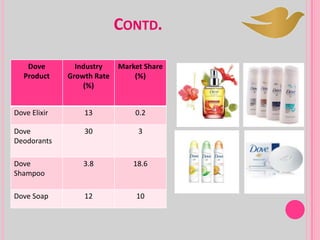
Dove
Product
Industry
Growth Rate
(%)
Market Share
(%)
Dove Elixir 13 0.2
Dove
Deodorants
30 3
Dove
Shampoo
3.8 18.6
Dove Soap 12 10
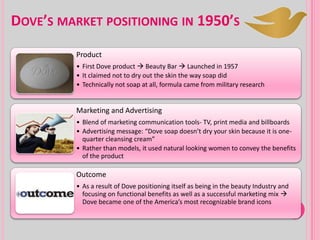
Product
• First Dove product  Beauty Bar  Launched in 1957
• It claimed not to dry out the skin the way soap did
• Technically not soap at all, formula came from military research
Marketing and Advertising
• Blend of marketing communication tools- TV, print media and billboards
• Advertising message: “Dove soap doesn’t dry your skin because it is one-
quarter cleansing cream”
• Rather than models, it used natural looking women to convey the benefits
of the product
Outcome
• As a result of Dove positioning itself as being in the beauty Industry and
focusing on functional benefits as well as a successful marketing mix 
Dove became one of the America’s most recognizable brand icons
DOVE’S MARKET POSITIONING IN 1950’S
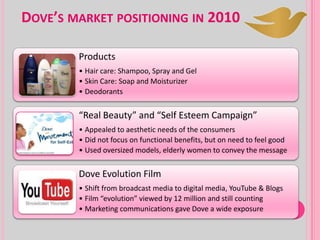
Products
• Hair care: Shampoo, Spray and Gel
• Skin Care: Soap and Moisturizer
• Deodorants
“Real Beauty” and “Self Esteem Campaign”
• Appealed to aesthetic needs of the consumers
• Did not focus on functional benefits, but on need to feel good
• Used oversized models, elderly women to convey the message
Dove Evolution Film
• Shift from broadcast media to digital media, YouTube & Blogs
• Film “evolution” viewed by 12 million and still counting
• Marketing communications gave Dove a wide exposure
DOVE’S MARKET POSITIONING IN 2010
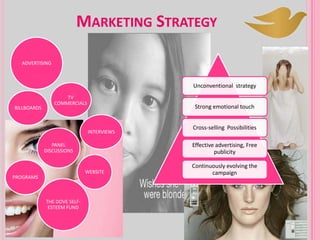
MARKETING STRATEGY
29
INTERVIEWS
ADVERTISING
BILLBOARDS
PANEL
DISCUSSIONS
TV
COMMERCIALS
PROGRAMS
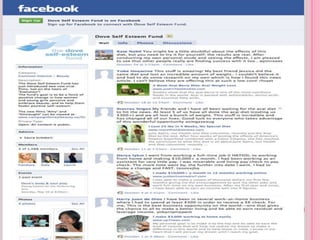
THE DOVE SELF-
ESTEEM FUND
WEBSITE
Unconventional strategy
Strong emotional touch
Cross-selling Possibilities
Effective advertising, Free
publicity
Continuously evolving the
campaign
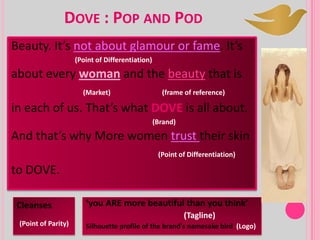
Beauty. It’s not about glamour or fame. It’s
(Point of Differentiation)
about every woman and the beauty that is
(Market) (frame of reference)
in each of us. That’s what DOVE is all about.
(Brand)
And that’s why More women trust their skin
(Point of Differentiation)
to DOVE.
DOVE : POP AND POD
Cleanses
(Point of Parity)
‘you ARE more beautiful than you think’
(Tagline)
Silhouette profile of the brand's namesake bird (Logo)
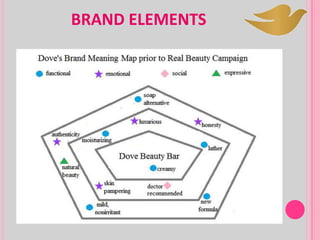
BRAND ELEMENTS
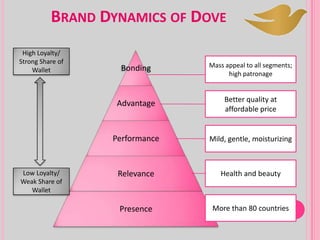
Bonding
Advantage
Performance
Relevance
Presence
Mass appeal to all segments;
high patronage
Better quality at
affordable price
Mild, gentle, moisturizing
Health and beauty
More than 80 countries
BRAND DYNAMICS OF DOVE
High Loyalty/
Strong Share of
Wallet
Low Loyalty/
Weak Share of
Wallet
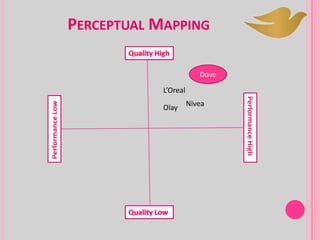
PERCEPTUAL MAPPING
Dove
L’Oreal
Olay Nivea
BRAND PERSONALITY
 Femininity & Mildness
The name, logo, tagline & the products – everything
is simple & feminine
 Self acceptance & Confidence
Highlights the commitment to breaking down
stereotypes & enabling women to celebrate real
inner beauty & beauty at every age
DOVE LOGO
 Logo of Dove is a perfect representation of
Softness
Gentleness
Sophistication
 The image of dove or peace pigeon symbolizes the
purity & softness of a dove in its products.
 Tagline : You ARE more beautiful than you think
Dove celebrates “Real Beauty”
Gorgeous Graceful
Beautiful Smart
Attractive
Adorable
Poised
Pretty Cute

Dove

  • 1.
    By- Nisha Dmello (14) DishaGupta (20) Anirudh Jindal (22) Vishnu Manasa Kanchiraju (25) Divya Kaul (27) Sayoni Maitra (31)
  • 2.
    ON THE AGENDA •BrandDefinition •Unilever - Category Management Strategy - Brand Management Strategy - Why does Unilever want fewer brands? •Evolution of Brand ‘Dove’ - Dove: POP & POD - Product Launch - What compelled Dove to go for CFRB •Dove’s market positioning in the 1950’s •Dove’s market positioning in 2007 - The CBBE Model - BRAND DYNAMICS OF DOVE - Marketing Strategy •‘We The PEOPLE’ - USER’s Verdict : MILDNESS IS THE KEY •Conflicting brand image •Risks to the brand today
  • 3.
    UNILEVER’S CATEGORY MANAGEMENTSTRATEGY Then  World’s largest producer but lacked a unified global identity.  Brands managed in a decentralized fashion  Years of slow performance  Lack of sound corporate strategy  Numerous low-volume brands  Small global presence compared to competition  Mediocre performance in emerging markets Now  Reduce portfolio to 400 “core” brands  Path to growth Initiative (Brand building and brand development – separate functions)  Concentrate on product innovation to fuel internal growth  An initiative to create an overall umbrella brand across all Unilever’s brands
  • 4.
    WHY DOES UNILEVERWANT FEWER BRANDS?  Global decentralization brought problems of control.  Company’s brand portfolio had grown is a relatively laissez-faire manner.  Unilever lacked a global identity.  Product categories had checkered identities.  Embarked on a 5 year strategic initiative “Path to Growth”: - Winnowing 1600 brands down to 400. - Selected “Masterbrands”, mandate to serve as umbrella identities over a range of product forms. - Global brand unit for each “Masterbrand”
  • 5.
  • 6.
    EVOLUTION OF BRAND‘DOVE’ 1940 Formula for Dove Bar (Mild Soap) 1950 Refined to original Dove Beauty Bar 1960 Launched in the market 1970 Popularity Increased as a milder soap 1980 Leading brand recommended by Physicians 1990 Dove beauty wash successfully launched 1995-2001 Extension of Dove’s range of products In a world of hype and stereotypes, Dove provides a refreshingly real alternative for women who recognize that beauty comes in all shapes and sizes. - UNILEVER Website
  • 7.
    ‘BEAUTIFUL YOU- TODAY,TOMORROW’ - A CALCULATED RISK?  Media Explosion on the idea of ‘BEAUTY’  Increased pressure to ‘Look beautiful’ according to popular perception  Worldwide criticism of Fashion Brands and brands that made people aspire to appear a standard way  Perceived Health Risks- Anorexia, Bolemia, Stress  A unique opportunity to play the game from the opposite end of the court
  • 9.
  • 10.
    PRODUCT LAUNCH “We wantto challenge the definition of the beauty. We believe that beauty has become too narrow in definition. We want to defy the stereotype that only young, blond and tall are beautiful.” -Philippe Harousseau, Dove’s Marketing Director CFRB (Campaign for Real Beauty): “DOVE FIRMING LOTION” Ads named as “LETS CELEBRATE CURVES” Intended to make more women feel beautiful.
  • 11.
  • 12.
    Product 1) Dove productline includes a variety of skin care soaps ,shampoos, deodorant's etc. 2) All the products aimed to be gentle on skin. Price 1)Initially launched at Rs 50 but was not accepted in the market . 2) After campaign for real beauty they reduced price to 28. Place 1) Dove products manufactured in Netherlands, India, USA, Germany ,Ireland ,Brazil. 2) Dove present all around Promotion 1)Media channels : magazines, TV, newspapers, etc. 2) Various campaigns released
  • 13.
    SEGMENTATION •Gender – Females(Working Women) •Income – High Income and upper income group Demographic Segmentation •It tries to portray that no women is ordinary looking and every one can look equally beautiful like we say •Beauty encompasses all ages, body shapes and sizes Psychographic Segmentation
  • 14.
     Targets womenof all ages ,shapes and sizes  Highly focuses on working women who do not have time to look after the skin and thing that dove with the moisturizing lotion is the best for the skin  Targets High Income group and middle income group people who can pay for the dove products which are prices a little more than normal beauty soaps  Targeting Women who love to maintain their skin  Women who are aware of the beauty product which can used on their skin TARGETING
  • 15.
    POSITIONING  Positioned asPersonal Care Beauty Product  Dove not named as soap instead a beauty bar which has moisturizing cream in it  High Moisturizer to differentiate it from other products  High Priced , good quality and gentle for skin Beauty products  Dove is not positioned to tell how to become beautiful it is concept says that dove helps you to be beautiful as you have always been
  • 16.
    PESTLE ANALYSIS Political Factors -Testingof cosmetics on animals Economic Factors -Economic recession makes customers switch brand Social Factors -The image of beauty among youth is distorted -Campaign to remove gender bias Legal Factors -Make the manufacturing process eco friendly -Bring the manufacturing sector within the domestic border
  • 17.
    PORTERS 5 FORCESMODEL Threat of substitutes High End brands: Dior, Chanel, Bvlgary Average Brands : L’Oreal, Olay Low end Brands :Lux, Nutregena Threat of new entrants Consumers open to trying new products More and more new entrants coming in the market Body Shop Bargaining power of suppliers Customer Loyalty Creative campaigns Good media exposure Bargaining Power of Buyers Sensitive to pricing Marginal difference leads to switch of product Decisions easily influenced by media Intensity of rivalry Creative marketing strategies Excellent marketing team Online and offline discussions with customers
  • 18.
    SWOT ANALYSIS Strengths: Product:  Dovecontains 1/4 moisturizing cream  Zero pH levels Promotion:  Beauty should be for everyone  Strong social media presence  Free publicity and unconventional strategies and excellent drive for advertisements  Wide range of loyal customers  Flagship product of HUL with strong brand awareness and appeal through personal touch Weakness: Price:  Highly priced for the Indian Market Promotion:  Targets only the upper middle class women and it gives an idea of not letting the ordinary women enjoy the touch of beauty  Critics objected the use of women as objects of their campaign  Low awareness in the Men body care product line
  • 19.
    SWOT ANALYSIS CONTD. Opportunities: Product: Can tap into the market developing beauty products for men  Continuous improvement is what Dove has been working on and should carry on with it as well Promotion:  Men’s participation in the body care increase from 2011-12  The fashion world is becoming more resistant to using emaciated models. Dove could collaborate with people in the fashion industry Threats: Product:  Variety of products of the same category in the market; so tough competition from Olay, Nutrogena & Nivea  Copy by the competitors(Olay total effects). Promotion:  Not so popular in non-metro cities & the product is only for higher and upper middle class group  June, 2005’s firming campaign took even fat women in the ad, so it might give it a slight aspect that is a brand of fat girls  The objectification of women and hence the risk of being rebuked by hardcore feminists  Undermining the aspirational essence in itself is a big risk. Dove is completely eliminating the reference group which kills the aspirational element from the whole ad campaign  Sustainability of campaign in long run  Risk of exposure in social media
  • 20.
  • 21.
    BRAND EXTENSION CONTD. DOVE Beauty Bar/Body wash HairCare Deodorant (Aerosol) Face Wash Lotions Men + Care [USA] Beauty Bar Body Wash Crème, Exfoliating, Fresh Moisture Shampoo Oil (Elixir) Conditioner Treatment Bar, Body Wash, Shampoo, Face Care, Deodorant Go Fresh, Deep Pure, Beauty Moisture Essential Nourishment, Go Fresh Nourishment, Indulgent Nourishment Original, Silky dry, New Dove Whitening, Go Fresh Cucumber, Grapefruit & Nectarine Nourished Shine, Hair fall Rescue, dryness Care Oil Care Treatment Musk & Serum, Hair fall Rescue Serum Intense Repair, Dandruff Care, Daily Shine, Nourishing Oil Care, Split End Rescue, Hail Fall Rescue, Dryness Care Same as Shampoo
  • 22.
    PRODUCT LIFE CYCLEOF ‘DOVE’ Marketing Objective Competition Product Price Promotion Place (distribution) Maintain Brand Loyalty Many Full Product Line Defend market share, profit Reminder Oriented Maximum outlets
  • 23.
    ANSOFF MATRIX OF‘DOVE’
  • 24.
    PRODUCT DEVELOPMENT  Agrowth strategy where a business aims to introduce new products into existing markets.  Suitable for a business where the product needs to be differentiated in order to remain competitive.  A successful product development strategy places emphasis on:  Research & development and innovation  Detailed insights into customer needs (and how they change)  Being first to market
  • 25.
    BCG MATRIX OF‘DOVE’ Dove Soap Dove Shampoo Dove Deodorants Dove Elixir
  • 26.
    CONTD. Dove Product Industry Growth Rate (%) Market Share (%) DoveElixir 13 0.2 Dove Deodorants 30 3 Dove Shampoo 3.8 18.6 Dove Soap 12 10
  • 27.
    Product • First Doveproduct  Beauty Bar  Launched in 1957 • It claimed not to dry out the skin the way soap did • Technically not soap at all, formula came from military research Marketing and Advertising • Blend of marketing communication tools- TV, print media and billboards • Advertising message: “Dove soap doesn’t dry your skin because it is one- quarter cleansing cream” • Rather than models, it used natural looking women to convey the benefits of the product Outcome • As a result of Dove positioning itself as being in the beauty Industry and focusing on functional benefits as well as a successful marketing mix  Dove became one of the America’s most recognizable brand icons DOVE’S MARKET POSITIONING IN 1950’S
  • 28.
    Products • Hair care:Shampoo, Spray and Gel • Skin Care: Soap and Moisturizer • Deodorants “Real Beauty” and “Self Esteem Campaign” • Appealed to aesthetic needs of the consumers • Did not focus on functional benefits, but on need to feel good • Used oversized models, elderly women to convey the message Dove Evolution Film • Shift from broadcast media to digital media, YouTube & Blogs • Film “evolution” viewed by 12 million and still counting • Marketing communications gave Dove a wide exposure DOVE’S MARKET POSITIONING IN 2010
  • 29.
    MARKETING STRATEGY 29 INTERVIEWS ADVERTISING BILLBOARDS PANEL DISCUSSIONS TV COMMERCIALS PROGRAMS THE DOVESELF- ESTEEM FUND WEBSITE Unconventional strategy Strong emotional touch Cross-selling Possibilities Effective advertising, Free publicity Continuously evolving the campaign
  • 31.
    Beauty. It’s notabout glamour or fame. It’s (Point of Differentiation) about every woman and the beauty that is (Market) (frame of reference) in each of us. That’s what DOVE is all about. (Brand) And that’s why More women trust their skin (Point of Differentiation) to DOVE. DOVE : POP AND POD Cleanses (Point of Parity) ‘you ARE more beautiful than you think’ (Tagline) Silhouette profile of the brand's namesake bird (Logo)
  • 32.
  • 33.
    Bonding Advantage Performance Relevance Presence Mass appeal toall segments; high patronage Better quality at affordable price Mild, gentle, moisturizing Health and beauty More than 80 countries BRAND DYNAMICS OF DOVE High Loyalty/ Strong Share of Wallet Low Loyalty/ Weak Share of Wallet
  • 34.
  • 35.
    BRAND PERSONALITY  Femininity& Mildness The name, logo, tagline & the products – everything is simple & feminine  Self acceptance & Confidence Highlights the commitment to breaking down stereotypes & enabling women to celebrate real inner beauty & beauty at every age
  • 36.
    DOVE LOGO  Logoof Dove is a perfect representation of Softness Gentleness Sophistication  The image of dove or peace pigeon symbolizes the purity & softness of a dove in its products.  Tagline : You ARE more beautiful than you think
  • 37.
    Dove celebrates “RealBeauty” Gorgeous Graceful Beautiful Smart Attractive Adorable Poised Pretty Cute

Editor's Notes

  • #20 Undermining the aspiration of consumers