BY K.Rajeshwari
16106B1058
INTRODUCTION
• Dell computer was founded by Michael Dell. Dell
traces origins to 1984 when Michael dell created PCs
limited.
• The principle of the company was to provide
computers at the lowest price possible
• This was achieved by removing the retailer in
between and using the low-cost direct marketing
method. In the first full year of business Dell was able
to achieve sales of $6 million which jumped to $40
million in the very next year.
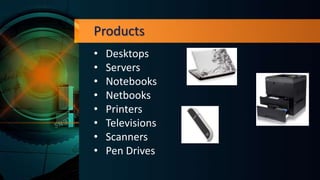
Products
• Desktops
• Servers
• Notebooks
• Netbooks
• Printers
• Televisions
• Scanners
• Pen Drives
• Dell International started in India by opening a customer
contact center at Bangalore in 2001.
• In 2003,the second contact center was opened at
Hyderabad.
• After the U.S., Dell India is the second biggest center with
13,000 employees.
• About 90% of dell computers are manufactured in China
Dell has grown by both increasing its customer base and
through acquisitions
2006 – Alien ware
2009 - Perot Systems
2010 - KACE Networks
2010 - SaaS
2012 - Sonic Wall
2012 –Wyse
2016- EMC Corporation
The Company conducts operations worldwide through
wholly owned subsidiaries. Sales outside the United
States accounted for approximately 35% of the
Company's revenues during the fiscal year ended
February 1, 2002 (fiscal 2002).
Direct Selling
• The company outsourced all components but performed assembly.
• It eliminated retailers and shipped directly from its factories to end
customers.
• It took customized orders for hardware and software
• It designed an integrated supply chain linking Dell’s suppliers very closely
to its assembly factories and order-intake system
• MICROSOFT - for Windows
• INTEL - for micro processors
• NVIDIA - for Graphic chips
• SONY - for monitors
Suppliers
Mass customization (end result: Delivers
exactly what the customer wants)
• Partnerships with suppliers
• Just-in-time components inventories
• Direct sales
• Market segmentation
• Customer service
• Extensive data and information sharing with both supply partners and
customers
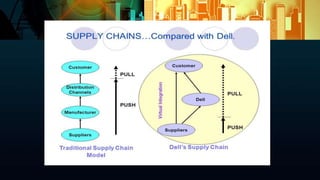
Supply Chain
• Dell eliminated the need for central warehousing as well as the
need for a physical store presence. Instead Dell attracts
customers to its site and then builds bonds with them there
rather than investing in a physical relationship.
• Dell’s manufacturing sites are in Brazil, China, Malaysia,
Ireland, and the U.S.
• Advantages of these locations are that some of them are low
cost
Strength
• Direct Model Approach, it provides Dell a way to
interact to customers directly
• Customization of products
• Reliability, Service and Support
• Latest Technology
SWOT Analysis
Weakness
• Market share growth is slow due to competition; Fake
products/ imitations affect sales
• Overdependence on Suppliers.
• Lack of Dell Stores, can be an issue for some customers
Opportunities
• With increase in e-commerce the online retail stores of
Dell provide them better framework to tap new business
• The Direct approach Model of Dell would help them
there existing to sell the other IT products, so new
product development opportunity is for Dell Tablet and
Smart phone Market
Threats
• With the increase in innovation in the market the
computer systems are becoming outdated, so Dell should
constantly come out with new products
• People need the quality products at low price which was
Dell strength due to it’s customize solution, but now its
competitors are coming up with products in same price
range
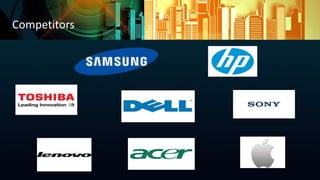
Competitors
THANK YOU

Dell final

  • 1.
  • 2.
    INTRODUCTION • Dell computerwas founded by Michael Dell. Dell traces origins to 1984 when Michael dell created PCs limited. • The principle of the company was to provide computers at the lowest price possible
  • 3.
    • This wasachieved by removing the retailer in between and using the low-cost direct marketing method. In the first full year of business Dell was able to achieve sales of $6 million which jumped to $40 million in the very next year.
  • 4.
    Products • Desktops • Servers •Notebooks • Netbooks • Printers • Televisions • Scanners • Pen Drives
  • 5.
    • Dell Internationalstarted in India by opening a customer contact center at Bangalore in 2001. • In 2003,the second contact center was opened at Hyderabad. • After the U.S., Dell India is the second biggest center with 13,000 employees. • About 90% of dell computers are manufactured in China
  • 6.
    Dell has grownby both increasing its customer base and through acquisitions 2006 – Alien ware 2009 - Perot Systems 2010 - KACE Networks 2010 - SaaS 2012 - Sonic Wall 2012 –Wyse 2016- EMC Corporation
  • 7.
    The Company conductsoperations worldwide through wholly owned subsidiaries. Sales outside the United States accounted for approximately 35% of the Company's revenues during the fiscal year ended February 1, 2002 (fiscal 2002).
  • 8.
    Direct Selling • Thecompany outsourced all components but performed assembly. • It eliminated retailers and shipped directly from its factories to end customers. • It took customized orders for hardware and software • It designed an integrated supply chain linking Dell’s suppliers very closely to its assembly factories and order-intake system
  • 9.
    • MICROSOFT -for Windows • INTEL - for micro processors • NVIDIA - for Graphic chips • SONY - for monitors Suppliers
  • 10.
    Mass customization (endresult: Delivers exactly what the customer wants) • Partnerships with suppliers • Just-in-time components inventories • Direct sales • Market segmentation • Customer service • Extensive data and information sharing with both supply partners and customers
  • 11.
    Supply Chain • Delleliminated the need for central warehousing as well as the need for a physical store presence. Instead Dell attracts customers to its site and then builds bonds with them there rather than investing in a physical relationship. • Dell’s manufacturing sites are in Brazil, China, Malaysia, Ireland, and the U.S. • Advantages of these locations are that some of them are low cost
  • 13.
    Strength • Direct ModelApproach, it provides Dell a way to interact to customers directly • Customization of products • Reliability, Service and Support • Latest Technology SWOT Analysis
  • 14.
    Weakness • Market sharegrowth is slow due to competition; Fake products/ imitations affect sales • Overdependence on Suppliers. • Lack of Dell Stores, can be an issue for some customers
  • 15.
    Opportunities • With increasein e-commerce the online retail stores of Dell provide them better framework to tap new business • The Direct approach Model of Dell would help them there existing to sell the other IT products, so new product development opportunity is for Dell Tablet and Smart phone Market
  • 16.
    Threats • With theincrease in innovation in the market the computer systems are becoming outdated, so Dell should constantly come out with new products • People need the quality products at low price which was Dell strength due to it’s customize solution, but now its competitors are coming up with products in same price range
  • 17.
  • 18.