Case study in the E-MARKETING course
Presented by: Ashraf Hatem Hlouh
Dell Computer Corporation
 Founded by 19-year-old Michael Dell in a dorm
room, grew by more than 50% a year over
1995-1998
 Dell produces custom build PCs in a matter of
hours and producing no PC component it could
sustain a large portion of PC market comparing
to IBM, HP, Compaq, Hitachi, Sony, Fujistu….
Dell Background
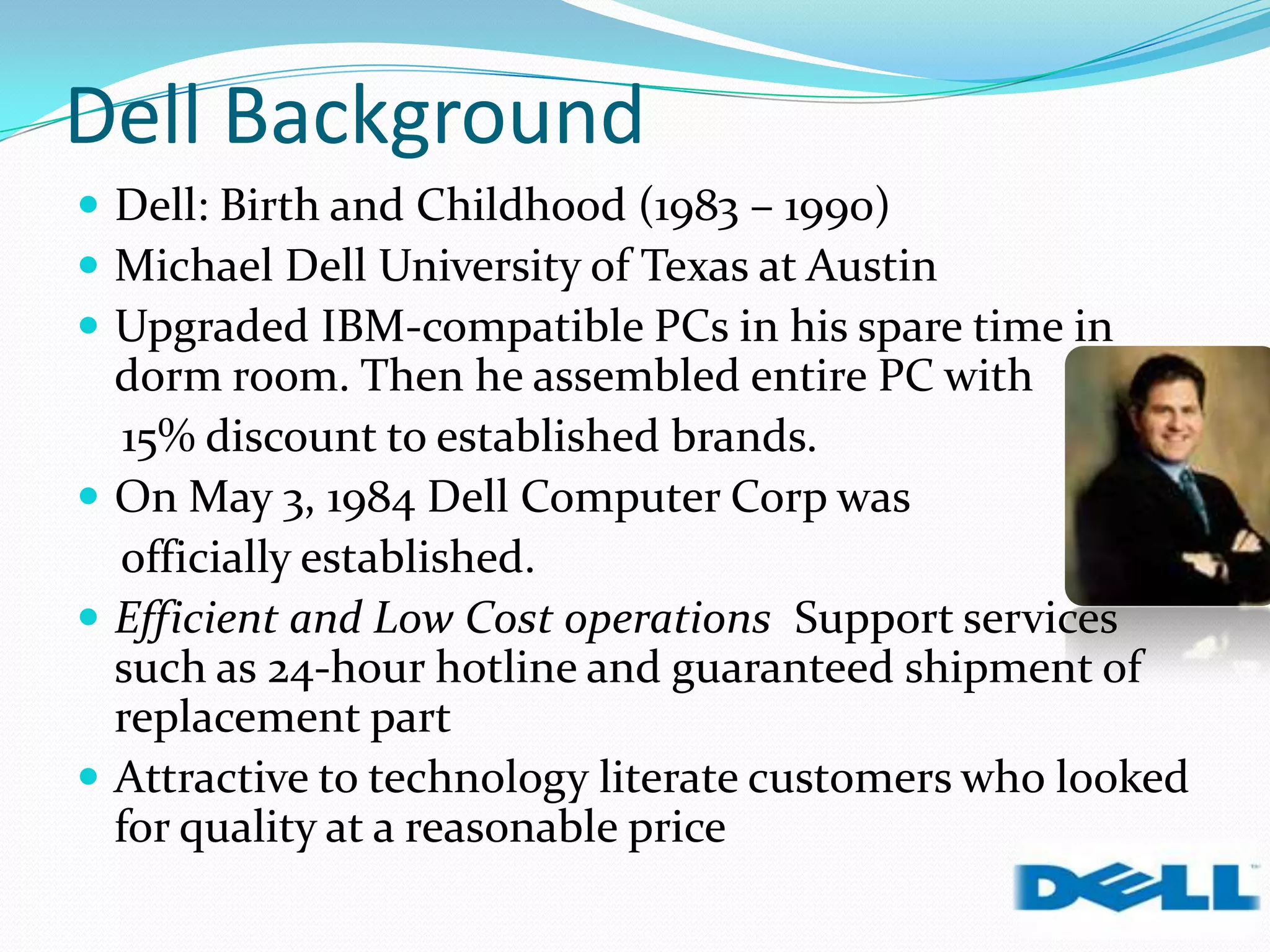
 Dell: Birth and Childhood (1983 – 1990)
 Michael Dell University of Texas at Austin
 Upgraded IBM-compatible PCs in his spare time in
dorm room. Then he assembled entire PC with
15% discount to established brands.
 On May 3, 1984 Dell Computer Corp was
officially established.
 Efficient and Low Cost operations Support services
such as 24-hour hotline and guaranteed shipment of
replacement part
 Attractive to technology literate customers who looked
for quality at a reasonable price
Dell Background
 Dell grew from nothing to $5 million at 1985
 International Expansion : 1987 UK ,1990: Limerick,
relend to serve the European, middle eastern and
African markets.
 Sales In 1990: $500 million Michael Dell became the
richest person in Texas.
 Dell’s Model being imitated by other vendors like
Gateway 2000
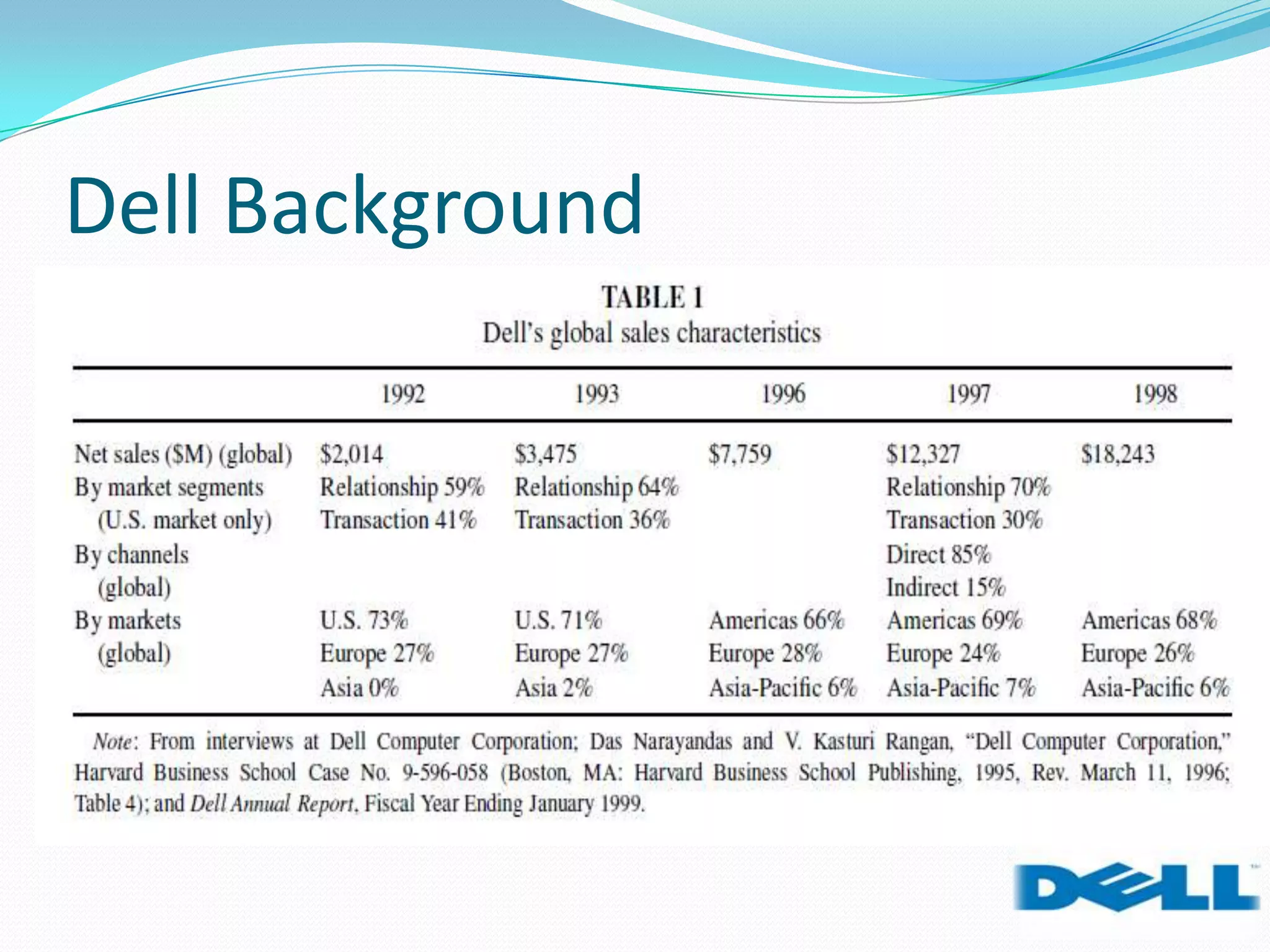
Dell Background
Dell Background
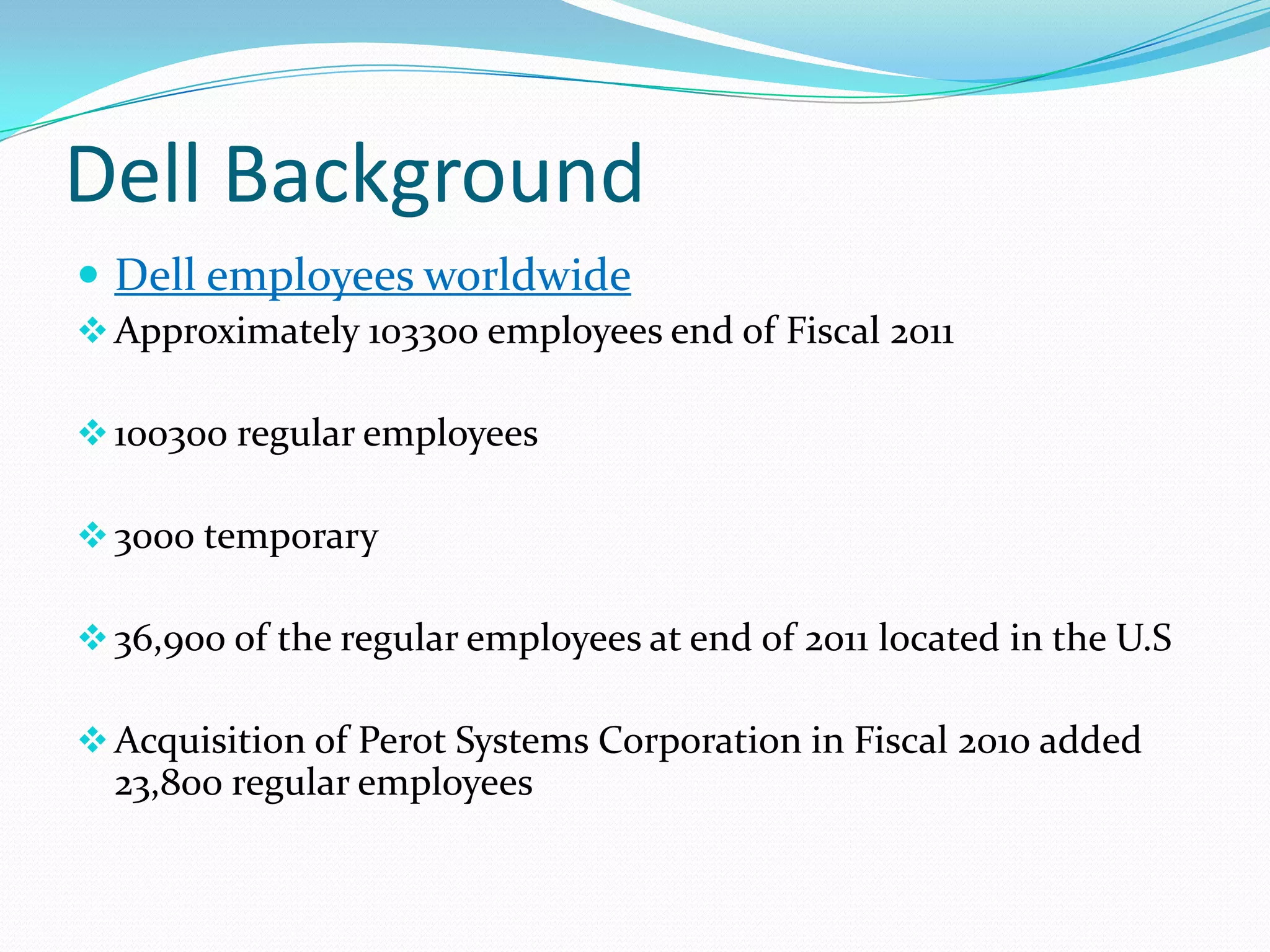
 Dell employees worldwide
Approximately 103300 employees end of Fiscal 2011
100300 regular employees
3000 temporary
36,900 of the regular employees at end of 2011 located in the U.S
Acquisition of Perot Systems Corporation in Fiscal 2010 added
23,800 regular employees
Dell Direct Model
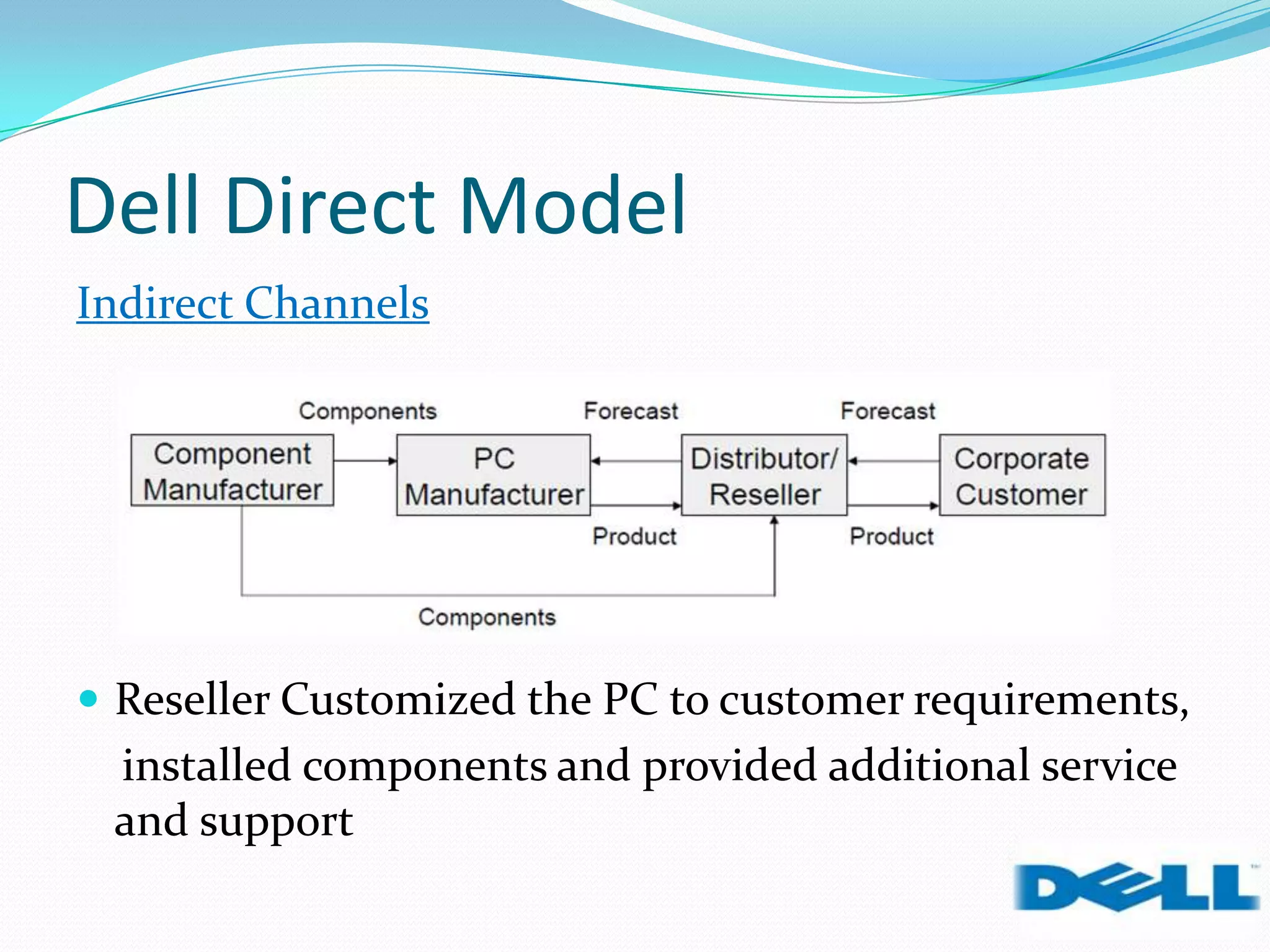
Indirect Channels
 Reseller Customized the PC to customer requirements,
installed components and provided additional service
and support
Dell Direct Model
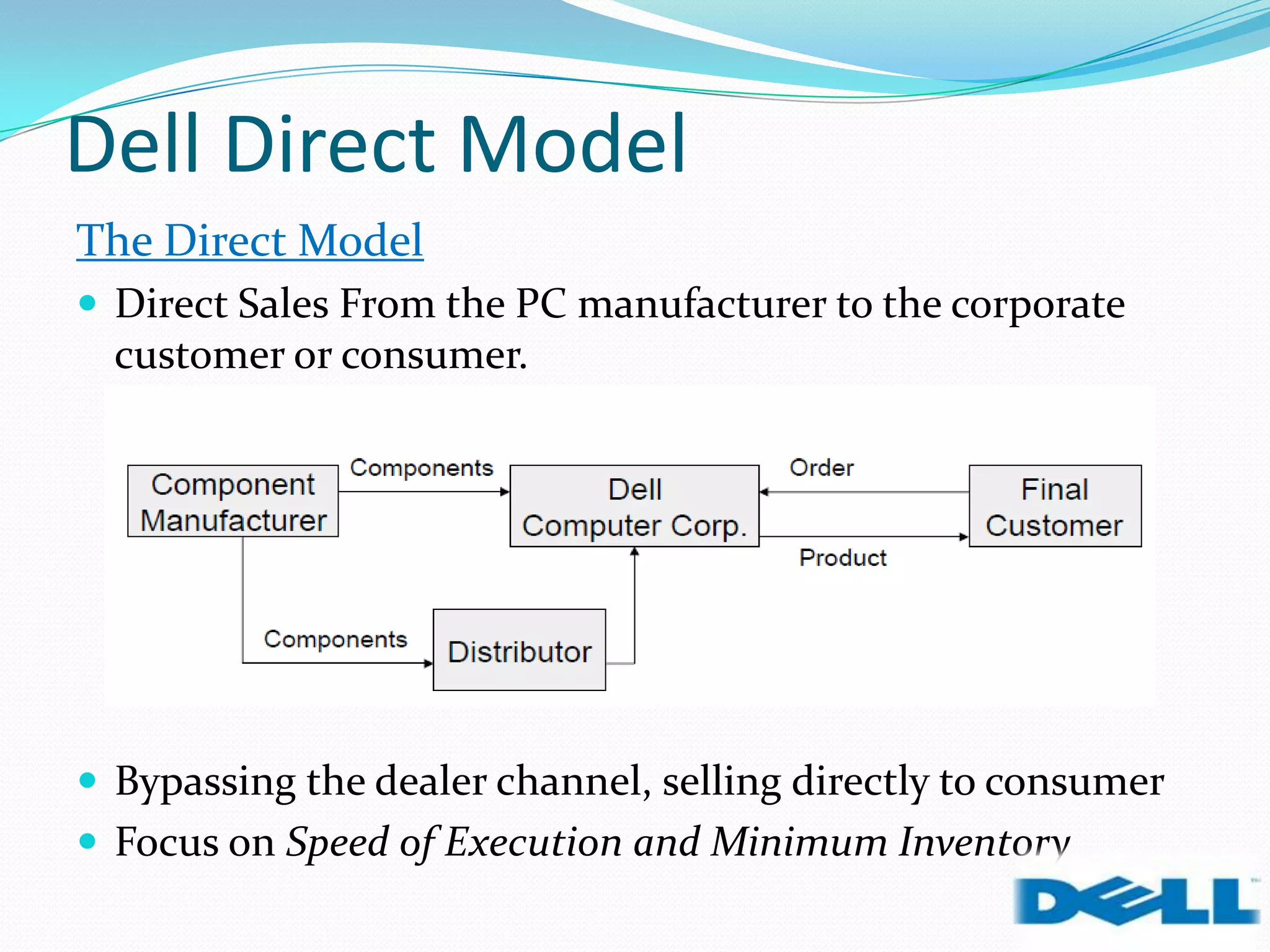
The Direct Model
 Direct Sales From the PC manufacturer to the corporate
customer or consumer.
 Bypassing the dealer channel, selling directly to consumer
 Focus on Speed of Execution and Minimum Inventory
Dell Direct Model
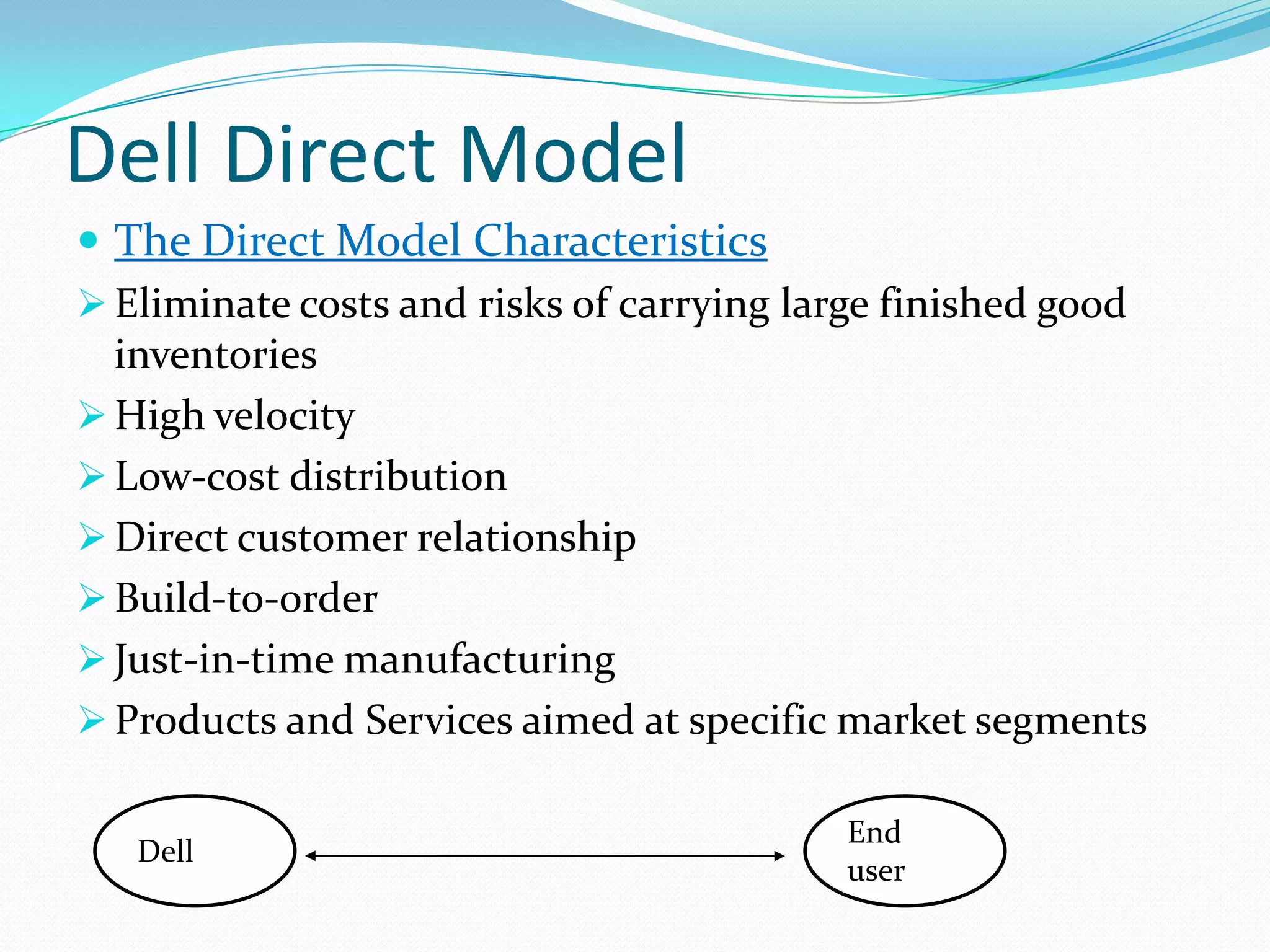
 The Direct Model Characteristics
 Eliminate costs and risks of carrying large finished good
inventories
 High velocity
 Low-cost distribution
 Direct customer relationship
 Build-to-order
 Just-in-time manufacturing
 Products and Services aimed at specific market segments
Dell
End
user
Dell Direct Model
 The Direct Model Characteristics
 Reduced channel costs: from 13.5%-15.5% to 2% of product
revenue
 Latest Technology was introduced faster than indirect
channels
 Dell can use IT to directly control its value chain, set
quality measures and monitor in real time how material is
flowing throughout the chain
 Managing Information to
 Increase Velocity,
 Track data on margins, selling price,…
 Utilize info. to get the suppliers in sync with the high-velocity model
Dell Direct Model
 The Direct Model Characteristics
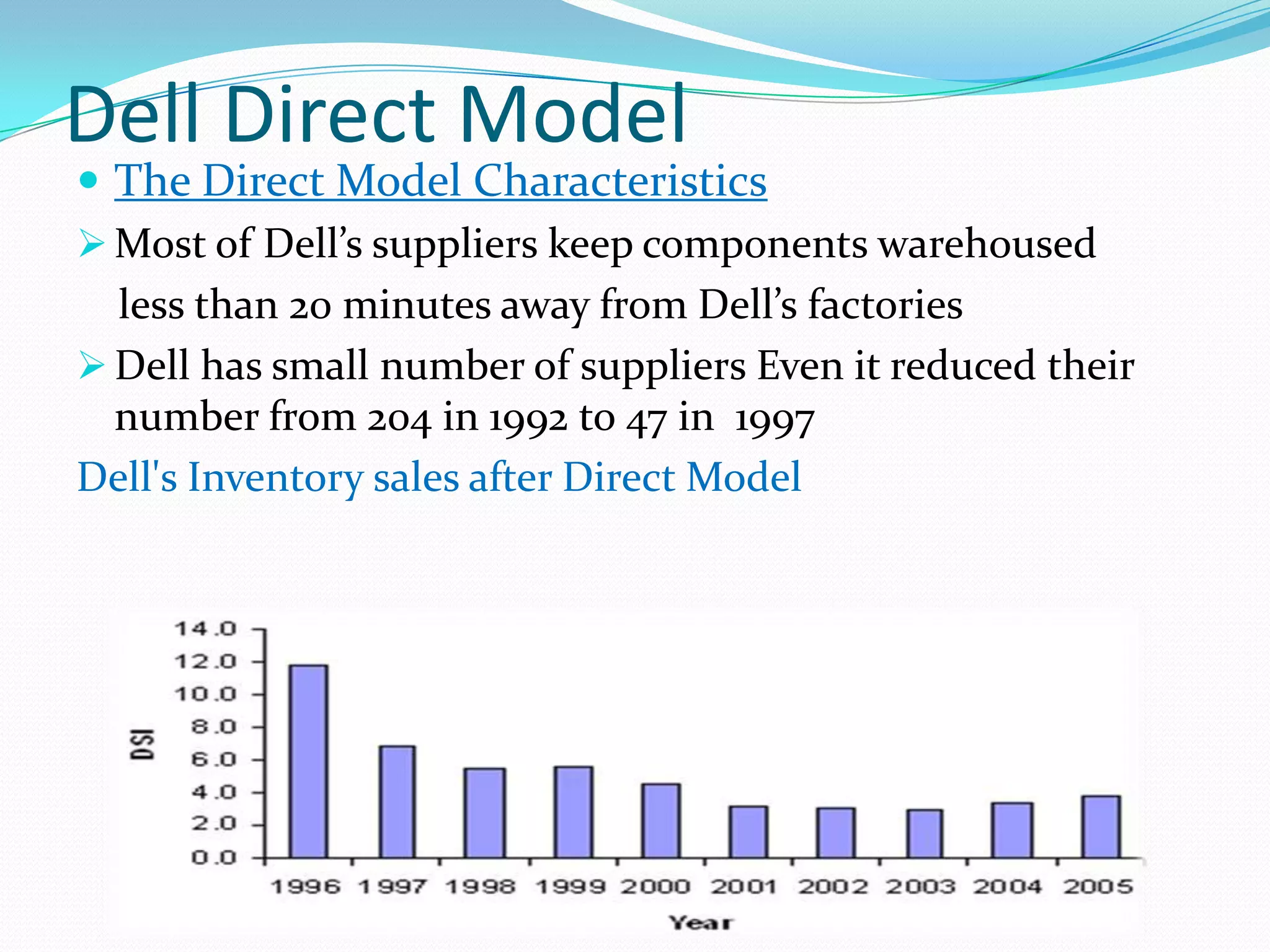
 Most of Dell’s suppliers keep components warehoused
less than 20 minutes away from Dell’s factories
 Dell has small number of suppliers Even it reduced their
number from 204 in 1992 to 47 in 1997
Dell's Inventory sales after Direct Model
Dell Direct Model
 Manufacturing Process
 No warehouse Space,
 No inventory other than work in process
 Manufacturing is synchronized to avoid storing parts or
finished systems
o This needs close relationship with suppliers
o Trust Manufactures like Sony, Logistics like UPS
o No test time
Dell Direct Model
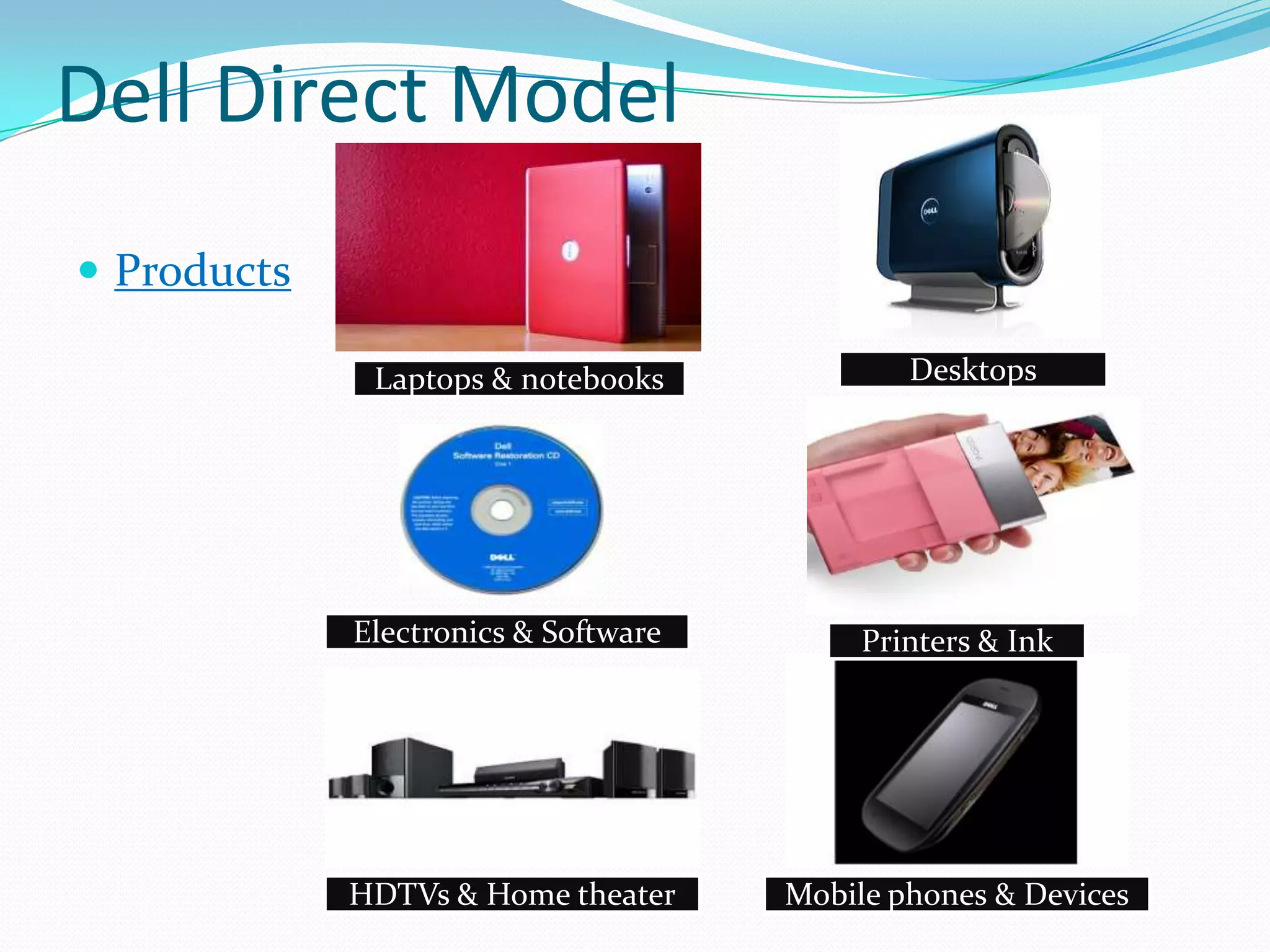
 Products
DesktopsLaptops & notebooks
Mobile phones & Devices
Printers & InkElectronics & Software
HDTVs & Home theater
Dell Direct Model
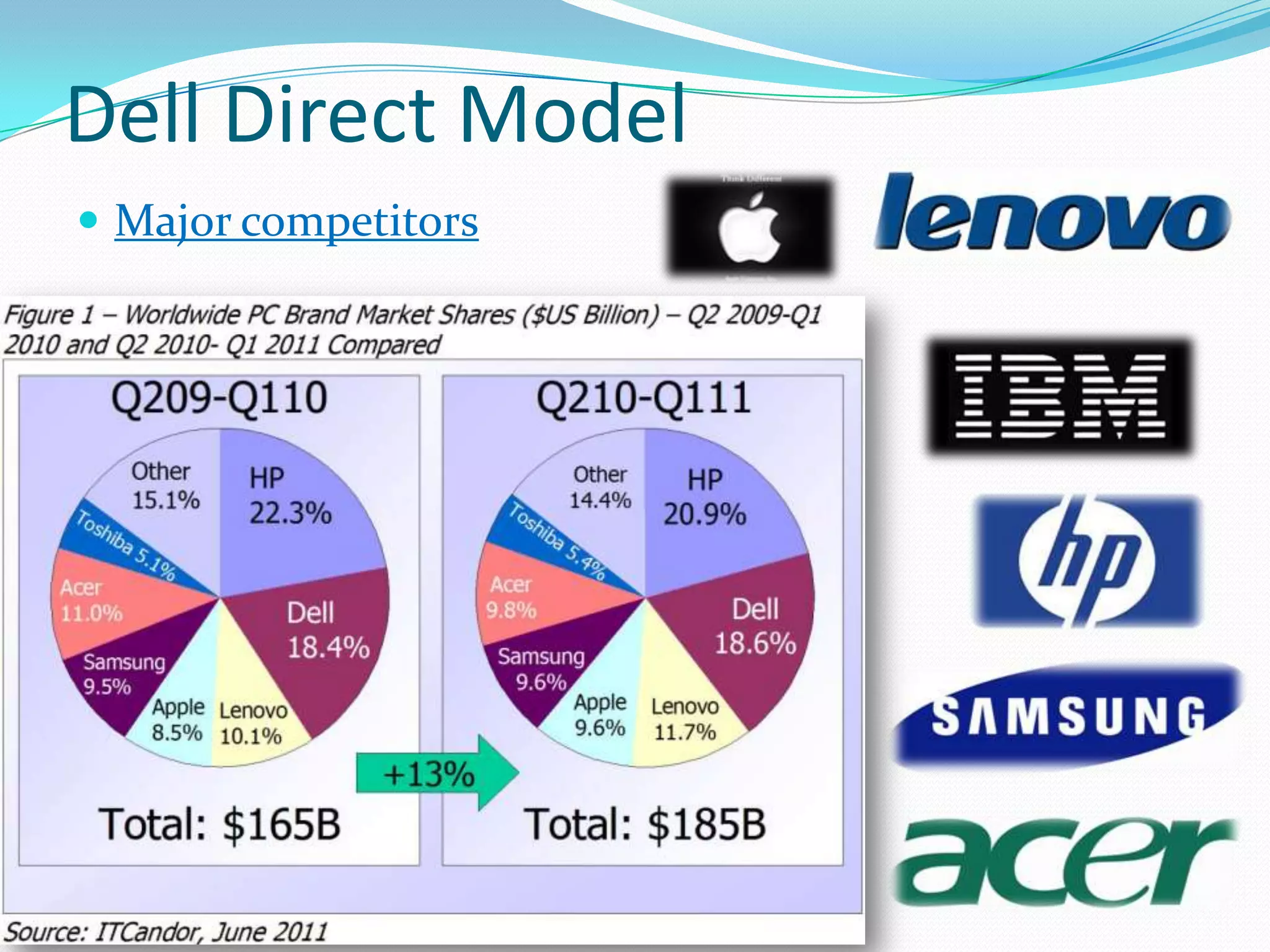
 Major competitors
Dell Direct Model
 Customer Service
 In 1986, San Francisco, Dell determines the company’s
future direction:
“The first: to really grow our business, we would have to target large
companies. The second: to land large companies we would have to
offer the absolute best support in the industry. That was how we came
up with the idea to provide the industry’s first on-site service for PC’s.
if a customer called us with a problem, we’d say, “We’ll be out
tomorrow to fix it”
Dell Direct Model
 Customer Service
 1,300 technical support personnel
 Accessible by phone 24 hours a day
 90% of calls can be solved on the phone by standard
 troubleshooting procedures
 Third-party maintenance providers like Unisys, Wang,
Decision one consulting and Digital Equipment
 Tight coordination with supplier, vendors and
maintenance providers feels like Just one large company
Dell Direct Model
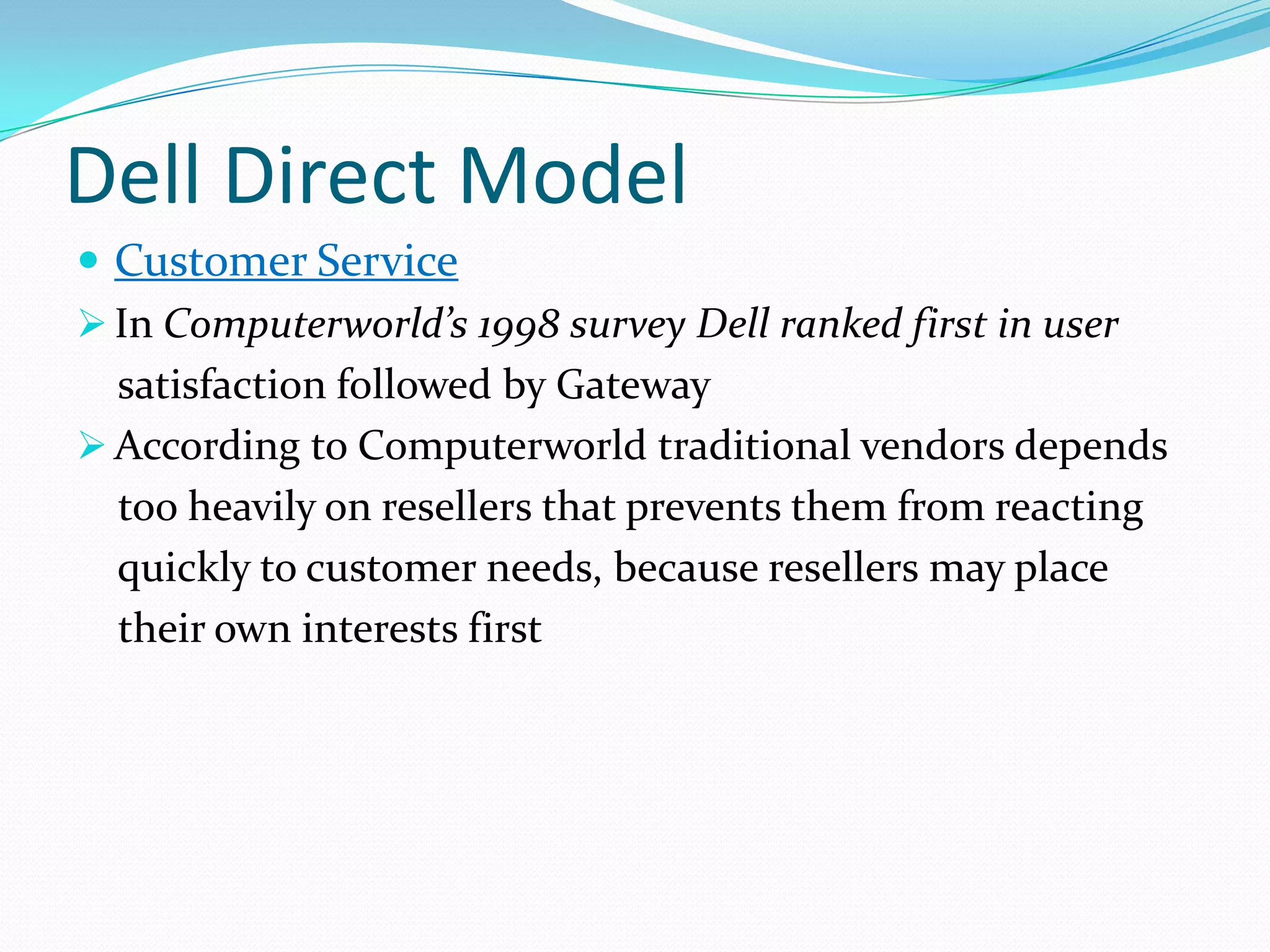
 Customer Service
 In Computerworld’s 1998 survey Dell ranked first in user
satisfaction followed by Gateway
 According to Computerworld traditional vendors depends
too heavily on resellers that prevents them from reacting
quickly to customer needs, because resellers may place
their own interests first
Dell Direct Model
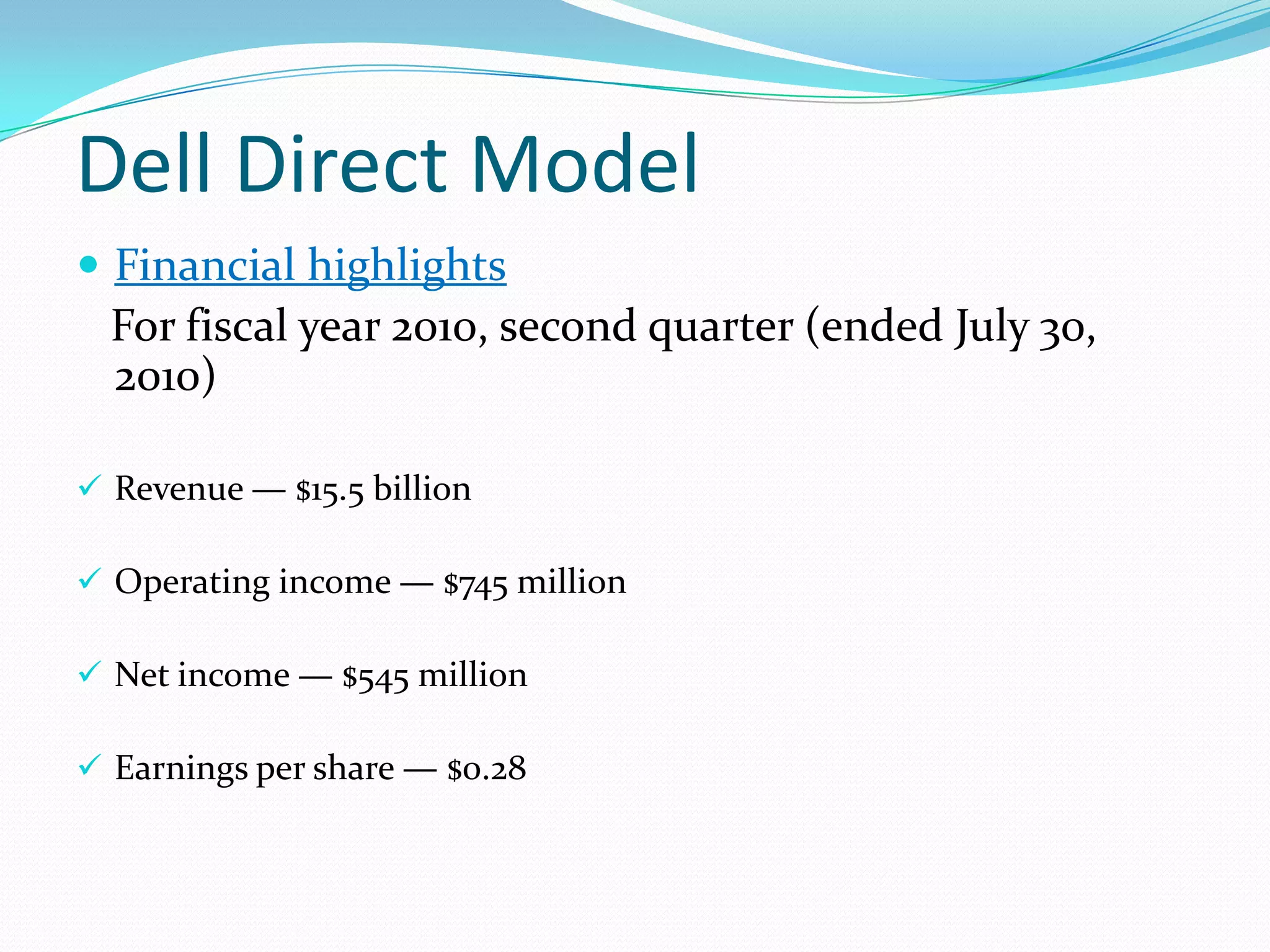
 Financial highlights
For fiscal year 2010, second quarter (ended July 30,
2010)
 Revenue — $15.5 billion
 Operating income — $745 million
 Net income — $545 million
 Earnings per share — $0.28
Dell Direct Model
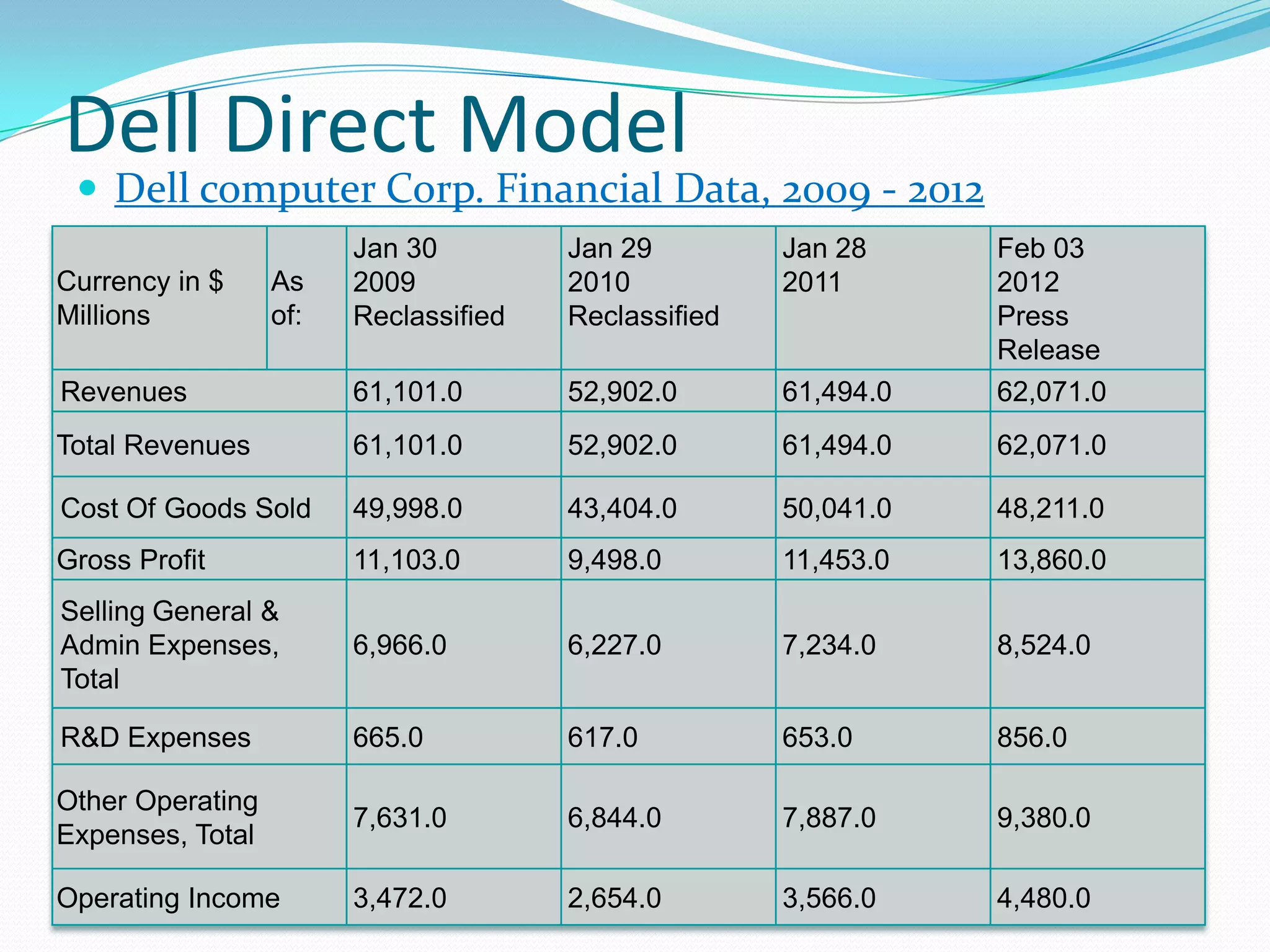
 Dell computer Corp. Financial Data, 2009 - 2012
Currency in $
Millions
As
of:
Jan 30
2009
Reclassified
Jan 29
2010
Reclassified
Jan 28
2011
Feb 03
2012
Press
Release
Revenues 61,101.0 52,902.0 61,494.0 62,071.0
Total Revenues 61,101.0 52,902.0 61,494.0 62,071.0
Cost Of Goods Sold 49,998.0 43,404.0 50,041.0 48,211.0
Gross Profit 11,103.0 9,498.0 11,453.0 13,860.0
Selling General &
Admin Expenses,
Total
6,966.0 6,227.0 7,234.0 8,524.0
R&D Expenses 665.0 617.0 653.0 856.0
Other Operating
Expenses, Total
7,631.0 6,844.0 7,887.0 9,380.0
Operating Income 3,472.0 2,654.0 3,566.0 4,480.0
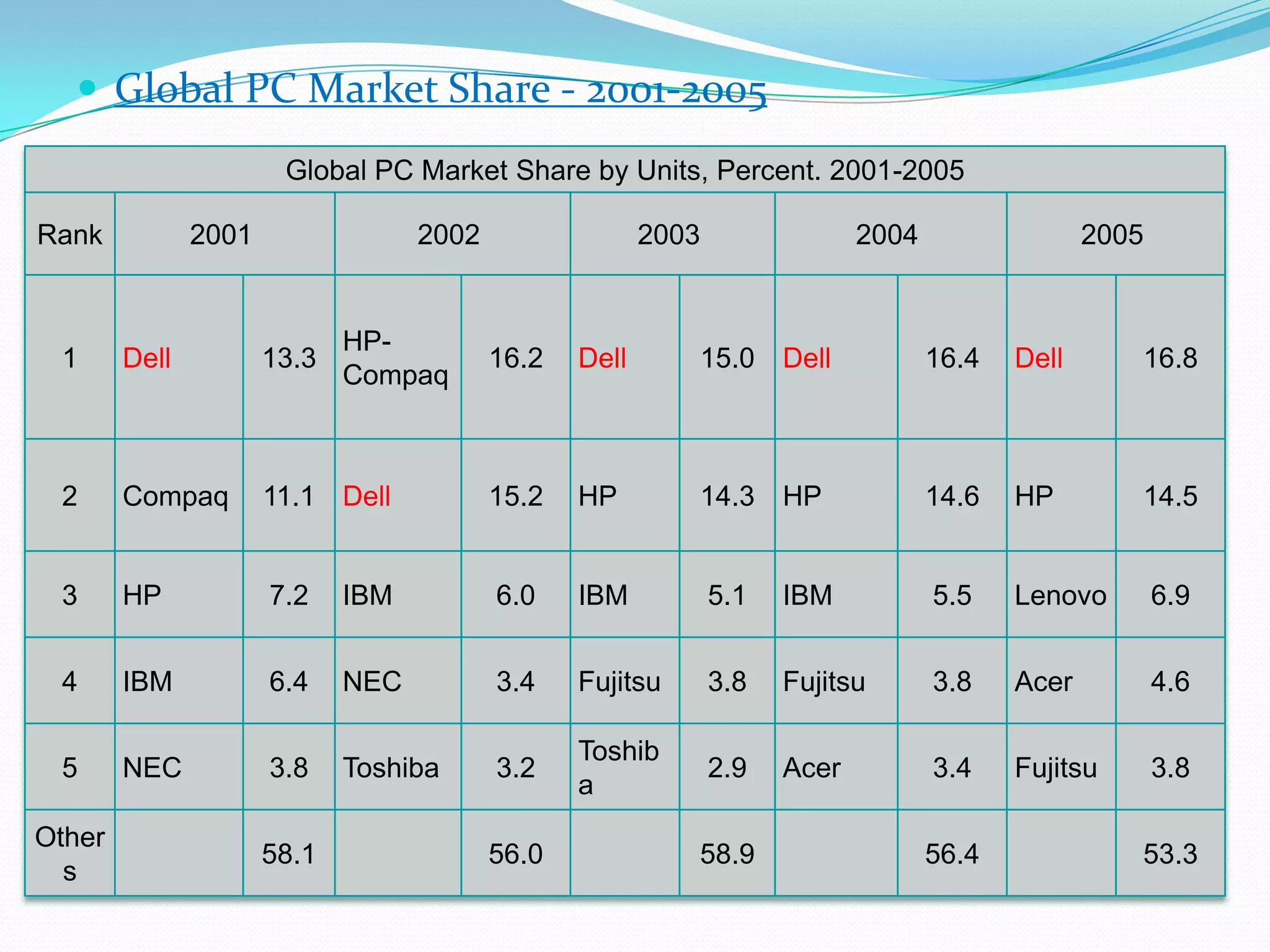
 Global PC Market Share - 2001-2005
Global PC Market Share by Units, Percent. 2001-2005
Rank 2001 2002 2003 2004 2005
1 Dell 13.3
HP-
Compaq
16.2 Dell 15.0 Dell 16.4 Dell 16.8
2 Compaq 11.1 Dell 15.2 HP 14.3 HP 14.6 HP 14.5
3 HP 7.2 IBM 6.0 IBM 5.1 IBM 5.5 Lenovo 6.9
4 IBM 6.4 NEC 3.4 Fujitsu 3.8 Fujitsu 3.8 Acer 4.6
5 NEC 3.8 Toshiba 3.2
Toshib
a
2.9 Acer 3.4 Fujitsu 3.8
Other
s
58.1 56.0 58.9 56.4 53.3
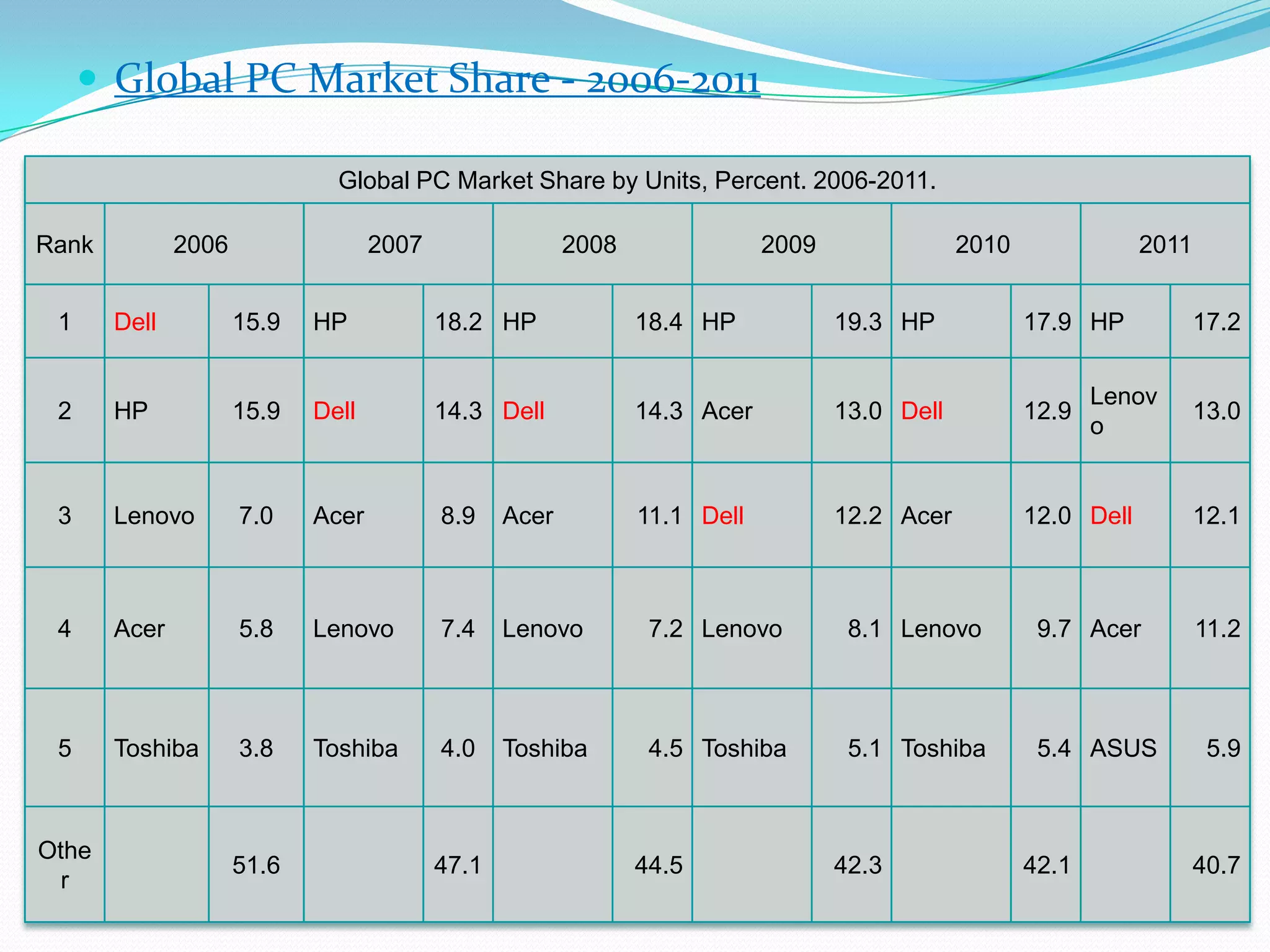
 Global PC Market Share - 2006-2011
Global PC Market Share by Units, Percent. 2006-2011.
Rank 2006 2007 2008 2009 2010 2011
1 Dell 15.9 HP 18.2 HP 18.4 HP 19.3 HP 17.9 HP 17.2
2 HP 15.9 Dell 14.3 Dell 14.3 Acer 13.0 Dell 12.9
Lenov
o
13.0
3 Lenovo 7.0 Acer 8.9 Acer 11.1 Dell 12.2 Acer 12.0 Dell 12.1
4 Acer 5.8 Lenovo 7.4 Lenovo 7.2 Lenovo 8.1 Lenovo 9.7 Acer 11.2
5 Toshiba 3.8 Toshiba 4.0 Toshiba 4.5 Toshiba 5.1 Toshiba 5.4 ASUS 5.9
Othe
r
51.6 47.1 44.5 42.3 42.1 40.7
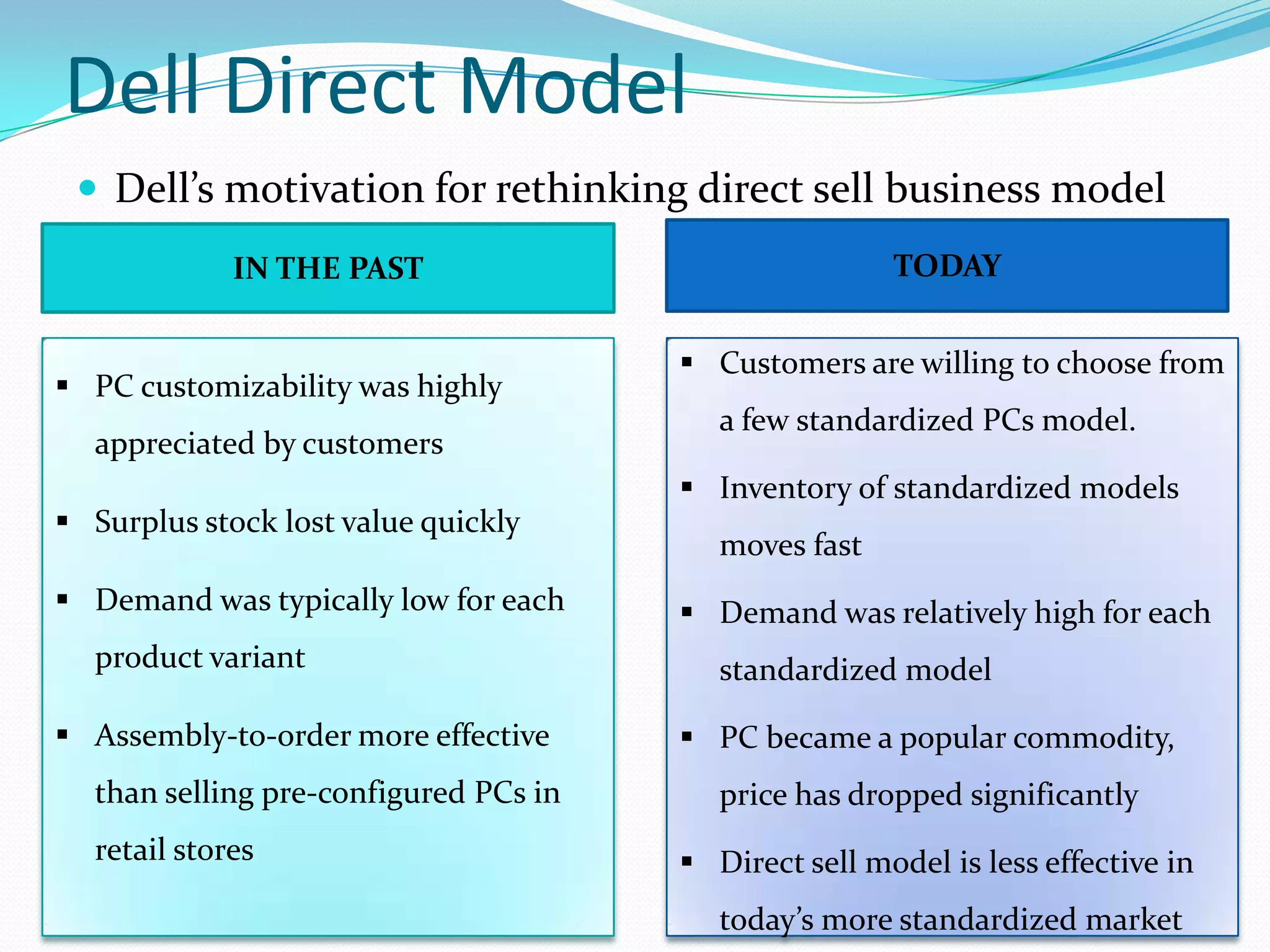
Dell Direct Model
 Dell’s motivation for rethinking direct sell business model
IN THE PAST TODAY
 PC customizability was highly
appreciated by customers
 Surplus stock lost value quickly
 Demand was typically low for each
product variant
 Assembly-to-order more effective
than selling pre-configured PCs in
retail stores
 Customers are willing to choose from
a few standardized PCs model.
 Inventory of standardized models
moves fast
 Demand was relatively high for each
standardized model
 PC became a popular commodity,
price has dropped significantly
 Direct sell model is less effective in
today’s more standardized market
Dell Direct Model
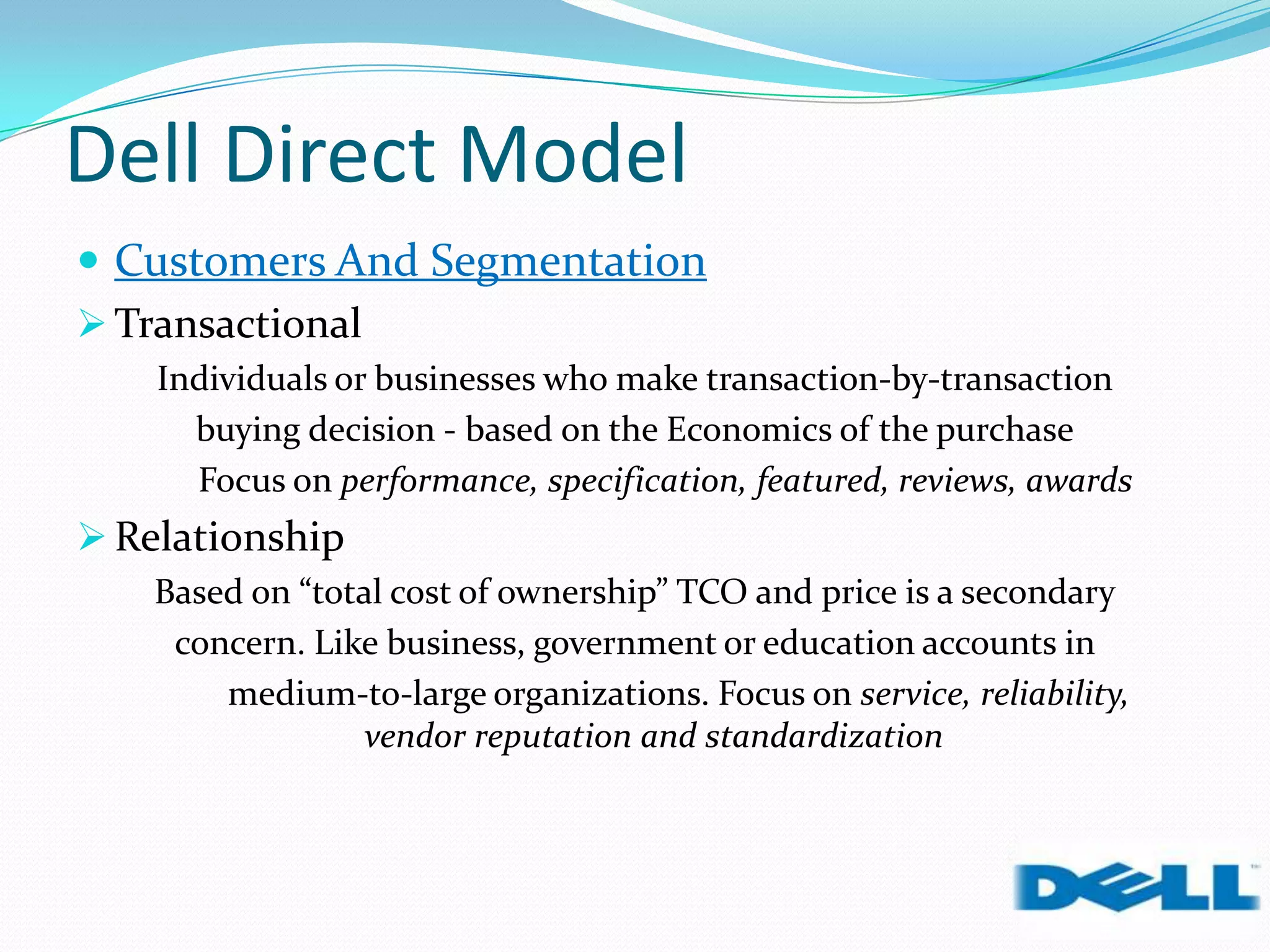
 Customers And Segmentation
 Transactional
Individuals or businesses who make transaction-by-transaction
buying decision - based on the Economics of the purchase
Focus on performance, specification, featured, reviews, awards
 Relationship
Based on “total cost of ownership” TCO and price is a secondary
concern. Like business, government or education accounts in
medium-to-large organizations. Focus on service, reliability,
vendor reputation and standardization
Dell Direct Model
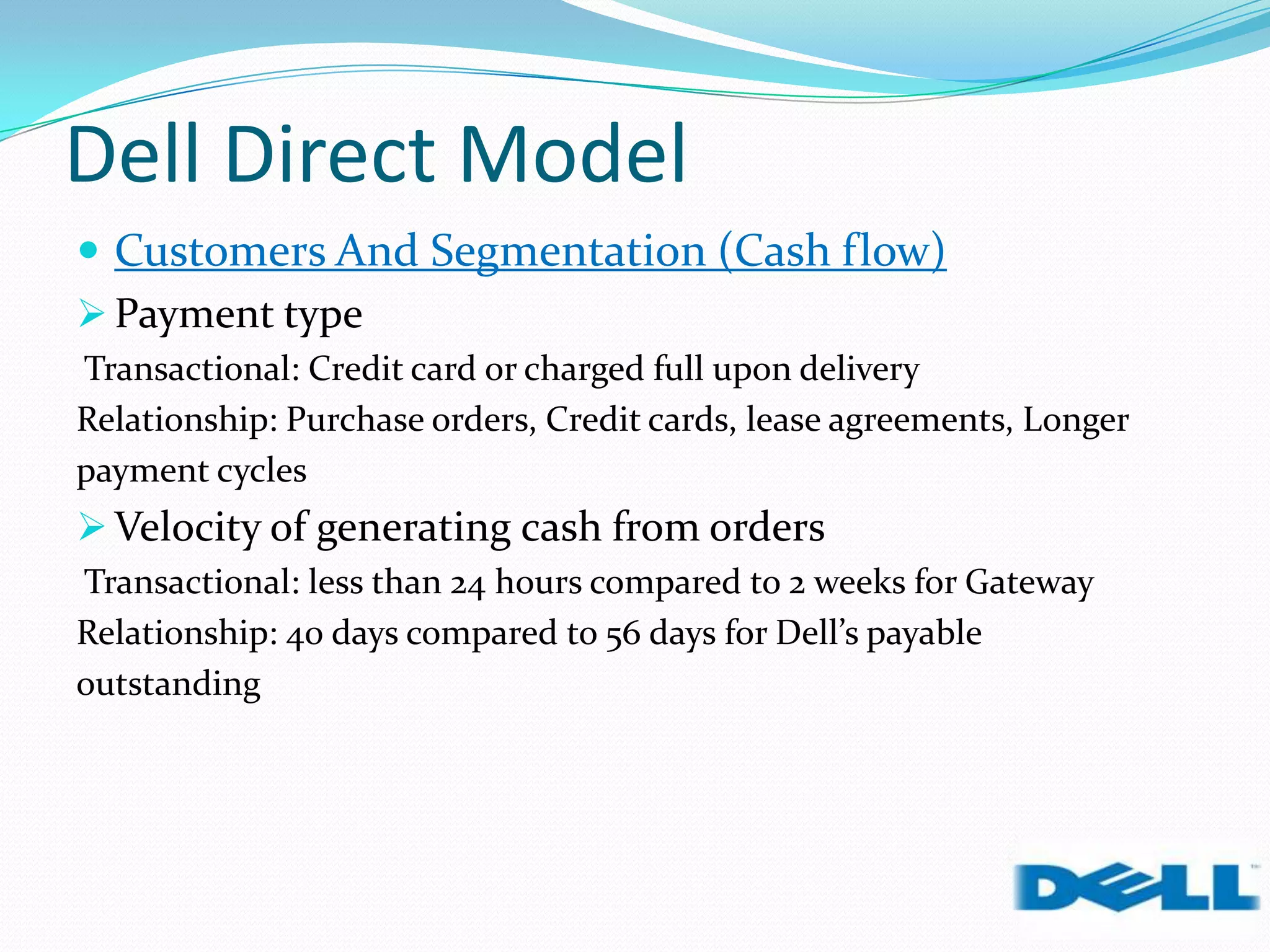
 Customers And Segmentation (Cash flow)
 Payment type
Transactional: Credit card or charged full upon delivery
Relationship: Purchase orders, Credit cards, lease agreements, Longer
payment cycles
 Velocity of generating cash from orders
Transactional: less than 24 hours compared to 2 weeks for Gateway
Relationship: 40 days compared to 56 days for Dell’s payable
outstanding
Dell Direct Model
 Customers And Segmentation
 Makes it easier to know the customer and identify unique
opportunities
 Better attention and Focus
 Bring Dell closer to customer to understand their needs and operating
environment
 Large Corporate Accounts “Gold” $5-$10 million
 Largest Account “Platinum” exceed of $10 million
Periodic regional “Platinum Council” for discussion and interaction
with Platinum accounts
Dell Direct Model
 Customers And Segmentation
 Geographic:
1. America( target, occupy 50% of net revenue)
2. Europe
3. Asia
4. Middle East
5. BRIC( Brazil, Russia, India & China)
 Psychographic
1. Interest community
2. Support forum
3. Blogs
4. Idea storm
 Behavioral
Dell Direct Model
 Behavioral
 Based on light, medium, and heavy product usage
 DELL: direct e-marketing through B2B market and B2C
market with market segment based on level of product usage
 B2C: for home (individual)- LIGHT PRODUCT USAGE
 B2B: a. small & medium businesses- MEDIUM PRODUCT
USAGE
A. Public sector( state & local government, federal government,
education, health care)- MEDIUM PRODUCT USAGE
B. Large enterprises – HEAVY PRODUCT USAGE
WWW.DELL.COM
 Developing www.dell.com
 Designing Started in 1995 Emphasize on early internet leadership
 It’s better to be in front with an imperfect internet
 implementation than to be late with the “perfect” Website Site
Launched in July 1996 Sales on the Web By December 1996 : $1 Million
a day By May 2000: $40 million daily {50% of total sales} In 2003: $16
billion
 Initially it was geared to Transactional Customers
 Manual order processor
 Order tracking system
 Technical support manuals, FAQs, troubleshooting info. Configuration
diagrams, software upgrades, device drivers
WWW.DELL.COM
 premier.dell.com
 Problem: Convincing large corporate customers to buy through Web
 Dell studied how they evaluated and acquired systems
 Dell designed Customized Websites called “Dell Premier Pages” for
“platinum” accounts, later for “gold” accounts.
 In fall 1997 Premier sites designed in less than a day for every customer
who has an agreement with Dell.
 “They place the order, it gets routed up to whoever in their company
needs to approve it, then is sent directly to us”, McNair
 September 2000 -> more than 50,000 Premier sites
WWW.DELL.COM
 valuechain.dell.com
 Customized Supplier Web pages Suppliers to share real-time
information with Dell on their Capacity, quality metrics, costs
Dell to share information on customer demand, product quality and
technical customer requirements
Conclusion
 The key to Dell’s success has been its direct sales and build-to-order
business model.
 This model is simple in concept but highly complex in its execution,
especially under conditions of rapid growth and New product lines
Ended up forcing its CEO to resign in 1999
 Problem: Conflicts between its traditional indirect sales channels and
its attempt to increase direct sales.
 Dell’s service advantage may be a greater differentiator than its 10-15%
cost advantage, Dell has everything we want in a tech company,
especially Focus, Dell does nothing but PCs
Conclusion
 Dell doesn’t even need the best product or price anymore,
because it is starting to own the PC space in buyers’ mind”
 Dell’s use of IT plays a vital role in the implementation of its
business model. The company has used IT to coordinate its
build-to-order processes from order taking through
procurement, logistics, production, service, and support.
Conclusion
 Companies such as Dell that are industry leaders in Internet commerce
will be able to expand their customer base and increase their business
with existing companies at a low marginal cost. They also can reduce
the cost of coordinating their supply chain through electronic linkages.
This will enable them to offer incentives to customers and suppliers
to do business electronically and continue to drive their own costs
down.
The dell model

The dell model

  • 1.
    Case study inthe E-MARKETING course Presented by: Ashraf Hatem Hlouh
  • 2.
    Dell Computer Corporation Founded by 19-year-old Michael Dell in a dorm room, grew by more than 50% a year over 1995-1998  Dell produces custom build PCs in a matter of hours and producing no PC component it could sustain a large portion of PC market comparing to IBM, HP, Compaq, Hitachi, Sony, Fujistu….
  • 3.
    Dell Background  Dell:Birth and Childhood (1983 – 1990)  Michael Dell University of Texas at Austin  Upgraded IBM-compatible PCs in his spare time in dorm room. Then he assembled entire PC with 15% discount to established brands.  On May 3, 1984 Dell Computer Corp was officially established.  Efficient and Low Cost operations Support services such as 24-hour hotline and guaranteed shipment of replacement part  Attractive to technology literate customers who looked for quality at a reasonable price
  • 4.
    Dell Background  Dellgrew from nothing to $5 million at 1985  International Expansion : 1987 UK ,1990: Limerick, relend to serve the European, middle eastern and African markets.  Sales In 1990: $500 million Michael Dell became the richest person in Texas.  Dell’s Model being imitated by other vendors like Gateway 2000
  • 5.
  • 6.
    Dell Background  Dellemployees worldwide Approximately 103300 employees end of Fiscal 2011 100300 regular employees 3000 temporary 36,900 of the regular employees at end of 2011 located in the U.S Acquisition of Perot Systems Corporation in Fiscal 2010 added 23,800 regular employees
  • 7.
    Dell Direct Model IndirectChannels  Reseller Customized the PC to customer requirements, installed components and provided additional service and support
  • 8.
    Dell Direct Model TheDirect Model  Direct Sales From the PC manufacturer to the corporate customer or consumer.  Bypassing the dealer channel, selling directly to consumer  Focus on Speed of Execution and Minimum Inventory
  • 9.
    Dell Direct Model The Direct Model Characteristics  Eliminate costs and risks of carrying large finished good inventories  High velocity  Low-cost distribution  Direct customer relationship  Build-to-order  Just-in-time manufacturing  Products and Services aimed at specific market segments Dell End user
  • 10.
    Dell Direct Model The Direct Model Characteristics  Reduced channel costs: from 13.5%-15.5% to 2% of product revenue  Latest Technology was introduced faster than indirect channels  Dell can use IT to directly control its value chain, set quality measures and monitor in real time how material is flowing throughout the chain  Managing Information to  Increase Velocity,  Track data on margins, selling price,…  Utilize info. to get the suppliers in sync with the high-velocity model
  • 11.
    Dell Direct Model The Direct Model Characteristics  Most of Dell’s suppliers keep components warehoused less than 20 minutes away from Dell’s factories  Dell has small number of suppliers Even it reduced their number from 204 in 1992 to 47 in 1997 Dell's Inventory sales after Direct Model
  • 12.
    Dell Direct Model Manufacturing Process  No warehouse Space,  No inventory other than work in process  Manufacturing is synchronized to avoid storing parts or finished systems o This needs close relationship with suppliers o Trust Manufactures like Sony, Logistics like UPS o No test time
  • 13.
    Dell Direct Model Products DesktopsLaptops & notebooks Mobile phones & Devices Printers & InkElectronics & Software HDTVs & Home theater
  • 14.
    Dell Direct Model Major competitors
  • 15.
    Dell Direct Model Customer Service  In 1986, San Francisco, Dell determines the company’s future direction: “The first: to really grow our business, we would have to target large companies. The second: to land large companies we would have to offer the absolute best support in the industry. That was how we came up with the idea to provide the industry’s first on-site service for PC’s. if a customer called us with a problem, we’d say, “We’ll be out tomorrow to fix it”
  • 16.
    Dell Direct Model Customer Service  1,300 technical support personnel  Accessible by phone 24 hours a day  90% of calls can be solved on the phone by standard  troubleshooting procedures  Third-party maintenance providers like Unisys, Wang, Decision one consulting and Digital Equipment  Tight coordination with supplier, vendors and maintenance providers feels like Just one large company
  • 17.
    Dell Direct Model Customer Service  In Computerworld’s 1998 survey Dell ranked first in user satisfaction followed by Gateway  According to Computerworld traditional vendors depends too heavily on resellers that prevents them from reacting quickly to customer needs, because resellers may place their own interests first
  • 18.
    Dell Direct Model Financial highlights For fiscal year 2010, second quarter (ended July 30, 2010)  Revenue — $15.5 billion  Operating income — $745 million  Net income — $545 million  Earnings per share — $0.28
  • 19.
    Dell Direct Model Dell computer Corp. Financial Data, 2009 - 2012 Currency in $ Millions As of: Jan 30 2009 Reclassified Jan 29 2010 Reclassified Jan 28 2011 Feb 03 2012 Press Release Revenues 61,101.0 52,902.0 61,494.0 62,071.0 Total Revenues 61,101.0 52,902.0 61,494.0 62,071.0 Cost Of Goods Sold 49,998.0 43,404.0 50,041.0 48,211.0 Gross Profit 11,103.0 9,498.0 11,453.0 13,860.0 Selling General & Admin Expenses, Total 6,966.0 6,227.0 7,234.0 8,524.0 R&D Expenses 665.0 617.0 653.0 856.0 Other Operating Expenses, Total 7,631.0 6,844.0 7,887.0 9,380.0 Operating Income 3,472.0 2,654.0 3,566.0 4,480.0
  • 20.
     Global PCMarket Share - 2001-2005 Global PC Market Share by Units, Percent. 2001-2005 Rank 2001 2002 2003 2004 2005 1 Dell 13.3 HP- Compaq 16.2 Dell 15.0 Dell 16.4 Dell 16.8 2 Compaq 11.1 Dell 15.2 HP 14.3 HP 14.6 HP 14.5 3 HP 7.2 IBM 6.0 IBM 5.1 IBM 5.5 Lenovo 6.9 4 IBM 6.4 NEC 3.4 Fujitsu 3.8 Fujitsu 3.8 Acer 4.6 5 NEC 3.8 Toshiba 3.2 Toshib a 2.9 Acer 3.4 Fujitsu 3.8 Other s 58.1 56.0 58.9 56.4 53.3
  • 21.
     Global PCMarket Share - 2006-2011 Global PC Market Share by Units, Percent. 2006-2011. Rank 2006 2007 2008 2009 2010 2011 1 Dell 15.9 HP 18.2 HP 18.4 HP 19.3 HP 17.9 HP 17.2 2 HP 15.9 Dell 14.3 Dell 14.3 Acer 13.0 Dell 12.9 Lenov o 13.0 3 Lenovo 7.0 Acer 8.9 Acer 11.1 Dell 12.2 Acer 12.0 Dell 12.1 4 Acer 5.8 Lenovo 7.4 Lenovo 7.2 Lenovo 8.1 Lenovo 9.7 Acer 11.2 5 Toshiba 3.8 Toshiba 4.0 Toshiba 4.5 Toshiba 5.1 Toshiba 5.4 ASUS 5.9 Othe r 51.6 47.1 44.5 42.3 42.1 40.7
  • 22.
    Dell Direct Model Dell’s motivation for rethinking direct sell business model IN THE PAST TODAY  PC customizability was highly appreciated by customers  Surplus stock lost value quickly  Demand was typically low for each product variant  Assembly-to-order more effective than selling pre-configured PCs in retail stores  Customers are willing to choose from a few standardized PCs model.  Inventory of standardized models moves fast  Demand was relatively high for each standardized model  PC became a popular commodity, price has dropped significantly  Direct sell model is less effective in today’s more standardized market
  • 23.
    Dell Direct Model Customers And Segmentation  Transactional Individuals or businesses who make transaction-by-transaction buying decision - based on the Economics of the purchase Focus on performance, specification, featured, reviews, awards  Relationship Based on “total cost of ownership” TCO and price is a secondary concern. Like business, government or education accounts in medium-to-large organizations. Focus on service, reliability, vendor reputation and standardization
  • 24.
    Dell Direct Model Customers And Segmentation (Cash flow)  Payment type Transactional: Credit card or charged full upon delivery Relationship: Purchase orders, Credit cards, lease agreements, Longer payment cycles  Velocity of generating cash from orders Transactional: less than 24 hours compared to 2 weeks for Gateway Relationship: 40 days compared to 56 days for Dell’s payable outstanding
  • 25.
    Dell Direct Model Customers And Segmentation  Makes it easier to know the customer and identify unique opportunities  Better attention and Focus  Bring Dell closer to customer to understand their needs and operating environment  Large Corporate Accounts “Gold” $5-$10 million  Largest Account “Platinum” exceed of $10 million Periodic regional “Platinum Council” for discussion and interaction with Platinum accounts
  • 26.
    Dell Direct Model Customers And Segmentation  Geographic: 1. America( target, occupy 50% of net revenue) 2. Europe 3. Asia 4. Middle East 5. BRIC( Brazil, Russia, India & China)  Psychographic 1. Interest community 2. Support forum 3. Blogs 4. Idea storm  Behavioral
  • 27.
    Dell Direct Model Behavioral  Based on light, medium, and heavy product usage  DELL: direct e-marketing through B2B market and B2C market with market segment based on level of product usage  B2C: for home (individual)- LIGHT PRODUCT USAGE  B2B: a. small & medium businesses- MEDIUM PRODUCT USAGE A. Public sector( state & local government, federal government, education, health care)- MEDIUM PRODUCT USAGE B. Large enterprises – HEAVY PRODUCT USAGE
  • 28.
    WWW.DELL.COM  Developing www.dell.com Designing Started in 1995 Emphasize on early internet leadership  It’s better to be in front with an imperfect internet  implementation than to be late with the “perfect” Website Site Launched in July 1996 Sales on the Web By December 1996 : $1 Million a day By May 2000: $40 million daily {50% of total sales} In 2003: $16 billion  Initially it was geared to Transactional Customers  Manual order processor  Order tracking system  Technical support manuals, FAQs, troubleshooting info. Configuration diagrams, software upgrades, device drivers
  • 29.
    WWW.DELL.COM  premier.dell.com  Problem:Convincing large corporate customers to buy through Web  Dell studied how they evaluated and acquired systems  Dell designed Customized Websites called “Dell Premier Pages” for “platinum” accounts, later for “gold” accounts.  In fall 1997 Premier sites designed in less than a day for every customer who has an agreement with Dell.  “They place the order, it gets routed up to whoever in their company needs to approve it, then is sent directly to us”, McNair  September 2000 -> more than 50,000 Premier sites
  • 30.
    WWW.DELL.COM  valuechain.dell.com  CustomizedSupplier Web pages Suppliers to share real-time information with Dell on their Capacity, quality metrics, costs Dell to share information on customer demand, product quality and technical customer requirements
  • 31.
    Conclusion  The keyto Dell’s success has been its direct sales and build-to-order business model.  This model is simple in concept but highly complex in its execution, especially under conditions of rapid growth and New product lines Ended up forcing its CEO to resign in 1999  Problem: Conflicts between its traditional indirect sales channels and its attempt to increase direct sales.  Dell’s service advantage may be a greater differentiator than its 10-15% cost advantage, Dell has everything we want in a tech company, especially Focus, Dell does nothing but PCs
  • 32.
    Conclusion  Dell doesn’teven need the best product or price anymore, because it is starting to own the PC space in buyers’ mind”  Dell’s use of IT plays a vital role in the implementation of its business model. The company has used IT to coordinate its build-to-order processes from order taking through procurement, logistics, production, service, and support.
  • 33.
    Conclusion  Companies suchas Dell that are industry leaders in Internet commerce will be able to expand their customer base and increase their business with existing companies at a low marginal cost. They also can reduce the cost of coordinating their supply chain through electronic linkages. This will enable them to offer incentives to customers and suppliers to do business electronically and continue to drive their own costs down.