TIME

What is it?
A dictionary defines time as "the point or
period at which things occur." Put simply,
        time is when stuff happens.
Imagine there is a bank account that
credits your account each morning
with $86,400. It carries over no balance
from day to day.
Every evening the bank deletes
whatever part of the balance you failed
to use during the day. What would you
do? Draw out every cent, of course?
Each of us has such a bank. It's name is
                 TIME.
   Every morning, it credits you with
            86,400 seconds.
Every night it writes off as lost, whatever
    of this you have failed to invest to a
               good purpose.
  It carries over no balance. It allows no
    over draft. Each day it opens a new
 account for you. Each night it burns the
             remains of the day.
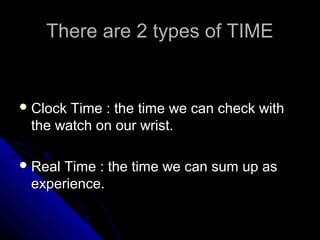
There are 2 types of TIME


 ClockTime : the time we can check with
 the watch on our wrist.

 RealTime : the time we can sum up as
 experience.
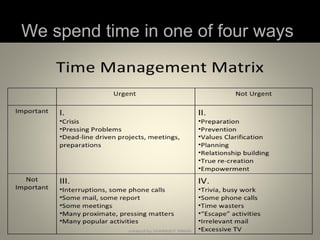
We spend time in one of four ways
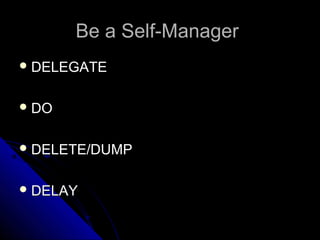
Be a Self-Manager
 DELEGATE


 DO


 DELETE/DUMP


 DELAY
Tips and tricks
 Plan your day,
 Write down your daily task
 Do not over estimate your ability
 Don’t waste your time while waiting
Law of Pareto :
 20% of our activities deliver 80 % of the
 result

 The   inverse is also true
Law of Parkinson :
 The  more time is available, the more time
  a task will consume
 The4 more time is available, the more time
  we will waste
 Efficiency increase as deadline
  approaches
Law of Carlson :
 Handling   a task only once and finishing it
  off, takes less time than handling it in
  several times
 Every interruption has a negative impact
  on efficiency
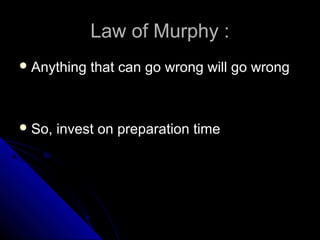
Law of Murphy :
 Anything   that can go wrong will go wrong


 So,   invest on preparation time
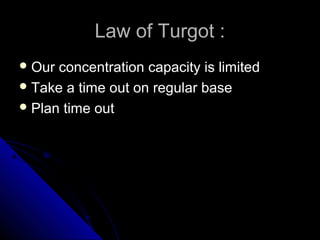
Law of Turgot :
 Our concentration capacity is limited
 Take a time out on regular base
 Plan time out
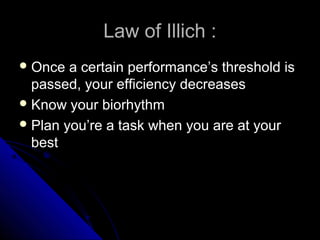
Law of Illich :
 Once  a certain performance’s threshold is
  passed, your efficiency decreases
 Know your biorhythm
 Plan you’re a task when you are at your
  best
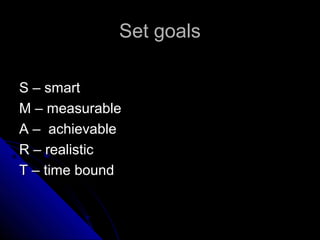
Set goals

S – smart
M – measurable
A – achievable
R – realistic
T – time bound
Why to implement Time
            Management ?
 Gain   time
 Motivates and initiates
 Reduces anxiety
 Self life control
 Achieve objectives at work and home
So, D.O.I.T.N.O.W
D – Divide your work, task break- down
O – Organize
I – Ignore interruptions
T – Train yourself, learn to do things
N – Now, not tomorrow
O – Opportunity should be grabbed
W – Watch out for time. Control time
   investment
“Know the true value of time; snatch, seize,
  and enjoy every moment of it. No idleness,
  no laziness, no procrastination; Never put
  off till tomorrow what you can do today.”

                        – Lord Chesterfield
The clock is running!! Make the most of today.

    To realise the value of ONE YEAR, ask a
          student who failed a grade.

  To realise the value of ONE MONTH, ask a
  mother who has given birth to a premature
                     baby.

  To realise the value of ONE WEEK, ask the
        editor of a weekly newspaper.
To realise the value of ONE HOUR, ask the
       lovers who are waiting to meet.
 To realise the value of ONE MINUTE, ask a
      person who just missed a train.
 To realise the value of ONE SECOND, ask
  someone who just avoided an accident.
 To realise the value of ONE MILLISECOND,
ask the person who won a silver medal at the
                  Olympics.
Remember,
The best manager of life is TIME
The best manager of time is YOU

         Thank You!!!

Time Management

  • 1.
  • 2.
    A dictionary definestime as "the point or period at which things occur." Put simply, time is when stuff happens.
  • 3.
    Imagine there isa bank account that credits your account each morning with $86,400. It carries over no balance from day to day. Every evening the bank deletes whatever part of the balance you failed to use during the day. What would you do? Draw out every cent, of course?
  • 4.
    Each of ushas such a bank. It's name is TIME. Every morning, it credits you with 86,400 seconds.
  • 5.
    Every night itwrites off as lost, whatever of this you have failed to invest to a good purpose. It carries over no balance. It allows no over draft. Each day it opens a new account for you. Each night it burns the remains of the day.
  • 6.
    There are 2types of TIME  ClockTime : the time we can check with the watch on our wrist.  RealTime : the time we can sum up as experience.
  • 7.
    We spend timein one of four ways
  • 8.
    Be a Self-Manager DELEGATE  DO  DELETE/DUMP  DELAY
  • 9.
    Tips and tricks Plan your day,  Write down your daily task  Do not over estimate your ability  Don’t waste your time while waiting
  • 10.
    Law of Pareto:  20% of our activities deliver 80 % of the result  The inverse is also true
  • 11.
    Law of Parkinson:  The more time is available, the more time a task will consume  The4 more time is available, the more time we will waste  Efficiency increase as deadline approaches
  • 12.
    Law of Carlson:  Handling a task only once and finishing it off, takes less time than handling it in several times  Every interruption has a negative impact on efficiency
  • 13.
    Law of Murphy:  Anything that can go wrong will go wrong  So, invest on preparation time
  • 14.
    Law of Turgot:  Our concentration capacity is limited  Take a time out on regular base  Plan time out
  • 15.
    Law of Illich:  Once a certain performance’s threshold is passed, your efficiency decreases  Know your biorhythm  Plan you’re a task when you are at your best
  • 16.
    Set goals S –smart M – measurable A – achievable R – realistic T – time bound
  • 17.
    Why to implementTime Management ?  Gain time  Motivates and initiates  Reduces anxiety  Self life control  Achieve objectives at work and home
  • 18.
    So, D.O.I.T.N.O.W D –Divide your work, task break- down O – Organize I – Ignore interruptions T – Train yourself, learn to do things N – Now, not tomorrow O – Opportunity should be grabbed W – Watch out for time. Control time investment
  • 19.
    “Know the truevalue of time; snatch, seize, and enjoy every moment of it. No idleness, no laziness, no procrastination; Never put off till tomorrow what you can do today.” – Lord Chesterfield
  • 20.
    The clock isrunning!! Make the most of today. To realise the value of ONE YEAR, ask a student who failed a grade. To realise the value of ONE MONTH, ask a mother who has given birth to a premature baby. To realise the value of ONE WEEK, ask the editor of a weekly newspaper.
  • 21.
    To realise thevalue of ONE HOUR, ask the lovers who are waiting to meet. To realise the value of ONE MINUTE, ask a person who just missed a train. To realise the value of ONE SECOND, ask someone who just avoided an accident. To realise the value of ONE MILLISECOND, ask the person who won a silver medal at the Olympics.
  • 22.
    Remember, The best managerof life is TIME The best manager of time is YOU Thank You!!!