DELEGATION
MS. MARIANNE LAYLO
Nurse Tutor
• Delegation is primarily about entrusting your authority to
others
-Raphael Barinshaky
• At its most basic, delegation is empowering
one person to act for another.
-Susanne Qualich
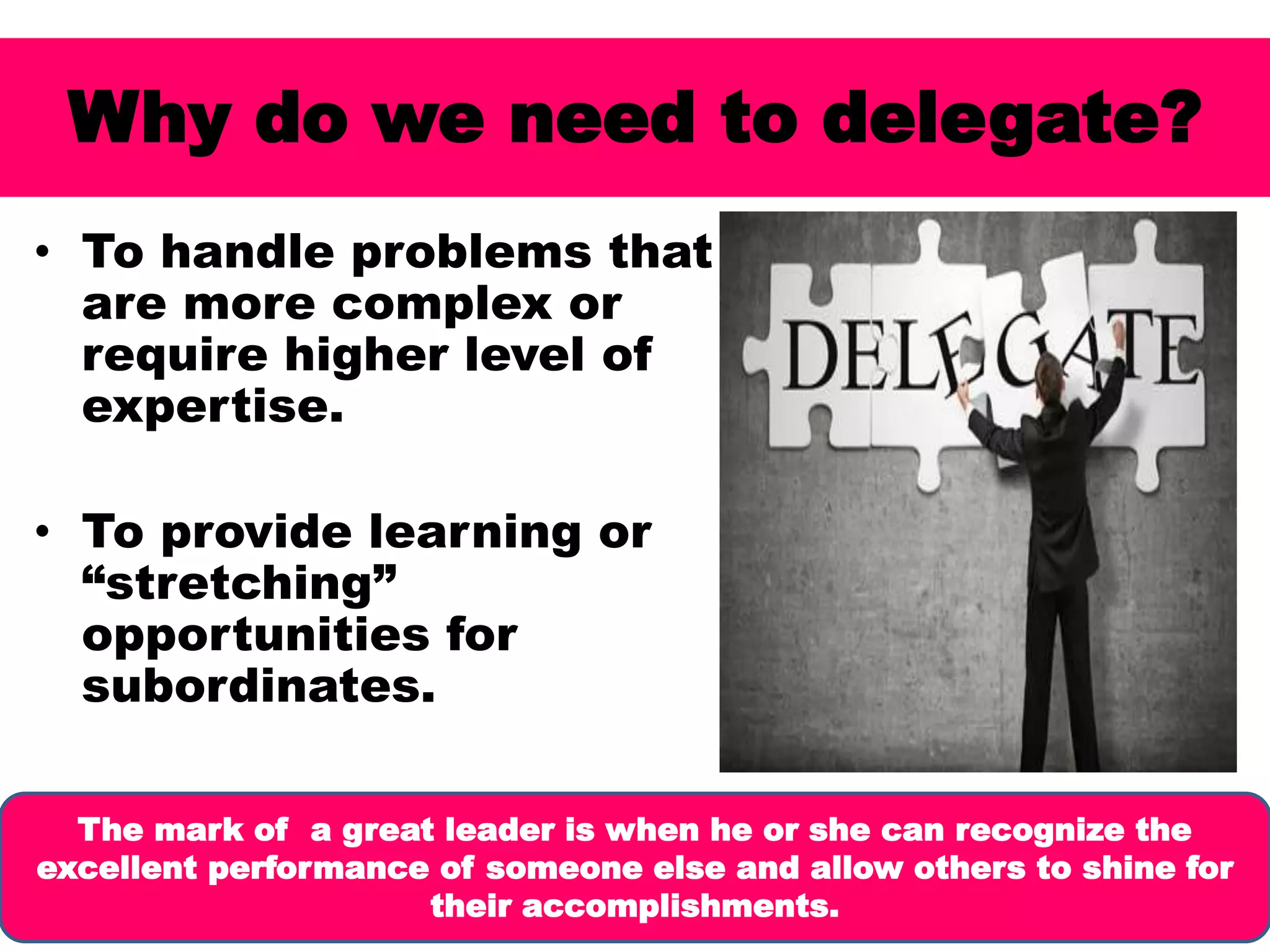
Why do we need to delegate?
• To handle problems that
are more complex or
require higher level of
expertise.
• To provide learning or
“stretching”
opportunities for
subordinates.
The mark of a great leader is when he or she can recognize the
excellent performance of someone else and allow others to shine for
their accomplishments.
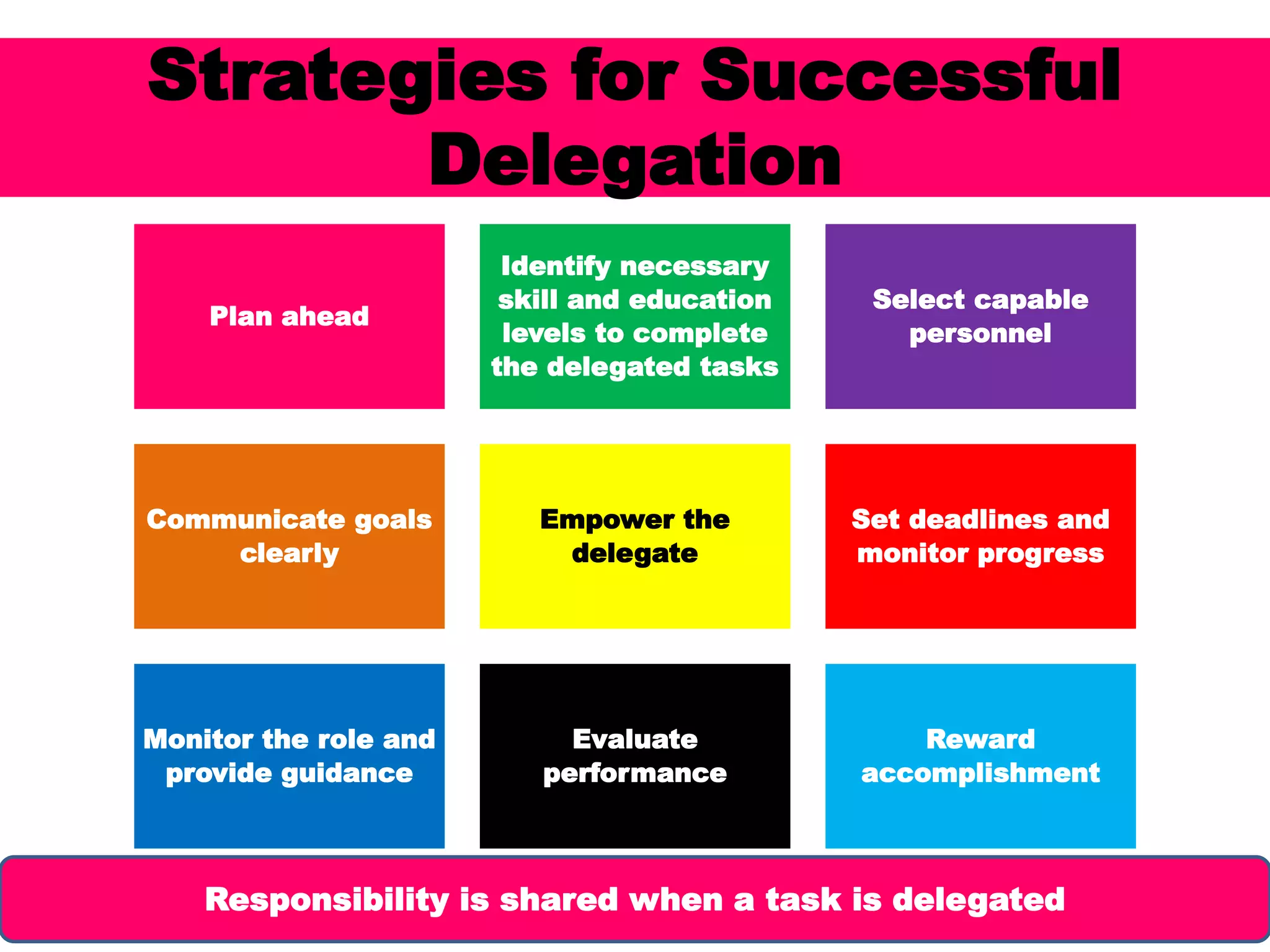
Strategies for Successful
Delegation
Plan ahead
Identify necessary
skill and education
levels to complete
the delegated tasks
Select capable
personnel
Communicate goals
clearly
Empower the
delegate
Set deadlines and
monitor progress
Monitor the role and
provide guidance
Evaluate
performance
Reward
accomplishment
Responsibility is shared when a task is delegated
Difficulty in Delegation
• Is it difficult for you
to delegate to
others?
• If so, do you know
why?
• Are you more apt to
underdelegate,
overdelegate or
delegate improperly?
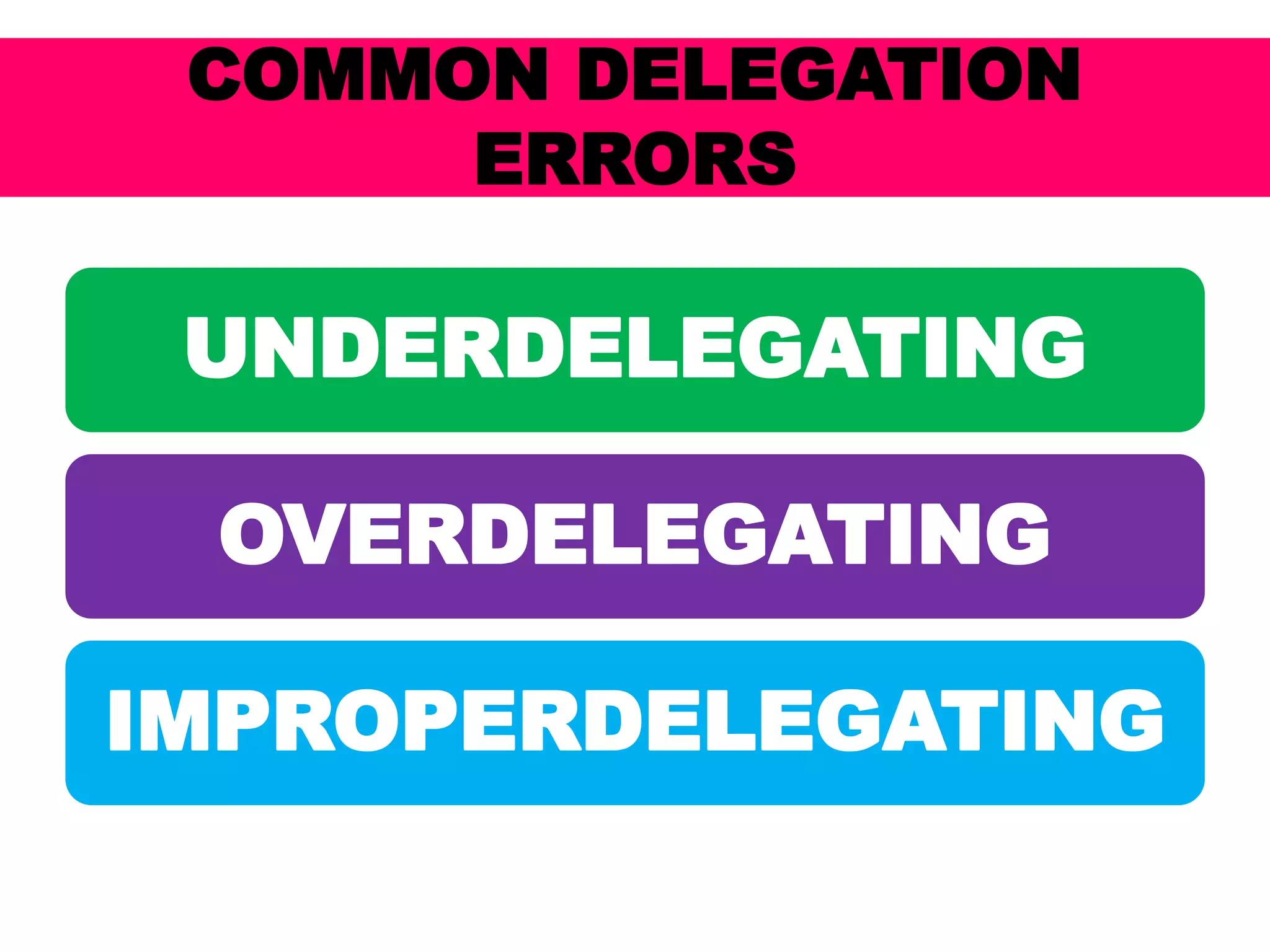
COMMON DELEGATION
ERRORS
UNDERDELEGATING
OVERDELEGATING
IMPROPERDELEGATING
UNDERDELEGATING
• Stems from the
individuals false
assumption that
delegation may be
interpreted as a lack
of ability from his or
her part to do the job
correctly or
completely.
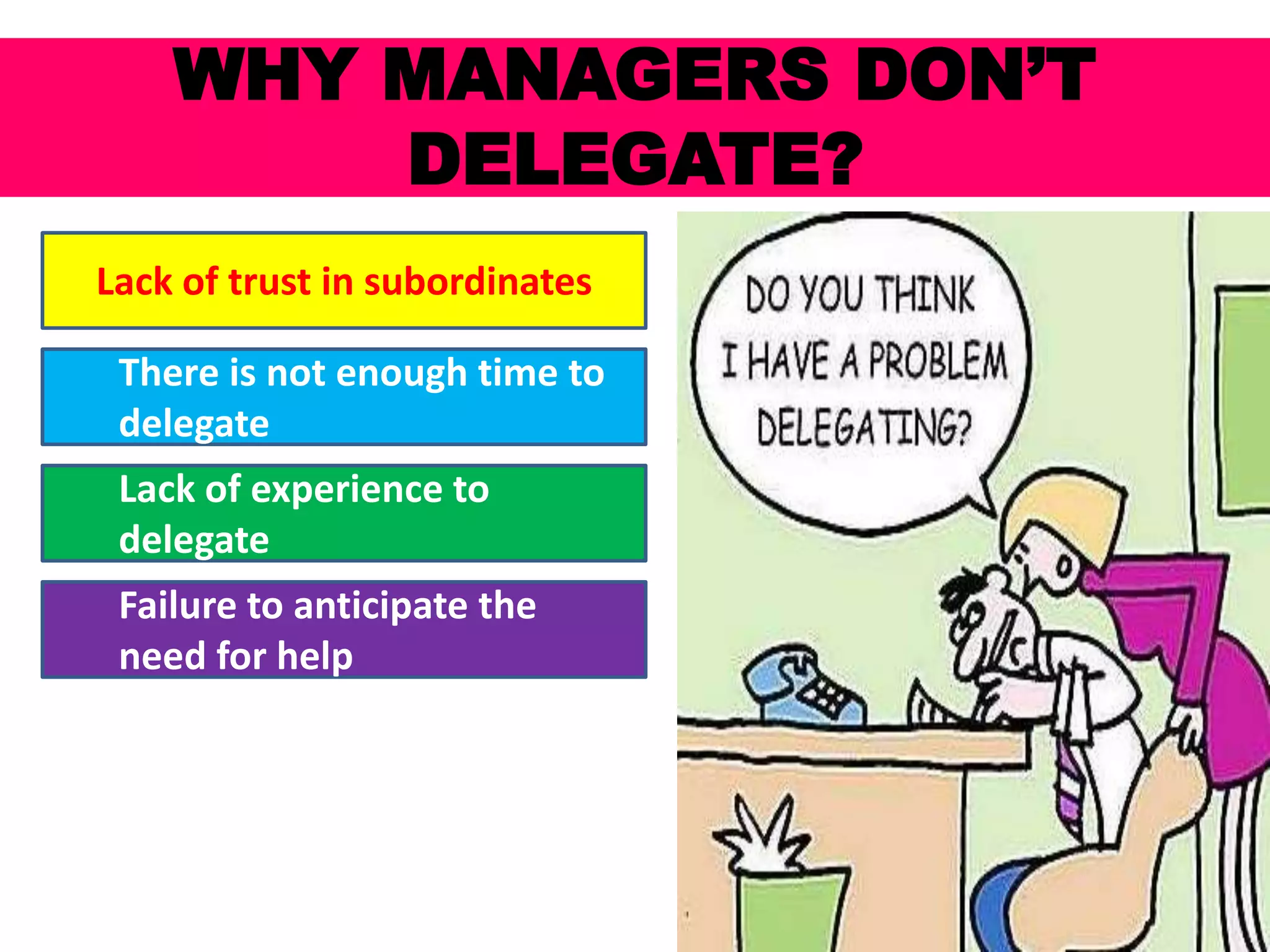
WHY MANAGERS DON’T
DELEGATE?
Lack of trust in subordinates
There is not enough time to
delegate
Lack of experience to
delegate
Failure to anticipate the
need for help
OVERDELEGATING
Wh
1. Because they are poor managers
of time
WHY MANAGERS DELEGATE
EVERYTHING?
2. They feel insecure in their ability
to perform a task
Delegating at the
wrong time,
to the wrong
person,
or for the wrong
reason.
IMPROPER DELEGATING
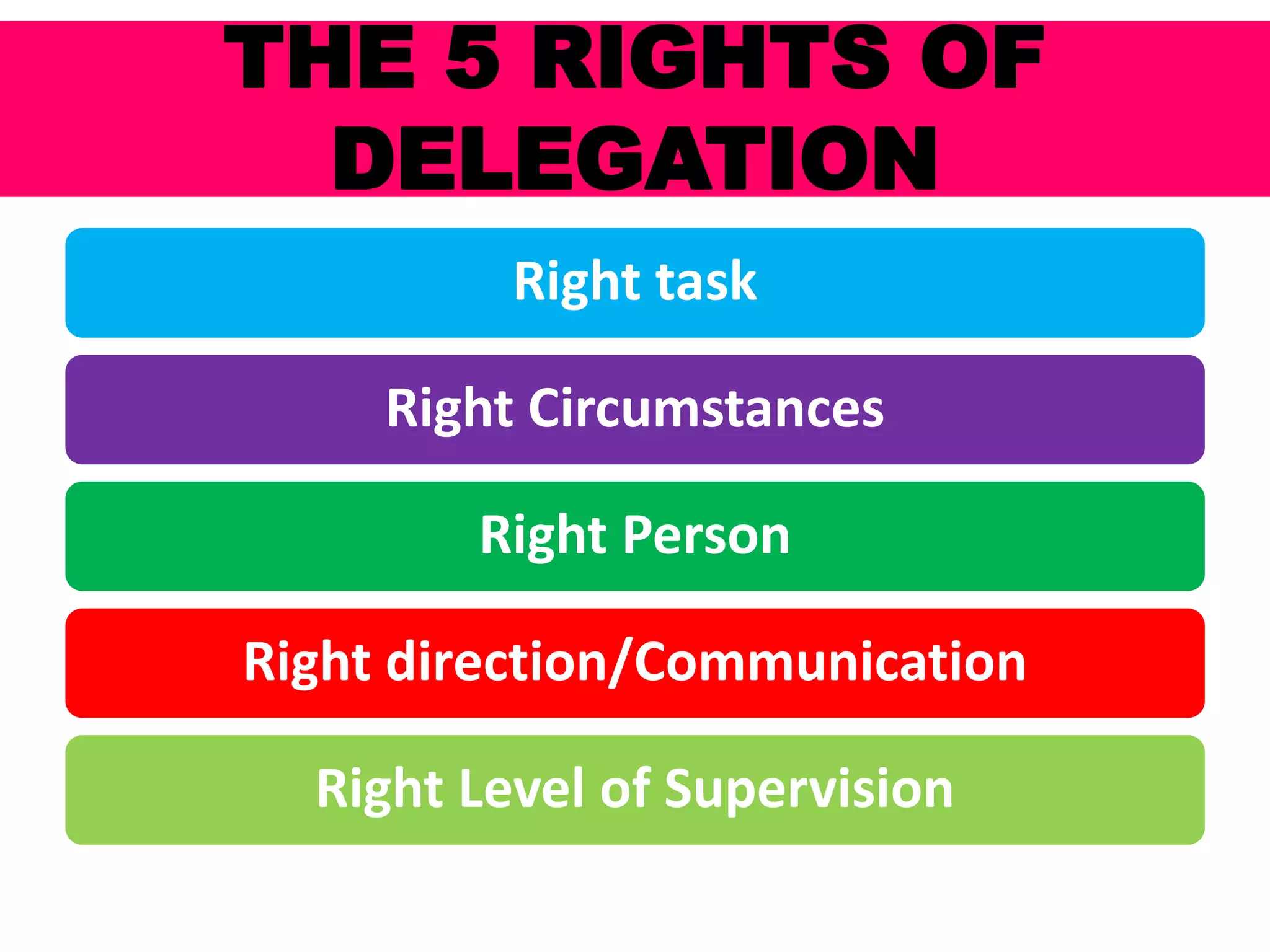
Right task
Right Circumstances
Right Person
Right direction/Communication
Right Level of Supervision
THE 5 RIGHTS OF
DELEGATION
Communication Space
Social
Organization
Time (Past,
Present and
Future Oriented
Cultures)
Environmental
Control
Biological
Variations
DELEGATING TO A
TRANSCULTURAL TEAM
CREATING A
MOTIVATING CLIMATE
The force within the individual that
influences or directs behavior.
INTRINSIC VS EXTRINSIC
MOTIVATION
INTRINSIC MOTIVATION EXTRINSIC MOTIVATION
Comes from within the
individual
Often influenced by
family unit and cultural
values
Comes from outside
the individual
Rewards and
reinforcements are
given to encourage
certain behaviors
and/or levels of
achievement.
MOTIVATIONAL THEORY
• Maslow (1970) believed that people are
motivated to satisfy certain needs

DELEGATION IN NURSING