MANAGEMENT OF SEVERE
DEHYDRATION
DR YAKUBU, AHAB
SUPERVISED BY DR. MADUBUKO C.
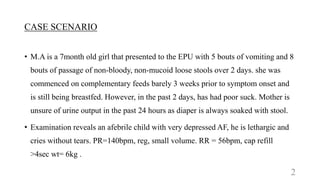
CASE SCENARIO
• M.A is a 7month old girl that presented to the EPU with 5 bouts of vomiting and 8
bouts of passage of non-bloody, non-mucoid loose stools over 2 days. she was
commenced on complementary feeds barely 3 weeks prior to symptom onset and
is still being breastfed. However, in the past 2 days, has had poor suck. Mother is
unsure of urine output in the past 24 hours as diaper is always soaked with stool.
• Examination reveals an afebrile child with very depressed AF, he is lethargic and
cries without tears. PR=140bpm, reg, small volume. RR = 56bpm, cap refill
>4sec wt= 6kg .
2
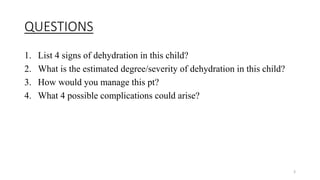
QUESTIONS
1. List 4 signs of dehydration in this child?
2. What is the estimated degree/severity of dehydration in this child?
3. How would you manage this pt?
4. What 4 possible complications could arise?
3
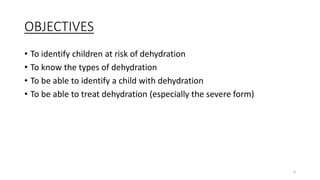
OBJECTIVES
• To identify children at risk of dehydration
• To know the types of dehydration
• To be able to identify a child with dehydration
• To be able to treat dehydration (especially the severe form)
4
OUTLINE
• INTRODUCTION
• CAUSES OF DEHYDRATION
• CLASSIFICATION OF DEHYDRATION
• TYPES OF DEHYDRATION
• CLINICAL FEATURES OF DEHYDRATION
• TREATMENT
• COMPLICATIONS
• CONCLUSION
5
INTRODUCTION
• Dehydration is the excessive loss of body water resulting in a decrease in
total body water.
• It is a state of negative fluid balance that can be caused by various diseases.
• Many clinical conditions lead to this abnormal water balance in children
and depending on the relative effects of intake and loss either dehydration
or overhydration may result.
• Total fluid loss > Total fluid intake
6
• Fluid loss from both intravascular and extravascular compartments
can result to dehydration.
• Extravascular loss- impairment of cellular function and loss of tissue
laxity
• Often there is an associated electrolyte loss with diarrhoea
• Sodium is the most affected electrolyte- Hyponatremia or
hypernatremia
• If not properly treated, morbidity and mortality rates increase.
7
Body water distribution
• Although a smaller percentage of body water is in the ECF( except in
the newborn) , it is more prone to fluctuation compared to the ICF, as
such, dehydration and overhydration are associated with changes in
the ECF volume.
• The newborn is made up of 70-80% water
• Adults 50-60% water
8
Body water distribution
• Infants are at higher risk of dehydration due to:
• High surface area to body ratio
• High basal fluid requirement
• Immature renal tubular reabsorbtion
• Inability to gain access to fluids when thirsty
9
Water balance
• The amount of water in the body is influenced by input and output
• Input – water, breastmilk, food
• Output – insensible loss- about 30ml/kg/day
- renal water loss – about 60ml/kg/day
- stool water loss – 10ml/kg/day
However, insensible loss vary with age.
it is more in preterm and reduces as the child gets older
10
Causes of Dehydration
1. REDUCED INTAKE – poor maternal lactation, GI malformations
(oesophageal atresia), poorly mixed baby formular
2. INCREASED LOSS -
 True volume depletion
• Increased insensible loss – persistent fever, phototherapy , burns,
hyperhidrosis, heat stroke, ventilator use
• Renal loss – DKA, DI, polyuric phase of AKI, adrenal insufficiency
• GI loss – diarrhea, vomiting, NG tube drainage
 Decreased intravascular volume with increased total body water
• Third space loss- peritonitis, nephrotic syndrome
11
CLASSIFICATION
Based on severity
1. Mild – loss of <5% body weight
2. Moderate – loss of 5-10% body weight
3. Severe – loss of >10% body weight
12
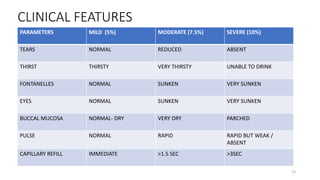
CLINICAL FEATURES
PARAMETERS MILD (5%) MODERATE (7.5%) SEVERE (10%)
TEARS NORMAL REDUCED ABSENT
THIRST THIRSTY VERY THIRSTY UNABLE TO DRINK
FONTANELLES NORMAL SUNKEN VERY SUNKEN
EYES NORMAL SUNKEN VERY SUNKEN
BUCCAL MUCOSA NORMAL- DRY VERY DRY PARCHED
PULSE NORMAL RAPID RAPID BUT WEAK /
ABSENT
CAPILLARY REFILL IMMEDIATE >1.5 SEC >3SEC
13
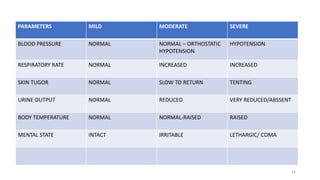
PARAMETERS MILD MODERATE SEVERE
BLOOD PRESSURE NORMAL NORMAL – ORTHOSTATIC
HYPOTENSION
HYPOTENSION
RESPIRATORY RATE NORMAL INCREASED INCREASED
SKIN TUGOR NORMAL SLOW TO RETURN TENTING
URINE OUTPUT NORMAL REDUCED VERY REDUCED/ABSSENT
BODY TEMPERATURE NORMAL NORMAL-RAISED RAISED
MENTAL STATE INTACT IRRITABLE LETHARGIC/ COMA
14
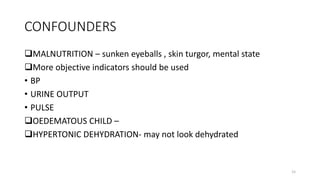
CONFOUNDERS
MALNUTRITION – sunken eyeballs , skin turgor, mental state
More objective indicators should be used
• BP
• URINE OUTPUT
• PULSE
OEDEMATOUS CHILD –
HYPERTONIC DEHYDRATION- may not look dehydrated
15
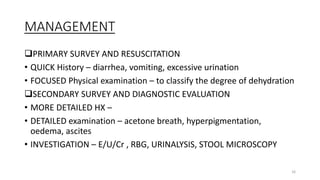
MANAGEMENT
PRIMARY SURVEY AND RESUSCITATION
• QUICK History – diarrhea, vomiting, excessive urination
• FOCUSED Physical examination – to classify the degree of dehydration
SECONDARY SURVEY AND DIAGNOSTIC EVALUATION
• MORE DETAILED HX –
• DETAILED examination – acetone breath, hyperpigmentation,
oedema, ascites
• INVESTIGATION – E/U/Cr , RBG, URINALYSIS, STOOL MICROSCOPY
16
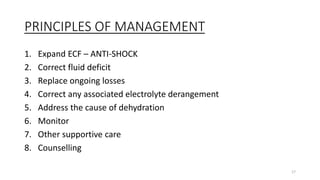
PRINCIPLES OF MANAGEMENT
1. Expand ECF – ANTI-SHOCK
2. Correct fluid deficit
3. Replace ongoing losses
4. Correct any associated electrolyte derangement
5. Address the cause of dehydration
6. Monitor
7. Other supportive care
8. Counselling
17
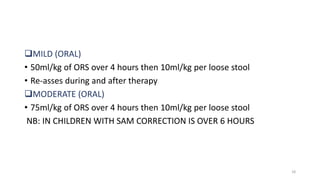
MILD (ORAL)
• 50ml/kg of ORS over 4 hours then 10ml/kg per loose stool
• Re-asses during and after therapy
MODERATE (ORAL)
• 75ml/kg of ORS over 4 hours then 10ml/kg per loose stool
NB: IN CHILDREN WITH SAM CORRECTION IS OVER 6 HOURS
18
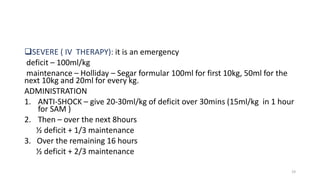
SEVERE ( IV THERAPY): it is an emergency
deficit – 100ml/kg
maintenance – Holliday – Segar formular 100ml for first 10kg, 50ml for the
next 10kg and 20ml for every kg.
ADMINISTRATION
1. ANTI-SHOCK – give 20-30ml/kg of deficit over 30mins (15ml/kg in 1 hour
for SAM )
2. Then – over the next 8hours
½ deficit + 1/3 maintenance
3. Over the remaining 16 hours
½ deficit + 2/3 maintenance
19
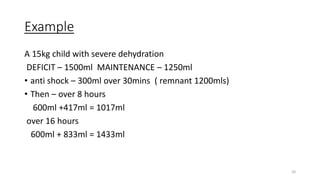
Example
A 15kg child with severe dehydration
DEFICIT – 1500ml MAINTENANCE – 1250ml
• anti shock – 300ml over 30mins ( remnant 1200mls)
• Then – over 8 hours
600ml +417ml = 1017ml
over 16 hours
600ml + 833ml = 1433ml
20
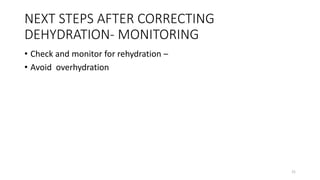
NEXT STEPS AFTER CORRECTING
DEHYDRATION- MONITORING
• Check and monitor for rehydration –
• Avoid overhydration
21
Principles of Treatment of Diarrhea
• Diarrhea disease is one of the commonest causes of dehydration
1. Correct dehydration
2. Replace ongoing losses (per loose stools)
3. Nutritional consideration
4. Additional therapy
• Antibiotics if indicated
• Zinc
• Vitamin A
22
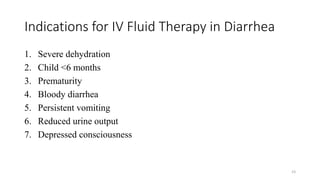
Indications for IV Fluid Therapy in Diarrhea
1. Severe dehydration
2. Child <6 months
3. Prematurity
4. Bloody diarrhea
5. Persistent vomiting
6. Reduced urine output
7. Depressed consciousness
23
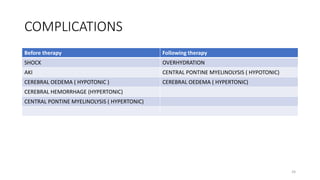
COMPLICATIONS
Before therapy Following therapy
SHOCK OVERHYDRATION
AKI CENTRAL PONTINE MYELINOLYSIS ( HYPOTONIC)
CEREBRAL OEDEMA ( HYPOTONIC ) CEREBRAL OEDEMA ( HYPERTONIC)
CEREBRAL HEMORRHAGE (HYPERTONIC)
CENTRAL PONTINE MYELINOLYSIS ( HYPERTONIC)
24
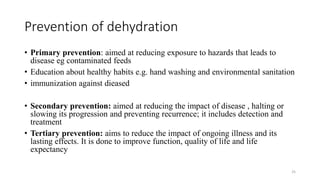
Prevention of dehydration
• Primary prevention: aimed at reducing exposure to hazards that leads to
disease eg contaminated feeds
• Education about healthy habits e.g. hand washing and environmental sanitation
• immunization against dieased
• Secondary prevention: aimed at reducing the impact of disease , halting or
slowing its progression and preventing recurrence; it includes detection and
treatment
• Tertiary prevention: aims to reduce the impact of ongoing illness and its
lasting effects. It is done to improve function, quality of life and life
expectancy
25
CONCLUSION
Dehydration is the excessive loss of body water resulting in a decrease
in total body water.
Infants are at higher risk of dehydration
Early detection and proper management of dehydration reduces
morbidity and mortality rates
26
•THANK YOU
27
REFERENCES
• PAEDIATRICS AND CHILD HEALTH IN A TROPICAL REGION – AZUBUIKE
AND NKANGINIEME
• NELSON TEXTBOOK OF PAEDIATRICS
• Medscape
28

DEHYDRATION PEDIATRICS PRESENTATION (1).pptx

  • 1.
    MANAGEMENT OF SEVERE DEHYDRATION DRYAKUBU, AHAB SUPERVISED BY DR. MADUBUKO C.
  • 2.
    CASE SCENARIO • M.Ais a 7month old girl that presented to the EPU with 5 bouts of vomiting and 8 bouts of passage of non-bloody, non-mucoid loose stools over 2 days. she was commenced on complementary feeds barely 3 weeks prior to symptom onset and is still being breastfed. However, in the past 2 days, has had poor suck. Mother is unsure of urine output in the past 24 hours as diaper is always soaked with stool. • Examination reveals an afebrile child with very depressed AF, he is lethargic and cries without tears. PR=140bpm, reg, small volume. RR = 56bpm, cap refill >4sec wt= 6kg . 2
  • 3.
    QUESTIONS 1. List 4signs of dehydration in this child? 2. What is the estimated degree/severity of dehydration in this child? 3. How would you manage this pt? 4. What 4 possible complications could arise? 3
  • 4.
    OBJECTIVES • To identifychildren at risk of dehydration • To know the types of dehydration • To be able to identify a child with dehydration • To be able to treat dehydration (especially the severe form) 4
  • 5.
    OUTLINE • INTRODUCTION • CAUSESOF DEHYDRATION • CLASSIFICATION OF DEHYDRATION • TYPES OF DEHYDRATION • CLINICAL FEATURES OF DEHYDRATION • TREATMENT • COMPLICATIONS • CONCLUSION 5
  • 6.
    INTRODUCTION • Dehydration isthe excessive loss of body water resulting in a decrease in total body water. • It is a state of negative fluid balance that can be caused by various diseases. • Many clinical conditions lead to this abnormal water balance in children and depending on the relative effects of intake and loss either dehydration or overhydration may result. • Total fluid loss > Total fluid intake 6
  • 7.
    • Fluid lossfrom both intravascular and extravascular compartments can result to dehydration. • Extravascular loss- impairment of cellular function and loss of tissue laxity • Often there is an associated electrolyte loss with diarrhoea • Sodium is the most affected electrolyte- Hyponatremia or hypernatremia • If not properly treated, morbidity and mortality rates increase. 7
  • 8.
    Body water distribution •Although a smaller percentage of body water is in the ECF( except in the newborn) , it is more prone to fluctuation compared to the ICF, as such, dehydration and overhydration are associated with changes in the ECF volume. • The newborn is made up of 70-80% water • Adults 50-60% water 8
  • 9.
    Body water distribution •Infants are at higher risk of dehydration due to: • High surface area to body ratio • High basal fluid requirement • Immature renal tubular reabsorbtion • Inability to gain access to fluids when thirsty 9
  • 10.
    Water balance • Theamount of water in the body is influenced by input and output • Input – water, breastmilk, food • Output – insensible loss- about 30ml/kg/day - renal water loss – about 60ml/kg/day - stool water loss – 10ml/kg/day However, insensible loss vary with age. it is more in preterm and reduces as the child gets older 10
  • 11.
    Causes of Dehydration 1.REDUCED INTAKE – poor maternal lactation, GI malformations (oesophageal atresia), poorly mixed baby formular 2. INCREASED LOSS -  True volume depletion • Increased insensible loss – persistent fever, phototherapy , burns, hyperhidrosis, heat stroke, ventilator use • Renal loss – DKA, DI, polyuric phase of AKI, adrenal insufficiency • GI loss – diarrhea, vomiting, NG tube drainage  Decreased intravascular volume with increased total body water • Third space loss- peritonitis, nephrotic syndrome 11
  • 12.
    CLASSIFICATION Based on severity 1.Mild – loss of <5% body weight 2. Moderate – loss of 5-10% body weight 3. Severe – loss of >10% body weight 12
  • 13.
    CLINICAL FEATURES PARAMETERS MILD(5%) MODERATE (7.5%) SEVERE (10%) TEARS NORMAL REDUCED ABSENT THIRST THIRSTY VERY THIRSTY UNABLE TO DRINK FONTANELLES NORMAL SUNKEN VERY SUNKEN EYES NORMAL SUNKEN VERY SUNKEN BUCCAL MUCOSA NORMAL- DRY VERY DRY PARCHED PULSE NORMAL RAPID RAPID BUT WEAK / ABSENT CAPILLARY REFILL IMMEDIATE >1.5 SEC >3SEC 13
  • 14.
    PARAMETERS MILD MODERATESEVERE BLOOD PRESSURE NORMAL NORMAL – ORTHOSTATIC HYPOTENSION HYPOTENSION RESPIRATORY RATE NORMAL INCREASED INCREASED SKIN TUGOR NORMAL SLOW TO RETURN TENTING URINE OUTPUT NORMAL REDUCED VERY REDUCED/ABSSENT BODY TEMPERATURE NORMAL NORMAL-RAISED RAISED MENTAL STATE INTACT IRRITABLE LETHARGIC/ COMA 14
  • 15.
    CONFOUNDERS MALNUTRITION – sunkeneyeballs , skin turgor, mental state More objective indicators should be used • BP • URINE OUTPUT • PULSE OEDEMATOUS CHILD – HYPERTONIC DEHYDRATION- may not look dehydrated 15
  • 16.
    MANAGEMENT PRIMARY SURVEY ANDRESUSCITATION • QUICK History – diarrhea, vomiting, excessive urination • FOCUSED Physical examination – to classify the degree of dehydration SECONDARY SURVEY AND DIAGNOSTIC EVALUATION • MORE DETAILED HX – • DETAILED examination – acetone breath, hyperpigmentation, oedema, ascites • INVESTIGATION – E/U/Cr , RBG, URINALYSIS, STOOL MICROSCOPY 16
  • 17.
    PRINCIPLES OF MANAGEMENT 1.Expand ECF – ANTI-SHOCK 2. Correct fluid deficit 3. Replace ongoing losses 4. Correct any associated electrolyte derangement 5. Address the cause of dehydration 6. Monitor 7. Other supportive care 8. Counselling 17
  • 18.
    MILD (ORAL) • 50ml/kgof ORS over 4 hours then 10ml/kg per loose stool • Re-asses during and after therapy MODERATE (ORAL) • 75ml/kg of ORS over 4 hours then 10ml/kg per loose stool NB: IN CHILDREN WITH SAM CORRECTION IS OVER 6 HOURS 18
  • 19.
    SEVERE ( IVTHERAPY): it is an emergency deficit – 100ml/kg maintenance – Holliday – Segar formular 100ml for first 10kg, 50ml for the next 10kg and 20ml for every kg. ADMINISTRATION 1. ANTI-SHOCK – give 20-30ml/kg of deficit over 30mins (15ml/kg in 1 hour for SAM ) 2. Then – over the next 8hours ½ deficit + 1/3 maintenance 3. Over the remaining 16 hours ½ deficit + 2/3 maintenance 19
  • 20.
    Example A 15kg childwith severe dehydration DEFICIT – 1500ml MAINTENANCE – 1250ml • anti shock – 300ml over 30mins ( remnant 1200mls) • Then – over 8 hours 600ml +417ml = 1017ml over 16 hours 600ml + 833ml = 1433ml 20
  • 21.
    NEXT STEPS AFTERCORRECTING DEHYDRATION- MONITORING • Check and monitor for rehydration – • Avoid overhydration 21
  • 22.
    Principles of Treatmentof Diarrhea • Diarrhea disease is one of the commonest causes of dehydration 1. Correct dehydration 2. Replace ongoing losses (per loose stools) 3. Nutritional consideration 4. Additional therapy • Antibiotics if indicated • Zinc • Vitamin A 22
  • 23.
    Indications for IVFluid Therapy in Diarrhea 1. Severe dehydration 2. Child <6 months 3. Prematurity 4. Bloody diarrhea 5. Persistent vomiting 6. Reduced urine output 7. Depressed consciousness 23
  • 24.
    COMPLICATIONS Before therapy Followingtherapy SHOCK OVERHYDRATION AKI CENTRAL PONTINE MYELINOLYSIS ( HYPOTONIC) CEREBRAL OEDEMA ( HYPOTONIC ) CEREBRAL OEDEMA ( HYPERTONIC) CEREBRAL HEMORRHAGE (HYPERTONIC) CENTRAL PONTINE MYELINOLYSIS ( HYPERTONIC) 24
  • 25.
    Prevention of dehydration •Primary prevention: aimed at reducing exposure to hazards that leads to disease eg contaminated feeds • Education about healthy habits e.g. hand washing and environmental sanitation • immunization against dieased • Secondary prevention: aimed at reducing the impact of disease , halting or slowing its progression and preventing recurrence; it includes detection and treatment • Tertiary prevention: aims to reduce the impact of ongoing illness and its lasting effects. It is done to improve function, quality of life and life expectancy 25
  • 26.
    CONCLUSION Dehydration is theexcessive loss of body water resulting in a decrease in total body water. Infants are at higher risk of dehydration Early detection and proper management of dehydration reduces morbidity and mortality rates 26
  • 27.
  • 28.
    REFERENCES • PAEDIATRICS ANDCHILD HEALTH IN A TROPICAL REGION – AZUBUIKE AND NKANGINIEME • NELSON TEXTBOOK OF PAEDIATRICS • Medscape 28