Van Thuy Hoang
Network Science Lab
Dept. of Artificial Intelligence
The Catholic University of Korea
E-mail: hoangvanthuy90@gmail.com
2023-12-26
Jinyoung Park, et. al. AAAI-22
2
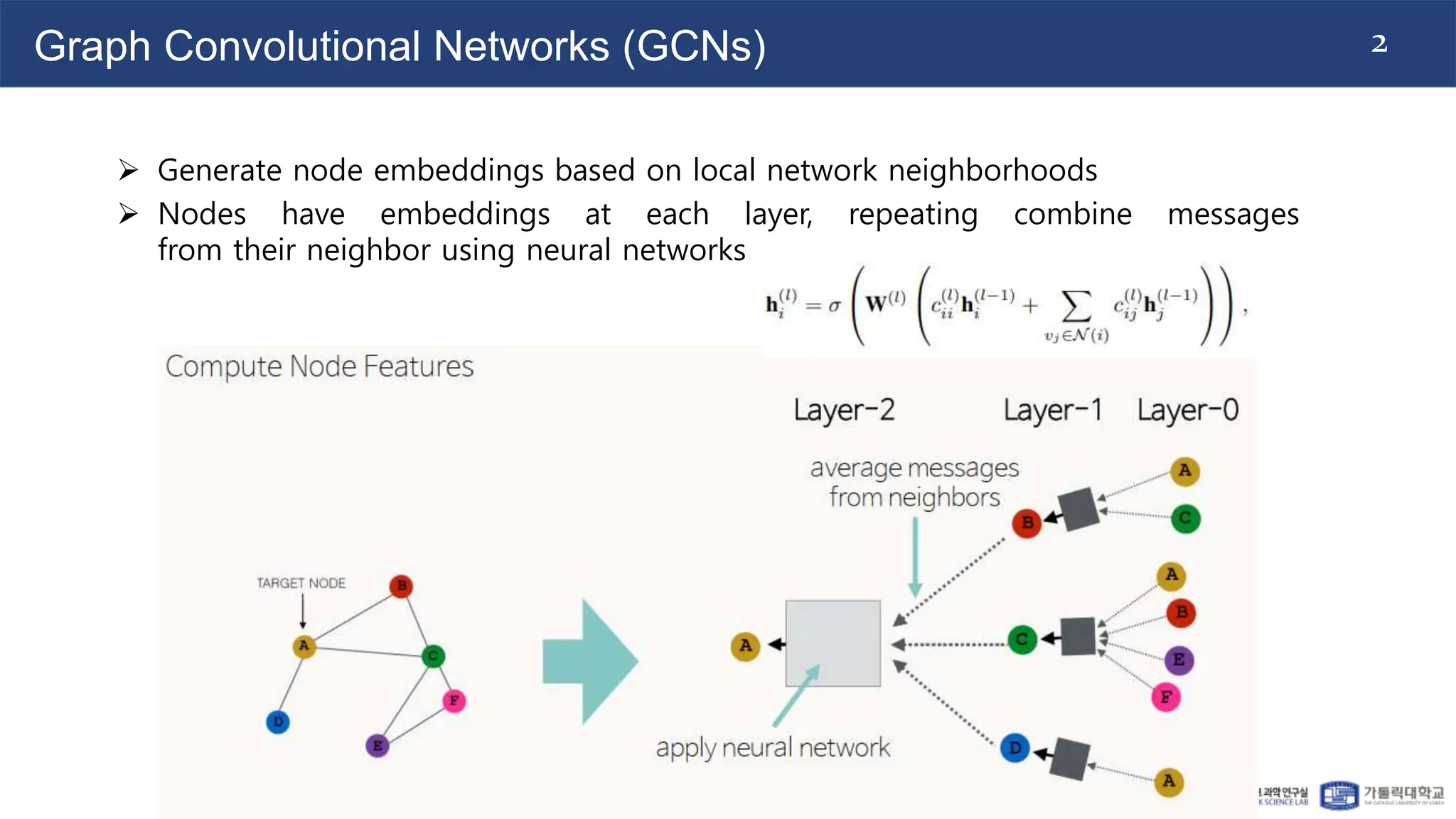
Graph Convolutional Networks (GCNs)
 Generate node embeddings based on local network neighborhoods
 Nodes have embeddings at each layer, repeating combine messages
from their neighbor using neural networks
3
Key Contributions
 Deformable Graph Transformer (DGT) performs sparse attention with
a reduced number of keys and values for learning node
representations
 DGA, that flexibly attends to a small set of relevant nodes based on
various types of the proximity between nodes
 Learnable positional encodings named Katz PE
4
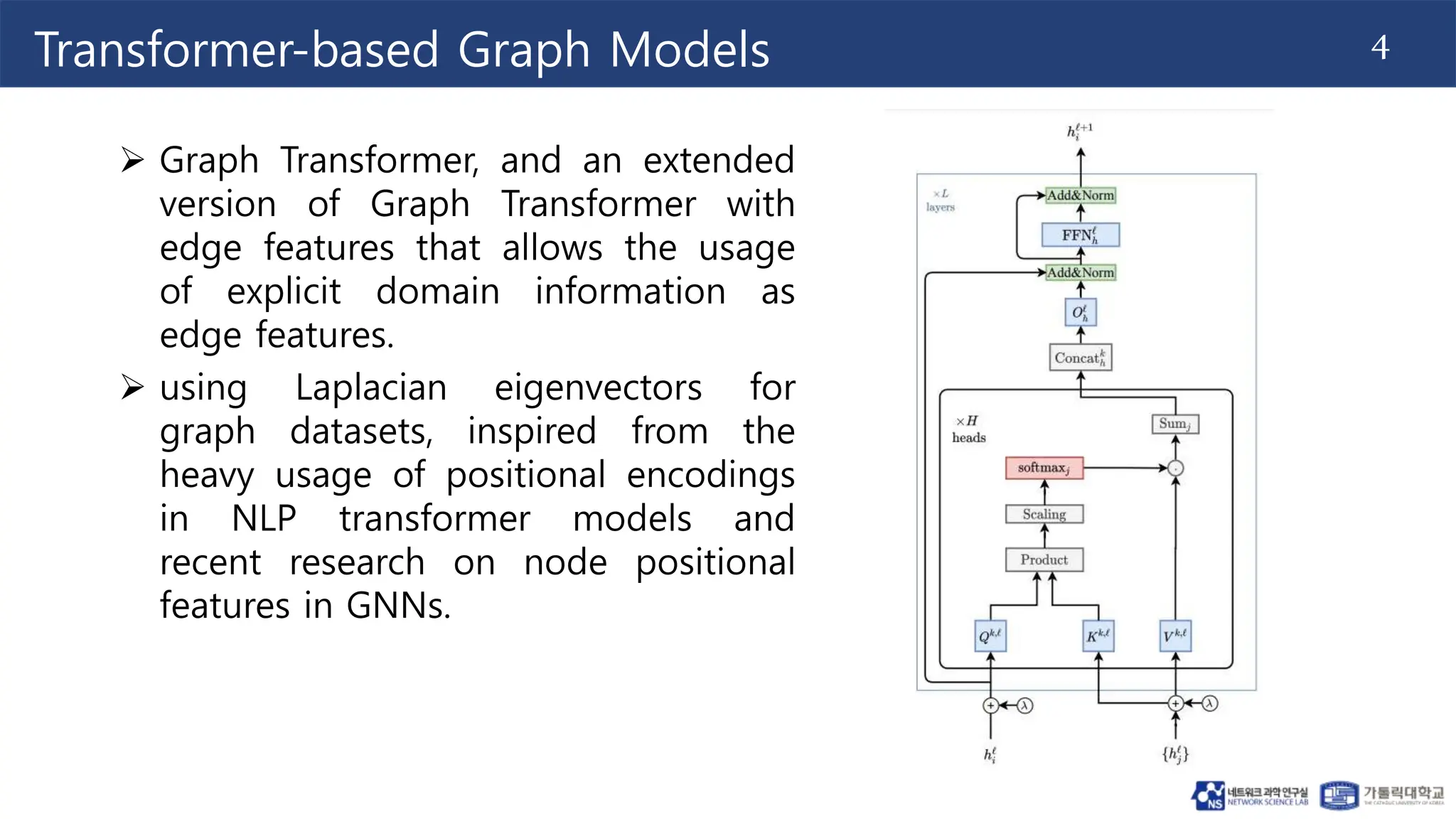
Transformer-based Graph Models
 Graph Transformer, and an extended
version of Graph Transformer with
edge features that allows the usage
of explicit domain information as
edge features.
 using Laplacian eigenvectors for
graph datasets, inspired from the
heavy usage of positional encodings
in NLP transformer models and
recent research on node positional
features in GNNs.
5
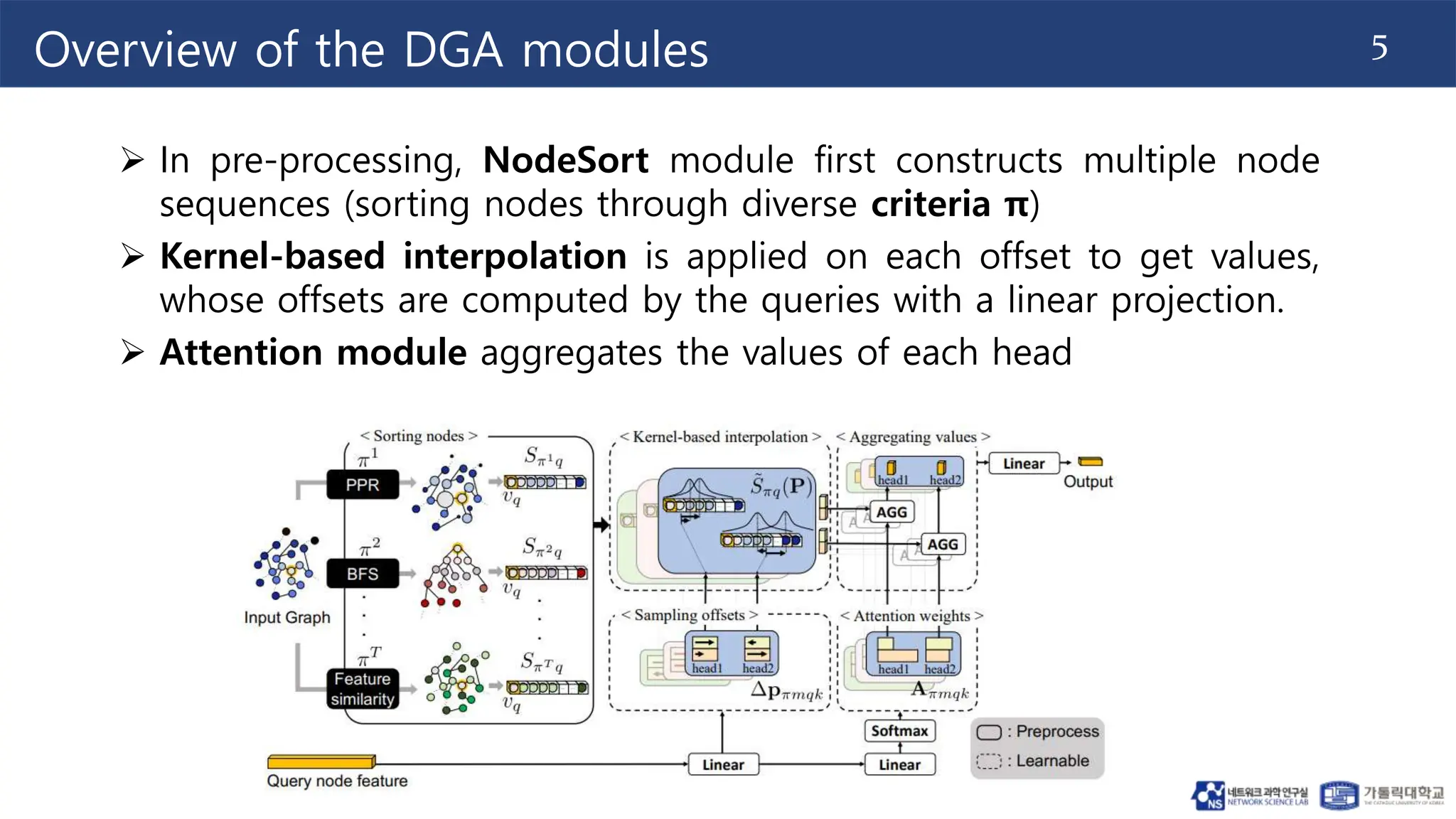
Overview of the DGA modules
 In pre-processing, NodeSort module first constructs multiple node
sequences (sorting nodes through diverse criteria π)
 Kernel-based interpolation is applied on each offset to get values,
whose offsets are computed by the queries with a linear projection.
 Attention module aggregates the values of each head
6
Overview of the DGA modules
 Multi-Head Attention (MHA) for Transformer-based graph models
7
DEFORMABLE GRAPH ATTENTION
 What we want: finding context nodes
 A NodeSort module that converts a graph into a sorted sequence
of nodes in a regular space
 Given a target node, NodeSort sorts nodes and returns a sequence
of their features
8
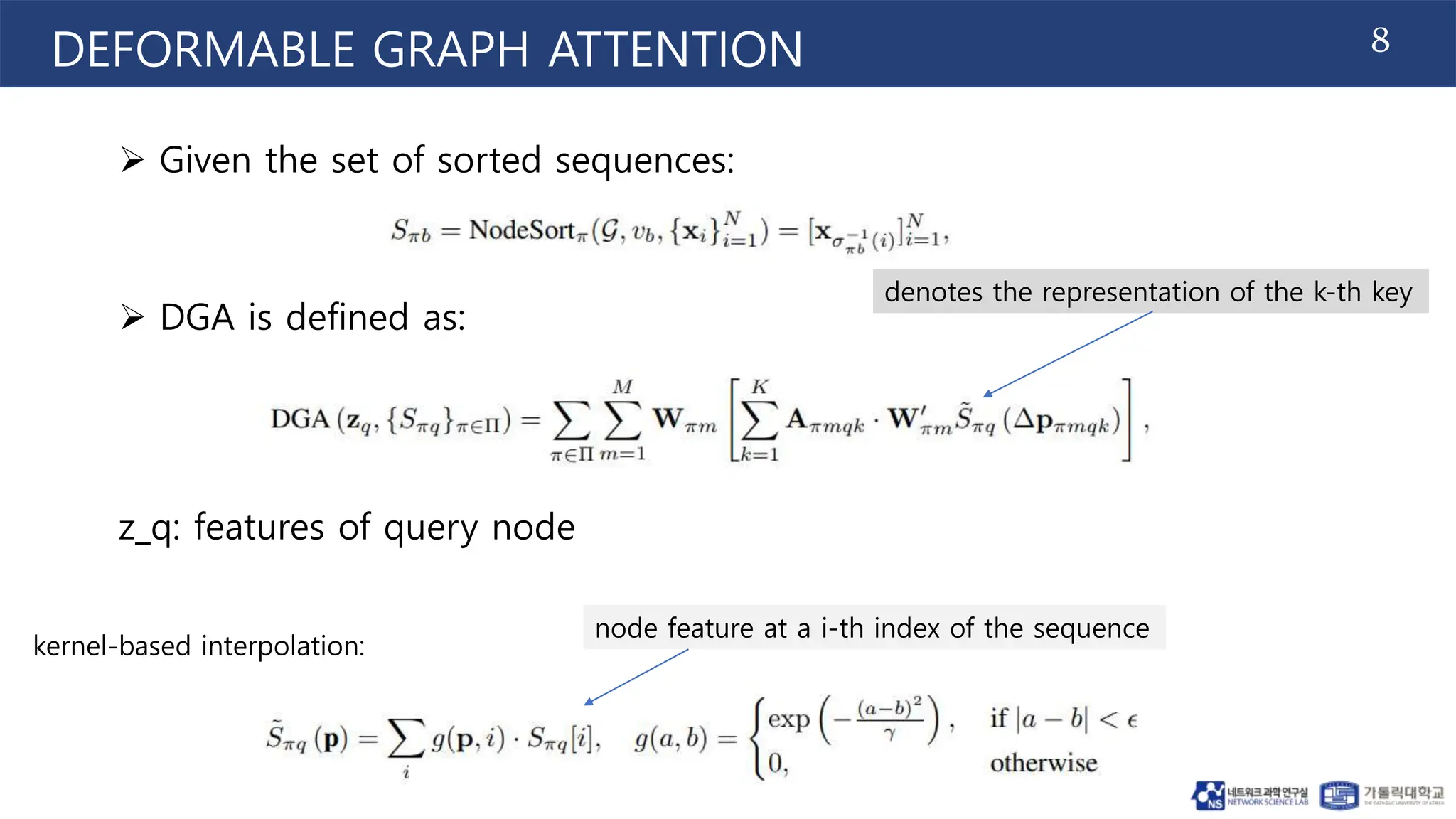
DEFORMABLE GRAPH ATTENTION
 Given the set of sorted sequences:
 DGA is defined as:
z_q: features of query node
denotes the representation of the k-th key
node feature at a i-th index of the sequence
kernel-based interpolation:
9
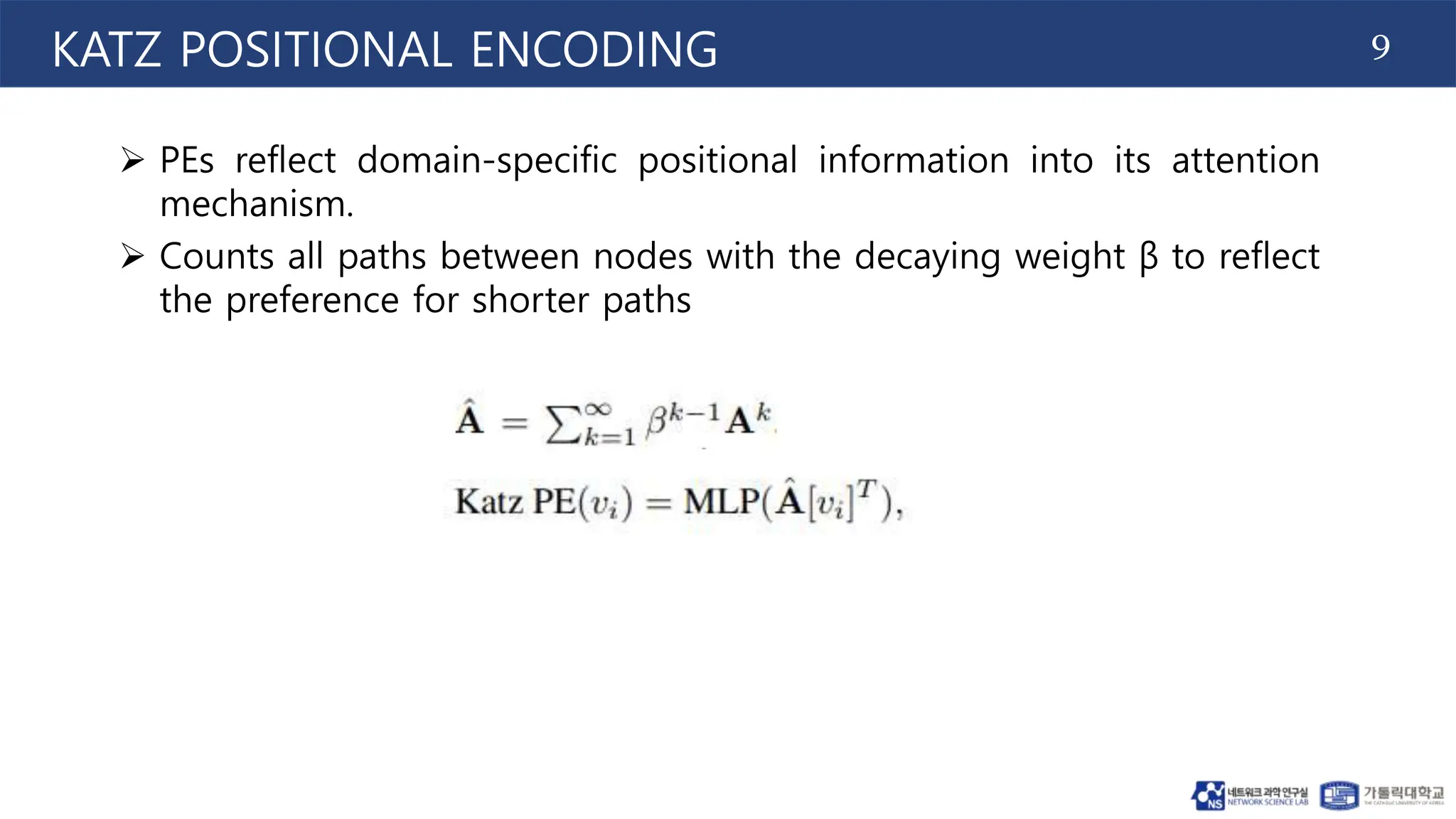
KATZ POSITIONAL ENCODING
 PEs reflect domain-specific positional information into its attention
mechanism.
 Counts all paths between nodes with the decaying weight β to reflect
the preference for shorter paths
10
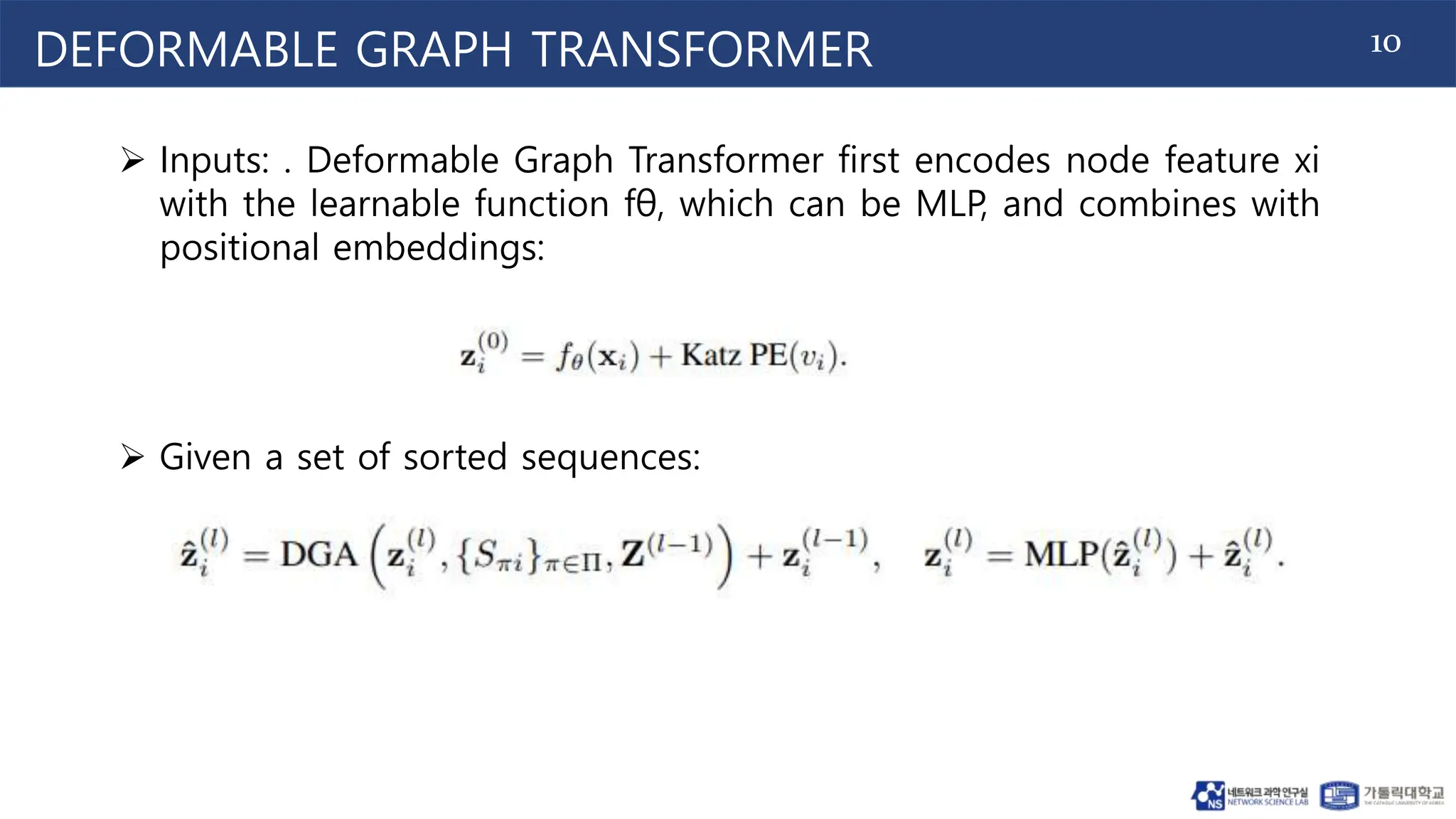
DEFORMABLE GRAPH TRANSFORMER
 Inputs: . Deformable Graph Transformer first encodes node feature xi
with the learnable function fθ, which can be MLP, and combines with
positional embeddings:
 Given a set of sorted sequences:
11
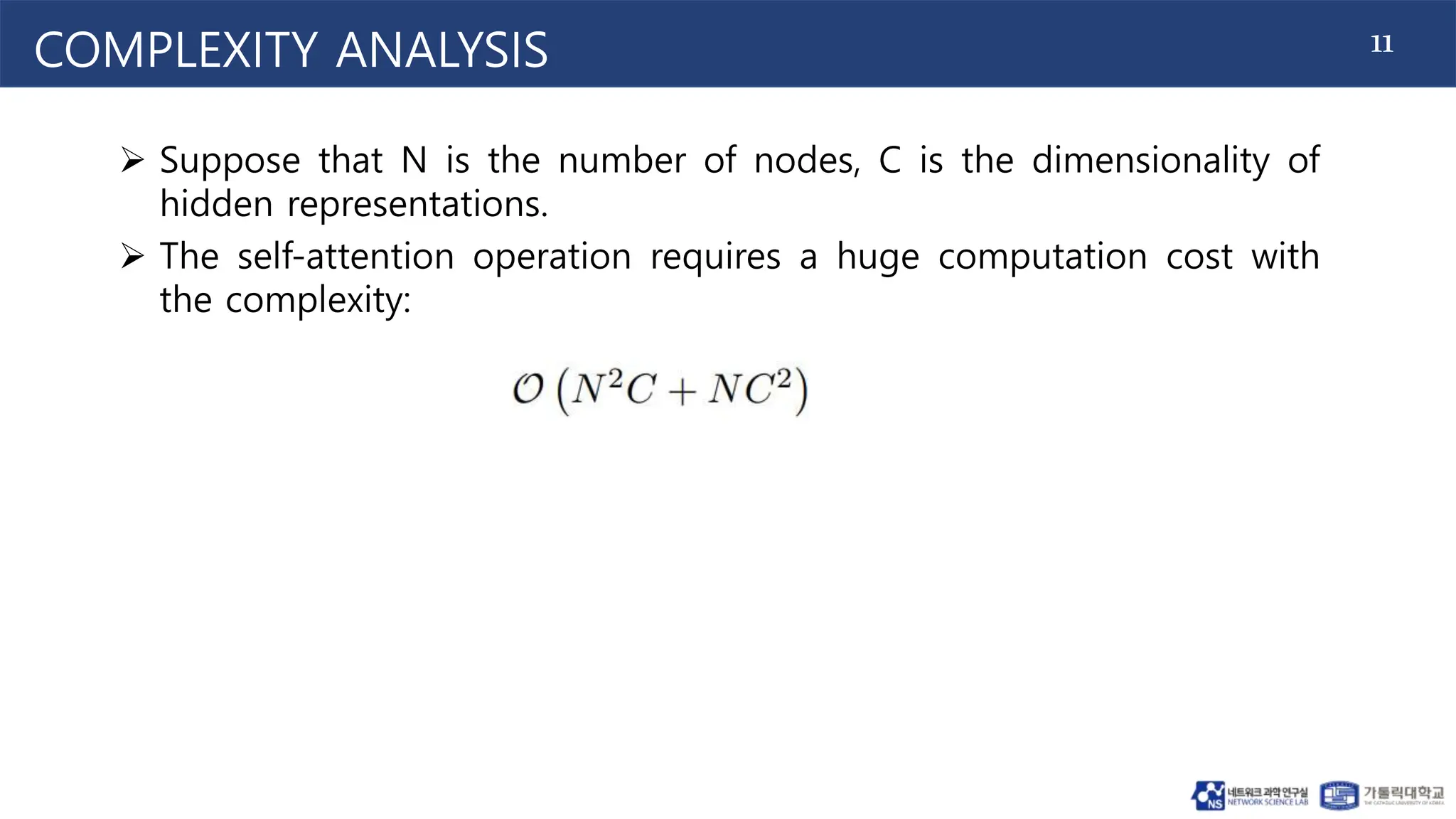
COMPLEXITY ANALYSIS
 Suppose that N is the number of nodes, C is the dimensionality of
hidden representations.
 The self-attention operation requires a huge computation cost with
the complexity:
12
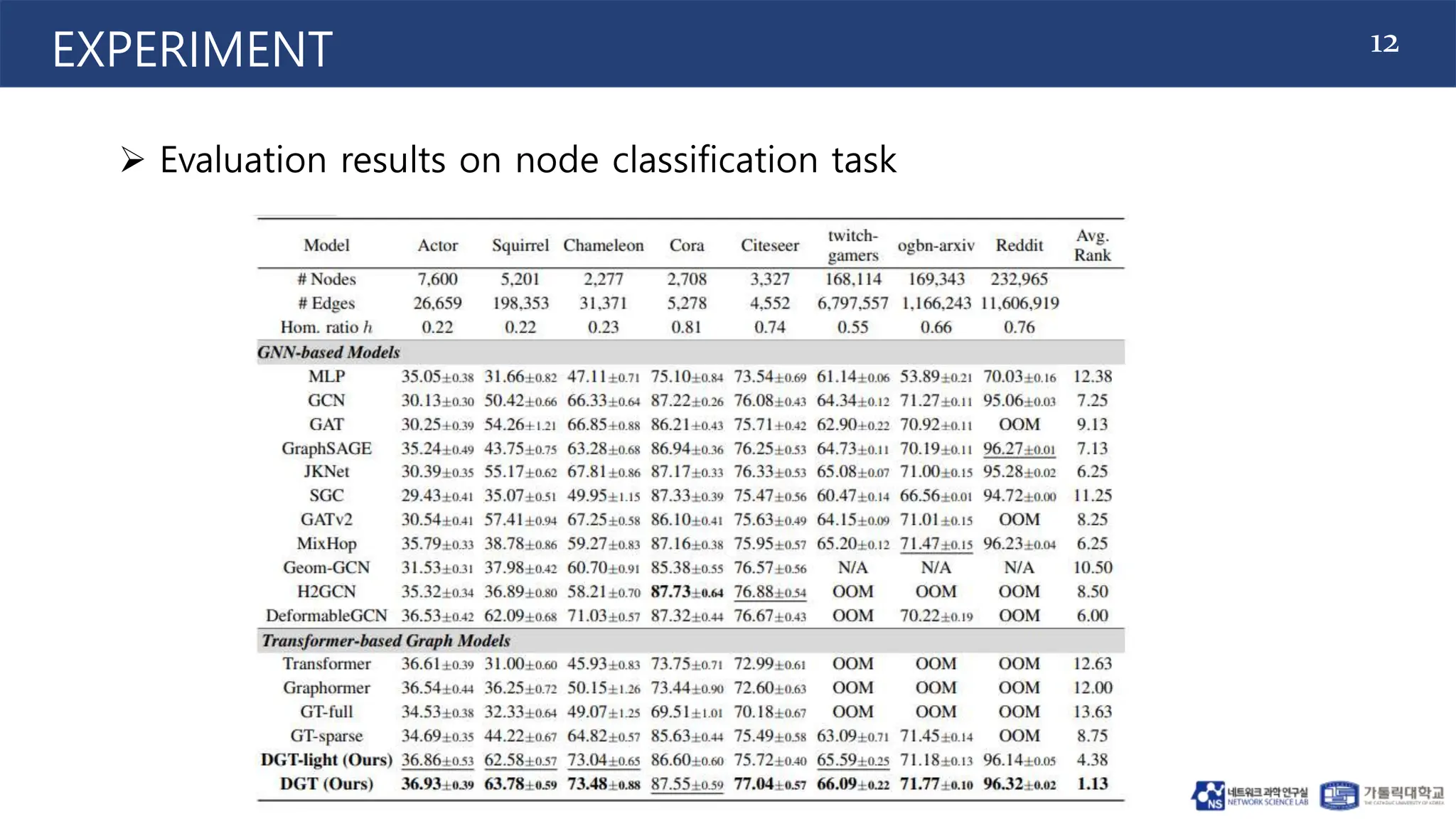
EXPERIMENT
 Evaluation results on node classification task
13
EXPERIMENT
 Performance comparisons on different ordering and criteria
absolute ordering with random permutation (AR),
absolute ordering with BFS (AB),
absolute ordering with multiple criteria (AM),
relative ordering with BFS (RB),
relative ordering with multiple criteria (RM)
14
CONCLUSION
 DGT that performs sparse attention, named Deformable Graph
Attention (DGA) for learning node representations on large-scale
graphs.
 address two limitations of Transformer-based graph models such as a
scalability issue and aggregation of noisy information.
 Attention considers both structural and semantic proximity based on
diverse node sequences.
DEFORMABLE GRAPH TRANSFORMER.pptx

DEFORMABLE GRAPH TRANSFORMER.pptx

  • 1.
    Van Thuy Hoang NetworkScience Lab Dept. of Artificial Intelligence The Catholic University of Korea E-mail: hoangvanthuy90@gmail.com 2023-12-26 Jinyoung Park, et. al. AAAI-22
  • 2.
    2 Graph Convolutional Networks(GCNs)  Generate node embeddings based on local network neighborhoods  Nodes have embeddings at each layer, repeating combine messages from their neighbor using neural networks
  • 3.
    3 Key Contributions  DeformableGraph Transformer (DGT) performs sparse attention with a reduced number of keys and values for learning node representations  DGA, that flexibly attends to a small set of relevant nodes based on various types of the proximity between nodes  Learnable positional encodings named Katz PE
  • 4.
    4 Transformer-based Graph Models Graph Transformer, and an extended version of Graph Transformer with edge features that allows the usage of explicit domain information as edge features.  using Laplacian eigenvectors for graph datasets, inspired from the heavy usage of positional encodings in NLP transformer models and recent research on node positional features in GNNs.
  • 5.
    5 Overview of theDGA modules  In pre-processing, NodeSort module first constructs multiple node sequences (sorting nodes through diverse criteria π)  Kernel-based interpolation is applied on each offset to get values, whose offsets are computed by the queries with a linear projection.  Attention module aggregates the values of each head
  • 6.
    6 Overview of theDGA modules  Multi-Head Attention (MHA) for Transformer-based graph models
  • 7.
    7 DEFORMABLE GRAPH ATTENTION What we want: finding context nodes  A NodeSort module that converts a graph into a sorted sequence of nodes in a regular space  Given a target node, NodeSort sorts nodes and returns a sequence of their features
  • 8.
    8 DEFORMABLE GRAPH ATTENTION Given the set of sorted sequences:  DGA is defined as: z_q: features of query node denotes the representation of the k-th key node feature at a i-th index of the sequence kernel-based interpolation:
  • 9.
    9 KATZ POSITIONAL ENCODING PEs reflect domain-specific positional information into its attention mechanism.  Counts all paths between nodes with the decaying weight β to reflect the preference for shorter paths
  • 10.
    10 DEFORMABLE GRAPH TRANSFORMER Inputs: . Deformable Graph Transformer first encodes node feature xi with the learnable function fθ, which can be MLP, and combines with positional embeddings:  Given a set of sorted sequences:
  • 11.
    11 COMPLEXITY ANALYSIS  Supposethat N is the number of nodes, C is the dimensionality of hidden representations.  The self-attention operation requires a huge computation cost with the complexity:
  • 12.
    12 EXPERIMENT  Evaluation resultson node classification task
  • 13.
    13 EXPERIMENT  Performance comparisonson different ordering and criteria absolute ordering with random permutation (AR), absolute ordering with BFS (AB), absolute ordering with multiple criteria (AM), relative ordering with BFS (RB), relative ordering with multiple criteria (RM)
  • 14.
    14 CONCLUSION  DGT thatperforms sparse attention, named Deformable Graph Attention (DGA) for learning node representations on large-scale graphs.  address two limitations of Transformer-based graph models such as a scalability issue and aggregation of noisy information.  Attention considers both structural and semantic proximity based on diverse node sequences.