Do Transformers Really Perform Bad for
Graph Representation?
AU T H O R S : C H E N G X U A N Y I N G , T I A N L E C A I , S H E N G J I E L U O 3 , S H U X I N Z H E N G 4 , G U O L I N
K E , D I H E , Y A N M I N G S H E , T I E - Y A N L I U
R E V I E W B Y: N G U Y E N T H A N H S A N G
N S L A B
1. Introduction
2. Contribution
3. Model Architecture
4. Experiments
5. Conclusions
TABLE OF CONTENT
+ The Transformer is well acknowledged as the most powerful neural network in
modelling sequential data, such as natural language and speech.
+ Transformer has still not been the de-facto standard on public graph
representation leaderboards.
+ Transformers could perform well for graph representation learning.
+ Many attempts of leveraging Transformer into the graph domain, but the only
effective way is replacing some key modules (e.g., feature aggregation) in classic
GNN variants by the softmax attention.
=> Whether transformer architecture is suitable to model graphs and how to make it
work in graph representation learning?
INTRODUCTION
+ An affirmative answer by developing Graphormer, which is directly built upon the
standard Transformer
+ Achieving state-of-the-art performance on a wide range of graph.
+ Proposing Centrality Encoding in Graphormer to capture the node importance in
the graph.
+ Proposing a novel Spatial Encoding in Graphormer to capture the structural
relation between nodes.
+ The great capacity of the model leads to state-of-the-art performance on a wide
range of tasks in practice.
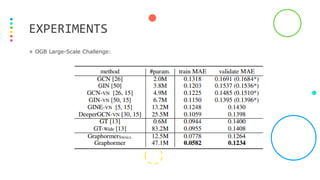
+ Graphormer outperforms most mainstream GNN variants by more than 10% points
in terms of the relative error.
CONTRIBUTIONS
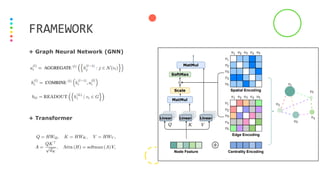
+ Graph Neural Network (GNN)
+ Transformer
FRAMEWORK
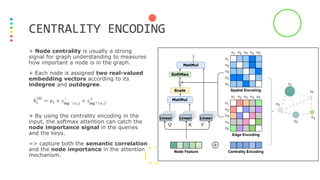
+ Node centrality is usually a strong
signal for graph understanding to measures
how important a node is in the graph.
+ Each node is assigned two real-valued
embedding vectors according to its
indegree and outdegree.
+ By using the centrality encoding in the
input, the softmax attention can catch the
node importance signal in the queries
and the keys.
=> capture both the semantic correlation
and the node importance in the attention
mechanism.
CENTRALITY ENCODING
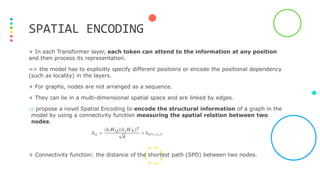
+ In each Transformer layer, each token can attend to the information at any position
and then process its representation.
=> the model has to explicitly specify different positions or encode the positional dependency
(such as locality) in the layers.
+ For graphs, nodes are not arranged as a sequence.
+ They can lie in a multi-dimensional spatial space and are linked by edges.
 propose a novel Spatial Encoding to encode the structural information of a graph in the
model by using a connectivity function measuring the spatial relation between two
nodes.
+ Connectivity function: the distance of the shortest path (SPD) between two nodes.
SPATIAL ENCODING
+ Edges also have structural features.
+ Finding (one of) the shortest path from two nodes and computing an average of the dot-
products of the edge feature and a learnable embedding along the path.
EDGE ENCODING
+ Graphormer Layer.
+ Special Node:
- Add a special node called [VNode] to the graph, and make connection between
[VNode] and each node individually.
- [VNode] is connected to all other nodes in graph to represent the sequence-level
feature on downstream tasks.
- The virtual node can aggregate the information of the whole graph (like the
READOUT function) and then propagate it to each node.
DETAILS OF GRAPHORMER
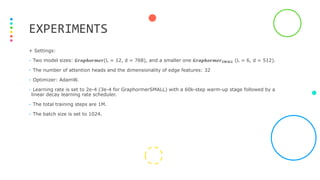
+ Settings:
- Two model sizes: 𝑮𝒓𝒂𝒑𝒉𝒐𝒓𝒎𝒆𝒓(L = 12, d = 768), and a smaller one 𝑮𝒓𝒂𝒑𝒉𝒐𝒓𝒎𝒆𝒓𝑺𝑴𝑨𝑳𝑳 (L = 6, d = 512).
- The number of attention heads and the dimensionality of edge features: 32
- Optimizer: AdamW.
- Learning rate is set to 2e-4 (3e-4 for GraphormerSMALL) with a 60k-step warm-up stage followed by a
linear decay learning rate scheduler.
- The total training steps are 1M.
- The batch size is set to 1024.
EXPERIMENTS
+ OGB Large-Scale Challenge:
EXPERIMENTS
+ This paper applies Transformers to graph representation.
+ Use three novel graph structural encodings:
- Path and Distance in GNNs.
- Positional Encoding in Transformer on Graph.
- Edge Feature.
+ An applicable graph sampling strategy is desired for node representation extraction with
Graphormer.
CONCLUSION
THANK YOU!

Sang_Graphormer.pdf

  • 1.
    Do Transformers ReallyPerform Bad for Graph Representation? AU T H O R S : C H E N G X U A N Y I N G , T I A N L E C A I , S H E N G J I E L U O 3 , S H U X I N Z H E N G 4 , G U O L I N K E , D I H E , Y A N M I N G S H E , T I E - Y A N L I U R E V I E W B Y: N G U Y E N T H A N H S A N G N S L A B
  • 2.
    1. Introduction 2. Contribution 3.Model Architecture 4. Experiments 5. Conclusions TABLE OF CONTENT
  • 3.
    + The Transformeris well acknowledged as the most powerful neural network in modelling sequential data, such as natural language and speech. + Transformer has still not been the de-facto standard on public graph representation leaderboards. + Transformers could perform well for graph representation learning. + Many attempts of leveraging Transformer into the graph domain, but the only effective way is replacing some key modules (e.g., feature aggregation) in classic GNN variants by the softmax attention. => Whether transformer architecture is suitable to model graphs and how to make it work in graph representation learning? INTRODUCTION
  • 4.
    + An affirmativeanswer by developing Graphormer, which is directly built upon the standard Transformer + Achieving state-of-the-art performance on a wide range of graph. + Proposing Centrality Encoding in Graphormer to capture the node importance in the graph. + Proposing a novel Spatial Encoding in Graphormer to capture the structural relation between nodes. + The great capacity of the model leads to state-of-the-art performance on a wide range of tasks in practice. + Graphormer outperforms most mainstream GNN variants by more than 10% points in terms of the relative error. CONTRIBUTIONS
  • 5.
    + Graph NeuralNetwork (GNN) + Transformer FRAMEWORK
  • 6.
    + Node centralityis usually a strong signal for graph understanding to measures how important a node is in the graph. + Each node is assigned two real-valued embedding vectors according to its indegree and outdegree. + By using the centrality encoding in the input, the softmax attention can catch the node importance signal in the queries and the keys. => capture both the semantic correlation and the node importance in the attention mechanism. CENTRALITY ENCODING
  • 7.
    + In eachTransformer layer, each token can attend to the information at any position and then process its representation. => the model has to explicitly specify different positions or encode the positional dependency (such as locality) in the layers. + For graphs, nodes are not arranged as a sequence. + They can lie in a multi-dimensional spatial space and are linked by edges.  propose a novel Spatial Encoding to encode the structural information of a graph in the model by using a connectivity function measuring the spatial relation between two nodes. + Connectivity function: the distance of the shortest path (SPD) between two nodes. SPATIAL ENCODING
  • 8.
    + Edges alsohave structural features. + Finding (one of) the shortest path from two nodes and computing an average of the dot- products of the edge feature and a learnable embedding along the path. EDGE ENCODING
  • 9.
    + Graphormer Layer. +Special Node: - Add a special node called [VNode] to the graph, and make connection between [VNode] and each node individually. - [VNode] is connected to all other nodes in graph to represent the sequence-level feature on downstream tasks. - The virtual node can aggregate the information of the whole graph (like the READOUT function) and then propagate it to each node. DETAILS OF GRAPHORMER
  • 10.
    + Settings: - Twomodel sizes: 𝑮𝒓𝒂𝒑𝒉𝒐𝒓𝒎𝒆𝒓(L = 12, d = 768), and a smaller one 𝑮𝒓𝒂𝒑𝒉𝒐𝒓𝒎𝒆𝒓𝑺𝑴𝑨𝑳𝑳 (L = 6, d = 512). - The number of attention heads and the dimensionality of edge features: 32 - Optimizer: AdamW. - Learning rate is set to 2e-4 (3e-4 for GraphormerSMALL) with a 60k-step warm-up stage followed by a linear decay learning rate scheduler. - The total training steps are 1M. - The batch size is set to 1024. EXPERIMENTS
  • 11.
    + OGB Large-ScaleChallenge: EXPERIMENTS
  • 12.
    + This paperapplies Transformers to graph representation. + Use three novel graph structural encodings: - Path and Distance in GNNs. - Positional Encoding in Transformer on Graph. - Edge Feature. + An applicable graph sampling strategy is desired for node representation extraction with Graphormer. CONCLUSION
  • 13.