INCOME INEQUALITY
Group Members:
SURAJ PATEL 14MBA074
VINESH PATEL 14MBA076
VIVEK PATEL 14MBA078
PAYAL PATEL 14MBA080
MANISH PRAJAPATI 14MBA082
SIDDTHARTH RAJGURU
14MBA084
MANEGERIAL ECONOMICS : MB700.1
22-Mar-16 1
Article topic: Income inequality up both
in rural and urban areas
22-Mar-16
2
INTRODUCTION
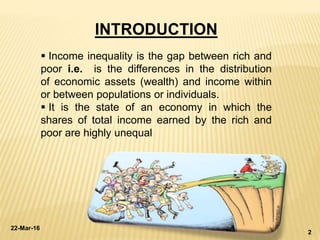
 Income inequality is the gap between rich and
poor i.e. is the differences in the distribution
of economic assets (wealth) and income within
or between populations or individuals.
 It is the state of an economy in which the
shares of total income earned by the rich and
poor are highly unequal
22-Mar-16
3
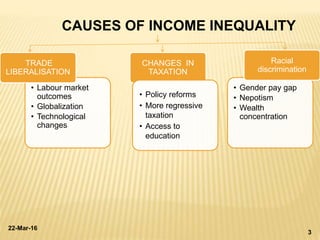
CAUSES OF INCOME INEQUALITY
• Labour market
outcomes
• Globalization
• Technological
changes
TRADE
LIBERALISATION
• Gender pay gap
• Nepotism
• Wealth
concentration
Racial
discrimination
CHANGES IN
TAXATION
• Policy reforms
• More regressive
taxation
• Access to
education
22-Mar-16
4
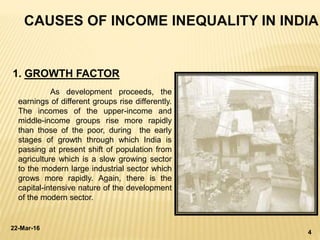
CAUSES OF INCOME INEQUALITY IN INDIA
1. GROWTH FACTOR
As development proceeds, the
earnings of different groups rise differently.
The incomes of the upper-income and
middle-income groups rise more rapidly
than those of the poor, during the early
stages of growth through which India is
passing at present shift of population from
agriculture which is a slow growing sector
to the modern large industrial sector which
grows more rapidly. Again, there is the
capital-intensive nature of the development
of the modern sector.
22-Mar-16
5
HIGHLY UNEQUAL ASSETS DISTRIBUTION
 Incomes are derived from two main sources, namely, assets like land, cattle,
shares, etc., and labour.
 In India a few own a large chunk of income – earning assets.
 These inequalities enable the few to get incomes in the form of rent, interest and
profit.
 As these assets accumulate and pass on from generation to generation, the
earning capacity of these increases continuously.
 As for rural areas, the ownership pattern of the most important asset, namely,
land, is highly unequal
 Private ownership of property and inheritance laws is mainly responsible for
highly unequal distribution of assets.
22-Mar-16
6
Of the large many at the bottom rung of incomes, a very great proportion lives in the
poor backward states regions, and most of the few at the top live in the high- income
states regions.
This is the geographical facet of income inequalities for the country as a whole.
 Within the states also there are inequalities, perhaps larger in the poorer states.
Both these aspects are the outcome of the different growth rates of the states, with
a few having grown at a fast rate, and many having lagged behind.
22-Mar-16
7
People at the bottom could raise their economic status and to an extent reduce
the distance separating them from those at the top, if they could get work. In
other words, if they did not possess adequate earning assets, they could at least
earn from their labour.
22-Mar-16
8
Income inequality up both in rural and
urban areas
Income inequality has increased in both rural as well as urban areas.
According to Gini co-efficient thee has been increase in income inequality in rural
India by 13% and in Urban India by 15%
India Financial Protection Survey (IFPS) has covered 63.016households in depth
across the country
There was increase in inequality because of
disparity income
expenditure and saving pattern
Urban income data shows that the size of a town/city makes a great difference to
the household income level
Thus income share is double than its population share
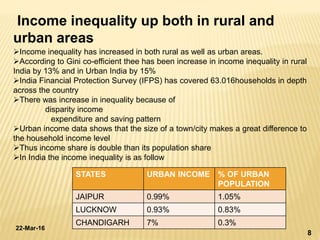
In India the income inequality is as follow
STATES URBAN INCOME % OF URBAN
POPULATION
JAIPUR 0.99% 1.05%
LUCKNOW 0.93% 0.83%
CHANDIGARH 7% 0.3%
22-Mar-16
9
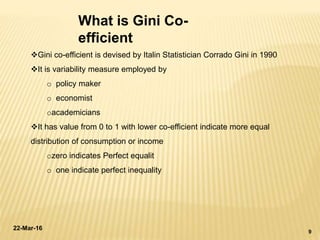
What is Gini Co-
efficient
Gini co-efficient is devised by Italin Statistician Corrado Gini in 1990
It is variability measure employed by
o policy maker
o economist
oacademicians
It has value from 0 to 1 with lower co-efficient indicate more equal
distribution of consumption or income
ozero indicates Perfect equalit
o one indicate perfect inequality
22-Mar-16
10
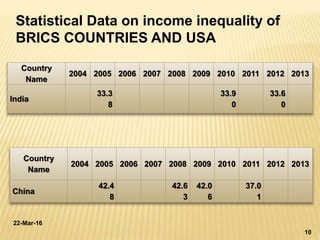
Statistical Data on income inequality of
BRICS COUNTRIES AND USA
Country
Name
2004 2005 2006 2007 2008 2009 2010 2011 2012 2013
India
33.3
8
33.9
0
33.6
0
Country
Name
2004 2005 2006 2007 2008 2009 2010 2011 2012 2013
China
42.4
8
42.6
3
42.0
6
37.0
1
22-Mar-16
11
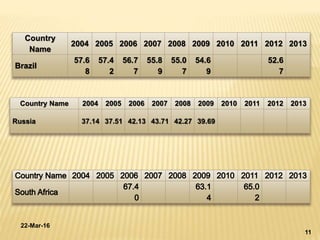
Country
Name
2004 2005 2006 2007 2008 2009 2010 2011 2012 2013
Brazil
57.6
8
57.4
2
56.7
7
55.8
9
55.0
7
54.6
9
52.6
7
Country Name 2004 2005 2006 2007 2008 2009 2010 2011 2012 2013
Russia 37.14 37.51 42.13 43.71 42.27 39.69
22-Mar-16
12
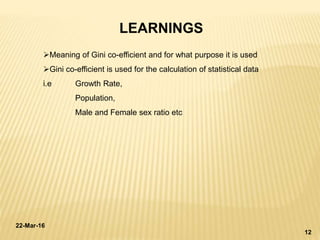
LEARNINGS
Meaning of Gini co-efficient and for what purpose it is used
Gini co-efficient is used for the calculation of statistical data
i.e Growth Rate,
Population,
Male and Female sex ratio etc
22-Mar-16
13
References
 http://articles.economictimes.indiatimes.com/2008-02-
07/news/27704400_1_gini-coefficient-income-inequality-households
 http://timesofindia.indiatimes.com/india/Indias-income-inequality-
has-doubled-in-20-years/articleshow/11012855.cms
http://data.worldbank.org/indicator/SI.POV.GINI
Link for pdf file http://www.epw.in/commentary/dynamics-income-inequality-india.html
www.slidesshare.com
22-Mar-16
14

Income Inequality presentation

  • 1.
    INCOME INEQUALITY Group Members: SURAJPATEL 14MBA074 VINESH PATEL 14MBA076 VIVEK PATEL 14MBA078 PAYAL PATEL 14MBA080 MANISH PRAJAPATI 14MBA082 SIDDTHARTH RAJGURU 14MBA084 MANEGERIAL ECONOMICS : MB700.1 22-Mar-16 1 Article topic: Income inequality up both in rural and urban areas
  • 2.
    22-Mar-16 2 INTRODUCTION  Income inequalityis the gap between rich and poor i.e. is the differences in the distribution of economic assets (wealth) and income within or between populations or individuals.  It is the state of an economy in which the shares of total income earned by the rich and poor are highly unequal
  • 3.
    22-Mar-16 3 CAUSES OF INCOMEINEQUALITY • Labour market outcomes • Globalization • Technological changes TRADE LIBERALISATION • Gender pay gap • Nepotism • Wealth concentration Racial discrimination CHANGES IN TAXATION • Policy reforms • More regressive taxation • Access to education
  • 4.
    22-Mar-16 4 CAUSES OF INCOMEINEQUALITY IN INDIA 1. GROWTH FACTOR As development proceeds, the earnings of different groups rise differently. The incomes of the upper-income and middle-income groups rise more rapidly than those of the poor, during the early stages of growth through which India is passing at present shift of population from agriculture which is a slow growing sector to the modern large industrial sector which grows more rapidly. Again, there is the capital-intensive nature of the development of the modern sector.
  • 5.
    22-Mar-16 5 HIGHLY UNEQUAL ASSETSDISTRIBUTION  Incomes are derived from two main sources, namely, assets like land, cattle, shares, etc., and labour.  In India a few own a large chunk of income – earning assets.  These inequalities enable the few to get incomes in the form of rent, interest and profit.  As these assets accumulate and pass on from generation to generation, the earning capacity of these increases continuously.  As for rural areas, the ownership pattern of the most important asset, namely, land, is highly unequal  Private ownership of property and inheritance laws is mainly responsible for highly unequal distribution of assets.
  • 6.
    22-Mar-16 6 Of the largemany at the bottom rung of incomes, a very great proportion lives in the poor backward states regions, and most of the few at the top live in the high- income states regions. This is the geographical facet of income inequalities for the country as a whole.  Within the states also there are inequalities, perhaps larger in the poorer states. Both these aspects are the outcome of the different growth rates of the states, with a few having grown at a fast rate, and many having lagged behind.
  • 7.
    22-Mar-16 7 People at thebottom could raise their economic status and to an extent reduce the distance separating them from those at the top, if they could get work. In other words, if they did not possess adequate earning assets, they could at least earn from their labour.
  • 8.
    22-Mar-16 8 Income inequality upboth in rural and urban areas Income inequality has increased in both rural as well as urban areas. According to Gini co-efficient thee has been increase in income inequality in rural India by 13% and in Urban India by 15% India Financial Protection Survey (IFPS) has covered 63.016households in depth across the country There was increase in inequality because of disparity income expenditure and saving pattern Urban income data shows that the size of a town/city makes a great difference to the household income level Thus income share is double than its population share In India the income inequality is as follow STATES URBAN INCOME % OF URBAN POPULATION JAIPUR 0.99% 1.05% LUCKNOW 0.93% 0.83% CHANDIGARH 7% 0.3%
  • 9.
    22-Mar-16 9 What is GiniCo- efficient Gini co-efficient is devised by Italin Statistician Corrado Gini in 1990 It is variability measure employed by o policy maker o economist oacademicians It has value from 0 to 1 with lower co-efficient indicate more equal distribution of consumption or income ozero indicates Perfect equalit o one indicate perfect inequality
  • 10.
    22-Mar-16 10 Statistical Data onincome inequality of BRICS COUNTRIES AND USA Country Name 2004 2005 2006 2007 2008 2009 2010 2011 2012 2013 India 33.3 8 33.9 0 33.6 0 Country Name 2004 2005 2006 2007 2008 2009 2010 2011 2012 2013 China 42.4 8 42.6 3 42.0 6 37.0 1
  • 11.
    22-Mar-16 11 Country Name 2004 2005 20062007 2008 2009 2010 2011 2012 2013 Brazil 57.6 8 57.4 2 56.7 7 55.8 9 55.0 7 54.6 9 52.6 7 Country Name 2004 2005 2006 2007 2008 2009 2010 2011 2012 2013 Russia 37.14 37.51 42.13 43.71 42.27 39.69
  • 12.
    22-Mar-16 12 LEARNINGS Meaning of Ginico-efficient and for what purpose it is used Gini co-efficient is used for the calculation of statistical data i.e Growth Rate, Population, Male and Female sex ratio etc
  • 13.
  • 14.