Meaning, Types and Measures of
Poverty
Course Title: Rural Poverty Studies
PRESENTED BY
Md. Sahed Khan
ID: 15RS JD-01M
Reg: 37769
Session: 2010-11
MS in Rural Sociology (2nd semester)
Department of Rural Sociology
BAU, Mymensingh-2202
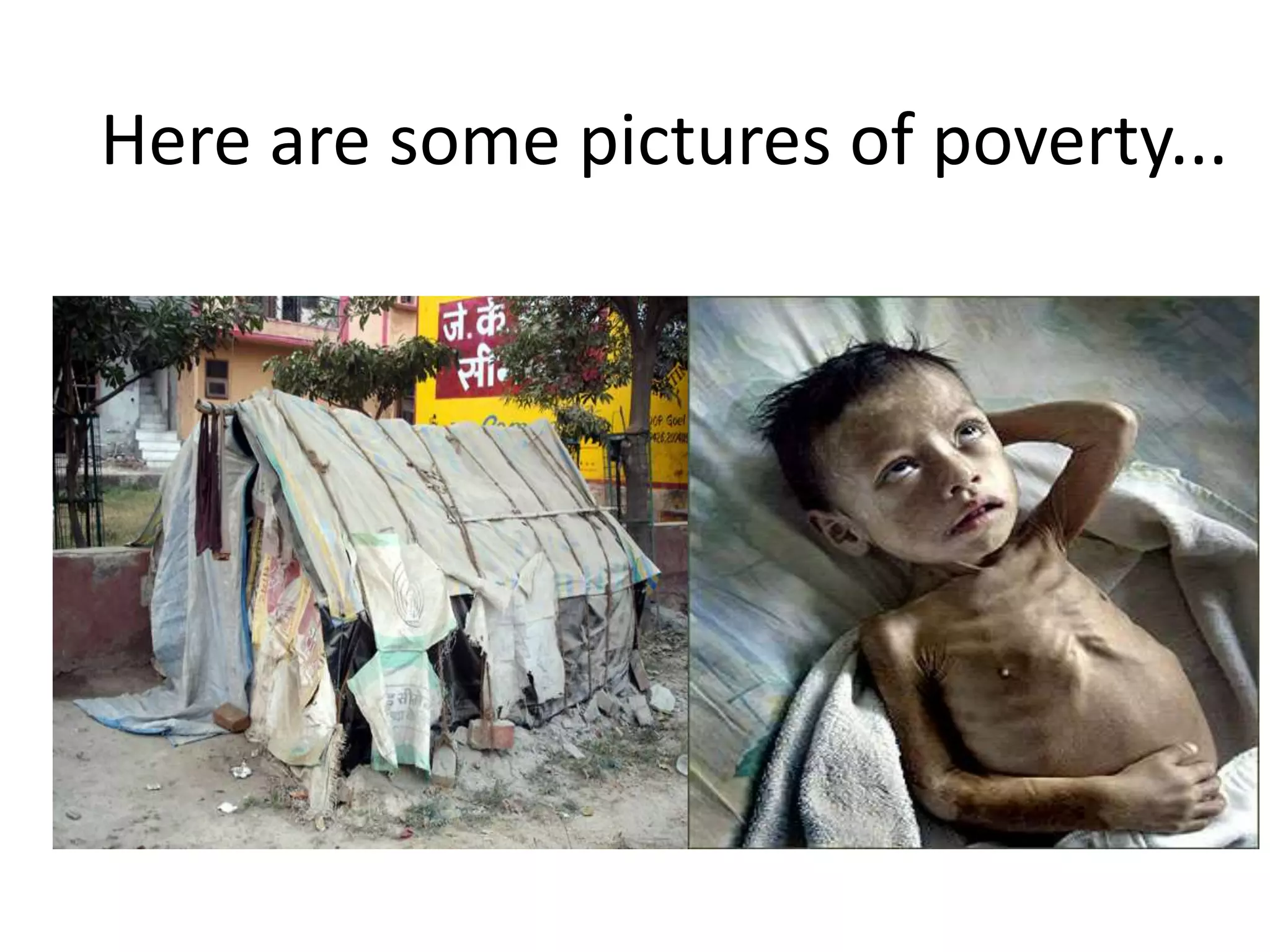
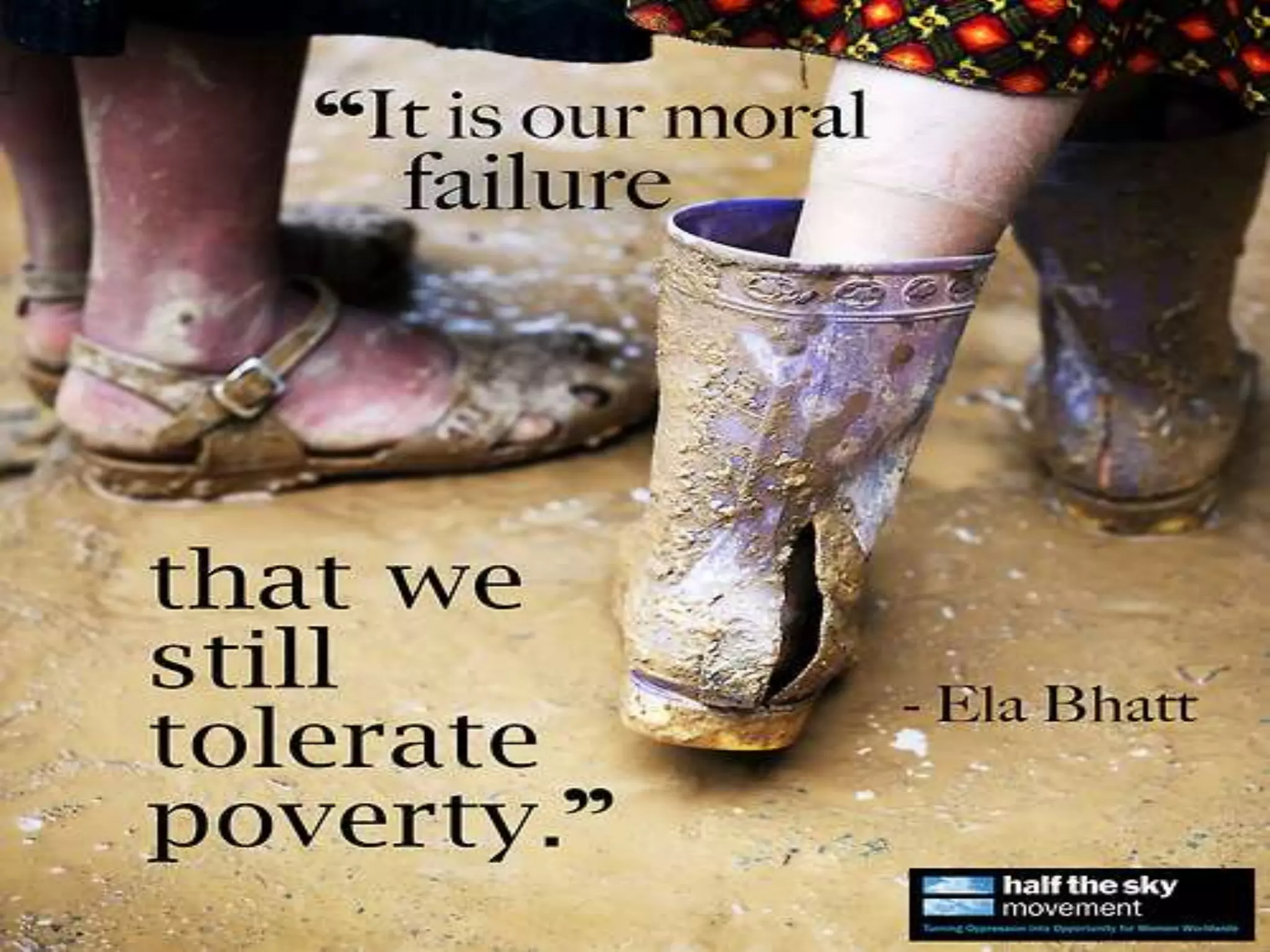
Here are some pictures of poverty...
We need to consider
Developed world poverty Developing world poverty
Global Facts of poverty
• 1.4 Billion people in developing countries live on $1.25 or less
• 3 out of every 4 people live on less than $1.25 a day
• 22,000 children die every day due to poverty
• 8 Million people die from lack of food and nutrition – about
24,000 deaths each day
• 60% of world’s hungry are women
• Every 5 second a child dies of hunger related diseases
• 98% of the world’s undernourished people live in LDCs
• 2/3 of the worlds hungry people live in just 7 countries:
Bangladesh, China, Democratic Republic Of Congo,
Ethiopia, India, Indonesia and Pakistan
POVERTY
What is poverty?
• A certain level of material deprivation , below which an
individual suffers physically, emotionally and socially.
• Poverty is a situation in which a person or household lacks
the resources necessary for his livelihood.
• Poverty consists of lack of food, clothing, housing, and other
essentials (moderate poverty) or of food alone (extreme
poverty).
Poverty in the words of United
Nations
• Poverty is the inability of getting choices and
opportunities, a violation of human dignity.
• It means lack of basic capacity to participate
effectively in society.
• It means not having enough to feed and clothe a
family, not having a school or clinic to go to; not
having the land on which to grow one’s food or a
job to earn one’s living.
Types of poverty
• Absolute poverty :
"a condition characterized by severe
deprivation of basic human needs, including
food, safe drinking water, sanitation facilities,
health, shelter, education and information. It
depends not only on income but also on
access to services.
[World Summit on Social Development in Copenhagen in 1995]
• Absolute poverty or destitution refers to the
deprivation of basic human needs, which
commonly includes food, water, sanitation,
clothing, shelter, health care and education.
CONTD…
• Relative poverty:
• Relative poverty defines people are relatively impoverished if
the customary (average) standard of living in their society
requires more spending than the income they have available
-In relation to other members and families in the society
-of the community have access to superior services and amenities.
CONTD…
• Chronic Poverty
-When poverty is handed over to individuals and families from
generations before them
-There is usually no escape from it
-Experience multiple deprivation, including
 Hunger
 Under nutrition
 Illiteracy
 Lack of access to safe drinking water and basic health
services
 Social discrimination
 Physical insecurity and
 political exclusion
CONTD…
 Collective poverty:
• -Affects a population collectively
• -A whole country can be classified as poverty-stricken due to
insufficiency of basic materials and services
• Situational Poverty
• -People or families can be poor due to some adversities like
 Earthquakes
 Floods
 A serious illness and so on
• -Sometimes, people can help themselves out of this situation
quickly if they are given a bit of assistance
Ways of Measuring Poverty
• Monetary poverty:
Consumption, Poverty line measures: definition of the
poverty line, headcount index, poverty severity
• Capability:
Basic needs, mortality, literacy, water, child malnutrition
• Inequality:
Income inequality, size distribution, Lorenz curve, Gini coefficient
• Participatory:
Not yet adapted
Measurements of monetary
poverty
• Food poverty line:
Minimum amount of food an individual must consume to stay
healthy
• Non food poverty line
Average per capita non-food expenditure of households whose
per capita total expenditure is close to the food poverty line
• National poverty Line
This is the percentage of people living below the national
poverty line
CONTD…
• Poverty line:
• A critical threshold of income, consumption, or more generally,
access to goods and services below which individuals are declared
to be poor
• Those with incomes or expenditures equal to or above the line are
not poor
• What is necessary to satisfy basic needs is different at different
times and in different countries. Therefore, poverty line may vary
with time and place
• Each country uses an imaginary line that is considered appropriate
for its existing level of development and its accepted minimum
social norms.
CONTD…
• Head Count Index:
• Widely used simple index to measure the proportion of
the population that is counted as poor
• Where,
Np = Number of poor
N = Total population
• Drawback:
• Fails to capture the extent to which individual income
falls below poverty line.
CONTD…
• Poverty Gap Index:
• Measure of the intensity of poverty
• Expressed as a percentage of the poverty line for a country
• A percentage between 0 and 100%
• Formula:
PGI = 1/N ∑ (Z-Yj/Z)
• Where
N = Total population
q = Population of poor who are living at or below
the poverty line
Z = The poverty line and
Yj = Income of the poor individual j
CONTD…
• Income Gap Ratio:
• Depicts the total shortfall of the poor from the poverty line,
divided by the total income required to bring all the poor
people to the poverty line
• Captures directly the acuteness of poverty, as it measures it
relative to the total income needed to eradicate poverty
• Drawback:
• Both PGR & IGR only capture the “per-capita intensity "of
poverty
Measurements of Capability
• Direct Calorie Intake (DCI)
 If its per capita calorie intake is less than the standard per
capita nutritional requirement (2,122 kcal per day)
 Best used to measure under-nourishment
 Food Energy Intake (FYI)
 Normally derived through regression of the relationship
between calorie intake and expenditure
 Cost of Basic Needs (CBN)
 Since 1995-96, BBS is using it
• Lower poverty line: Total expenditures on food and
non-food combined are equal to or less than the food
poverty line
• Upper poverty line: Estimated by adding together the
food and non-food poverty lines
Measurements of Inequality
• The Lorenz Curve
• Diagrammatic way to depict the distribution of income
in any society
• Horizontal axis depicts cumulative percentages of
population arranged in increasing order of income
• Vertical axis depicts percentage of national income
accruing to any fraction of population
CONTD…
• Always bowed to the right of the line of equality
• More skewed the curve, greater the Inequality
Thank You All

Poverty meaning types and measures by sahed khan

  • 1.
    Meaning, Types andMeasures of Poverty Course Title: Rural Poverty Studies PRESENTED BY Md. Sahed Khan ID: 15RS JD-01M Reg: 37769 Session: 2010-11 MS in Rural Sociology (2nd semester) Department of Rural Sociology BAU, Mymensingh-2202
  • 3.
    Here are somepictures of poverty...
  • 4.
    Here are somepictures of poverty...
  • 5.
    We need toconsider Developed world poverty Developing world poverty
  • 6.
    Global Facts ofpoverty • 1.4 Billion people in developing countries live on $1.25 or less • 3 out of every 4 people live on less than $1.25 a day • 22,000 children die every day due to poverty • 8 Million people die from lack of food and nutrition – about 24,000 deaths each day • 60% of world’s hungry are women • Every 5 second a child dies of hunger related diseases • 98% of the world’s undernourished people live in LDCs • 2/3 of the worlds hungry people live in just 7 countries: Bangladesh, China, Democratic Republic Of Congo, Ethiopia, India, Indonesia and Pakistan
  • 8.
    POVERTY What is poverty? •A certain level of material deprivation , below which an individual suffers physically, emotionally and socially. • Poverty is a situation in which a person or household lacks the resources necessary for his livelihood. • Poverty consists of lack of food, clothing, housing, and other essentials (moderate poverty) or of food alone (extreme poverty).
  • 9.
    Poverty in thewords of United Nations • Poverty is the inability of getting choices and opportunities, a violation of human dignity. • It means lack of basic capacity to participate effectively in society. • It means not having enough to feed and clothe a family, not having a school or clinic to go to; not having the land on which to grow one’s food or a job to earn one’s living.
  • 11.
    Types of poverty •Absolute poverty : "a condition characterized by severe deprivation of basic human needs, including food, safe drinking water, sanitation facilities, health, shelter, education and information. It depends not only on income but also on access to services. [World Summit on Social Development in Copenhagen in 1995] • Absolute poverty or destitution refers to the deprivation of basic human needs, which commonly includes food, water, sanitation, clothing, shelter, health care and education.
  • 12.
    CONTD… • Relative poverty: •Relative poverty defines people are relatively impoverished if the customary (average) standard of living in their society requires more spending than the income they have available -In relation to other members and families in the society -of the community have access to superior services and amenities.
  • 13.
    CONTD… • Chronic Poverty -Whenpoverty is handed over to individuals and families from generations before them -There is usually no escape from it -Experience multiple deprivation, including  Hunger  Under nutrition  Illiteracy  Lack of access to safe drinking water and basic health services  Social discrimination  Physical insecurity and  political exclusion
  • 14.
    CONTD…  Collective poverty: •-Affects a population collectively • -A whole country can be classified as poverty-stricken due to insufficiency of basic materials and services • Situational Poverty • -People or families can be poor due to some adversities like  Earthquakes  Floods  A serious illness and so on • -Sometimes, people can help themselves out of this situation quickly if they are given a bit of assistance
  • 15.
    Ways of MeasuringPoverty • Monetary poverty: Consumption, Poverty line measures: definition of the poverty line, headcount index, poverty severity • Capability: Basic needs, mortality, literacy, water, child malnutrition • Inequality: Income inequality, size distribution, Lorenz curve, Gini coefficient • Participatory: Not yet adapted
  • 16.
    Measurements of monetary poverty •Food poverty line: Minimum amount of food an individual must consume to stay healthy • Non food poverty line Average per capita non-food expenditure of households whose per capita total expenditure is close to the food poverty line • National poverty Line This is the percentage of people living below the national poverty line
  • 17.
    CONTD… • Poverty line: •A critical threshold of income, consumption, or more generally, access to goods and services below which individuals are declared to be poor • Those with incomes or expenditures equal to or above the line are not poor • What is necessary to satisfy basic needs is different at different times and in different countries. Therefore, poverty line may vary with time and place • Each country uses an imaginary line that is considered appropriate for its existing level of development and its accepted minimum social norms.
  • 18.
    CONTD… • Head CountIndex: • Widely used simple index to measure the proportion of the population that is counted as poor • Where, Np = Number of poor N = Total population • Drawback: • Fails to capture the extent to which individual income falls below poverty line.
  • 19.
    CONTD… • Poverty GapIndex: • Measure of the intensity of poverty • Expressed as a percentage of the poverty line for a country • A percentage between 0 and 100% • Formula: PGI = 1/N ∑ (Z-Yj/Z) • Where N = Total population q = Population of poor who are living at or below the poverty line Z = The poverty line and Yj = Income of the poor individual j
  • 20.
    CONTD… • Income GapRatio: • Depicts the total shortfall of the poor from the poverty line, divided by the total income required to bring all the poor people to the poverty line • Captures directly the acuteness of poverty, as it measures it relative to the total income needed to eradicate poverty • Drawback: • Both PGR & IGR only capture the “per-capita intensity "of poverty
  • 21.
    Measurements of Capability •Direct Calorie Intake (DCI)  If its per capita calorie intake is less than the standard per capita nutritional requirement (2,122 kcal per day)  Best used to measure under-nourishment  Food Energy Intake (FYI)  Normally derived through regression of the relationship between calorie intake and expenditure  Cost of Basic Needs (CBN)  Since 1995-96, BBS is using it • Lower poverty line: Total expenditures on food and non-food combined are equal to or less than the food poverty line • Upper poverty line: Estimated by adding together the food and non-food poverty lines
  • 22.
    Measurements of Inequality •The Lorenz Curve • Diagrammatic way to depict the distribution of income in any society • Horizontal axis depicts cumulative percentages of population arranged in increasing order of income • Vertical axis depicts percentage of national income accruing to any fraction of population
  • 23.
    CONTD… • Always bowedto the right of the line of equality • More skewed the curve, greater the Inequality
  • 24.