Electric discharge machining (EDM):
A powerful spark cause pitting of metal at both anode(+)and cathode(-).EDM
are also known as spark machining or spark erosion, it is a process of controlled erosion
of electrically conducting material by an interrupted, discharged between the
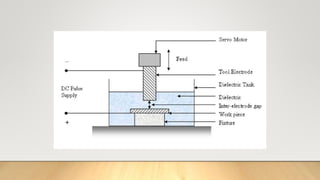
tool(cathode) and workpiece(anode) separated by a dielectric fluid medium. The gap
between workpiece and tool is 0.01 to 0.05. this spark gap is either flooded or
immersed in dielectric fluid. The gap between tool and workpiece is maintained by
mean of servo control unit, which sense the gap voltage and adjust the gap.
Metal removing rate is directly proportional to the working current value.
Commonly used liquid dielectric are paraffine or transformer or kerosene oil.
The voltage gradient is set up between the tool and the workpiece to break down the
dielectric medium, a conducting electric path is developed for spark discharge
because of the ionization of the dielectric fluid and thereby causes the current to flow.
The amount of metal removing per spark is depend upon the electric energy expand
per spark and the period over which it is expanded. The temperature of arc is reaches
about 10000`c, due to this the work surface is melt and vaporise.
 Advantage:
a) Hard material machined easily.
b) Any complicated shape is made.
c) In this process mechanical force is not involve.
 Disadvantage:
a) The workpiece and tool both must be conductor of electricity .
b) Process is slow.
c) Power consumption is high.
d) Heat is involved in this process.
 Application:
a) Reshaping of cutting tool and broaches.
b) Drilling a small hole in hardened part such as nozzle.
c) For machining orifice, airbag valve, slots in diesel fuel injection
nozzle.

Define Electric discharge machining process (EDM)

  • 1.
    Electric discharge machining(EDM): A powerful spark cause pitting of metal at both anode(+)and cathode(-).EDM are also known as spark machining or spark erosion, it is a process of controlled erosion of electrically conducting material by an interrupted, discharged between the tool(cathode) and workpiece(anode) separated by a dielectric fluid medium. The gap between workpiece and tool is 0.01 to 0.05. this spark gap is either flooded or immersed in dielectric fluid. The gap between tool and workpiece is maintained by mean of servo control unit, which sense the gap voltage and adjust the gap. Metal removing rate is directly proportional to the working current value.
  • 2.
    Commonly used liquiddielectric are paraffine or transformer or kerosene oil. The voltage gradient is set up between the tool and the workpiece to break down the dielectric medium, a conducting electric path is developed for spark discharge because of the ionization of the dielectric fluid and thereby causes the current to flow. The amount of metal removing per spark is depend upon the electric energy expand per spark and the period over which it is expanded. The temperature of arc is reaches about 10000`c, due to this the work surface is melt and vaporise.
  • 4.
     Advantage: a) Hardmaterial machined easily. b) Any complicated shape is made. c) In this process mechanical force is not involve.
  • 5.
     Disadvantage: a) Theworkpiece and tool both must be conductor of electricity . b) Process is slow. c) Power consumption is high. d) Heat is involved in this process.
  • 6.
     Application: a) Reshapingof cutting tool and broaches. b) Drilling a small hole in hardened part such as nozzle. c) For machining orifice, airbag valve, slots in diesel fuel injection nozzle.