Electrical Discharge Machining
(EDM)
By
Rubul Dutta
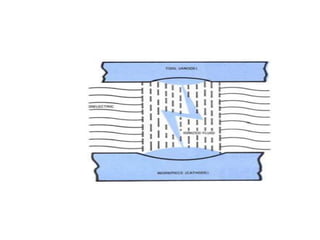
Electric discharge machining, also known as
Spark erosion, electro-erosion or spark
machining is a process of metal removal based
on the principle of erosion of metals by an
interrupted electric spark discharge between
the electrode tool (Cathode) and the work
(anode).
The workpiece and the tool are electrically
connected to a D.C electric power supply. The
work piece is connected to the positive
terminal of the electric source, so that it
becomes the anode. The tool is the cathode. A
gap, known as the spark gape in the range of
0.005 to 0.05 mm is maintained between the
workpiece and the tool, and suitable dielectric
fluid, which is non conductor of electricity is
forced through this gap at pressure of 2
kgf/cm2 or less.
Spark Gap
The EDM process involves a controlled erosion
of electrically conductive materials by the
initiation of rapid and repetitive spark
discharge between the electrode tool and
workpiece separated by a small gap of about
0.01-0.05 mm known as the spark gap.
overcut
The shape of the area of the cavity produced
in the workpiece should theoretically be the
same as that of the tool. Overcut is the
distance, the spark will penetrate the
workpiece from the tool and remove metal
from the workpiece. Theoretically, it is slightly
larger then the gap between the end of the
tool and the workpiece.
Dielectric fluid
Dielectric fluid is flushed through the spark gap
and is supplied through a hole in the tool or from
external jets.
Properties of dielectric fluid.
1. The dielectric fluid should have sufficient and
stable dielectric strength to serve as insulation
between the electrode and the tool.
2. It should deionize rapidly after the spark
discharge has taken place.
3. It should have low viscosity and a good
wetting capacity.
4. It should be chemically neutral so as not
attack the electrode, the workpiece, the table
or the working container.
5. Its flash point must be sufficiently high to
avoid any fire hazards.
6. It should not emit any toxic vapours or have
unpleasant odours.
Function of dielectric fluid
1. Formation of barriers (insulation) between
electrode and workpiece.
2. Fluid ionises to allow good conduction of
spark.
3. Act as a coolant for eroded particles from
spark gap.
4. Flushers away eroded particles from spark
gap.
5. Prevents oxidation of work piece.
Types of dielectric fluid
1. Hydrocarbon oils.
2. Kerosene,
3. Silicon oils,
4. Deionized water,
5. Polar liquid. (aqueous solution of ethylene glycol)
The choice of any particular dielectric depends on the
workpiece size, complexity of shape, tolerance, surface
finish and material removal rates.
Application of EDM
The development of EDM has been rapid and
provides another method of machining metals in
the tool room. It can be used to machine cavities
or intricate shapes in very hard materials, thus it
becomes especially useful for machining blind
cavities in dies used in die casting, stamping,
forging and injecting moulding. It makes possible
the machining of intricate cavities and holes in
hardened steel or special alloy steel without the
need of sectioning the cavity.
Types of Electrode Material
The electrode materials generally used can be
classified as metallic materials (copper), Non-
metallic materials(graphite), and combination of
metallic and non-metallic materials (copper
graphite). Copper, yellow brass, zinc, graphite
and some other materials are used for tools.
Low wearing tools include silver tungsten,
copper tungsten, and metalized graphite. For
commercial applications, copper is best suited
for fine machining. One of the advantages of
EDM is due to the fact that a tool made of a
material softer than the workpiece material
and which is good conductor of electricity can
be used to machine a material of any
hardness.
Advantages of EDM
1. Any complicated shape that can be made on
the tool can be reproduces on the workpiece.
2. EDM can be employed for extremely
hardened workpiece.
3. Highly complicated shapes can be made by
fabricating the tool with split sectioned
shapes, by welding, brazing or by applying
quick setting conductive epoxy adhesives.
Disadvantages
1. Machining time are too long.
2. Excessive tool wear.
3. High specific power consumption.
Principles of EDM
Electrical Discharge Machining (EDM) is a
controlled metal removal process that is used to
remove metal by means of electric spark erosion.
In this process an electric spark is used as the
cutting tool to cut (erode) the workpiece to
produce the finished part to the desired shape.
The metal-removal process is performed by
applying a pulsating (ON/OFF) electrical charge of
high-frequency current through the electrode to
the workpiece. This removes (erodes) very tiny
pieces of metal from the workpiece at a contrlled
rate.
EDM Process
EDM spark erosion is the same as having a
electrical short that burns a small hole in a
piece of metal it contacts, with the EDM
process both the workpiece material and the
electrode material must be conductor of
electricity.
The EDM process can be used in two different
ways.
1. A preshaped or formed electrode usually made from
graphite or copper is shaped to the form of the cavity it
is to reproduce. The formed electrode is fed vertically
down and the reverse shape of the electrode is eroded
in to the solid workpiece.
2. A continuous travelling vertical wire electrode, the
diameter of a small needle or less , is controlled by the
computer to follow a programmed path to erode or cut
a narrow slot through the workpiece to produce the
required shape.
What is the function of dielectric
fluids.
During the EDM process the workpiece and the
electrode are submerged in the dielectric oil,
which is an electrical insulator that helps to
control the arc discharge . The dielectric oil,
that provides a means of flushing, is pumped
through the arc gap. This removes suspended
particles of workpiece material and electrode
from the work cavity.
Flushing
The most important factor in EDM is to have
proper flushing, because eroded particles
must be removed from the gap from efficient
cutting. Flushing also brings fresh dielectric oil
into the gap and cools the electrode and the
workpiece.
Types of flushing:
1. Pressure flushing.
2. Suction flushing,
3. Combined Pressure and Suction Flushing.
4. Jet Flushing,
5. Pulse Flushing.
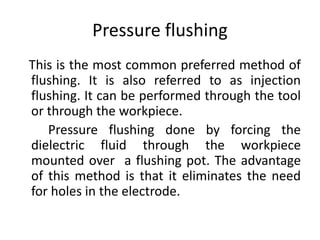
Pressure flushing
This is the most common preferred method of
flushing. It is also referred to as injection
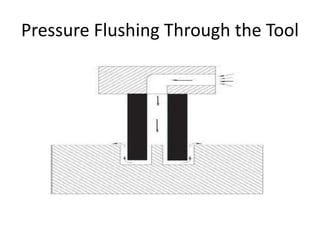
flushing. It can be performed through the tool
or through the workpiece.
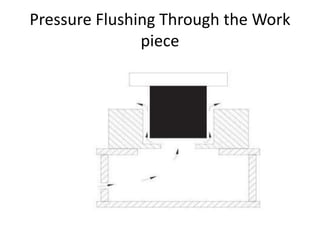
Pressure flushing done by forcing the
dielectric fluid through the workpiece
mounted over a flushing pot. The advantage
of this method is that it eliminates the need
for holes in the electrode.
Pressure Flushing Through the Tool
Pressure Flushing Through the Work
piece
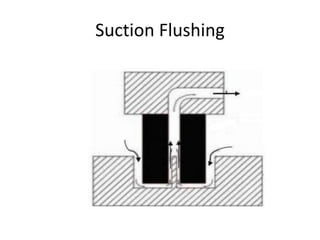
Suction Flushing
Suction Flushing also known as vacuum
flushing, has the capability of removing the
eroded gap particles. It can be done through
the electrode or through the workpiece.
Suction Flushing
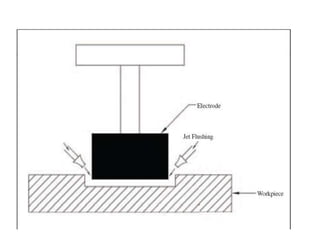
Jet Flushing
Jet or side flushing is done by tubes or flushing
nozzles which direct the dielectric fluid in to
the gap, pulse flushing is usually used along
with get flushing.
Wire cut EDM
The wire cut EDM is a discharge machine that
uses CNC movement to produce the desired
contour or shape. It does not require a special
shaped electrode, instead it uses a continuous
travelling vertical wire under tension as the
electrode. The electrode in wire cut EDM is
about as thick as a small diameter needle
whose path is controlled by the machine
computer to produce the shape required.

CNC EDM (ELECTRIC DECHARGE MACHINE) pptx

  • 1.
  • 2.
    Electric discharge machining,also known as Spark erosion, electro-erosion or spark machining is a process of metal removal based on the principle of erosion of metals by an interrupted electric spark discharge between the electrode tool (Cathode) and the work (anode). The workpiece and the tool are electrically connected to a D.C electric power supply. The
  • 3.
    work piece isconnected to the positive terminal of the electric source, so that it becomes the anode. The tool is the cathode. A gap, known as the spark gape in the range of 0.005 to 0.05 mm is maintained between the workpiece and the tool, and suitable dielectric fluid, which is non conductor of electricity is forced through this gap at pressure of 2 kgf/cm2 or less.
  • 4.
    Spark Gap The EDMprocess involves a controlled erosion of electrically conductive materials by the initiation of rapid and repetitive spark discharge between the electrode tool and workpiece separated by a small gap of about 0.01-0.05 mm known as the spark gap.
  • 5.
    overcut The shape ofthe area of the cavity produced in the workpiece should theoretically be the same as that of the tool. Overcut is the distance, the spark will penetrate the workpiece from the tool and remove metal from the workpiece. Theoretically, it is slightly larger then the gap between the end of the tool and the workpiece.
  • 6.
    Dielectric fluid Dielectric fluidis flushed through the spark gap and is supplied through a hole in the tool or from external jets. Properties of dielectric fluid. 1. The dielectric fluid should have sufficient and stable dielectric strength to serve as insulation between the electrode and the tool. 2. It should deionize rapidly after the spark discharge has taken place.
  • 7.
    3. It shouldhave low viscosity and a good wetting capacity. 4. It should be chemically neutral so as not attack the electrode, the workpiece, the table or the working container. 5. Its flash point must be sufficiently high to avoid any fire hazards. 6. It should not emit any toxic vapours or have unpleasant odours.
  • 8.
    Function of dielectricfluid 1. Formation of barriers (insulation) between electrode and workpiece. 2. Fluid ionises to allow good conduction of spark. 3. Act as a coolant for eroded particles from spark gap. 4. Flushers away eroded particles from spark gap. 5. Prevents oxidation of work piece.
  • 9.
    Types of dielectricfluid 1. Hydrocarbon oils. 2. Kerosene, 3. Silicon oils, 4. Deionized water, 5. Polar liquid. (aqueous solution of ethylene glycol) The choice of any particular dielectric depends on the workpiece size, complexity of shape, tolerance, surface finish and material removal rates.
  • 10.
    Application of EDM Thedevelopment of EDM has been rapid and provides another method of machining metals in the tool room. It can be used to machine cavities or intricate shapes in very hard materials, thus it becomes especially useful for machining blind cavities in dies used in die casting, stamping, forging and injecting moulding. It makes possible the machining of intricate cavities and holes in hardened steel or special alloy steel without the need of sectioning the cavity.
  • 11.
    Types of ElectrodeMaterial The electrode materials generally used can be classified as metallic materials (copper), Non- metallic materials(graphite), and combination of metallic and non-metallic materials (copper graphite). Copper, yellow brass, zinc, graphite and some other materials are used for tools. Low wearing tools include silver tungsten, copper tungsten, and metalized graphite. For commercial applications, copper is best suited
  • 12.
    for fine machining.One of the advantages of EDM is due to the fact that a tool made of a material softer than the workpiece material and which is good conductor of electricity can be used to machine a material of any hardness.
  • 13.
    Advantages of EDM 1.Any complicated shape that can be made on the tool can be reproduces on the workpiece. 2. EDM can be employed for extremely hardened workpiece. 3. Highly complicated shapes can be made by fabricating the tool with split sectioned shapes, by welding, brazing or by applying quick setting conductive epoxy adhesives.
  • 14.
    Disadvantages 1. Machining timeare too long. 2. Excessive tool wear. 3. High specific power consumption.
  • 15.
    Principles of EDM ElectricalDischarge Machining (EDM) is a controlled metal removal process that is used to remove metal by means of electric spark erosion. In this process an electric spark is used as the cutting tool to cut (erode) the workpiece to produce the finished part to the desired shape. The metal-removal process is performed by applying a pulsating (ON/OFF) electrical charge of high-frequency current through the electrode to the workpiece. This removes (erodes) very tiny pieces of metal from the workpiece at a contrlled rate.
  • 17.
    EDM Process EDM sparkerosion is the same as having a electrical short that burns a small hole in a piece of metal it contacts, with the EDM process both the workpiece material and the electrode material must be conductor of electricity. The EDM process can be used in two different ways.
  • 18.
    1. A preshapedor formed electrode usually made from graphite or copper is shaped to the form of the cavity it is to reproduce. The formed electrode is fed vertically down and the reverse shape of the electrode is eroded in to the solid workpiece. 2. A continuous travelling vertical wire electrode, the diameter of a small needle or less , is controlled by the computer to follow a programmed path to erode or cut a narrow slot through the workpiece to produce the required shape.
  • 19.
    What is thefunction of dielectric fluids. During the EDM process the workpiece and the electrode are submerged in the dielectric oil, which is an electrical insulator that helps to control the arc discharge . The dielectric oil, that provides a means of flushing, is pumped through the arc gap. This removes suspended particles of workpiece material and electrode from the work cavity.
  • 20.
    Flushing The most importantfactor in EDM is to have proper flushing, because eroded particles must be removed from the gap from efficient cutting. Flushing also brings fresh dielectric oil into the gap and cools the electrode and the workpiece.
  • 21.
    Types of flushing: 1.Pressure flushing. 2. Suction flushing, 3. Combined Pressure and Suction Flushing. 4. Jet Flushing, 5. Pulse Flushing.
  • 22.
    Pressure flushing This isthe most common preferred method of flushing. It is also referred to as injection flushing. It can be performed through the tool or through the workpiece. Pressure flushing done by forcing the dielectric fluid through the workpiece mounted over a flushing pot. The advantage of this method is that it eliminates the need for holes in the electrode.
  • 23.
  • 24.
  • 25.
    Suction Flushing Suction Flushingalso known as vacuum flushing, has the capability of removing the eroded gap particles. It can be done through the electrode or through the workpiece.
  • 26.
  • 27.
    Jet Flushing Jet orside flushing is done by tubes or flushing nozzles which direct the dielectric fluid in to the gap, pulse flushing is usually used along with get flushing.
  • 29.
    Wire cut EDM Thewire cut EDM is a discharge machine that uses CNC movement to produce the desired contour or shape. It does not require a special shaped electrode, instead it uses a continuous travelling vertical wire under tension as the electrode. The electrode in wire cut EDM is about as thick as a small diameter needle whose path is controlled by the machine computer to produce the shape required.