Mechanics of
Manufacturing Processes
Lectures by Dr Liaqat Ali
Electrical Discharge Machining
• Electrical Discharge Machining (EDM) is a highly precise and
innovative manufacturing process that has revolutionised the way
complex shapes and intricate features are fabricated from electrically
conductive materials. Unlike conventional machining methods that
involve physical contact between a cutting tool and the workpiece,
EDM employs electrical discharges to erode material with
exceptional precision and minimal mechanical stress.
• It uses electrical sparks to erode material from a workpiece. It's ideal
for intricate shapes and hard materials, offering high accuracy in
industries like aerospace and toolmaking.
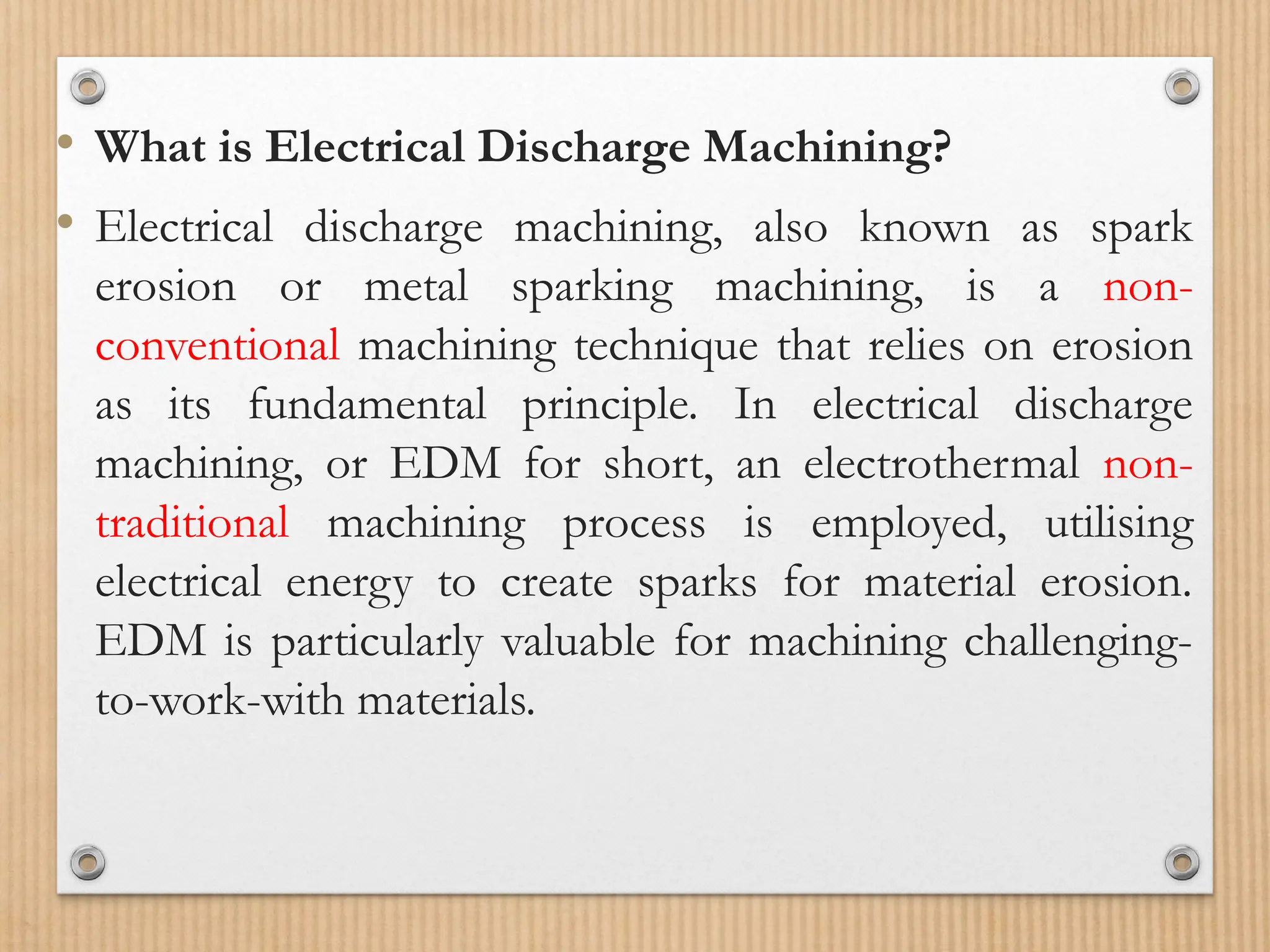
• What is Electrical Discharge Machining?
• Electrical discharge machining, also known as spark
erosion or metal sparking machining, is a non-
conventional machining technique that relies on erosion
as its fundamental principle. In electrical discharge
machining, or EDM for short, an electrothermal non-
traditional machining process is employed, utilising
electrical energy to create sparks for material erosion.
EDM is particularly valuable for machining challenging-
to-work-with materials.
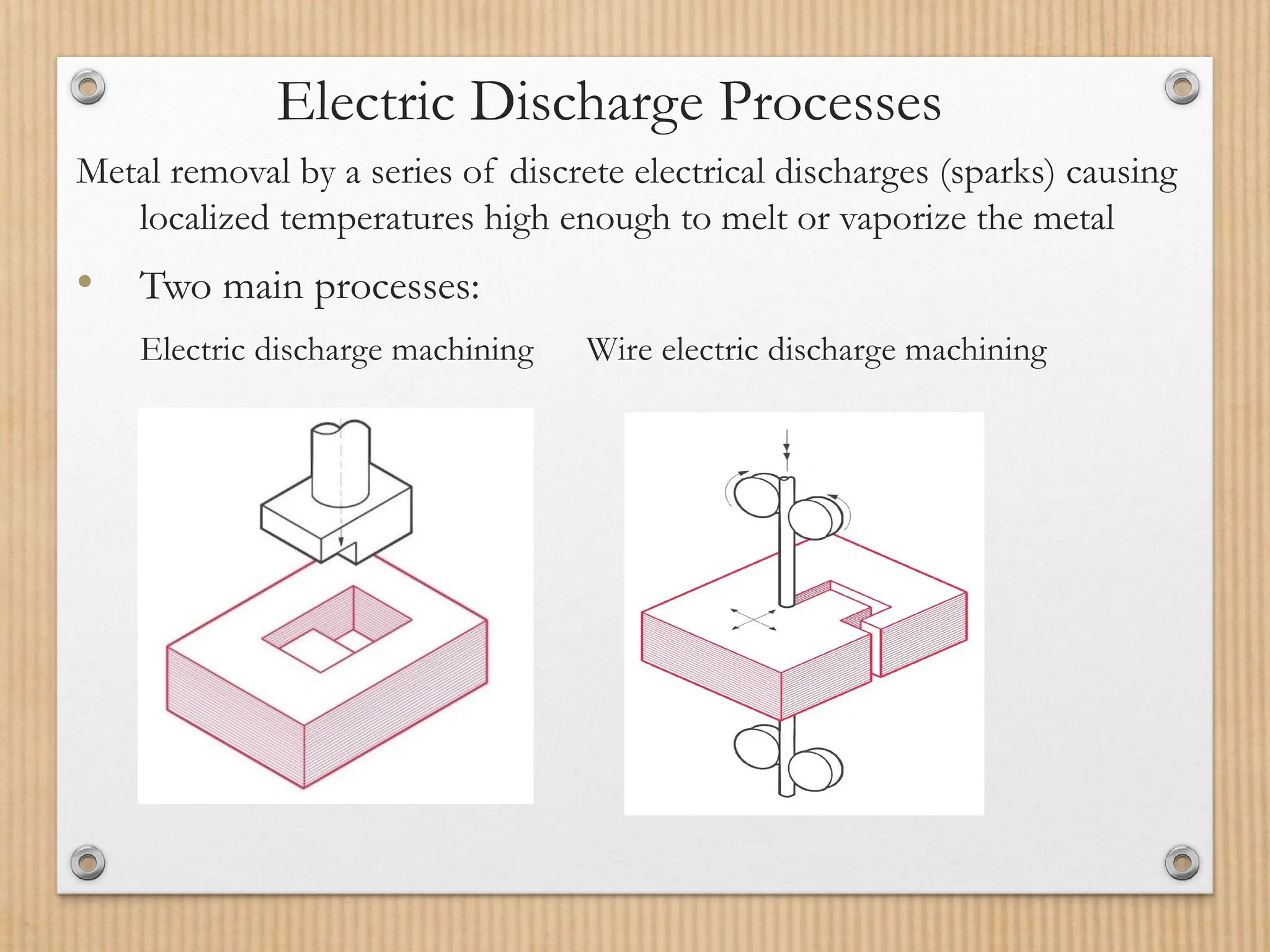
Electric Discharge Processes
Metal removal by a series of discrete electrical discharges (sparks) causing
localized temperatures high enough to melt or vaporize the metal
• Two main processes:
Electric discharge machining Wire electric discharge machining
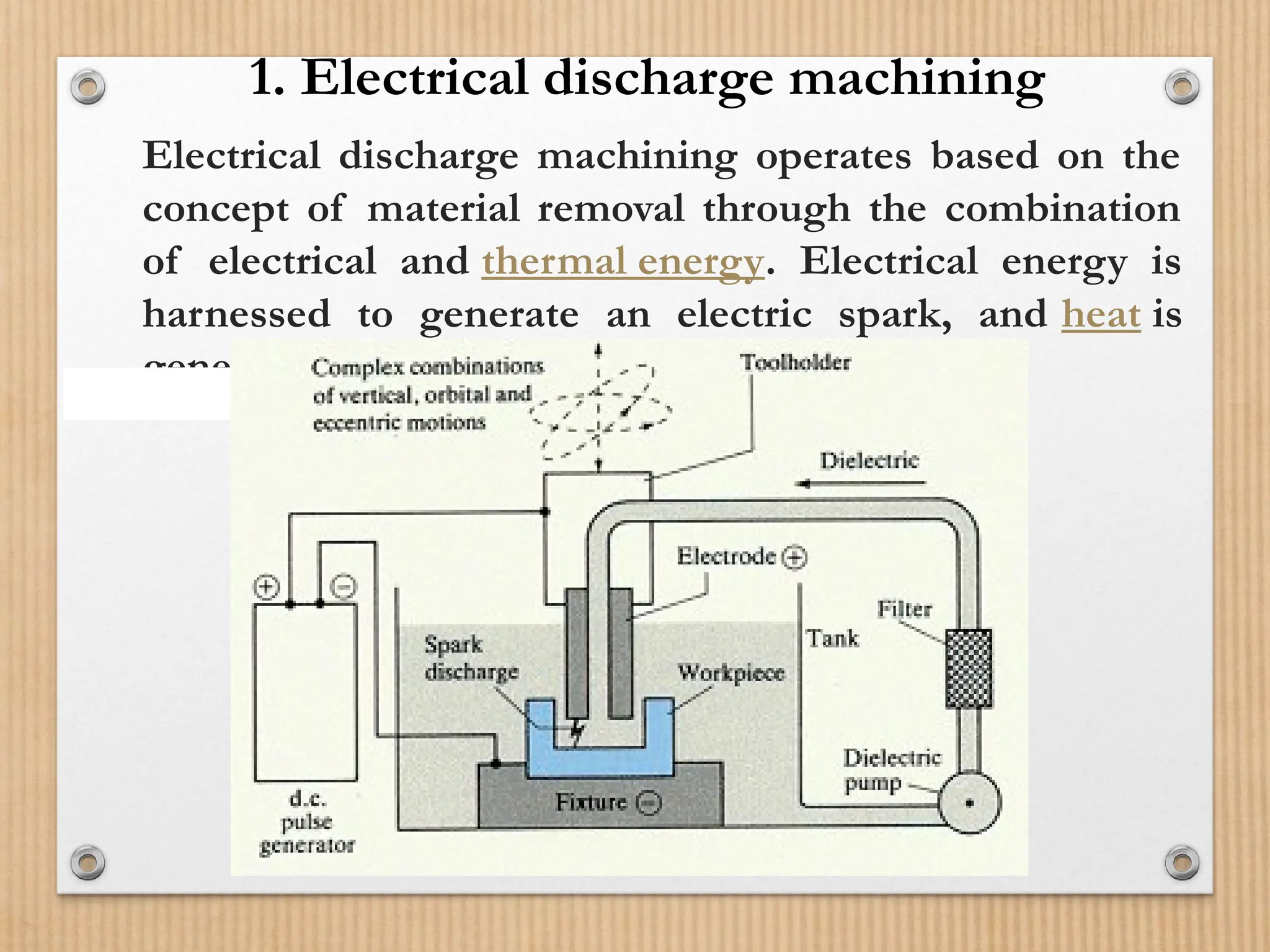
Electrical discharge machining operates based on the
concept of material removal through the combination
of electrical and thermal energy. Electrical energy is
harnessed to generate an electric spark, and heat is
generated as a result of metal erosion
1. Electrical discharge machining
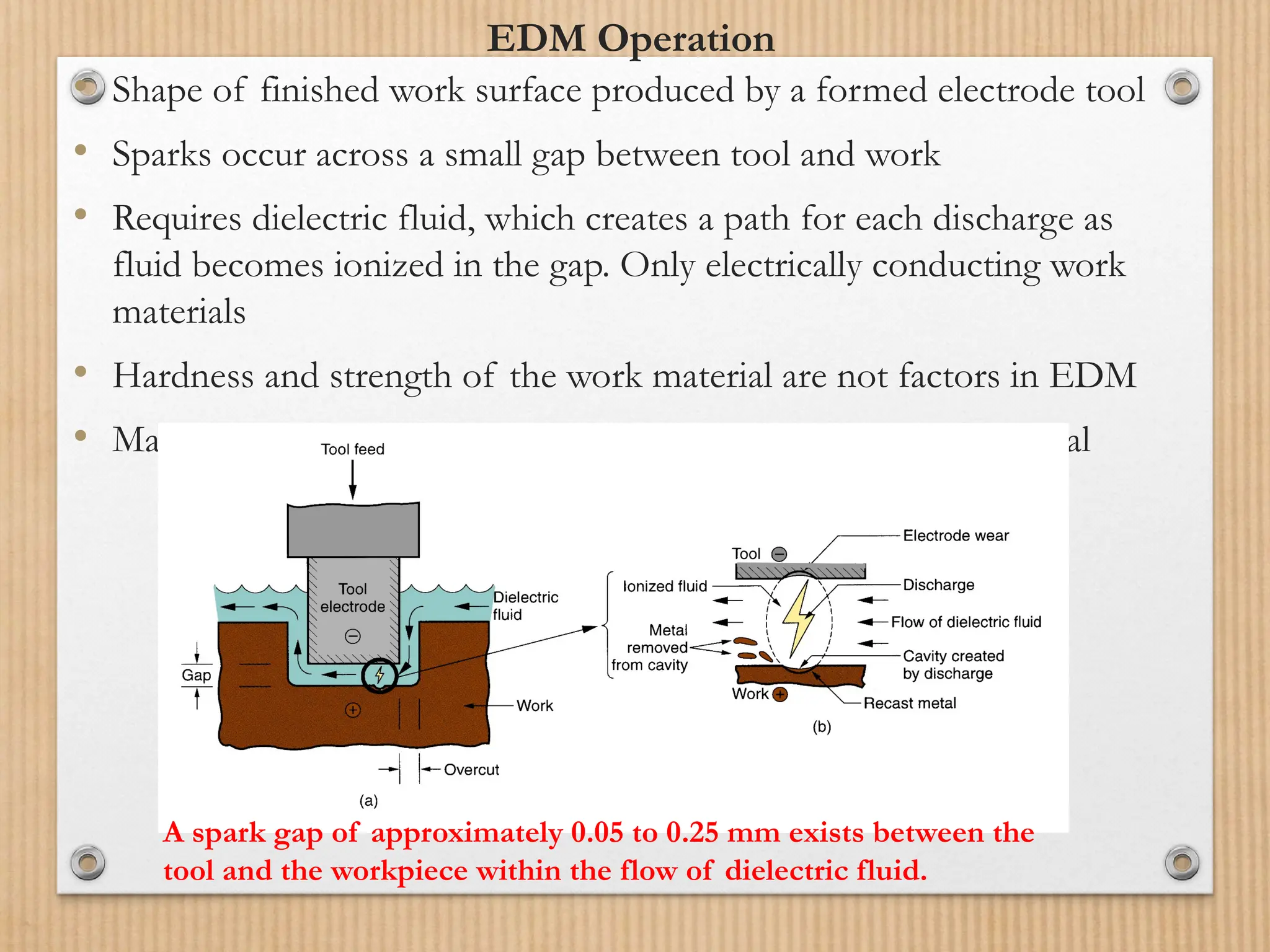
EDM Operation
• Shape of finished work surface produced by a formed electrode tool
• Sparks occur across a small gap between tool and work
• Requires dielectric fluid, which creates a path for each discharge as
fluid becomes ionized in the gap. Only electrically conducting work
materials
• Hardness and strength of the work material are not factors in EDM
• Material removal rate is related to melting point of work material
A spark gap of approximately 0.05 to 0.25 mm exists between the
tool and the workpiece within the flow of dielectric fluid.
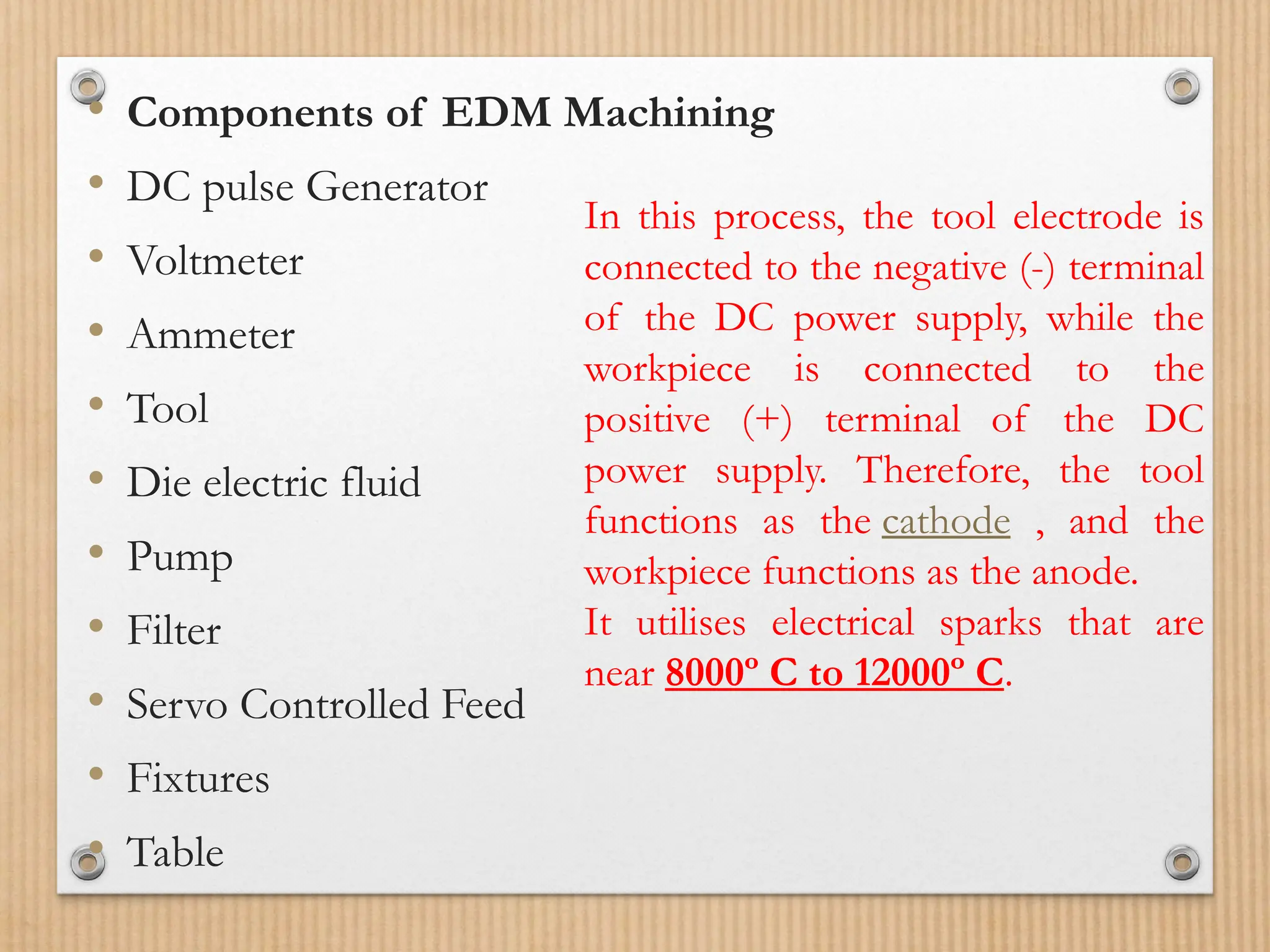
• Components of EDM Machining
• DC pulse Generator
• Voltmeter
• Ammeter
• Tool
• Die electric fluid
• Pump
• Filter
• Servo Controlled Feed
• Fixtures
• Table
In this process, the tool electrode is
connected to the negative (-) terminal
of the DC power supply, while the
workpiece is connected to the
positive (+) terminal of the DC
power supply. Therefore, the tool
functions as the cathode , and the
workpiece functions as the anode.
It utilises electrical sparks that are
near 8000º C to 12000º C.
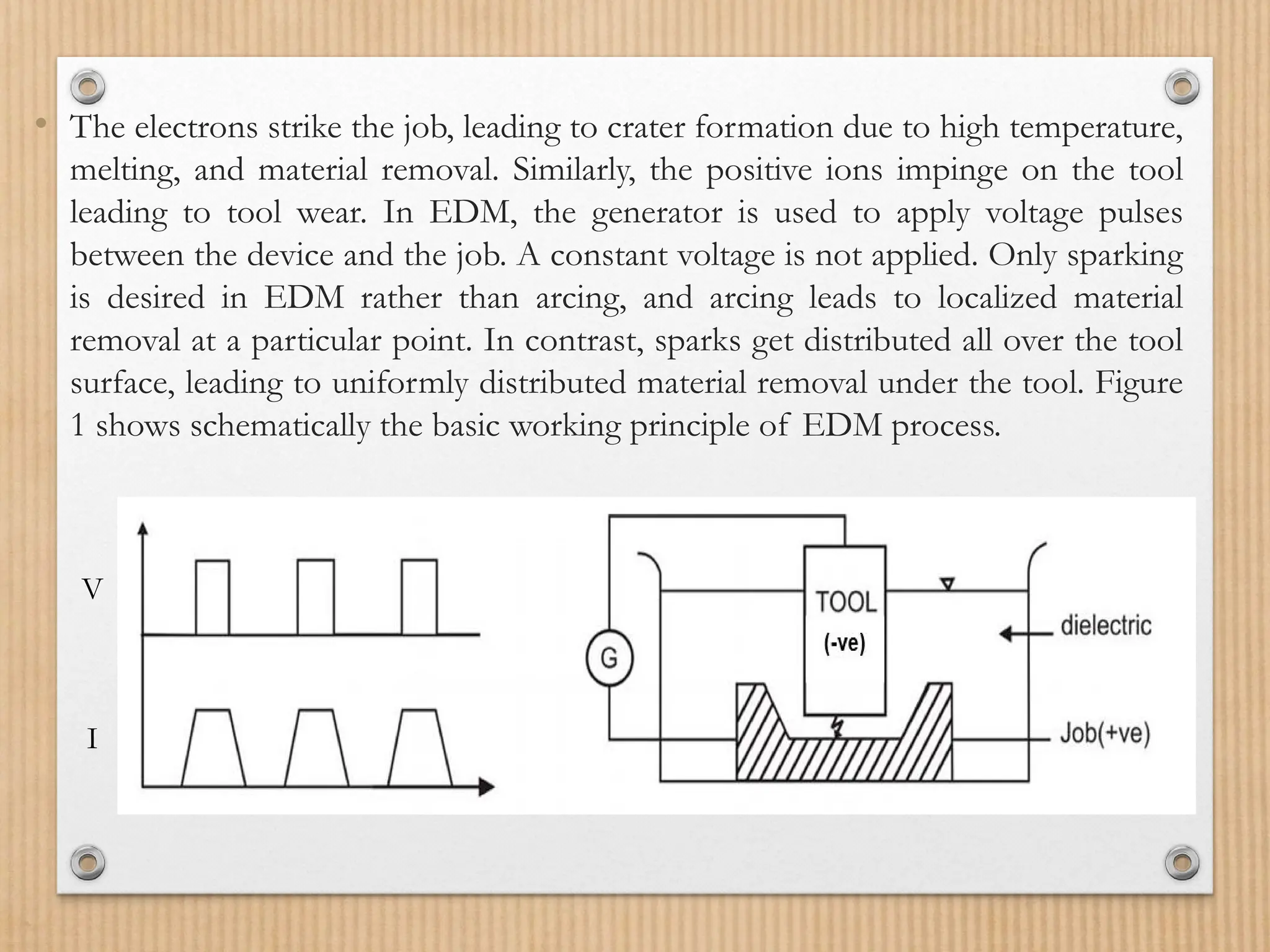
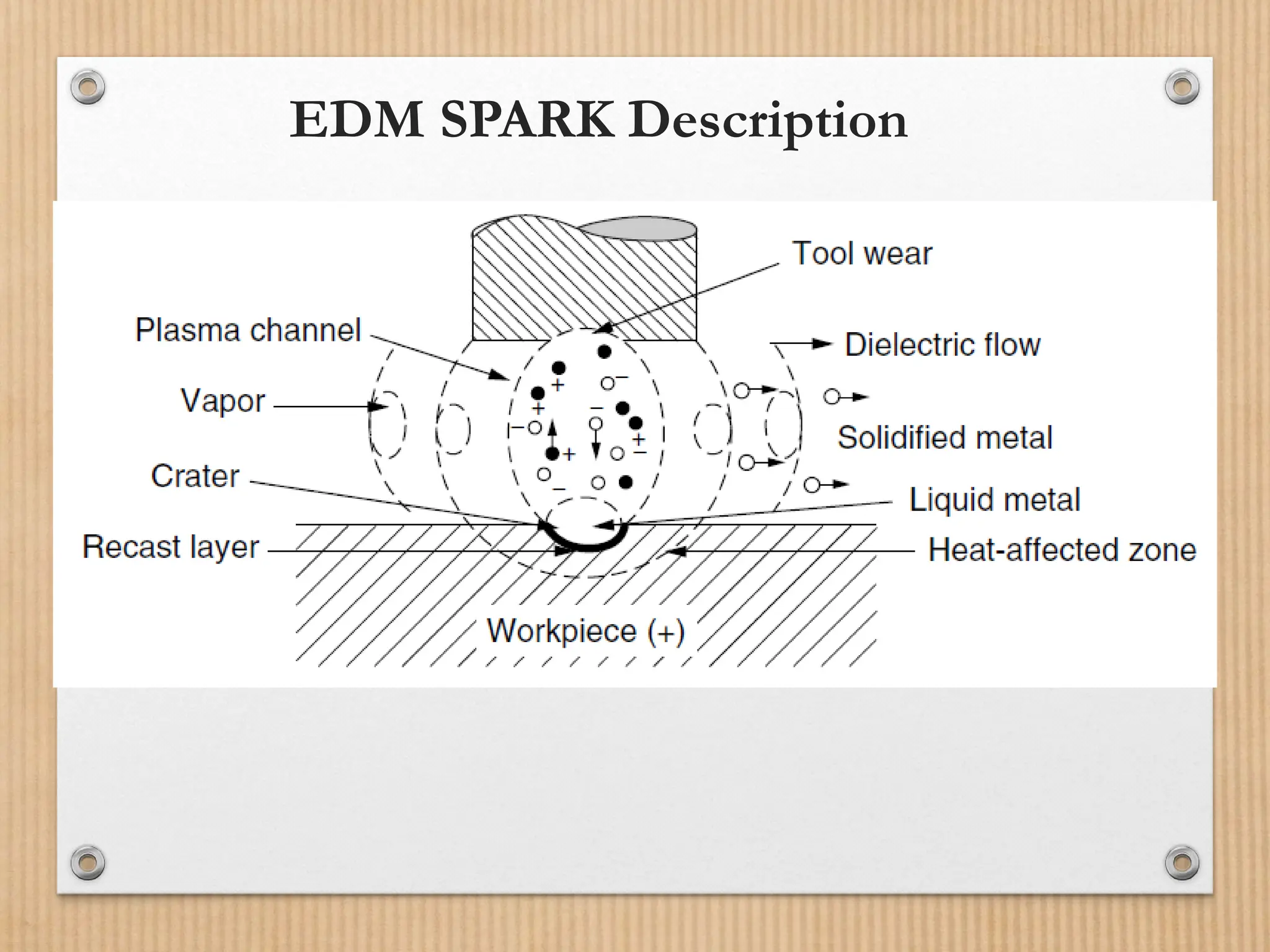
• The electrons strike the job, leading to crater formation due to high temperature,
melting, and material removal. Similarly, the positive ions impinge on the tool
leading to tool wear. In EDM, the generator is used to apply voltage pulses
between the device and the job. A constant voltage is not applied. Only sparking
is desired in EDM rather than arcing, and arcing leads to localized material
removal at a particular point. In contrast, sparks get distributed all over the tool
surface, leading to uniformly distributed material removal under the tool. Figure
1 shows schematically the basic working principle of EDM process.
V
I
EDM SPARK Description
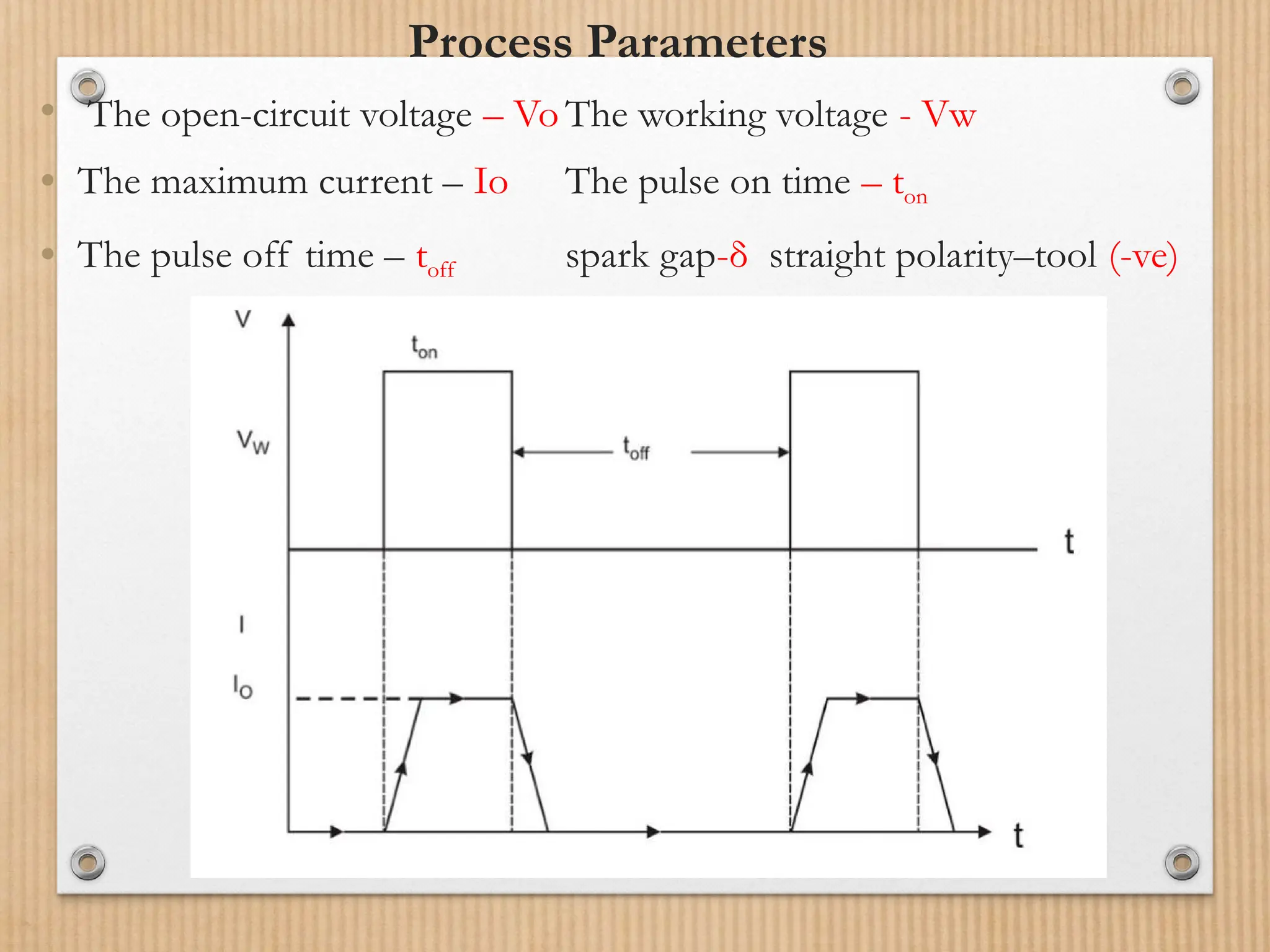
Process Parameters
• The open-circuit voltage – Vo The working voltage - Vw
• The maximum current – Io The pulse on time – ton
• The pulse off time – toff spark gap-δ straight polarity–tool (-ve)
Modeling of Material Removal and Product Quality
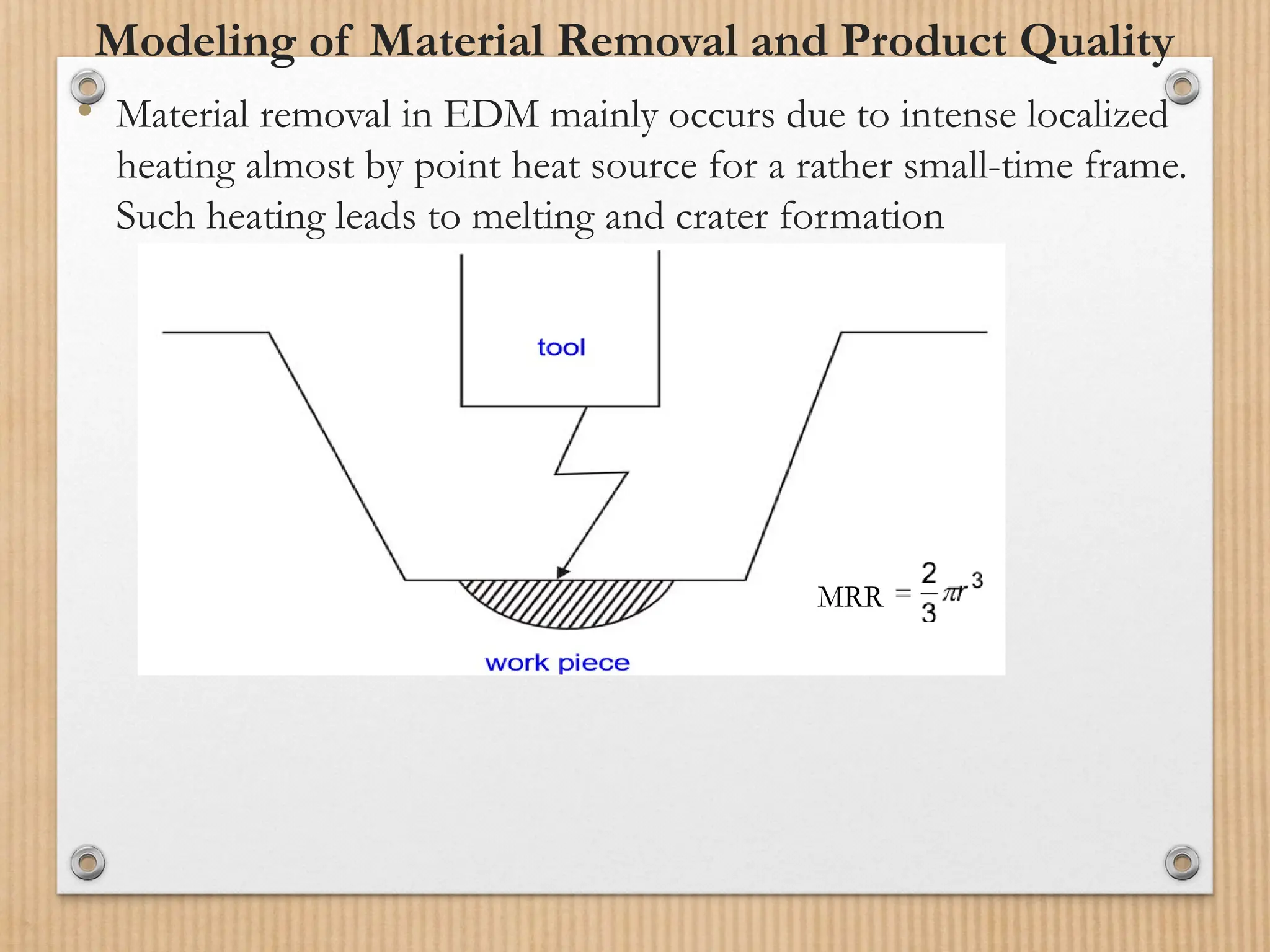
• Material removal in EDM mainly occurs due to intense localized
heating almost by point heat source for a rather small-time frame.
Such heating leads to melting and crater formation
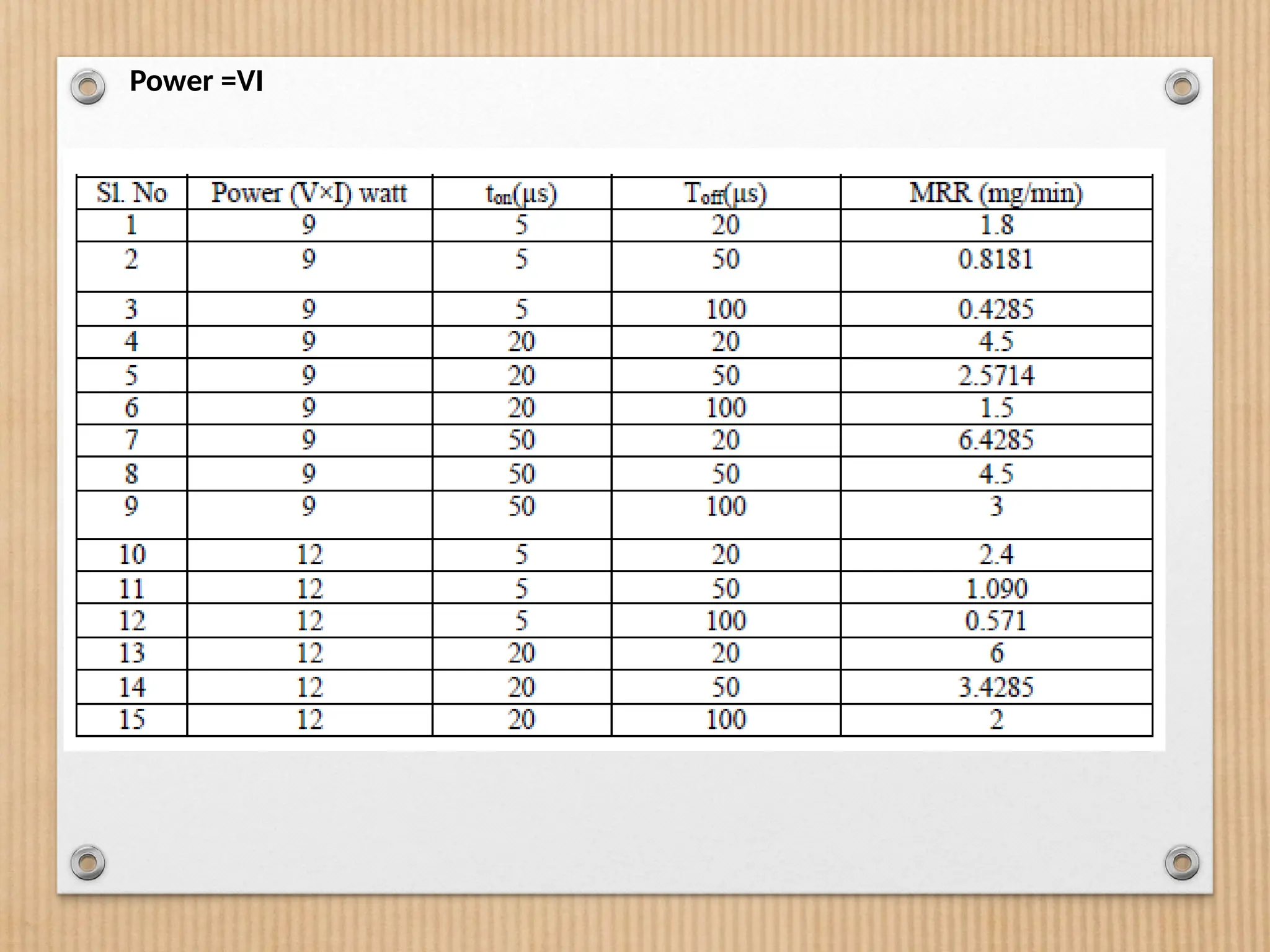
MRR
MRR
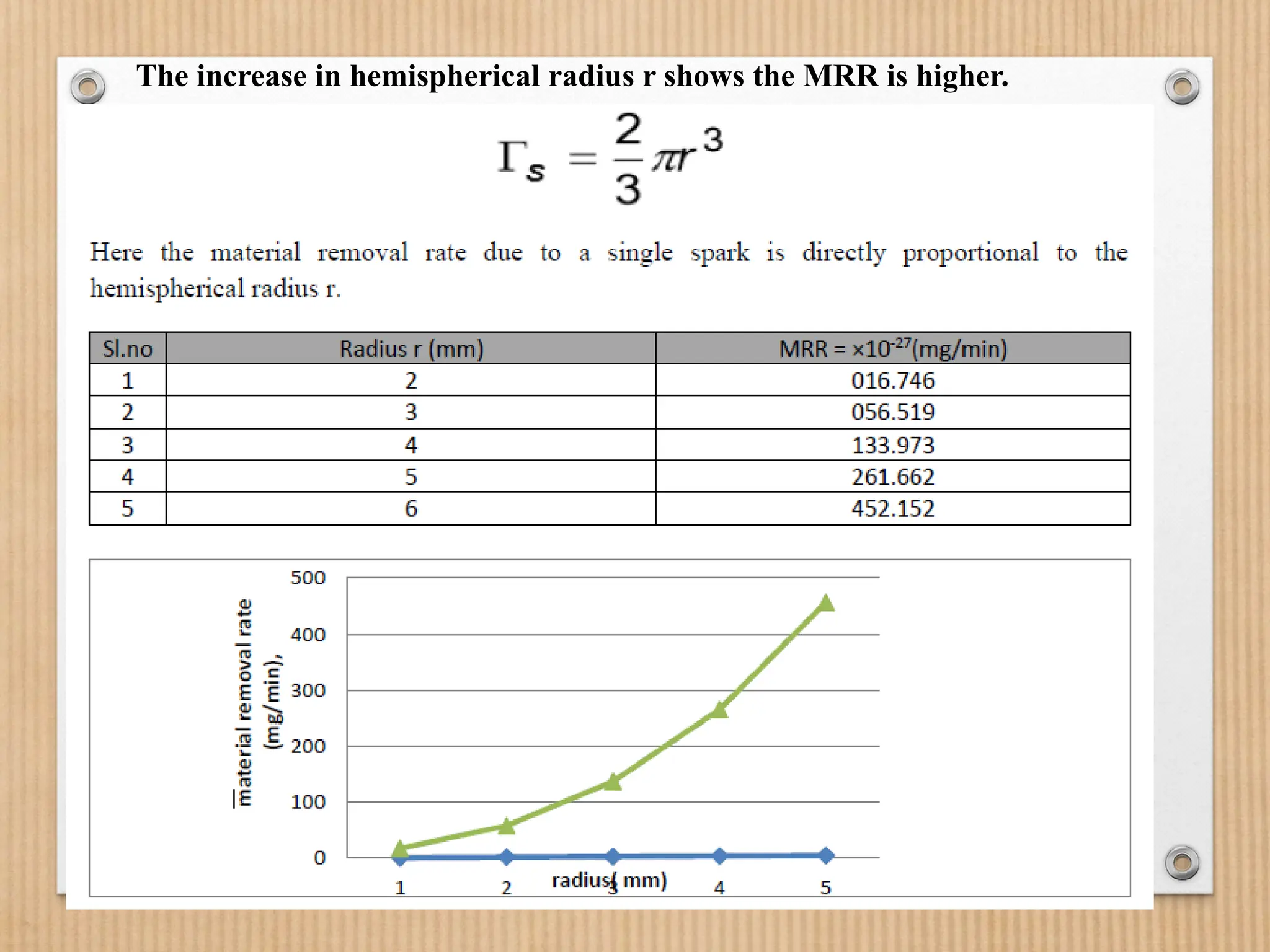
The increase in hemispherical radius r shows the MRR is higher.
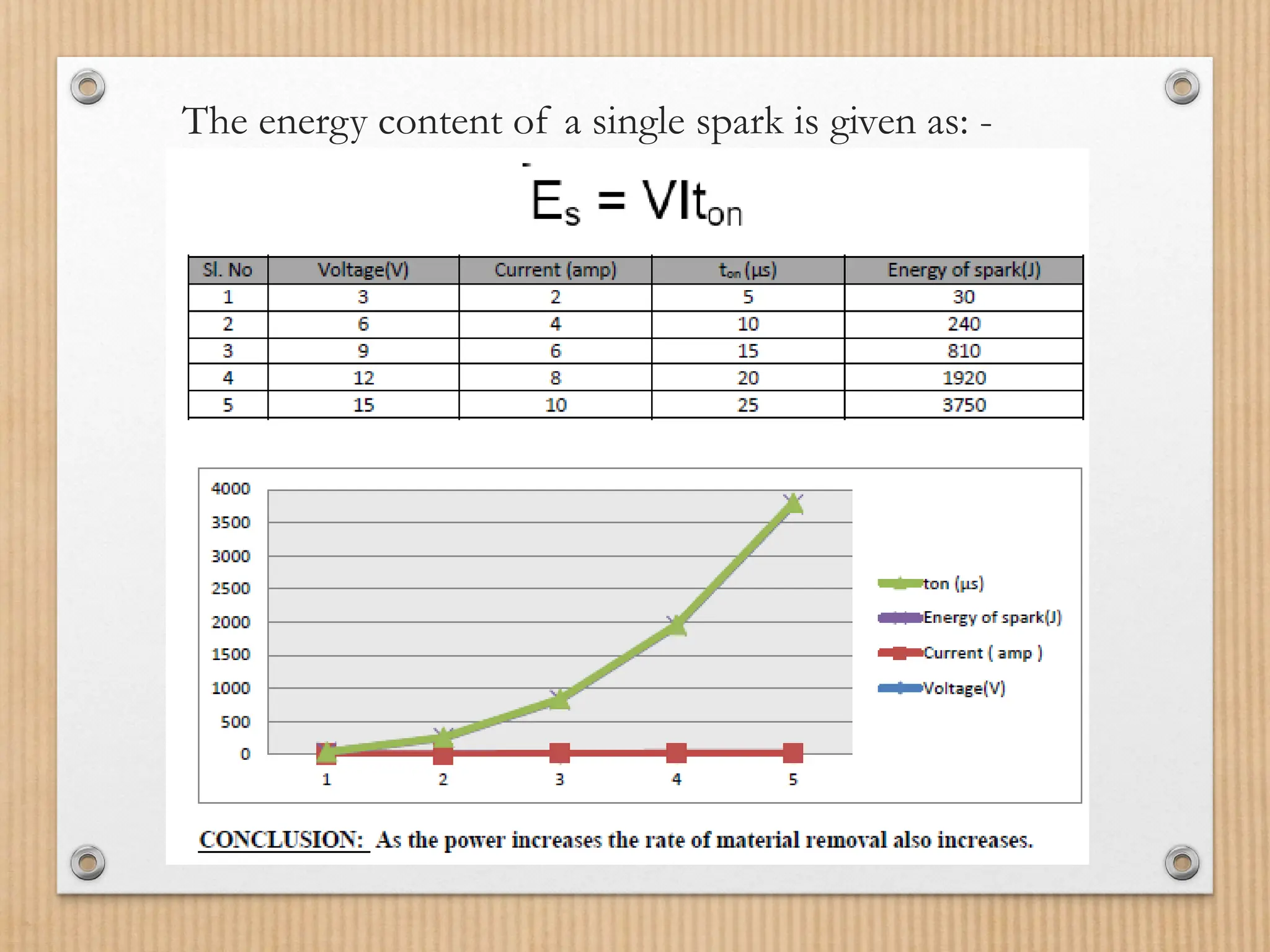
The energy content of a single spark is given as: -
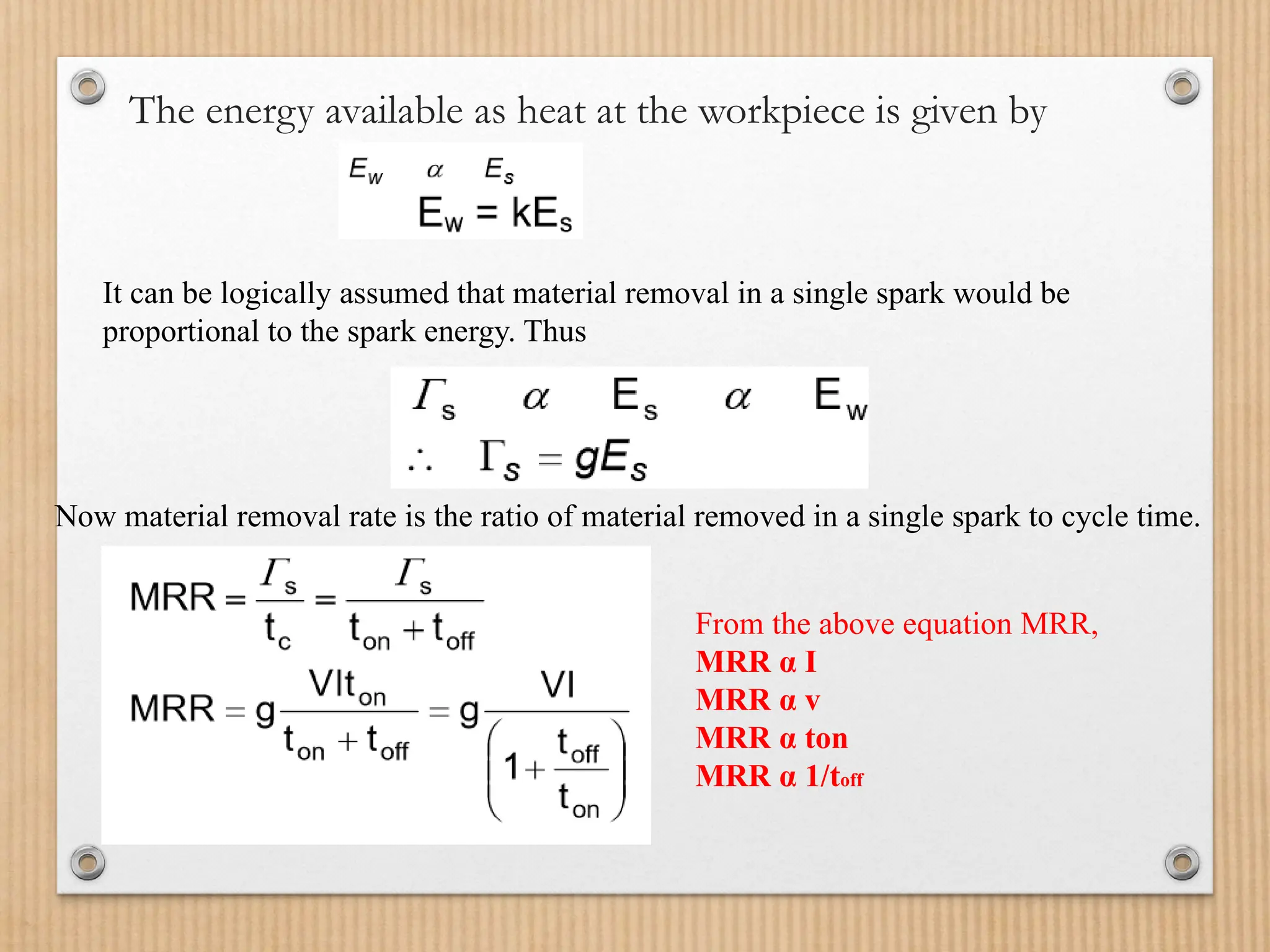
The energy available as heat at the workpiece is given by
It can be logically assumed that material removal in a single spark would be
proportional to the spark energy. Thus
Now material removal rate is the ratio of material removed in a single spark to cycle time.
From the above equation MRR,
MRR α I
MRR α v
MRR α ton
MRR α 1/toff
Power =VI
The model presented in the table is a very simplified one, and a linear
relationship is not observed in practice. But even then, such a simplified
model captures the complexity of EDM in a very efficient manner.
MRR in practice increases with an increase in working voltage, current,
pulse on time, and decreases in pulse off time. Product quality is an
essential characteristic of a manufacturing process along with MRR.
The followings are the product quality issues in EDM: -
• Surface finish
• Overcut
• Taper cut
No two sparks take place side by side. They occur randomly so that over
time one gets uniform average material removal over the whole tool
cross-section.
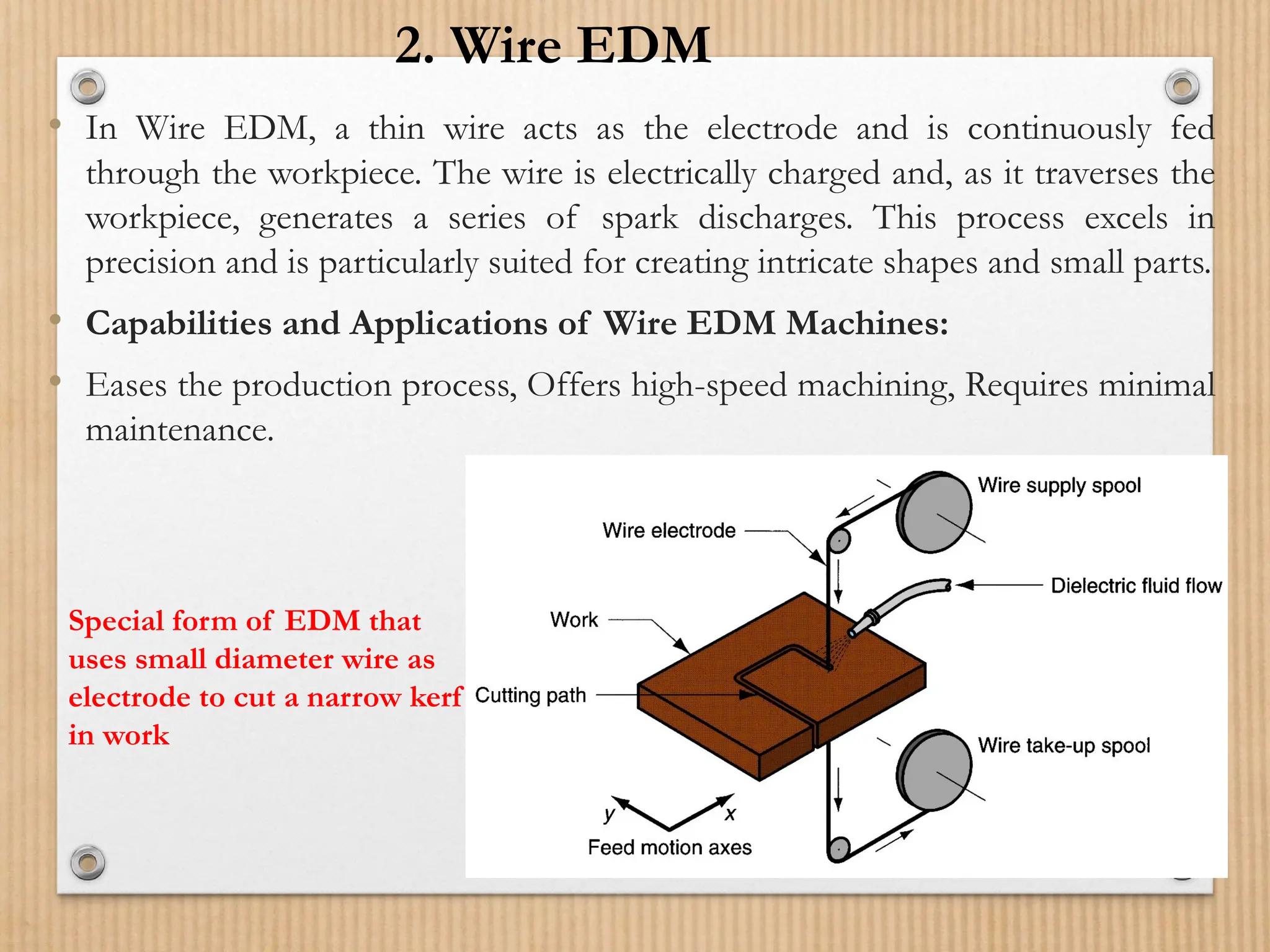
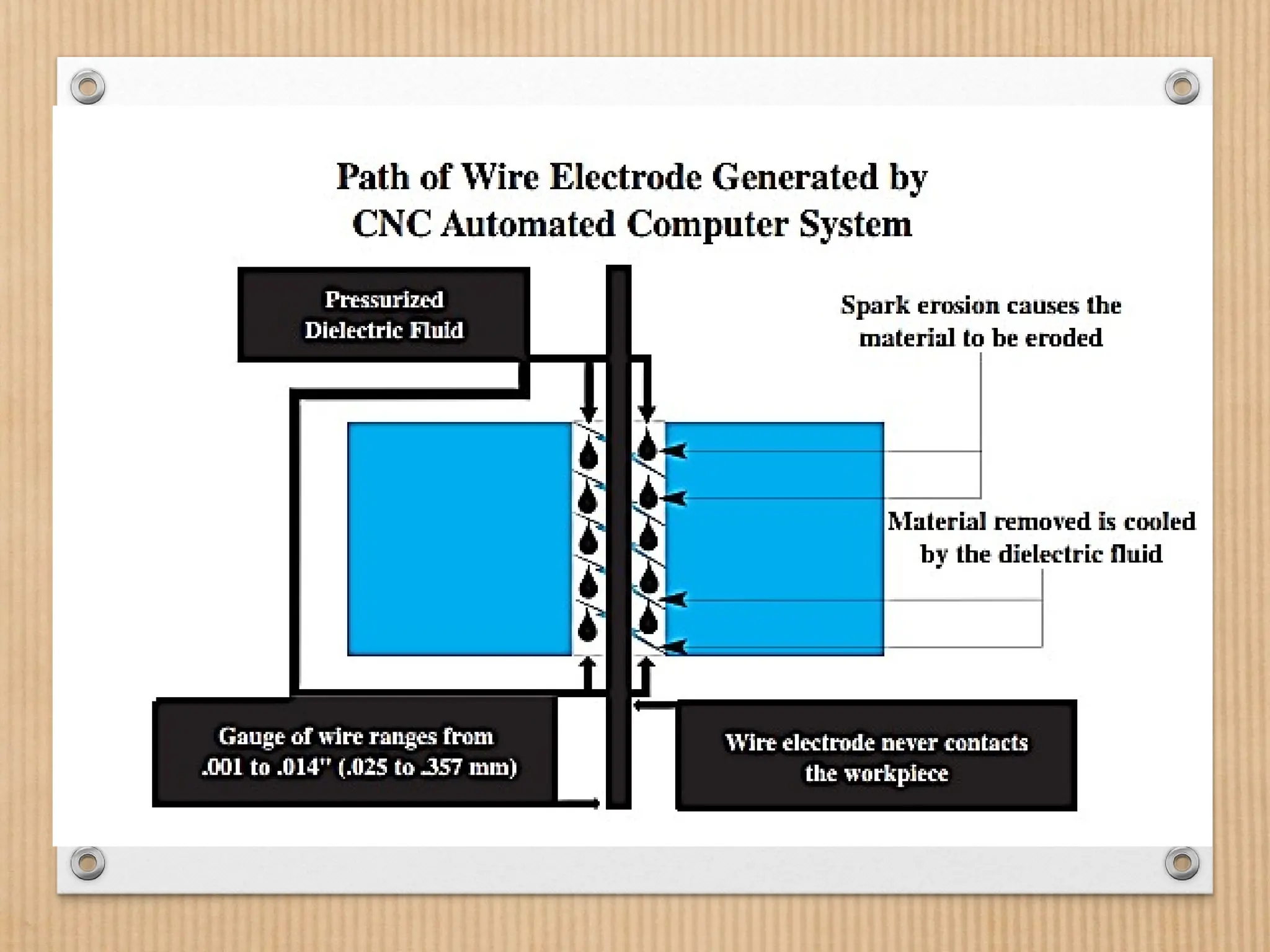
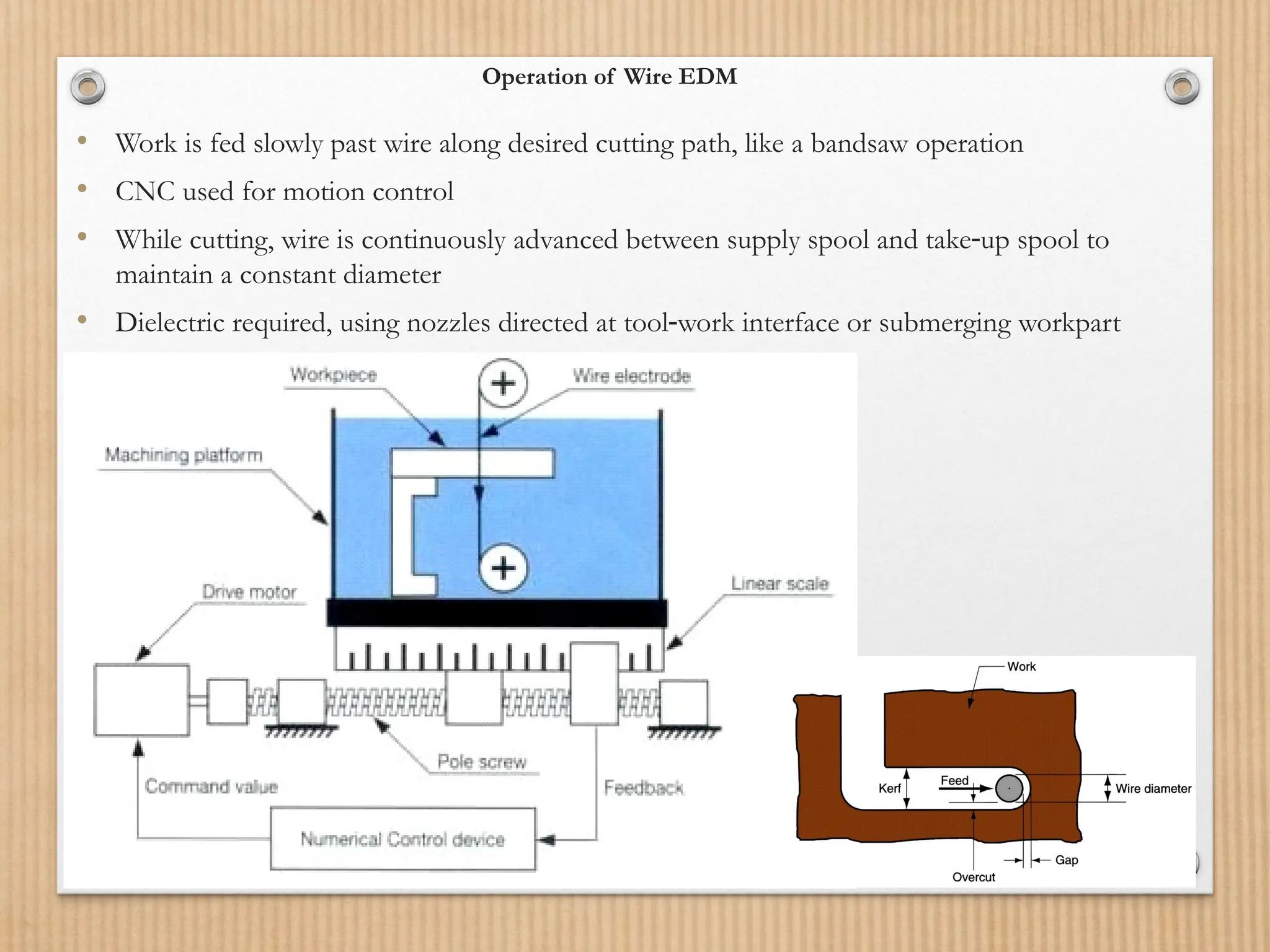
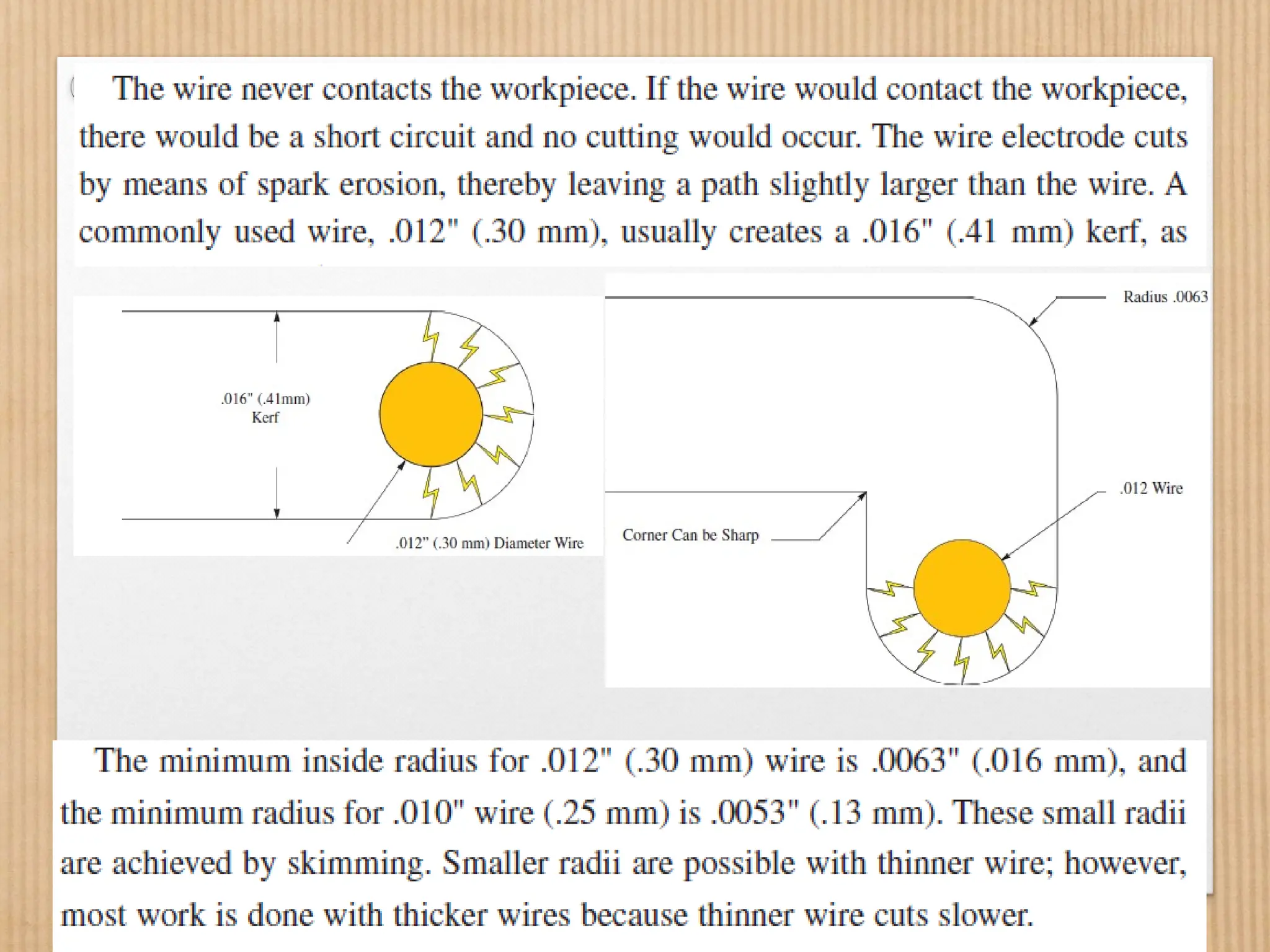
• In Wire EDM, a thin wire acts as the electrode and is continuously fed
through the workpiece. The wire is electrically charged and, as it traverses the
workpiece, generates a series of spark discharges. This process excels in
precision and is particularly suited for creating intricate shapes and small parts.
• Capabilities and Applications of Wire EDM Machines:
• Eases the production process, Offers high-speed machining, Requires minimal
maintenance.
Special form of EDM that
uses small diameter wire as
electrode to cut a narrow kerf
in work
2. Wire EDM
Operation of Wire EDM
• Work is fed slowly past wire along desired cutting path, like a bandsaw operation
• CNC used for motion control
• While cutting, wire is continuously advanced between supply spool and take up spool to
‑
maintain a constant diameter
• Dielectric required, using nozzles directed at tool work interface or submerging workpart
‑
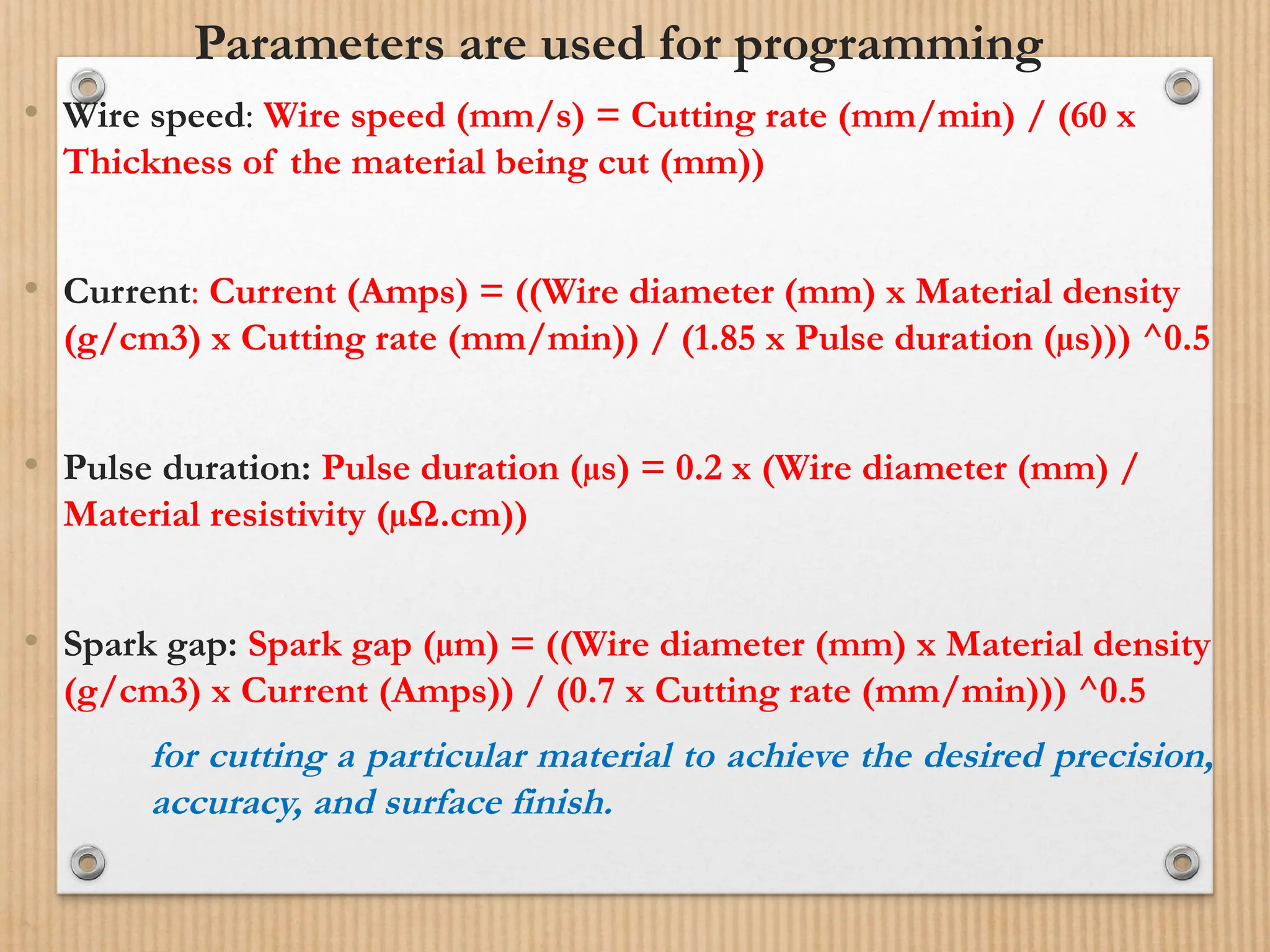
Parameters are used for programming
• Wire speed: Wire speed (mm/s) = Cutting rate (mm/min) / (60 x
Thickness of the material being cut (mm))
• Current: Current (Amps) = ((Wire diameter (mm) x Material density
(g/cm3) x Cutting rate (mm/min)) / (1.85 x Pulse duration (µs))) ^0.5
• Pulse duration: Pulse duration (µs) = 0.2 x (Wire diameter (mm) /
Material resistivity (µΩ.cm))
• Spark gap: Spark gap (µm) = ((Wire diameter (mm) x Material density
(g/cm3) x Current (Amps)) / (0.7 x Cutting rate (mm/min))) ^0.5
for cutting a particular material to achieve the desired precision,
accuracy, and surface finish.
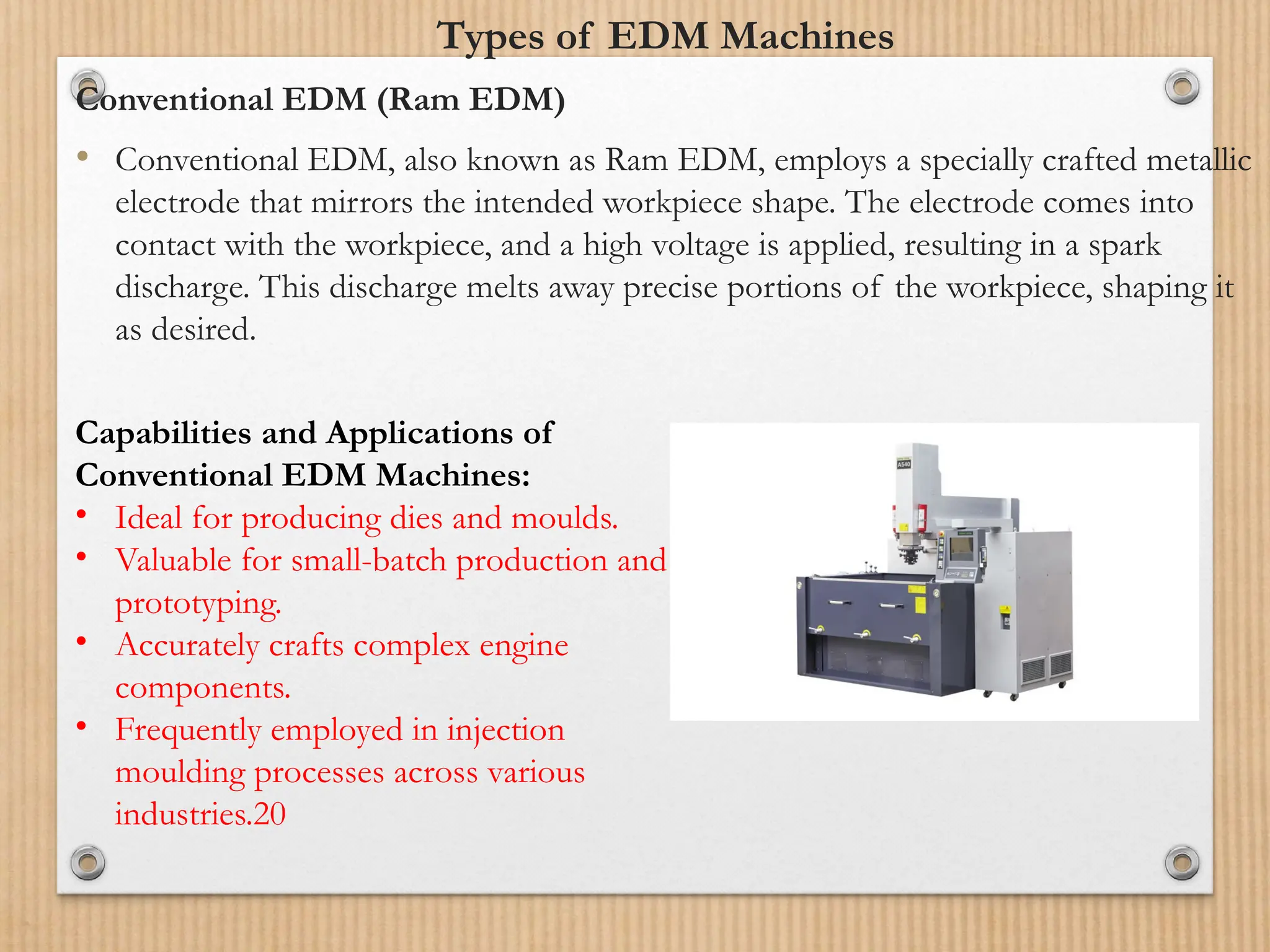
Types of EDM Machines
Conventional EDM (Ram EDM)
• Conventional EDM, also known as Ram EDM, employs a specially crafted metallic
electrode that mirrors the intended workpiece shape. The electrode comes into
contact with the workpiece, and a high voltage is applied, resulting in a spark
discharge. This discharge melts away precise portions of the workpiece, shaping it
as desired.
Capabilities and Applications of
Conventional EDM Machines:
• Ideal for producing dies and moulds.
• Valuable for small-batch production and
prototyping.
• Accurately crafts complex engine
components.
• Frequently employed in injection
moulding processes across various
industries.20
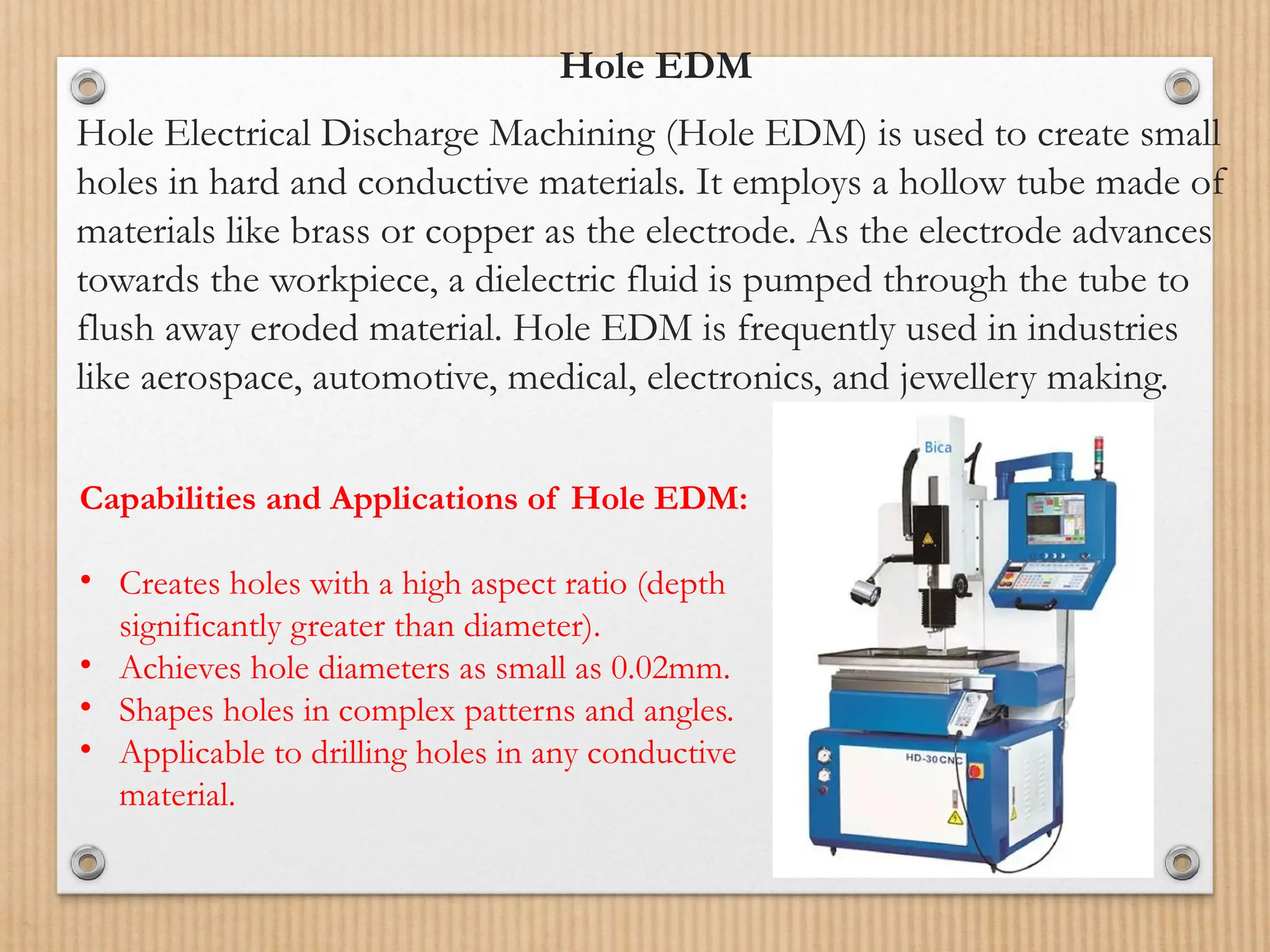
Hole EDM
Hole Electrical Discharge Machining (Hole EDM) is used to create small
holes in hard and conductive materials. It employs a hollow tube made of
materials like brass or copper as the electrode. As the electrode advances
towards the workpiece, a dielectric fluid is pumped through the tube to
flush away eroded material. Hole EDM is frequently used in industries
like aerospace, automotive, medical, electronics, and jewellery making.
Capabilities and Applications of Hole EDM:
• Creates holes with a high aspect ratio (depth
significantly greater than diameter).
• Achieves hole diameters as small as 0.02mm.
• Shapes holes in complex patterns and angles.
• Applicable to drilling holes in any conductive
material.
• Advantages of Electrical Discharge Machining
• High Precision
• Material Versatility
• Burr-Free Finishes
• Complex Geometries
• Hardened Materials
• No Tool Wear
• Heat-Affected Zone Control
• Thin Workpieces
• Low Impact on Workpiece
Disadvantages of Electrical Discharge Machining
• Excessive tool wear.
• High power consumption.
• The sharp corner cannot be reproduced.
• High heat development causes a change in the metallurgical
properties of materials.
• The workpiece must be an electrical conductor.
• Surface cracking may take place in some materials.
• Redressing of a tool is required for deep holes.
• Over-cut is formed.
• Difficult finding expert machinists.
• Applications of Electrical Discharge Machining
• The various applications encompass the following:
• Helical profile milling.
• Curved hole drilling.
• Engraving operation on harder materials.
• Drilling for micro holes in the nozzle.
• Used in thread cutting.
• Used in wire cutting.
• Rotary form cutting.
• Cutting off operation.
Types of Commonly Used Dielectric Fluids
• Dielectric fluids play a crucial role in the process of electrical
discharge machining (EDM) by acting as a medium for the sparks
to travel between the electrode and the workpiece. There are
several types of dielectric fluids commonly used in EDM, each
with its own set of properties and advantages. In this section, we
will explore some of the most commonly used dielectric fluids in
EDM and discuss their characteristics and applications.
• Dielectric fluid should provide an oxygen free machining environment.
• It should have enough strong dielectric resistance so that it does not
break down electrically too easily but at the same time ionize when
electrons collide with its molecule.
• During sparking it should be thermally resistant as well.
Types of Commonly Used Dielectric Fluids
• Hydrocarbon Oil
• A synthetic solution designed to have high thermal conductivity, excellent dielectric
properties, and compatibility with different materials in electronic systems.
• Transformer Oil
Dielectric transformer oil functions as an insulator and cooler to a
transformer’s metal components. It also prevents oxidation and corrosion around
the core and windings of a transformer.
• Paraffin Oil: Paraffin is a type of hydrocarbon oil commonly used as a fuel for jet
engines and rockets, as well as a fuel or fuel component for diesel and tractor
engines. Paraffin oil has a high viscosity index which is good for engine oil but bad
for transformers.
• Kerosene: Kerosene is a specific type of paraffin oil also used as a dielectric fluid.
It is a great insulator that is used as a cheaper alternative to clear out the debris
during the erosion process in EDM.
• Dielectric Gas (Sulphur Hexafluoride): Also known as an
insulating gas or sulphur hexafluoride, dielectric gas is a material
in a gaseous state that prevents electrical discharge. Although
this is not a liquid, it is another popular dielectric material often
used in power equipment and gas-insulated transmission lines.
• Lubricating Oil: This broad term is used for dielectric oils
designed to insulate, repel moisture, and prevent corrosion.
Selecting the Right Dielectric Fluid
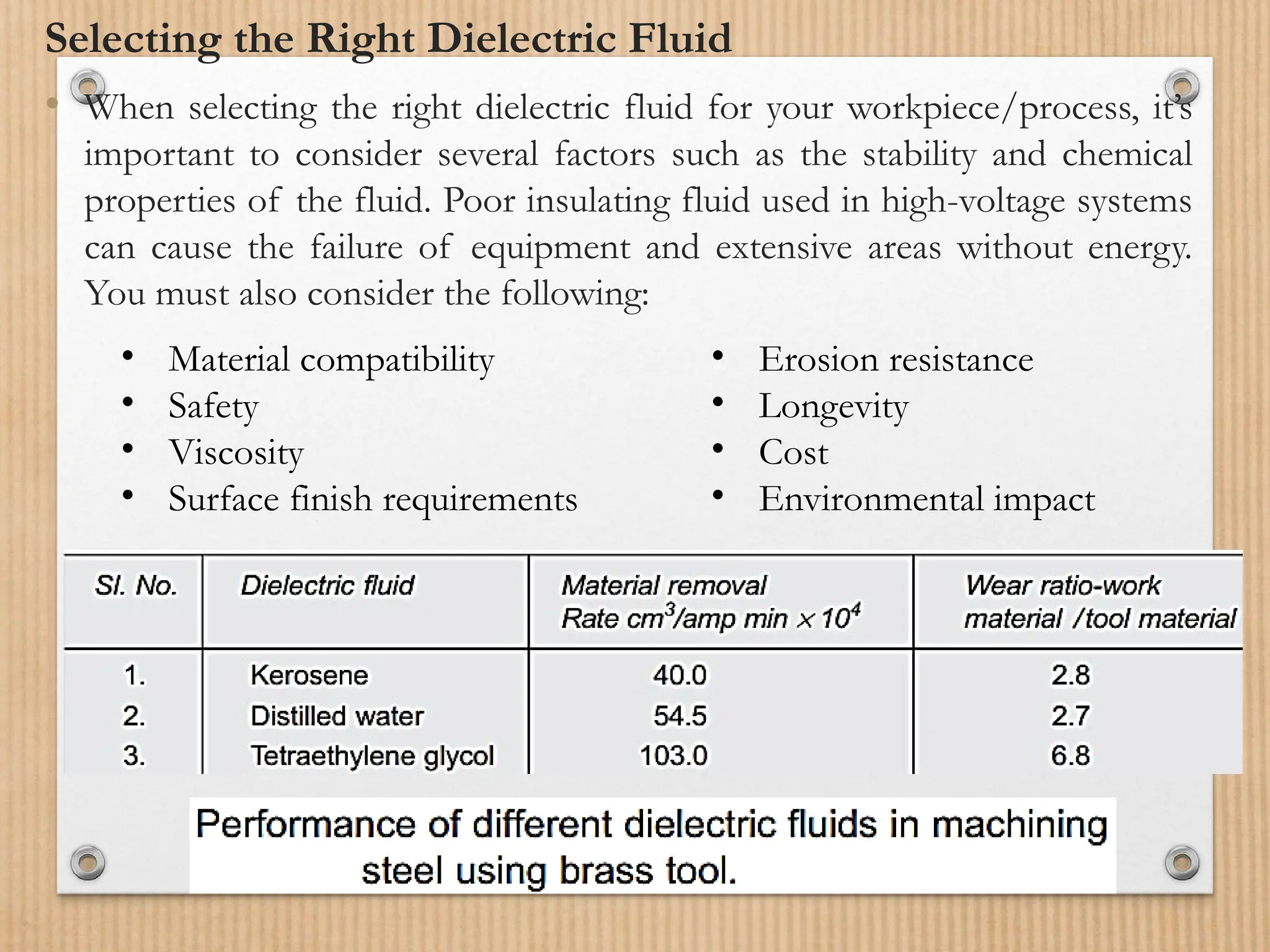
• When selecting the right dielectric fluid for your workpiece/process, it’s
important to consider several factors such as the stability and chemical
properties of the fluid. Poor insulating fluid used in high-voltage systems
can cause the failure of equipment and extensive areas without energy.
You must also consider the following:
• Material compatibility
• Safety
• Viscosity
• Surface finish requirements
• Erosion resistance
• Longevity
• Cost
• Environmental impact
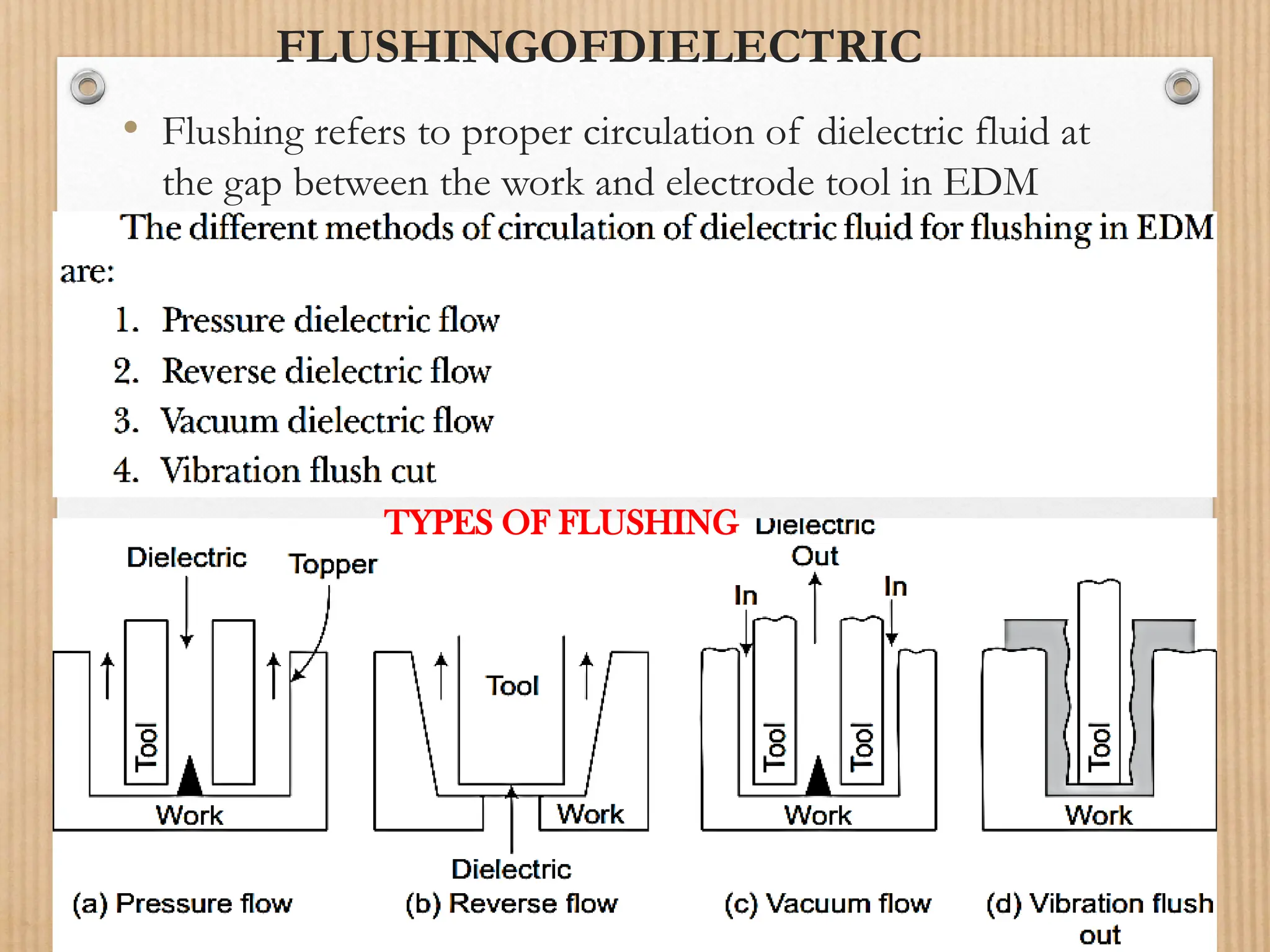
FLUSHINGOFDIELECTRIC
• Flushing refers to proper circulation of dielectric fluid at
the gap between the work and electrode tool in EDM
TYPES OF FLUSHING
Electrode Material
The essential characteristics of electrode materials are:
• High electrical conductivity
• High thermal conductivity
• Higher density
• High melting point
• Easy manufacturability
• Cost – cheap
The followings are the different electrode materials that are used
commonly in the industry:
• Graphite
• Electrolytic oxygen-free copper
• Tellurium copper – 99% Cu + 0.5% tellurium
• Brass
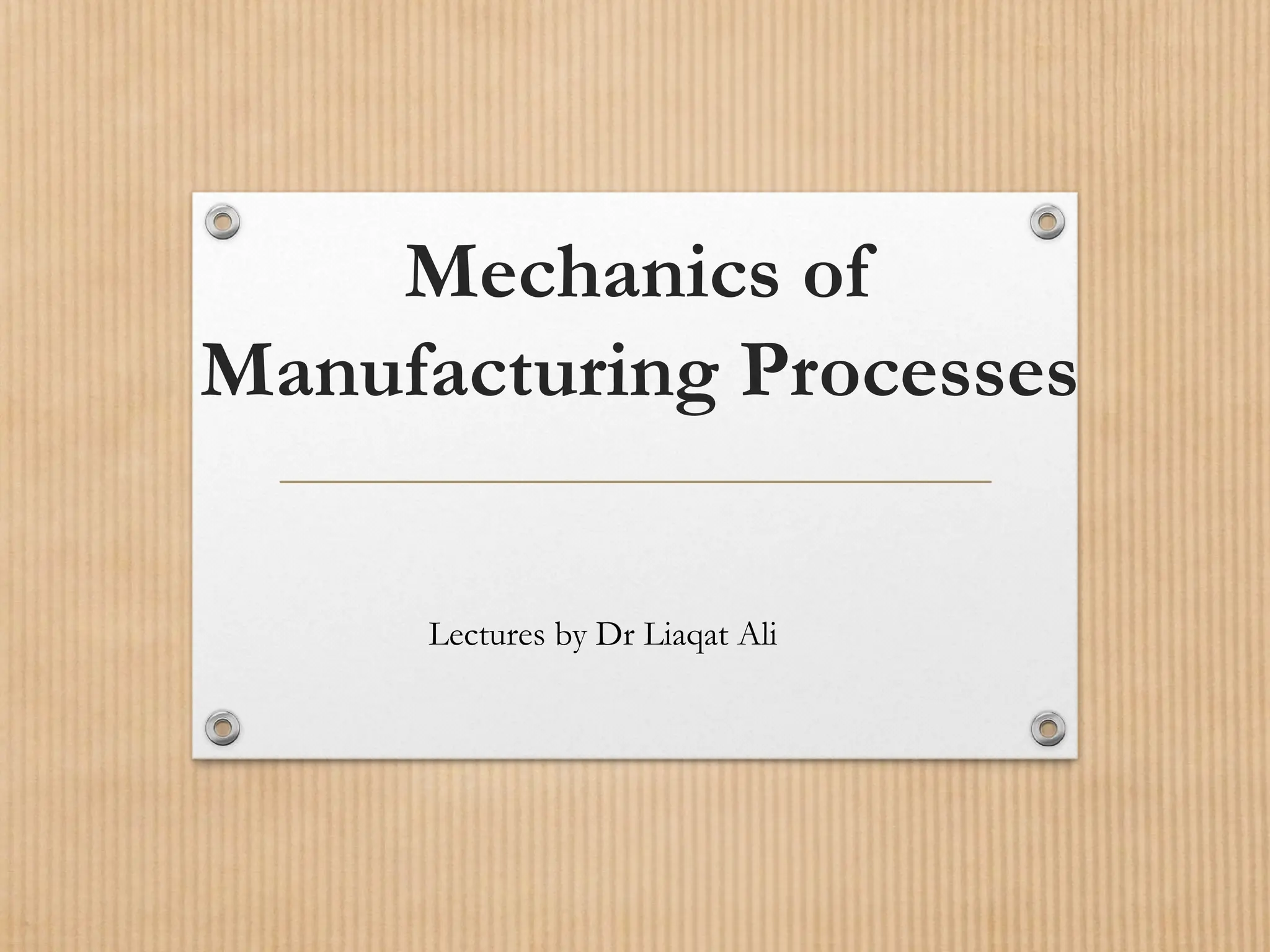
TOOL MATERIAL USED IN EDM AND THEIR CHARACTERISTICS

MS Lecture 10 Mechanics of Mfg processes.pptx

  • 1.
  • 2.
    Electrical Discharge Machining •Electrical Discharge Machining (EDM) is a highly precise and innovative manufacturing process that has revolutionised the way complex shapes and intricate features are fabricated from electrically conductive materials. Unlike conventional machining methods that involve physical contact between a cutting tool and the workpiece, EDM employs electrical discharges to erode material with exceptional precision and minimal mechanical stress. • It uses electrical sparks to erode material from a workpiece. It's ideal for intricate shapes and hard materials, offering high accuracy in industries like aerospace and toolmaking.
  • 3.
    • What isElectrical Discharge Machining? • Electrical discharge machining, also known as spark erosion or metal sparking machining, is a non- conventional machining technique that relies on erosion as its fundamental principle. In electrical discharge machining, or EDM for short, an electrothermal non- traditional machining process is employed, utilising electrical energy to create sparks for material erosion. EDM is particularly valuable for machining challenging- to-work-with materials.
  • 4.
    Electric Discharge Processes Metalremoval by a series of discrete electrical discharges (sparks) causing localized temperatures high enough to melt or vaporize the metal • Two main processes: Electric discharge machining Wire electric discharge machining
  • 5.
    Electrical discharge machiningoperates based on the concept of material removal through the combination of electrical and thermal energy. Electrical energy is harnessed to generate an electric spark, and heat is generated as a result of metal erosion 1. Electrical discharge machining
  • 6.
    EDM Operation • Shapeof finished work surface produced by a formed electrode tool • Sparks occur across a small gap between tool and work • Requires dielectric fluid, which creates a path for each discharge as fluid becomes ionized in the gap. Only electrically conducting work materials • Hardness and strength of the work material are not factors in EDM • Material removal rate is related to melting point of work material A spark gap of approximately 0.05 to 0.25 mm exists between the tool and the workpiece within the flow of dielectric fluid.
  • 7.
    • Components ofEDM Machining • DC pulse Generator • Voltmeter • Ammeter • Tool • Die electric fluid • Pump • Filter • Servo Controlled Feed • Fixtures • Table In this process, the tool electrode is connected to the negative (-) terminal of the DC power supply, while the workpiece is connected to the positive (+) terminal of the DC power supply. Therefore, the tool functions as the cathode , and the workpiece functions as the anode. It utilises electrical sparks that are near 8000º C to 12000º C.
  • 8.
    • The electronsstrike the job, leading to crater formation due to high temperature, melting, and material removal. Similarly, the positive ions impinge on the tool leading to tool wear. In EDM, the generator is used to apply voltage pulses between the device and the job. A constant voltage is not applied. Only sparking is desired in EDM rather than arcing, and arcing leads to localized material removal at a particular point. In contrast, sparks get distributed all over the tool surface, leading to uniformly distributed material removal under the tool. Figure 1 shows schematically the basic working principle of EDM process. V I
  • 9.
  • 10.
    Process Parameters • Theopen-circuit voltage – Vo The working voltage - Vw • The maximum current – Io The pulse on time – ton • The pulse off time – toff spark gap-δ straight polarity–tool (-ve)
  • 11.
    Modeling of MaterialRemoval and Product Quality • Material removal in EDM mainly occurs due to intense localized heating almost by point heat source for a rather small-time frame. Such heating leads to melting and crater formation MRR
  • 12.
    MRR The increase inhemispherical radius r shows the MRR is higher.
  • 13.
    The energy contentof a single spark is given as: -
  • 14.
    The energy availableas heat at the workpiece is given by It can be logically assumed that material removal in a single spark would be proportional to the spark energy. Thus Now material removal rate is the ratio of material removed in a single spark to cycle time. From the above equation MRR, MRR α I MRR α v MRR α ton MRR α 1/toff
  • 15.
  • 16.
    The model presentedin the table is a very simplified one, and a linear relationship is not observed in practice. But even then, such a simplified model captures the complexity of EDM in a very efficient manner. MRR in practice increases with an increase in working voltage, current, pulse on time, and decreases in pulse off time. Product quality is an essential characteristic of a manufacturing process along with MRR. The followings are the product quality issues in EDM: - • Surface finish • Overcut • Taper cut No two sparks take place side by side. They occur randomly so that over time one gets uniform average material removal over the whole tool cross-section.
  • 17.
    • In WireEDM, a thin wire acts as the electrode and is continuously fed through the workpiece. The wire is electrically charged and, as it traverses the workpiece, generates a series of spark discharges. This process excels in precision and is particularly suited for creating intricate shapes and small parts. • Capabilities and Applications of Wire EDM Machines: • Eases the production process, Offers high-speed machining, Requires minimal maintenance. Special form of EDM that uses small diameter wire as electrode to cut a narrow kerf in work 2. Wire EDM
  • 19.
    Operation of WireEDM • Work is fed slowly past wire along desired cutting path, like a bandsaw operation • CNC used for motion control • While cutting, wire is continuously advanced between supply spool and take up spool to ‑ maintain a constant diameter • Dielectric required, using nozzles directed at tool work interface or submerging workpart ‑
  • 21.
    Parameters are usedfor programming • Wire speed: Wire speed (mm/s) = Cutting rate (mm/min) / (60 x Thickness of the material being cut (mm)) • Current: Current (Amps) = ((Wire diameter (mm) x Material density (g/cm3) x Cutting rate (mm/min)) / (1.85 x Pulse duration (µs))) ^0.5 • Pulse duration: Pulse duration (µs) = 0.2 x (Wire diameter (mm) / Material resistivity (µΩ.cm)) • Spark gap: Spark gap (µm) = ((Wire diameter (mm) x Material density (g/cm3) x Current (Amps)) / (0.7 x Cutting rate (mm/min))) ^0.5 for cutting a particular material to achieve the desired precision, accuracy, and surface finish.
  • 22.
    Types of EDMMachines Conventional EDM (Ram EDM) • Conventional EDM, also known as Ram EDM, employs a specially crafted metallic electrode that mirrors the intended workpiece shape. The electrode comes into contact with the workpiece, and a high voltage is applied, resulting in a spark discharge. This discharge melts away precise portions of the workpiece, shaping it as desired. Capabilities and Applications of Conventional EDM Machines: • Ideal for producing dies and moulds. • Valuable for small-batch production and prototyping. • Accurately crafts complex engine components. • Frequently employed in injection moulding processes across various industries.20
  • 23.
    Hole EDM Hole ElectricalDischarge Machining (Hole EDM) is used to create small holes in hard and conductive materials. It employs a hollow tube made of materials like brass or copper as the electrode. As the electrode advances towards the workpiece, a dielectric fluid is pumped through the tube to flush away eroded material. Hole EDM is frequently used in industries like aerospace, automotive, medical, electronics, and jewellery making. Capabilities and Applications of Hole EDM: • Creates holes with a high aspect ratio (depth significantly greater than diameter). • Achieves hole diameters as small as 0.02mm. • Shapes holes in complex patterns and angles. • Applicable to drilling holes in any conductive material.
  • 24.
    • Advantages ofElectrical Discharge Machining • High Precision • Material Versatility • Burr-Free Finishes • Complex Geometries • Hardened Materials • No Tool Wear • Heat-Affected Zone Control • Thin Workpieces • Low Impact on Workpiece
  • 25.
    Disadvantages of ElectricalDischarge Machining • Excessive tool wear. • High power consumption. • The sharp corner cannot be reproduced. • High heat development causes a change in the metallurgical properties of materials. • The workpiece must be an electrical conductor. • Surface cracking may take place in some materials. • Redressing of a tool is required for deep holes. • Over-cut is formed. • Difficult finding expert machinists.
  • 26.
    • Applications ofElectrical Discharge Machining • The various applications encompass the following: • Helical profile milling. • Curved hole drilling. • Engraving operation on harder materials. • Drilling for micro holes in the nozzle. • Used in thread cutting. • Used in wire cutting. • Rotary form cutting. • Cutting off operation.
  • 27.
    Types of CommonlyUsed Dielectric Fluids • Dielectric fluids play a crucial role in the process of electrical discharge machining (EDM) by acting as a medium for the sparks to travel between the electrode and the workpiece. There are several types of dielectric fluids commonly used in EDM, each with its own set of properties and advantages. In this section, we will explore some of the most commonly used dielectric fluids in EDM and discuss their characteristics and applications. • Dielectric fluid should provide an oxygen free machining environment. • It should have enough strong dielectric resistance so that it does not break down electrically too easily but at the same time ionize when electrons collide with its molecule. • During sparking it should be thermally resistant as well.
  • 28.
    Types of CommonlyUsed Dielectric Fluids • Hydrocarbon Oil • A synthetic solution designed to have high thermal conductivity, excellent dielectric properties, and compatibility with different materials in electronic systems. • Transformer Oil Dielectric transformer oil functions as an insulator and cooler to a transformer’s metal components. It also prevents oxidation and corrosion around the core and windings of a transformer. • Paraffin Oil: Paraffin is a type of hydrocarbon oil commonly used as a fuel for jet engines and rockets, as well as a fuel or fuel component for diesel and tractor engines. Paraffin oil has a high viscosity index which is good for engine oil but bad for transformers. • Kerosene: Kerosene is a specific type of paraffin oil also used as a dielectric fluid. It is a great insulator that is used as a cheaper alternative to clear out the debris during the erosion process in EDM.
  • 29.
    • Dielectric Gas(Sulphur Hexafluoride): Also known as an insulating gas or sulphur hexafluoride, dielectric gas is a material in a gaseous state that prevents electrical discharge. Although this is not a liquid, it is another popular dielectric material often used in power equipment and gas-insulated transmission lines. • Lubricating Oil: This broad term is used for dielectric oils designed to insulate, repel moisture, and prevent corrosion.
  • 30.
    Selecting the RightDielectric Fluid • When selecting the right dielectric fluid for your workpiece/process, it’s important to consider several factors such as the stability and chemical properties of the fluid. Poor insulating fluid used in high-voltage systems can cause the failure of equipment and extensive areas without energy. You must also consider the following: • Material compatibility • Safety • Viscosity • Surface finish requirements • Erosion resistance • Longevity • Cost • Environmental impact
  • 31.
    FLUSHINGOFDIELECTRIC • Flushing refersto proper circulation of dielectric fluid at the gap between the work and electrode tool in EDM TYPES OF FLUSHING
  • 32.
    Electrode Material The essentialcharacteristics of electrode materials are: • High electrical conductivity • High thermal conductivity • Higher density • High melting point • Easy manufacturability • Cost – cheap The followings are the different electrode materials that are used commonly in the industry: • Graphite • Electrolytic oxygen-free copper • Tellurium copper – 99% Cu + 0.5% tellurium • Brass
  • 33.
    TOOL MATERIAL USEDIN EDM AND THEIR CHARACTERISTICS