DEFIBRILLATION


          ALS Subcommittee 2010
Cardiac Arrest Algorithm

D – danger
R – response
S – shout
A – airway
B – breathing
C – circulation
            D – defibrillation

                                    ALS Subcommittee 2010
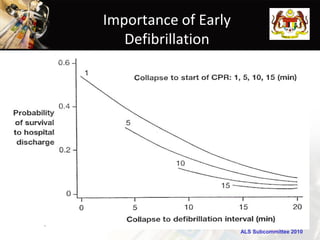
Importance of Early
                   Defibrillation
• To give the victim the best chance of survival, 3
  actions must occur within the first moments of a
  cardiac arrest:

  1) Activation of the emergency medical services
  2) Provision of CPR
  3) Operation of a defibrillator
                    AHA guidelines 2010.Section 6.Electrical therapies

                                                   ALS Subcommittee 2010
Importance of Early
   Defibrillation


                      ALS Subcommittee 2010
Why Defibrillate?


• Does NOT equal to resuscitation outcome

• The goal is to RESTORE sinus rhythm


                                        ALS Subcommittee 2010
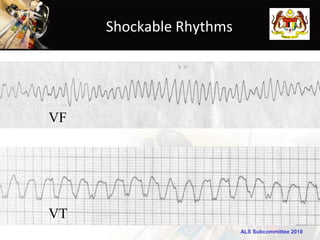
Shockable Rhythms


VF


VT
                         ALS Subcommittee 2010
Definition of Defibrillation

• Defined as the termination of VF for at least
  5s after the shock
  – an electrophysiological event that occurs 30-
    50ms after shock delivery; the heart is stunned
    and hopefully the SA Node will take over


                                          ALS Subcommittee 2010
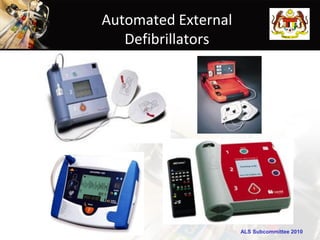
Automated External
   Defibrillators


                     ALS Subcommittee 2010
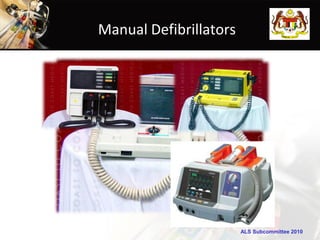
Manual Defibrillators


                        ALS Subcommittee 2010
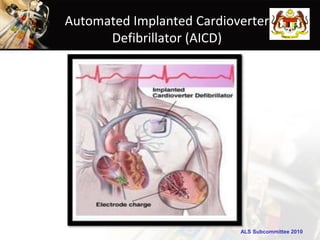
Automated Implanted Cardioverter
      Defibrillator (AICD)


                           ALS Subcommittee 2010
Types of Defibrillators by
                    Waveform

• Monophasic

• Biphasic


                                     ALS Subcommittee 2010
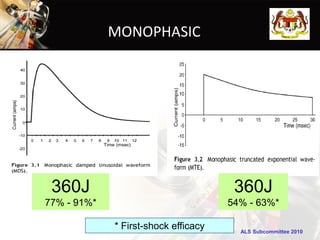
MONOPHASIC


 360J                                  360J
77% - 91%*                            54% - 63%*

             * First-shock efficacy     ALS Subcommittee 2010
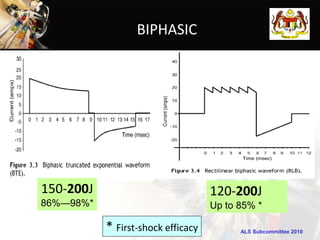
BIPHASIC


150-200J                            120-200J
86%—98%*                            Up to 85% *

           * First-shock efficacy         ALS Subcommittee 2010
IMPORTANT POINTS DURING
     DEFIBRILLATION


                   ALS Subcommittee 2010
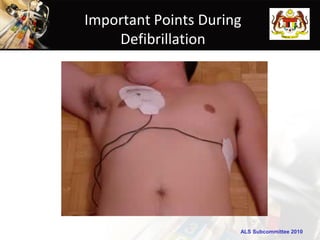
Important Points During
                      Defibrillation

•   Hairy chest
•   Wet chest
•   Breasts
•   Patches
            Wrenn, K. The hazards of defibrillation through nitroglycerin
                    patches. Ann Emerg Med 1990; 19(11): 1327-8

• AICD / pacemaker


                                                          ALS Subcommittee 2010
Important Points During
                   Defibrillation
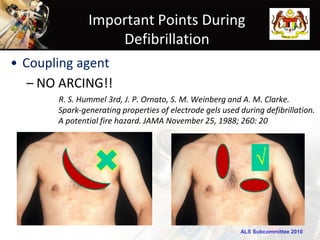
• Coupling agent
   – NO ARCING!!
       R. S. Hummel 3rd, J. P. Ornato, S. M. Weinberg and A. M. Clarke.
       Spark-generating properties of electrode gels used during defibrillation.
       A potential fire hazard. JAMA November 25, 1988; 260: 20


                                                              √


                                                          ALS Subcommittee 2010
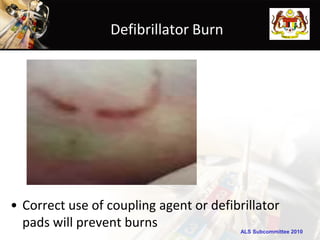
Defibrillator Burn


• Correct use of coupling agent or defibrillator
  pads will prevent burns                ALS Subcommittee 2010
Important Points During
                 Defibrillation

• Paddle force
   – 8kg in adult, 5kg in 1-8 year old children when
     using adult paddles

• Paddle size
   – Minimum 150cm2, diameter 8-12cm


                                        ALS Subcommittee 2010
Important Points During
                   Defibrillation

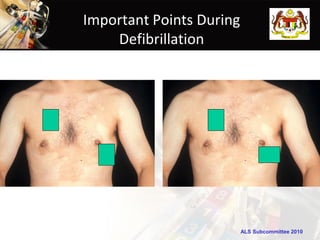
• Paddle position
   1. Sternal - apical
   2. Biaxillary
   3. Right or left upper back – apical
   4. Antero-posterior especially in atrial
       arrhythmias
• All 4 positions are equally effective in shock
  success       Deakin CD, Sado DM, Petley GW, Clewlow F. Is the orientation
                      of the apical defibrillation paddle of importance during manual
                      external defibrillation? Resuscitation 2003;56:15—8
                                                               ALS Subcommittee 2010
Important Points During
    Defibrillation


                          ALS Subcommittee 2010
Important Points During
    Defibrillation


                      ALS Subcommittee 2010
Important Points During
                       Defibrillation

• Fire
   May be ignited by sparks from poorly applied
     defibrillator paddles in the presence of an
     oxygen-enriched atmosphere


        Miller, P. H. Potential fire hazard in defibrillation. JAMA 1972;221(2): 192. Early report of fire hazard during defibrillation
                           Fires from Defibrillation during Oxygen Administration. Hazard. Health Devices Jul 1994;23(7):307-8
        Robertshaw, H. and G. McAnulty. Ambient oxygen concentrations during simulated cardiopulmonary resuscitation. Anaesthesia
                           1998;53(7): 634-7
        Theodorou et al. Fire Attributable to a Defibrillation Attempt in a Neonate. Pediatrics 2003;112:677-679


                                                                                                      ALS Subcommittee 2010
Important Points During
               Defibrillation

• One I clear, Two you clear, Three everybody
  clear

• Look back at monitor before shocking

• Paddles MUST be horizontal at all times!


                                      ALS Subcommittee 2010
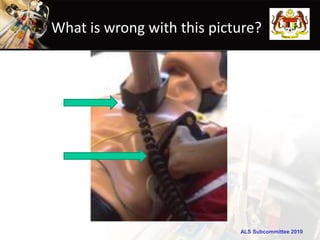
What is wrong with this picture?


                            ALS Subcommittee 2010
How to defibrillate ?
                 stop look go
1. Attach electrodes to patient’s chest
2. Turn defibrillator on – select leads
3. Analyse the rhythm ?shockable
4. Apply coupling agent or pads to patient’s chest
5. Select energy level
6. Apply paddles to chest
7. Charge the paddles
8. The “Clear” chant
9. Check monitor again
10.Discharge shock and return paddles to machine
                                        ALS Subcommittee 2010
Synchronised Cardioversion

• For rhythms with an organised QRS complex and
  perfusing i.e. with a pulse but haemodynamically
  unstable
  – Shock delivery timed with the QRS complex
     • Low-energy shock of 50-200J
• Indications:    Supraventricular tachycardia
                  Atrial flutter
                  Atrial fibrillation
                  Unstable monomorphic VT
• Not effective in junctional tachycardia or
  multifocal atrial tachycardia
                                                 ALS Subcommittee 2010
Defibrillation + CPR

• Early defibrillation is critical to survival from
  sudden cardiac arrest because:

  1. The most frequent initial rhythm in sudden
     cardiac arrest is VF
  2. Rx for VF is defibrillation
  3. Probability for successful defibrillation
     diminishes with time
  4. VF tends to deteriorate to asystole within a
     few minutes
                                           ALS Subcommittee 2010
If Flatline…

• Always double check that it IS a flatline

  – Check other leads
  – Check attachment of leads
  – Increase the size of rhythm to rule out fine
    ventricular fibrillation


                                         ALS Subcommittee 2010
SUMMARY

• Definition
• Types of defibrillator
• Tips for defibrillation
   –   Hairy chest
   –   Wet chest
   –   Breast
   –   Patches
   –   AICD / pacemaker
   –   Coupling agent
   –   Paddle force, paddle size, paddle position
   –   Fire                                         ALS Subcommittee 2010
References


1. American Heart Association CPR Guidelines Nov
   2010
2. European Resuscitation Council Guidelines for
   Resuscitation 2010
3. Ibrahim WH. Recent advances and
   controversies in adult cardiopulmonary
   resuscitation. Postgrad Med J 2007;83:649-54

                                     ALS Subcommittee 2010
THANK YOU
NATIONAL COMMITTEE ON RESUSCITATION TRAINING
  SUBCOMMITEE FOR ADVANCED LIFE SUPPORT

           Dr Tan Cheng Cheng
           Dr Luah Lean Wah
           Dr Ismail Tan bin Mohd Ali Tan
           Dr Wan Nasrudin bin Wan Ismail
           Dr Chong Yoon Sin
           Dr Priya Gill
           Dr Ridzuan bin Dato’ Mohd Isa
           Dr Thohiroh binti Abdul Razak
           Dr Adi bin Osman

                                             ALS Subcommittee 2010

Defib skillstation22122011edited

  • 1.
    DEFIBRILLATION ALS Subcommittee 2010
  • 2.
    Cardiac Arrest Algorithm D– danger R – response S – shout A – airway B – breathing C – circulation D – defibrillation ALS Subcommittee 2010
  • 3.
    Importance of Early Defibrillation • To give the victim the best chance of survival, 3 actions must occur within the first moments of a cardiac arrest: 1) Activation of the emergency medical services 2) Provision of CPR 3) Operation of a defibrillator AHA guidelines 2010.Section 6.Electrical therapies ALS Subcommittee 2010
  • 4.
    Importance of Early Defibrillation ALS Subcommittee 2010
  • 5.
    Why Defibrillate? • DoesNOT equal to resuscitation outcome • The goal is to RESTORE sinus rhythm ALS Subcommittee 2010
  • 6.
    Shockable Rhythms VF VT ALS Subcommittee 2010
  • 7.
    Definition of Defibrillation •Defined as the termination of VF for at least 5s after the shock – an electrophysiological event that occurs 30- 50ms after shock delivery; the heart is stunned and hopefully the SA Node will take over ALS Subcommittee 2010
  • 8.
    Automated External Defibrillators ALS Subcommittee 2010
  • 9.
    Manual Defibrillators ALS Subcommittee 2010
  • 10.
    Automated Implanted Cardioverter Defibrillator (AICD) ALS Subcommittee 2010
  • 11.
    Types of Defibrillatorsby Waveform • Monophasic • Biphasic ALS Subcommittee 2010
  • 12.
    MONOPHASIC 360J 360J 77% - 91%* 54% - 63%* * First-shock efficacy ALS Subcommittee 2010
  • 13.
    BIPHASIC 150-200J 120-200J 86%—98%* Up to 85% * * First-shock efficacy ALS Subcommittee 2010
  • 14.
    IMPORTANT POINTS DURING DEFIBRILLATION ALS Subcommittee 2010
  • 15.
    Important Points During Defibrillation • Hairy chest • Wet chest • Breasts • Patches Wrenn, K. The hazards of defibrillation through nitroglycerin patches. Ann Emerg Med 1990; 19(11): 1327-8 • AICD / pacemaker ALS Subcommittee 2010
  • 16.
    Important Points During Defibrillation • Coupling agent – NO ARCING!! R. S. Hummel 3rd, J. P. Ornato, S. M. Weinberg and A. M. Clarke. Spark-generating properties of electrode gels used during defibrillation. A potential fire hazard. JAMA November 25, 1988; 260: 20 √ ALS Subcommittee 2010
  • 17.
    Defibrillator Burn • Correctuse of coupling agent or defibrillator pads will prevent burns ALS Subcommittee 2010
  • 18.
    Important Points During Defibrillation • Paddle force – 8kg in adult, 5kg in 1-8 year old children when using adult paddles • Paddle size – Minimum 150cm2, diameter 8-12cm ALS Subcommittee 2010
  • 19.
    Important Points During Defibrillation • Paddle position 1. Sternal - apical 2. Biaxillary 3. Right or left upper back – apical 4. Antero-posterior especially in atrial arrhythmias • All 4 positions are equally effective in shock success Deakin CD, Sado DM, Petley GW, Clewlow F. Is the orientation of the apical defibrillation paddle of importance during manual external defibrillation? Resuscitation 2003;56:15—8 ALS Subcommittee 2010
  • 20.
    Important Points During Defibrillation ALS Subcommittee 2010
  • 21.
    Important Points During Defibrillation ALS Subcommittee 2010
  • 22.
    Important Points During Defibrillation • Fire May be ignited by sparks from poorly applied defibrillator paddles in the presence of an oxygen-enriched atmosphere Miller, P. H. Potential fire hazard in defibrillation. JAMA 1972;221(2): 192. Early report of fire hazard during defibrillation Fires from Defibrillation during Oxygen Administration. Hazard. Health Devices Jul 1994;23(7):307-8 Robertshaw, H. and G. McAnulty. Ambient oxygen concentrations during simulated cardiopulmonary resuscitation. Anaesthesia 1998;53(7): 634-7 Theodorou et al. Fire Attributable to a Defibrillation Attempt in a Neonate. Pediatrics 2003;112:677-679 ALS Subcommittee 2010
  • 23.
    Important Points During Defibrillation • One I clear, Two you clear, Three everybody clear • Look back at monitor before shocking • Paddles MUST be horizontal at all times! ALS Subcommittee 2010
  • 24.
    What is wrongwith this picture? ALS Subcommittee 2010
  • 25.
    How to defibrillate? stop look go 1. Attach electrodes to patient’s chest 2. Turn defibrillator on – select leads 3. Analyse the rhythm ?shockable 4. Apply coupling agent or pads to patient’s chest 5. Select energy level 6. Apply paddles to chest 7. Charge the paddles 8. The “Clear” chant 9. Check monitor again 10.Discharge shock and return paddles to machine ALS Subcommittee 2010
  • 26.
    Synchronised Cardioversion • Forrhythms with an organised QRS complex and perfusing i.e. with a pulse but haemodynamically unstable – Shock delivery timed with the QRS complex • Low-energy shock of 50-200J • Indications: Supraventricular tachycardia Atrial flutter Atrial fibrillation Unstable monomorphic VT • Not effective in junctional tachycardia or multifocal atrial tachycardia ALS Subcommittee 2010
  • 27.
    Defibrillation + CPR •Early defibrillation is critical to survival from sudden cardiac arrest because: 1. The most frequent initial rhythm in sudden cardiac arrest is VF 2. Rx for VF is defibrillation 3. Probability for successful defibrillation diminishes with time 4. VF tends to deteriorate to asystole within a few minutes ALS Subcommittee 2010
  • 28.
    If Flatline… • Alwaysdouble check that it IS a flatline – Check other leads – Check attachment of leads – Increase the size of rhythm to rule out fine ventricular fibrillation ALS Subcommittee 2010
  • 29.
    SUMMARY • Definition • Typesof defibrillator • Tips for defibrillation – Hairy chest – Wet chest – Breast – Patches – AICD / pacemaker – Coupling agent – Paddle force, paddle size, paddle position – Fire ALS Subcommittee 2010
  • 30.
    References 1. American HeartAssociation CPR Guidelines Nov 2010 2. European Resuscitation Council Guidelines for Resuscitation 2010 3. Ibrahim WH. Recent advances and controversies in adult cardiopulmonary resuscitation. Postgrad Med J 2007;83:649-54 ALS Subcommittee 2010
  • 31.
    THANK YOU NATIONAL COMMITTEEON RESUSCITATION TRAINING SUBCOMMITEE FOR ADVANCED LIFE SUPPORT  Dr Tan Cheng Cheng  Dr Luah Lean Wah  Dr Ismail Tan bin Mohd Ali Tan  Dr Wan Nasrudin bin Wan Ismail  Dr Chong Yoon Sin  Dr Priya Gill  Dr Ridzuan bin Dato’ Mohd Isa  Dr Thohiroh binti Abdul Razak  Dr Adi bin Osman ALS Subcommittee 2010