Introduction
 The defense mechanisms reside in the unconscious domain
of the ego
 Ego delay and modulation of drive expression through the
defense mechanisms
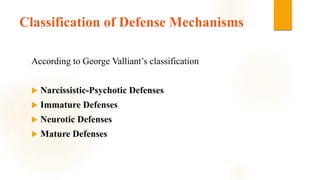
Classification of Defense Mechanisms
According to George Valliant’s classification
 Narcissistic-Psychotic Defenses
 Immature Defenses
 Neurotic Defenses
 Mature Defenses
Narcissistic-Psychotic Defenses
 Defenses are the most primitive
 Appear in children and adult dreams or fantasies
 And also in persons who are psychotically disturbed.
 defenses are usually found as part of a psychotic process
 They share the common note of avoiding, negating, or
distorting reality
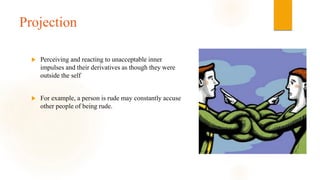
Projection
 Perceiving and reacting to unacceptable inner
impulses and their derivatives as though they were
outside the self
 For example, a person is rude may constantly accuse
other people of being rude.
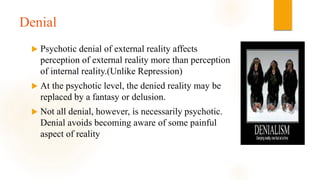
Denial
 Psychotic denial of external reality affects
perception of external reality more than perception
of internal reality.(Unlike Repression)
 At the psychotic level, the denied reality may be
replaced by a fantasy or delusion.
 Not all denial, however, is necessarily psychotic.
Denial avoids becoming aware of some painful
aspect of reality
Denial
 Denial may function in the service of more neurotic or even adaptive objectives.
(like projection)
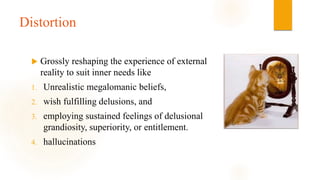
Distortion
 Grossly reshaping the experience of external
reality to suit inner needs like
1. Unrealistic megalomanic beliefs,

2. wish fulfilling delusions, and
3. employing sustained feelings of delusional
grandiosity, superiority, or entitlement.
4. hallucinations
Immature Defenses
 Seen in adolescents and some nonpsychotic patients
 Also in adult character disorders
 They are regarded as socially awkward and undesirable.
 They often moderate with improvement in interpersonal
relationships or with increased personal maturity.
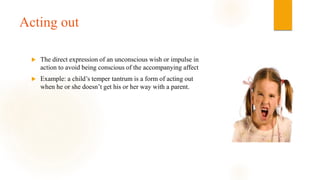
Acting out
 The direct expression of an unconscious wish or impulse in
action to avoid being conscious of the accompanying affect
 Example: a child’s temper tantrum is a form of acting out
when he or she doesn’t get his or her way with a parent.
Blocking
 An inhibition of affects especially, but
possibly also thinking and impulses
(close to repression)
 Has a component of tension arising
from the inhibition of the impulse,
affect, or thought.
Hypochondriasis
 Transformation of reproach toward others into self-
reproach in the form of somatic complaints of pain, illness,
and so forth.
 Reproach arising from bereavement, loneliness, or
unacceptable aggressive impulses
 illness may also be overemphasized or exaggerated
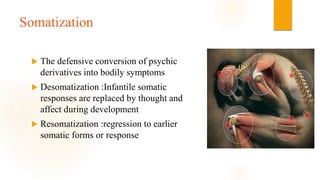
Somatization
 The defensive conversion of psychic
derivatives into bodily symptoms
 Desomatization :Infantile somatic
responses are replaced by thought and
affect during development
 Resomatization :regression to earlier
somatic forms or response
Projection
 On a nonpsychotic level, projection involves attributing one’s
own unacknowledged feelings to others which include
 severe prejudice, rejection of intimacy through suspiciousness,
hypervigilance to external danger, and injustice collecting
 Projection operates correlatively to introjection
 material of the projection derives from the internalized but
usually unconscious configuration of the subject’s introjects.
Introjection
 The introjection of a loved object involves the internalization of
characteristics of the object with the goal of ensuring closeness to
and constant presence of the object
 Introjection of a feared object serves to avoid anxiety through
internalizing the aggressive characteristic of the object, thereby
putting the aggression under one’s own control
 The aggression is no longer felt as coming from outside, but is taken
within and utilized defensively, thus turning the subject’s weak,
passive position into an active, strong one
Introjection
 Introjection can also take place out of a sense of guilt in which the
self-punishing introject is attributable to the hostile-destructive
component of an ambivalent tie to an object
Regression
 A return to a previous stage of development or functioning to
avoid the anxieties or hostilities involved in later stages
 This is often the result of a disruption of equilibrium at a later
phase of development
 Reflects a basic tendency to achieve instinctual gratification or to
escape instinctual tension
Regression
 By returning to earlier modes and levels of gratification when later
and more differentiated modes fail or involve intolerable conflict.
 Example: an adolescent who is overwhelmed with fear, anger and
growing sexual impulses might become clingy and start exhibiting
earlier childhood behaviours such as bedwetting, nail biting
Passive-aggressive behavior
 Aggression toward an object expressed indirectly and
ineffectively through
1. Passivity,
2. Masochism, and
3. Turning against the self
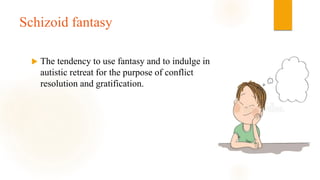
Schizoid fantasy
 The tendency to use fantasy and to indulge in
autistic retreat for the purpose of conflict
resolution and gratification.
Neurotic Defenses
 common in apparently normal and healthy individuals
 as well as in neurotic disorders
 expressed in neurotic forms of behaviour
 adaptive or socially acceptable
Controlling
 excessive attempt to manage or regulate events or objects
in the environment
 in the interest of minimizing anxiety and solving internal
conflicts
Displacement
 unconscious shifting of impulses or affective investment
from one object to another
 in the interest of solving a conflict
 object is changed, the instinctual nature of the impulse and
its aim remain unchanged.
 The man who gets angry at his boss for fear of being fired
he instead comes home and kicks the dog or starts an
argument with his wife.
Dissociation
 A temporary but drastic modification of character or sense
of personal identity to avoid emotional distress
 includes fugue states and hysterical conversion reactions.
Rationalization
 A justification of attitudes, beliefs, or behavior that might
be unacceptable
 By an incorrect application of justifying reasons or the
invention of a convincing fallacy.
Reaction formation
 Management of unacceptable impulses by permitting
expression of the impulse in antithetical form
 This is equivalently an expression of the impulse in the
negative
 Reaction formation can become a character trait on a
permanent basis, usually as an aspect of obsessional character
 Example: when a 2nd child is born ina family the first child may
show extraordinary concern for the welfare of the newborn.
This way his unconscious hate and aggression for his little
brother is covered up.
Repression
 Consists of the expelling and withholding of an idea or feeling
from conscious awareness
 may operate by excluding from awareness what was once
experienced on a conscious level (secondary repression) or
 It may curb ideas and feelings before they have reached
consciousness (primary repression).
 When a child finds out abouth birth of 2nd baby ,he may feel his
love is divided. He feels jealousy and rivalry towards his little
brother. He represses his aggression for fear of punishment on
further loss of love,but may channelize his aggression through
some other activity.
Intellectualization
 The control of affects and impulses by way of thinking
about them instead of experiencing them
 It is a systematic excess of thinking, deprived of its affect
Isolation
 The intrapsychic splitting or separation of affect from
content
Externalization
 Tendency to perceive in the external world and in external
objects components of one’s own personality
 Which include instinctual impulses, conflicts, moods,
attitudes, and styles of thinking
 Example: a patient who is overly argumentative might
instead perceive others as argumentative and himself as
blameless.
Sexualization
 The endowing of an object with sexual significance that it
did not previously have
 To ward off anxieties connected with prohibited impulses
Mature Defenses
 healthy and adaptive throughout the life cycle
 socially adaptive
 useful in the integration of personal needs and motives, social
demands, and interpersonal relations
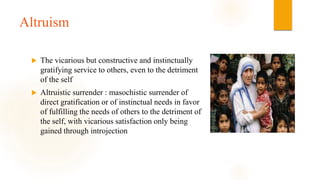
Altruism
 The vicarious but constructive and instinctually
gratifying service to others, even to the detriment
of the self
 Altruistic surrender : masochistic surrender of
direct gratification or of instinctual needs in favor
of fulfilling the needs of others to the detriment of
the self, with vicarious satisfaction only being
gained through introjection
Anticipation
 Realistic anticipation of or planning for future inner discomfort
 Implies overly concerned planning, worrying, and anticipation of
dire and dreadful possible outcomes
 Example: moderate amount of anxiety before surgery promotes post
surgical adaptation.
Humor
 overt expression of feelings without personal discomfort or
immobilization and without unpleasant effect on others
 allows one to bear what is too terrible to be borne
Sublimation
 gratification of an impulse whose goal is retained
 but aim or object is changed from a socially objectionable one to a
socially valued one
 Sublimation of aggressive impulses takes place through pleasurable
games and sports
 sublimation allows instincts to be channeled rather than diverted.
 feelings are acknowledged, modified, and directed toward a
relatively significant goal
 A writer may direct his libido to creation of poem, thus indirectly
satisfying drives.
Suppression
 conscious or semiconscious decision to postpone attention
to a conscious impulse or conflict
Defense mechanism.pptx

Defense mechanism.pptx

  • 2.
    Introduction  The defensemechanisms reside in the unconscious domain of the ego  Ego delay and modulation of drive expression through the defense mechanisms
  • 3.
    Classification of DefenseMechanisms According to George Valliant’s classification  Narcissistic-Psychotic Defenses  Immature Defenses  Neurotic Defenses  Mature Defenses
  • 4.
    Narcissistic-Psychotic Defenses  Defensesare the most primitive  Appear in children and adult dreams or fantasies  And also in persons who are psychotically disturbed.  defenses are usually found as part of a psychotic process  They share the common note of avoiding, negating, or distorting reality
  • 5.
    Projection  Perceiving andreacting to unacceptable inner impulses and their derivatives as though they were outside the self  For example, a person is rude may constantly accuse other people of being rude.
  • 6.
    Denial  Psychotic denialof external reality affects perception of external reality more than perception of internal reality.(Unlike Repression)  At the psychotic level, the denied reality may be replaced by a fantasy or delusion.  Not all denial, however, is necessarily psychotic. Denial avoids becoming aware of some painful aspect of reality
  • 7.
    Denial  Denial mayfunction in the service of more neurotic or even adaptive objectives. (like projection)
  • 8.
    Distortion  Grossly reshapingthe experience of external reality to suit inner needs like 1. Unrealistic megalomanic beliefs, 2. wish fulfilling delusions, and 3. employing sustained feelings of delusional grandiosity, superiority, or entitlement. 4. hallucinations
  • 9.
    Immature Defenses  Seenin adolescents and some nonpsychotic patients  Also in adult character disorders  They are regarded as socially awkward and undesirable.  They often moderate with improvement in interpersonal relationships or with increased personal maturity.
  • 10.
    Acting out  Thedirect expression of an unconscious wish or impulse in action to avoid being conscious of the accompanying affect  Example: a child’s temper tantrum is a form of acting out when he or she doesn’t get his or her way with a parent.
  • 11.
    Blocking  An inhibitionof affects especially, but possibly also thinking and impulses (close to repression)  Has a component of tension arising from the inhibition of the impulse, affect, or thought.
  • 12.
    Hypochondriasis  Transformation ofreproach toward others into self- reproach in the form of somatic complaints of pain, illness, and so forth.  Reproach arising from bereavement, loneliness, or unacceptable aggressive impulses  illness may also be overemphasized or exaggerated
  • 13.
    Somatization  The defensiveconversion of psychic derivatives into bodily symptoms  Desomatization :Infantile somatic responses are replaced by thought and affect during development  Resomatization :regression to earlier somatic forms or response
  • 14.
    Projection  On anonpsychotic level, projection involves attributing one’s own unacknowledged feelings to others which include  severe prejudice, rejection of intimacy through suspiciousness, hypervigilance to external danger, and injustice collecting  Projection operates correlatively to introjection  material of the projection derives from the internalized but usually unconscious configuration of the subject’s introjects.
  • 15.
    Introjection  The introjectionof a loved object involves the internalization of characteristics of the object with the goal of ensuring closeness to and constant presence of the object  Introjection of a feared object serves to avoid anxiety through internalizing the aggressive characteristic of the object, thereby putting the aggression under one’s own control  The aggression is no longer felt as coming from outside, but is taken within and utilized defensively, thus turning the subject’s weak, passive position into an active, strong one
  • 16.
    Introjection  Introjection canalso take place out of a sense of guilt in which the self-punishing introject is attributable to the hostile-destructive component of an ambivalent tie to an object
  • 17.
    Regression  A returnto a previous stage of development or functioning to avoid the anxieties or hostilities involved in later stages  This is often the result of a disruption of equilibrium at a later phase of development  Reflects a basic tendency to achieve instinctual gratification or to escape instinctual tension
  • 18.
    Regression  By returningto earlier modes and levels of gratification when later and more differentiated modes fail or involve intolerable conflict.  Example: an adolescent who is overwhelmed with fear, anger and growing sexual impulses might become clingy and start exhibiting earlier childhood behaviours such as bedwetting, nail biting
  • 19.
    Passive-aggressive behavior  Aggressiontoward an object expressed indirectly and ineffectively through 1. Passivity, 2. Masochism, and 3. Turning against the self
  • 20.
    Schizoid fantasy  Thetendency to use fantasy and to indulge in autistic retreat for the purpose of conflict resolution and gratification.
  • 21.
    Neurotic Defenses  commonin apparently normal and healthy individuals  as well as in neurotic disorders  expressed in neurotic forms of behaviour  adaptive or socially acceptable
  • 22.
    Controlling  excessive attemptto manage or regulate events or objects in the environment  in the interest of minimizing anxiety and solving internal conflicts
  • 23.
    Displacement  unconscious shiftingof impulses or affective investment from one object to another  in the interest of solving a conflict  object is changed, the instinctual nature of the impulse and its aim remain unchanged.  The man who gets angry at his boss for fear of being fired he instead comes home and kicks the dog or starts an argument with his wife.
  • 24.
    Dissociation  A temporarybut drastic modification of character or sense of personal identity to avoid emotional distress  includes fugue states and hysterical conversion reactions.
  • 25.
    Rationalization  A justificationof attitudes, beliefs, or behavior that might be unacceptable  By an incorrect application of justifying reasons or the invention of a convincing fallacy.
  • 26.
    Reaction formation  Managementof unacceptable impulses by permitting expression of the impulse in antithetical form  This is equivalently an expression of the impulse in the negative  Reaction formation can become a character trait on a permanent basis, usually as an aspect of obsessional character  Example: when a 2nd child is born ina family the first child may show extraordinary concern for the welfare of the newborn. This way his unconscious hate and aggression for his little brother is covered up.
  • 27.
    Repression  Consists ofthe expelling and withholding of an idea or feeling from conscious awareness  may operate by excluding from awareness what was once experienced on a conscious level (secondary repression) or  It may curb ideas and feelings before they have reached consciousness (primary repression).  When a child finds out abouth birth of 2nd baby ,he may feel his love is divided. He feels jealousy and rivalry towards his little brother. He represses his aggression for fear of punishment on further loss of love,but may channelize his aggression through some other activity.
  • 28.
    Intellectualization  The controlof affects and impulses by way of thinking about them instead of experiencing them  It is a systematic excess of thinking, deprived of its affect
  • 29.
    Isolation  The intrapsychicsplitting or separation of affect from content
  • 30.
    Externalization  Tendency toperceive in the external world and in external objects components of one’s own personality  Which include instinctual impulses, conflicts, moods, attitudes, and styles of thinking  Example: a patient who is overly argumentative might instead perceive others as argumentative and himself as blameless.
  • 31.
    Sexualization  The endowingof an object with sexual significance that it did not previously have  To ward off anxieties connected with prohibited impulses
  • 32.
    Mature Defenses  healthyand adaptive throughout the life cycle  socially adaptive  useful in the integration of personal needs and motives, social demands, and interpersonal relations
  • 33.
    Altruism  The vicariousbut constructive and instinctually gratifying service to others, even to the detriment of the self  Altruistic surrender : masochistic surrender of direct gratification or of instinctual needs in favor of fulfilling the needs of others to the detriment of the self, with vicarious satisfaction only being gained through introjection
  • 34.
    Anticipation  Realistic anticipationof or planning for future inner discomfort  Implies overly concerned planning, worrying, and anticipation of dire and dreadful possible outcomes  Example: moderate amount of anxiety before surgery promotes post surgical adaptation.
  • 35.
    Humor  overt expressionof feelings without personal discomfort or immobilization and without unpleasant effect on others  allows one to bear what is too terrible to be borne
  • 36.
    Sublimation  gratification ofan impulse whose goal is retained  but aim or object is changed from a socially objectionable one to a socially valued one  Sublimation of aggressive impulses takes place through pleasurable games and sports  sublimation allows instincts to be channeled rather than diverted.  feelings are acknowledged, modified, and directed toward a relatively significant goal  A writer may direct his libido to creation of poem, thus indirectly satisfying drives.
  • 37.
    Suppression  conscious orsemiconscious decision to postpone attention to a conscious impulse or conflict