Defense Mechanism
Prof. D. E.Bhaskii
Introduction
• Defense mechanisms are psychological strategies that
are unconsciously used to protect a person from
anxiety arising from unacceptable thoughts or feelings.
• A defense mechanism is an unconscious psychological
mechanism that reduces anxiety arising from
unacceptable or potentially harmful stimuli.
• Defense mechanisms may result in healthy or
unhealthy consequences depending on the
circumstances and frequency with which the
mechanism is used.
• Defense mechanism, in psychoanalytic
theory, any of a group of mental processes
that enables the mind to reach compromise
solutions to conflicts that it is unable to
resolve. The process is usually unconscious,
and the compromise generally involves
concealing from oneself internal drives or
feelings that threaten to lower self-esteem
or provoke anxiety.
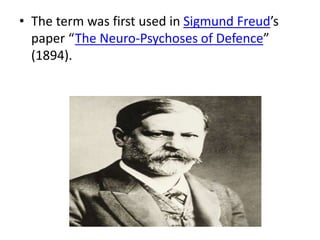
• The term was first used in Sigmund Freud’s
paper “The Neuro-Psychoses of Defence”
(1894).
Need of defense mechanism
• We use defense mechanisms to protect ourselves
from feelings of anxiety or guilt, which arise
because we feel threatened, or because
our superego becomes too demanding.
• Defense mechanisms operate at an unconscious
level and help ward off unpleasant feelings (i.e.,
anxiety) or make good things feel better for the
individual.
• Ego-defense mechanisms are natural and
normal. When they get out of proportion (i.e.,
used with frequency), neuroses develop, such as
anxiety states, phobias, obsessions, or hysteria.
Common classification
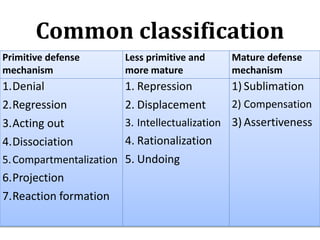
Primitive defense
mechanism
Less primitive and
more mature
Mature defense
mechanism
1.Denial
2.Regression
3.Acting out
4.Dissociation
5.Compartmentalization
6.Projection
7.Reaction formation
1. Repression
2. Displacement
3. Intellectualization
4. Rationalization
5. Undoing
1) Sublimation
2) Compensation
3) Assertiveness
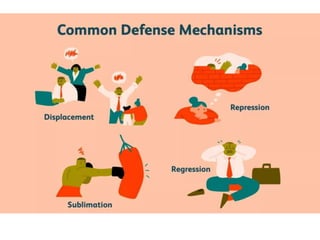
Repression
• Repression is an unconscious defense
mechanism employed by the ego to keep
disturbing or threatening thoughts from
becoming conscious.
• Repression is the withdrawal
from consciousness of an unwanted idea,
affect, or desire by pushing it down, or
repressing it, into the unconscious part of
the mind.
Repression Examples
• For example, a person who has repressed
memories of abuse suffered as a child may
later have difficulty forming relationships.
Projection
• In which an individual attributes
unwanted thoughts, feelings and
motives onto another person
• Projection is a form of defense in
which unwanted feelings are displaced
onto another person, where they then
appear as a threat from the external
world.
Projection - Examples
• For example, if you have a strong dislike for
someone, you might instead believe that
they do not like you.
Displacement
• Displacement is the redirection of an
impulse (usually aggression) onto a
powerless substitute target.
• Rather than express our anger in ways that
could lead to negative consequences (like
arguing with our boss), we instead express
our anger towards a person or object that
poses no threat (such as our spouse,
children, or pets).
Sublimation
• When we manage to displace our
unacceptable emotions into behaviors
which are constructive and socially
acceptable, rather than destructive
activities.
• For example, a person experiencing extreme
anger might take up kick-boxing as a means
of venting frustration.
Regression
• Regression is a return to earlier stages of
development and abandoned forms of
gratification belonging to them
• For an example an adolescent who is
overwhelmed with fear, anger and growing
sexual impulses might become clingy and
start exhibiting earlier childhood behaviors
he has long since overcome, such as
bedwetting.
Rationalization
• When a person finds a situation difficult to
accept, they will make up a logical reason
why it has happened. For example, a person
may explain a natural disaster as 'God's
will'.
• A student might blame a poor exam score on
the instructor rather than their own lack of
preparation.
Reaction Formation
• Reaction Formation is the converting of
unwanted or dangerous thoughts,
feelings or impulses into their opposites.
• An example of reaction formation would
be treating someone you strongly dislike
in an excessively friendly manner in order
to hide your true feelings.
Denial
• Denial of reality is when we refuse to accept
or believe the existence of something that is
very unpleasant to us.
• We use denial most often when faced with
death, serious illness or something painful and
threatening.
Identification
• By this adjustment, the individual feels the
personal satisfaction in the success and
achievements of other people and groups.
• Thus the little boy takes the masculine
attributes that he admires in his father.
• Girls identify with their mother, later
perhaps with their teacher, and later still
perhaps with a film star.
Conversion
• Conversion is a defense mechanism by which an
emotional conflict is expressed as a physical
symptom for which there is no demonstrable
organic basis.
• A student nurse, very anxious about exam, may
develop a headache.
• A small boy who hated his father so deeply that he
wished to strike him. He could suddenly develop
complete paralysis of his right arm which would do
two things for him
• a. Resolve the conflict (he cannot strike his father
even if wished to do so)
• b. Bring him a great deal of attention and sympathy
Compensation
• Compensation is a process of psychologically
counterbalancing perceived weaknesses by
emphasizing strength in other arenas.
• For instance, when a person says, “I may not
know how to cook, but I can sure do the
dishes!,” they’re trying to compensate for their
lack of cooking skills by emphasizing their
cleaning skills instead.
• When done appropriately and not in an
attempt to over-compensate, compensation is
defense mechanism that helps reinforce a
person’s self-esteem and self-image.
Fantasy or Day-Dreaming
• It is a kind of withdrawal when faced with
real problems of life.
• Day dreaming is a pleasant thing. It may
help us to escape during times of stress.
• For example, when one is having financial
problems, one can escape form them
temporarily by planning how to spend an
imaginary fortune.
Acting out
• Acting Out is performing an extreme
behavior in order to express thoughts
or feelings the person feels incapable of
otherwise expressing.
• Coping with stress by engaging in
actions rather than acknowledging and
bearing certain feelings
• Instead of saying, “I’m angry with you,” a
person who acts out may instead throw a book
at the person, or punch a hole through a wall.
When a person acts out, it can act as a pressure
release, and often helps the individual feel
calmer and peaceful once again.
• For instance, a child’s temper tantrum is a form
of acting out when he or she doesn’t get his or
her way with a parent. Self-injury may also be a
form of acting-out, expressing in physical pain
what one cannot stand to feel emotionally.
Intellectualization
• Intellectualization works to reduce anxiety by
thinking about events in a cold, clinical way.
This defense mechanism allows us to avoid
thinking about the stressful, emotional aspect
of the situation and instead focus only on the
intellectual component.
• For example, a person who has just been
diagnosed with a terminal illness might focus
on learning everything about the disease in
order to avoid distress and remain distant from
the reality of the situation.
Dissociation
• Dissociation is when a person loses track of
time and/or person, and instead finds another
representation of their self in order to
continue in the moment. A person who
dissociates often loses track of time or
themselves and their usual thought processes
and memories. People who have a history of
any kind of childhood abuse often suffer from
some form of dissociation.
Undoing
• Undoing is the attempt to take back an
unconscious behavior or thought that is
unacceptable or hurtful.
• For instance, after realizing you just insulted
your significant other unintentionally, you
might spend then next hour praising their
beauty, charm and intellect. By “undoing” the
previous action, the person is attempting to
counteract the damage done by the original
comment, hoping the two will balance one
another out.
• Undoing: Trying to make up for what one
feels are inappropriate thoughts, feelings, or
behaviors (e.g., if you hurt someone's
feelings, you might offer to do something
nice for them in order to assuage your
anxiety or guilt)
Other defense Mechanisms
• Aim inhibition: Accepting a modified form
of their original goal (e.g., becoming a high
school basketball coach rather than a
professional athlete)
• Altruism: Satisfying internal needs through
helping others
• Avoidance: Refusing to deal with or
encounter unpleasant objects or situations
• Dissociation: Becoming separated or
removed from one's experience
• Humor: Pointing out the funny or
ironic aspects of a situation
• Passive-aggression: Indirectly
expressing anger
Defense mechanisms and the
nurse
• Understanding defense mechanism will
enable the nurse to support the patient and
his family.
• Denial, for example, is a common reaction to
a serious diagnosis or at the time of death.
• Some patients, will often practice regression
through tears, trembling or demanding
special treatment.
• Patients who must deal with the stress of
serious illness may shift the blame for their
condition onto the nurse (projection). They
may complain of poor nursing care to a nurse
who is actually very skillful.
• Nurses should not show anger and retaliate
but should encourage the patients to explore
the realistic aspects of the situation.
• Both well adjusted and maladjusted
individuals make use of the defense
mechanism for their daily life.
• The well adjusted individuals use them
sparingly and socially desirable ways, where
as the maladjusted individuals including
psychotics and neurotics use them too
frequently and inappropriately.
Thank you

Defense mechanism

  • 1.
  • 2.
    Introduction • Defense mechanismsare psychological strategies that are unconsciously used to protect a person from anxiety arising from unacceptable thoughts or feelings. • A defense mechanism is an unconscious psychological mechanism that reduces anxiety arising from unacceptable or potentially harmful stimuli. • Defense mechanisms may result in healthy or unhealthy consequences depending on the circumstances and frequency with which the mechanism is used.
  • 3.
    • Defense mechanism,in psychoanalytic theory, any of a group of mental processes that enables the mind to reach compromise solutions to conflicts that it is unable to resolve. The process is usually unconscious, and the compromise generally involves concealing from oneself internal drives or feelings that threaten to lower self-esteem or provoke anxiety.
  • 4.
    • The termwas first used in Sigmund Freud’s paper “The Neuro-Psychoses of Defence” (1894).
  • 5.
    Need of defensemechanism • We use defense mechanisms to protect ourselves from feelings of anxiety or guilt, which arise because we feel threatened, or because our superego becomes too demanding. • Defense mechanisms operate at an unconscious level and help ward off unpleasant feelings (i.e., anxiety) or make good things feel better for the individual. • Ego-defense mechanisms are natural and normal. When they get out of proportion (i.e., used with frequency), neuroses develop, such as anxiety states, phobias, obsessions, or hysteria.
  • 6.
    Common classification Primitive defense mechanism Lessprimitive and more mature Mature defense mechanism 1.Denial 2.Regression 3.Acting out 4.Dissociation 5.Compartmentalization 6.Projection 7.Reaction formation 1. Repression 2. Displacement 3. Intellectualization 4. Rationalization 5. Undoing 1) Sublimation 2) Compensation 3) Assertiveness
  • 8.
    Repression • Repression isan unconscious defense mechanism employed by the ego to keep disturbing or threatening thoughts from becoming conscious. • Repression is the withdrawal from consciousness of an unwanted idea, affect, or desire by pushing it down, or repressing it, into the unconscious part of the mind.
  • 9.
    Repression Examples • Forexample, a person who has repressed memories of abuse suffered as a child may later have difficulty forming relationships.
  • 10.
    Projection • In whichan individual attributes unwanted thoughts, feelings and motives onto another person • Projection is a form of defense in which unwanted feelings are displaced onto another person, where they then appear as a threat from the external world.
  • 11.
    Projection - Examples •For example, if you have a strong dislike for someone, you might instead believe that they do not like you.
  • 12.
    Displacement • Displacement isthe redirection of an impulse (usually aggression) onto a powerless substitute target. • Rather than express our anger in ways that could lead to negative consequences (like arguing with our boss), we instead express our anger towards a person or object that poses no threat (such as our spouse, children, or pets).
  • 13.
    Sublimation • When wemanage to displace our unacceptable emotions into behaviors which are constructive and socially acceptable, rather than destructive activities. • For example, a person experiencing extreme anger might take up kick-boxing as a means of venting frustration.
  • 14.
    Regression • Regression isa return to earlier stages of development and abandoned forms of gratification belonging to them • For an example an adolescent who is overwhelmed with fear, anger and growing sexual impulses might become clingy and start exhibiting earlier childhood behaviors he has long since overcome, such as bedwetting.
  • 15.
    Rationalization • When aperson finds a situation difficult to accept, they will make up a logical reason why it has happened. For example, a person may explain a natural disaster as 'God's will'. • A student might blame a poor exam score on the instructor rather than their own lack of preparation.
  • 16.
    Reaction Formation • ReactionFormation is the converting of unwanted or dangerous thoughts, feelings or impulses into their opposites. • An example of reaction formation would be treating someone you strongly dislike in an excessively friendly manner in order to hide your true feelings.
  • 17.
    Denial • Denial ofreality is when we refuse to accept or believe the existence of something that is very unpleasant to us. • We use denial most often when faced with death, serious illness or something painful and threatening.
  • 18.
    Identification • By thisadjustment, the individual feels the personal satisfaction in the success and achievements of other people and groups. • Thus the little boy takes the masculine attributes that he admires in his father. • Girls identify with their mother, later perhaps with their teacher, and later still perhaps with a film star.
  • 19.
    Conversion • Conversion isa defense mechanism by which an emotional conflict is expressed as a physical symptom for which there is no demonstrable organic basis. • A student nurse, very anxious about exam, may develop a headache. • A small boy who hated his father so deeply that he wished to strike him. He could suddenly develop complete paralysis of his right arm which would do two things for him • a. Resolve the conflict (he cannot strike his father even if wished to do so) • b. Bring him a great deal of attention and sympathy
  • 20.
    Compensation • Compensation isa process of psychologically counterbalancing perceived weaknesses by emphasizing strength in other arenas. • For instance, when a person says, “I may not know how to cook, but I can sure do the dishes!,” they’re trying to compensate for their lack of cooking skills by emphasizing their cleaning skills instead. • When done appropriately and not in an attempt to over-compensate, compensation is defense mechanism that helps reinforce a person’s self-esteem and self-image.
  • 21.
    Fantasy or Day-Dreaming •It is a kind of withdrawal when faced with real problems of life. • Day dreaming is a pleasant thing. It may help us to escape during times of stress. • For example, when one is having financial problems, one can escape form them temporarily by planning how to spend an imaginary fortune.
  • 22.
    Acting out • ActingOut is performing an extreme behavior in order to express thoughts or feelings the person feels incapable of otherwise expressing. • Coping with stress by engaging in actions rather than acknowledging and bearing certain feelings
  • 23.
    • Instead ofsaying, “I’m angry with you,” a person who acts out may instead throw a book at the person, or punch a hole through a wall. When a person acts out, it can act as a pressure release, and often helps the individual feel calmer and peaceful once again. • For instance, a child’s temper tantrum is a form of acting out when he or she doesn’t get his or her way with a parent. Self-injury may also be a form of acting-out, expressing in physical pain what one cannot stand to feel emotionally.
  • 24.
    Intellectualization • Intellectualization worksto reduce anxiety by thinking about events in a cold, clinical way. This defense mechanism allows us to avoid thinking about the stressful, emotional aspect of the situation and instead focus only on the intellectual component. • For example, a person who has just been diagnosed with a terminal illness might focus on learning everything about the disease in order to avoid distress and remain distant from the reality of the situation.
  • 25.
    Dissociation • Dissociation iswhen a person loses track of time and/or person, and instead finds another representation of their self in order to continue in the moment. A person who dissociates often loses track of time or themselves and their usual thought processes and memories. People who have a history of any kind of childhood abuse often suffer from some form of dissociation.
  • 26.
    Undoing • Undoing isthe attempt to take back an unconscious behavior or thought that is unacceptable or hurtful. • For instance, after realizing you just insulted your significant other unintentionally, you might spend then next hour praising their beauty, charm and intellect. By “undoing” the previous action, the person is attempting to counteract the damage done by the original comment, hoping the two will balance one another out.
  • 27.
    • Undoing: Tryingto make up for what one feels are inappropriate thoughts, feelings, or behaviors (e.g., if you hurt someone's feelings, you might offer to do something nice for them in order to assuage your anxiety or guilt)
  • 29.
    Other defense Mechanisms •Aim inhibition: Accepting a modified form of their original goal (e.g., becoming a high school basketball coach rather than a professional athlete) • Altruism: Satisfying internal needs through helping others • Avoidance: Refusing to deal with or encounter unpleasant objects or situations
  • 30.
    • Dissociation: Becomingseparated or removed from one's experience • Humor: Pointing out the funny or ironic aspects of a situation • Passive-aggression: Indirectly expressing anger
  • 31.
    Defense mechanisms andthe nurse • Understanding defense mechanism will enable the nurse to support the patient and his family. • Denial, for example, is a common reaction to a serious diagnosis or at the time of death. • Some patients, will often practice regression through tears, trembling or demanding special treatment.
  • 32.
    • Patients whomust deal with the stress of serious illness may shift the blame for their condition onto the nurse (projection). They may complain of poor nursing care to a nurse who is actually very skillful. • Nurses should not show anger and retaliate but should encourage the patients to explore the realistic aspects of the situation.
  • 33.
    • Both welladjusted and maladjusted individuals make use of the defense mechanism for their daily life. • The well adjusted individuals use them sparingly and socially desirable ways, where as the maladjusted individuals including psychotics and neurotics use them too frequently and inappropriately.
  • 34.