Psychoanalytic Perspective
Sigmund Freud
and
Defense Mechanism
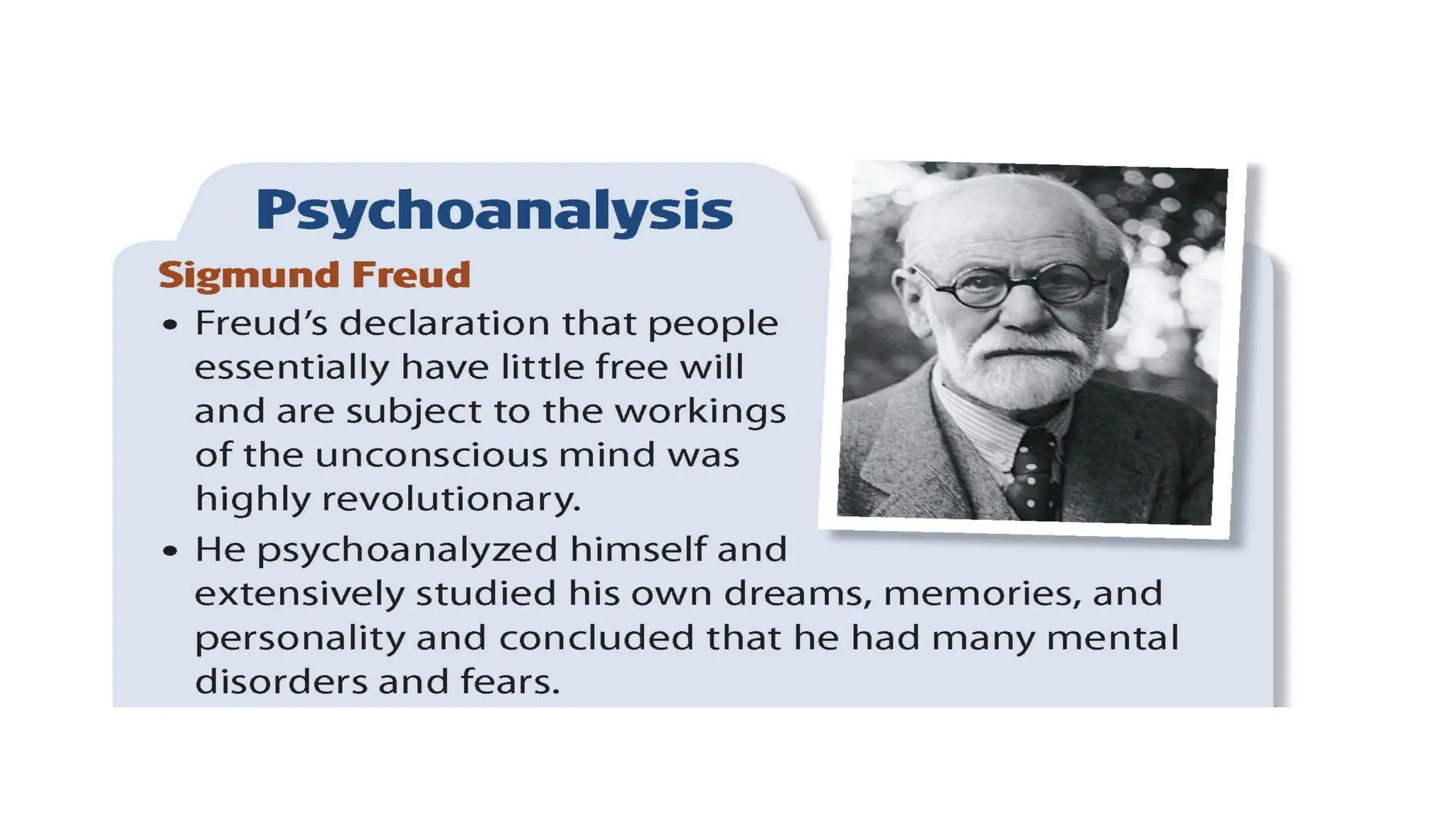
Sigmund Freud and Psychoanalysis
•He theorized that the key to human behavior is satisfying
desires.
•Freud was the most famous of the early psychologists.
•He developed psychoanalysis, which emphasizes
unconscious motives and internal conflicts in human
behavior.
•He developed psychodynamic thinking, which assumes that
most of what exists in an individual's mind is unconscious
and consists of conflicting impulses, urges, and wishes.
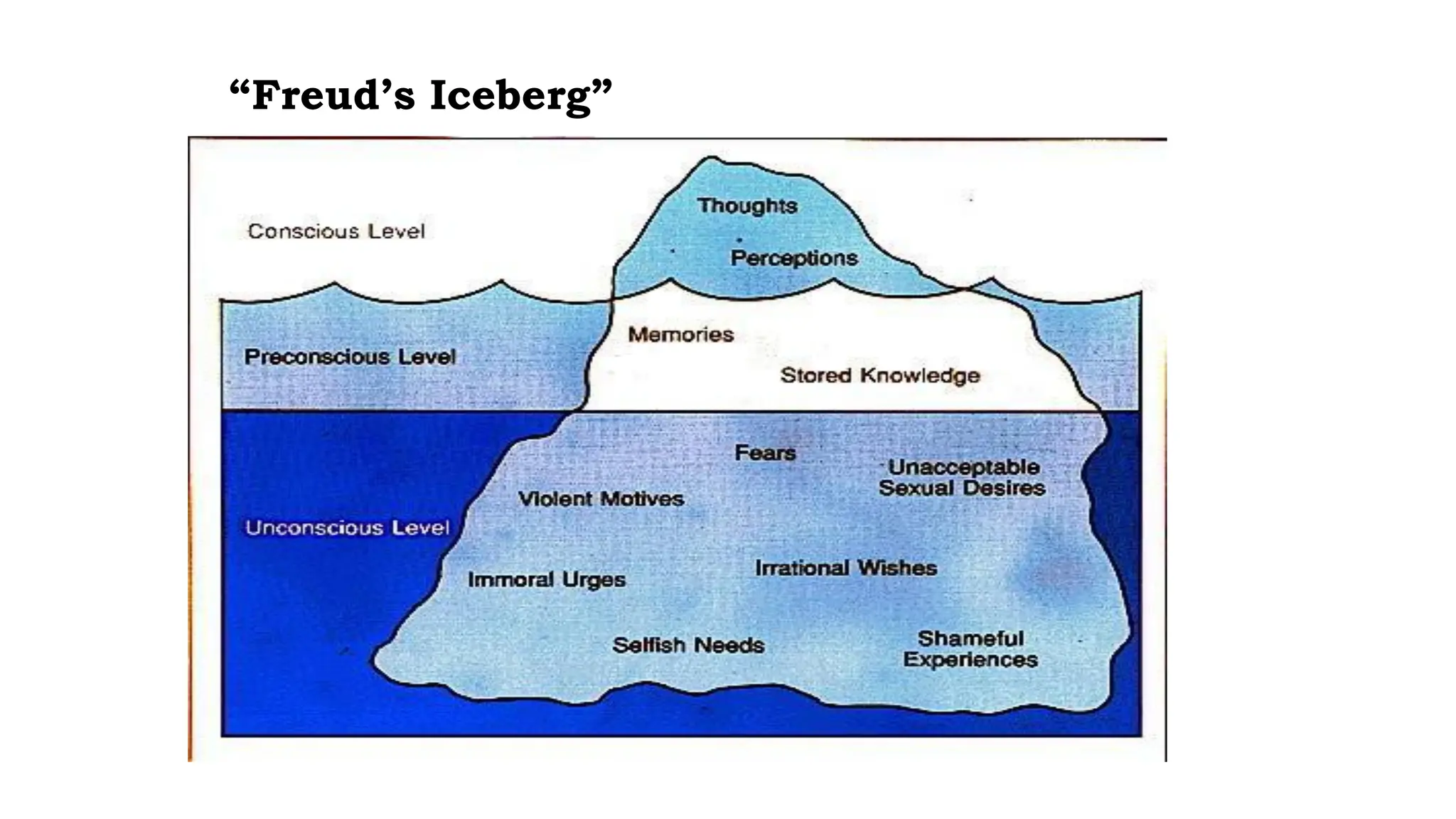
“Freud’s Iceberg”
Mind and Iceberg: Three levels of Mind
❖Conscious
❖Subconscious
❖Unconscious
❖Structure of Personality:
❖ID
❖Pleasure Principle
❖EGO
❖Reality Principle (Executive of Personality)
❖Superego
❖ Moral Principles
Anxiety
&
Defense Mechanism
Basic Concept
•In Sigmund Freud's topographical model of
personality, the ego is the aspect of personality
that deals with reality.
•While doing this, the ego also has to cope with the
conflicting demands of the id and the superego.
•The id seeks to fulfill all wants, needs, and
impulses while the superego tries to get the
ego to act in an idealistic and moral manner.
•What happens when the ego cannot deal
with the demands of ones desires, the
constraints of reality, and ones own moral
standards?
•Anxiety acts as a signal to the ego that things
are not going right.
Basic concepts
Freud identified three different types of anxiety.
•Reality Anxiety: This is the most basic form of
anxiety and is typically based on fears of real and
possible events, such as being bitten by a dog or
falling from a ladder.
The most common way of reducing tension from
Reality Anxiety is taking oneself away from the
situation !
•Neurotic Anxiety: This is a form of anxiety which
comes from an unconscious fear that the basic
impulses of the ID (the primitive part of our
personality) will take control of the person, leading
to eventual punishment(this is thus a form of
Moral Anxiety).
Id x Ego: Neurotic Anxiety
•Moral Anxiety: This form of anxiety comes from a
fear of violating values and moral codes, and
appears as feelings of guilt or shame.
Superego x Ego: Moral Anxiety
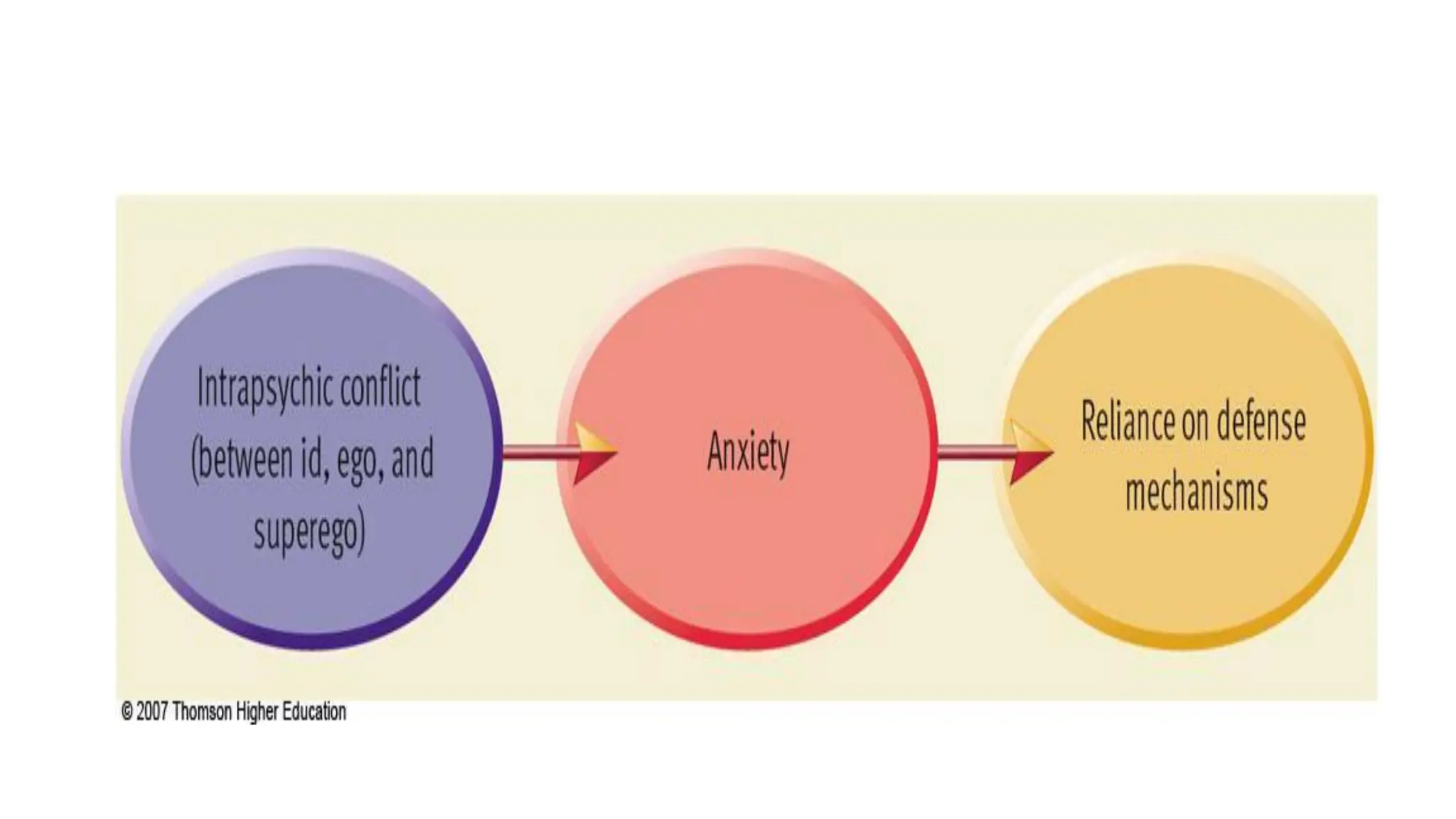
•According to Freud, anxiety is an unpleasant inner
state that people seek to avoid.
•When anxiety occurs, the mind first responds by an
increase in problem-solving thinking, seeking rational
ways of escaping the situation.
•If this is not fruitful (and maybe anyway), ego has
some tools it…, tools that help defend the ego… these
are called Ego Defense Mechanisms or Defenses.
•They helped shield the ego from the conflicts created
by the id, superego, and reality.
•Denial: Arguing against an anxiety provoking
stimuli by stating it doesn't exist.
•Many people use denial in their everyday lives to
avoid dealing with painful feelings or areas of their
life they don’t wish to admit.
Examples:
1) Patient denies that his physician's diagnosis of
cancer is correct and seeks a second opinion.
2) Alcoholics vigorously deny that they have a
problem.
3) Cultural Perspective
•Displacement: Taking out impulses on a less
threatening target.
•It occurs when the Id wants to do something of which
the Super ego does not permit. The Ego thus finds
some other way of releasing the psychic energy of the
Id.
• Thus there is a transfer of energy from a repressed
object to a more acceptable object.
•Displacements are often quite satisfactory and
workable mechanisms for releasing energy more
safely.
•Examples:
1) The boss gets angry and shouts at a person.
He goes home and shouts at his wife. She then
shouts at their son. With nobody left to displace
anger onto, he goes and kicks the dog.
2) A man wins the lottery. He turns to the person
next to him and gives the person a big hug.
•Intellectualization: “Flight into reason”.
Avoiding unacceptable emotions by focusing
on the intellectual aspects.
•Intellectualization protects against anxiety by
repressing the emotions connected with an event.
It is also known as 'Isolation of affect' as the
affective elements are removed from the situation.
•Projection: Placing unacceptable impulses
in yourself onto someone else.
•Neurotic projection is perceiving others as operating
in ways one unconsciously finds objectionable in
yourself.
•Complementary projection is assuming that others
do, think and feel in the same way as you.
•Rationalization: Supplying a logical or rational reason
as opposed to the real reason.
•When a person does something of which the moral
super ego disapproves, then the ego seeks to defend
itself by adding reasons that make the action acceptable
to the super ego. Thus we are able to do something that
is outside our values and get away with it without
feeling too guilty.
•Examples 1) A parent punishes a child and says that it
is for the child's 'own good'.
2) A person evades paying taxes and then rationalizes
it by talking about how the government wastes money
(and how it is better for people to keep what they can).
•Reaction Formation: Taking the opposite belief
because the true belief causes anxiety.
•It appears as a defense against a feared social
punishment.
•A common pattern in Reaction Formation is for
the person to show ‘excessive behavior’.
•Psychoanalysts believe that extreme patterns of
Reaction Formation are found in paranoia and
obsessive-compulsive disorder (OCD), where the
person becomes trapped in a cycle of repeating a
behavior that they know (at least at a deep level) is
somehow wrong.
•Regression: Returning to a previous stage of
development.
•Examples:
1) A person who suffers a mental breakdown
assumes a fetal position, rocking and crying.
2) Emotional Tantrum
3) A patient makes childish demands and
becomes dependent on the nurse for care that
they could do for themselves.
Repression: Pulling into the unconscious.
•The level of 'forgetting' in repression can vary from
a temporary abolition of uncomfortable thoughts
to a high level of amnesia, where events that
caused the anxiety are buried very deep.
•A high level of repression can cause a high level of
anxiety or dysfunction, although this may also be
caused by the repression of one particularly
traumatic incident.
Sublimation: acting out unacceptable impulses
in a socially acceptable way.
•Sublimation is probably the most useful and
constructive of the defense mechanisms as it
takes the energy of something that is potentially
harmful and turns it to doing something good
and useful.
•sublimating your aggressive impulses toward a
career such as, boxer
•Examples –
•A angry man does pushups to work off his
temper.
•A person who has an obsessive need for
control and order becomes a successful
business entrepreneur.
•Becoming a surgeon because of your desire
to cut; lifting weights to release 'pent up'
energy
•Acting Out: The individual deals with emotional
conflict or internal or external stressors by actions
rather than reflections or feelings.
•When a person acts out, it can act as a pressure
release, and often helps the individual feel calmer
and peaceful once again.
•For instance, a child’s temper tantrum is a form of
acting out when he or she doesn’t get his or her
way with a parent. Self-injury may also be a form
of acting-out, expressing in physical pain what
one cannot stand to feel emotionally.
Important Characteristics
•Defenses are a major means of managing impulse and
affect
•Defenses are unconscious
•Defenses are discrete from one another
• Although often the hallmarks of major psychiatric
syndromes, defenses are dynamic and reversible;
•Defenses can be adaptive as well as pathological.
▪The ego’s protective methods of reducing anxiety.
▪Ego defenses are not necessarily unhealthy as
one thinks.
▪In fact, the lack of these defenses, or the
inability to use them effectively can often lead to
problems in life.
▪ However, we sometimes employ the defenses at
the wrong time or overuse them, which can be
equally destructive.
Purpose of Defense Mechanisms
•Defenses allow individuals a period of respite to master
changes in self-image that cannot be immediately
integrated, as might result from puberty, an
amputation, or a promotion (i.e., changes in reality).
•Defenses can deflect or deny sudden increases in
biological drives. Awareness of instinctual wishes is
usually diminished; alternatively, antithetical wishes
may be passionately adhered to.
•Defenses enable individuals to mitigate unresolved
conflicts with important people, living or dead.
•Finally, ego mechanisms of defense can keep
anxiety, shame, and guilt within bearable limits
during sudden conflicts with conscience and
culture.
Outcomes of Mature Defenses
1) Excellent adjustment as an adult,
2) Happiness,
3) Job satisfaction,
4) Rich friendships/ relationships,
5) Fewer medical hospitalizations over life,
6) Better overall health,
7) A lower incidence of mental illness.
Outcomes of Immature Defenses:
1) Poor adjustment as an adult,
2) Higher divorce rates and marital discord,
3) Poor friendship/ relationship patterns,
4) Higher incidence of mental illness,
5) Greater number of sick leave days taken,
6) Poorer health generally
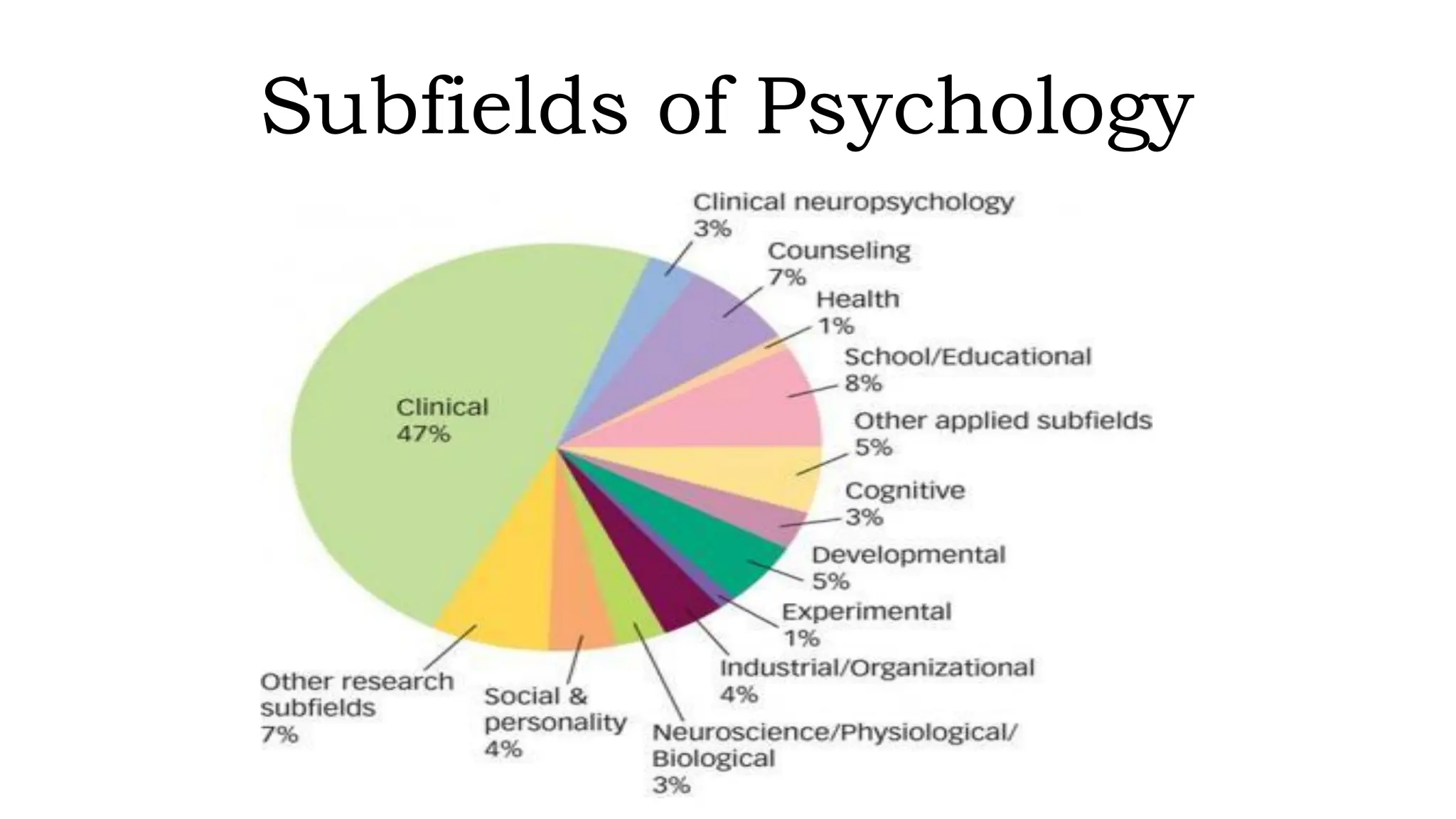
Subfields of Psychology
Subfields and Applications of Psychology
❖Developmental Psychology: Deals with how people change
physically, cognitively, and socially across life span
❖Educational Psychology: Deals with all the aspects of
educational process such as, mode of teaching and
instruction, techniques of instruction, learning disability
etc.
❖Cognitive Psychology: Deals with all the aspects of
cognition such as, learning, memory, thinking, reasoning,
decision making etc.
❖ Environmental Psychology: Deals with the
relationship between humans and the physical
environment
❖ Engineering Psychology: Deals with designing
machines, products, services or tasks considering
human limitations
❖Forensic Psychology: Deals with the possible
association between psychopathology and criminal
behaviour
❖Industrial/ Organizational Psychology: Studies all aspect
of behaviour in organizational setup such as, how to
improve the productivity of employees, training
programme for employees, designing a system of
performance appraisal
❖ Psychobiology: Investigate the biological basis of behavior
❖ Social Psychology: How social context affects the behavior
of the individual and groups. It takes into account all
aspects of social behaviour and and thought.
❖
❖Experimental Psychology: Deals with all aspects of
basic psychological processes such as, perception,
learning, thinking, motivation etc.
❖Health or Medical Psychology: Aims to study the role of
psychological factors in influencing and marinating
physical health. It also emphasizes the promotion of
good physical health
❖ Abnormal Psychology: Deals with various forms of
psychopathology
❖ Clinical Psychology: Deals with the diagnosis and
treatment of psychological disorders
8.2. Psychoanalytic Perspective.pptx.pdf

  • 1.
  • 3.
    Sigmund Freud andPsychoanalysis •He theorized that the key to human behavior is satisfying desires. •Freud was the most famous of the early psychologists. •He developed psychoanalysis, which emphasizes unconscious motives and internal conflicts in human behavior. •He developed psychodynamic thinking, which assumes that most of what exists in an individual's mind is unconscious and consists of conflicting impulses, urges, and wishes.
  • 4.
  • 5.
    Mind and Iceberg:Three levels of Mind ❖Conscious ❖Subconscious ❖Unconscious
  • 6.
    ❖Structure of Personality: ❖ID ❖PleasurePrinciple ❖EGO ❖Reality Principle (Executive of Personality) ❖Superego ❖ Moral Principles
  • 7.
  • 8.
    Basic Concept •In SigmundFreud's topographical model of personality, the ego is the aspect of personality that deals with reality. •While doing this, the ego also has to cope with the conflicting demands of the id and the superego.
  • 9.
    •The id seeksto fulfill all wants, needs, and impulses while the superego tries to get the ego to act in an idealistic and moral manner. •What happens when the ego cannot deal with the demands of ones desires, the constraints of reality, and ones own moral standards? •Anxiety acts as a signal to the ego that things are not going right.
  • 10.
    Basic concepts Freud identifiedthree different types of anxiety. •Reality Anxiety: This is the most basic form of anxiety and is typically based on fears of real and possible events, such as being bitten by a dog or falling from a ladder. The most common way of reducing tension from Reality Anxiety is taking oneself away from the situation !
  • 11.
    •Neurotic Anxiety: Thisis a form of anxiety which comes from an unconscious fear that the basic impulses of the ID (the primitive part of our personality) will take control of the person, leading to eventual punishment(this is thus a form of Moral Anxiety). Id x Ego: Neurotic Anxiety •Moral Anxiety: This form of anxiety comes from a fear of violating values and moral codes, and appears as feelings of guilt or shame. Superego x Ego: Moral Anxiety
  • 12.
    •According to Freud,anxiety is an unpleasant inner state that people seek to avoid. •When anxiety occurs, the mind first responds by an increase in problem-solving thinking, seeking rational ways of escaping the situation. •If this is not fruitful (and maybe anyway), ego has some tools it…, tools that help defend the ego… these are called Ego Defense Mechanisms or Defenses. •They helped shield the ego from the conflicts created by the id, superego, and reality.
  • 14.
    •Denial: Arguing againstan anxiety provoking stimuli by stating it doesn't exist. •Many people use denial in their everyday lives to avoid dealing with painful feelings or areas of their life they don’t wish to admit. Examples: 1) Patient denies that his physician's diagnosis of cancer is correct and seeks a second opinion. 2) Alcoholics vigorously deny that they have a problem. 3) Cultural Perspective
  • 15.
    •Displacement: Taking outimpulses on a less threatening target. •It occurs when the Id wants to do something of which the Super ego does not permit. The Ego thus finds some other way of releasing the psychic energy of the Id. • Thus there is a transfer of energy from a repressed object to a more acceptable object.
  • 16.
    •Displacements are oftenquite satisfactory and workable mechanisms for releasing energy more safely. •Examples: 1) The boss gets angry and shouts at a person. He goes home and shouts at his wife. She then shouts at their son. With nobody left to displace anger onto, he goes and kicks the dog. 2) A man wins the lottery. He turns to the person next to him and gives the person a big hug.
  • 17.
    •Intellectualization: “Flight intoreason”. Avoiding unacceptable emotions by focusing on the intellectual aspects. •Intellectualization protects against anxiety by repressing the emotions connected with an event. It is also known as 'Isolation of affect' as the affective elements are removed from the situation.
  • 18.
    •Projection: Placing unacceptableimpulses in yourself onto someone else. •Neurotic projection is perceiving others as operating in ways one unconsciously finds objectionable in yourself. •Complementary projection is assuming that others do, think and feel in the same way as you.
  • 19.
    •Rationalization: Supplying alogical or rational reason as opposed to the real reason. •When a person does something of which the moral super ego disapproves, then the ego seeks to defend itself by adding reasons that make the action acceptable to the super ego. Thus we are able to do something that is outside our values and get away with it without feeling too guilty. •Examples 1) A parent punishes a child and says that it is for the child's 'own good'. 2) A person evades paying taxes and then rationalizes it by talking about how the government wastes money (and how it is better for people to keep what they can).
  • 20.
    •Reaction Formation: Takingthe opposite belief because the true belief causes anxiety. •It appears as a defense against a feared social punishment. •A common pattern in Reaction Formation is for the person to show ‘excessive behavior’. •Psychoanalysts believe that extreme patterns of Reaction Formation are found in paranoia and obsessive-compulsive disorder (OCD), where the person becomes trapped in a cycle of repeating a behavior that they know (at least at a deep level) is somehow wrong.
  • 21.
    •Regression: Returning toa previous stage of development. •Examples: 1) A person who suffers a mental breakdown assumes a fetal position, rocking and crying. 2) Emotional Tantrum 3) A patient makes childish demands and becomes dependent on the nurse for care that they could do for themselves.
  • 22.
    Repression: Pulling intothe unconscious. •The level of 'forgetting' in repression can vary from a temporary abolition of uncomfortable thoughts to a high level of amnesia, where events that caused the anxiety are buried very deep. •A high level of repression can cause a high level of anxiety or dysfunction, although this may also be caused by the repression of one particularly traumatic incident.
  • 23.
    Sublimation: acting outunacceptable impulses in a socially acceptable way. •Sublimation is probably the most useful and constructive of the defense mechanisms as it takes the energy of something that is potentially harmful and turns it to doing something good and useful. •sublimating your aggressive impulses toward a career such as, boxer
  • 24.
    •Examples – •A angryman does pushups to work off his temper. •A person who has an obsessive need for control and order becomes a successful business entrepreneur. •Becoming a surgeon because of your desire to cut; lifting weights to release 'pent up' energy
  • 25.
    •Acting Out: Theindividual deals with emotional conflict or internal or external stressors by actions rather than reflections or feelings. •When a person acts out, it can act as a pressure release, and often helps the individual feel calmer and peaceful once again. •For instance, a child’s temper tantrum is a form of acting out when he or she doesn’t get his or her way with a parent. Self-injury may also be a form of acting-out, expressing in physical pain what one cannot stand to feel emotionally.
  • 26.
    Important Characteristics •Defenses area major means of managing impulse and affect •Defenses are unconscious •Defenses are discrete from one another • Although often the hallmarks of major psychiatric syndromes, defenses are dynamic and reversible; •Defenses can be adaptive as well as pathological.
  • 27.
    ▪The ego’s protectivemethods of reducing anxiety. ▪Ego defenses are not necessarily unhealthy as one thinks. ▪In fact, the lack of these defenses, or the inability to use them effectively can often lead to problems in life. ▪ However, we sometimes employ the defenses at the wrong time or overuse them, which can be equally destructive.
  • 28.
    Purpose of DefenseMechanisms •Defenses allow individuals a period of respite to master changes in self-image that cannot be immediately integrated, as might result from puberty, an amputation, or a promotion (i.e., changes in reality). •Defenses can deflect or deny sudden increases in biological drives. Awareness of instinctual wishes is usually diminished; alternatively, antithetical wishes may be passionately adhered to.
  • 29.
    •Defenses enable individualsto mitigate unresolved conflicts with important people, living or dead. •Finally, ego mechanisms of defense can keep anxiety, shame, and guilt within bearable limits during sudden conflicts with conscience and culture.
  • 30.
    Outcomes of MatureDefenses 1) Excellent adjustment as an adult, 2) Happiness, 3) Job satisfaction, 4) Rich friendships/ relationships, 5) Fewer medical hospitalizations over life, 6) Better overall health, 7) A lower incidence of mental illness.
  • 31.
    Outcomes of ImmatureDefenses: 1) Poor adjustment as an adult, 2) Higher divorce rates and marital discord, 3) Poor friendship/ relationship patterns, 4) Higher incidence of mental illness, 5) Greater number of sick leave days taken, 6) Poorer health generally
  • 32.
  • 33.
    Subfields and Applicationsof Psychology ❖Developmental Psychology: Deals with how people change physically, cognitively, and socially across life span ❖Educational Psychology: Deals with all the aspects of educational process such as, mode of teaching and instruction, techniques of instruction, learning disability etc. ❖Cognitive Psychology: Deals with all the aspects of cognition such as, learning, memory, thinking, reasoning, decision making etc.
  • 34.
    ❖ Environmental Psychology:Deals with the relationship between humans and the physical environment ❖ Engineering Psychology: Deals with designing machines, products, services or tasks considering human limitations ❖Forensic Psychology: Deals with the possible association between psychopathology and criminal behaviour
  • 35.
    ❖Industrial/ Organizational Psychology:Studies all aspect of behaviour in organizational setup such as, how to improve the productivity of employees, training programme for employees, designing a system of performance appraisal ❖ Psychobiology: Investigate the biological basis of behavior ❖ Social Psychology: How social context affects the behavior of the individual and groups. It takes into account all aspects of social behaviour and and thought. ❖
  • 36.
    ❖Experimental Psychology: Dealswith all aspects of basic psychological processes such as, perception, learning, thinking, motivation etc. ❖Health or Medical Psychology: Aims to study the role of psychological factors in influencing and marinating physical health. It also emphasizes the promotion of good physical health ❖ Abnormal Psychology: Deals with various forms of psychopathology ❖ Clinical Psychology: Deals with the diagnosis and treatment of psychological disorders