PRESENTER-DR. SHANUSONI
MODERATOR-MAJOR(DR.) RAKESH
SAXENA
DEFENSE MECHANISM
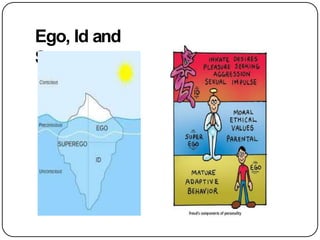
Ego, Id and
Superego
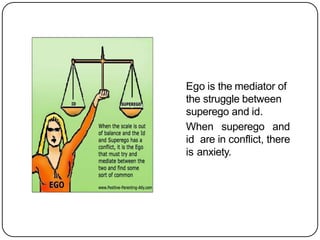
Ego is the mediator of
the struggle between
superego and id.
When superego and
id are in conflict, there
is anxiety.
Defense mechanisms according
to Sigmund Freud
“ Defense mechanisms are unconscious
mental processes used by ego to reduce
anxiety”
People seek to avoid anxiety.
When person cannot think of rational ways of escaping
the situation, ego uses defence mechanisms to escape
anxiety.
Genesis of defense
mechanisms
Properties of defence
mechanisms
According to Freud,
1. Major means of managingconflictandaffect.
2. Relatively unconscious.
3. Discrete from each other
4. Although often the hallmarksofpsychiatric
syndromes, they are reversible
5. Adaptive as well as pathological.
They deny, falsify or distort reality
They work through self- deception(distorting reality so
that it becomes less threatening.)
Specific to id impulses.
Depends on developmental stage
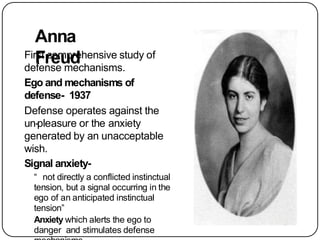
Anna
Freud
First comprehensive study of
defense mechanisms.
Ego and mechanisms of
defense- 1937
Defense operates against the
un-pleasure or the anxiety
generated by an unacceptable
wish.
Signal anxiety-
“ not directly a conflicted instinctual
tension, but a signal occurring in the
ego of an anticipated instinctual
tension”
Anxiety which alerts the ego to
danger and stimulates defense
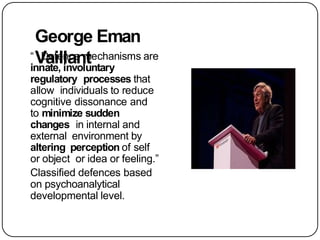
George Eman
Vaillant
“ Defence mechanisms are
innate, involuntary
regulatory processes that
allow individuals to reduce
cognitive dissonance and
to minimize sudden
changes in internal and
external environment by
altering perception of self
or object or idea or feeling.”
Classified defences based
on psychoanalytical
developmental level.
Unconscious responses to external stressors as
well as to anxiety arising from internal
conflict.
Originally described by Sigmund Freud
.
Later elaborated by his daughter , Anna Freud.
Freud identified defense mechanisms in his
study of the ‘psychopathology of ever yday
life’
George Valliant’sClassification
Four types:-
Narcissistic-Psychotic Defenses
Immature Defenses
Neurotic Defenses
Mature Defenses
NARCI SSI STI
C- PSY CHOTI
C
I MMATUR E NEUR OTIC MATURE
DENIAL ACTING OUT CONTROLLING ALTRUISM
PROJECTION BLOCK ING DISPLACEMENT ANTICIPATION
DISTORTION HYPOCHONDRIASIS DISSOCIATION ASCETICISIM
INTROJECTION EX TERNALIZATION HUMOR
PASSIVE-
AGGRESSIV E
BEHAVIOR
INHIBITION SUBLIMATION
PROJECTION INTELLECTUALIZA
TI ON
SUPRESSION
REGRESSION ISOLATION
SCHIZOID FANTASY RATIONALIZATION
SOMATIZATION REACTION
FORMATIO
N
Narcissistic-Psychotic
Defenses
These defenses are usually found as part of a
psychotic process, but may also occur in young
children and adult dreams or fantasies.
They share the common note of avoiding, negating,
or distorting reality.
1.Projectio
nPerceiving and reacting to unacceptable inner
impulses and their derivatives as though they were
outside the self.
On a psychotic level, this takes the form of frank
delusions about external reality, usually
persecutory, includes both perception of one's own
feelings and those of another with subsequent
acting on the perception (psychotic paranoid
delusions).
Impulses may derive from id or superego
(hallucinated recriminations).
2.Denia
l Psychotic denial of external reality, unlike repression,
affects perception of external reality more than
perception of internal reality.
Seeing, but refusing to acknowledge what one sees, or
hearing and negating what is actually heard are
examples of denial and exemplify the close
relationship of denial to sensory experience.
Not all denial, however, is necessarily psychotic. Like
projection, denial may function in the service of more
neurotic or even adaptive objectives.
Denial avoids becoming aware of some painfu l aspect
of reality. At the psychotic level, the denied reality may
be replaced by a fantasy or delusion.
3.Distortio
nGrossly reshaping the experience of external
reality to suit inner needs, including unrealistic
megalomanic beliefs, hallucinations, wish-fulfilling
delusions, and employing sustained feelings of
delusional grandiosity, superiority, or entitlement.
Immature
Defenses
These mechanisms are fairly common in
preadolescent years and in adult character
disorders.
They are often mobilized by anxieties related to
intimacy or its loss.
Although they are regarded as socially awkward
and undesirable, they often moderate with
improvement in interpersonal relationships or with
increased personal maturity.
1.Acting
out
The direct expression of an unconscious wish or
impulse in action to avoid being conscious of the
accompanying affect.
The unconscious fantasy, involving objects, is lived
out and impulsively enacted in behavior, thus
gratifying the impulse more than the prohibition
against it.
On a chronic level, acting out involves giving in to
impulses to avoid the tension that would result
from postponement of their expression.
2.Blockin
gAn inhibition, usually temporary in nature, of
affects especially, but possibly also thinking and
impulses. It is close to repression in its effects but
has a component of tension arising from the
inhibition of the impulse, affect, or thought.
3.Hypochondriasi
sTransformation of reproach toward others arising
from bereavement, loneliness, or unacceptable
aggressive impulses, into self-reproach in the form
of somatic complaints of pain, illness, and so forth.
Real illness may also be overemphasized or
exaggerated for its evasive and regressive
possibilities. Thus, responsibility may be avoided,
guilt may be circumvented, and instinctual
impulses may be warded off.
4.Introjectio
nIn addition to the developmental functions of the
process of introjection, it also can serve specific
defensive functions.
The introjection of a loved object involves the
internalization of characteristics of the object with the
goal of ensuring closeness to and constant presence
of the object.
Anxiety consequent to separation or tension arising
out of ambivalence toward the object is thus
diminished.
If the object is lost, introjection nullifies or negates the
loss by taking on characteristics of the object, thus in a
sense internally preserving the object.
Even if the object is not lost, the internalization usually
involves a shift of cathexis reflecting a significant
alteration in the object relationship.
lntrojection of a feared object serves to avoid anxiety
through internalizing the aggressive characteristic of
the object, thereby putting the aggression under one's
own control.
The aggression is no longer felt as coming from
outside, but is taken within and utilized defensively,
thus turning the subject's weak, passive position into
an active, strong one. The classic example is
"identification with the aggressor.
"lntrojection can also take place out of a sense of guilt
in which the self-punishing introject is attributable to the
hostile destructive component of an ambivalent tie to
an object.
Thus, the self-punitive qualities of the object are taken
over and established within one's self as a symptom or
character trait, which effectively represents both the
destruction and the preservation of the object. This is
also cal led identification with the victim.
5.Passive aggressive
behaviour
Aggression toward an object expressed indirectly
and ineffectively through passivity, masochism,
and turning against the self.
6.Projectio
nOn a nonpsychotic level, projection involves
attributing one's own unacknowledged feelings to
others; it includes severe prejudice, rejection of
intimacy through suspiciousness, hypervigilance
to external danger, and injustice collecting.
Projection operates correlatively to introjection,
such that the material of the projection derives
from the internalized but usually unconscious
configuration of the subject's introjects. At higher
levels of function, projection may take the form of
misattributing or misinterpreting motives, attitudes,
feelings, or intentions of others.
7.Regressio
nA return to a previous stage of development or
functioning to avoid the anxieties or hostilities
involved in later stages. A return to earlier points of
fixation embodying modes of behavior previously
given up.
This is often the result of a disruption of
equilibrium at a later phase of development.
This reflects a basic tendency to achieve
instinctual gratification or to escape instinctual
tension by returning to earlier modes and levels of
gratification when later and more differentiated
modes fail or involve intolerable conflict.
8.Schizoid
fantasy
The tendency to use fantasy and to indulge in
autistic retreat for the purpose of conflict
resolution and gratification
9.Somatizatio
nThe defensive conversion of psychic derivatives
into bodily symptoms; tendency to react with
somatic rather than psychic manifestations.
Infantile somatic responses are replaced by
thought and affect during development
(desomatization); regression to earlier somatic
forms or response (resomatization) may result
from unresolved conflicts and may play an
important role in psychophysiological and
psychosomatic reactions.
Neurotic
Defenses
These are common in apparently normal and
healthy individuals as well as in neurotic disorders.
They function usually in the alleviation of
distressing affects and may be expressed in
neurotic forms of behavior.
Depending on circumstances, they can also have
an adaptive or socially acceptable aspect.
1.Controllin
gThe excessive attempt to manage or regulate
events or objects in the environment in the interest
of minimizing anxiety and solving internal conflicts.
2.Displaceme
nt
Involves a purposeful, unconscious shifting of
impulses or affective investment from one object
to another in the interest of solving a conflict.
Although the object is changed, the instinctual
nature of the impulse and its aim remain
unchanged.
3.Dissociatio
nA temporary but drastic modification of character or
sense of personal identity to avoid emotional
distress; it includes fugue states and hysterical
conversion reactions.
Externalizatio
nA general term, correlative to internalization,
referring to the tendency to perceive in the external
world and in external objects components of one's
own personality, including instinctual impulses,
conflicts, moods, attitudes, and styles of thinking.
It is a more general term than projection, which is
defined by its derivation from and correlation with
specific introjects.
Inhibitio
nThe unconsciously determined limitation or
renunciation of specific ego functions, singly or i n
combination, to avoid anxiety arising out of
conflict with instinctual impulses, superego, or
environmental forces or figures.
Intellectualizatio
nThe control of affects and impulses by way of
thinking about them instead of experiencing them.
It is a systematic excess of thinking, deprived of its
affect, to defend against anxiety caused by
unacceptable impulses.
Isolatio
nThe intrapsychic splitting or separation of affect
from content resulting in repression of either idea or
affect or the displacement of affect to a different
or substitute content.
Rationalisatio
nA justification of attitudes, beliefs, or behavior that
might otherwise be unacceptable by an incorrect
application of justifying reasons or the invention of a
convincing fallacy.
Reaction
formation
The management of unacceptable impulses by
permitting expression of the impulse in antithetical
form. This is equivalently an expression of the
impulse in the negative. Where instinctual conflict
is persistent, reaction formation can become a
character trait on a permanent basis, usually as an
aspect of obsessional character.
Repressio
nConsists of the expel ling and withholding from
conscious awareness of an idea or feeling. It may
operate either by excluding from awareness what
was once experienced on a conscious level
(secondary repression) or it may curb ideas and
feelings before they have reached consciousness
(primary repression).
The "forgetting" associated with repression is
unique in that it is often accompanied by highly
symbolic behavior, which suggests that the
repressed is not really forgotten.
Sexualizatio
nThe endowing of an object or function with sexual
significance that it did not previously have, or
possesses to a lesser degree, to ward off anxieties
connected with prohibited impulses.
Mature
defenses
These mechanisms are healthy and adaptive
throughout the life cycle. They are socially
adaptive and useful in the integration of personal
needs and motives, social demands, and
interpersonal relations. They can underlie
seemingly admirable and virtuous patterns of
behavior.
Altruis
m
The vicarious but constructive and instinctually
gratifying service to others, even to the detriment
of the self. This must be distinguished from
altruistic surrender, which involves a masochistic
surrender of direct gratification or of instinctual
needs in favor of fulfilling the needs of others to
the detriment of the self, with vicarious satisfaction
only being gained through introjection.
Anticipatio
nThe realistic anticipation of or planning for future
inner discomfort: Implies overly concerned
planning, worrying, and anticipation of dire and
dreadful possible outcomes.
Asceticis
m
The elimination of directly pleasurable affects
attributable to an experience. The moral element is
implicit i n setting values on specific pleasures.
Asceticism is directed against all "base" pleasures
perceived consciously, and gratification is derived
from the renunciation.
Humo
r The overt expression of feelings without personal
discomfort or immobilization and without
unpleasant effect on others. Humor allows one to
bear, and yet focus on, what is too terrible to be
borne, in contrast to wit, which always involves
distraction or displacement away from the affective
issue.
Sublimatio
nThe gratification of an impulse whose goal is retained
but whose aim or object is changed from a socially
objectionable one to a socially valued one.
Libidinal sublimation involves a desexualization of
drive impulses and the placing of a value judgment
that substitutes what is valued by the superego or
society.
Sublimation of aggressive impulses takes place
through pleasurable games and sports.
Unlike neurotic defenses, sublimation allows instincts
to be channeled rather than dammed up or diverted.
Thus, in sublimation, feelings are acknowledged,
modified, and directed toward a relatively significant
person or goal so that modest instinctual satisfaction
results.
Supressio
nThe conscious or semiconscious decision to
postpone attention to a conscious impulse or
conflict.
THANK
YOU

Defence mechanism.pptx

  • 1.
  • 2.
  • 3.
    Ego is themediator of the struggle between superego and id. When superego and id are in conflict, there is anxiety.
  • 4.
    Defense mechanisms according toSigmund Freud “ Defense mechanisms are unconscious mental processes used by ego to reduce anxiety” People seek to avoid anxiety. When person cannot think of rational ways of escaping the situation, ego uses defence mechanisms to escape anxiety.
  • 5.
  • 6.
    Properties of defence mechanisms Accordingto Freud, 1. Major means of managingconflictandaffect. 2. Relatively unconscious. 3. Discrete from each other 4. Although often the hallmarksofpsychiatric syndromes, they are reversible 5. Adaptive as well as pathological.
  • 7.
    They deny, falsifyor distort reality They work through self- deception(distorting reality so that it becomes less threatening.) Specific to id impulses. Depends on developmental stage
  • 8.
    Anna Freud First comprehensive studyof defense mechanisms. Ego and mechanisms of defense- 1937 Defense operates against the un-pleasure or the anxiety generated by an unacceptable wish. Signal anxiety- “ not directly a conflicted instinctual tension, but a signal occurring in the ego of an anticipated instinctual tension” Anxiety which alerts the ego to danger and stimulates defense
  • 9.
    George Eman Vaillant “ Defencemechanisms are innate, involuntary regulatory processes that allow individuals to reduce cognitive dissonance and to minimize sudden changes in internal and external environment by altering perception of self or object or idea or feeling.” Classified defences based on psychoanalytical developmental level.
  • 10.
    Unconscious responses toexternal stressors as well as to anxiety arising from internal conflict. Originally described by Sigmund Freud . Later elaborated by his daughter , Anna Freud. Freud identified defense mechanisms in his study of the ‘psychopathology of ever yday life’
  • 11.
    George Valliant’sClassification Four types:- Narcissistic-PsychoticDefenses Immature Defenses Neurotic Defenses Mature Defenses
  • 12.
    NARCI SSI STI C-PSY CHOTI C I MMATUR E NEUR OTIC MATURE DENIAL ACTING OUT CONTROLLING ALTRUISM PROJECTION BLOCK ING DISPLACEMENT ANTICIPATION DISTORTION HYPOCHONDRIASIS DISSOCIATION ASCETICISIM INTROJECTION EX TERNALIZATION HUMOR PASSIVE- AGGRESSIV E BEHAVIOR INHIBITION SUBLIMATION PROJECTION INTELLECTUALIZA TI ON SUPRESSION REGRESSION ISOLATION SCHIZOID FANTASY RATIONALIZATION SOMATIZATION REACTION FORMATIO N
  • 13.
    Narcissistic-Psychotic Defenses These defenses areusually found as part of a psychotic process, but may also occur in young children and adult dreams or fantasies. They share the common note of avoiding, negating, or distorting reality.
  • 14.
    1.Projectio nPerceiving and reactingto unacceptable inner impulses and their derivatives as though they were outside the self. On a psychotic level, this takes the form of frank delusions about external reality, usually persecutory, includes both perception of one's own feelings and those of another with subsequent acting on the perception (psychotic paranoid delusions). Impulses may derive from id or superego (hallucinated recriminations).
  • 15.
    2.Denia l Psychotic denialof external reality, unlike repression, affects perception of external reality more than perception of internal reality. Seeing, but refusing to acknowledge what one sees, or hearing and negating what is actually heard are examples of denial and exemplify the close relationship of denial to sensory experience. Not all denial, however, is necessarily psychotic. Like projection, denial may function in the service of more neurotic or even adaptive objectives. Denial avoids becoming aware of some painfu l aspect of reality. At the psychotic level, the denied reality may be replaced by a fantasy or delusion.
  • 16.
    3.Distortio nGrossly reshaping theexperience of external reality to suit inner needs, including unrealistic megalomanic beliefs, hallucinations, wish-fulfilling delusions, and employing sustained feelings of delusional grandiosity, superiority, or entitlement.
  • 17.
    Immature Defenses These mechanisms arefairly common in preadolescent years and in adult character disorders. They are often mobilized by anxieties related to intimacy or its loss. Although they are regarded as socially awkward and undesirable, they often moderate with improvement in interpersonal relationships or with increased personal maturity.
  • 18.
    1.Acting out The direct expressionof an unconscious wish or impulse in action to avoid being conscious of the accompanying affect. The unconscious fantasy, involving objects, is lived out and impulsively enacted in behavior, thus gratifying the impulse more than the prohibition against it. On a chronic level, acting out involves giving in to impulses to avoid the tension that would result from postponement of their expression.
  • 19.
    2.Blockin gAn inhibition, usuallytemporary in nature, of affects especially, but possibly also thinking and impulses. It is close to repression in its effects but has a component of tension arising from the inhibition of the impulse, affect, or thought.
  • 20.
    3.Hypochondriasi sTransformation of reproachtoward others arising from bereavement, loneliness, or unacceptable aggressive impulses, into self-reproach in the form of somatic complaints of pain, illness, and so forth. Real illness may also be overemphasized or exaggerated for its evasive and regressive possibilities. Thus, responsibility may be avoided, guilt may be circumvented, and instinctual impulses may be warded off.
  • 21.
    4.Introjectio nIn addition tothe developmental functions of the process of introjection, it also can serve specific defensive functions. The introjection of a loved object involves the internalization of characteristics of the object with the goal of ensuring closeness to and constant presence of the object. Anxiety consequent to separation or tension arising out of ambivalence toward the object is thus diminished. If the object is lost, introjection nullifies or negates the loss by taking on characteristics of the object, thus in a sense internally preserving the object. Even if the object is not lost, the internalization usually involves a shift of cathexis reflecting a significant alteration in the object relationship.
  • 22.
    lntrojection of afeared object serves to avoid anxiety through internalizing the aggressive characteristic of the object, thereby putting the aggression under one's own control. The aggression is no longer felt as coming from outside, but is taken within and utilized defensively, thus turning the subject's weak, passive position into an active, strong one. The classic example is "identification with the aggressor. "lntrojection can also take place out of a sense of guilt in which the self-punishing introject is attributable to the hostile destructive component of an ambivalent tie to an object. Thus, the self-punitive qualities of the object are taken over and established within one's self as a symptom or character trait, which effectively represents both the destruction and the preservation of the object. This is also cal led identification with the victim.
  • 23.
    5.Passive aggressive behaviour Aggression towardan object expressed indirectly and ineffectively through passivity, masochism, and turning against the self.
  • 24.
    6.Projectio nOn a nonpsychoticlevel, projection involves attributing one's own unacknowledged feelings to others; it includes severe prejudice, rejection of intimacy through suspiciousness, hypervigilance to external danger, and injustice collecting. Projection operates correlatively to introjection, such that the material of the projection derives from the internalized but usually unconscious configuration of the subject's introjects. At higher levels of function, projection may take the form of misattributing or misinterpreting motives, attitudes, feelings, or intentions of others.
  • 25.
    7.Regressio nA return toa previous stage of development or functioning to avoid the anxieties or hostilities involved in later stages. A return to earlier points of fixation embodying modes of behavior previously given up. This is often the result of a disruption of equilibrium at a later phase of development. This reflects a basic tendency to achieve instinctual gratification or to escape instinctual tension by returning to earlier modes and levels of gratification when later and more differentiated modes fail or involve intolerable conflict.
  • 26.
    8.Schizoid fantasy The tendency touse fantasy and to indulge in autistic retreat for the purpose of conflict resolution and gratification
  • 27.
    9.Somatizatio nThe defensive conversionof psychic derivatives into bodily symptoms; tendency to react with somatic rather than psychic manifestations. Infantile somatic responses are replaced by thought and affect during development (desomatization); regression to earlier somatic forms or response (resomatization) may result from unresolved conflicts and may play an important role in psychophysiological and psychosomatic reactions.
  • 28.
    Neurotic Defenses These are commonin apparently normal and healthy individuals as well as in neurotic disorders. They function usually in the alleviation of distressing affects and may be expressed in neurotic forms of behavior. Depending on circumstances, they can also have an adaptive or socially acceptable aspect.
  • 29.
    1.Controllin gThe excessive attemptto manage or regulate events or objects in the environment in the interest of minimizing anxiety and solving internal conflicts.
  • 30.
    2.Displaceme nt Involves a purposeful,unconscious shifting of impulses or affective investment from one object to another in the interest of solving a conflict. Although the object is changed, the instinctual nature of the impulse and its aim remain unchanged.
  • 31.
    3.Dissociatio nA temporary butdrastic modification of character or sense of personal identity to avoid emotional distress; it includes fugue states and hysterical conversion reactions.
  • 32.
    Externalizatio nA general term,correlative to internalization, referring to the tendency to perceive in the external world and in external objects components of one's own personality, including instinctual impulses, conflicts, moods, attitudes, and styles of thinking. It is a more general term than projection, which is defined by its derivation from and correlation with specific introjects.
  • 33.
    Inhibitio nThe unconsciously determinedlimitation or renunciation of specific ego functions, singly or i n combination, to avoid anxiety arising out of conflict with instinctual impulses, superego, or environmental forces or figures.
  • 34.
    Intellectualizatio nThe control ofaffects and impulses by way of thinking about them instead of experiencing them. It is a systematic excess of thinking, deprived of its affect, to defend against anxiety caused by unacceptable impulses.
  • 35.
    Isolatio nThe intrapsychic splittingor separation of affect from content resulting in repression of either idea or affect or the displacement of affect to a different or substitute content.
  • 36.
    Rationalisatio nA justification ofattitudes, beliefs, or behavior that might otherwise be unacceptable by an incorrect application of justifying reasons or the invention of a convincing fallacy.
  • 37.
    Reaction formation The management ofunacceptable impulses by permitting expression of the impulse in antithetical form. This is equivalently an expression of the impulse in the negative. Where instinctual conflict is persistent, reaction formation can become a character trait on a permanent basis, usually as an aspect of obsessional character.
  • 38.
    Repressio nConsists of theexpel ling and withholding from conscious awareness of an idea or feeling. It may operate either by excluding from awareness what was once experienced on a conscious level (secondary repression) or it may curb ideas and feelings before they have reached consciousness (primary repression). The "forgetting" associated with repression is unique in that it is often accompanied by highly symbolic behavior, which suggests that the repressed is not really forgotten.
  • 39.
    Sexualizatio nThe endowing ofan object or function with sexual significance that it did not previously have, or possesses to a lesser degree, to ward off anxieties connected with prohibited impulses.
  • 40.
    Mature defenses These mechanisms arehealthy and adaptive throughout the life cycle. They are socially adaptive and useful in the integration of personal needs and motives, social demands, and interpersonal relations. They can underlie seemingly admirable and virtuous patterns of behavior.
  • 41.
    Altruis m The vicarious butconstructive and instinctually gratifying service to others, even to the detriment of the self. This must be distinguished from altruistic surrender, which involves a masochistic surrender of direct gratification or of instinctual needs in favor of fulfilling the needs of others to the detriment of the self, with vicarious satisfaction only being gained through introjection.
  • 42.
    Anticipatio nThe realistic anticipationof or planning for future inner discomfort: Implies overly concerned planning, worrying, and anticipation of dire and dreadful possible outcomes.
  • 43.
    Asceticis m The elimination ofdirectly pleasurable affects attributable to an experience. The moral element is implicit i n setting values on specific pleasures. Asceticism is directed against all "base" pleasures perceived consciously, and gratification is derived from the renunciation.
  • 44.
    Humo r The overtexpression of feelings without personal discomfort or immobilization and without unpleasant effect on others. Humor allows one to bear, and yet focus on, what is too terrible to be borne, in contrast to wit, which always involves distraction or displacement away from the affective issue.
  • 45.
    Sublimatio nThe gratification ofan impulse whose goal is retained but whose aim or object is changed from a socially objectionable one to a socially valued one. Libidinal sublimation involves a desexualization of drive impulses and the placing of a value judgment that substitutes what is valued by the superego or society. Sublimation of aggressive impulses takes place through pleasurable games and sports. Unlike neurotic defenses, sublimation allows instincts to be channeled rather than dammed up or diverted. Thus, in sublimation, feelings are acknowledged, modified, and directed toward a relatively significant person or goal so that modest instinctual satisfaction results.
  • 46.
    Supressio nThe conscious orsemiconscious decision to postpone attention to a conscious impulse or conflict.
  • 48.