Disorders of Speech
Dr. Anand Barot
Resident Doctor
Department of Psychiatry
Speech and Language
• Speech is defined as the process of organizing thoughts , producing
specific sounds that convey meaning to the listener.
• Speech is just a sound & sound has to be produced in a specific
manner & understanding of the sound that somebody tells also
ambits of language.
• So assessment of language has to be done with assessment of
speech.
• Whole assessment of mental status examination relays on speech.
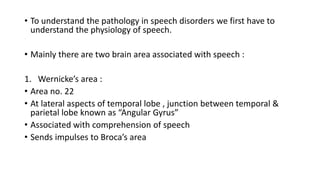
• To understand the pathology in speech disorders we first have to
understand the physiology of speech.
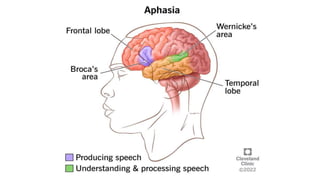
• Mainly there are two brain area associated with speech :
1. Wernicke’s area :
• Area no. 22
• At lateral aspects of temporal lobe , junction between temporal &
parietal lobe known as “Angular Gyrus”
• Associated with comprehension of speech
• Sends impulses to Broca’s area
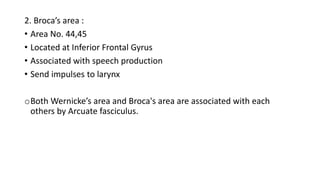
2. Broca’s area :
• Area No. 44,45
• Located at Inferior Frontal Gyrus
• Associated with speech production
• Send impulses to larynx
oBoth Wernicke’s area and Broca's area are associated with each
others by Arcuate fasciculus.
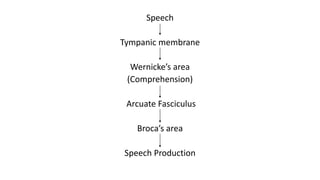
Speech
Tympanic membrane
Wernicke’s area
(Comprehension)
Arcuate Fasciculus
Broca’s area
Speech Production
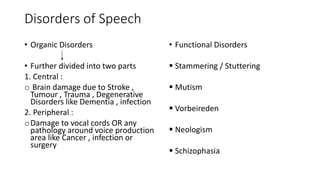
Disorders of Speech
• Organic Disorders
• Further divided into two parts
1. Central :
o Brain damage due to Stroke ,
Tumour , Trauma , Degenerative
Disorders like Dementia , infection
2. Peripheral :
oDamage to vocal cords OR any
pathology around voice production
area like Cancer , infection or
surgery
• Functional Disorders
 Stammering / Stuttering
 Mutism
 Vorbeireden
 Neologism
 Schizophasia
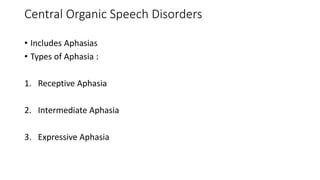
Central Organic Speech Disorders
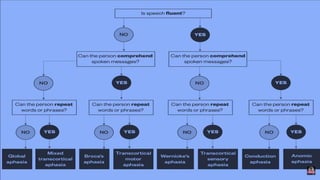
• Includes Aphasias
• Types of Aphasia :
1. Receptive Aphasia
2. Intermediate Aphasia
3. Expressive Aphasia
Receptive Aphasia
• 3 types
1. Pure word deafness
2. Pure word blindness
3. Visual asymbolia
1. Pure Word Deafness
• Also known as subcortical auditory aphasia
• Lesion : Dominant temporal lobe
• Spontaneous Speech Present
• Speak , read , write fluently and correctly with comprehension
• Hearing is unimpaired , Hears words as sound but can’t recognize meaning
even though he knows that they are words.
• Form of agnosia(lack of recognition) for spoken words
2. Pure Word Blindness
• Also known as agnosic alexia without dysgraphia
• Lesion : Left visual cortex and the corpus callosum
• Speak normally , understand spoken words & write spontaneously
• Can’t read with understanding (alexia)
• More difficulty in printed than hand written script
• Patient also suffer from right homonymous hemianopia and inability to
name colours even though they can be perceived.
3. Visual Asymbolia
• Aka Cortical visual aphasia
• Disorganisation of visual word schemas, so words cannot recognized &
motor word cannot be activated
• Lesion : Angular and Supramarginal Gyri
• Able to understand words or sentence but Difficulty in read & write
• Often associated with Acalculia , Spatial disorientation , Visual agnosia ,
Nominal aphasia & right homonymous hemianopia
Intermediate Aphasia
1. Nominal Aphasia
• Unable to produce name and sound at will
• Lesion : Diffuse brain damage or damage to dominant temporoparietal
region
• Patient describe the object & its function , recognize name when presented
• E.g. patient describe watch as a clock vessel
• Speech is flat , structure of sentence is correct & understanding unimpaired
Intermediate Aphasia
2. Central or Conduction Aphasia
• Lesion : Arcuate fibre
• Loss of connection between Wernicke’s and Broca’s area
• Patient cannot repeat the message although he can speak or write
• If he is questioned about message, he is able to give ‘yes’ or ‘no’ answers
correctly
• Marked errors of grammars and syntax
Expressive Aphasia
1. Cortical Motor Area
• Also known as Broca’s aphasia / Verbal aphasia
• Lesion : Broca’s area in 3rd frontal gyrus
• Disturbance to the process of selecting words , constructing sentences &
expressing them
• Patient understand what is said to them and knows what they want to say
but cannot find the right words
• Words are mispronounced , telegram style speech
• Gesture used to replace verbal communication
2. Pure word Dumbness
• Unable to speak spontaneously, to repeat words & to read aloud
• Can write spontaneously & copy
• Lesion : Beneath region of insula
Functional Disorders of Speech
1. Stammering / Stuttering
• Normal flow of speech is interrupted by pauses or by repetition of fragments of
words
• Begins at age of 4 and more common in boys than girls
• Improves with time & only become noticeable when person is anxious
• Grimacing and tic-like movement of body are associated with stammer
• Occasionally stammering occurs during severe adolescent crisis or at onset of
acute schizophrenia
2. Mutism – Complete loss of speech
oElective Mutism :
• Patient decide not to speak to certain person
• E .g . Child not speak in school but speak well with parents
oHysterical Mutism (Dissociative disorder) :
• Loss of speech because of extreme conflict in mind
Mutism
oDepressive Mutism :
• In severe depression Patient’s thought process completely
stops/retarded not able to produce sound
oCatatonic Mutism :
• Mutism is almost always present in catatonic stupor but it may also
occur in non-stuperose catatonic individual as a mannerism
3. Vorbeireden
• Talking past the point or approximate answer
• Content of the patient’s replies to questions shows that they
understand what has been asked but have responded by talking
about an associated topic
• E.g. if asked “what is the color of grass?” , the patient may reply
“white” & if then asked “what is the color of snow?” , the patient may
reply “Green”.
• Occurs in hysterical pseudodementia when psychiatric symptoms are
‘unconsciously’ being presented for some advantage
• Approximate answer may be a feature od ganser syndrome
• Also found in acute schizophrenia mostly with hebephrenic subtype
• Individual in catatonic state also talk past the point, particularly when
asked personal questions that they find painful , such as the length of
their stay in hospital
4. Neologism
• New words that are constructed by the patient or ordinary words that are
used in a new way.
• seen in schizophrenia
• Some patient with motor aphasia use the wrong word, invent new words
or distort phonetic structure of words that usually known as paraphasia.
• Neologism in patient with catatonia known as Mannerism or stereotypies.
• Neologism may be the obvious result of derailment; for example a
patient used the word ‘relativity’ instead of word ‘relationship’
• Technical Neologism : new word to describe an experience that is
completely outside the realms of normal.
• Hallucinatory voices seem to play a great part in formation of
neologism.
• Voices may use neologism or this may lead patient to use them as
well.
5. Schizophasia
• Also known as Speech Confusion or Word Salad or Formal thought
Disorder
• Disorganized speech seen in schizophrenia
Speech Disturbances
1. Aphonia & Dysphonia
• Aphonia : loss of ability to vocalize , patient talks in whisper
• Dysphonia : impairment with hoarseness but without complete loss of
function
• Occurs with paralysis of 9th cranial nerve OR with disease of vocal cord
• Aphonia without organic disease = Dissociative aphonia , common among
ENT patients
2. Dysarthria
• Disorder of articulation by lesion of brainstem such as bulbar &
pseudobulbar palsy
• Also occurred with structure or muscular disorder of mouth, pharynx,
larynx and thorax
• Idiosyncratic disorders of articulation are sometimes seen in
schizophrenia and also with personality disorders consciously
produced
3. Logoclonia
• Spastic repetition of syllables occurs with parkinsonism
• Patient may stuck using particular word
4. Echolalia
• Patient repeats words or sentences that are spoken to him or in his
presence
• No understanding of meaning of words
• Demonstrated in excited schizophrenia states , with mental retardation &
with organic states like dementia
Assessment of Speech
• Should be done in Mother Tongue
• By History & Collecting information
• By observation , By interviewing , By cognitive test
For Speech Sample
• We have to ask open ended questions
• Like 1. Asking about patient’s festival / friends / place / city / work /
school / college
• 2. Asking about climate change / politics / media / education system
• If patient fails to answer this we can ask : how do you prepare coffee?
Speech in MSE
• Speech has to be elicited by following headings :
oCoherence : By seeing that speech is Logical, Consistent &
understandable
oRelevant : By seeing answer of the questions we ask
oSpontaneity : By seeing how spontaneous the speech is
oAmount of speech : By seeing volume of speech
oTone : By seeing loudness of patient voice
oTempo : By seeing flow of speech
oReaction Time : By seeing time to take response of questions
oProsody : By seeing emotional intonations of speech
oIf all components normal : C / R / T / T / RT / V is normal

Disorders of Speech.pptx

  • 1.
    Disorders of Speech Dr.Anand Barot Resident Doctor Department of Psychiatry
  • 2.
    Speech and Language •Speech is defined as the process of organizing thoughts , producing specific sounds that convey meaning to the listener. • Speech is just a sound & sound has to be produced in a specific manner & understanding of the sound that somebody tells also ambits of language. • So assessment of language has to be done with assessment of speech. • Whole assessment of mental status examination relays on speech.
  • 4.
    • To understandthe pathology in speech disorders we first have to understand the physiology of speech. • Mainly there are two brain area associated with speech : 1. Wernicke’s area : • Area no. 22 • At lateral aspects of temporal lobe , junction between temporal & parietal lobe known as “Angular Gyrus” • Associated with comprehension of speech • Sends impulses to Broca’s area
  • 5.
    2. Broca’s area: • Area No. 44,45 • Located at Inferior Frontal Gyrus • Associated with speech production • Send impulses to larynx oBoth Wernicke’s area and Broca's area are associated with each others by Arcuate fasciculus.
  • 6.
    Speech Tympanic membrane Wernicke’s area (Comprehension) ArcuateFasciculus Broca’s area Speech Production
  • 7.
    Disorders of Speech •Organic Disorders • Further divided into two parts 1. Central : o Brain damage due to Stroke , Tumour , Trauma , Degenerative Disorders like Dementia , infection 2. Peripheral : oDamage to vocal cords OR any pathology around voice production area like Cancer , infection or surgery • Functional Disorders  Stammering / Stuttering  Mutism  Vorbeireden  Neologism  Schizophasia
  • 8.
    Central Organic SpeechDisorders • Includes Aphasias • Types of Aphasia : 1. Receptive Aphasia 2. Intermediate Aphasia 3. Expressive Aphasia
  • 9.
    Receptive Aphasia • 3types 1. Pure word deafness 2. Pure word blindness 3. Visual asymbolia
  • 10.
    1. Pure WordDeafness • Also known as subcortical auditory aphasia • Lesion : Dominant temporal lobe • Spontaneous Speech Present • Speak , read , write fluently and correctly with comprehension • Hearing is unimpaired , Hears words as sound but can’t recognize meaning even though he knows that they are words. • Form of agnosia(lack of recognition) for spoken words
  • 11.
    2. Pure WordBlindness • Also known as agnosic alexia without dysgraphia • Lesion : Left visual cortex and the corpus callosum • Speak normally , understand spoken words & write spontaneously • Can’t read with understanding (alexia) • More difficulty in printed than hand written script • Patient also suffer from right homonymous hemianopia and inability to name colours even though they can be perceived.
  • 12.
    3. Visual Asymbolia •Aka Cortical visual aphasia • Disorganisation of visual word schemas, so words cannot recognized & motor word cannot be activated • Lesion : Angular and Supramarginal Gyri • Able to understand words or sentence but Difficulty in read & write • Often associated with Acalculia , Spatial disorientation , Visual agnosia , Nominal aphasia & right homonymous hemianopia
  • 13.
    Intermediate Aphasia 1. NominalAphasia • Unable to produce name and sound at will • Lesion : Diffuse brain damage or damage to dominant temporoparietal region • Patient describe the object & its function , recognize name when presented • E.g. patient describe watch as a clock vessel • Speech is flat , structure of sentence is correct & understanding unimpaired
  • 14.
    Intermediate Aphasia 2. Centralor Conduction Aphasia • Lesion : Arcuate fibre • Loss of connection between Wernicke’s and Broca’s area • Patient cannot repeat the message although he can speak or write • If he is questioned about message, he is able to give ‘yes’ or ‘no’ answers correctly • Marked errors of grammars and syntax
  • 15.
    Expressive Aphasia 1. CorticalMotor Area • Also known as Broca’s aphasia / Verbal aphasia • Lesion : Broca’s area in 3rd frontal gyrus • Disturbance to the process of selecting words , constructing sentences & expressing them • Patient understand what is said to them and knows what they want to say but cannot find the right words
  • 16.
    • Words aremispronounced , telegram style speech • Gesture used to replace verbal communication 2. Pure word Dumbness • Unable to speak spontaneously, to repeat words & to read aloud • Can write spontaneously & copy • Lesion : Beneath region of insula
  • 18.
    Functional Disorders ofSpeech 1. Stammering / Stuttering • Normal flow of speech is interrupted by pauses or by repetition of fragments of words • Begins at age of 4 and more common in boys than girls • Improves with time & only become noticeable when person is anxious • Grimacing and tic-like movement of body are associated with stammer • Occasionally stammering occurs during severe adolescent crisis or at onset of acute schizophrenia
  • 19.
    2. Mutism –Complete loss of speech oElective Mutism : • Patient decide not to speak to certain person • E .g . Child not speak in school but speak well with parents oHysterical Mutism (Dissociative disorder) : • Loss of speech because of extreme conflict in mind
  • 20.
    Mutism oDepressive Mutism : •In severe depression Patient’s thought process completely stops/retarded not able to produce sound oCatatonic Mutism : • Mutism is almost always present in catatonic stupor but it may also occur in non-stuperose catatonic individual as a mannerism
  • 21.
    3. Vorbeireden • Talkingpast the point or approximate answer • Content of the patient’s replies to questions shows that they understand what has been asked but have responded by talking about an associated topic • E.g. if asked “what is the color of grass?” , the patient may reply “white” & if then asked “what is the color of snow?” , the patient may reply “Green”.
  • 22.
    • Occurs inhysterical pseudodementia when psychiatric symptoms are ‘unconsciously’ being presented for some advantage • Approximate answer may be a feature od ganser syndrome • Also found in acute schizophrenia mostly with hebephrenic subtype • Individual in catatonic state also talk past the point, particularly when asked personal questions that they find painful , such as the length of their stay in hospital
  • 23.
    4. Neologism • Newwords that are constructed by the patient or ordinary words that are used in a new way. • seen in schizophrenia • Some patient with motor aphasia use the wrong word, invent new words or distort phonetic structure of words that usually known as paraphasia. • Neologism in patient with catatonia known as Mannerism or stereotypies.
  • 24.
    • Neologism maybe the obvious result of derailment; for example a patient used the word ‘relativity’ instead of word ‘relationship’ • Technical Neologism : new word to describe an experience that is completely outside the realms of normal. • Hallucinatory voices seem to play a great part in formation of neologism. • Voices may use neologism or this may lead patient to use them as well.
  • 25.
    5. Schizophasia • Alsoknown as Speech Confusion or Word Salad or Formal thought Disorder • Disorganized speech seen in schizophrenia
  • 26.
    Speech Disturbances 1. Aphonia& Dysphonia • Aphonia : loss of ability to vocalize , patient talks in whisper • Dysphonia : impairment with hoarseness but without complete loss of function • Occurs with paralysis of 9th cranial nerve OR with disease of vocal cord • Aphonia without organic disease = Dissociative aphonia , common among ENT patients
  • 27.
    2. Dysarthria • Disorderof articulation by lesion of brainstem such as bulbar & pseudobulbar palsy • Also occurred with structure or muscular disorder of mouth, pharynx, larynx and thorax • Idiosyncratic disorders of articulation are sometimes seen in schizophrenia and also with personality disorders consciously produced
  • 28.
    3. Logoclonia • Spasticrepetition of syllables occurs with parkinsonism • Patient may stuck using particular word 4. Echolalia • Patient repeats words or sentences that are spoken to him or in his presence • No understanding of meaning of words • Demonstrated in excited schizophrenia states , with mental retardation & with organic states like dementia
  • 29.
    Assessment of Speech •Should be done in Mother Tongue • By History & Collecting information • By observation , By interviewing , By cognitive test
  • 30.
    For Speech Sample •We have to ask open ended questions • Like 1. Asking about patient’s festival / friends / place / city / work / school / college • 2. Asking about climate change / politics / media / education system • If patient fails to answer this we can ask : how do you prepare coffee?
  • 31.
    Speech in MSE •Speech has to be elicited by following headings : oCoherence : By seeing that speech is Logical, Consistent & understandable oRelevant : By seeing answer of the questions we ask oSpontaneity : By seeing how spontaneous the speech is oAmount of speech : By seeing volume of speech
  • 32.
    oTone : Byseeing loudness of patient voice oTempo : By seeing flow of speech oReaction Time : By seeing time to take response of questions oProsody : By seeing emotional intonations of speech oIf all components normal : C / R / T / T / RT / V is normal