Muhammad Baqar
Post RN BScN, MSPH
Unit -3
DEFENSE MECHANISM OR MENTAL
MECHANISMS
Objectives
At the end of this lesson you will be able to:
o Define defense mechanisms
o State the different defense mechanisms.
Defense Mechanisms
o Methods of attempting to protect the self and
cope with basic drives or emotionally painful
thoughts, feelings, or events.
o Defense mechanisms are used to reduce anxiety
or resolved conflict by modifying or changing our
behavior.
o All Defense Mechanisms are Unconscious
(except Suppression), distinct, Dynamic &
Irreversible, Adaptive & Maladaptive
Defense Mechanisms
Highly adaptive (mature)
o Sublimation
o Repression
Less adaptive
o Displacement, Intellectualization, Isolation of
Affect, Rationalization, Reaction Formation
Primitive (immature)
o Acting out, Denial (deletion from consciousness),
Projection & Splitting
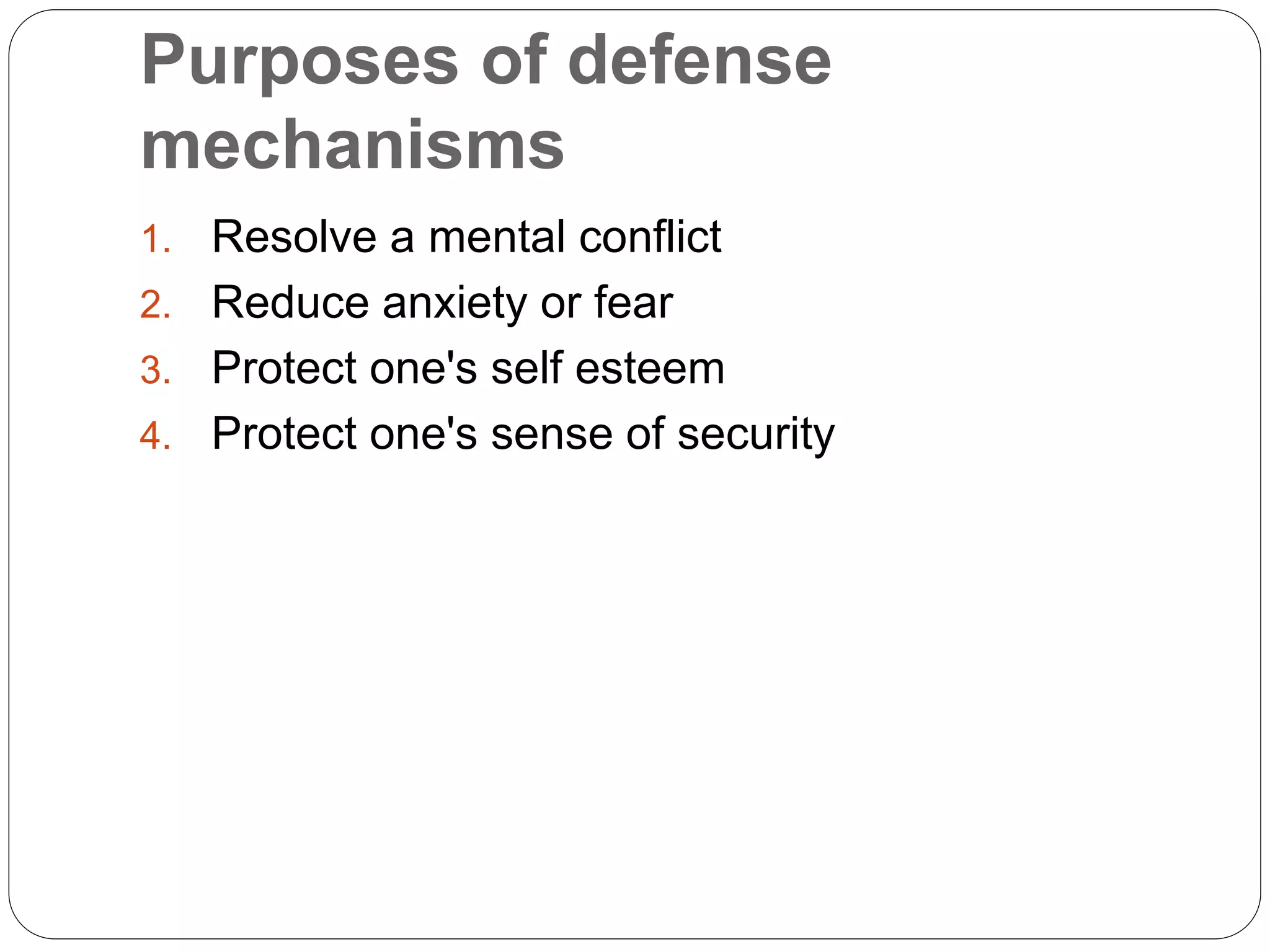
Purposes of defense
mechanisms
1. Resolve a mental conflict
2. Reduce anxiety or fear
3. Protect one's self esteem
4. Protect one's sense of security
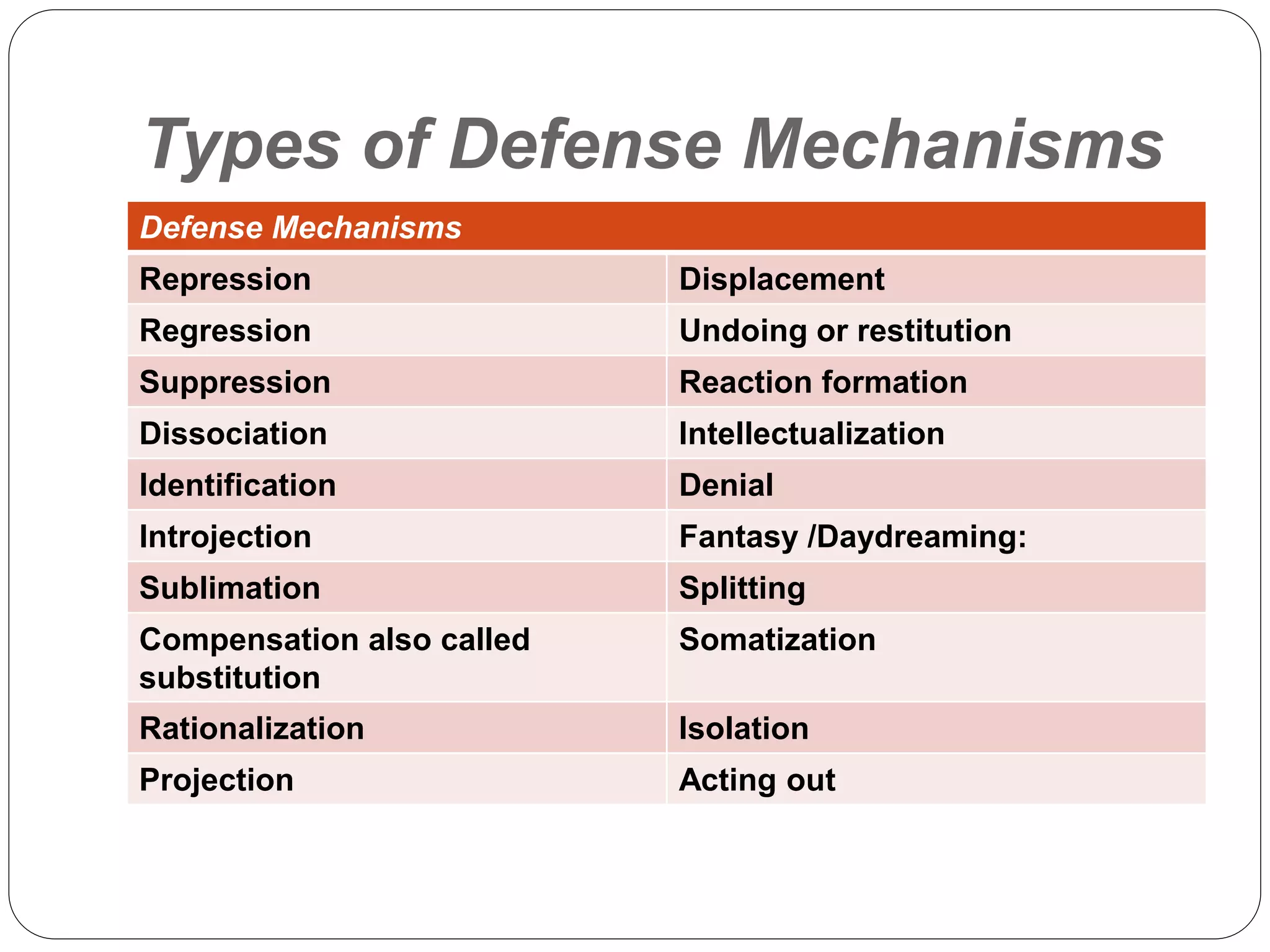
Types of Defense Mechanisms
Defense Mechanisms
Repression Displacement
Regression Undoing or restitution
Suppression Reaction formation
Dissociation Intellectualization
Identification Denial
Introjection Fantasy /Daydreaming:
Sublimation Splitting
Compensation also called
substitution
Somatization
Rationalization Isolation
Projection Acting out
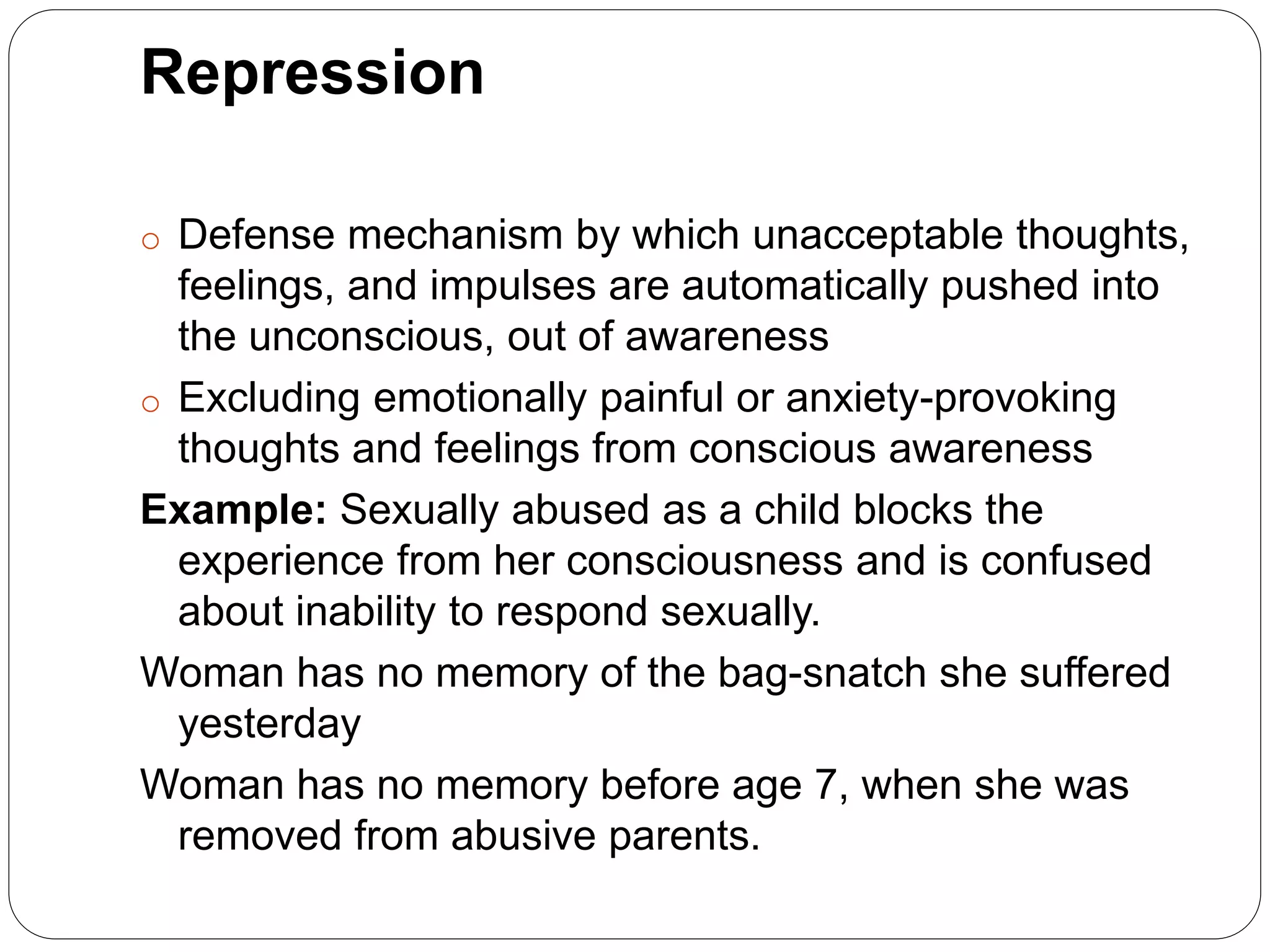
Repression
o Defense mechanism by which unacceptable thoughts,
feelings, and impulses are automatically pushed into
the unconscious, out of awareness
o Excluding emotionally painful or anxiety-provoking
thoughts and feelings from conscious awareness
Example: Sexually abused as a child blocks the
experience from her consciousness and is confused
about inability to respond sexually.
Woman has no memory of the bag-snatch she suffered
yesterday
Woman has no memory before age 7, when she was
removed from abusive parents.
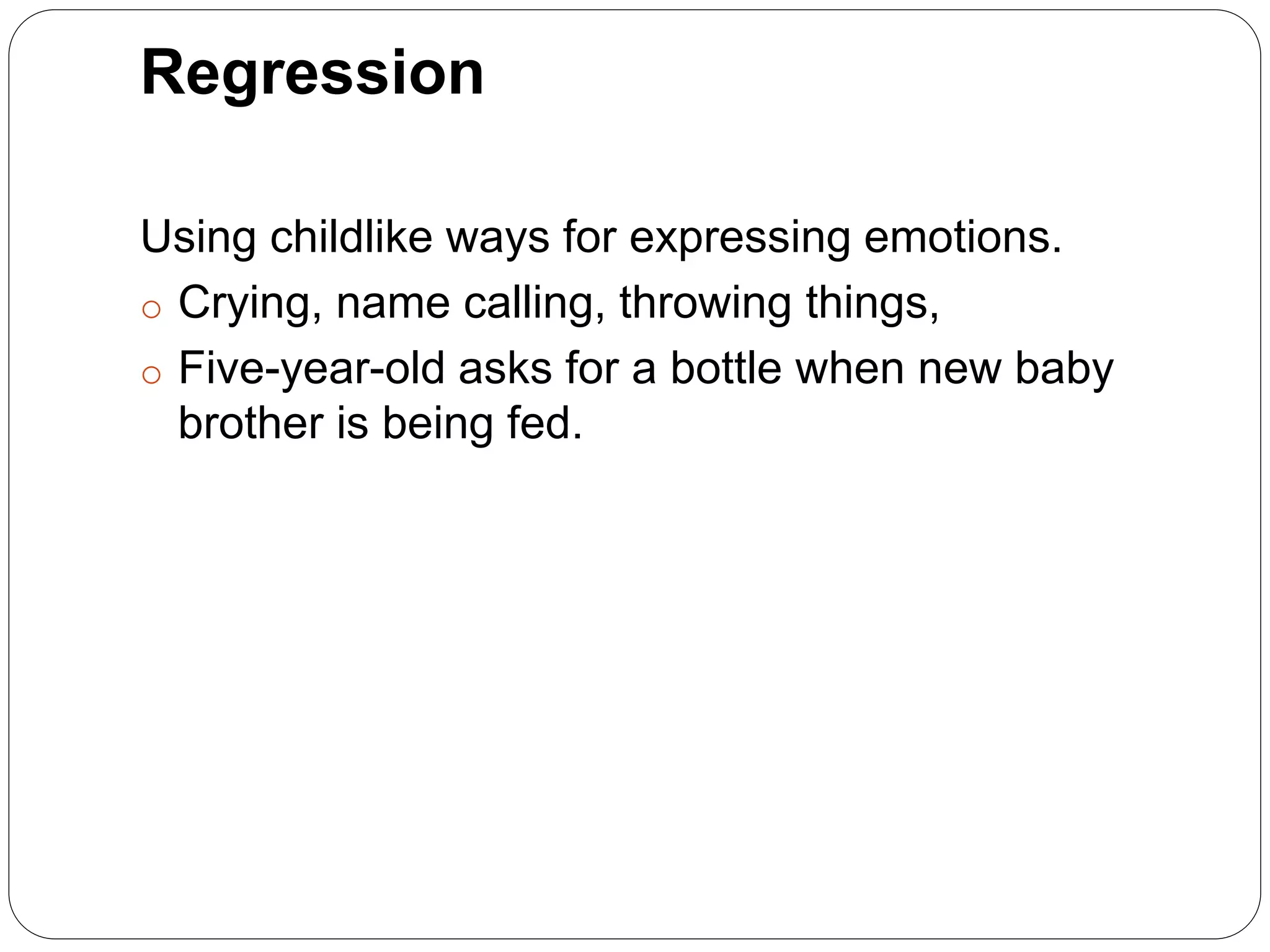
Regression
Using childlike ways for expressing emotions.
o Crying, name calling, throwing things,
o Five-year-old asks for a bottle when new baby
brother is being fed.
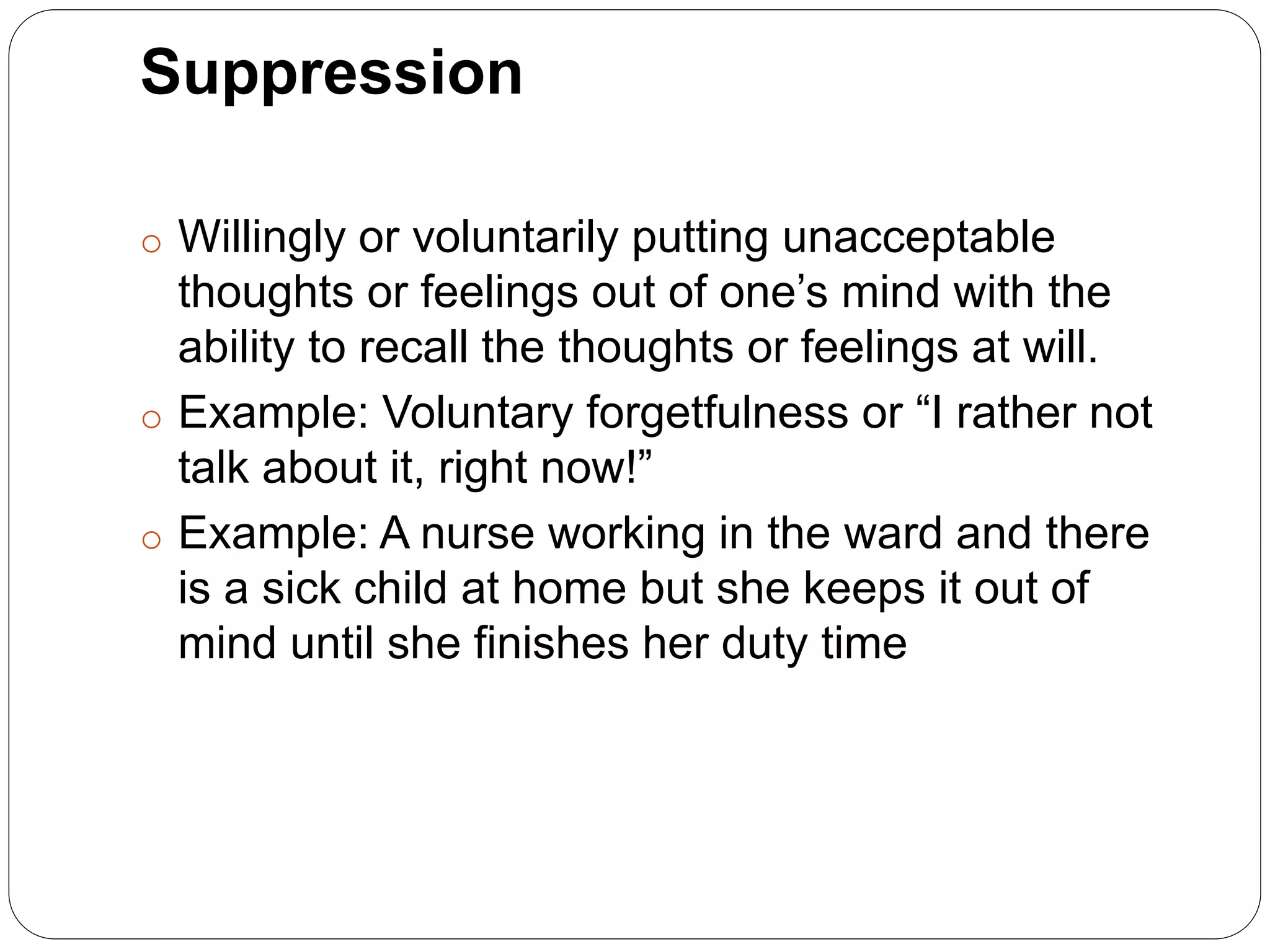
Suppression
o Willingly or voluntarily putting unacceptable
thoughts or feelings out of one’s mind with the
ability to recall the thoughts or feelings at will.
o Example: Voluntary forgetfulness or “I rather not
talk about it, right now!”
o Example: A nurse working in the ward and there
is a sick child at home but she keeps it out of
mind until she finishes her duty time
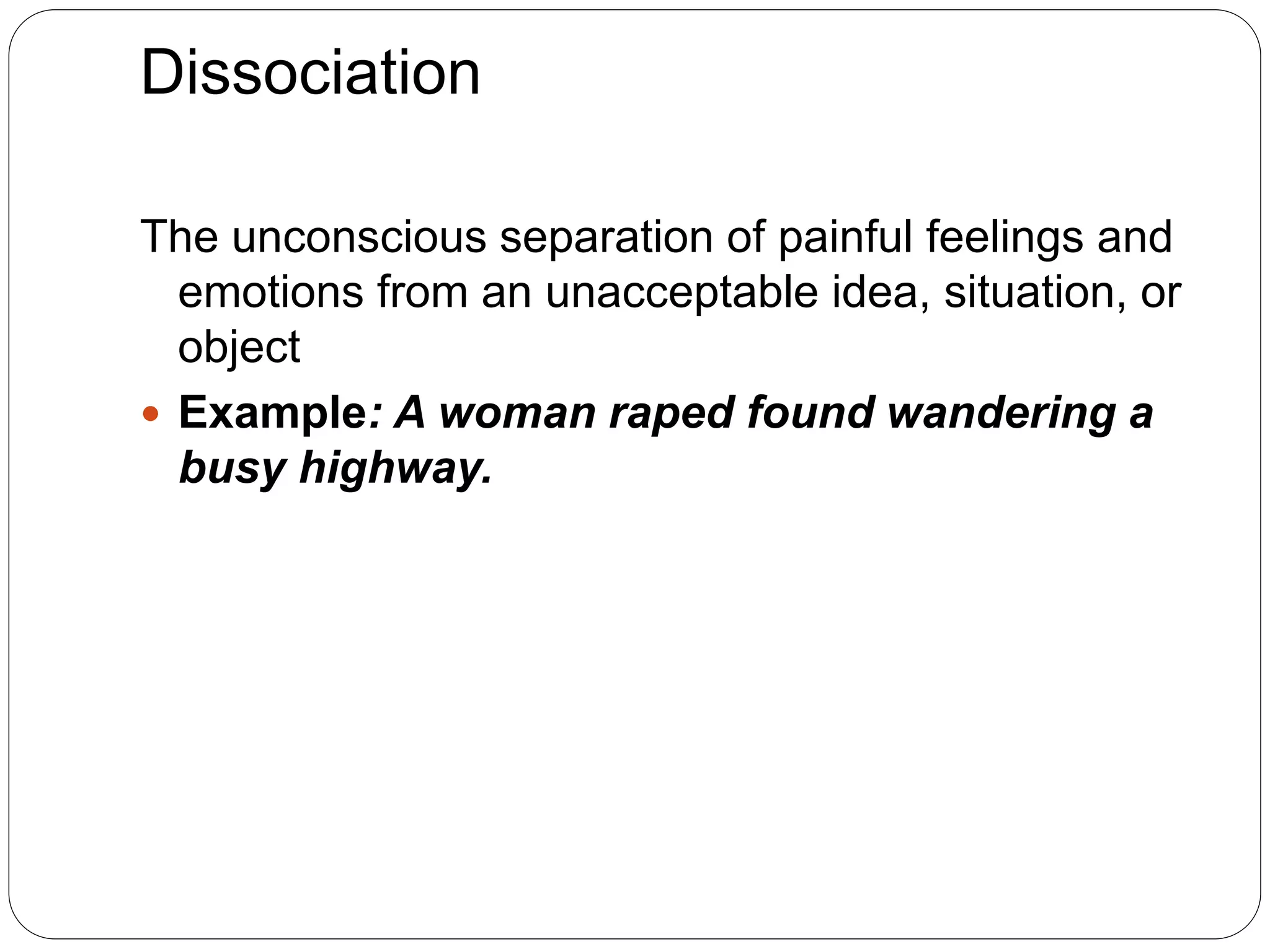
Dissociation
The unconscious separation of painful feelings and
emotions from an unacceptable idea, situation, or
object
 Example: A woman raped found wandering a
busy highway.
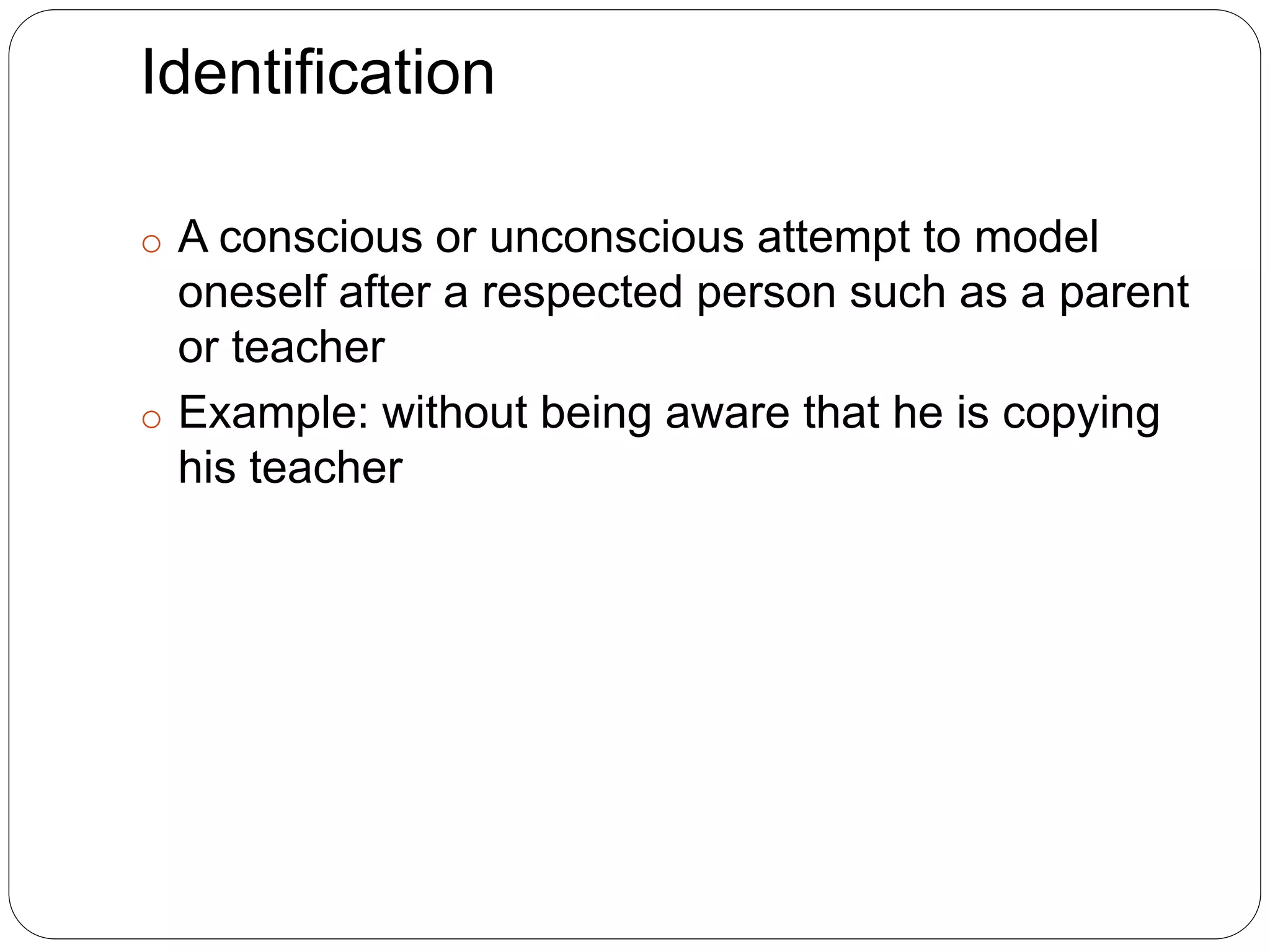
Identification
o A conscious or unconscious attempt to model
oneself after a respected person such as a parent
or teacher
o Example: without being aware that he is copying
his teacher
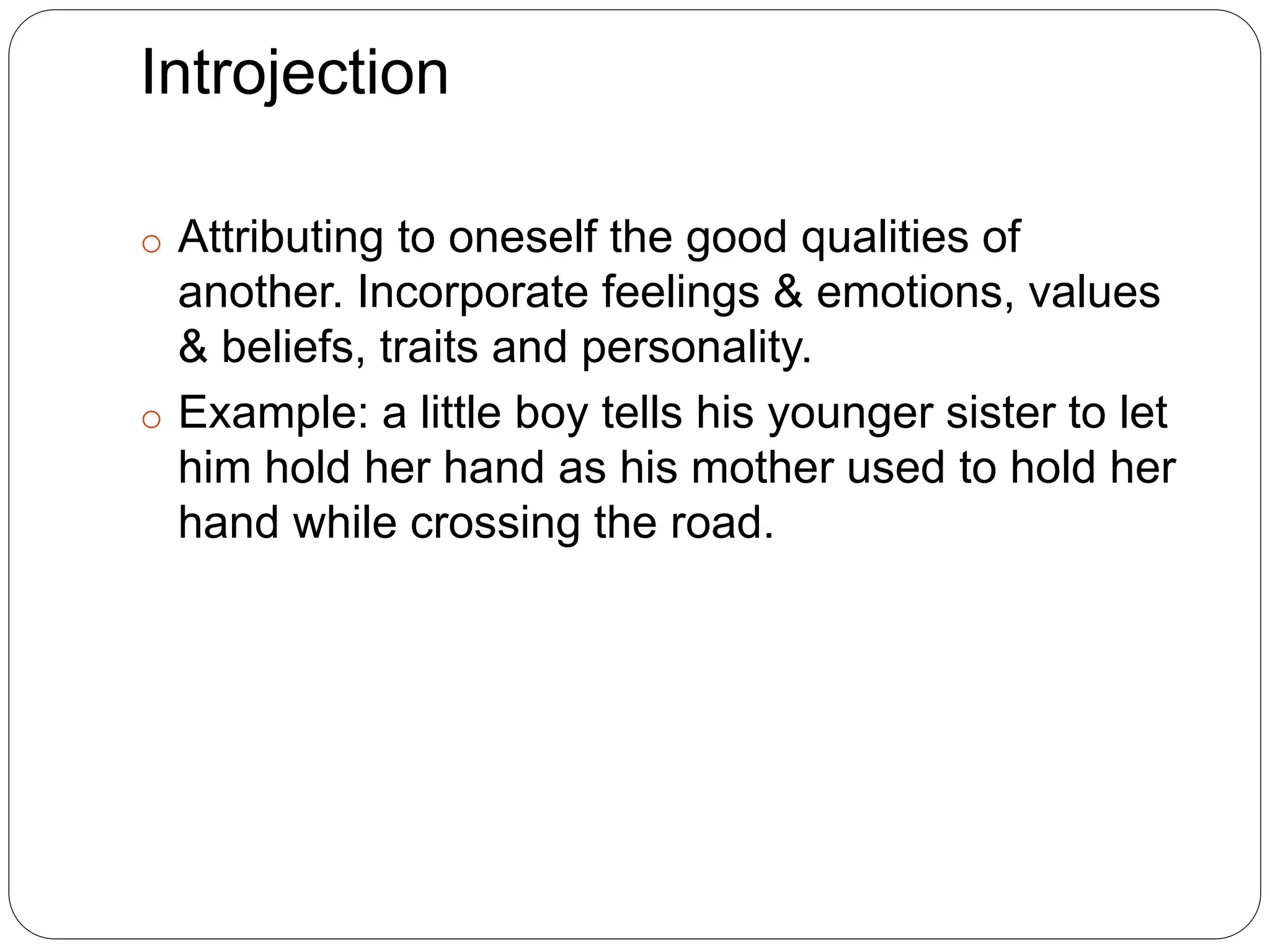
Introjection
o Attributing to oneself the good qualities of
another. Incorporate feelings & emotions, values
& beliefs, traits and personality.
o Example: a little boy tells his younger sister to let
him hold her hand as his mother used to hold her
hand while crossing the road.
Sublimation
o Redirecting bad or unacceptable
behavior/emotions into positive behavior.
o Example: We sublimate the desire to fight into the
ritualistic activities of formal competition.
o Wife who is angry enough to hot husband goes
around scrubbing and cleaning the whole house.
Compensation
o also called substitution: It involves trying to make
up for feelings of inadequacy or frustration in one
area by excelling or overusing in another.
o Example: An adolescent takes up jogging
because he failed to make the swimming team.
o “I am not good at football so I will try the swim
team
o Example: An unattractive girl became a very good
tennis player.
Rationalization
o Unconsciously used to justify ideas, actions
and/or feelings with good acceptable reasons or
explanation. Irrational/illogical excuses to escape
responsibility .
o Example: Student fails an exam, blames it on the
poor lectures.
Projection
o Blame other people or things for failure
o Example: “It’s my psychiatric teacher’s fault I
failed the test”
o Person rejects unwanted characteristics of self
and assigns them to others.
Example: man who was late for work blames wife
for not setting the alarm clock.
Displacement
o The transfer of negative emotions from one
person or thing to an unrelated person or thing.
Or
o Mechanism that serves to transfer feelings such
as frustration, aggression or anxiety from one
idea, person or object to another
o Example: Shouting at a subordinate after being
shouted at by the boss.
Undoing or restitution
o Doing something to counteract or make up for a
misbehavior or wrongdoing
o Example: Sending flowers after embarrassing her
in public.
Reaction formation
o expressing emotions that are the exact opposite
of what ones feel. Mask anger/hate with
kindness. Teasing/bothering someone you like.
o Example: Man who dislikes his mother in low is
very polite towards her.
Intellectualization
o Using only logical explanations without feelings or
an affective component
o Example: person who does not want close to the
women emotionally give intellectual explanation
for lack of involvement of getting close to a
women.
Denial
o failure to accept reality.
o This is not happening. It can’t happen to me.”
Or
o This is the unconscious refusal to face thoughts,
feeling, wishes, needs or reality factors that are
intolerable:
o Example: a student who is determinedly late for a
scheduled class because that student is actually very
fearful of the topic, so he/she expresses the fear by
being absent from the class, or
o A person who has just been admitted to a mental
hospital states “I am really not sick, I am just in here
Fantasy /Daydreaming
o Escaping from an unpleasant situation by using
imagination.
o Living in a fantasy world
OR
o This refers to imagined events or mental images
to express unconscious ideas, conflict, gratify
unconscious wishes, or prepare for anticipated
future events.
Summary
o Defense mechanisms are used to reduce
anxiety.
o Defense mechanisms not a very effective way to
deal with stress.
Defense mechanisms are Highly adaptive
(mature),Less adaptive, Primitive (immature)
involuntary coping mechanisms.

Unit 3 defense mechanisms

  • 1.
    Muhammad Baqar Post RNBScN, MSPH Unit -3 DEFENSE MECHANISM OR MENTAL MECHANISMS
  • 2.
    Objectives At the endof this lesson you will be able to: o Define defense mechanisms o State the different defense mechanisms.
  • 3.
    Defense Mechanisms o Methodsof attempting to protect the self and cope with basic drives or emotionally painful thoughts, feelings, or events. o Defense mechanisms are used to reduce anxiety or resolved conflict by modifying or changing our behavior. o All Defense Mechanisms are Unconscious (except Suppression), distinct, Dynamic & Irreversible, Adaptive & Maladaptive
  • 4.
    Defense Mechanisms Highly adaptive(mature) o Sublimation o Repression Less adaptive o Displacement, Intellectualization, Isolation of Affect, Rationalization, Reaction Formation Primitive (immature) o Acting out, Denial (deletion from consciousness), Projection & Splitting
  • 5.
    Purposes of defense mechanisms 1.Resolve a mental conflict 2. Reduce anxiety or fear 3. Protect one's self esteem 4. Protect one's sense of security
  • 6.
    Types of DefenseMechanisms Defense Mechanisms Repression Displacement Regression Undoing or restitution Suppression Reaction formation Dissociation Intellectualization Identification Denial Introjection Fantasy /Daydreaming: Sublimation Splitting Compensation also called substitution Somatization Rationalization Isolation Projection Acting out
  • 7.
    Repression o Defense mechanismby which unacceptable thoughts, feelings, and impulses are automatically pushed into the unconscious, out of awareness o Excluding emotionally painful or anxiety-provoking thoughts and feelings from conscious awareness Example: Sexually abused as a child blocks the experience from her consciousness and is confused about inability to respond sexually. Woman has no memory of the bag-snatch she suffered yesterday Woman has no memory before age 7, when she was removed from abusive parents.
  • 8.
    Regression Using childlike waysfor expressing emotions. o Crying, name calling, throwing things, o Five-year-old asks for a bottle when new baby brother is being fed.
  • 9.
    Suppression o Willingly orvoluntarily putting unacceptable thoughts or feelings out of one’s mind with the ability to recall the thoughts or feelings at will. o Example: Voluntary forgetfulness or “I rather not talk about it, right now!” o Example: A nurse working in the ward and there is a sick child at home but she keeps it out of mind until she finishes her duty time
  • 10.
    Dissociation The unconscious separationof painful feelings and emotions from an unacceptable idea, situation, or object  Example: A woman raped found wandering a busy highway.
  • 11.
    Identification o A consciousor unconscious attempt to model oneself after a respected person such as a parent or teacher o Example: without being aware that he is copying his teacher
  • 12.
    Introjection o Attributing tooneself the good qualities of another. Incorporate feelings & emotions, values & beliefs, traits and personality. o Example: a little boy tells his younger sister to let him hold her hand as his mother used to hold her hand while crossing the road.
  • 13.
    Sublimation o Redirecting bador unacceptable behavior/emotions into positive behavior. o Example: We sublimate the desire to fight into the ritualistic activities of formal competition. o Wife who is angry enough to hot husband goes around scrubbing and cleaning the whole house.
  • 14.
    Compensation o also calledsubstitution: It involves trying to make up for feelings of inadequacy or frustration in one area by excelling or overusing in another. o Example: An adolescent takes up jogging because he failed to make the swimming team. o “I am not good at football so I will try the swim team o Example: An unattractive girl became a very good tennis player.
  • 15.
    Rationalization o Unconsciously usedto justify ideas, actions and/or feelings with good acceptable reasons or explanation. Irrational/illogical excuses to escape responsibility . o Example: Student fails an exam, blames it on the poor lectures.
  • 16.
    Projection o Blame otherpeople or things for failure o Example: “It’s my psychiatric teacher’s fault I failed the test” o Person rejects unwanted characteristics of self and assigns them to others. Example: man who was late for work blames wife for not setting the alarm clock.
  • 17.
    Displacement o The transferof negative emotions from one person or thing to an unrelated person or thing. Or o Mechanism that serves to transfer feelings such as frustration, aggression or anxiety from one idea, person or object to another o Example: Shouting at a subordinate after being shouted at by the boss.
  • 18.
    Undoing or restitution oDoing something to counteract or make up for a misbehavior or wrongdoing o Example: Sending flowers after embarrassing her in public.
  • 19.
    Reaction formation o expressingemotions that are the exact opposite of what ones feel. Mask anger/hate with kindness. Teasing/bothering someone you like. o Example: Man who dislikes his mother in low is very polite towards her.
  • 20.
    Intellectualization o Using onlylogical explanations without feelings or an affective component o Example: person who does not want close to the women emotionally give intellectual explanation for lack of involvement of getting close to a women.
  • 21.
    Denial o failure toaccept reality. o This is not happening. It can’t happen to me.” Or o This is the unconscious refusal to face thoughts, feeling, wishes, needs or reality factors that are intolerable: o Example: a student who is determinedly late for a scheduled class because that student is actually very fearful of the topic, so he/she expresses the fear by being absent from the class, or o A person who has just been admitted to a mental hospital states “I am really not sick, I am just in here
  • 22.
    Fantasy /Daydreaming o Escapingfrom an unpleasant situation by using imagination. o Living in a fantasy world OR o This refers to imagined events or mental images to express unconscious ideas, conflict, gratify unconscious wishes, or prepare for anticipated future events.
  • 23.
    Summary o Defense mechanismsare used to reduce anxiety. o Defense mechanisms not a very effective way to deal with stress. Defense mechanisms are Highly adaptive (mature),Less adaptive, Primitive (immature) involuntary coping mechanisms.