Deep learning
For Natural Language Processing
Presented By: Waziri Shebogholo
University of Dodoma
shebogholo@gmail.com
Overview of the talk
 Introduction to NLP
 Applications of NLP
 Word representations
 Language Model
 RNN model and it’s variants
 Sentiment analysis (practical)
 Conclusion
What is Natural Language Processing?
Let’s define NLP as:-
The field of study that aims at making computers
able to understand human language and perform
useful tasks, like making appointments.
It’s at the intersection of CS, AI and Linguistics.
NLP is difficult, but why?
 Complexity in representing and learning
 Human languages are ambiguous
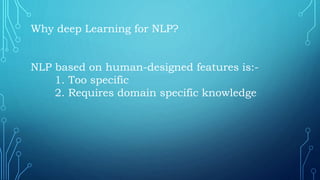
Why deep Learning for NLP?
NLP based on human-designed features is:-
1. Too specific
2. Requires domain specific knowledge
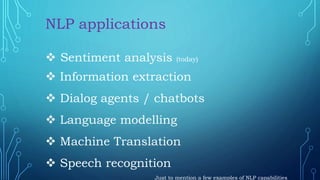
NLP applications
 Sentiment analysis (today)
 Information extraction
 Dialog agents / chatbots
 Language modelling
 Machine Translation
 Speech recognition
Just to mention a few examples of NLP capabilities
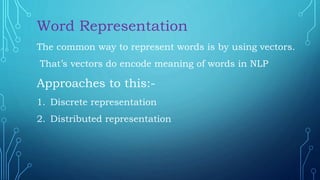
Word Representation
The common way to represent words is by using vectors.
That’s vectors do encode meaning of words in NLP
Approaches to this:-
1. Discrete representation
2. Distributed representation
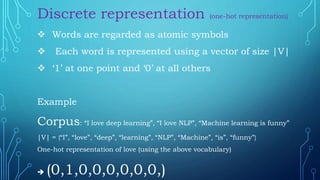
Discrete representation (one-hot representation)
 Words are regarded as atomic symbols
 Each word is represented using a vector of size |V|
 ‘1’ at one point and ‘0’ at all others
Example
Corpus: “I love deep learning”, “I love NLP”, “Machine learning is funny”
|V| = {“I”, “love”, “deep”, “learning”, “NLP”, “Machine”, “is”, “funny”}
One-hot representation of love (using the above vocabulary)
 (0,1,0,0,0,0,0,0,)
Problems with one-hot representation
 Similar words aren't represented the same way
 Computational complexity due to curse of
dimensionality
Alternative!
Distributed representation
Represent a word by means of its neighbors
“You shall know a word by the company it keeps.”
J.R. Firth, 1957
All words or just few words?
1. Full-window approach, e.g. Latent Semantic Analysis
2. Local-window approach, e.g. Word2Vec (our focus)
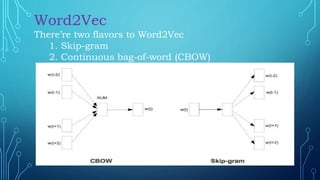
Word2Vec
There’re two flavors to Word2Vec
1. Skip-gram
2. Continuous bag-of-word (CBOW)
About the two models
1. CBOW
Predict the center word given the surrounding words
2. Skip-gram
Predict the surrounding words given the center word.
Language Model
Compute probability of the next word
given the previous words.
Why do we have to care about LMs?
They’re used in a lot of NLP tasks from
machine translation, text generation, speech
recognition, and a lot more.
Language Models
1. Count-based Language Models
Apply fixed window size of the
previous words to calculate probabilities of
the upcoming words.
2. Neural Network Models
It may condition a word based on all
of the previous words in a corpus. RNN is
the most widely used model in this task.
Recurrent Neural Network (RNN)
In deep learning, all problems can be
classified as:-
1. Fixed topological structure problems
e.g. Images …image classification
2. Sequential data problems
e.g. text/audio …speech recognition
RNN for sequential data.
RNN
In a normal feed forward network for making
prediction, you need not any relation to previous
outputs that has been classified.
Scenario:
While reading a book, you need to remember the
context mentioned and what’s discussed in the
entire book.
This is the case in sentiment analysis where
algorithm need to remember the context of words
before classifying document as Neg/Pos.
Why are RNN’s capable of such a task:-
1. Hidden states can store a lot of
information and pass it on, effectively
2. Hidden states are updated by
nonlinear function.
Where do we find RNNs
1. Chatbots
2. Handwriting detection
3. Video and audio classification
4. Sentiment analysis
5. Time series analysis
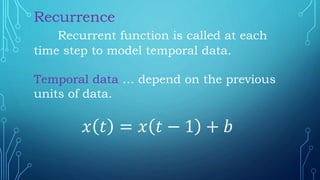
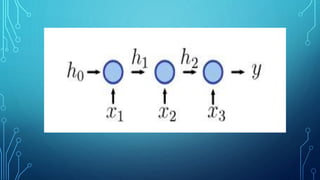
Recurrence
Recurrent function is called at each
time step to model temporal data.
Temporal data … depend on the previous
units of data.
𝑥 𝑡 = 𝑥 𝑡 − 1 + 𝑏
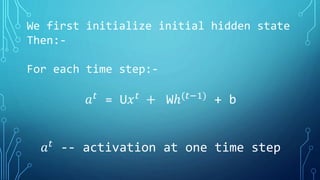
We first initialize initial hidden state
Then:-
For each time step:-
𝑎 𝑡
= U𝑥 𝑡
+ Wℎ(𝑡−1)
+ b
𝑎 𝑡
-- activation at one time step
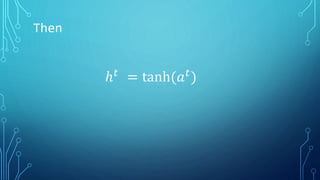
Then
ℎ 𝑡 = tanh(𝑎 𝑡)
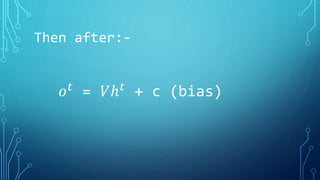
Then after:-
𝑜 𝑡 = 𝑉ℎ 𝑡 + c (bias)
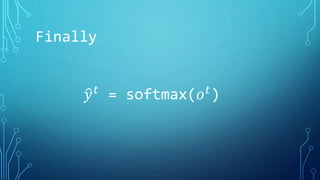
Finally
𝑦 𝑡 = softmax(𝑜 𝑡)
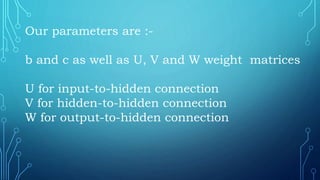
Our parameters are :-
b and c as well as U, V and W weight matrices
U for input-to-hidden connection
V for hidden-to-hidden connection
W for output-to-hidden connection
Note: That was example network
that maps input to output of the same
length.
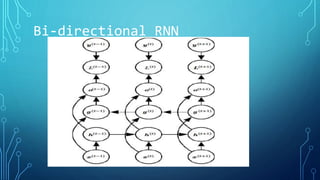
Bi-directional RNN
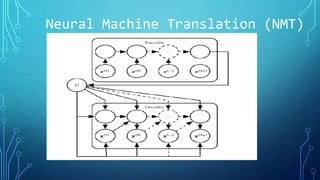
Neural Machine Translation (NMT)
Sentiment analysis
!
Deep Learning for Natural Language Processing

Deep Learning for Natural Language Processing

  • 1.
    Deep learning For NaturalLanguage Processing Presented By: Waziri Shebogholo University of Dodoma shebogholo@gmail.com
  • 2.
    Overview of thetalk  Introduction to NLP  Applications of NLP  Word representations  Language Model  RNN model and it’s variants  Sentiment analysis (practical)  Conclusion
  • 3.
    What is NaturalLanguage Processing? Let’s define NLP as:- The field of study that aims at making computers able to understand human language and perform useful tasks, like making appointments. It’s at the intersection of CS, AI and Linguistics. NLP is difficult, but why?  Complexity in representing and learning  Human languages are ambiguous
  • 4.
    Why deep Learningfor NLP? NLP based on human-designed features is:- 1. Too specific 2. Requires domain specific knowledge
  • 5.
    NLP applications  Sentimentanalysis (today)  Information extraction  Dialog agents / chatbots  Language modelling  Machine Translation  Speech recognition Just to mention a few examples of NLP capabilities
  • 6.
    Word Representation The commonway to represent words is by using vectors. That’s vectors do encode meaning of words in NLP Approaches to this:- 1. Discrete representation 2. Distributed representation
  • 7.
    Discrete representation (one-hotrepresentation)  Words are regarded as atomic symbols  Each word is represented using a vector of size |V|  ‘1’ at one point and ‘0’ at all others Example Corpus: “I love deep learning”, “I love NLP”, “Machine learning is funny” |V| = {“I”, “love”, “deep”, “learning”, “NLP”, “Machine”, “is”, “funny”} One-hot representation of love (using the above vocabulary)  (0,1,0,0,0,0,0,0,)
  • 8.
    Problems with one-hotrepresentation  Similar words aren't represented the same way  Computational complexity due to curse of dimensionality Alternative!
  • 9.
    Distributed representation Represent aword by means of its neighbors “You shall know a word by the company it keeps.” J.R. Firth, 1957 All words or just few words? 1. Full-window approach, e.g. Latent Semantic Analysis 2. Local-window approach, e.g. Word2Vec (our focus)
  • 10.
    Word2Vec There’re two flavorsto Word2Vec 1. Skip-gram 2. Continuous bag-of-word (CBOW)
  • 11.
    About the twomodels 1. CBOW Predict the center word given the surrounding words 2. Skip-gram Predict the surrounding words given the center word.
  • 12.
    Language Model Compute probabilityof the next word given the previous words. Why do we have to care about LMs? They’re used in a lot of NLP tasks from machine translation, text generation, speech recognition, and a lot more.
  • 13.
    Language Models 1. Count-basedLanguage Models Apply fixed window size of the previous words to calculate probabilities of the upcoming words. 2. Neural Network Models It may condition a word based on all of the previous words in a corpus. RNN is the most widely used model in this task.
  • 14.
    Recurrent Neural Network(RNN) In deep learning, all problems can be classified as:- 1. Fixed topological structure problems e.g. Images …image classification 2. Sequential data problems e.g. text/audio …speech recognition RNN for sequential data.
  • 15.
    RNN In a normalfeed forward network for making prediction, you need not any relation to previous outputs that has been classified. Scenario: While reading a book, you need to remember the context mentioned and what’s discussed in the entire book. This is the case in sentiment analysis where algorithm need to remember the context of words before classifying document as Neg/Pos.
  • 16.
    Why are RNN’scapable of such a task:- 1. Hidden states can store a lot of information and pass it on, effectively 2. Hidden states are updated by nonlinear function.
  • 17.
    Where do wefind RNNs 1. Chatbots 2. Handwriting detection 3. Video and audio classification 4. Sentiment analysis 5. Time series analysis
  • 18.
    Recurrence Recurrent function iscalled at each time step to model temporal data. Temporal data … depend on the previous units of data. 𝑥 𝑡 = 𝑥 𝑡 − 1 + 𝑏
  • 20.
    We first initializeinitial hidden state Then:- For each time step:- 𝑎 𝑡 = U𝑥 𝑡 + Wℎ(𝑡−1) + b 𝑎 𝑡 -- activation at one time step
  • 21.
    Then ℎ 𝑡 =tanh(𝑎 𝑡)
  • 22.
    Then after:- 𝑜 𝑡= 𝑉ℎ 𝑡 + c (bias)
  • 23.
    Finally 𝑦 𝑡 =softmax(𝑜 𝑡)
  • 24.
    Our parameters are:- b and c as well as U, V and W weight matrices U for input-to-hidden connection V for hidden-to-hidden connection W for output-to-hidden connection
  • 25.
    Note: That wasexample network that maps input to output of the same length.
  • 26.
  • 27.
  • 28.