Bhaskar Mitra, Microsoft (Bing Sciences)
http://research.microsoft.com/people/bmitra
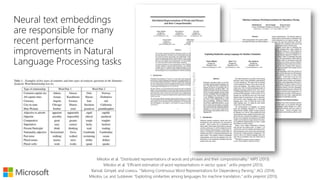
Neural text embeddings
are responsible for many
recent performance
improvements in Natural
Language Processing tasks
Mikolov et al. "Distributed representations of words and phrases and their compositionality." NIPS (2013).
Mikolov et al. "Efficient estimation of word representations in vector space." arXiv preprint (2013).
Bansal, Gimpel, and Livescu. "Tailoring Continuous Word Representations for Dependency Parsing." ACL (2014).
Mikolov, Le, and Sutskever. "Exploiting similarities among languages for machine translation." arXiv preprint (2013).
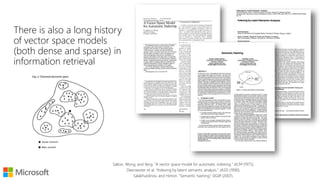
There is also a long history
of vector space models
(both dense and sparse) in
information retrieval
Salton, Wong, and Yang. "A vector space model for automatic indexing." ACM (1975).
Deerwester et al. "Indexing by latent semantic analysis." JASIS (1990).
Salakhutdinov, and Hinton. "Semantic hashing.“ SIGIR (2007).
What is an embedding?
A vector representation of items
Vectors are real-valued and dense
Vectors are small
Number of dimensions much smaller than the number of items
Items can be…
Words, short text, long text, images, entities, audio, etc. – depends on the task
Think sparse, act dense
Mostly the same principles apply to both the vector
space models
Sparse vectors are easier to visualize and reason
about
Learning embeddings is mostly about compression
and generalization over their sparse counterparts
Learning word embeddings
Start with a paired items dataset
[source, target]
Train a neural network
Bottleneck layer gives you a
dense vector representation
E.g., word2vec
Pennington, Socher, and Manning. "Glove: Global Vectors for Word Representation." EMNLP (2014).
Target
Item
Source
Item
Source
Embedding
Target
Embedding
Distance
Metric
Learning word embeddings
Start with a paired items dataset
[source, target]
Make a Source x Target matrix
Factorizing the matrix gives you
a dense vector representation
E.g., LSA, GloVe
T0 T1 T2 T3 T4 T5 T6 T7 T8
S0
S1
S2
S3
S5
S6
S7
Pennington, Socher, and Manning. "Glove: Global Vectors for Word Representation." EMNLP (2014).
Learning word embeddings
Start with a paired items dataset
[source, target]
Make a bi-partite graph
PPMI over edges gives you a
sparse vector representation
E.g., explicit representations
Levy et. al. “Linguistic regularities in sparse and explicit word representations”. CoNLL (2015)
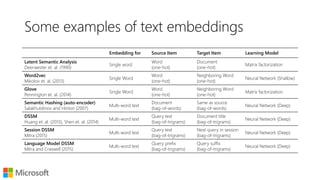
Some examples of text embeddings
Embedding for Source Item Target Item Learning Model
Latent Semantic Analysis
Deerwester et. al. (1990)
Single word
Word
(one-hot)
Document
(one-hot)
Matrix factorization
Word2vec
Mikolov et. al. (2013)
Single Word
Word
(one-hot)
Neighboring Word
(one-hot)
Neural Network (Shallow)
Glove
Pennington et. al. (2014)
Single Word
Word
(one-hot)
Neighboring Word
(one-hot)
Matrix factorization
Semantic Hashing (auto-encoder)
Salakhutdinov and Hinton (2007)
Multi-word text
Document
(bag-of-words)
Same as source
(bag-of-words)
Neural Network (Deep)
DSSM
Huang et. al. (2013), Shen et. al. (2014)
Multi-word text
Query text
(bag-of-trigrams)
Document title
(bag-of-trigrams)
Neural Network (Deep)
Session DSSM
Mitra (2015)
Multi-word text
Query text
(bag-of-trigrams)
Next query in session
(bag-of-trigrams)
Neural Network (Deep)
Language Model DSSM
Mitra and Craswell (2015)
Multi-word text
Query prefix
(bag-of-trigrams)
Query suffix
(bag-of-trigrams)
Neural Network (Deep)
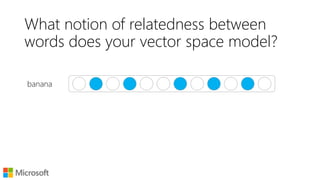
What notion of relatedness between
words does your vector space model?
banana
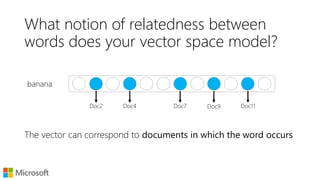
banana
Doc7 Doc9Doc2 Doc4 Doc11
What notion of relatedness between
words does your vector space model?
The vector can correspond to documents in which the word occurs
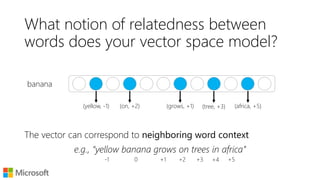
The vector can correspond to neighboring word context
e.g., “yellow banana grows on trees in africa”
banana
(grows, +1) (tree, +3)(yellow, -1) (on, +2) (africa, +5)
+1 +3-1 +2 +50 +4
What notion of relatedness between
words does your vector space model?
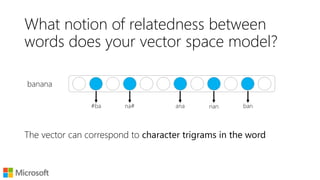
The vector can correspond to character trigrams in the word
banana
ana nan#ba na# ban
What notion of relatedness between
words does your vector space model?
Each of the previous vector
spaces model a different notion
of relatedness between words
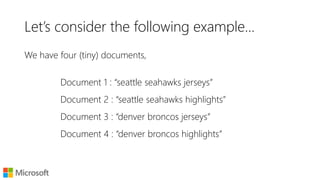
Let’s consider the following example…
We have four (tiny) documents,
Document 1 : “seattle seahawks jerseys”
Document 2 : “seattle seahawks highlights”
Document 3 : “denver broncos jerseys”
Document 4 : “denver broncos highlights”
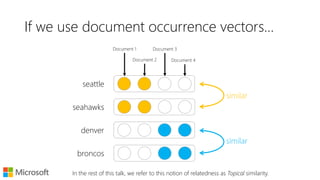
If we use document occurrence vectors…
seattle
Document 1 Document 3
Document 2 Document 4
seahawks
denver
broncos
similar
similar
In the rest of this talk, we refer to this notion of relatedness as Topical similarity.
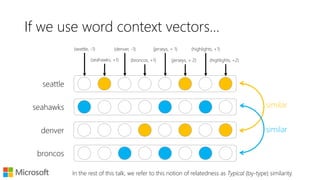
If we use word context vectors…
seattle
(seattle, -1) (denver, -1)
(seahawks, +1) (broncos, +1)
(jerseys, + 1)
(jerseys, + 2)
(highlights, +1)
(highlights, +2)
seahawks
denver
broncos
similar
similar
In the rest of this talk, we refer to this notion of relatedness as Typical (by-type) similarity.
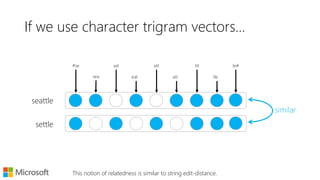
If we use character trigram vectors…
This notion of relatedness is similar to string edit-distance.
seattle
#se set
sea eat
ett
att
ttl
tle
settle
le#
similar
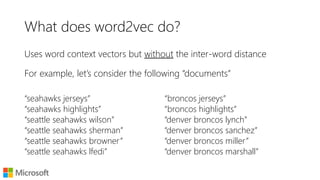
What does word2vec do?
“seahawks jerseys”
“seahawks highlights”
“seattle seahawks wilson”
“seattle seahawks sherman”
“seattle seahawks browner”
“seattle seahawks lfedi”
“broncos jerseys”
“broncos highlights”
“denver broncos lynch”
“denver broncos sanchez”
“denver broncos miller”
“denver broncos marshall”
Uses word context vectors but without the inter-word distance
For example, let’s consider the following “documents”
What does word2vec do?
seattle
seattle denver
seahawks broncos
jerseys
highlights
wilson
sherman
seahawks
denver
broncos
similar
browner
lfedi
lynch
sanchez
miller
marshall
[seahawks] – [seattle] + [Denver]
Mikolov et al. "Distributed representations of words and phrases and their compositionality." NIPS (2013).
Mikolov et al. "Efficient estimation of word representations in vector space." arXiv preprint (2013).
Session Modelling
Text Embeddings for
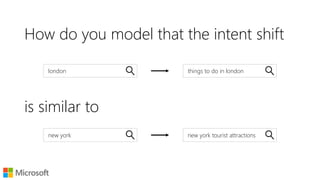
How do you model that the intent shift
is similar to
london things to do in london
new york new york tourist attractions
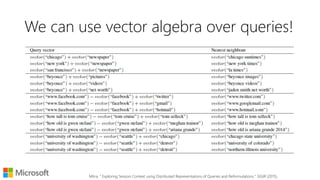
We can use vector algebra over queries!
Mitra. " Exploring Session Context using Distributed Representations of Queries and Reformulations." SIGIR (2015).
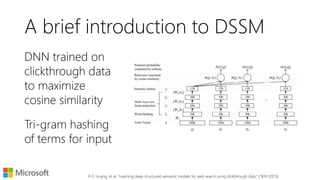
A brief introduction to DSSM
DNN trained on
clickthrough data
to maximize
cosine similarity
Tri-gram hashing
of terms for input
P.-S. Huang, et al. “Learning deep structured semantic models for web search using clickthrough data.” CIKM (2013).
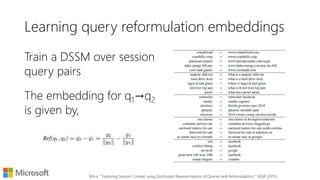
Learning query reformulation embeddings
Train a DSSM over session
query pairs
The embedding for q1→q2
is given by,
Mitra. " Exploring Session Context using Distributed Representations of Queries and Reformulations." SIGIR (2015).
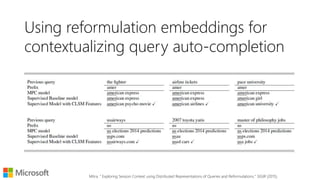
Using reformulation embeddings for
contextualizing query auto-completion
Mitra. " Exploring Session Context using Distributed Representations of Queries and Reformulations." SIGIR (2015).
Ideas I would love to discuss!
Modelling search trails as paths in the embedding space
Using embeddings to discover latent structure in information
seeking tasks
Embeddings for temporal modelling
Document Ranking
Text Embeddings for
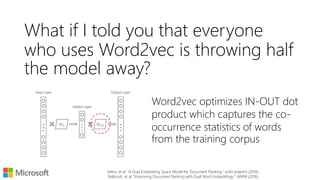
What if I told you that everyone
who uses Word2vec is throwing half
the model away?
Word2vec optimizes IN-OUT dot
product which captures the co-
occurrence statistics of words
from the training corpus
Mitra, et al. "A Dual Embedding Space Model for Document Ranking." arXiv preprint (2016).
Nalisnick, et al. "Improving Document Ranking with Dual Word Embeddings." WWW (2016).
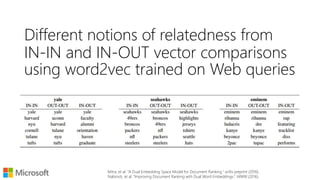
Different notions of relatedness from
IN-IN and IN-OUT vector comparisons
using word2vec trained on Web queries
Mitra, et al. "A Dual Embedding Space Model for Document Ranking." arXiv preprint (2016).
Nalisnick, et al. "Improving Document Ranking with Dual Word Embeddings." WWW (2016).
Using IN-OUT similarity to model
document aboutness
Mitra, et al. "A Dual Embedding Space Model for Document Ranking." arXiv preprint (2016).
Nalisnick, et al. "Improving Document Ranking with Dual Word Embeddings." WWW (2016).
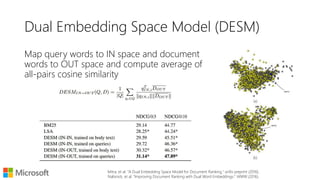
Dual Embedding Space Model (DESM)
Map query words to IN space and document
words to OUT space and compute average of
all-pairs cosine similarity
Mitra, et al. "A Dual Embedding Space Model for Document Ranking." arXiv preprint (2016).
Nalisnick, et al. "Improving Document Ranking with Dual Word Embeddings." WWW (2016).
Ideas I would love to discuss!
Exploring traditional IR concepts (e.g., term frequency, term
importance, document length normalization, etc.) in the
context of dense vector representations of words
How can we formalize what relationship (typical, topical, etc.)
an embedding space models?
Get the data
IN+OUT Embeddings for 2.7M words
trained on 600M+ Bing queries
research.microsoft.com/projects/DESM
Download
Query Auto-Completion
Text Embeddings for
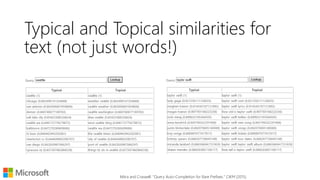
Typical and Topical similarities for
text (not just words!)
Mitra and Craswell. "Query Auto-Completion for Rare Prefixes." CIKM (2015).
The Typical-DSSM is trained on query prefix-
suffix pairs, as opposed to the Topical-DSSM
trained on query-document pairs
We can use the Typical-DSSM model for
query auto-completion for rare or unseen
prefixes!
Mitra and Craswell. "Query Auto-Completion for Rare Prefixes." CIKM (2015).
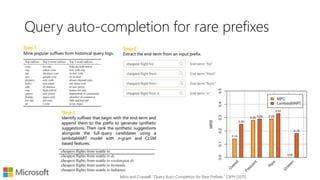
Query auto-completion for rare prefixes
Mitra and Craswell. "Query Auto-Completion for Rare Prefixes." CIKM (2015).
Ideas I would love to discuss!
Query auto-completion beyond just ranking “previously
seen” queries
Neural models for query completion (LSTMs/RNNs still
perform surprisingly poorly on metrics like MRR)
Neu-IR 2016
The SIGIR 2016 Workshop on
Neural Information Retrieval
Pisa, Tuscany, Italy
Workshop: July 21st, 2016
Submission deadline: May 30th, 2016
http://research.microsoft.com/neuir2016
(Call for Participation)
W. Bruce Croft
University of Massachusetts
Amherst, US
Jiafeng Guo
Chinese Academy of Sciences
Beijing, China
Maarten de Rijke
University of Amsterdam
Amsterdam, The Netherlands
Bhaskar Mitra
Bing, Microsoft
Cambridge, UK
Nick Craswell
Bing, Microsoft
Bellevue, US
Organizers

Using Text Embeddings for Information Retrieval

  • 1.
    Bhaskar Mitra, Microsoft(Bing Sciences) http://research.microsoft.com/people/bmitra
  • 2.
    Neural text embeddings areresponsible for many recent performance improvements in Natural Language Processing tasks Mikolov et al. "Distributed representations of words and phrases and their compositionality." NIPS (2013). Mikolov et al. "Efficient estimation of word representations in vector space." arXiv preprint (2013). Bansal, Gimpel, and Livescu. "Tailoring Continuous Word Representations for Dependency Parsing." ACL (2014). Mikolov, Le, and Sutskever. "Exploiting similarities among languages for machine translation." arXiv preprint (2013).
  • 3.
    There is alsoa long history of vector space models (both dense and sparse) in information retrieval Salton, Wong, and Yang. "A vector space model for automatic indexing." ACM (1975). Deerwester et al. "Indexing by latent semantic analysis." JASIS (1990). Salakhutdinov, and Hinton. "Semantic hashing.“ SIGIR (2007).
  • 4.
    What is anembedding? A vector representation of items Vectors are real-valued and dense Vectors are small Number of dimensions much smaller than the number of items Items can be… Words, short text, long text, images, entities, audio, etc. – depends on the task
  • 5.
    Think sparse, actdense Mostly the same principles apply to both the vector space models Sparse vectors are easier to visualize and reason about Learning embeddings is mostly about compression and generalization over their sparse counterparts
  • 6.
    Learning word embeddings Startwith a paired items dataset [source, target] Train a neural network Bottleneck layer gives you a dense vector representation E.g., word2vec Pennington, Socher, and Manning. "Glove: Global Vectors for Word Representation." EMNLP (2014). Target Item Source Item Source Embedding Target Embedding Distance Metric
  • 7.
    Learning word embeddings Startwith a paired items dataset [source, target] Make a Source x Target matrix Factorizing the matrix gives you a dense vector representation E.g., LSA, GloVe T0 T1 T2 T3 T4 T5 T6 T7 T8 S0 S1 S2 S3 S5 S6 S7 Pennington, Socher, and Manning. "Glove: Global Vectors for Word Representation." EMNLP (2014).
  • 8.
    Learning word embeddings Startwith a paired items dataset [source, target] Make a bi-partite graph PPMI over edges gives you a sparse vector representation E.g., explicit representations Levy et. al. “Linguistic regularities in sparse and explicit word representations”. CoNLL (2015)
  • 9.
    Some examples oftext embeddings Embedding for Source Item Target Item Learning Model Latent Semantic Analysis Deerwester et. al. (1990) Single word Word (one-hot) Document (one-hot) Matrix factorization Word2vec Mikolov et. al. (2013) Single Word Word (one-hot) Neighboring Word (one-hot) Neural Network (Shallow) Glove Pennington et. al. (2014) Single Word Word (one-hot) Neighboring Word (one-hot) Matrix factorization Semantic Hashing (auto-encoder) Salakhutdinov and Hinton (2007) Multi-word text Document (bag-of-words) Same as source (bag-of-words) Neural Network (Deep) DSSM Huang et. al. (2013), Shen et. al. (2014) Multi-word text Query text (bag-of-trigrams) Document title (bag-of-trigrams) Neural Network (Deep) Session DSSM Mitra (2015) Multi-word text Query text (bag-of-trigrams) Next query in session (bag-of-trigrams) Neural Network (Deep) Language Model DSSM Mitra and Craswell (2015) Multi-word text Query prefix (bag-of-trigrams) Query suffix (bag-of-trigrams) Neural Network (Deep)
  • 10.
    What notion ofrelatedness between words does your vector space model? banana
  • 11.
    banana Doc7 Doc9Doc2 Doc4Doc11 What notion of relatedness between words does your vector space model? The vector can correspond to documents in which the word occurs
  • 12.
    The vector cancorrespond to neighboring word context e.g., “yellow banana grows on trees in africa” banana (grows, +1) (tree, +3)(yellow, -1) (on, +2) (africa, +5) +1 +3-1 +2 +50 +4 What notion of relatedness between words does your vector space model?
  • 13.
    The vector cancorrespond to character trigrams in the word banana ana nan#ba na# ban What notion of relatedness between words does your vector space model?
  • 14.
    Each of theprevious vector spaces model a different notion of relatedness between words
  • 15.
    Let’s consider thefollowing example… We have four (tiny) documents, Document 1 : “seattle seahawks jerseys” Document 2 : “seattle seahawks highlights” Document 3 : “denver broncos jerseys” Document 4 : “denver broncos highlights”
  • 16.
    If we usedocument occurrence vectors… seattle Document 1 Document 3 Document 2 Document 4 seahawks denver broncos similar similar In the rest of this talk, we refer to this notion of relatedness as Topical similarity.
  • 17.
    If we useword context vectors… seattle (seattle, -1) (denver, -1) (seahawks, +1) (broncos, +1) (jerseys, + 1) (jerseys, + 2) (highlights, +1) (highlights, +2) seahawks denver broncos similar similar In the rest of this talk, we refer to this notion of relatedness as Typical (by-type) similarity.
  • 18.
    If we usecharacter trigram vectors… This notion of relatedness is similar to string edit-distance. seattle #se set sea eat ett att ttl tle settle le# similar
  • 19.
    What does word2vecdo? “seahawks jerseys” “seahawks highlights” “seattle seahawks wilson” “seattle seahawks sherman” “seattle seahawks browner” “seattle seahawks lfedi” “broncos jerseys” “broncos highlights” “denver broncos lynch” “denver broncos sanchez” “denver broncos miller” “denver broncos marshall” Uses word context vectors but without the inter-word distance For example, let’s consider the following “documents”
  • 20.
    What does word2vecdo? seattle seattle denver seahawks broncos jerseys highlights wilson sherman seahawks denver broncos similar browner lfedi lynch sanchez miller marshall [seahawks] – [seattle] + [Denver] Mikolov et al. "Distributed representations of words and phrases and their compositionality." NIPS (2013). Mikolov et al. "Efficient estimation of word representations in vector space." arXiv preprint (2013).
  • 21.
  • 22.
    How do youmodel that the intent shift is similar to london things to do in london new york new york tourist attractions
  • 23.
    We can usevector algebra over queries! Mitra. " Exploring Session Context using Distributed Representations of Queries and Reformulations." SIGIR (2015).
  • 24.
    A brief introductionto DSSM DNN trained on clickthrough data to maximize cosine similarity Tri-gram hashing of terms for input P.-S. Huang, et al. “Learning deep structured semantic models for web search using clickthrough data.” CIKM (2013).
  • 25.
    Learning query reformulationembeddings Train a DSSM over session query pairs The embedding for q1→q2 is given by, Mitra. " Exploring Session Context using Distributed Representations of Queries and Reformulations." SIGIR (2015).
  • 26.
    Using reformulation embeddingsfor contextualizing query auto-completion Mitra. " Exploring Session Context using Distributed Representations of Queries and Reformulations." SIGIR (2015).
  • 27.
    Ideas I wouldlove to discuss! Modelling search trails as paths in the embedding space Using embeddings to discover latent structure in information seeking tasks Embeddings for temporal modelling
  • 28.
  • 29.
    What if Itold you that everyone who uses Word2vec is throwing half the model away? Word2vec optimizes IN-OUT dot product which captures the co- occurrence statistics of words from the training corpus Mitra, et al. "A Dual Embedding Space Model for Document Ranking." arXiv preprint (2016). Nalisnick, et al. "Improving Document Ranking with Dual Word Embeddings." WWW (2016).
  • 30.
    Different notions ofrelatedness from IN-IN and IN-OUT vector comparisons using word2vec trained on Web queries Mitra, et al. "A Dual Embedding Space Model for Document Ranking." arXiv preprint (2016). Nalisnick, et al. "Improving Document Ranking with Dual Word Embeddings." WWW (2016).
  • 31.
    Using IN-OUT similarityto model document aboutness Mitra, et al. "A Dual Embedding Space Model for Document Ranking." arXiv preprint (2016). Nalisnick, et al. "Improving Document Ranking with Dual Word Embeddings." WWW (2016).
  • 32.
    Dual Embedding SpaceModel (DESM) Map query words to IN space and document words to OUT space and compute average of all-pairs cosine similarity Mitra, et al. "A Dual Embedding Space Model for Document Ranking." arXiv preprint (2016). Nalisnick, et al. "Improving Document Ranking with Dual Word Embeddings." WWW (2016).
  • 33.
    Ideas I wouldlove to discuss! Exploring traditional IR concepts (e.g., term frequency, term importance, document length normalization, etc.) in the context of dense vector representations of words How can we formalize what relationship (typical, topical, etc.) an embedding space models?
  • 34.
    Get the data IN+OUTEmbeddings for 2.7M words trained on 600M+ Bing queries research.microsoft.com/projects/DESM Download
  • 35.
  • 36.
    Typical and Topicalsimilarities for text (not just words!) Mitra and Craswell. "Query Auto-Completion for Rare Prefixes." CIKM (2015).
  • 37.
    The Typical-DSSM istrained on query prefix- suffix pairs, as opposed to the Topical-DSSM trained on query-document pairs We can use the Typical-DSSM model for query auto-completion for rare or unseen prefixes! Mitra and Craswell. "Query Auto-Completion for Rare Prefixes." CIKM (2015).
  • 38.
    Query auto-completion forrare prefixes Mitra and Craswell. "Query Auto-Completion for Rare Prefixes." CIKM (2015).
  • 39.
    Ideas I wouldlove to discuss! Query auto-completion beyond just ranking “previously seen” queries Neural models for query completion (LSTMs/RNNs still perform surprisingly poorly on metrics like MRR)
  • 40.
    Neu-IR 2016 The SIGIR2016 Workshop on Neural Information Retrieval Pisa, Tuscany, Italy Workshop: July 21st, 2016 Submission deadline: May 30th, 2016 http://research.microsoft.com/neuir2016 (Call for Participation) W. Bruce Croft University of Massachusetts Amherst, US Jiafeng Guo Chinese Academy of Sciences Beijing, China Maarten de Rijke University of Amsterdam Amsterdam, The Netherlands Bhaskar Mitra Bing, Microsoft Cambridge, UK Nick Craswell Bing, Microsoft Bellevue, US Organizers