IOSR Journal of Economics and Finance (IOSR-JEF)
e-ISSN: 2321-5933, p-ISSN: 2321-5925.Volume 6, Issue 5. Ver. II (Sep. - Oct. 2015), PP 16-23
www.iosrjournals.org
DOI: 10.9790/5933-06521623 www.iosrjournals.org 16 | Page
Deconvolution and Interpretation of Well Test Data ‘Masked’ By
Wellbore Storage in A Build Up Test
1
Akintola A. S, 2
Oriji. A. B and 3
Duru K.M
1,2,3
Department of Petroleum and Gas Engineering University of Port Harcourt, Nigeria.
Abstract: When a well test contains a series of different flow rates, or a continuously varying flow rate, the
combination of the pressure transients due to varying flow rate is called convolution. while deconvolution
means removing a distorting effect upon the variable of interest. This paper is on the study of an analytical
technique that can be used to explicitly deconvolve wellbore storage distorted well test data using pressure data
and the flow rate. Then to determine the reservoir properties from this deconvolved well test data by using the
conventional well test interpretation methods. Also the comparison of the material balance deconvolution
method results with the β-deconvlolution method result were carried out and then used to determine which
method was a better deconvolution tool. The results showed that the material balance deconvolution technique
performed very well with minor discrepancies and gave better estimation of the reservoir parameters.
Keywords: Buildup Test, β-deconvlolution, Wellbore Storage Effect, Material Balance deconvolution,
I. Introduction:
Well testing can be said to be the only technique that examines a significant portion of the reservoir
under dynamic conditions in order to determine its production capability and reservoir properties. It has long
been recognized that wellbore storage (after flow) can impede pressure transient test analysis thus several
methods have been suggested for determining the effects of afterflow when well known semi-logarithmic
techniques cannot be used for transient test analysis. Often times, during well testing, the test may not be carried
out for a very long time so as to acquire sufficient information that can be used to interpret the result in the usual
conventional method available in literatures, hence, the need to make use of the early time region (ETR) data,
for the interpretation. In such situation, we then have to try to make the data as reliable as possible by
eliminating wellbore storage effect from the data.
Ramey H.T(1970) concluded that annulus unloading and wellbore storage are important physical
effect that often controls the behavior of early pressure data taken during a well test. Van Everdingen and Hurst..
(1953) reported that wellbore storage effects include a ―skin effect‖ or a region of altered permeability adjacent
to the wellbore and that in many cases the production flow rate can be approximated using equation. Kuchuk
F.J, (1985) applied ―β deconvolution‖ for the analysis of wellbore storage distorted pressure transient data and
formulated the β-deconvolution equation that helps to computes the undistorted pressure drop function directly
from the wellbore storage affected data. Bourdet et al (1989) showed that the most recently documented
pressure derivative approach has combined the most powerful aspects of the two previously distinct methods
into a single stage interpretative plot Roumboustsos and Stewart (1985) developed convolution and
deconvolution methods based on the ideas proposed by kuchuk. Kuchuk presented a generalized rate-
convolution and deconvolution methods. He obtained deconvolved pressure values from the Riemann sum and
from exponential wellbore flow-rate case. Igbokoyi, A.O (2007) used the deconvolution approach and the
resulting Duhamels integral formulation to develop a model that successfully interpreted short-time pressure
data distorted by wellbore storage and skin in a buildup test.
II. Material Balance Deconvolution
Material balance deconvolution is a practical approach for the analysis of pressure transient data
distorted by wellbore storage effects, The general form of material balance deconvolution provide for the
pressure drawdown case in terms of the material balance time function and the rate normalized pressure drop
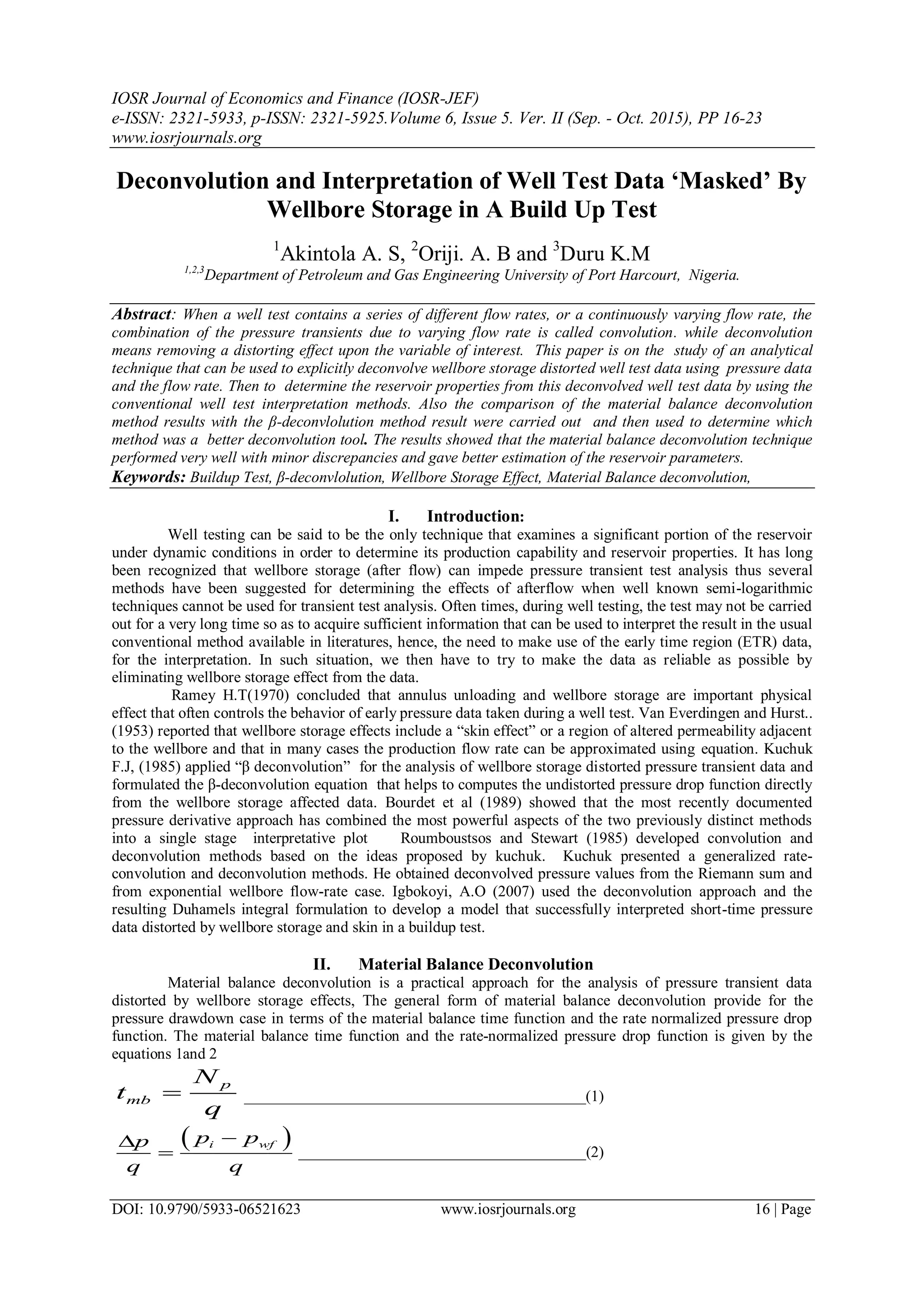
function. The material balance time function and the rate-normalized pressure drop function is given by the
equations 1and 2
p
mb
N
t
q
 ____________________________________________(1)
 i wfp pp
q q

 _____________________________________(2)
Deconvolution and Interpretation of Well Test Data ‘Masked’ By Wellbore Storage in A Build…
DOI: 10.9790/5933-06521623 www.iosrjournals.org 17 | Page
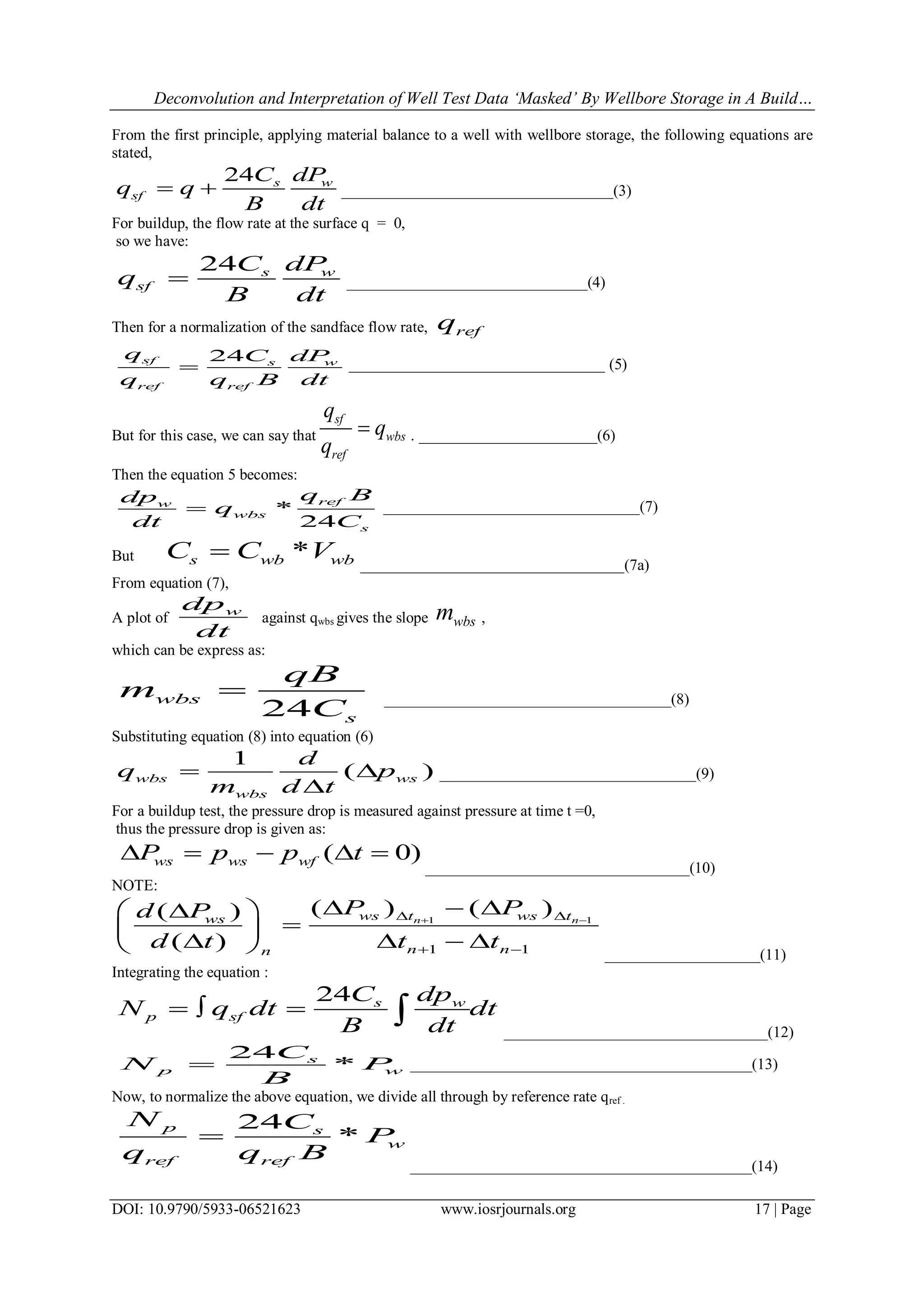
From the first principle, applying material balance to a well with wellbore storage, the following equations are
stated,
24 s w
sf
C dP
q q
B dt
  ___________________________________(3)
For buildup, the flow rate at the surface q = 0,
so we have:
24 s w
sf
C dP
q
B dt
 _______________________________(4)
Then for a normalization of the sandface flow rate, refq
24sf s w
ref ref
q C dP
q q B dt
 _________________________________ (5)
But for this case, we can say that
sf
wbs
ref
q
q
q
 . _______________________(6)
Then the equation 5 becomes:
*
24
refw
wbs
s
q Bdp
q
dt C
 _________________________________(7)
But *s wb wbC C V __________________________________(7a)
From equation (7),
A plot of wdp
dt
against qwbs gives the slope wbsm ,
which can be express as:
24
wbs
s
qB
m
C
 _____________________________________(8)
Substituting equation (8) into equation (6)
1
( )wbs ws
wbs
d
q p
m d t
 

_________________________________(9)
For a buildup test, the pressure drop is measured against pressure at time t =0,
thus the pressure drop is given as:
( 0)ws ws wfP p p t    
__________________________________(10)
NOTE:
1 1
1 1
( ) ( )( )
( )
n nws t ws tws
n nn
P Pd P
d t t t
  
 
   
 
     ____________________(11)
Integrating the equation :
24 s w
p sf
C dp
N q dt dt
B dt
    __________________________________(12)
24
*s
p w
C
N P
B
 ____________________________________________(13)
Now, to normalize the above equation, we divide all through by reference rate qref .
24
*p s
w
ref ref
N C
P
q q B

____________________________________________(14)
Deconvolution and Interpretation of Well Test Data ‘Masked’ By Wellbore Storage in A Build…
DOI: 10.9790/5933-06521623 www.iosrjournals.org 18 | Page
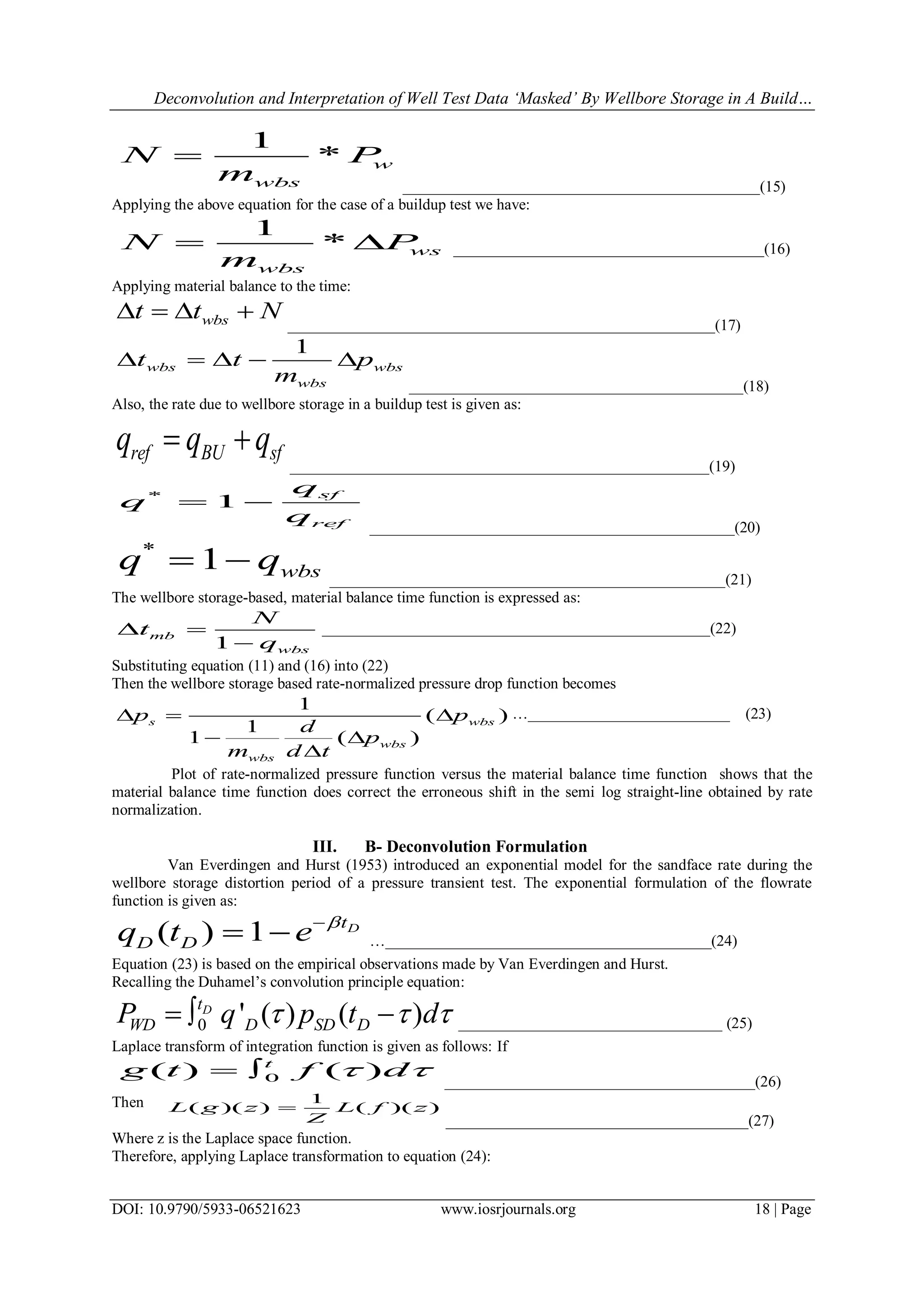
1
* w
wbs
N P
m

______________________________________________(15)
Applying the above equation for the case of a buildup test we have:
1
* ws
wbs
N P
m
  ________________________________________(16)
Applying material balance to the time:
wbst t N    _______________________________________________________(17)
1
wbs wbs
wbs
t t p
m
    
___________________________________________(18)
Also, the rate due to wellbore storage in a buildup test is given as:
ref BU sfq q q 
______________________________________________________(19)
*
1
sf
ref
q
q
q
 
_______________________________________________(20)
*
1 wbsq q  ___________________________________________________(21)
The wellbore storage-based, material balance time function is expressed as:
1
mb
wbs
N
t
q
 

__________________________________________________(22)
Substituting equation (11) and (16) into (22)
Then the wellbore storage based rate-normalized pressure drop function becomes
1
( )
1
1 ( )
s wbs
wbs
wbs
p p
d
p
m d t
  
 

…__________________________ (23)
Plot of rate-normalized pressure function versus the material balance time function shows that the
material balance time function does correct the erroneous shift in the semi log straight-line obtained by rate
normalization.
III. Β- Deconvolution Formulation
Van Everdingen and Hurst (1953) introduced an exponential model for the sandface rate during the
wellbore storage distortion period of a pressure transient test. The exponential formulation of the flowrate
function is given as:
( ) 1 Dt
D Dq t e 
  …__________________________________________(24)
Equation (23) is based on the empirical observations made by Van Everdingen and Hurst.
Recalling the Duhamel‘s convolution principle equation:
0 ' ( ) ( )Dt
WD D SD DP q p t d     __________________________________ (25)
Laplace transform of integration function is given as follows: If
0( ) ( )t
g t f d  
________________________________________(26)
Then 1
( )( ) ( )( )L g z L f z
Z

_______________________________________(27)
Where z is the Laplace space function.
Therefore, applying Laplace transformation to equation (24):
Deconvolution and Interpretation of Well Test Data ‘Masked’ By Wellbore Storage in A Build…
DOI: 10.9790/5933-06521623 www.iosrjournals.org 19 | Page
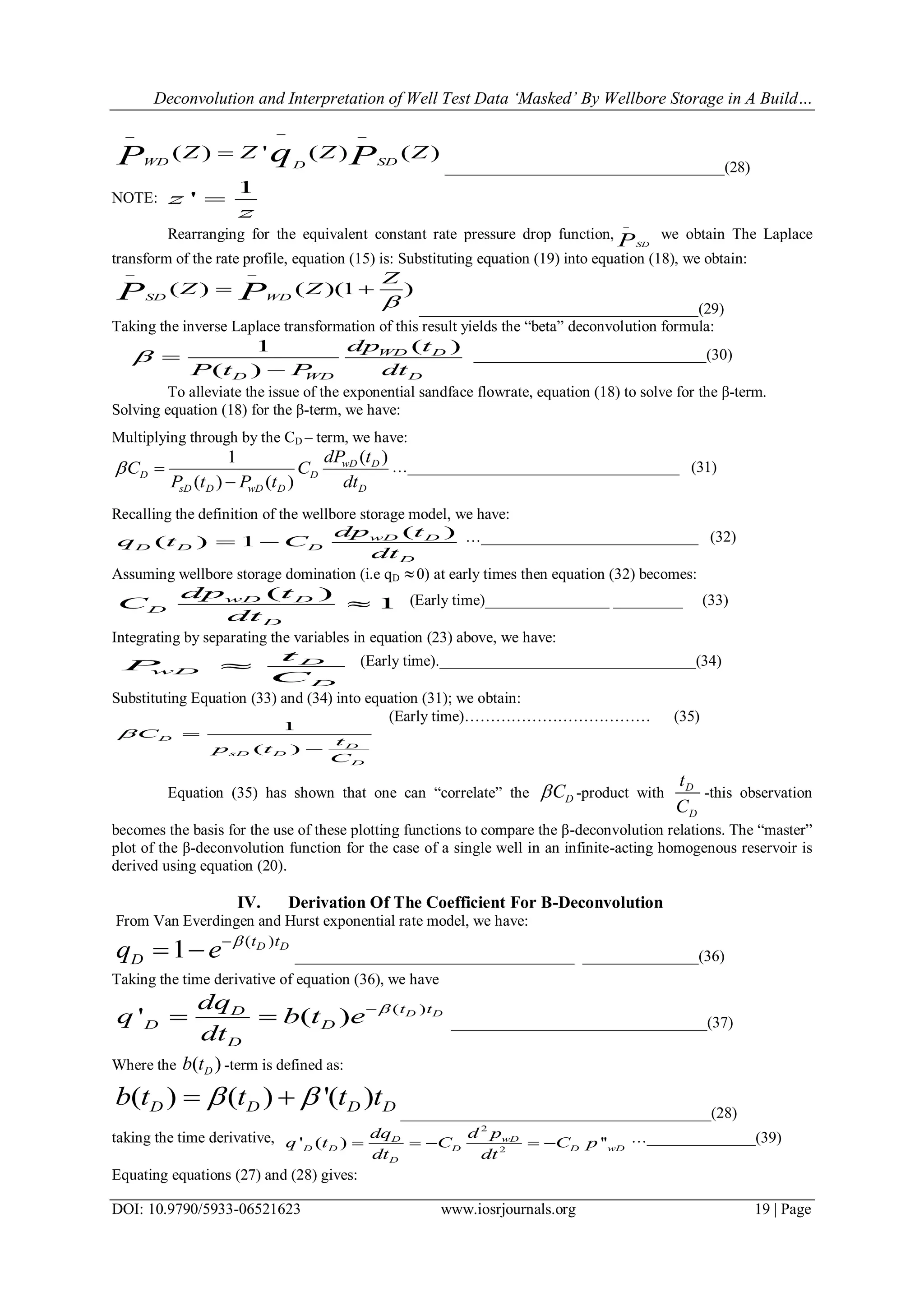
( ) ' ( ) ( )WD SDD
Z Z Z ZqP P
 

____________________________________(28)
NOTE:
1
'z
z

Rearranging for the equivalent constant rate pressure drop function,
SDP

we obtain The Laplace
transform of the rate profile, equation (15) is: Substituting equation (19) into equation (18), we obtain:
( ) ( )(1 )SD WD
Z
Z ZP P 
 
 
____________________________________(29)
Taking the inverse Laplace transformation of this result yields the ―beta‖ deconvolution formula:
( )1
( )
WD D
D WD D
dp t
P t P dt
 

______________________________(30)
To alleviate the issue of the exponential sandface flowrate, equation (18) to solve for the β-term.
Solving equation (18) for the β-term, we have:
Multiplying through by the CD – term, we have:
( )1
( ) ( )
wD D
D D
sD D wD D D
dP t
C C
P t P t dt
 

…___________________________________ (31)
Recalling the definition of the wellbore storage model, we have:
( )
( ) 1 wD D
D D D
D
dp t
q t C
dt
  …____________________________ (32)
Assuming wellbore storage domination (i.e qD 0) at early times then equation (32) becomes:
( )
1wD D
D
D
dp t
C
dt
 (Early time)________________ _________ (33)
Integrating by separating the variables in equation (23) above, we have:
D
wD
D
t
P
C
 (Early time)._________________________________(34)
Substituting Equation (33) and (34) into equation (31); we obtain:
1
( )
D
D
sD D
D
C
t
p t
C
 

(Early time)……………………………… (35)
Equation (35) has shown that one can ―correlate‖ the DC -product with D
D
t
C
-this observation
becomes the basis for the use of these plotting functions to compare the β-deconvolution relations. The ―master‖
plot of the β-deconvolution function for the case of a single well in an infinite-acting homogenous reservoir is
derived using equation (20).
IV. Derivation Of The Coefficient For Β-Deconvolution
From Van Everdingen and Hurst exponential rate model, we have:
( )
1 D Dt t
Dq e 
  ____________________________________ _______________(36)
Taking the time derivative of equation (36), we have
( )
' ( ) D Dt tD
D D
D
dq
q b t e
dt

  _________________________________(37)
Where the ( )Db t -term is defined as:
( ) ( ) '( )D D D Db t t t t  
________________________________________(28)
taking the time derivative,
2
2
' ( ) ''wDD
D D D D wD
D
d pdq
q t C C p
dt dt
     …______________(39)
Equating equations (27) and (28) gives:
Deconvolution and Interpretation of Well Test Data ‘Masked’ By Wellbore Storage in A Build…
DOI: 10.9790/5933-06521623 www.iosrjournals.org 20 | Page
2
( )
2
'' ( ) ( ) D Dt twD
D wD D D D
D
d p
C p t C b t e
dt

   …_____________________________________(40)
Equating equation (21) and (25), we have:
( )
' ( )D Dt t wD
D D wD D
D
dp
e C C p t
dt

  _________________________________________(41)
Combining equation (28) and (29) and solving for ( )Db t
''1
( )
'
wD
D
D wD
p
b t
t p
  ( ) '( )D D Dt t t   ______________________________(42)
Where the ''wDp and 'wDp terms are defined as:
wD
wDd D
D
dp
P t
dt

___________________________________________________(43)
2
2
2
wD
wDdd D
D
d p
P t
dt

_________________________________________________ (44)
Equation (41) can be used to determine β(tD) and β‘(tD) — a graphical representation of the equation,
where the intercept and slope values are β(tD) and β‘(tD) respectively.
The value of β(tD) and β‘(tD) can be approximated by numerical methods such as least square —
which is the functional approach adopted here
V. Discussion And Result:
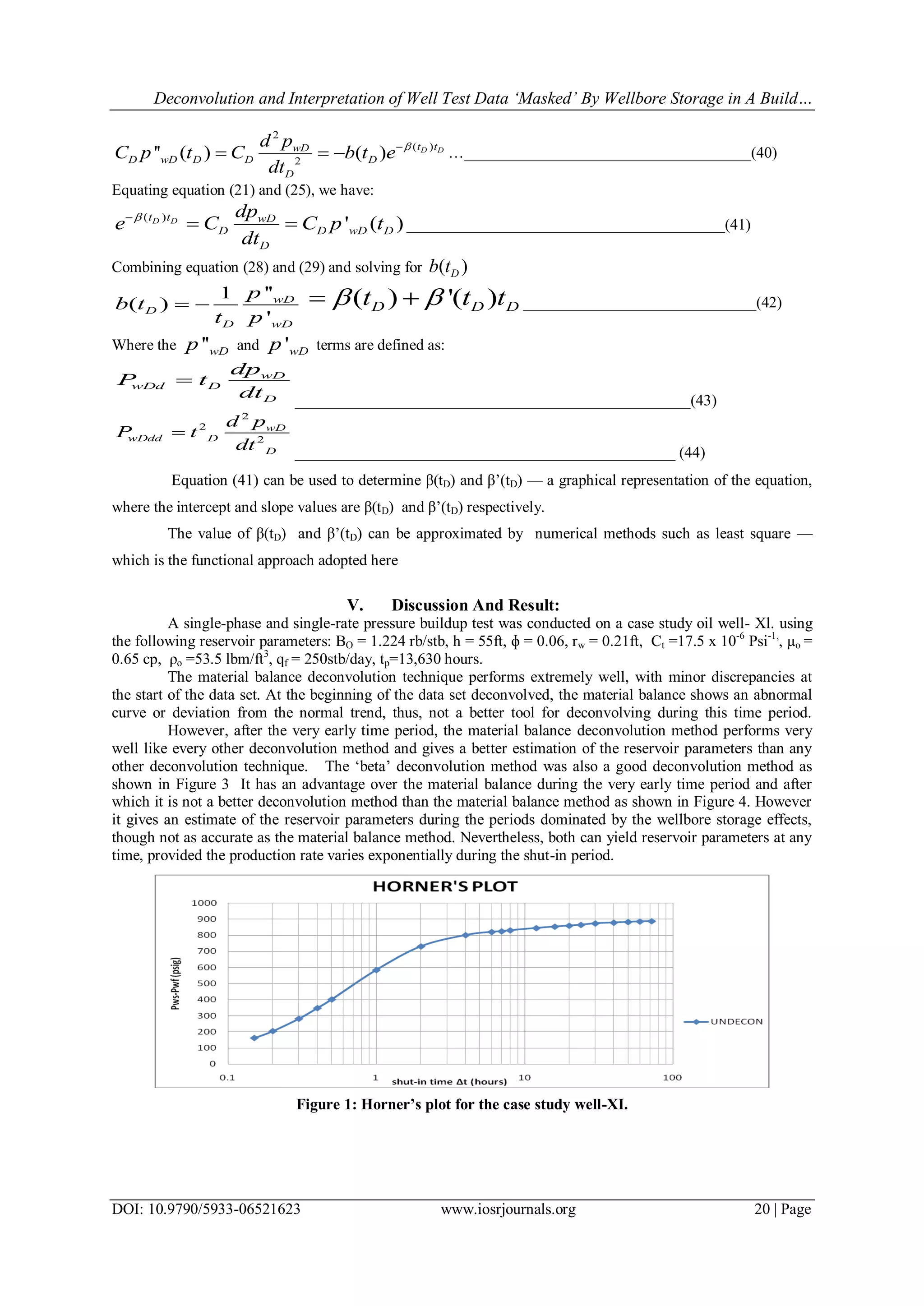
A single-phase and single-rate pressure buildup test was conducted on a case study oil well- Xl. using
the following reservoir parameters: BO = 1.224 rb/stb, h = 55ft, ɸ = 0.06, rw = 0.21ft, Ct =17.5 x 10⁻⁶
Psi-1,
, µo =
0.65 cp, ρo =53.5 lbm/ft3
, qf = 250stb/day, tp=13,630 hours.
The material balance deconvolution technique performs extremely well, with minor discrepancies at
the start of the data set. At the beginning of the data set deconvolved, the material balance shows an abnormal
curve or deviation from the normal trend, thus, not a better tool for deconvolving during this time period.
However, after the very early time period, the material balance deconvolution method performs very
well like every other deconvolution method and gives a better estimation of the reservoir parameters than any
other deconvolution technique. The ‗beta‘ deconvolution method was also a good deconvolution method as
shown in Figure 3 It has an advantage over the material balance during the very early time period and after
which it is not a better deconvolution method than the material balance method as shown in Figure 4. However
it gives an estimate of the reservoir parameters during the periods dominated by the wellbore storage effects,
though not as accurate as the material balance method. Nevertheless, both can yield reservoir parameters at any
time, provided the production rate varies exponentially during the shut-in period.
Figure 1: Horner’s plot for the case study well-XI.
Deconvolution and Interpretation of Well Test Data ‘Masked’ By Wellbore Storage in A Build…
DOI: 10.9790/5933-06521623 www.iosrjournals.org 21 | Page
Table1 : Pressure buildup data from the case study well-XI
S/N
Pws
1
0 3519
2 0.15 3680
3 0.2 3723
4 0.3 3800
5 0.4 3866
6 0.5 3920
7 1 4103
8 2 4250
9 4 4320
10 6 4340
11 7 4344
12 8 4350
13 12 4364
14 16 4373
15 20 4379
16 24 4384
17 30 4393
18 40 4398
19 50 4402
20 60 4405
21 72 4407
Table 2: Shut-in time and undeconvolved Pressure data
S/N Pws
1. 0 3519 0
2 0.15 3680 161
3 0.2 3723 204
4 0.3 3800 281
5 0.4 3866 347
6 0.5 3920 401
7 1 4103 584
8 2 4250 731
9 4 4320 801
10 6 4340 821
11 7 4344 825
12 8 4350 831
13 12 4364 845
14 16 4373 854
15 20 4379 860
16 24 4384 865
17 30 4393 874
18 40 4398 879
19 50 4402 883
20 60 4405 886
21 72 4407 888
Deconvolution and Interpretation of Well Test Data ‘Masked’ By Wellbore Storage in A Build…
DOI: 10.9790/5933-06521623 www.iosrjournals.org 22 | Page
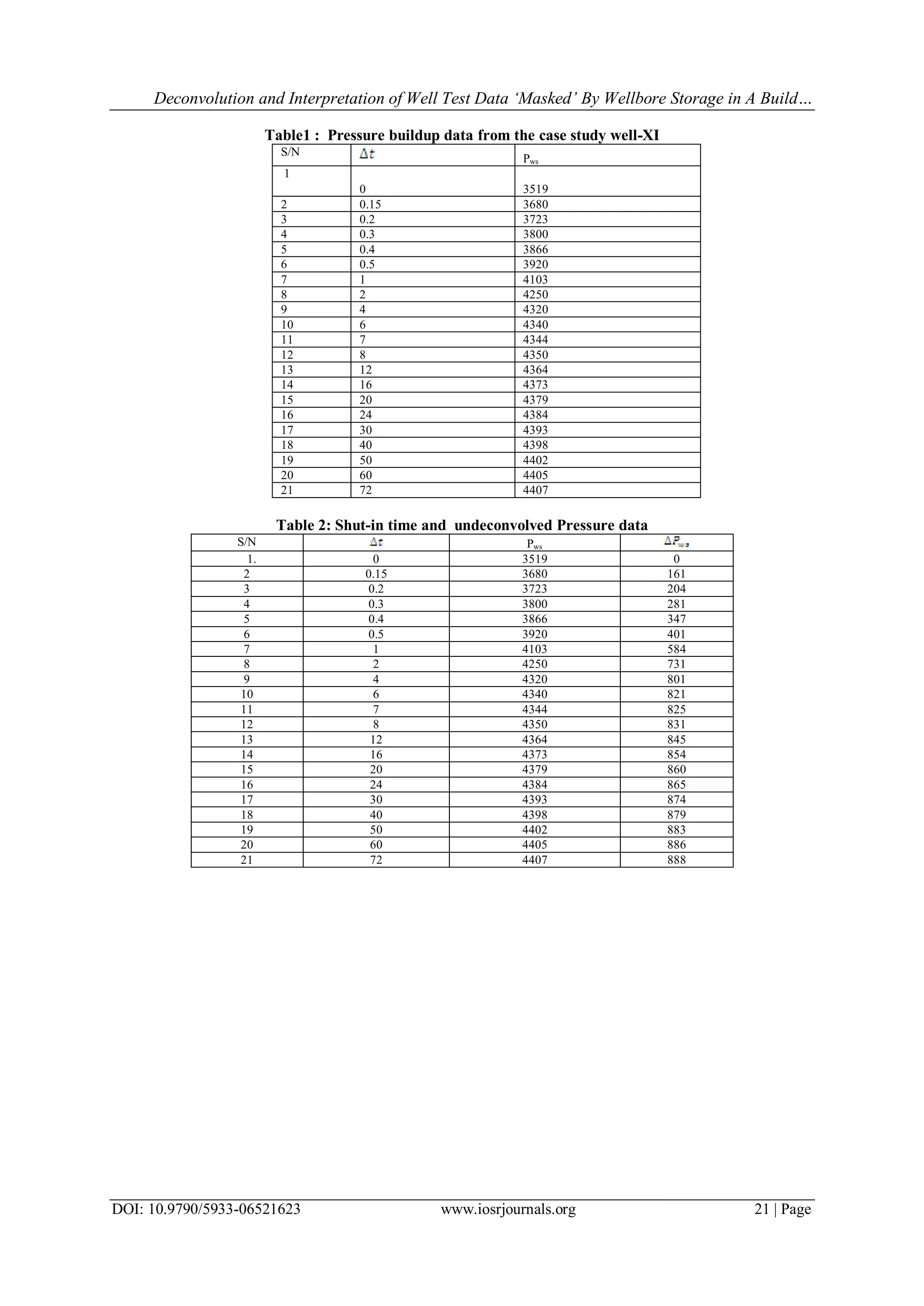
Table 3: Material data deconvolution data
Figure 2: Material balance deconvolved data
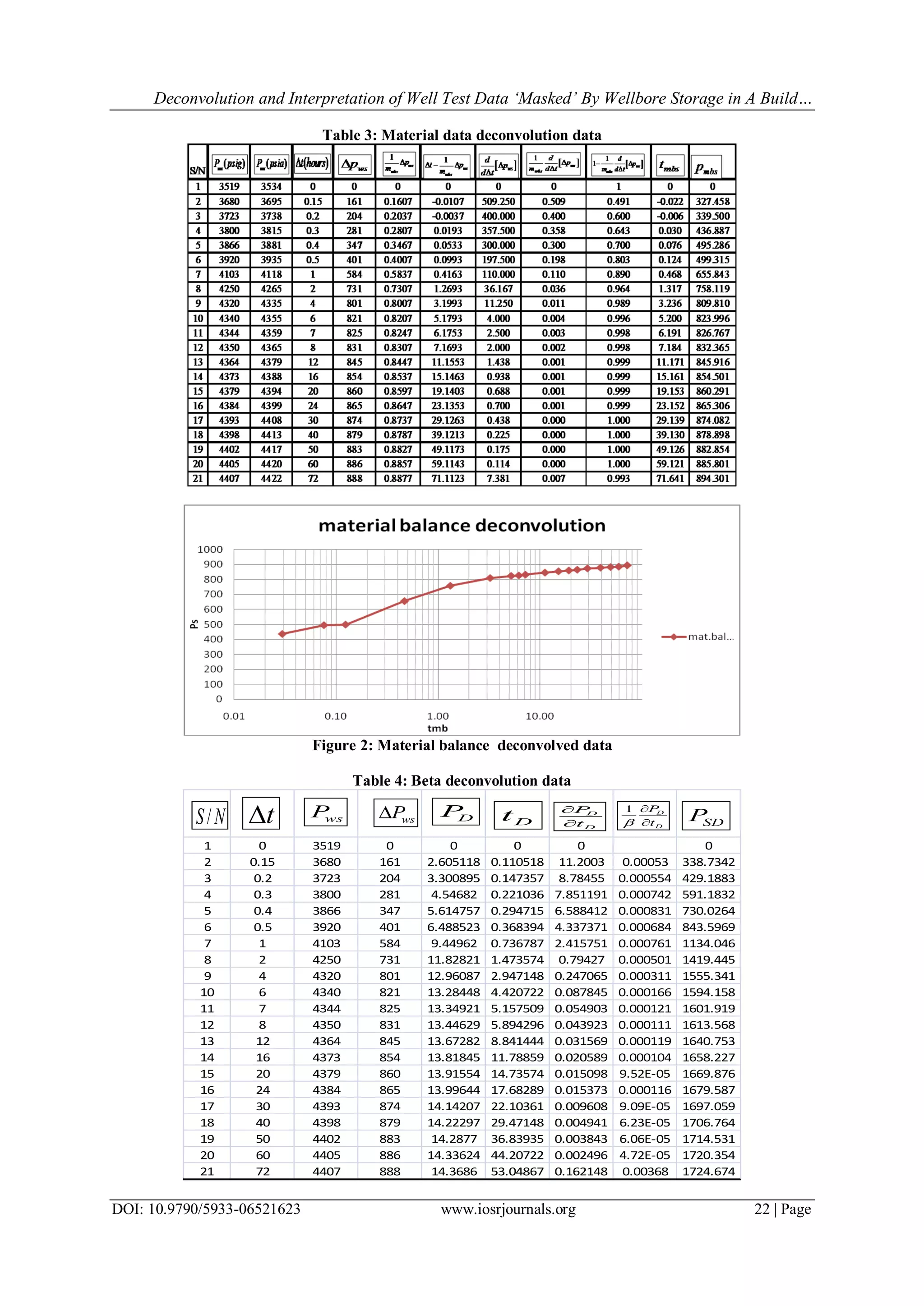
Table 4: Beta deconvolution data
1 0 3519 0 0 0 0 0
2 0.15 3680 161 2.605118 0.110518 11.2003 0.00053 338.7342
3 0.2 3723 204 3.300895 0.147357 8.78455 0.000554 429.1883
4 0.3 3800 281 4.54682 0.221036 7.851191 0.000742 591.1832
5 0.4 3866 347 5.614757 0.294715 6.588412 0.000831 730.0264
6 0.5 3920 401 6.488523 0.368394 4.337371 0.000684 843.5969
7 1 4103 584 9.44962 0.736787 2.415751 0.000761 1134.046
8 2 4250 731 11.82821 1.473574 0.79427 0.000501 1419.445
9 4 4320 801 12.96087 2.947148 0.247065 0.000311 1555.341
10 6 4340 821 13.28448 4.420722 0.087845 0.000166 1594.158
11 7 4344 825 13.34921 5.157509 0.054903 0.000121 1601.919
12 8 4350 831 13.44629 5.894296 0.043923 0.000111 1613.568
13 12 4364 845 13.67282 8.841444 0.031569 0.000119 1640.753
14 16 4373 854 13.81845 11.78859 0.020589 0.000104 1658.227
15 20 4379 860 13.91554 14.73574 0.015098 9.52E-05 1669.876
16 24 4384 865 13.99644 17.68289 0.015373 0.000116 1679.587
17 30 4393 874 14.14207 22.10361 0.009608 9.09E-05 1697.059
18 40 4398 879 14.22297 29.47148 0.004941 6.23E-05 1706.764
19 50 4402 883 14.2877 36.83935 0.003843 6.06E-05 1714.531
20 60 4405 886 14.33624 44.20722 0.002496 4.72E-05 1720.354
21 72 4407 888 14.3686 53.04867 0.162148 0.00368 1724.674
t/S N wsP wsP DP Dt D
D
P
t


1 D
D
P
t

 SDP
Deconvolution and Interpretation of Well Test Data ‘Masked’ By Wellbore Storage in A Build…
DOI: 10.9790/5933-06521623 www.iosrjournals.org 23 | Page
Figure 3: β-deconvolved data
Figure 4: Comparison of the deconvolved and undeconvolved data
Table 5. Comparing the Undeconvolution and Deconvoluted Results
PARAMETER UNDECONVOLUTED
(MTR) MATERIAL BAL BETA'
m(psi/cycle) 70 110 200
K(mD) 8.4 5.4 3.9
S 5.87 4.2 2.7
DECONVOLUTED
References
[1]. Bassey, E.E: (1997) ‖Deconvolution of Pressure Buildup Data Distorted by Wellbore Storage and Skin in Horizontal Wells‖ M.sc
Thesis, University of Ibadan, Nigeria
[2]. Bourdet D, Ayoub, J.A and Pirard, Y.M(1998): ‖Use of pressure derivation in well test interpretation‖ SPEFE 293-302.
[3]. Horner, D.R(1951):‖Pressure Build-up in Wells‖. Proc.Third World Pet. Cong, E.J. Brill, leiden , 503-521.
[4]. Igbokoyi, A.O(2007):‖ Deconvolution of pressure buildup data distorted by wellbore storage‖ An M.sc Thesis in Petroleum
Engineering University of Ibadan, Nigeria.
[5]. kuchuk, F. J(1985):‖well testing in low transmissivity oil reservoir‖ paper SPE 13666 .SPE California Regional Meeting,
Bakersfield, March 27-29
[6]. Lee W. J:(1982)‖ Well Testing‖ New York and Dallas: Society of Petroleum Engineers of AIME
[7]. Mathew C.S and Russel, D.G(1967) ‗Pressure Build-up and flow tests in wells‘‘ Monograph Series, Society of Petroleum Engineers
of AIME, Dallas .
[8]. Oyewole, A.A(1995) :‖ Deconvolution of a two rate drawdown test distorted by wellbore storage and skin‖ M.sc Thesis, University
of Ibadan, Nigeria.
[9]. Ramey H.J Jr(1970):‖Short-time Well Test Data interpretation in the presence of skin effect and wellbore storage‖ J. Pet Tech. 97-
104
[10]. Sulaimon A(1997):‖ Deconvolution of A Two-Rate Drawdown test distorted by wellbore storage and skin‖ M.sc Thesis, University
of Ibadan, Nigeria .
[11]. Van Everdingen, A.F. and Hurst, W(1953).: ―The Application of the Laplace transformation to flow problems. Trans. AIME Vol.
186, 305-324

Deconvolution and Interpretation of Well Test Data ‘Masked’ By Wellbore Storage in A Build Up Test

  • 1.
    IOSR Journal ofEconomics and Finance (IOSR-JEF) e-ISSN: 2321-5933, p-ISSN: 2321-5925.Volume 6, Issue 5. Ver. II (Sep. - Oct. 2015), PP 16-23 www.iosrjournals.org DOI: 10.9790/5933-06521623 www.iosrjournals.org 16 | Page Deconvolution and Interpretation of Well Test Data ‘Masked’ By Wellbore Storage in A Build Up Test 1 Akintola A. S, 2 Oriji. A. B and 3 Duru K.M 1,2,3 Department of Petroleum and Gas Engineering University of Port Harcourt, Nigeria. Abstract: When a well test contains a series of different flow rates, or a continuously varying flow rate, the combination of the pressure transients due to varying flow rate is called convolution. while deconvolution means removing a distorting effect upon the variable of interest. This paper is on the study of an analytical technique that can be used to explicitly deconvolve wellbore storage distorted well test data using pressure data and the flow rate. Then to determine the reservoir properties from this deconvolved well test data by using the conventional well test interpretation methods. Also the comparison of the material balance deconvolution method results with the β-deconvlolution method result were carried out and then used to determine which method was a better deconvolution tool. The results showed that the material balance deconvolution technique performed very well with minor discrepancies and gave better estimation of the reservoir parameters. Keywords: Buildup Test, β-deconvlolution, Wellbore Storage Effect, Material Balance deconvolution, I. Introduction: Well testing can be said to be the only technique that examines a significant portion of the reservoir under dynamic conditions in order to determine its production capability and reservoir properties. It has long been recognized that wellbore storage (after flow) can impede pressure transient test analysis thus several methods have been suggested for determining the effects of afterflow when well known semi-logarithmic techniques cannot be used for transient test analysis. Often times, during well testing, the test may not be carried out for a very long time so as to acquire sufficient information that can be used to interpret the result in the usual conventional method available in literatures, hence, the need to make use of the early time region (ETR) data, for the interpretation. In such situation, we then have to try to make the data as reliable as possible by eliminating wellbore storage effect from the data. Ramey H.T(1970) concluded that annulus unloading and wellbore storage are important physical effect that often controls the behavior of early pressure data taken during a well test. Van Everdingen and Hurst.. (1953) reported that wellbore storage effects include a ―skin effect‖ or a region of altered permeability adjacent to the wellbore and that in many cases the production flow rate can be approximated using equation. Kuchuk F.J, (1985) applied ―β deconvolution‖ for the analysis of wellbore storage distorted pressure transient data and formulated the β-deconvolution equation that helps to computes the undistorted pressure drop function directly from the wellbore storage affected data. Bourdet et al (1989) showed that the most recently documented pressure derivative approach has combined the most powerful aspects of the two previously distinct methods into a single stage interpretative plot Roumboustsos and Stewart (1985) developed convolution and deconvolution methods based on the ideas proposed by kuchuk. Kuchuk presented a generalized rate- convolution and deconvolution methods. He obtained deconvolved pressure values from the Riemann sum and from exponential wellbore flow-rate case. Igbokoyi, A.O (2007) used the deconvolution approach and the resulting Duhamels integral formulation to develop a model that successfully interpreted short-time pressure data distorted by wellbore storage and skin in a buildup test. II. Material Balance Deconvolution Material balance deconvolution is a practical approach for the analysis of pressure transient data distorted by wellbore storage effects, The general form of material balance deconvolution provide for the pressure drawdown case in terms of the material balance time function and the rate normalized pressure drop function. The material balance time function and the rate-normalized pressure drop function is given by the equations 1and 2 p mb N t q  ____________________________________________(1)  i wfp pp q q   _____________________________________(2)
  • 2.
    Deconvolution and Interpretationof Well Test Data ‘Masked’ By Wellbore Storage in A Build… DOI: 10.9790/5933-06521623 www.iosrjournals.org 17 | Page From the first principle, applying material balance to a well with wellbore storage, the following equations are stated, 24 s w sf C dP q q B dt   ___________________________________(3) For buildup, the flow rate at the surface q = 0, so we have: 24 s w sf C dP q B dt  _______________________________(4) Then for a normalization of the sandface flow rate, refq 24sf s w ref ref q C dP q q B dt  _________________________________ (5) But for this case, we can say that sf wbs ref q q q  . _______________________(6) Then the equation 5 becomes: * 24 refw wbs s q Bdp q dt C  _________________________________(7) But *s wb wbC C V __________________________________(7a) From equation (7), A plot of wdp dt against qwbs gives the slope wbsm , which can be express as: 24 wbs s qB m C  _____________________________________(8) Substituting equation (8) into equation (6) 1 ( )wbs ws wbs d q p m d t    _________________________________(9) For a buildup test, the pressure drop is measured against pressure at time t =0, thus the pressure drop is given as: ( 0)ws ws wfP p p t     __________________________________(10) NOTE: 1 1 1 1 ( ) ( )( ) ( ) n nws t ws tws n nn P Pd P d t t t                 ____________________(11) Integrating the equation : 24 s w p sf C dp N q dt dt B dt     __________________________________(12) 24 *s p w C N P B  ____________________________________________(13) Now, to normalize the above equation, we divide all through by reference rate qref . 24 *p s w ref ref N C P q q B  ____________________________________________(14)
  • 3.
    Deconvolution and Interpretationof Well Test Data ‘Masked’ By Wellbore Storage in A Build… DOI: 10.9790/5933-06521623 www.iosrjournals.org 18 | Page 1 * w wbs N P m  ______________________________________________(15) Applying the above equation for the case of a buildup test we have: 1 * ws wbs N P m   ________________________________________(16) Applying material balance to the time: wbst t N    _______________________________________________________(17) 1 wbs wbs wbs t t p m      ___________________________________________(18) Also, the rate due to wellbore storage in a buildup test is given as: ref BU sfq q q  ______________________________________________________(19) * 1 sf ref q q q   _______________________________________________(20) * 1 wbsq q  ___________________________________________________(21) The wellbore storage-based, material balance time function is expressed as: 1 mb wbs N t q    __________________________________________________(22) Substituting equation (11) and (16) into (22) Then the wellbore storage based rate-normalized pressure drop function becomes 1 ( ) 1 1 ( ) s wbs wbs wbs p p d p m d t       …__________________________ (23) Plot of rate-normalized pressure function versus the material balance time function shows that the material balance time function does correct the erroneous shift in the semi log straight-line obtained by rate normalization. III. Β- Deconvolution Formulation Van Everdingen and Hurst (1953) introduced an exponential model for the sandface rate during the wellbore storage distortion period of a pressure transient test. The exponential formulation of the flowrate function is given as: ( ) 1 Dt D Dq t e    …__________________________________________(24) Equation (23) is based on the empirical observations made by Van Everdingen and Hurst. Recalling the Duhamel‘s convolution principle equation: 0 ' ( ) ( )Dt WD D SD DP q p t d     __________________________________ (25) Laplace transform of integration function is given as follows: If 0( ) ( )t g t f d   ________________________________________(26) Then 1 ( )( ) ( )( )L g z L f z Z  _______________________________________(27) Where z is the Laplace space function. Therefore, applying Laplace transformation to equation (24):
  • 4.
    Deconvolution and Interpretationof Well Test Data ‘Masked’ By Wellbore Storage in A Build… DOI: 10.9790/5933-06521623 www.iosrjournals.org 19 | Page ( ) ' ( ) ( )WD SDD Z Z Z ZqP P    ____________________________________(28) NOTE: 1 'z z  Rearranging for the equivalent constant rate pressure drop function, SDP  we obtain The Laplace transform of the rate profile, equation (15) is: Substituting equation (19) into equation (18), we obtain: ( ) ( )(1 )SD WD Z Z ZP P      ____________________________________(29) Taking the inverse Laplace transformation of this result yields the ―beta‖ deconvolution formula: ( )1 ( ) WD D D WD D dp t P t P dt    ______________________________(30) To alleviate the issue of the exponential sandface flowrate, equation (18) to solve for the β-term. Solving equation (18) for the β-term, we have: Multiplying through by the CD – term, we have: ( )1 ( ) ( ) wD D D D sD D wD D D dP t C C P t P t dt    …___________________________________ (31) Recalling the definition of the wellbore storage model, we have: ( ) ( ) 1 wD D D D D D dp t q t C dt   …____________________________ (32) Assuming wellbore storage domination (i.e qD 0) at early times then equation (32) becomes: ( ) 1wD D D D dp t C dt  (Early time)________________ _________ (33) Integrating by separating the variables in equation (23) above, we have: D wD D t P C  (Early time)._________________________________(34) Substituting Equation (33) and (34) into equation (31); we obtain: 1 ( ) D D sD D D C t p t C    (Early time)……………………………… (35) Equation (35) has shown that one can ―correlate‖ the DC -product with D D t C -this observation becomes the basis for the use of these plotting functions to compare the β-deconvolution relations. The ―master‖ plot of the β-deconvolution function for the case of a single well in an infinite-acting homogenous reservoir is derived using equation (20). IV. Derivation Of The Coefficient For Β-Deconvolution From Van Everdingen and Hurst exponential rate model, we have: ( ) 1 D Dt t Dq e    ____________________________________ _______________(36) Taking the time derivative of equation (36), we have ( ) ' ( ) D Dt tD D D D dq q b t e dt    _________________________________(37) Where the ( )Db t -term is defined as: ( ) ( ) '( )D D D Db t t t t   ________________________________________(28) taking the time derivative, 2 2 ' ( ) ''wDD D D D D wD D d pdq q t C C p dt dt      …______________(39) Equating equations (27) and (28) gives:
  • 5.
    Deconvolution and Interpretationof Well Test Data ‘Masked’ By Wellbore Storage in A Build… DOI: 10.9790/5933-06521623 www.iosrjournals.org 20 | Page 2 ( ) 2 '' ( ) ( ) D Dt twD D wD D D D D d p C p t C b t e dt     …_____________________________________(40) Equating equation (21) and (25), we have: ( ) ' ( )D Dt t wD D D wD D D dp e C C p t dt    _________________________________________(41) Combining equation (28) and (29) and solving for ( )Db t ''1 ( ) ' wD D D wD p b t t p   ( ) '( )D D Dt t t   ______________________________(42) Where the ''wDp and 'wDp terms are defined as: wD wDd D D dp P t dt  ___________________________________________________(43) 2 2 2 wD wDdd D D d p P t dt  _________________________________________________ (44) Equation (41) can be used to determine β(tD) and β‘(tD) — a graphical representation of the equation, where the intercept and slope values are β(tD) and β‘(tD) respectively. The value of β(tD) and β‘(tD) can be approximated by numerical methods such as least square — which is the functional approach adopted here V. Discussion And Result: A single-phase and single-rate pressure buildup test was conducted on a case study oil well- Xl. using the following reservoir parameters: BO = 1.224 rb/stb, h = 55ft, ɸ = 0.06, rw = 0.21ft, Ct =17.5 x 10⁻⁶ Psi-1, , µo = 0.65 cp, ρo =53.5 lbm/ft3 , qf = 250stb/day, tp=13,630 hours. The material balance deconvolution technique performs extremely well, with minor discrepancies at the start of the data set. At the beginning of the data set deconvolved, the material balance shows an abnormal curve or deviation from the normal trend, thus, not a better tool for deconvolving during this time period. However, after the very early time period, the material balance deconvolution method performs very well like every other deconvolution method and gives a better estimation of the reservoir parameters than any other deconvolution technique. The ‗beta‘ deconvolution method was also a good deconvolution method as shown in Figure 3 It has an advantage over the material balance during the very early time period and after which it is not a better deconvolution method than the material balance method as shown in Figure 4. However it gives an estimate of the reservoir parameters during the periods dominated by the wellbore storage effects, though not as accurate as the material balance method. Nevertheless, both can yield reservoir parameters at any time, provided the production rate varies exponentially during the shut-in period. Figure 1: Horner’s plot for the case study well-XI.
  • 6.
    Deconvolution and Interpretationof Well Test Data ‘Masked’ By Wellbore Storage in A Build… DOI: 10.9790/5933-06521623 www.iosrjournals.org 21 | Page Table1 : Pressure buildup data from the case study well-XI S/N Pws 1 0 3519 2 0.15 3680 3 0.2 3723 4 0.3 3800 5 0.4 3866 6 0.5 3920 7 1 4103 8 2 4250 9 4 4320 10 6 4340 11 7 4344 12 8 4350 13 12 4364 14 16 4373 15 20 4379 16 24 4384 17 30 4393 18 40 4398 19 50 4402 20 60 4405 21 72 4407 Table 2: Shut-in time and undeconvolved Pressure data S/N Pws 1. 0 3519 0 2 0.15 3680 161 3 0.2 3723 204 4 0.3 3800 281 5 0.4 3866 347 6 0.5 3920 401 7 1 4103 584 8 2 4250 731 9 4 4320 801 10 6 4340 821 11 7 4344 825 12 8 4350 831 13 12 4364 845 14 16 4373 854 15 20 4379 860 16 24 4384 865 17 30 4393 874 18 40 4398 879 19 50 4402 883 20 60 4405 886 21 72 4407 888
  • 7.
    Deconvolution and Interpretationof Well Test Data ‘Masked’ By Wellbore Storage in A Build… DOI: 10.9790/5933-06521623 www.iosrjournals.org 22 | Page Table 3: Material data deconvolution data Figure 2: Material balance deconvolved data Table 4: Beta deconvolution data 1 0 3519 0 0 0 0 0 2 0.15 3680 161 2.605118 0.110518 11.2003 0.00053 338.7342 3 0.2 3723 204 3.300895 0.147357 8.78455 0.000554 429.1883 4 0.3 3800 281 4.54682 0.221036 7.851191 0.000742 591.1832 5 0.4 3866 347 5.614757 0.294715 6.588412 0.000831 730.0264 6 0.5 3920 401 6.488523 0.368394 4.337371 0.000684 843.5969 7 1 4103 584 9.44962 0.736787 2.415751 0.000761 1134.046 8 2 4250 731 11.82821 1.473574 0.79427 0.000501 1419.445 9 4 4320 801 12.96087 2.947148 0.247065 0.000311 1555.341 10 6 4340 821 13.28448 4.420722 0.087845 0.000166 1594.158 11 7 4344 825 13.34921 5.157509 0.054903 0.000121 1601.919 12 8 4350 831 13.44629 5.894296 0.043923 0.000111 1613.568 13 12 4364 845 13.67282 8.841444 0.031569 0.000119 1640.753 14 16 4373 854 13.81845 11.78859 0.020589 0.000104 1658.227 15 20 4379 860 13.91554 14.73574 0.015098 9.52E-05 1669.876 16 24 4384 865 13.99644 17.68289 0.015373 0.000116 1679.587 17 30 4393 874 14.14207 22.10361 0.009608 9.09E-05 1697.059 18 40 4398 879 14.22297 29.47148 0.004941 6.23E-05 1706.764 19 50 4402 883 14.2877 36.83935 0.003843 6.06E-05 1714.531 20 60 4405 886 14.33624 44.20722 0.002496 4.72E-05 1720.354 21 72 4407 888 14.3686 53.04867 0.162148 0.00368 1724.674 t/S N wsP wsP DP Dt D D P t   1 D D P t   SDP
  • 8.
    Deconvolution and Interpretationof Well Test Data ‘Masked’ By Wellbore Storage in A Build… DOI: 10.9790/5933-06521623 www.iosrjournals.org 23 | Page Figure 3: β-deconvolved data Figure 4: Comparison of the deconvolved and undeconvolved data Table 5. Comparing the Undeconvolution and Deconvoluted Results PARAMETER UNDECONVOLUTED (MTR) MATERIAL BAL BETA' m(psi/cycle) 70 110 200 K(mD) 8.4 5.4 3.9 S 5.87 4.2 2.7 DECONVOLUTED References [1]. Bassey, E.E: (1997) ‖Deconvolution of Pressure Buildup Data Distorted by Wellbore Storage and Skin in Horizontal Wells‖ M.sc Thesis, University of Ibadan, Nigeria [2]. Bourdet D, Ayoub, J.A and Pirard, Y.M(1998): ‖Use of pressure derivation in well test interpretation‖ SPEFE 293-302. [3]. Horner, D.R(1951):‖Pressure Build-up in Wells‖. Proc.Third World Pet. Cong, E.J. Brill, leiden , 503-521. [4]. Igbokoyi, A.O(2007):‖ Deconvolution of pressure buildup data distorted by wellbore storage‖ An M.sc Thesis in Petroleum Engineering University of Ibadan, Nigeria. [5]. kuchuk, F. J(1985):‖well testing in low transmissivity oil reservoir‖ paper SPE 13666 .SPE California Regional Meeting, Bakersfield, March 27-29 [6]. Lee W. J:(1982)‖ Well Testing‖ New York and Dallas: Society of Petroleum Engineers of AIME [7]. Mathew C.S and Russel, D.G(1967) ‗Pressure Build-up and flow tests in wells‘‘ Monograph Series, Society of Petroleum Engineers of AIME, Dallas . [8]. Oyewole, A.A(1995) :‖ Deconvolution of a two rate drawdown test distorted by wellbore storage and skin‖ M.sc Thesis, University of Ibadan, Nigeria. [9]. Ramey H.J Jr(1970):‖Short-time Well Test Data interpretation in the presence of skin effect and wellbore storage‖ J. Pet Tech. 97- 104 [10]. Sulaimon A(1997):‖ Deconvolution of A Two-Rate Drawdown test distorted by wellbore storage and skin‖ M.sc Thesis, University of Ibadan, Nigeria . [11]. Van Everdingen, A.F. and Hurst, W(1953).: ―The Application of the Laplace transformation to flow problems. Trans. AIME Vol. 186, 305-324