PRESENTATION ON
3-Dimensional Consolidation Test on Soft Marine
Clay under Vacuum Preloading With PVD
By
Pankaj Dhangare
Roll No. 142040013
S.Y. M.-Tech Structures,
VJTI, Mumbai
Under the guidance of
Prof. Dr. V. B. Deshmukh 2/24/2016
1
INTRODUCTION
 Infrastructure development Basic need
 Costal roads
 Airports,
 Bus Terminals, Housing Projects, Landfills
 Major Problems with the construction
 Existence of soft marine clay along the coastal region
 Low SBC, Low permeability, High Magnitude of Settlement
 Time
 Environment
2/24/2016
2
DEVELOPMENT OF VERTICAL DRAIN THEORY
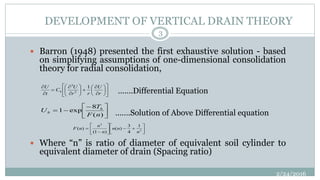
 Barron (1948) presented the first exhaustive solution - based
on simplifying assumptions of one-dimensional consolidation
theory for radial consolidation,
 Where “n” is ratio of diameter of equivalent soil cylinder to
equivalent diameter of drain (Spacing ratio)

























r
U
rr
U
C
t
U
h
1
2
2
(4.1)







)(
8
exp1
nF
T
U h
h













 2
2
1
4
3
)(
)1(
)(
n
nn
n
n
nF (4.4)
2/24/2016
3
…….Differential Equation
…….Solution of Above Differential equation
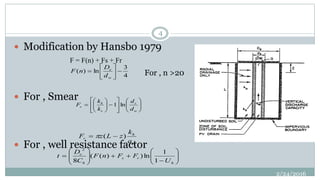
 Modification by Hansbo 1979
 For , Smear
 For , well resistance factor
F = F(n) + Fs + Fr
4
3
ln)( 






w
e
d
D
nF For , n >20





















w
s
s
h
s
d
d
k
k
F ln1
w
h
r
q
k
zLzF )(  
















h
rs
h
e
U
FFnF
C
D
t
1
1
ln))((
8
2
2/24/2016
4
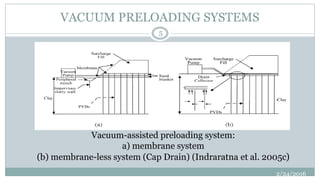
VACUUM PRELOADING SYSTEMS
Vacuum-assisted preloading system:
a) membrane system
(b) membrane-less system (Cap Drain) (Indraratna et al. 2005c)
2/24/2016
5
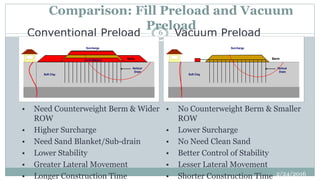
Comparison: Fill Preload and Vacuum
Preload
Conventional Preload Vacuum Preload
Soft Clay
Vertical
Drain
Surcharge
Sand Blanket Berm
Soft Clay
Vertical
Drain
Surcharge
Berm
• Need Counterweight Berm & Wider
ROW
• Higher Surcharge
• Need Sand Blanket/Sub-drain
• Lower Stability
• Greater Lateral Movement
• Longer Construction Time
• No Counterweight Berm & Smaller
ROW
• Lower Surcharge
• No Need Clean Sand
• Better Control of Stability
• Lesser Lateral Movement
• Shorter Construction Time 2/24/2016
6
REVIEW OF LITERATURE
1. Settlements due to vacuum preloading
Mohamedelhassan and Shang (2002)
Combined application of vacuum and fill loads resulted in an increase
in rate and magnitude of settlement.
Under similar loading conditions, both vacuum and equivalent fill
preload generate a similar settlement response
Principal of superposition valid and justifies use of available
consolidation theories for designing the preloading projects involving
vacuum as a preload
2/24/2016
7
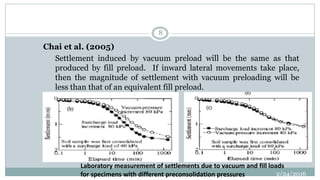
Chai et al. (2005)
Settlement induced by vacuum preload will be the same as that
produced by fill preload. If inward lateral movements take place,
then the magnitude of settlement with vacuum preloading will be
less than that of an equivalent fill preload.
Laboratory measurement of settlements due to vacuum and fill loads
for specimens with different preconsolidation pressures 2/24/2016
8
2. Increases in Shear Strength due to Vacuum
Preloading
Mesri and Khan (2012)
All empirical concepts concerning undrained shear
strength of soft clay and silt deposits developed
based on fill loading equally applicable to vacuum
loading.
The increases in undrained shear strength of soft
clay and silt deposits resulting from consolidation
under a vacuum load and equivalent fill load, for all
practical purposes, are identical.
3. Vacuum Preloading Techniques-
Experimental Contribution
Indraratna (2004) and Rujiakiatkamjorn
(2007)
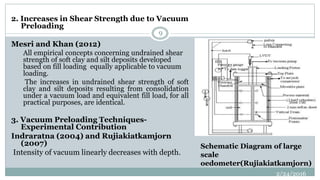
Intensity of vacuum linearly decreases with depth.
Schematic Diagram of large
scale
oedometer(Rujiakiatkamjorn)
2/24/2016
9
Saowapakpiboon and Bergado (2010)
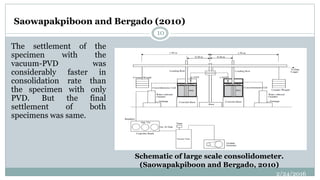
Schematic of large scale consolidometer.
(Saowapakpiboon and Bergado, 2010)
The settlement of the
specimen with the
vacuum-PVD was
considerably faster in
consolidation rate than
the specimen with only
PVD. But the final
settlement of both
specimens was same.
2/24/2016
10
4. Porewater pressure generation and dissipation
Mohamedelhassan and Shang (2002)
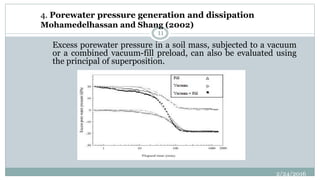
Excess porewater pressure in a soil mass, subjected to a vacuum
or a combined vacuum-fill preload, can also be evaluated using
the principal of superposition.
2/24/2016
11
CRITICAL COMMENTS
 Mohammedalhassan and Shang (2002) suggested that,
Magnitude of settlement and its rate under one-
dimensional condition surcharge and vacuum of the same
magnitude produce almost identical settlements whereas
Chai et al. (2005a) found that even under one- dimensional
condition, the higher the initial vertical effective stress is,
the smaller the settlement will be in the case of vacuum 3 D
consolidation
 No one tested the undisturbed sample till now
 Most of the work has been done in the abroad 2/24/2016
12
OBJECTIVES
 To evaluate engineering properties of reconstituted sample of
soft marine clay.
 To test reconstituted sample to evaluate 3-Dimensional
consolidation parameters and draw isochrones accurately by
measuring pore pressure with pressure cell.
 To check predominated laboratory undrained shear strength
along with vacuum preloading using PVD.
 To evaluate compressibility parameters under 3-D flow due to
vacuum consolidation with prefabricated vertical drains (PVD).
2/24/2016
13
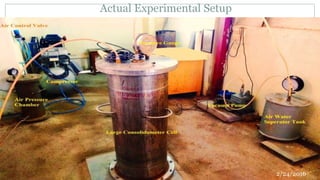
Actual Experimental Setup
2/24/2016
14
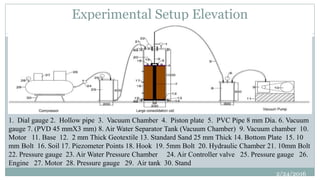
Experimental Setup Elevation
2/24/2016
15
1. Dial gauge 2. Hollow pipe 3. Vacuum Chamber 4. Piston plate 5. PVC Pipe 8 mm Dia. 6. Vacuum
gauge 7. (PVD 45 mmX3 mm) 8. Air Water Separator Tank (Vacuum Chamber) 9. Vacuum chamber 10.
Motor 11. Base 12. 2 mm Thick Geotextile 13. Standard Sand 25 mm Thick 14. Bottom Plate 15. 10
mm Bolt 16. Soil 17. Piezometer Points 18. Hook 19. 5mm Bolt 20. Hydraulic Chamber 21. 10mm Bolt
22. Pressure gauge 23. Air Water Pressure Chamber 24. Air Controller valve 25. Pressure gauge 26.
Engine 27. Motor 28. Pressure gauge 29. Air tank 30. Stand
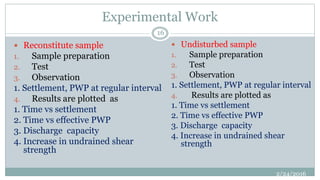
Experimental Work
2/24/2016
16
 Reconstitute sample
1. Sample preparation
2. Test
3. Observation
1. Settlement, PWP at regular interval
4. Results are plotted as
1. Time vs settlement
2. Time vs effective PWP
3. Discharge capacity
4. Increase in undrained shear
strength
 Undisturbed sample
1. Sample preparation
2. Test
3. Observation
1. Settlement, PWP at regular interval
4. Results are plotted as
1. Time vs settlement
2. Time vs effective PWP
3. Discharge capacity
4. Increase in undrained shear
strength
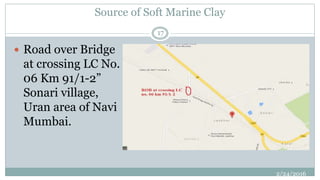
Source of Soft Marine Clay
 Road over Bridge
at crossing LC No.
06 Km 91/1-2”
Sonari village,
Uran area of Navi
Mumbai.
2/24/2016
17
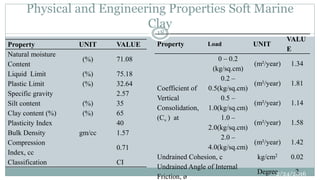
Physical and Engineering Properties Soft Marine
Clay
Property UNIT VALUE
Natural moisture
Content
(%) 71.08
Liquid Limit (%) 75.18
Plastic Limit (%) 32.64
Specific gravity 2.57
Silt content (%) 35
Clay content (%) (%) 65
Plasticity Index 40
Bulk Density gm/cc 1.57
Compression
Index, cc
0.71
Classification CI
Property Load UNIT
VALU
E
Coefficient of
Vertical
Consolidation,
(Cv ) at
0 – 0.2
(kg/sq.cm)
(m²/year) 1.34
0.2 –
0.5(kg/sq.cm)
(m²/year) 1.81
0.5 –
1.0(kg/sq.cm)
(m²/year) 1.14
1.0 –
2.0(kg/sq.cm)
(m²/year) 1.58
2.0 –
4.0(kg/sq.cm)
(m²/year) 1.42
Undrained Cohesion, c kg/cm2 0.02
Undrained Angle of Internal
Friction, ø
Degree 22/24/2016
18
Reconstitute Sample
1. Sampling Process
2. Test
i) Surcharge 0.6 kg/sq.cm and Vacuum 1.0
kg/sq.cm(Test 1)
ii) Surcharge 1.0 kg/sq.cm and Vacuum 1.0
kg/sq.cm(Test 2)
2/24/2016
19
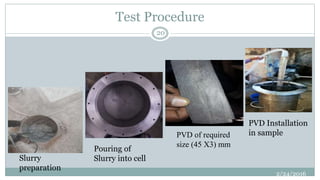
Test Procedure
2/24/2016
20
Slurry
preparation
Pouring of
Slurry into cell
PVD of required
size (45 X3) mm
PVD Installation
in sample
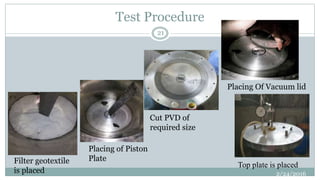
Test Procedure
2/24/2016
21
Filter geotextile
is placed
Placing of Piston
Plate
Cut PVD of
required size
Placing Of Vacuum lid
Top plate is placed
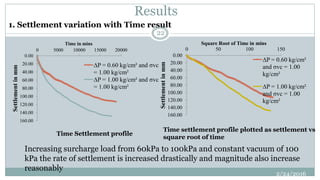
Results
0.00
20.00
40.00
60.00
80.00
100.00
120.00
140.00
160.00
0 5000 10000 15000 20000
Settlementinmm
Time in mins
∆P = 0.60 kg/cm² and σvc
= 1.00 kg/cm²
∆P = 1.00 kg/cm² and σvc
= 1.00 kg/cm²
0.00
20.00
40.00
60.00
80.00
100.00
120.00
140.00
160.00
0 50 100 150
Settlementinmm
Square Root of Time in mins
∆P = 0.60 kg/cm²
and σvc = 1.00
kg/cm²
∆P = 1.00 kg/cm²
and σvc = 1.00
kg/cm²
Increasing surcharge load from 60kPa to 100kPa and constant vacuum of 100
kPa the rate of settlement is increased drastically and magnitude also increase
reasonably
Time Settlement profile
Time settlement profile plotted as settlement vs
square root of time
1. Settlement variation with Time result
2/24/2016
22
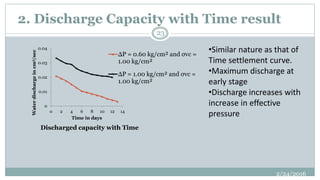
2. Discharge Capacity with Time result
0
0.01
0.02
0.03
0.04
0 2 4 6 8 10 12 14
Waterdischargeincm3/sec
Time in days
∆P = 0.60 kg/cm² and σvc =
1.00 kg/cm²
∆P = 1.00 kg/cm² and σvc =
1.00 kg/cm²
Discharged capacity with Time
•Similar nature as that of
Time settlement curve.
•Maximum discharge at
early stage
•Discharge increases with
increase in effective
pressure
2/24/2016
23
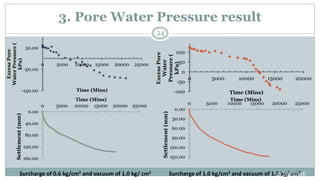
3. Pore Water Pressure result
-150.00
-50.00
50.00
0 5000 10000 15000 20000 25000
ExcessPore
WaterPressure(
kPa)
Time (Mins) -100
-50
0
50
100
0 5000 10000 15000 20000
ExcessPore
Water
Pressure(
kPa)
Time (Mins)
0.00
40.00
80.00
120.00
160.00
0 5000 10000 15000 20000 25000
Settlement(mm)
Time (Mins)
0.00
30.00
60.00
90.00
120.00
150.00
0 5000 10000 15000 20000 25000
Settlement(mm)
Time (Mins)
Surcharge of 0.6 kg/cm2 and vacuum of 1.0 kg/ cm2 Surcharge of 1.0 kg/cm2 and vacuum of 1.0 kg/ cm2
2/24/2016
24
Geotechnical and Physical properties of improved clay samples
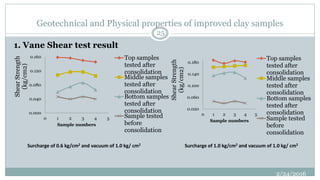
1. Vane Shear test result
0.000
0.040
0.080
0.120
0.160
0 1 2 3 4 5
ShearStrength
(kg/cm2)
Sample numbers
Top samples
tested after
consolidation
Middle samples
tested after
consolidation
Bottom samples
tested after
consolidation
Sample tested
before
consolidation
0.020
0.060
0.100
0.140
0.180
0 1 2 3 4 5
ShearStrength
(kg/cm2)
Sample numbers
Top samples
tested after
consolidation
Middle samples
tested after
consolidation
Bottom samples
tested after
consolidation
Sample tested
before
consolidation
Surcharge of 0.6 kg/cm2 and vacuum of 1.0 kg/ cm2 Surcharge of 1.0 kg/cm2 and vacuum of 1.0 kg/ cm2
2/24/2016
25
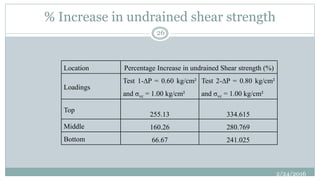
% Increase in undrained shear strength
2/24/2016
26
Location Percentage Increase in undrained Shear strength (%)
Loadings
Test 1-∆P = 0.60 kg/cm²
and σvc = 1.00 kg/cm²
Test 2-∆P = 0.80 kg/cm²
and σvc = 1.00 kg/cm²
Top
255.13 334.615
Middle 160.26 280.769
Bottom 66.67 241.025
Geotechnical and Physical properties of improved clay samples
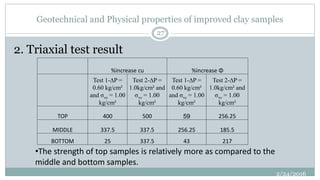
2. Triaxial test result
%increase cu %increase Φ
Test 1-∆P =
0.60 kg/cm²
and σvc = 1.00
kg/cm²
Test 2-∆P =
1.0kg/cm² and
σvc = 1.00
kg/cm²
Test 1-∆P =
0.60 kg/cm²
and σvc = 1.00
kg/cm²
Test 2-∆P =
1.0kg/cm² and
σvc = 1.00
kg/cm²
TOP 400 500 59 256.25
MIDDLE 337.5 337.5 256.25 185.5
BOTTOM 25 337.5 43 217
•The strength of top samples is relatively more as compared to the
middle and bottom samples.
2/24/2016
27
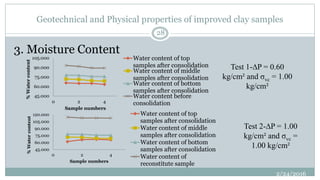
3. Moisture Content
Geotechnical and Physical properties of improved clay samples
45.000
60.000
75.000
90.000
105.000
0 2 4
%Watercontent
Sample numbers
Water content of top
samples after consolidation
Water content of middle
samples after consolidation
Water content of bottom
samples after consolidation
Water content before
consolidation
45.000
60.000
75.000
90.000
105.000
120.000
0 2 4
%Watercontent
Sample numbers
Water content of top
samples after consolidation
Water content of middle
samples after consolidation
Water content of bottom
samples after consolidation
Water content of
reconstitute sample
Test 1-∆P = 0.60
kg/cm² and σvc = 1.00
kg/cm²
Test 2-∆P = 1.00
kg/cm² and σvc =
1.00 kg/cm²
2/24/2016
28
Undisturbed Sample
1. Sampling Process
2. Test
i) Surcharge 0.6 kg/sq.cm and Vacuum 1.0
kg/sq.cm(Test 3)
2/24/2016
29
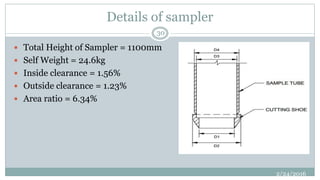
Details of sampler
 Total Height of Sampler = 1100mm
 Self Weight = 24.6kg
 Inside clearance = 1.56%
 Outside clearance = 1.23%
 Area ratio = 6.34%
2/24/2016
30
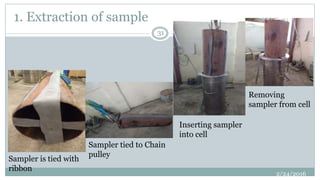
1. Extraction of sample
2/24/2016
31
Sampler is tied with
ribbon
Sampler tied to Chain
pulley
Inserting sampler
into cell
Removing
sampler from cell
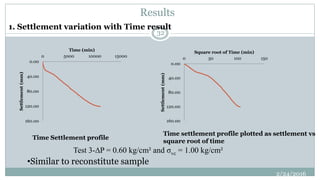
Results
1. Settlement variation with Time result
0.00
40.00
80.00
120.00
160.00
0 5000 10000 15000
Settlement(mm)
Time (min)
0.00
40.00
80.00
120.00
160.00
0 50 100 150
Settlement(mm)
Square root of Time (min)
Test 3-∆P = 0.60 kg/cm² and σvc = 1.00 kg/cm²
Time Settlement profile
Time settlement profile plotted as settlement vs
square root of time
•Similar to reconstitute sample
2/24/2016
32
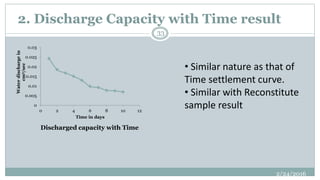
2. Discharge Capacity with Time result
Discharged capacity with Time
• Similar nature as that of
Time settlement curve.
• Similar with Reconstitute
sample result0
0.005
0.01
0.015
0.02
0.025
0.03
0 2 4 6 8 10 12
Waterdischargein
cm3/sec
Time in days
2/24/2016
33
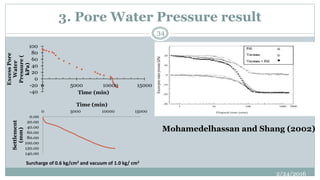
3. Pore Water Pressure result
Surcharge of 0.6 kg/cm2 and vacuum of 1.0 kg/ cm2
-40
-20
0
20
40
60
80
100
0 5000 10000 15000
ExcessPore
Water
Pressure(
kPa)
Time (min)
0.00
20.00
40.00
60.00
80.00
100.00
120.00
140.00
0 5000 10000 15000
Settlement
(mm)
Time (min)
Mohamedelhassan and Shang (2002)
2/24/2016
34
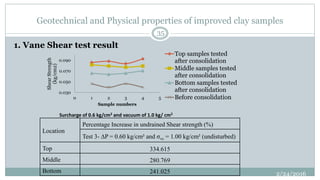
Geotechnical and Physical properties of improved clay samples
1. Vane Shear test result
Surcharge of 0.6 kg/cm2 and vacuum of 1.0 kg/ cm2
0.030
0.050
0.070
0.090
0 1 2 3 4 5
ShearStrength
(kg/cm2)
Sample numbers
Top samples tested
after consolidation
Middle samples tested
after consolidation
Bottom samples tested
after consolidation
Before consolidation
Location
Percentage Increase in undrained Shear strength (%)
Test 3- ∆P = 0.60 kg/cm² and σvc = 1.00 kg/cm² (undisturbed)
Top 334.615
Middle 280.769
Bottom 241.025 2/24/2016
35
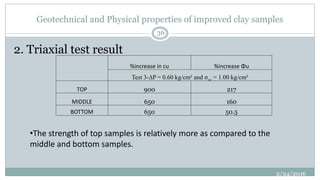
Geotechnical and Physical properties of improved clay samples
2. Triaxial test result
%increase in cu %increase Φu
Test 3-∆P = 0.60 kg/cm² and σvc = 1.00 kg/cm²
TOP 900 217
MIDDLE 650 160
BOTTOM 650 50.5
•The strength of top samples is relatively more as compared to the
middle and bottom samples.
2/24/2016
36
3. Moisture Content
Geotechnical and Physical properties of improved clay samples
Test 3-∆P = 0.60 kg/cm² and σvc = 1.00 kg/cm²
50.000
65.000
80.000
95.000
0 2 4 6
%Watercontent
Sample numbers
Water content of top
samples after consolidation
Water content of middle
samples after consolidation
Water content of bottom
samples after consolidation
Water content before
consolidation
•Moisture content of
Undisturbed sample was
reduced in the range of 30
to 35% .
2/24/2016
37
Conclusion
 Increase in surcharge load increases the rate of consolidation.
 Gain in shear strength and reduction in moisture content are
significant especially when specimen consolidated under
higher vacuum pressure.
 Pore pressure variation with time is in good agreement with
settlement profile but having slower rate.
 Results obtained for reconstituted sample and undisturbed
sample are similar so, there is no need of testing undisturbed
sample. Results of reconstituted samples can be used for
determine consolidation parameters.
2/24/2016
38
References
2/24/2016
39
 Barron, R.A. (1948), Consolidation of fine-grained soils by drain wells, Trans. ASCE No. 2346, pp. 718-754.
 Mohamedelhassan, E. and Shang, J.Q. (2002). “Vacuum and surcharge combined one dimensional consolidation of
clay soils”. Can. Geotechnique, J 39, 1126 -1138
 Saowapakpiboon, J., Bergado, D.T., Chai, J.C., Kovittayanon, N. and Zwart, T.P. (2010). “Vacuum –PVD combination
with embankment loading consolidation in soft Bangkok clay: A case study of the Suvarnabhumi airport project”.
Proc.Of the 4thAsian Regional Conference on Geosynthetics, Shanghai – China. 440 – 449
 Kjellman.(1952). “Consolidation of clay soil by means of Atmospheric pressure”. Proc., Conference on soil stabilization,
MIT, 258 – 263
 Bergado, D.T., Miura, N., Singh, N., and Panichayatum, B. (1988), Improvement of soft Bangkok clay using vertical
band drains based on full-scale test, Proc. Int. Conf. Eng'g. Problems of Reg. Soils, Beijing, China, pp. 379-384.
 Leong, E.C., Soemitro, R.A.A. and Rahardjo, H. (2000).“Soil improvement by surcharge and vacuum preloading”.
Geotechnique 50, No. 5, 601 – 605
 Bergado, D.T., Alfaro, M.C., and Balasubramaniam, A.S. (1993a), Improvement of soft Bangkok clay using vertical
drains, Geotextiles and Geomembranes J., Vol. 12, No. 7, pp. 615-664.
 Hansbo, S. (1979), Consolidation of fine-grained soils by prefabricated drains, Proc. 10th Intl. Conf. Soil Mech. and
Found. Eng'g., Stockholm, Vol. 3, pp. 12-22.
 Mesri, G. (1973), Coefficient of secondary compression, J. Soil Mech. and Found. Div., ASCE, Vol. 99, No. SMI, pp.
123-147.
References
2/24/2016
40
 Bergado, D.T., Balasubramaniam, A.S., Fannin, R.J. and Holtz, R.D. (2002). “PVD in soft Bangkok
clay; A case study of New Bangkok International Airport Project”. Can. Geotechnique, J 39, 304 – 315
 Rujikiatkamjorn.C. and Indraratna, B. (2005). “Soft ground improvement by vacuum assisted
preloading”. University of Wollongong
 Chai, J.C., Carter, J.P. and Hayashi, S. (2005). “Ground deformation induced by vacuum
consolidation” Journal of Geotechnical and Geoenvironmental Engineering, ASCE. 1552 – 1561
 Shang J.Q., Tang, M. and Miao, Z. (1998). “Vacuum preloading consolidation of reclaimed land: a case
study”. Can. Geotechnique, J 35, 740 – 749
 Yan, S.W. and Chu, J. (2005).“Soil improvement for a storage yard using the combined vacuum and
fill preloading method”. Canadian Geotechnique, J 42, 1094 – 1104
 Rujikiatkamjorn.C. and Indraratna, B. (2007).“Analysis of Radial Vacuum-Assisted Consolidation
Using 3D Finite Element Method”. University of Wollongong
 Chu, J., Yan, S.W. and Yang, H (2000).“Soil improvement by the vacuum preloading method for an oil
storage station”. Geotechnique 50, No. 6, 625 - 632
 Terzaghi, K. (1943), Theoretical soil mechanics, John Wiley and Sons, New York.
 Advanced Foundation Engineering by B. M. Das
 IS 1892-1979 Code of practice for subsurface investigation for foundation.
2/24/2016
41
Thank You

3d consolidation test

  • 1.
    PRESENTATION ON 3-Dimensional ConsolidationTest on Soft Marine Clay under Vacuum Preloading With PVD By Pankaj Dhangare Roll No. 142040013 S.Y. M.-Tech Structures, VJTI, Mumbai Under the guidance of Prof. Dr. V. B. Deshmukh 2/24/2016 1
  • 2.
    INTRODUCTION  Infrastructure developmentBasic need  Costal roads  Airports,  Bus Terminals, Housing Projects, Landfills  Major Problems with the construction  Existence of soft marine clay along the coastal region  Low SBC, Low permeability, High Magnitude of Settlement  Time  Environment 2/24/2016 2
  • 3.
    DEVELOPMENT OF VERTICALDRAIN THEORY  Barron (1948) presented the first exhaustive solution - based on simplifying assumptions of one-dimensional consolidation theory for radial consolidation,  Where “n” is ratio of diameter of equivalent soil cylinder to equivalent diameter of drain (Spacing ratio)                          r U rr U C t U h 1 2 2 (4.1)        )( 8 exp1 nF T U h h               2 2 1 4 3 )( )1( )( n nn n n nF (4.4) 2/24/2016 3 …….Differential Equation …….Solution of Above Differential equation
  • 4.
     Modification byHansbo 1979  For , Smear  For , well resistance factor F = F(n) + Fs + Fr 4 3 ln)(        w e d D nF For , n >20                      w s s h s d d k k F ln1 w h r q k zLzF )(                   h rs h e U FFnF C D t 1 1 ln))(( 8 2 2/24/2016 4
  • 5.
    VACUUM PRELOADING SYSTEMS Vacuum-assistedpreloading system: a) membrane system (b) membrane-less system (Cap Drain) (Indraratna et al. 2005c) 2/24/2016 5
  • 6.
    Comparison: Fill Preloadand Vacuum Preload Conventional Preload Vacuum Preload Soft Clay Vertical Drain Surcharge Sand Blanket Berm Soft Clay Vertical Drain Surcharge Berm • Need Counterweight Berm & Wider ROW • Higher Surcharge • Need Sand Blanket/Sub-drain • Lower Stability • Greater Lateral Movement • Longer Construction Time • No Counterweight Berm & Smaller ROW • Lower Surcharge • No Need Clean Sand • Better Control of Stability • Lesser Lateral Movement • Shorter Construction Time 2/24/2016 6
  • 7.
    REVIEW OF LITERATURE 1.Settlements due to vacuum preloading Mohamedelhassan and Shang (2002) Combined application of vacuum and fill loads resulted in an increase in rate and magnitude of settlement. Under similar loading conditions, both vacuum and equivalent fill preload generate a similar settlement response Principal of superposition valid and justifies use of available consolidation theories for designing the preloading projects involving vacuum as a preload 2/24/2016 7
  • 8.
    Chai et al.(2005) Settlement induced by vacuum preload will be the same as that produced by fill preload. If inward lateral movements take place, then the magnitude of settlement with vacuum preloading will be less than that of an equivalent fill preload. Laboratory measurement of settlements due to vacuum and fill loads for specimens with different preconsolidation pressures 2/24/2016 8
  • 9.
    2. Increases inShear Strength due to Vacuum Preloading Mesri and Khan (2012) All empirical concepts concerning undrained shear strength of soft clay and silt deposits developed based on fill loading equally applicable to vacuum loading. The increases in undrained shear strength of soft clay and silt deposits resulting from consolidation under a vacuum load and equivalent fill load, for all practical purposes, are identical. 3. Vacuum Preloading Techniques- Experimental Contribution Indraratna (2004) and Rujiakiatkamjorn (2007) Intensity of vacuum linearly decreases with depth. Schematic Diagram of large scale oedometer(Rujiakiatkamjorn) 2/24/2016 9
  • 10.
    Saowapakpiboon and Bergado(2010) Schematic of large scale consolidometer. (Saowapakpiboon and Bergado, 2010) The settlement of the specimen with the vacuum-PVD was considerably faster in consolidation rate than the specimen with only PVD. But the final settlement of both specimens was same. 2/24/2016 10
  • 11.
    4. Porewater pressuregeneration and dissipation Mohamedelhassan and Shang (2002) Excess porewater pressure in a soil mass, subjected to a vacuum or a combined vacuum-fill preload, can also be evaluated using the principal of superposition. 2/24/2016 11
  • 12.
    CRITICAL COMMENTS  Mohammedalhassanand Shang (2002) suggested that, Magnitude of settlement and its rate under one- dimensional condition surcharge and vacuum of the same magnitude produce almost identical settlements whereas Chai et al. (2005a) found that even under one- dimensional condition, the higher the initial vertical effective stress is, the smaller the settlement will be in the case of vacuum 3 D consolidation  No one tested the undisturbed sample till now  Most of the work has been done in the abroad 2/24/2016 12
  • 13.
    OBJECTIVES  To evaluateengineering properties of reconstituted sample of soft marine clay.  To test reconstituted sample to evaluate 3-Dimensional consolidation parameters and draw isochrones accurately by measuring pore pressure with pressure cell.  To check predominated laboratory undrained shear strength along with vacuum preloading using PVD.  To evaluate compressibility parameters under 3-D flow due to vacuum consolidation with prefabricated vertical drains (PVD). 2/24/2016 13
  • 14.
  • 15.
    Experimental Setup Elevation 2/24/2016 15 1.Dial gauge 2. Hollow pipe 3. Vacuum Chamber 4. Piston plate 5. PVC Pipe 8 mm Dia. 6. Vacuum gauge 7. (PVD 45 mmX3 mm) 8. Air Water Separator Tank (Vacuum Chamber) 9. Vacuum chamber 10. Motor 11. Base 12. 2 mm Thick Geotextile 13. Standard Sand 25 mm Thick 14. Bottom Plate 15. 10 mm Bolt 16. Soil 17. Piezometer Points 18. Hook 19. 5mm Bolt 20. Hydraulic Chamber 21. 10mm Bolt 22. Pressure gauge 23. Air Water Pressure Chamber 24. Air Controller valve 25. Pressure gauge 26. Engine 27. Motor 28. Pressure gauge 29. Air tank 30. Stand
  • 16.
    Experimental Work 2/24/2016 16  Reconstitutesample 1. Sample preparation 2. Test 3. Observation 1. Settlement, PWP at regular interval 4. Results are plotted as 1. Time vs settlement 2. Time vs effective PWP 3. Discharge capacity 4. Increase in undrained shear strength  Undisturbed sample 1. Sample preparation 2. Test 3. Observation 1. Settlement, PWP at regular interval 4. Results are plotted as 1. Time vs settlement 2. Time vs effective PWP 3. Discharge capacity 4. Increase in undrained shear strength
  • 17.
    Source of SoftMarine Clay  Road over Bridge at crossing LC No. 06 Km 91/1-2” Sonari village, Uran area of Navi Mumbai. 2/24/2016 17
  • 18.
    Physical and EngineeringProperties Soft Marine Clay Property UNIT VALUE Natural moisture Content (%) 71.08 Liquid Limit (%) 75.18 Plastic Limit (%) 32.64 Specific gravity 2.57 Silt content (%) 35 Clay content (%) (%) 65 Plasticity Index 40 Bulk Density gm/cc 1.57 Compression Index, cc 0.71 Classification CI Property Load UNIT VALU E Coefficient of Vertical Consolidation, (Cv ) at 0 – 0.2 (kg/sq.cm) (m²/year) 1.34 0.2 – 0.5(kg/sq.cm) (m²/year) 1.81 0.5 – 1.0(kg/sq.cm) (m²/year) 1.14 1.0 – 2.0(kg/sq.cm) (m²/year) 1.58 2.0 – 4.0(kg/sq.cm) (m²/year) 1.42 Undrained Cohesion, c kg/cm2 0.02 Undrained Angle of Internal Friction, ø Degree 22/24/2016 18
  • 19.
    Reconstitute Sample 1. SamplingProcess 2. Test i) Surcharge 0.6 kg/sq.cm and Vacuum 1.0 kg/sq.cm(Test 1) ii) Surcharge 1.0 kg/sq.cm and Vacuum 1.0 kg/sq.cm(Test 2) 2/24/2016 19
  • 20.
    Test Procedure 2/24/2016 20 Slurry preparation Pouring of Slurryinto cell PVD of required size (45 X3) mm PVD Installation in sample
  • 21.
    Test Procedure 2/24/2016 21 Filter geotextile isplaced Placing of Piston Plate Cut PVD of required size Placing Of Vacuum lid Top plate is placed
  • 22.
    Results 0.00 20.00 40.00 60.00 80.00 100.00 120.00 140.00 160.00 0 5000 1000015000 20000 Settlementinmm Time in mins ∆P = 0.60 kg/cm² and σvc = 1.00 kg/cm² ∆P = 1.00 kg/cm² and σvc = 1.00 kg/cm² 0.00 20.00 40.00 60.00 80.00 100.00 120.00 140.00 160.00 0 50 100 150 Settlementinmm Square Root of Time in mins ∆P = 0.60 kg/cm² and σvc = 1.00 kg/cm² ∆P = 1.00 kg/cm² and σvc = 1.00 kg/cm² Increasing surcharge load from 60kPa to 100kPa and constant vacuum of 100 kPa the rate of settlement is increased drastically and magnitude also increase reasonably Time Settlement profile Time settlement profile plotted as settlement vs square root of time 1. Settlement variation with Time result 2/24/2016 22
  • 23.
    2. Discharge Capacitywith Time result 0 0.01 0.02 0.03 0.04 0 2 4 6 8 10 12 14 Waterdischargeincm3/sec Time in days ∆P = 0.60 kg/cm² and σvc = 1.00 kg/cm² ∆P = 1.00 kg/cm² and σvc = 1.00 kg/cm² Discharged capacity with Time •Similar nature as that of Time settlement curve. •Maximum discharge at early stage •Discharge increases with increase in effective pressure 2/24/2016 23
  • 24.
    3. Pore WaterPressure result -150.00 -50.00 50.00 0 5000 10000 15000 20000 25000 ExcessPore WaterPressure( kPa) Time (Mins) -100 -50 0 50 100 0 5000 10000 15000 20000 ExcessPore Water Pressure( kPa) Time (Mins) 0.00 40.00 80.00 120.00 160.00 0 5000 10000 15000 20000 25000 Settlement(mm) Time (Mins) 0.00 30.00 60.00 90.00 120.00 150.00 0 5000 10000 15000 20000 25000 Settlement(mm) Time (Mins) Surcharge of 0.6 kg/cm2 and vacuum of 1.0 kg/ cm2 Surcharge of 1.0 kg/cm2 and vacuum of 1.0 kg/ cm2 2/24/2016 24
  • 25.
    Geotechnical and Physicalproperties of improved clay samples 1. Vane Shear test result 0.000 0.040 0.080 0.120 0.160 0 1 2 3 4 5 ShearStrength (kg/cm2) Sample numbers Top samples tested after consolidation Middle samples tested after consolidation Bottom samples tested after consolidation Sample tested before consolidation 0.020 0.060 0.100 0.140 0.180 0 1 2 3 4 5 ShearStrength (kg/cm2) Sample numbers Top samples tested after consolidation Middle samples tested after consolidation Bottom samples tested after consolidation Sample tested before consolidation Surcharge of 0.6 kg/cm2 and vacuum of 1.0 kg/ cm2 Surcharge of 1.0 kg/cm2 and vacuum of 1.0 kg/ cm2 2/24/2016 25
  • 26.
    % Increase inundrained shear strength 2/24/2016 26 Location Percentage Increase in undrained Shear strength (%) Loadings Test 1-∆P = 0.60 kg/cm² and σvc = 1.00 kg/cm² Test 2-∆P = 0.80 kg/cm² and σvc = 1.00 kg/cm² Top 255.13 334.615 Middle 160.26 280.769 Bottom 66.67 241.025
  • 27.
    Geotechnical and Physicalproperties of improved clay samples 2. Triaxial test result %increase cu %increase Φ Test 1-∆P = 0.60 kg/cm² and σvc = 1.00 kg/cm² Test 2-∆P = 1.0kg/cm² and σvc = 1.00 kg/cm² Test 1-∆P = 0.60 kg/cm² and σvc = 1.00 kg/cm² Test 2-∆P = 1.0kg/cm² and σvc = 1.00 kg/cm² TOP 400 500 59 256.25 MIDDLE 337.5 337.5 256.25 185.5 BOTTOM 25 337.5 43 217 •The strength of top samples is relatively more as compared to the middle and bottom samples. 2/24/2016 27
  • 28.
    3. Moisture Content Geotechnicaland Physical properties of improved clay samples 45.000 60.000 75.000 90.000 105.000 0 2 4 %Watercontent Sample numbers Water content of top samples after consolidation Water content of middle samples after consolidation Water content of bottom samples after consolidation Water content before consolidation 45.000 60.000 75.000 90.000 105.000 120.000 0 2 4 %Watercontent Sample numbers Water content of top samples after consolidation Water content of middle samples after consolidation Water content of bottom samples after consolidation Water content of reconstitute sample Test 1-∆P = 0.60 kg/cm² and σvc = 1.00 kg/cm² Test 2-∆P = 1.00 kg/cm² and σvc = 1.00 kg/cm² 2/24/2016 28
  • 29.
    Undisturbed Sample 1. SamplingProcess 2. Test i) Surcharge 0.6 kg/sq.cm and Vacuum 1.0 kg/sq.cm(Test 3) 2/24/2016 29
  • 30.
    Details of sampler Total Height of Sampler = 1100mm  Self Weight = 24.6kg  Inside clearance = 1.56%  Outside clearance = 1.23%  Area ratio = 6.34% 2/24/2016 30
  • 31.
    1. Extraction ofsample 2/24/2016 31 Sampler is tied with ribbon Sampler tied to Chain pulley Inserting sampler into cell Removing sampler from cell
  • 32.
    Results 1. Settlement variationwith Time result 0.00 40.00 80.00 120.00 160.00 0 5000 10000 15000 Settlement(mm) Time (min) 0.00 40.00 80.00 120.00 160.00 0 50 100 150 Settlement(mm) Square root of Time (min) Test 3-∆P = 0.60 kg/cm² and σvc = 1.00 kg/cm² Time Settlement profile Time settlement profile plotted as settlement vs square root of time •Similar to reconstitute sample 2/24/2016 32
  • 33.
    2. Discharge Capacitywith Time result Discharged capacity with Time • Similar nature as that of Time settlement curve. • Similar with Reconstitute sample result0 0.005 0.01 0.015 0.02 0.025 0.03 0 2 4 6 8 10 12 Waterdischargein cm3/sec Time in days 2/24/2016 33
  • 34.
    3. Pore WaterPressure result Surcharge of 0.6 kg/cm2 and vacuum of 1.0 kg/ cm2 -40 -20 0 20 40 60 80 100 0 5000 10000 15000 ExcessPore Water Pressure( kPa) Time (min) 0.00 20.00 40.00 60.00 80.00 100.00 120.00 140.00 0 5000 10000 15000 Settlement (mm) Time (min) Mohamedelhassan and Shang (2002) 2/24/2016 34
  • 35.
    Geotechnical and Physicalproperties of improved clay samples 1. Vane Shear test result Surcharge of 0.6 kg/cm2 and vacuum of 1.0 kg/ cm2 0.030 0.050 0.070 0.090 0 1 2 3 4 5 ShearStrength (kg/cm2) Sample numbers Top samples tested after consolidation Middle samples tested after consolidation Bottom samples tested after consolidation Before consolidation Location Percentage Increase in undrained Shear strength (%) Test 3- ∆P = 0.60 kg/cm² and σvc = 1.00 kg/cm² (undisturbed) Top 334.615 Middle 280.769 Bottom 241.025 2/24/2016 35
  • 36.
    Geotechnical and Physicalproperties of improved clay samples 2. Triaxial test result %increase in cu %increase Φu Test 3-∆P = 0.60 kg/cm² and σvc = 1.00 kg/cm² TOP 900 217 MIDDLE 650 160 BOTTOM 650 50.5 •The strength of top samples is relatively more as compared to the middle and bottom samples. 2/24/2016 36
  • 37.
    3. Moisture Content Geotechnicaland Physical properties of improved clay samples Test 3-∆P = 0.60 kg/cm² and σvc = 1.00 kg/cm² 50.000 65.000 80.000 95.000 0 2 4 6 %Watercontent Sample numbers Water content of top samples after consolidation Water content of middle samples after consolidation Water content of bottom samples after consolidation Water content before consolidation •Moisture content of Undisturbed sample was reduced in the range of 30 to 35% . 2/24/2016 37
  • 38.
    Conclusion  Increase insurcharge load increases the rate of consolidation.  Gain in shear strength and reduction in moisture content are significant especially when specimen consolidated under higher vacuum pressure.  Pore pressure variation with time is in good agreement with settlement profile but having slower rate.  Results obtained for reconstituted sample and undisturbed sample are similar so, there is no need of testing undisturbed sample. Results of reconstituted samples can be used for determine consolidation parameters. 2/24/2016 38
  • 39.
    References 2/24/2016 39  Barron, R.A.(1948), Consolidation of fine-grained soils by drain wells, Trans. ASCE No. 2346, pp. 718-754.  Mohamedelhassan, E. and Shang, J.Q. (2002). “Vacuum and surcharge combined one dimensional consolidation of clay soils”. Can. Geotechnique, J 39, 1126 -1138  Saowapakpiboon, J., Bergado, D.T., Chai, J.C., Kovittayanon, N. and Zwart, T.P. (2010). “Vacuum –PVD combination with embankment loading consolidation in soft Bangkok clay: A case study of the Suvarnabhumi airport project”. Proc.Of the 4thAsian Regional Conference on Geosynthetics, Shanghai – China. 440 – 449  Kjellman.(1952). “Consolidation of clay soil by means of Atmospheric pressure”. Proc., Conference on soil stabilization, MIT, 258 – 263  Bergado, D.T., Miura, N., Singh, N., and Panichayatum, B. (1988), Improvement of soft Bangkok clay using vertical band drains based on full-scale test, Proc. Int. Conf. Eng'g. Problems of Reg. Soils, Beijing, China, pp. 379-384.  Leong, E.C., Soemitro, R.A.A. and Rahardjo, H. (2000).“Soil improvement by surcharge and vacuum preloading”. Geotechnique 50, No. 5, 601 – 605  Bergado, D.T., Alfaro, M.C., and Balasubramaniam, A.S. (1993a), Improvement of soft Bangkok clay using vertical drains, Geotextiles and Geomembranes J., Vol. 12, No. 7, pp. 615-664.  Hansbo, S. (1979), Consolidation of fine-grained soils by prefabricated drains, Proc. 10th Intl. Conf. Soil Mech. and Found. Eng'g., Stockholm, Vol. 3, pp. 12-22.  Mesri, G. (1973), Coefficient of secondary compression, J. Soil Mech. and Found. Div., ASCE, Vol. 99, No. SMI, pp. 123-147.
  • 40.
    References 2/24/2016 40  Bergado, D.T.,Balasubramaniam, A.S., Fannin, R.J. and Holtz, R.D. (2002). “PVD in soft Bangkok clay; A case study of New Bangkok International Airport Project”. Can. Geotechnique, J 39, 304 – 315  Rujikiatkamjorn.C. and Indraratna, B. (2005). “Soft ground improvement by vacuum assisted preloading”. University of Wollongong  Chai, J.C., Carter, J.P. and Hayashi, S. (2005). “Ground deformation induced by vacuum consolidation” Journal of Geotechnical and Geoenvironmental Engineering, ASCE. 1552 – 1561  Shang J.Q., Tang, M. and Miao, Z. (1998). “Vacuum preloading consolidation of reclaimed land: a case study”. Can. Geotechnique, J 35, 740 – 749  Yan, S.W. and Chu, J. (2005).“Soil improvement for a storage yard using the combined vacuum and fill preloading method”. Canadian Geotechnique, J 42, 1094 – 1104  Rujikiatkamjorn.C. and Indraratna, B. (2007).“Analysis of Radial Vacuum-Assisted Consolidation Using 3D Finite Element Method”. University of Wollongong  Chu, J., Yan, S.W. and Yang, H (2000).“Soil improvement by the vacuum preloading method for an oil storage station”. Geotechnique 50, No. 6, 625 - 632  Terzaghi, K. (1943), Theoretical soil mechanics, John Wiley and Sons, New York.  Advanced Foundation Engineering by B. M. Das  IS 1892-1979 Code of practice for subsurface investigation for foundation.
  • 41.