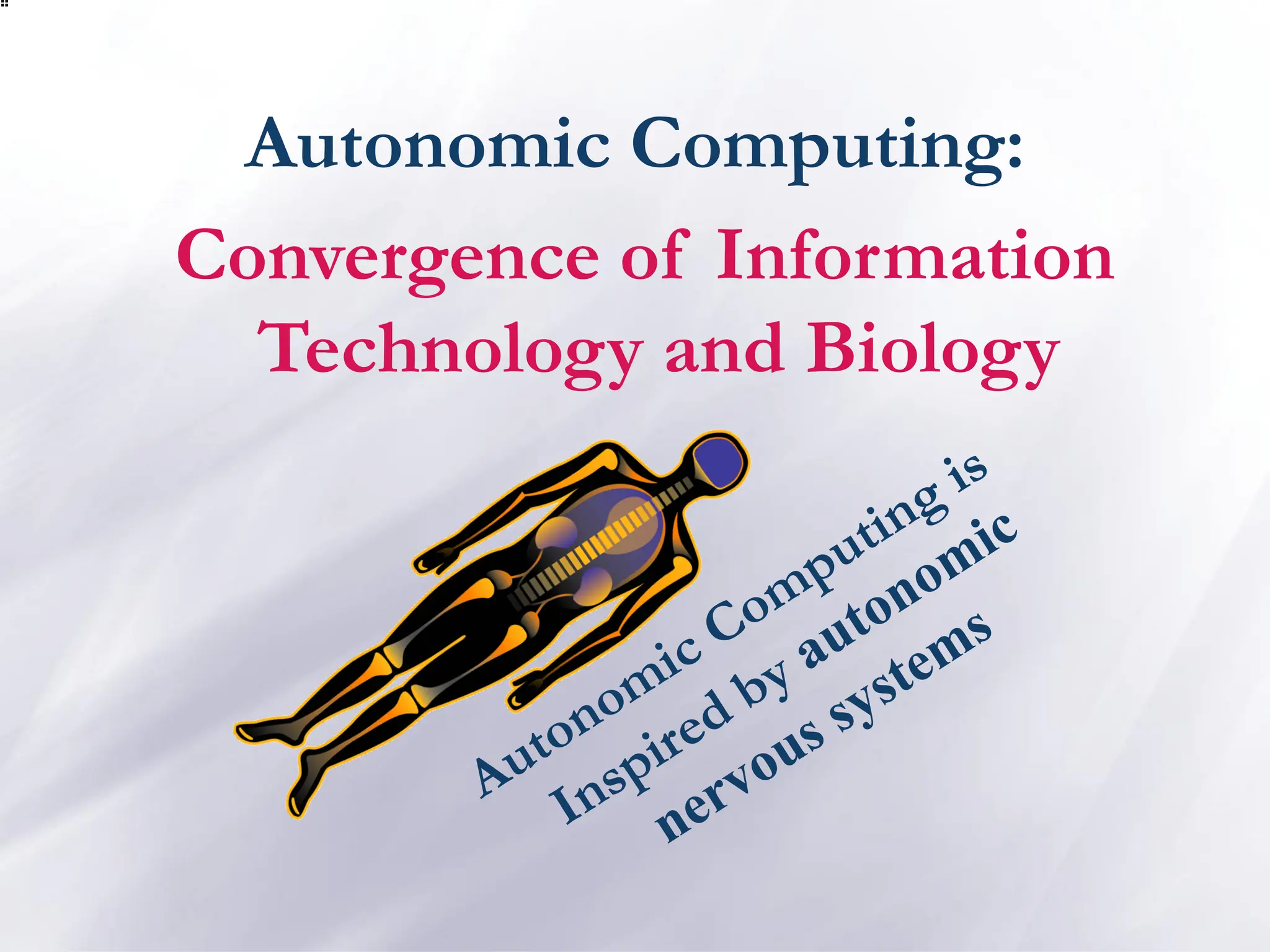
Autonomic Computing:
Convergence of Information
Technology and Biology
Over the past forty years the computer industry has been defined and driven by
an obsession with faster, smaller, and more powerful. It's now time to re-examine
the goal !! (IBM Research - http://www.research.ibm.com/autonomic/research/)
The focus has been on raw processing power and the individual components that allow
ever smaller and greater capacity to store, process and move data. And while scientists
and researchers have met this demand with astonishing regularity, we have missed an
opportunity to look at the evolution of computing from a more holistic perspective.
There are a number of immediate needs that require us to adjust our thinking and
reinterpret our approach to computing in general, and specifically to the interaction
between computer hardware, software and networks. The current strain on IT services
demands that we turn our best minds to developing computer systems to be more
automated and less reliant on human intervention.
IBM calls the next generation of computing AUTONOMIC, because it must act like
our autonomic nervous systems. It must provide an unprecedented level of self-
regulation while hiding complexity from the user. And it will be a radical shift in the
way we conceive and develop computing systems today. This will call for more than
retooling old systems -- autonomic computing calls for a whole new area of study.
Autonomic computing
Convergence of Information Technology and Biology:
Current computing methods and management
tools seem to be inadequate for handling the
scale, complexity, dynamism and heterogeneity
of emerging Pervasive and Grid systems
Biological systems have evolved strategies to
cope with dynamic, complex, highly uncertain
constraints
Autonomic computing
Adaptive Biological Systems:
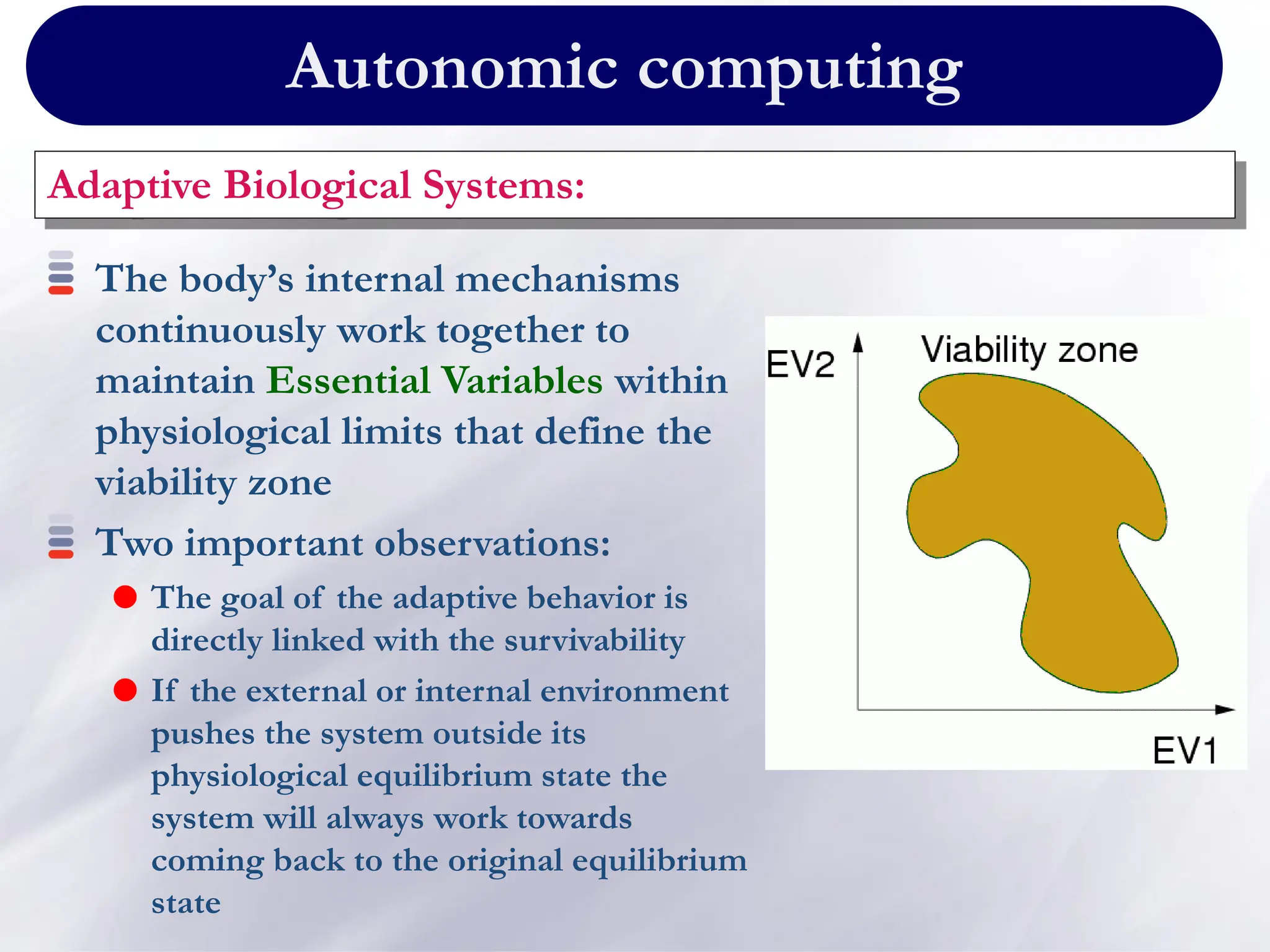
The body’s internal mechanisms
continuously work together to
maintain Essential Variables within
physiological limits that define the
viability zone
Two important observations:
 The goal of the adaptive behavior is
directly linked with the survivability
 If the external or internal environment
pushes the system outside its
physiological equilibrium state the
system will always work towards
coming back to the original equilibrium
state
Autonomic computing
Adaptive Biological Systems …
Nature has evolved to provide:
 Self configuring, self adapting, self optimizing, self healing, self
protecting, highly decentralized, heterogeneous architectures that
work !!!
 E.g. the autonomic nervous system
 Tells your heart how fast to beat, checks your blood’s sugar and
oxygen levels, and controls your pupils so the right amount of light
reaches your eyes as you read, monitors your temperature and adjusts
your blood flow and skin functions to keep it in a proper range
 Coordinates - an increase in heart rate without a corresponding
adjustment to breathing and blood pressure would be disastrous
 Is autonomic - you can make a mad-dash for the train without having
to calculate how much faster to breathe and pump your heart, or if
you’ll need that little dose of adrenaline to make it through the doors
before they close
Autonomic computing
Adaptive Biological Systems …
What can we learn from the nature?
An organism runs itself and regulates its internal balances
 By monitoring and reacting to body’s internal changes, for example,
heartbeat, blood sugar level, body temperature, etc. using complex
activities
Organisms work together with each other
Can be seen as a sophisticated example of adaptive biological
systems in nature
Autonomic computing is inspired from Autonomic
Nervous System!!
Autonomic computing
Vision for Autonomic Computing at IBM:
They consider it as “Intelligent” open system that:
 Manage complexity
 Know themselves
 Continuously tune themselves
 Adapt to unpredictable conditions
 Prevent and recover from failures
 Provide a safe environment
Paul Horn, IBM Senior Vice President of Research has stated:
« It is time to design and build computing systems capable of
running themselves, adjusting to varying circumstances, and
preparing their resources to handle most efficiently the
workloads we put upon them. » October 2001
Autonomic computing
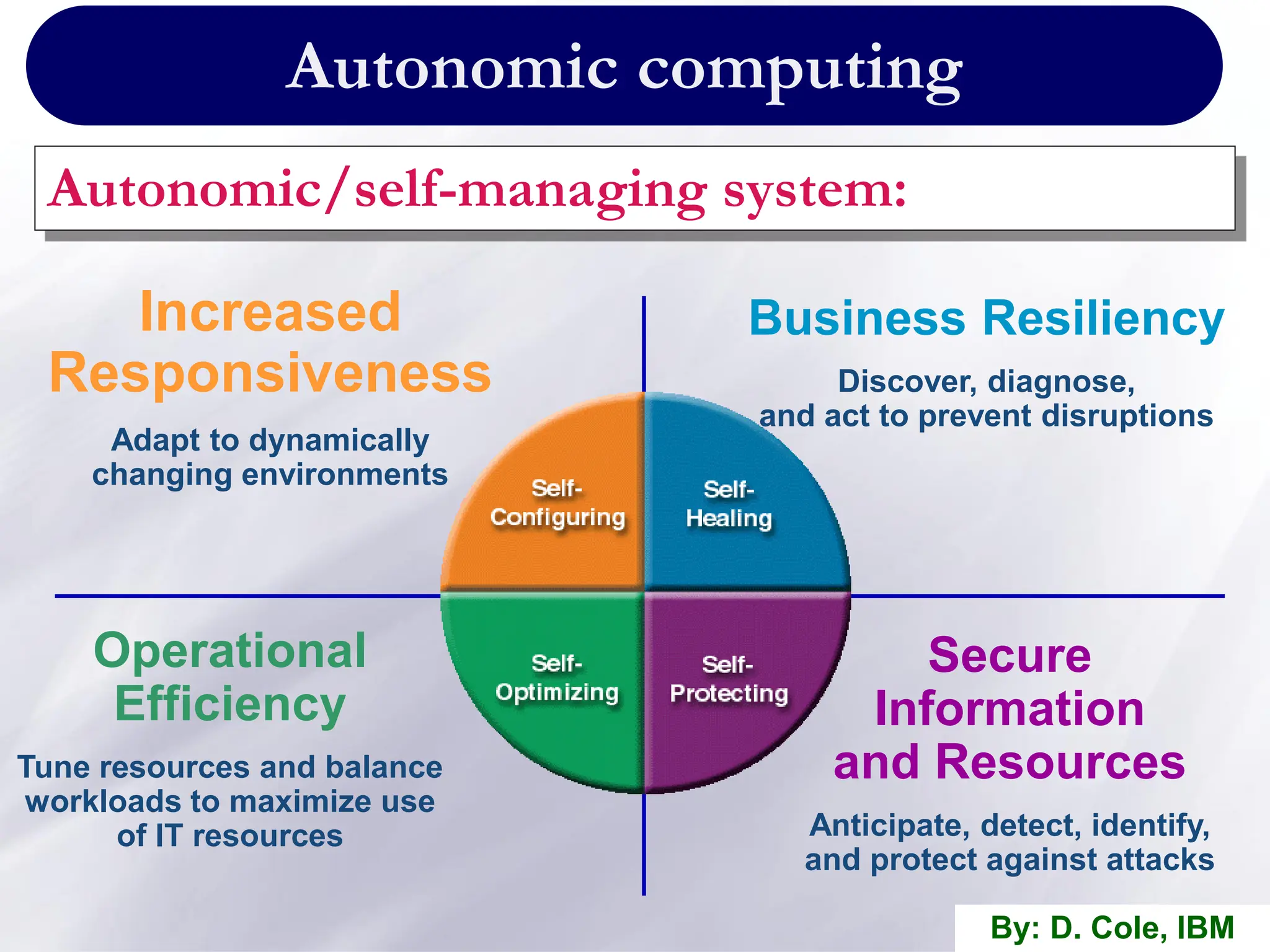
Autonomic/self-managing system:
Increased
Responsiveness
Adapt to dynamically
changing environments
Business Resiliency
Discover, diagnose,
and act to prevent disruptions
Operational
Efficiency
Tune resources and balance
workloads to maximize use
of IT resources
Secure
Information
and Resources
Anticipate, detect, identify,
and protect against attacks
By: D. Cole, IBM
Autonomic computing
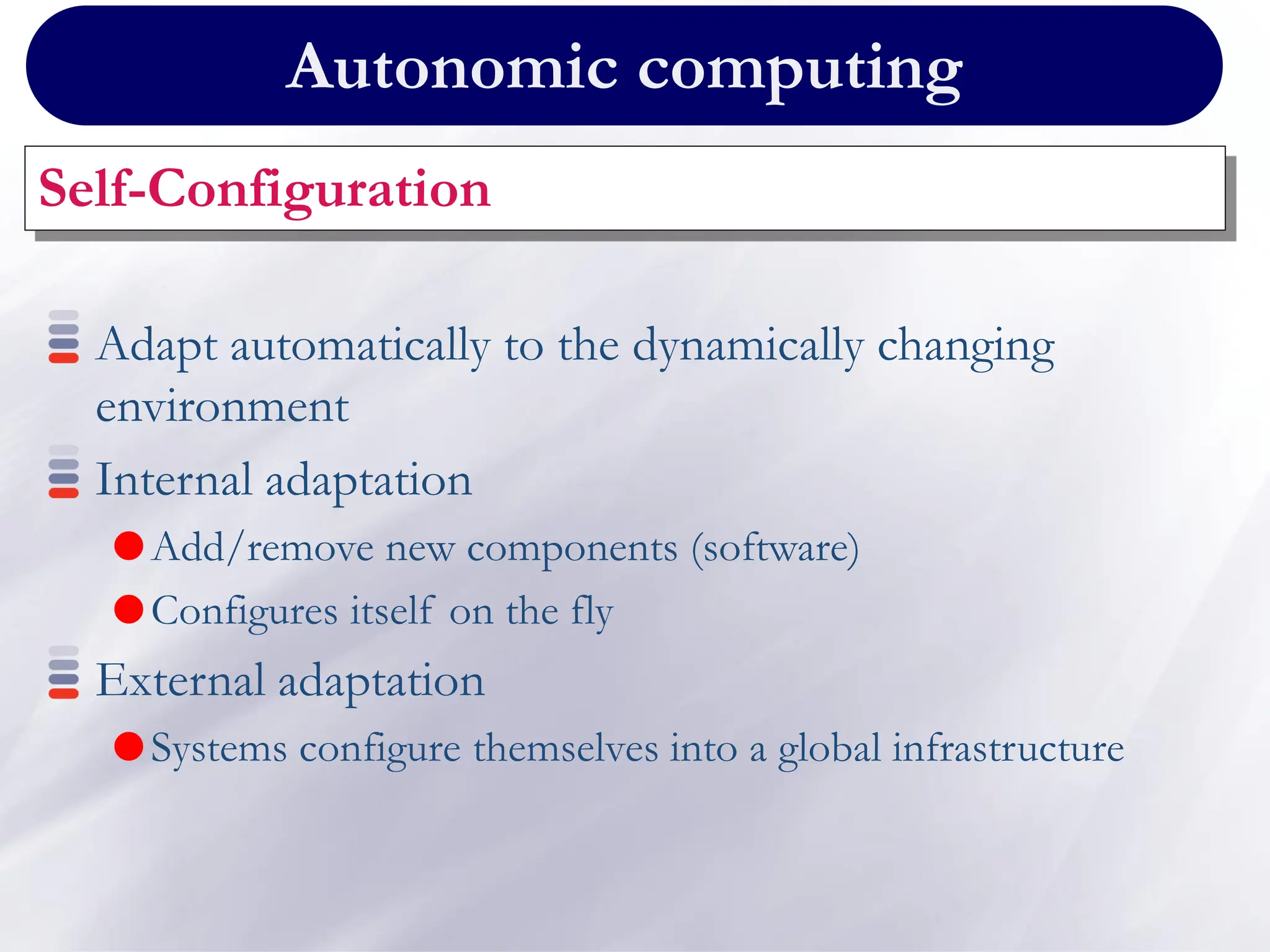
Self-Configuration
Adapt automatically to the dynamically changing
environment
Internal adaptation
Add/remove new components (software)
Configures itself on the fly
External adaptation
Systems configure themselves into a global infrastructure
Autonomic computing
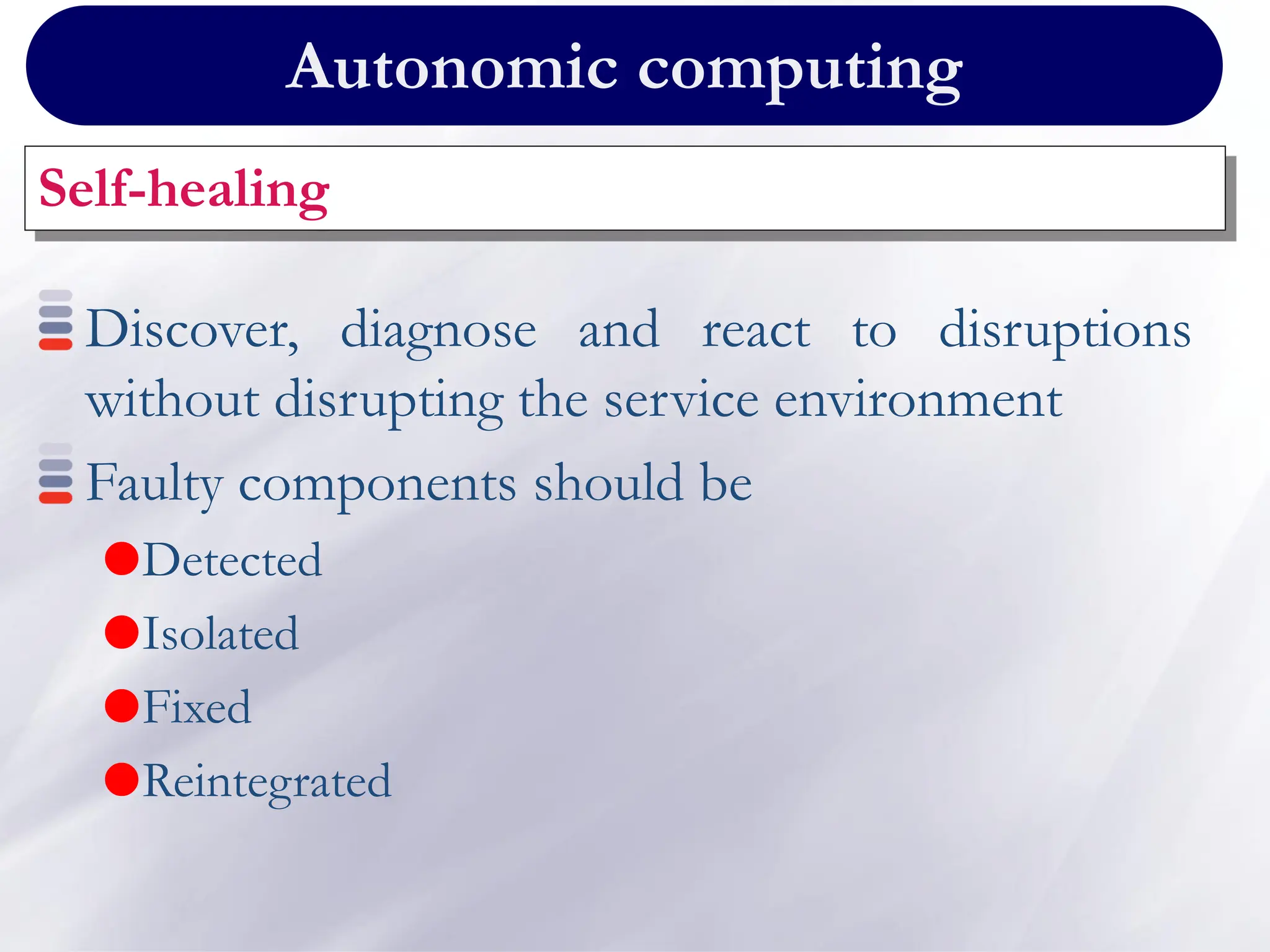
Self-healing
Discover, diagnose and react to disruptions
without disrupting the service environment
Faulty components should be
Detected
Isolated
Fixed
Reintegrated
Autonomic computing
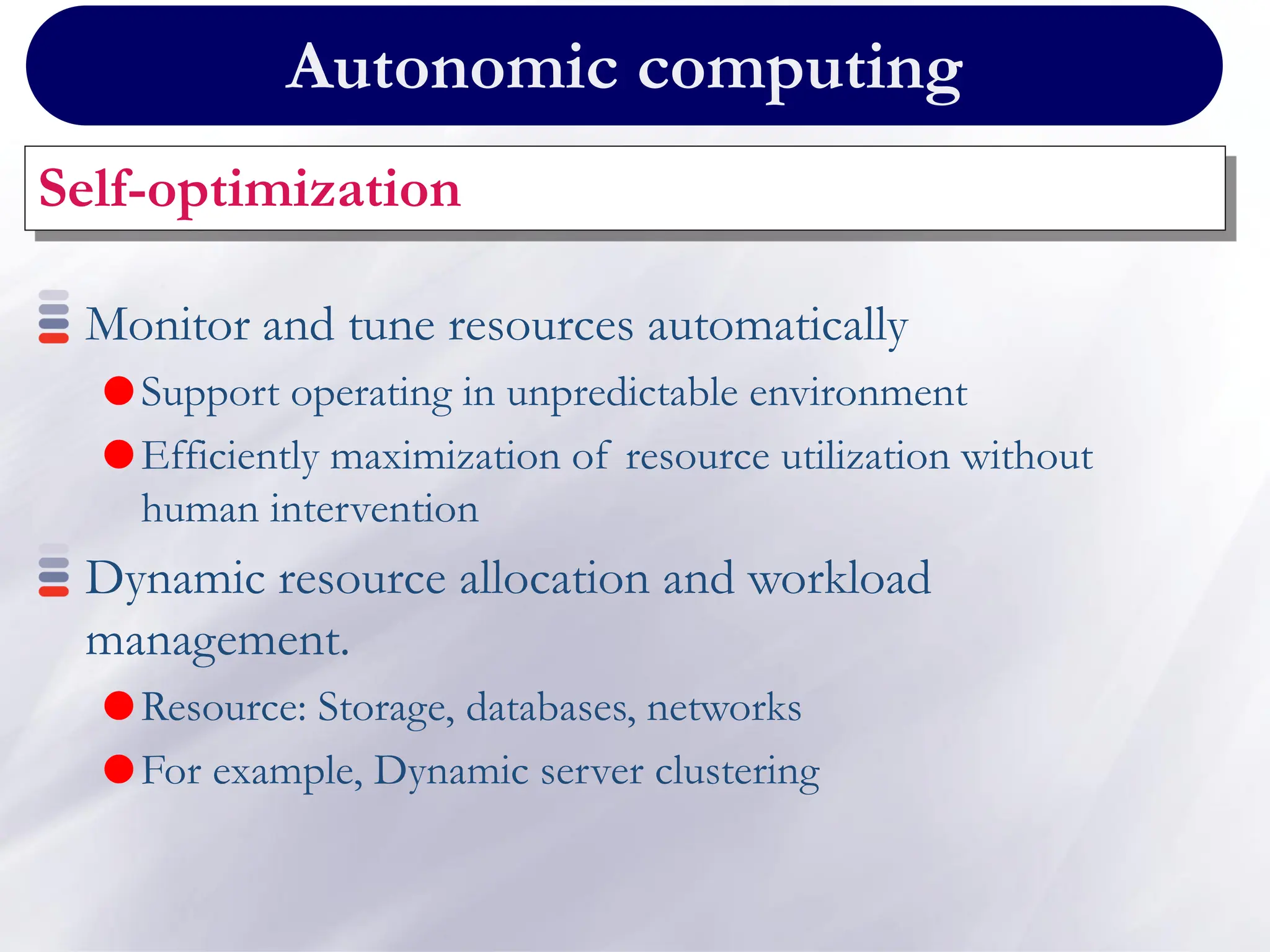
Self-optimization
Monitor and tune resources automatically
Support operating in unpredictable environment
Efficiently maximization of resource utilization without
human intervention
Dynamic resource allocation and workload
management.
Resource: Storage, databases, networks
For example, Dynamic server clustering
Autonomic computing
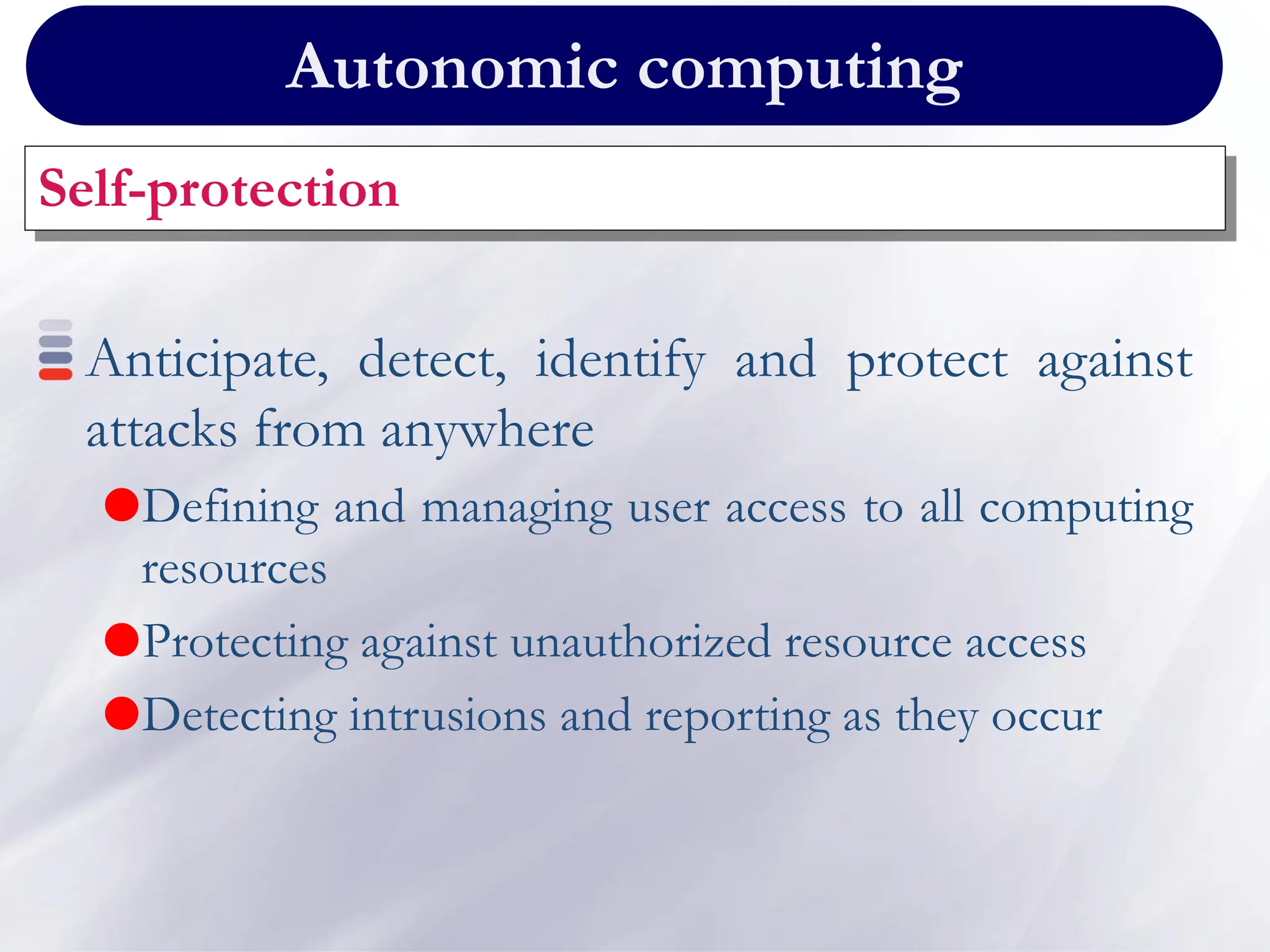
Self-protection
Anticipate, detect, identify and protect against
attacks from anywhere
Defining and managing user access to all computing
resources
Protecting against unauthorized resource access
Detecting intrusions and reporting as they occur
Autonomic computing
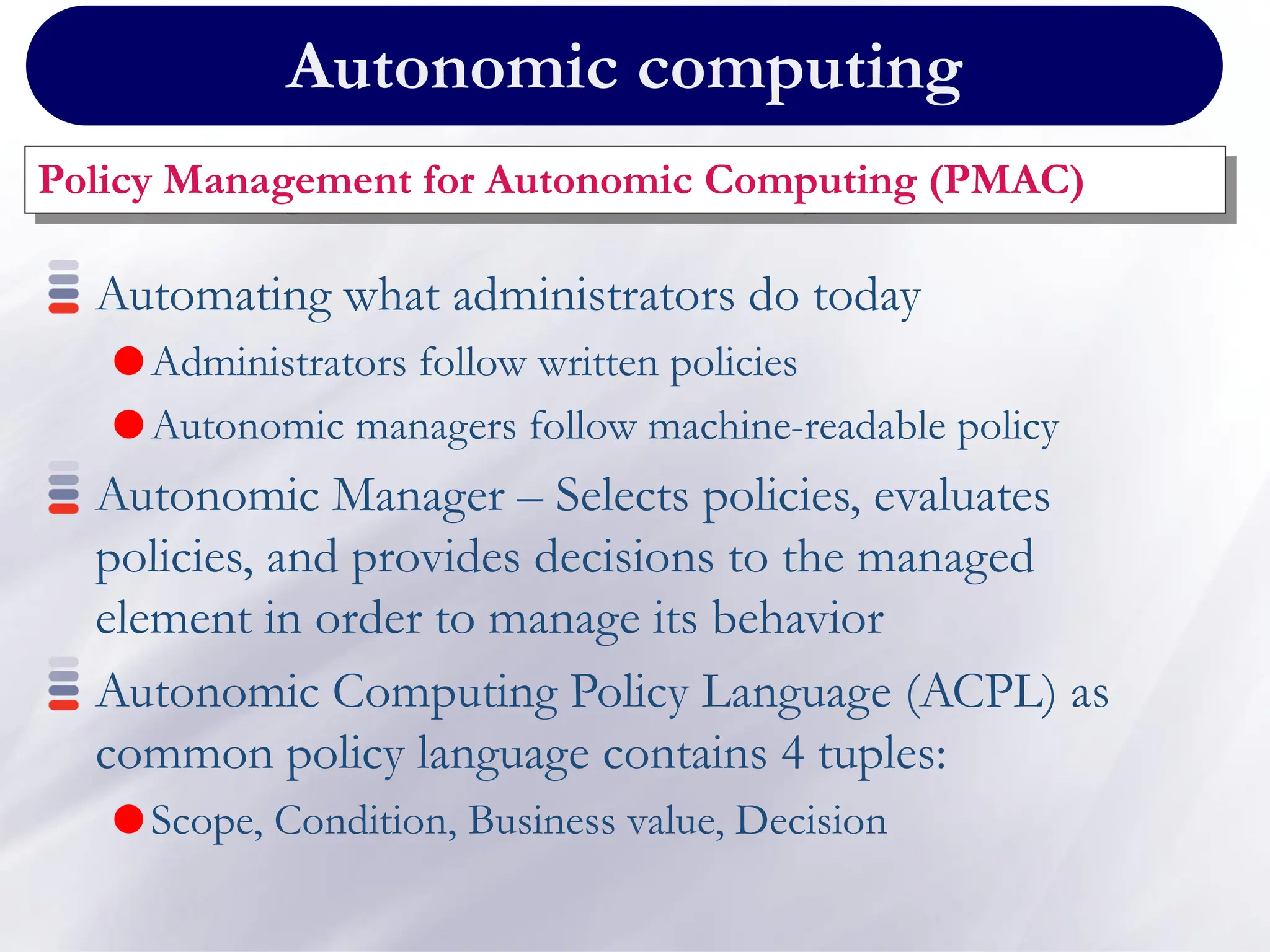
Policy Management for Autonomic Computing (PMAC)
Automating what administrators do today
Administrators follow written policies
Autonomic managers follow machine-readable policy
Autonomic Manager – Selects policies, evaluates
policies, and provides decisions to the managed
element in order to manage its behavior
Autonomic Computing Policy Language (ACPL) as
common policy language contains 4 tuples:
Scope, Condition, Business value, Decision

Selected Pervasive Computing edited 04.pdf

  • 1.
    Autonomic Computing: Convergence ofInformation Technology and Biology
  • 2.
    Over the pastforty years the computer industry has been defined and driven by an obsession with faster, smaller, and more powerful. It's now time to re-examine the goal !! (IBM Research - http://www.research.ibm.com/autonomic/research/) The focus has been on raw processing power and the individual components that allow ever smaller and greater capacity to store, process and move data. And while scientists and researchers have met this demand with astonishing regularity, we have missed an opportunity to look at the evolution of computing from a more holistic perspective. There are a number of immediate needs that require us to adjust our thinking and reinterpret our approach to computing in general, and specifically to the interaction between computer hardware, software and networks. The current strain on IT services demands that we turn our best minds to developing computer systems to be more automated and less reliant on human intervention. IBM calls the next generation of computing AUTONOMIC, because it must act like our autonomic nervous systems. It must provide an unprecedented level of self- regulation while hiding complexity from the user. And it will be a radical shift in the way we conceive and develop computing systems today. This will call for more than retooling old systems -- autonomic computing calls for a whole new area of study.
  • 3.
    Autonomic computing Convergence ofInformation Technology and Biology: Current computing methods and management tools seem to be inadequate for handling the scale, complexity, dynamism and heterogeneity of emerging Pervasive and Grid systems Biological systems have evolved strategies to cope with dynamic, complex, highly uncertain constraints
  • 4.
    Autonomic computing Adaptive BiologicalSystems: The body’s internal mechanisms continuously work together to maintain Essential Variables within physiological limits that define the viability zone Two important observations:  The goal of the adaptive behavior is directly linked with the survivability  If the external or internal environment pushes the system outside its physiological equilibrium state the system will always work towards coming back to the original equilibrium state
  • 5.
    Autonomic computing Adaptive BiologicalSystems … Nature has evolved to provide:  Self configuring, self adapting, self optimizing, self healing, self protecting, highly decentralized, heterogeneous architectures that work !!!  E.g. the autonomic nervous system  Tells your heart how fast to beat, checks your blood’s sugar and oxygen levels, and controls your pupils so the right amount of light reaches your eyes as you read, monitors your temperature and adjusts your blood flow and skin functions to keep it in a proper range  Coordinates - an increase in heart rate without a corresponding adjustment to breathing and blood pressure would be disastrous  Is autonomic - you can make a mad-dash for the train without having to calculate how much faster to breathe and pump your heart, or if you’ll need that little dose of adrenaline to make it through the doors before they close
  • 6.
    Autonomic computing Adaptive BiologicalSystems … What can we learn from the nature? An organism runs itself and regulates its internal balances  By monitoring and reacting to body’s internal changes, for example, heartbeat, blood sugar level, body temperature, etc. using complex activities Organisms work together with each other Can be seen as a sophisticated example of adaptive biological systems in nature Autonomic computing is inspired from Autonomic Nervous System!!
  • 7.
    Autonomic computing Vision forAutonomic Computing at IBM: They consider it as “Intelligent” open system that:  Manage complexity  Know themselves  Continuously tune themselves  Adapt to unpredictable conditions  Prevent and recover from failures  Provide a safe environment Paul Horn, IBM Senior Vice President of Research has stated: « It is time to design and build computing systems capable of running themselves, adjusting to varying circumstances, and preparing their resources to handle most efficiently the workloads we put upon them. » October 2001
  • 8.
    Autonomic computing Autonomic/self-managing system: Increased Responsiveness Adaptto dynamically changing environments Business Resiliency Discover, diagnose, and act to prevent disruptions Operational Efficiency Tune resources and balance workloads to maximize use of IT resources Secure Information and Resources Anticipate, detect, identify, and protect against attacks By: D. Cole, IBM
  • 9.
    Autonomic computing Self-Configuration Adapt automaticallyto the dynamically changing environment Internal adaptation Add/remove new components (software) Configures itself on the fly External adaptation Systems configure themselves into a global infrastructure
  • 10.
    Autonomic computing Self-healing Discover, diagnoseand react to disruptions without disrupting the service environment Faulty components should be Detected Isolated Fixed Reintegrated
  • 11.
    Autonomic computing Self-optimization Monitor andtune resources automatically Support operating in unpredictable environment Efficiently maximization of resource utilization without human intervention Dynamic resource allocation and workload management. Resource: Storage, databases, networks For example, Dynamic server clustering
  • 12.
    Autonomic computing Self-protection Anticipate, detect,identify and protect against attacks from anywhere Defining and managing user access to all computing resources Protecting against unauthorized resource access Detecting intrusions and reporting as they occur
  • 13.
    Autonomic computing Policy Managementfor Autonomic Computing (PMAC) Automating what administrators do today Administrators follow written policies Autonomic managers follow machine-readable policy Autonomic Manager – Selects policies, evaluates policies, and provides decisions to the managed element in order to manage its behavior Autonomic Computing Policy Language (ACPL) as common policy language contains 4 tuples: Scope, Condition, Business value, Decision