1
Expert Systems
2
What is an Expert System?
• Hardware and software that contain knowledge and
manipulate knowledge by inferences
• Mycin (Shortliffe 1976): Expert system for medicine
– Program for advising physicians on treating bacterial
infections
– Question and answer dialogues with user
– Accounts for uncertainties
– Explains its reasoning
3
Characteristics of an Expert System
• Can explain their reasoning or suggested decisions
– Why recommend a certain medicine?
• Can display “intelligent” behavior
• Can draw conclusions from complex relationships
– A patient is diagnosed with two diseases,
– The cures for the diseases may have conflicts
• Can provide portable knowledge
– Capture knowledge in one’s brain
• Can deal with uncertainty
– A patient is diagnose without running all the tests
4
Characteristics of an Expert System
• Not widely used or tested
• Limited to relatively narrow problems
• Cannot readily deal with “mixed” knowledge
– Expert systems should talk to each other
• Cannot refine its own knowledge
– Should be able to keep a consistent knowledgebase
– Should have a way to gain new knowledge
• May have high development costs
• Raise legal and ethical concerns
5
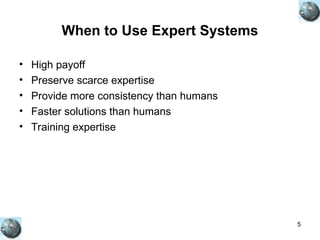
When to Use Expert Systems
• High payoff
• Preserve scarce expertise
• Provide more consistency than humans
• Faster solutions than humans
• Training expertise
6
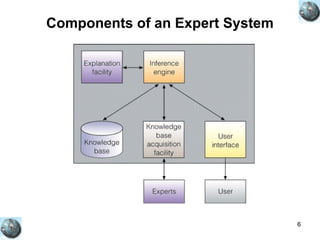
Components of an Expert System
7
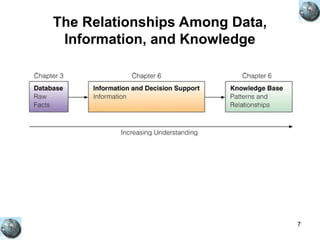
The Relationships Among Data,
Information, and Knowledge
8
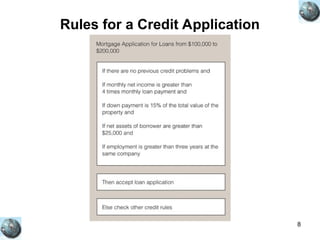
Rules for a Credit Application
9
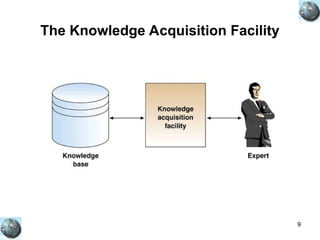
The Knowledge Acquisition Facility
10
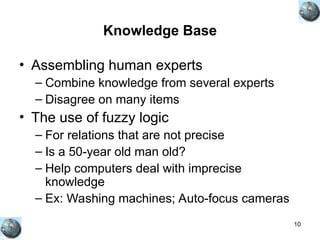
Knowledge Base
• Assembling human experts
– Combine knowledge from several experts
– Disagree on many items
• The use of fuzzy logic
– For relations that are not precise
– Is a 50-year old man old?
– Help computers deal with imprecise
knowledge
– Ex: Washing machines; Auto-focus cameras
11
Knowledge Base
• The use of rules
– Rule: Conditional statement (if … then)
– If the condition matches, the action fires
– More rules generally mean more precision
• The use of cases
– Template of problems or situations
– To find the solution of a new case, find similar
old cases and apply result
12
Inference Engine (1)
• Use information and relations to derive new facts
to solve problems or predict possible outcomes
• Main reasoning component
• Find the right facts, apply the right relations, etc.
• Ex: Facts: male(Ali), female(Oya)
• Relations: father(X, Y) => male(X)
• The engine can conclude that Oya cannot be a
father.
13
Inference Engine (2)
• Backward chaining
– You start with conclusions
– You want to find out if you can get to the conclusion
from your facts
• Forward chaining
– You start with facts and try to reach conclusions
– More expensive since it can generate many
conclusions
14
Other Components
• Explanation Facility
– Enables the expert system to explain its reasoning
– Helps the user to judge the expert system
• Knowledge Acquisition Facility
– Get and update knowledge
– Provide a way to capture and store knowledge
– Can be semi-automated
• User Interface
– Help users interact with the system
– Improve usability
15
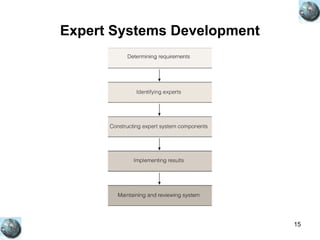
Expert Systems Development
16
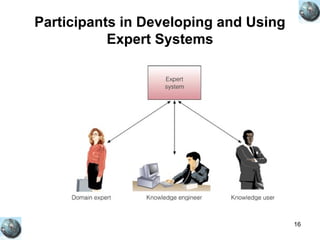
Participants in Developing and Using
Expert Systems
17
Domain Expert
• Recognize the real problem
• Develop a general framework for problem solving
• Formulate theories about the situation
• Develop and use general rules to solve a problem
• Know when to break the rules or general principles
• Solve problems quickly and efficiently
18
Other participants
• Knowledge Engineer
– Works in design and implementation of the expert
system
– Has considerable information about expert systems
• Knowledge User
– End user who will benefit from the system
– No need to know anything about expert systems
– Can help in testing
19
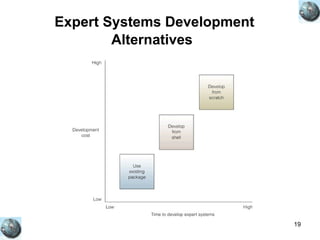
Expert Systems Development
Alternatives
20
Applications of Expert System and
Artificial Intelligence
• Games: Proverb solves crossword puzzles
• Writing: Evaluate and rate writings
• Information management and retrieval
• Virus detection
– Learns the actions of a virus
• Hospitals and medical facilities
21
THANK YOU

Artificial Intelligence Expert Systems Presentation.ppt

  • 1.
  • 2.
    2 What is anExpert System? • Hardware and software that contain knowledge and manipulate knowledge by inferences • Mycin (Shortliffe 1976): Expert system for medicine – Program for advising physicians on treating bacterial infections – Question and answer dialogues with user – Accounts for uncertainties – Explains its reasoning
  • 3.
    3 Characteristics of anExpert System • Can explain their reasoning or suggested decisions – Why recommend a certain medicine? • Can display “intelligent” behavior • Can draw conclusions from complex relationships – A patient is diagnosed with two diseases, – The cures for the diseases may have conflicts • Can provide portable knowledge – Capture knowledge in one’s brain • Can deal with uncertainty – A patient is diagnose without running all the tests
  • 4.
    4 Characteristics of anExpert System • Not widely used or tested • Limited to relatively narrow problems • Cannot readily deal with “mixed” knowledge – Expert systems should talk to each other • Cannot refine its own knowledge – Should be able to keep a consistent knowledgebase – Should have a way to gain new knowledge • May have high development costs • Raise legal and ethical concerns
  • 5.
    5 When to UseExpert Systems • High payoff • Preserve scarce expertise • Provide more consistency than humans • Faster solutions than humans • Training expertise
  • 6.
    6 Components of anExpert System
  • 7.
    7 The Relationships AmongData, Information, and Knowledge
  • 8.
    8 Rules for aCredit Application
  • 9.
  • 10.
    10 Knowledge Base • Assemblinghuman experts – Combine knowledge from several experts – Disagree on many items • The use of fuzzy logic – For relations that are not precise – Is a 50-year old man old? – Help computers deal with imprecise knowledge – Ex: Washing machines; Auto-focus cameras
  • 11.
    11 Knowledge Base • Theuse of rules – Rule: Conditional statement (if … then) – If the condition matches, the action fires – More rules generally mean more precision • The use of cases – Template of problems or situations – To find the solution of a new case, find similar old cases and apply result
  • 12.
    12 Inference Engine (1) •Use information and relations to derive new facts to solve problems or predict possible outcomes • Main reasoning component • Find the right facts, apply the right relations, etc. • Ex: Facts: male(Ali), female(Oya) • Relations: father(X, Y) => male(X) • The engine can conclude that Oya cannot be a father.
  • 13.
    13 Inference Engine (2) •Backward chaining – You start with conclusions – You want to find out if you can get to the conclusion from your facts • Forward chaining – You start with facts and try to reach conclusions – More expensive since it can generate many conclusions
  • 14.
    14 Other Components • ExplanationFacility – Enables the expert system to explain its reasoning – Helps the user to judge the expert system • Knowledge Acquisition Facility – Get and update knowledge – Provide a way to capture and store knowledge – Can be semi-automated • User Interface – Help users interact with the system – Improve usability
  • 15.
  • 16.
    16 Participants in Developingand Using Expert Systems
  • 17.
    17 Domain Expert • Recognizethe real problem • Develop a general framework for problem solving • Formulate theories about the situation • Develop and use general rules to solve a problem • Know when to break the rules or general principles • Solve problems quickly and efficiently
  • 18.
    18 Other participants • KnowledgeEngineer – Works in design and implementation of the expert system – Has considerable information about expert systems • Knowledge User – End user who will benefit from the system – No need to know anything about expert systems – Can help in testing
  • 19.
  • 20.
    20 Applications of ExpertSystem and Artificial Intelligence • Games: Proverb solves crossword puzzles • Writing: Evaluate and rate writings • Information management and retrieval • Virus detection – Learns the actions of a virus • Hospitals and medical facilities
  • 21.

Editor's Notes

  • #2 An expert system can explain how it reached a conclusion by showing the path of rules and inferences in its knowledge base that it followed. This is valuable to users of the conclusions. For instance, a physician using an expert system to help diagnose a blood disease could compare the expert system’s reasoning to her own to determine her level of confidence in the system’s conclusion. This is also useful in training novices in an area. For example, a new loan processor making a decision to approve or deny a loan can see the expert system’s reasoning and learn from it. Because an expert’s knowledge is codified in an expert system, expert systems can preserve scarce expertise and give others access to it. Given a data set, an expert system can propose new ideas, which is a characteristic of expert behavior. For example, expert systems can diagnose patients’ conditions from their symptoms or suggest where to drill for oil, based on geologic data and expert knowledge. Expert systems can evaluate complex relationships to reach a conclusion or make a recommendation. Although expert systems generally require a well-structured problem, it can have many complex relationships. The information can be incomplete or somewhat inaccurate, since expert systems can use probabilities and heuristics.
  • #3 An expert system can explain how it reached a conclusion by showing the path of rules and inferences in its knowledge base that it followed. This is valuable to users of the conclusions. For instance, a physician using an expert system to help diagnose a blood disease could compare the expert system’s reasoning to her own to determine her level of confidence in the system’s conclusion. This is also useful in training novices in an area. For example, a new loan processor making a decision to approve or deny a loan can see the expert system’s reasoning and learn from it. Because an expert’s knowledge is codified in an expert system, expert systems can preserve scarce expertise and give others access to it. Given a data set, an expert system can propose new ideas, which is a characteristic of expert behavior. For example, expert systems can diagnose patients’ conditions from their symptoms or suggest where to drill for oil, based on geologic data and expert knowledge. Expert systems can evaluate complex relationships to reach a conclusion or make a recommendation. Although expert systems generally require a well-structured problem, it can have many complex relationships. The information can be incomplete or somewhat inaccurate, since expert systems can use probabilities and heuristics.
  • #5 Since expert systems can be difficult and expensive to develop, they should be used where they can be most beneficial. This slide summarizes situations where expert systems have been shown to be worth implementing. Clearly, when there is a high potential payoff, or when the expertise is needed at a place dangerous to humans, it makes sense to develop the expert system. It is generally also worthwhile to develop an expert system to capture and preserve expertise that not many people have, that is expensive, or that can’t be duplicated in other ways. Also, an expert system is called for when this kind of scarce expertise is needed in many locations at once. No matter how hard they try, people cannot be 100% consistent – they tire, have bad moods, or are distracted. Where consistency is needed – say in loan approval – investing in an expert system may be worthwhile. In complex tasks, such as configuring large computer installations, it may take humans too long to do the job for the company to be competitive. Using an expert system to complete the task quicker than your competition would be wise. And finally, sharing scarce expertise or training others in the area, is a solid use of expert systems.
  • #21 Virtual reality systems offer a new, highly-interactive, three-dimensional interface between computers and people. Virtual reality applications have begun to spread through businesses.